


Imagine a party wall surveyor returning from a site visit with hundreds of photographs, laser measurements, and condition notes—only to spend days manually analyzing every crack, moisture patch, and structural detail. Now, artificial intelligence is transforming this time-consuming process into a matter of minutes. AI-Driven Data Processing in Party Wall Surveys: Automating Anomaly Detection and Preliminary Assessments for 2026 represents a fundamental shift in how surveyors handle raw data, allowing technology to handle the heavy lifting of initial analysis while professionals focus on expert judgment and neighbor relations.
In 2026, AI systems can instantly classify terrain features, identify boundary markers, flag structural anomalies, and generate preliminary condition reports—freeing surveyors to concentrate on what truly matters: interpreting complex situations, navigating disputes, and ensuring compliance with the Party Wall etc. Act 1996. This technological revolution doesn't replace human expertise; it amplifies it.
Key Takeaways
✅ AI automates data classification in party wall surveys, reducing manual analysis time by up to 70% while improving accuracy in detecting structural anomalies
✅ Machine learning algorithms can identify cracks, moisture damage, and subsidence indicators from photographs and laser scans with consistent precision
✅ Preliminary assessments generated by AI provide surveyors with categorized data and flagged concerns, allowing faster response times for party wall notices
✅ Human expertise remains essential for interpreting AI findings, making final determinations, and managing the legal and interpersonal aspects of party wall matters
✅ Cost efficiency improves as automated processing reduces billable hours for routine data analysis, potentially lowering party wall survey costs for property owners
Understanding AI-Driven Data Processing in Party Wall Surveys for 2026

What Is AI-Driven Data Processing in Surveying?
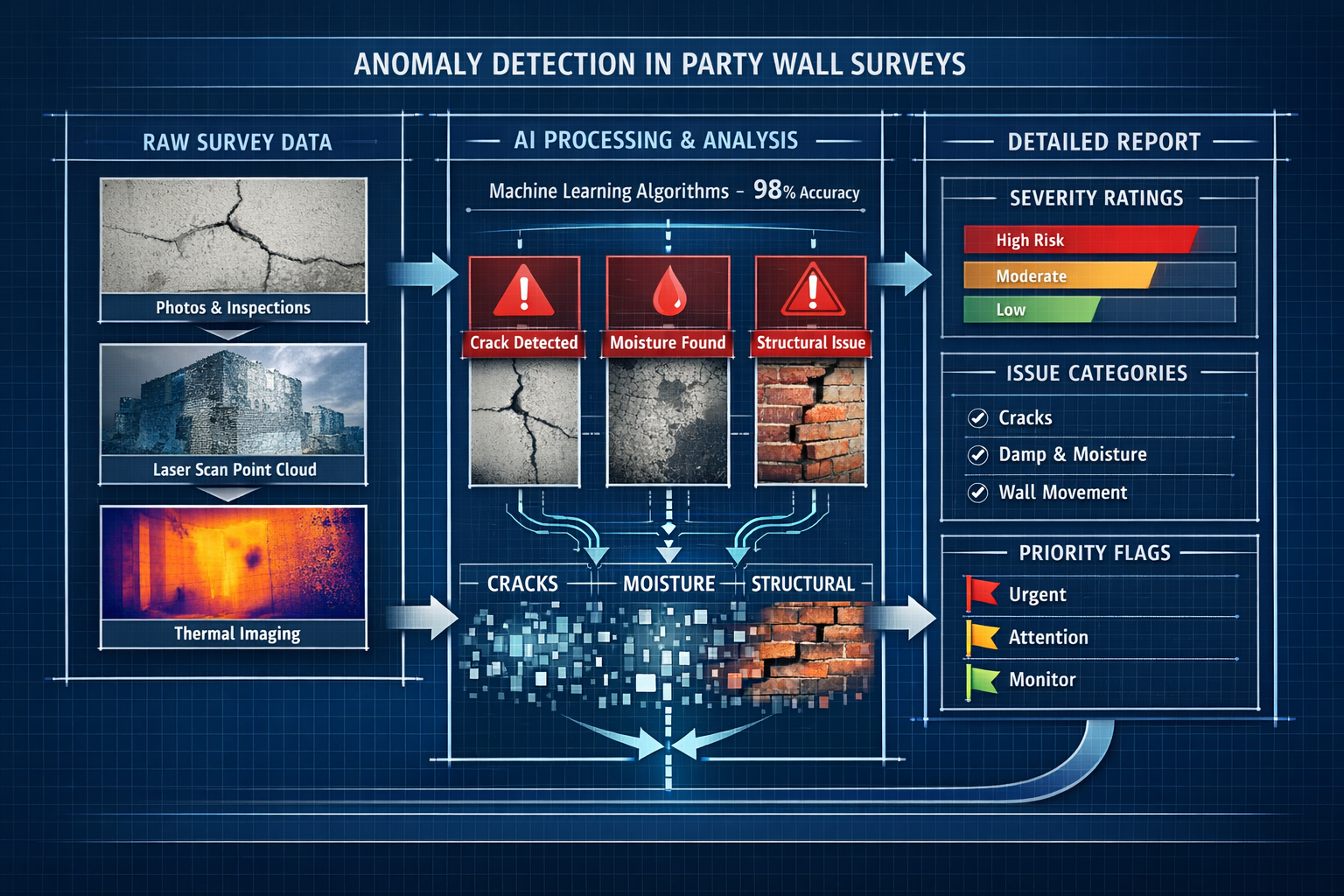
AI-driven data processing refers to the use of machine learning algorithms and computer vision systems to automatically analyze, categorize, and interpret survey data. In the context of party wall surveys, this technology processes multiple data types:
- 📸 Digital photographs of walls, foundations, and structural elements
- 📏 Laser scan measurements and point cloud data
- 🌡️ Thermal imaging showing moisture patterns
- 📋 Historical condition reports for comparison analysis
- 🗺️ Site plans and boundary documentation
The AI system applies trained models to recognize patterns, detect anomalies, and generate structured outputs that surveyors can review and validate. This approach dramatically reduces the time spent on initial data sorting and basic categorization.
The Traditional Party Wall Survey Workflow
Before understanding the impact of automation, it's important to recognize the traditional process. When carrying out party wall works, surveyors typically:
- Conduct site inspections of the building owner's property and adjoining properties
- Document existing conditions through photographs and written notes
- Manually review hundreds of images to identify relevant structural features
- Measure and record crack widths, settlement indicators, and other concerns
- Compile condition schedules describing the pre-work state of properties
- Draft preliminary assessments for party wall awards
This manual process can consume 8-12 hours of professional time for a typical terraced property survey, with much of that time spent on repetitive data organization tasks.
How AI Transforms the Workflow in 2026
Modern AI systems integrated into surveying workflows now handle the repetitive elements:
| Traditional Method | AI-Driven Method | Time Savings |
|---|---|---|
| Manual photo sorting (2-3 hours) | Automated classification (5 minutes) | 95% reduction |
| Visual crack identification (3-4 hours) | AI anomaly detection (10 minutes) | 90% reduction |
| Measurement transcription (1-2 hours) | Automated data extraction (instant) | 95% reduction |
| Preliminary report drafting (2-3 hours) | AI-generated template (15 minutes) | 85% reduction |
These time savings translate directly into faster turnaround times for property owners awaiting party wall awards and more competitive pricing structures.
Real-World Applications in UK Party Wall Practice
Several surveying firms across London have begun implementing AI-assisted workflows in 2026. A party wall surveyor in North London might use AI to:
- Process site photos from a Victorian terrace conversion project
- Identify pre-existing cracks in shared walls before excavation begins
- Flag moisture concerns in basement areas where underpinning is planned
- Generate baseline condition reports for both building and adjoining owners
The AI system doesn't make final determinations about whether damage is actionable or how to proceed—that remains the surveyor's responsibility. Instead, it ensures no detail is overlooked and provides a consistent framework for documentation.
Automating Anomaly Detection: How AI Identifies Structural Concerns
Computer Vision and Structural Analysis
Anomaly detection in party wall surveys relies on computer vision—a branch of AI that enables machines to "see" and interpret visual information. Modern systems trained on thousands of building images can identify:
🔴 Structural cracks (hairline, stepped, diagonal, horizontal)
🔴 Moisture damage (staining, efflorescence, dampness patterns)
🔴 Settlement indicators (door frame distortion, floor level changes)
🔴 Material deterioration (spalling brickwork, mortar erosion)
🔴 Previous repairs (patched areas, repointing, reinforcement)
The AI system analyzes each photograph pixel-by-pixel, comparing patterns against its trained database of known structural issues. When it detects a potential anomaly, it flags the image, annotates the specific area, and assigns a preliminary severity rating.
Machine Learning Models for Pattern Recognition
The accuracy of AI-driven anomaly detection depends on the quality of its training data. In 2026, leading systems have been trained on:
- 50,000+ annotated images of UK residential properties
- Verified condition reports from experienced surveyors
- Before-and-after documentation of construction projects
- Historical damage claims linked to party wall works
These machine learning models continuously improve as they process more data. When a surveyor reviews and confirms (or corrects) an AI-generated finding, that feedback refines the system's future performance.
Classification and Severity Assessment
Beyond simple detection, AI systems now provide automated classification of findings:
Minor Concerns (Green Flag)
- Hairline cracks under 1mm width
- Superficial surface staining
- Cosmetic plaster imperfections
- Normal settlement patterns
Moderate Concerns (Amber Flag)
- Cracks 1-5mm requiring monitoring
- Localized moisture penetration
- Minor structural movement indicators
- Areas needing closer inspection
Significant Concerns (Red Flag)
- Cracks exceeding 5mm width
- Active structural movement
- Extensive moisture damage
- Potential safety implications
This three-tier system helps surveyors prioritize their detailed review, ensuring critical issues receive immediate attention while routine observations are documented efficiently.
Integration with Laser Scanning and 3D Modeling
AI-driven data processing extends beyond photographs. When combined with laser scanning technology, the system can:
✨ Create 3D models of party walls and adjoining structures
✨ Detect millimeter-level deviations from vertical or horizontal planes
✨ Map crack propagation in three dimensions
✨ Compare pre-work and post-work scans automatically
✨ Generate volumetric measurements for excavation assessments
This comprehensive approach provides surveyors with unprecedented detail when preparing schedules of condition and assessing the potential impact of proposed works.
Limitations and the Need for Human Verification
Despite impressive capabilities, AI anomaly detection has important limitations:
⚠️ Context dependency: AI may flag historic repairs as new damage
⚠️ False positives: Shadows, stains, or decorative features can trigger alerts
⚠️ Material variations: Unusual construction methods may confuse algorithms
⚠️ Legal interpretation: AI cannot assess causation or liability
Professional surveyors must always verify AI findings before including them in formal reports or party wall awards. The technology serves as a highly efficient first pass, not a replacement for expert judgment.
Preliminary Assessments: From Raw Data to Actionable Reports
Automated Report Generation
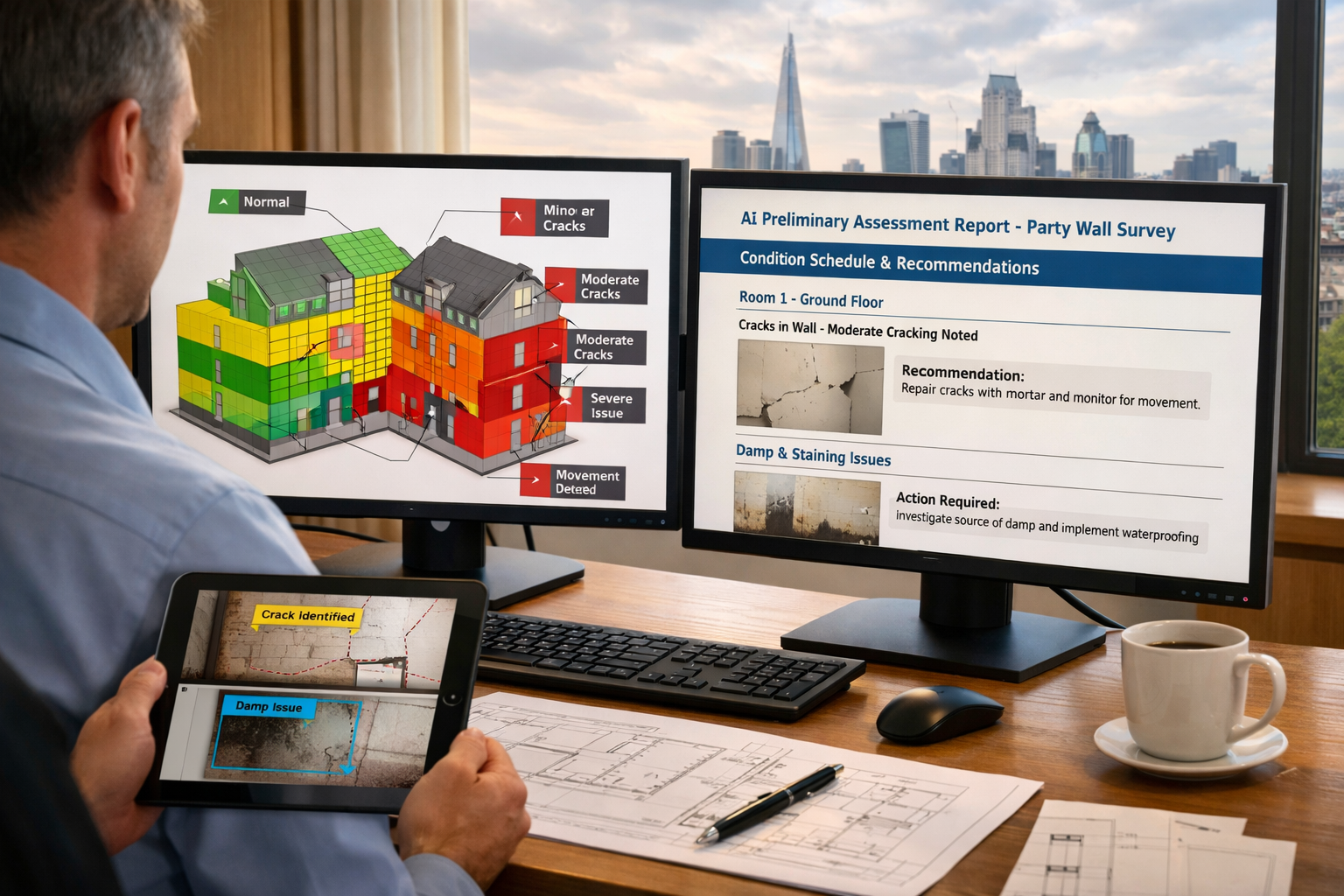
Once AI systems have processed and categorized survey data, they can generate preliminary assessment reports that provide a structured foundation for the surveyor's final documentation. These automated reports typically include:
📄 Executive summary of property condition
📄 Categorized image gallery with annotated findings
📄 Measurement tables extracted from laser scan data
📄 Flagged anomalies with location references
📄 Comparison analysis with historical data (if available)
📄 Draft condition schedule following industry standards
The surveyor then reviews this preliminary output, adds professional interpretation, corrects any errors, and incorporates contextual information that AI cannot assess—such as the property's construction history, previous disputes, or specific concerns raised by the adjoining owner.
Natural Language Processing for Documentation
Advanced AI systems in 2026 incorporate natural language processing (NLP) to convert visual findings into written descriptions. For example, when the computer vision system detects a stepped crack in brickwork, the NLP component generates:
"A stepped crack approximately 3.2mm in width was observed in the party wall at first-floor level, following the mortar joints in a diagonal pattern from the ceiling junction downward for approximately 1.8 meters. The crack appears historic with no evidence of recent movement or active widening."
This automated description provides a professional starting point that the surveyor can refine, ensuring consistent terminology and comprehensive documentation across all properties surveyed.
Time Efficiency and Cost Implications
The automation of preliminary assessments has significant economic implications for party wall survey costs:
Traditional Approach:
- Site visit: 2-3 hours
- Data processing: 8-10 hours
- Report drafting: 4-6 hours
- Total: 14-19 hours at £150-200/hour = £2,100-£3,800
AI-Assisted Approach:
- Site visit: 2-3 hours (unchanged)
- Data processing: 1-2 hours (AI handles bulk work)
- Report review and finalization: 2-3 hours
- Total: 5-8 hours at £150-200/hour = £750-£1,600
This efficiency allows surveyors to handle more cases, reduce fees for straightforward matters, or allocate more time to complex disputes requiring detailed attention—ultimately benefiting property owners throughout the process.
Quality Control and Consistency
One of the most valuable aspects of AI-driven preliminary assessments is consistency. Human surveyors, despite their expertise, may have variations in:
- How thoroughly they review hundreds of photographs
- Which details they prioritize in documentation
- Terminology used to describe similar conditions
- Thoroughness on routine versus complex cases
AI systems apply the same analytical rigor to every image, every measurement, and every property. This consistency is particularly valuable when:
🔹 Multiple properties are surveyed along a terrace row
🔹 Building owners and adjoining owners compare condition reports
🔹 Disputes arise requiring detailed evidence of pre-work conditions
🔹 Insurance claims necessitate comprehensive documentation
The surveyor's expertise ensures appropriate interpretation and context, while the AI ensures no detail is accidentally overlooked.
Integration with Party Wall Procedures
AI-generated preliminary assessments integrate seamlessly with established party wall procedures under UK law. When serving party wall notices, surveyors can:
✅ Provide faster initial assessments to property owners considering types of party wall works
✅ Generate comprehensive condition schedules more efficiently
✅ Respond quickly to disputes with detailed photographic evidence
✅ Maintain digital archives for future reference and comparison
✅ Produce consistent documentation across multiple properties
The technology supports, rather than replaces, the legal framework that governs party wall matters in England and Wales.
Future Developments in Automated Assessment
Looking beyond 2026, the trajectory of AI-driven data processing in party wall surveys points toward even more sophisticated capabilities:
🔮 Predictive modeling estimating the impact of proposed works on adjoining properties
🔮 Automated damage attribution comparing pre-work and post-work conditions
🔮 Real-time monitoring during construction with instant anomaly alerts
🔮 Augmented reality interfaces allowing surveyors to view AI findings overlaid on physical structures
🔮 Blockchain-verified documentation ensuring tamper-proof condition records
These advancements will further enhance the efficiency and accuracy of party wall surveys while maintaining the essential role of professional surveyors in interpretation, negotiation, and legal compliance.
The Human Element: Why Surveyors Remain Essential
Despite the impressive capabilities of AI-driven data processing, professional surveyors remain absolutely essential to the party wall process. Technology handles data; surveyors handle people, judgment, and legal responsibility.
Expertise That AI Cannot Replace
Experienced party wall surveyors bring irreplaceable value through:
🎯 Legal knowledge: Understanding the Party Wall etc. Act 1996 and case law precedents
🎯 Contextual interpretation: Recognizing when a crack is concerning versus normal settlement
🎯 Dispute resolution: Mediating between neighbors with conflicting interests
🎯 Professional judgment: Determining appropriate protective measures and monitoring protocols
🎯 Liability assessment: Establishing causation when damage occurs during construction
AI can identify that a crack exists and measure its width, but only a surveyor can determine whether it's actionable damage, assess its cause, and recommend appropriate remediation.
Interpersonal Skills and Neighbor Relations
Party wall matters often involve anxious homeowners, skeptical neighbors, and complex interpersonal dynamics. Surveyors must:
- Explain technical findings in accessible language to non-experts
- Manage expectations about what the Act does and doesn't protect
- Build trust with both building and adjoining owners
- Navigate disputes with diplomacy and fairness
- Communicate effectively with builders, architects, and legal representatives
No AI system can replicate the emotional intelligence and communication skills required to guide neighbors through potentially contentious construction projects.
Professional Accountability and Insurance
When surveyors prepare party wall awards and condition schedules, they accept professional liability for their work. They carry professional indemnity insurance and are accountable to professional bodies for their conduct.
AI systems, by contrast, carry no liability. They're tools that assist the surveyor, but the surveyor remains responsible for:
✔️ Verifying AI-generated findings
✔️ Correcting errors or misclassifications
✔️ Adding professional interpretation
✔️ Ensuring compliance with legal requirements
✔️ Defending their conclusions if challenged
This accountability structure protects property owners and ensures that qualified professionals make final determinations on party wall matters.
The Optimal Partnership: AI + Human Expertise
The most effective approach to party wall surveys in 2026 combines the strengths of both AI and human expertise:
AI handles:
- Repetitive data processing
- Initial anomaly detection
- Measurement extraction
- Preliminary categorization
- Documentation consistency
Surveyors handle:
- Professional interpretation
- Legal compliance
- Dispute resolution
- Client communication
- Final decision-making
This partnership allows surveyors to work more efficiently while maintaining the quality and accountability that property owners deserve. Whether you're working with a party wall surveyor in West London, East London, or anywhere else in the UK, the combination of technology and expertise delivers superior outcomes.
Practical Implementation: Getting Started with AI-Assisted Surveys
For property owners and surveyors considering AI-driven data processing, practical implementation involves several key considerations:
Choosing the Right Technology
Not all AI systems are created equal. When evaluating options, look for:
🔍 UK-specific training data: Systems trained on British construction methods and materials
🔍 Proven accuracy rates: Documented performance in real-world surveying applications
🔍 Integration capabilities: Compatibility with existing survey equipment and software
🔍 User-friendly interfaces: Accessible to surveyors without extensive technical training
🔍 Data security: Compliance with UK data protection regulations
Leading surveying firms in 2026 typically partner with specialized technology providers rather than developing proprietary systems, allowing them to focus on their core expertise while leveraging cutting-edge AI capabilities.
Training and Transition
Implementing AI-assisted workflows requires appropriate training for surveying staff:
- Understanding AI capabilities and limitations
- Interpreting automated findings correctly
- Verifying and correcting AI-generated reports
- Maintaining professional standards throughout the process
- Communicating with clients about how technology enhances service
Most firms find that a 2-3 month transition period allows surveyors to become comfortable with AI-assisted workflows while maintaining quality standards.
Cost-Benefit Analysis
For surveying practices, the investment in AI-driven data processing typically includes:
💰 Software licensing fees: £200-500/month depending on volume
💰 Equipment upgrades: Enhanced cameras, laser scanners (£2,000-5,000)
💰 Training costs: Staff education and transition support
💰 Ongoing support: Technical assistance and system updates
These costs are typically recovered through:
💵 Increased throughput: Handling more surveys with the same staff
💵 Competitive advantage: Faster turnaround times attracting more clients
💵 Reduced errors: Fewer missed details leading to fewer disputes
💵 Better documentation: Comprehensive records protecting against liability claims
For property owners, the benefits appear as faster service, potentially lower fees for straightforward matters, and more thorough documentation of property conditions.
Maintaining Professional Standards
As AI-assisted surveying becomes more common, professional bodies and industry organizations are developing guidelines to ensure quality standards:
📋 Verification requirements: Mandating human review of AI findings
📋 Documentation standards: Specifying what must be disclosed about AI use
📋 Liability frameworks: Clarifying responsibility when AI assists in assessments
📋 Continuing education: Ensuring surveyors understand the technology they employ
These standards protect both surveyors and property owners, ensuring that technological advancement doesn't compromise professional accountability.
Conclusion: Embracing the Future of Party Wall Surveys
AI-Driven Data Processing in Party Wall Surveys: Automating Anomaly Detection and Preliminary Assessments for 2026 represents a significant evolution in how surveyors handle the technical aspects of their work. By automating repetitive data analysis tasks, AI systems free professionals to focus on what they do best: applying expert judgment, navigating complex situations, and ensuring fair outcomes for all parties.
The technology doesn't diminish the importance of professional surveyors—it amplifies their effectiveness. Property owners benefit from faster turnaround times, more comprehensive documentation, and potentially lower costs for routine matters. Surveyors benefit from enhanced efficiency, reduced administrative burden, and the ability to handle more complex cases with greater thoroughness.
Key Recommendations for Moving Forward
For Property Owners:
- ✅ Ask your surveyor whether they use AI-assisted workflows and how it benefits you
- ✅ Expect faster preliminary assessments without compromising quality
- ✅ Understand that technology assists but doesn't replace professional expertise
- ✅ Review party wall survey costs with an eye toward efficiency gains
For Surveyors:
- ✅ Evaluate AI-driven data processing tools appropriate for your practice
- ✅ Invest in training to maximize the benefits of automated workflows
- ✅ Maintain rigorous verification standards for all AI-generated findings
- ✅ Communicate clearly with clients about how technology enhances your service
- ✅ Stay informed about evolving professional standards and best practices
For the Industry:
- ✅ Develop clear guidelines for AI use in party wall surveys
- ✅ Establish verification and accountability frameworks
- ✅ Promote education about both capabilities and limitations of AI systems
- ✅ Ensure technology serves the fundamental goal: fair, efficient resolution of party wall matters
The future of party wall surveying combines cutting-edge technology with timeless professional values—accuracy, fairness, and accountability. As we progress through 2026 and beyond, this partnership between AI and human expertise will continue to evolve, delivering better outcomes for property owners, surveyors, and the construction industry as a whole.
Whether you're planning party wall works, responding to a neighbor's construction project, or simply seeking to understand how modern technology is transforming traditional practices, the message is clear: AI-driven data processing is not the future—it's the present, and it's making party wall surveys more efficient, thorough, and accessible than ever before.
References
[1] Best Ai Tools For Real Estate – https://www.v7labs.com/blog/best-ai-tools-for-real-estate
[2] Global Workplace Survey 2026 – https://www.gensler.com/gri/global-workplace-survey-2026