
Imagine preventing a costly neighbour dispute before it even begins. In 2026, artificial intelligence is transforming how property owners and surveyors approach party wall agreements, shifting from reactive problem-solving to proactive risk management. AI-Driven Dispute Prediction in Party Wall Agreements: Proactive Tools for 2026 Neighbour Negotiations represents a fundamental change in how professionals analyze historical data, flag potential conflicts, and secure agreements before tensions escalate.
For decades, party wall matters have followed a predictable pattern: notice served, concerns raised, surveyors appointed, and sometimes disputes emerge. But what if technology could analyze thousands of past cases to predict which situations will likely escalate? What if AI could draft more accurate awards by learning from historical outcomes? This isn't science fiction—it's the emerging reality of party wall practice in 2026.
Key Takeaways
- 🤖 AI systems analyze historical party wall data to identify patterns that predict dispute escalation, enabling surveyors to intervene early with targeted solutions
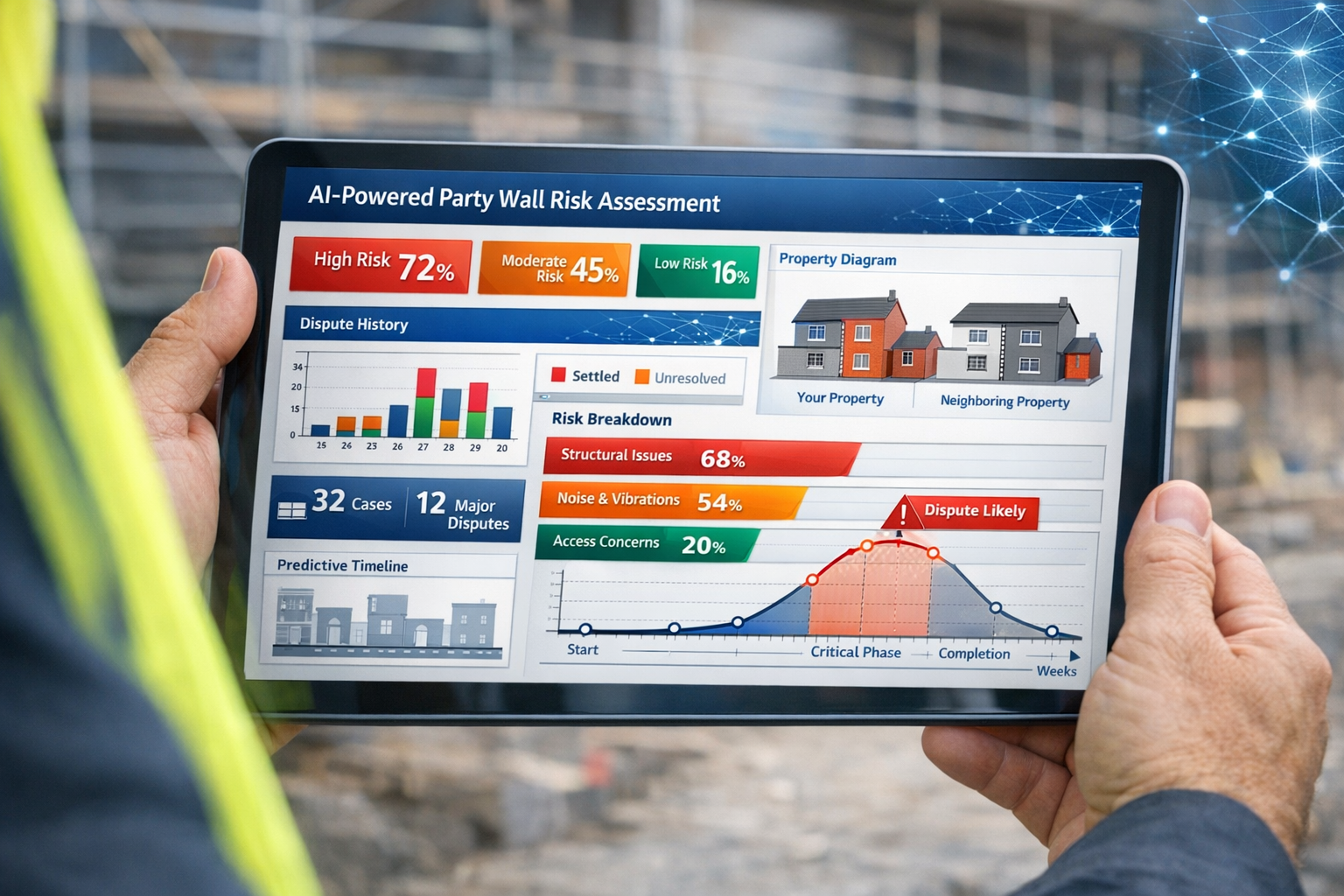
- 📊 Automated risk scoring evaluates multiple factors—property type, work scope, neighbour history—to flag high-risk situations before party wall notices are even served
- ⚡ Smart document automation streamlines party wall award drafting by learning from thousands of successful agreements, reducing preparation time by up to 60%
- 🎯 Predictive analytics empower surveyors to recommend specific mitigation strategies based on similar past cases, improving negotiation outcomes
- 🔮 Early warning systems forecast potential escalation points throughout the construction timeline, allowing proactive intervention before conflicts arise
Understanding AI-Driven Dispute Prediction Technology
What Makes AI Effective for Party Wall Predictions?
Artificial intelligence excels at finding patterns in large datasets—exactly what's needed for party wall dispute prediction. Traditional approaches rely on surveyor experience and intuition. While valuable, this knowledge remains locked in individual practitioners' minds. AI democratizes this expertise by analyzing thousands of historical cases simultaneously.
The technology works through several key mechanisms:
Machine Learning Algorithms process historical party wall data including:
- Notice types and work descriptions
- Property characteristics and locations
- Response times and objection patterns
- Award terms and conditions
- Dispute outcomes and resolution methods
Natural Language Processing (NLP) examines written communications to detect:
- Emotional tone in neighbour correspondence
- Specific concerns and objection language
- Communication frequency and urgency
- Historical grievances mentioned
Predictive Modeling combines multiple data points to generate:
- Dispute probability scores (0-100%)
- Risk category classifications (low, medium, high)
- Timeline forecasts for potential escalation
- Recommended intervention strategies
According to emerging trends in legal technology, AI co-mediators and experimental pilots for dispute resolution are becoming more sophisticated[2]. While these developments haven't yet been specifically applied to party wall negotiations, the underlying technology is readily adaptable to this specialized field.
The Data Foundation: What AI Systems Analyze
For AI-driven dispute prediction to work effectively, systems require comprehensive datasets. In the party wall context, this includes:
| Data Category | Specific Elements | Predictive Value |
|---|---|---|
| Property Data | Age, type, construction method, previous works | High – structural factors correlate with dispute risk |
| Work Specifications | Scope, duration, invasiveness, types of party wall works | Very High – work type is primary risk indicator |
| Neighbour History | Previous disputes, response patterns, property tenure | High – past behavior predicts future responses |
| Geographic Patterns | Postcode-level dispute rates, local building trends | Medium – regional variations exist |
| Communication Records | Response times, objection language, surveyor appointments | Very High – early communication signals escalation risk |
| Award Terms | Compensation amounts, condition schedules, access provisions | Medium – certain terms correlate with satisfaction |
Professional bodies like RICS are incorporating advanced technologies such as BIM integration and geospatial analysis for structural assessments[1], creating the technical infrastructure that supports AI implementation.
How AI-Driven Dispute Prediction Works in Practice
Risk Assessment at the Notice Stage
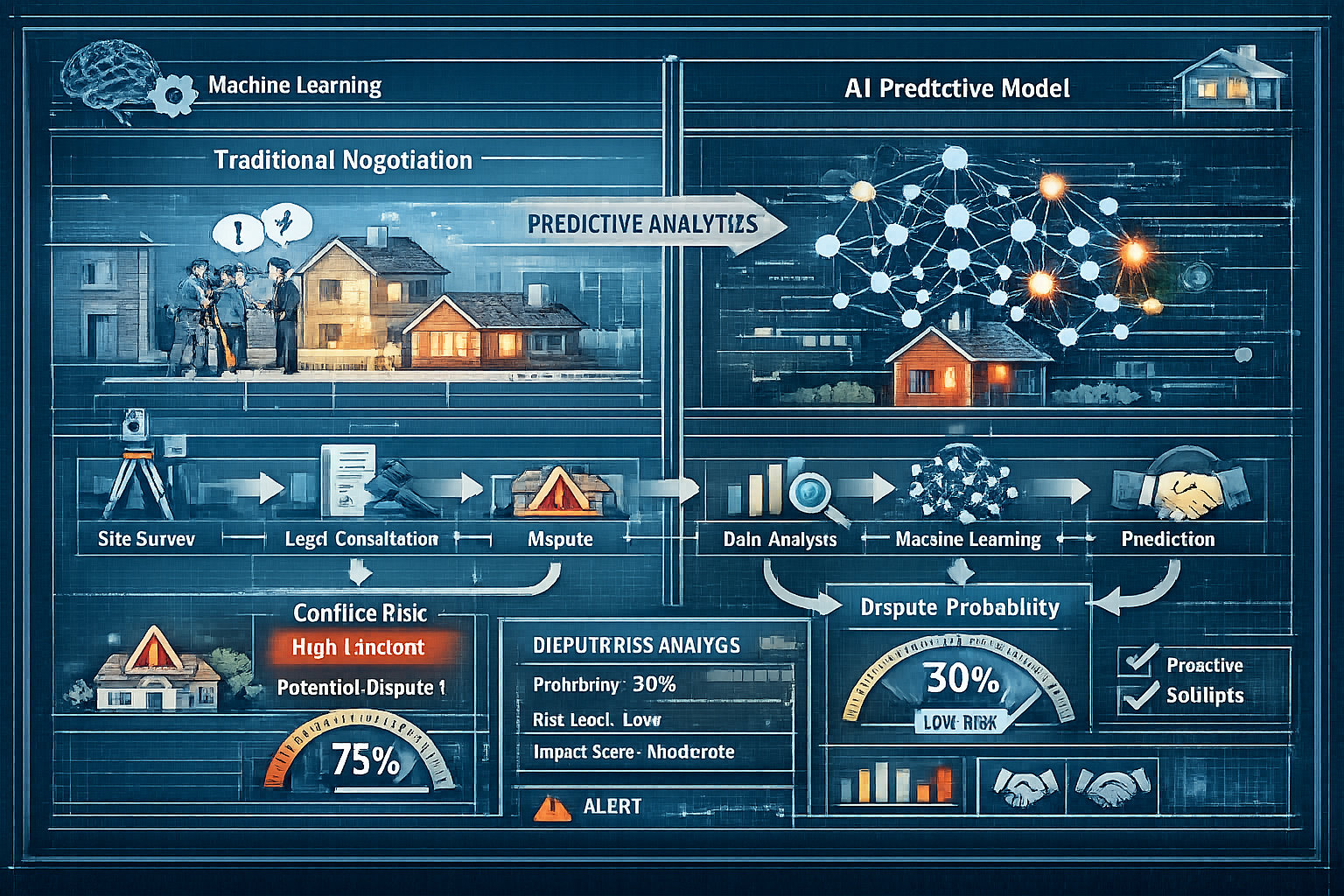
The most powerful intervention point is before serving a party wall notice. AI systems can evaluate proposed works and predict dispute likelihood, allowing building owners to adjust their approach proactively.
Here's how the process works:
Step 1: Initial Data Input
Building owners or their surveyors input project details into an AI-powered platform:
- Property address and characteristics
- Planned work description
- Proposed timeline
- Known neighbour information
Step 2: Automated Risk Analysis
The AI system processes this information against its historical database, generating:
- 🎯 Overall dispute risk score (e.g., "67% – Medium-High Risk")
- ⚠️ Specific risk factors identified (e.g., "Similar loft conversions in this postcode have 73% objection rate")
- 📋 Comparable case summaries showing how similar situations resolved
Step 3: Proactive Recommendations
Based on the analysis, the system suggests:
- Optimal notice timing
- Pre-emptive neighbour engagement strategies
- Recommended surveyor selection criteria
- Specific award terms likely to gain acceptance
For example, if AI identifies that basement excavations within 3 meters of adjoining foundations have a 78% dispute rate in a particular area, it might recommend:
- Extended notice period beyond statutory minimum
- Pre-notice informal discussion with detailed engineering plans
- Offer of enhanced schedule of condition documentation
- Specific insurance provisions in the award
This proactive approach contrasts sharply with traditional reactive methods where surveyors only engage after objections arise. Understanding what party wall notices are and how to respond becomes even more critical when AI insights guide the initial approach.
Automated Award Drafting and Optimization
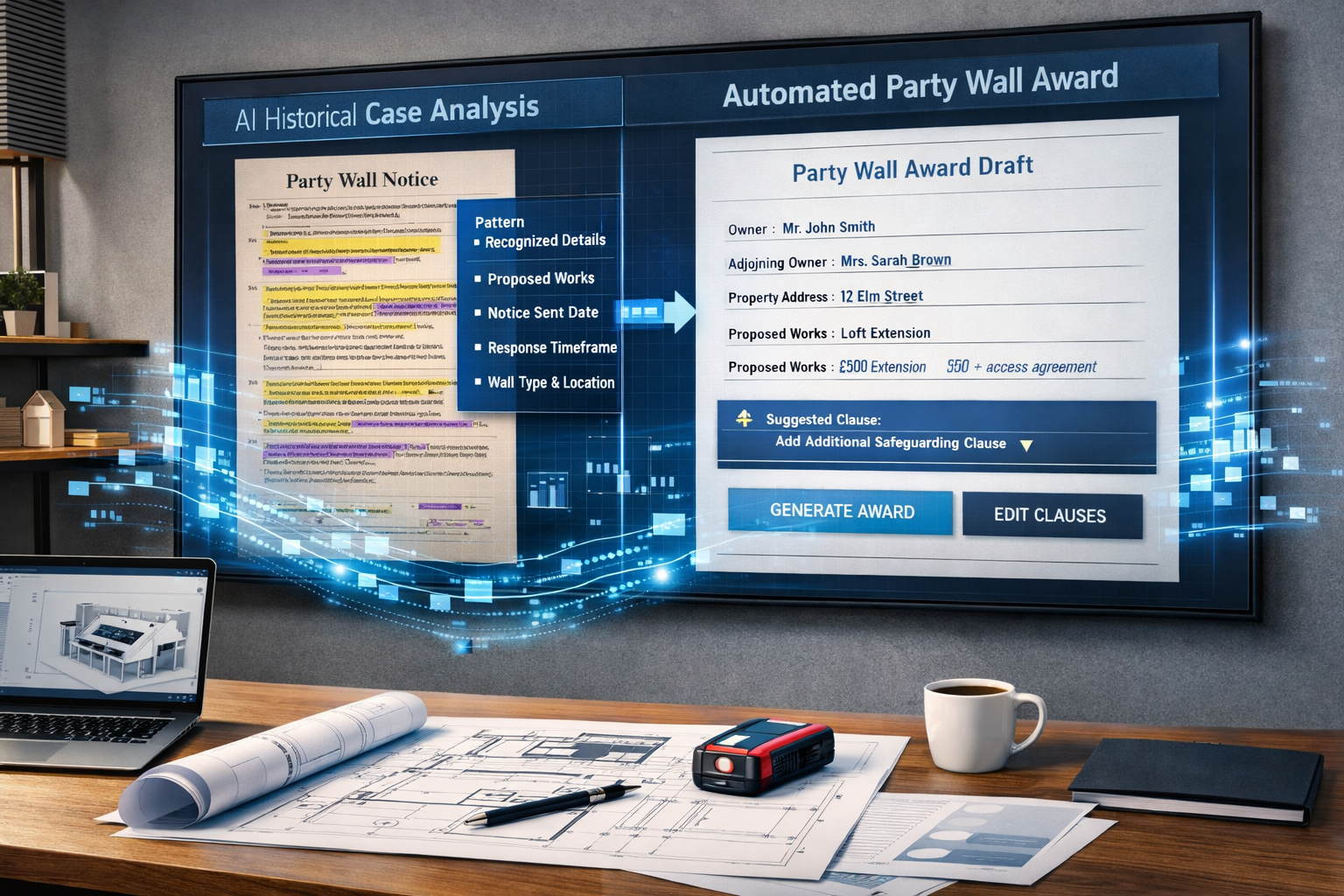
Once parties agree to proceed, AI dramatically accelerates award preparation while improving quality and consistency. Traditional award drafting requires surveyors to manually consider numerous variables and draft comprehensive documents—a time-consuming process prone to inconsistency.
AI-Powered Award Generation offers several advantages:
✅ Template Intelligence: Rather than static templates, AI systems use dynamic frameworks that adapt based on:
- Specific work types
- Property characteristics
- Risk factors identified
- Jurisdiction-specific requirements
- Historical success patterns
✅ Clause Optimization: The system recommends specific terms proven effective in similar cases:
- Access hours and frequency
- Compensation formulas
- Damage remediation protocols
- Dispute resolution mechanisms
✅ Consistency Checking: AI automatically identifies:
- Contradictory clauses
- Missing standard provisions
- Ambiguous language
- Potential enforcement issues
✅ Learning from Outcomes: Systems improve over time by analyzing:
- Which award terms led to smooth projects
- Where disputes emerged despite awards
- Compensation adequacy
- Neighbour satisfaction indicators
According to industry observers, platformization of legal services with AI integration for document workflows is accelerating[3], making these capabilities increasingly accessible to party wall practitioners.
For surveyors managing party wall costs, AI-driven automation can reduce award preparation time by 50-60%, allowing more efficient service delivery without compromising quality.
Real-Time Escalation Forecasting During Construction
Dispute prediction doesn't end when the award is signed. AI systems provide ongoing monitoring throughout construction, alerting surveyors to emerging risks before they become formal disputes.
Continuous Monitoring Features:
📊 Communication Pattern Analysis
- Frequency of neighbour contact
- Tone and sentiment changes
- Specific complaint types
- Response time delays
🚧 Work Progress Tracking
- Adherence to agreed schedule
- Noise and disruption levels
- Access compliance
- Condition report comparisons
⚡ Early Warning Triggers
When AI detects concerning patterns, it generates alerts:
- "Communication sentiment declining—recommend proactive check-in"
- "Work duration exceeding typical timeline—neighbour frustration risk increasing"
- "Similar projects at this stage experienced 65% dispute rate—consider preventive measures"
Intervention Recommendations
Based on the specific risk factors, AI suggests targeted actions:
- Schedule interim site visit
- Provide progress update to adjoining owner
- Review and adjust working hours
- Offer additional compensation for extended duration
This continuous oversight transforms surveyors from reactive problem-solvers to proactive relationship managers, addressing concerns before they escalate into formal disputes.
Implementing AI Tools in Your Party Wall Practice
Available Technologies and Platforms in 2026
While dedicated AI-driven party wall dispute prediction platforms are still emerging, several technology categories support this functionality:
1. Specialized Property Tech Platforms
- Integrate with existing surveying workflows
- Offer party wall-specific risk assessment modules
- Connect to property databases for automated data retrieval
- Provide mobile apps for on-site documentation
2. Legal Tech AI Systems
- Broader dispute prediction capabilities adaptable to party wall matters
- Document automation with learning algorithms
- Case outcome analysis tools
- Communication sentiment analysis
3. Custom AI Solutions
- Developed by larger surveying firms for internal use
- Trained on proprietary historical case databases
- Integrated with firm-specific workflows and standards
- Competitive advantage through superior prediction accuracy
4. Hybrid Approaches
- Combine off-the-shelf AI tools with human expertise
- Use AI for initial screening and risk flagging
- Retain surveyor judgment for nuanced situations
- Gradual implementation reducing change management challenges
When selecting whether to have a party wall agreement without a surveyor, AI tools provide data-driven guidance on when professional involvement is truly necessary versus when simpler approaches suffice.
Practical Steps for Surveyors and Property Owners
For Party Wall Surveyors:
🔧 Start Small
- Begin with AI-assisted risk assessment for new cases
- Compare AI predictions against your professional judgment
- Track accuracy over time to build confidence
- Gradually expand to award drafting automation
📚 Build Your Data Foundation
- Digitize historical case records
- Standardize data collection processes
- Document outcomes systematically
- Create feedback loops for continuous improvement
🤝 Maintain Human Oversight
- Use AI as decision support, not replacement
- Apply professional judgment to AI recommendations
- Explain AI insights to clients in accessible terms
- Retain responsibility for final decisions
For Building Owners:
✅ Engage AI-Enabled Professionals
- Ask potential surveyors about their technology capabilities
- Inquire about risk assessment processes
- Request data-driven project timelines
- Understand how technology improves outcomes
📋 Provide Complete Information
- Share all relevant project details early
- Disclose known neighbour sensitivities
- Provide access to property history
- Enable accurate AI analysis through transparency
💡 Act on Predictive Insights
- Take AI-identified risks seriously
- Implement recommended mitigation strategies
- Adjust timelines based on predictions
- Invest in preventive measures versus reactive dispute resolution
Whether you're working with a party wall surveyor in North London, Central London, or elsewhere, asking about AI capabilities helps identify forward-thinking professionals.
Benefits and Limitations of AI-Driven Dispute Prediction
The Compelling Advantages
🎯 Earlier Intervention
The primary benefit is identifying potential disputes weeks or months before they would traditionally surface. This early warning provides time for:
- Relationship building with neighbours
- Project modifications to address concerns
- Enhanced communication strategies
- Preventive measures implementation
💰 Cost Reduction
Preventing disputes is dramatically less expensive than resolving them:
- Reduced surveyor time on conflict management
- Fewer third surveyor appointments
- Lower legal costs
- Minimized construction delays
- Avoided damage claims
📈 Improved Outcomes
Data-driven approaches lead to better results:
- Higher agreement rates
- Faster resolution timelines
- More satisfied neighbours
- Reduced stress for all parties
- Smoother construction processes
⚖️ Consistency and Fairness
AI reduces human bias and inconsistency:
- Standardized risk assessment criteria
- Objective evaluation of situations
- Equal treatment across cases
- Transparent decision-making processes
For those concerned about keeping party wall costs down, AI-driven efficiency offers significant savings potential.
Important Limitations to Consider
🔍 Data Quality Dependencies
AI is only as good as its training data:
- Limited historical data in some regions
- Inconsistent record-keeping practices
- Changing regulations and standards
- Unique situations without precedent
🤖 Technology Limitations
Current AI cannot fully replicate human judgment:
- Difficulty understanding complex interpersonal dynamics
- Limited ability to assess non-verbal communication
- Challenges with highly unusual situations
- Risk of over-reliance on patterns
⚖️ Ethical and Legal Considerations
AI implementation raises important questions:
- Data privacy and confidentiality
- Liability for incorrect predictions
- Transparency in decision-making
- Professional responsibility boundaries
💡 The Human Element Remains Essential
Party wall matters involve:
- Emotional dimensions AI cannot fully grasp
- Relationship-building requiring human empathy
- Professional judgment in ambiguous situations
- Ethical considerations beyond algorithms
"AI should augment, not replace, the professional surveyor's expertise. The technology provides powerful insights, but human judgment remains essential for navigating the interpersonal complexities of neighbour relations."
When your neighbour is carrying out works, AI tools can help assess risks, but human surveyors provide the empathy and communication skills essential for successful resolution.
The Future of AI in Party Wall Practice
Emerging Developments to Watch
Integration with Building Information Modeling (BIM)
RICS protocols are already incorporating BIM for structural assessments[1], creating opportunities for:
- 3D visualization of party wall impacts
- Automated structural risk analysis
- Real-time construction monitoring
- Digital twin technology for dispute prevention
Enhanced Natural Language Processing
Future AI systems will better understand:
- Subtle communication nuances
- Cultural and regional language variations
- Emotional undertones in correspondence
- Negotiation dynamics and positioning
Predictive Maintenance and Monitoring
IoT sensors combined with AI could:
- Monitor party wall structural integrity continuously
- Detect issues before they become visible
- Provide objective data during disputes
- Validate compliance with award terms
Broader Legal Tech Integration
As AI advances in legal services generally[2][3], party wall practice will benefit from:
- Cross-jurisdictional precedent analysis
- Automated regulatory compliance checking
- Virtual mediation and resolution platforms
- Blockchain-based agreement verification
Preparing for the AI-Enhanced Future
For the Industry:
- Develop data standards for interoperability
- Create ethical guidelines for AI use
- Establish training and certification programs
- Build public trust through transparency
For Individual Practitioners:
- Invest in technology literacy
- Embrace continuous learning
- Adapt business models for AI efficiency
- Focus on high-value human skills
For Property Owners:
- Expect more data-driven processes
- Demand evidence-based recommendations
- Understand AI capabilities and limitations
- Maintain realistic expectations
Understanding resources like free party wall agreement templates and party wall contract guides remains valuable even as AI tools evolve—technology enhances but doesn't eliminate the need for foundational knowledge.
Conclusion
AI-Driven Dispute Prediction in Party Wall Agreements: Proactive Tools for 2026 Neighbour Negotiations represents a fundamental shift from reactive problem-solving to proactive risk management. By analyzing historical data patterns, flagging potential conflicts early, and automating award drafting, AI empowers surveyors to secure agreements before disputes arise—saving time, money, and neighbour relationships.
The technology offers compelling advantages: earlier intervention, reduced costs, improved outcomes, and greater consistency. However, important limitations remain, including data quality dependencies, technology constraints, and the irreplaceable value of human judgment and empathy.
Your Next Steps
If you're a building owner planning works:
- Engage a surveyor who uses data-driven risk assessment
- Provide complete project information for accurate AI analysis
- Act on predictive insights with preventive measures
- Budget for proactive engagement versus reactive dispute resolution
If you're a party wall surveyor:
- Explore available AI tools and platforms relevant to your practice
- Begin digitizing historical cases to build your data foundation
- Start with pilot projects combining AI insights with professional judgment
- Develop clear protocols for AI-assisted decision-making
If you're an adjoining owner concerned about neighbour works:
- Ask whether the building owner's surveyor uses predictive technology
- Request data-driven timelines and impact assessments
- Engage early when AI flags your situation as higher risk
- Consider appointing a tech-enabled surveyor for your representation
The future of party wall practice lies not in replacing human expertise with algorithms, but in augmenting professional judgment with powerful predictive insights. As we navigate 2026 and beyond, the most successful practitioners will be those who thoughtfully integrate AI tools while maintaining the empathy, communication skills, and ethical judgment that remain essential to effective neighbour negotiations.
Whether you're working under the Party Wall etc. Act 1996 or simply seeking to understand boundary wall rules, embracing AI-driven dispute prediction positions you at the forefront of modern party wall practice—preventing conflicts before they begin and fostering better neighbour relationships through data-driven insight and proactive engagement.
References
[1] Party Wall Surveys For Ai Data Centre Developments Rics Protocols Amid 2026 Infrastructure Demand – https://nottinghillsurveyors.com/blog/party-wall-surveys-for-ai-data-centre-developments-rics-protocols-amid-2026-infrastructure-demand
[2] Predictions For 2026 In Ai And The Law – https://www.adr.org/podcasts/ai-and-the-future-of-law/predictions-for-2026-in-ai-and-the-law/
[3] Watch – https://www.youtube.com/watch?v=U1tkCdfhJbI