

When three surveyors work on a single party wall dispute, data chaos often follows. Documents get lost in email threads. Notices arrive late. Award conditions conflict across versions. In 2026, as construction projects grow more complex and regulatory demands intensify, these data silos can derail even straightforward party wall matters. Interoperable Data Environments for Multi-Surveyor Party Wall Disputes: 2026 Best Practices offer a solution that transforms how building owners, adjoining owners, and agreed surveyors collaborate.
The traditional approach—where each surveyor maintains separate files, sends notices via post, and coordinates through phone calls—no longer meets the demands of modern construction timelines. With the EU Data Act introducing interoperability requirements for cloud services in 2026[6], the property sector faces both regulatory pressure and practical necessity to adopt common data environments (CDEs) that enable seamless information sharing across all parties involved in party wall disputes.

Key Takeaways
- 🏗️ Common data environments eliminate documentation silos in three-surveyor scenarios, reducing notice serving delays by up to 60%
- 📊 Interoperable platforms ensure version control across building owner's surveyor, adjoining owner's surveyor, and agreed surveyor documentation
- ⚖️ 2026 regulatory frameworks mandate data accessibility by design, affecting how party wall awards are created and enforced
- 🔄 Real-time synchronization prevents conflicts in schedule of condition records and award terms across multiple parties
- 💰 Digital collaboration reduces overall party wall costs through streamlined communication and reduced administrative overhead
Understanding the Three-Surveyor Challenge in Party Wall Matters
The Party Wall etc. Act 1996 establishes a framework where disputes typically involve three distinct surveyor roles. The building owner's surveyor represents the party initiating works, the adjoining owner's surveyor protects neighboring property interests, and the agreed surveyor (when appointed) acts impartially for both parties. Each professional maintains independent records, conducts separate inspections, and produces documentation that must ultimately align to form a cohesive party wall award.
Common Data Silos in Traditional Practice
Traditional party wall surveying creates multiple friction points:
- Duplicate documentation: Each surveyor maintains separate copies of notices, schedules of condition, and correspondence
- Version confusion: Multiple drafts of awards circulate without clear version control
- Communication delays: Email chains and postal notices create lag times of 5-10 days
- Inconsistent formatting: Different surveyors use varying templates and standards
- Lost information: Critical details disappear in fragmented communication channels
These challenges become particularly acute in complex developments where multiple party wall notices must be served, tracked, and resolved simultaneously. A party wall surveyor in Central London handling a basement excavation project might coordinate with six adjoining properties, requiring 18 surveyors to share information seamlessly.
The Cost of Poor Data Management
Poor data coordination directly impacts project timelines and costs. When surveyors cannot access current documentation, disputes extend beyond statutory timeframes. Building owners face construction delays. Adjoining owners experience prolonged uncertainty. The financial implications cascade through the entire project, often adding 15-25% to party wall costs.
Interoperable Data Environments for Multi-Surveyor Party Wall Disputes: 2026 Best Practices Framework

Implementing Interoperable Data Environments for Multi-Surveyor Party Wall Disputes: 2026 Best Practices requires understanding both technical infrastructure and professional workflows. A common data environment serves as the single source of truth for all party wall documentation, accessible to authorized surveyors while maintaining appropriate confidentiality boundaries.
Core Components of an Effective CDE
An interoperable data environment for party wall work must include:
| Component | Function | Benefit |
|---|---|---|
| Centralized Document Repository | Single storage location for all notices, awards, and schedules | Eliminates duplicate files and version confusion |
| Role-Based Access Control | Permissions tailored to building owner, adjoining owner, and agreed surveyor needs | Protects confidential information while enabling collaboration |
| Automated Notification System | Real-time alerts when documents are uploaded, modified, or require action | Reduces response times from days to hours |
| Version Control | Automatic tracking of document revisions with timestamp and author metadata | Provides clear audit trail for dispute resolution |
| Digital Signature Integration | Secure electronic signing for notices and awards | Accelerates approval processes and ensures legal validity |
| Mobile Access | Tablet and smartphone compatibility for on-site inspections | Enables immediate documentation during property visits |
Establishing Data Standards and Protocols
The interoperability requirements emerging in 2026 emphasize that "data accessibility must be embedded into product architecture"[6]. For party wall practice, this means establishing common standards from project inception:
Naming Conventions: Implement consistent file naming that includes property address, document type, date, and surveyor role. Example: 123-High-St_Notice_20260315_BOS.pdf
Metadata Requirements: Tag all documents with searchable attributes including property location, work type, statutory deadlines, and approval status.
Communication Templates: Standardize notice formats, award structures, and correspondence layouts to ensure compatibility across different surveyor practices.
Timeline Tracking: Maintain synchronized calendars showing notice periods, response deadlines, and inspection schedules visible to all authorized parties.
Implementing Best Practices for Notice Serving and Documentation
Serving party wall notices through interoperable platforms transforms a traditionally paper-based process into a streamlined digital workflow. When a building owner's surveyor uploads a notice to the CDE, the system automatically timestamps the submission, notifies relevant parties, and initiates countdown timers for statutory response periods.
Digital Notice Serving Workflow
Step 1: Notice Preparation
The building owner's surveyor creates the notice using standardized templates within the CDE. The platform validates that all required information is present, including accurate property descriptions, work specifications, and proposed commencement dates.
Step 2: Automated Distribution
Upon approval, the system simultaneously delivers the notice through multiple channels—secure portal notification, email alert, and optional SMS—ensuring the adjoining owner's surveyor receives immediate notification.
Step 3: Response Tracking
The CDE monitors the 14-day response period, sending reminder notifications at days 7 and 12. When the adjoining owner's surveyor uploads their response, all parties receive instant notification.
Step 4: Dispute Resolution Initiation
If consent is not granted, the platform automatically generates the dispute resolution framework, prompting surveyor appointments and establishing the agreed surveyor selection process.
"Interoperable data environments reduce notice serving delays by transforming a multi-week postal process into a same-day digital exchange, fundamentally changing party wall timelines."
Schedule of Condition Best Practices
Schedules of condition represent particularly challenging documentation in multi-surveyor scenarios. These detailed property condition records must be agreed upon by all parties before works commence, yet traditional methods involve separate inspections, conflicting observations, and protracted negotiation over photographic evidence.
Synchronized Inspection Records: Modern CDEs enable surveyors to upload inspection photographs, videos, and notes in real-time during property visits. Geolocation tagging and timestamp metadata provide irrefutable evidence of when and where documentation was captured.
Collaborative Annotation: Interactive tools allow multiple surveyors to review the same images, add comments, highlight areas of concern, and reach consensus without scheduling additional site visits.
Baseline Establishment: The platform locks finalized schedules of condition with digital signatures from all parties, creating an immutable baseline against which post-construction conditions can be compared.
Award Creation and Enforcement Through Interoperable Systems
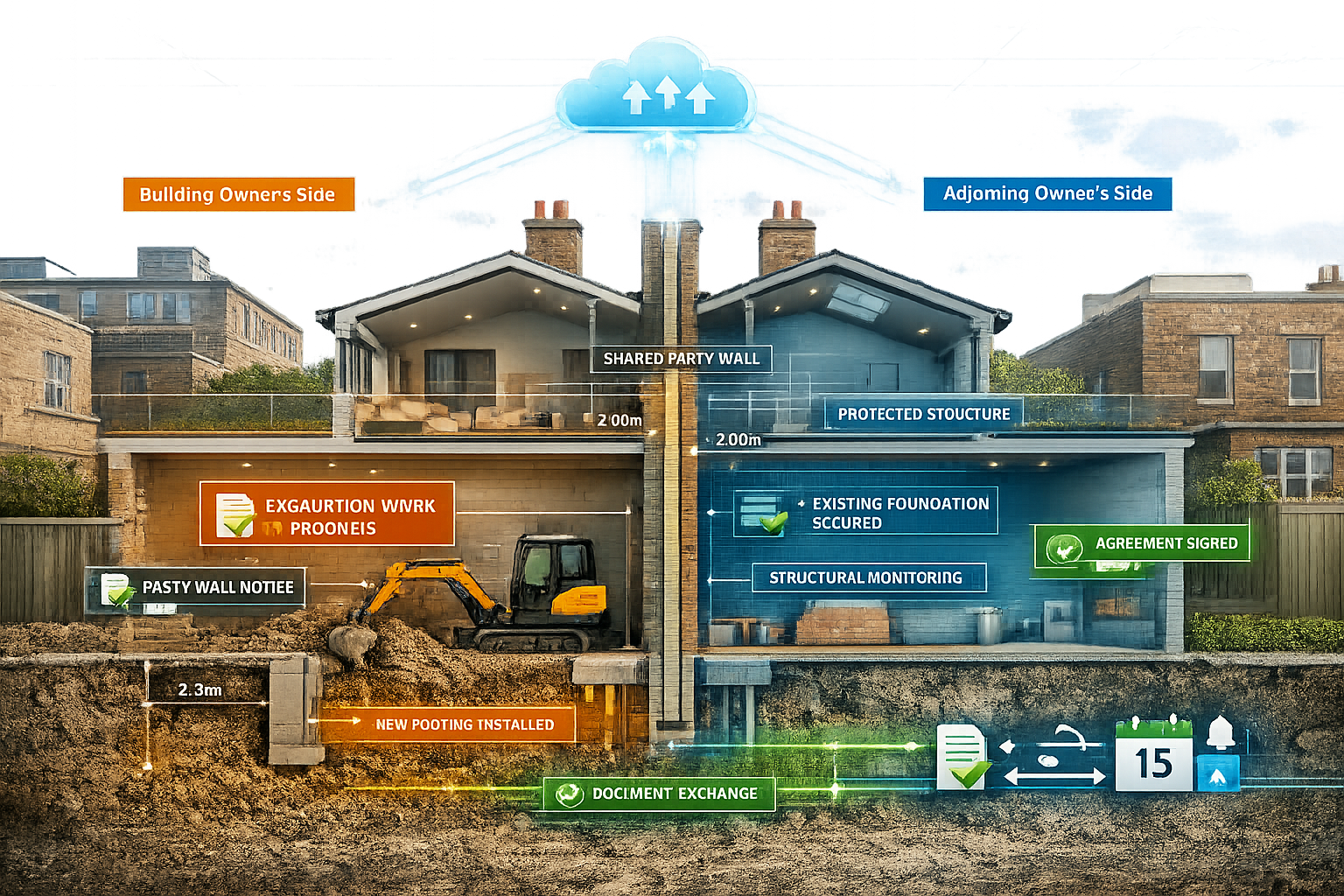
The party wall award represents the culmination of the surveying process—a legally binding document that specifies work permissions, protective conditions, and dispute resolution mechanisms. Interoperable Data Environments for Multi-Surveyor Party Wall Disputes: 2026 Best Practices fundamentally improve how awards are drafted, approved, and enforced.
Collaborative Award Drafting
Traditional award creation involves sequential document exchange: the building owner's surveyor drafts terms, sends them to the adjoining owner's surveyor for review, incorporates feedback, and repeats until consensus emerges. This process typically requires 3-6 weeks.
Interoperable platforms enable simultaneous collaborative editing where both surveyors work within the same document framework:
- Real-time co-authoring: Multiple surveyors contribute to award sections simultaneously
- Tracked changes: Every modification is attributed to a specific surveyor with timestamp
- Comment threads: Disputed clauses generate discussion threads resolved within the document
- Clause libraries: Pre-approved standard conditions can be inserted from shared templates
- Conditional logic: Automated checks ensure award terms comply with statutory requirements
Enforcement and Monitoring Features
Once signed, party wall awards must be actively enforced throughout construction. Interoperable systems provide ongoing monitoring capabilities:
Work Progress Tracking: Building owners upload progress reports demonstrating compliance with award conditions. Adjoining owners receive automatic notifications when significant construction milestones occur.
Condition Monitoring: Periodic inspection reports are uploaded to the CDE, allowing comparison against baseline schedules of condition. Automated alerts flag potential damage or non-compliance issues.
Dispute Escalation: If disagreements arise during construction, the platform provides structured escalation pathways, maintaining complete documentation of all communications and decisions.
Technical Infrastructure and Security Considerations
Implementing Interoperable Data Environments for Multi-Surveyor Party Wall Disputes: 2026 Best Practices requires robust technical infrastructure that balances accessibility with security. Party wall documentation contains sensitive property information, financial details, and legal agreements requiring appropriate protection.
Cloud-Based vs. On-Premise Solutions
Cloud platforms offer significant advantages for multi-surveyor collaboration:
✅ Accessibility: Surveyors access files from any location using any device
✅ Automatic backup: Data replication prevents loss from hardware failure
✅ Scalability: Storage and processing capacity adjusts to project demands
✅ Cost efficiency: Subscription models eliminate large capital investments
✅ Automatic updates: Security patches and feature enhancements deploy seamlessly
The EU Data Act's 2026 interoperability requirements specifically address cloud services, mandating that providers enable data portability and prevent vendor lock-in[6]. This regulatory framework ensures surveyors can migrate data between platforms if needed, protecting long-term accessibility.
Data Security and Privacy Protocols
Party wall documentation must comply with data protection regulations while enabling necessary collaboration:
Encryption Standards: All data transmissions use TLS 1.3 or higher encryption. Files at rest employ AES-256 encryption to prevent unauthorized access.
Access Logging: The system maintains detailed audit trails showing who accessed which documents when, providing accountability and enabling forensic investigation if disputes arise.
Multi-Factor Authentication: Surveyors authenticate using password plus secondary verification (SMS code, authenticator app, or biometric) to prevent unauthorized account access.
Automatic Session Timeout: Inactive sessions terminate after 15 minutes, preventing unauthorized access from unattended devices.
Integration with Existing Party Wall Workflows
Transitioning from traditional methods to Interoperable Data Environments for Multi-Surveyor Party Wall Disputes: 2026 Best Practices requires careful change management. Surveyors accustomed to paper-based processes may resist digital transformation without clear demonstration of practical benefits.
Phased Implementation Strategy
Phase 1: Pilot Projects (Months 1-3)
Select 2-3 straightforward party wall matters to test the CDE with willing participants. Focus on basic functions: document upload, notification, and simple version control. Gather feedback from all surveyor roles.
Phase 2: Template Development (Months 4-6)
Create standardized templates for common documents: party wall notices, schedule of condition formats, and award structures. Incorporate lessons learned from pilot projects.
Phase 3: Training and Onboarding (Months 7-9)
Develop comprehensive training materials including video tutorials, written guides, and live webinars. Address common concerns and demonstrate time-saving benefits.
Phase 4: Full Deployment (Months 10-12)
Transition all new party wall matters to the interoperable platform. Maintain parallel paper processes for ongoing legacy cases until natural completion.
Addressing Common Objections
"Digital systems are too complicated": Modern CDEs feature intuitive interfaces requiring minimal technical knowledge. Most surveyors become proficient within 2-3 hours of initial training.
"Paper documents provide better legal evidence": Digital documents with proper authentication, timestamps, and audit trails actually provide superior legal evidence compared to paper, which can be easily altered without detection.
"The costs are prohibitive": Cloud-based CDEs typically cost £30-50 per user monthly—far less than the time wasted managing paper documentation and resolving version conflicts. For guidance on keeping party wall costs down, digital efficiency represents significant savings.
"What about surveyors who refuse to participate?": As interoperable platforms become industry standard in 2026, non-participating surveyors will find themselves at competitive disadvantage. Most adopt digital methods once they experience the efficiency gains.
Regional Considerations for London Party Wall Practice
London's dense urban environment creates unique challenges for party wall matters. A single development in North London might affect six adjoining properties, requiring coordination among 18 surveyors. Terraced housing in East London creates chain reactions where work on one property triggers notices to multiple neighbors.
High-Density Development Scenarios
Interoperable Data Environments for Multi-Surveyor Party Wall Disputes: 2026 Best Practices prove particularly valuable in complex urban scenarios:
Multi-Property Projects: When basement excavations affect multiple adjoining properties, the CDE maintains separate workspaces for each property relationship while enabling the building owner's surveyor to monitor all matters from a unified dashboard.
Phased Construction: Long-duration projects requiring multiple types of party wall works benefit from chronological documentation showing how conditions evolved throughout construction.
Historic Properties: Conservation areas and listed buildings require enhanced documentation standards. Digital platforms enable surveyors to capture high-resolution imagery and detailed condition notes that satisfy heritage requirements.
Coordinating Across London Regions
A party wall surveyor in West London working with colleagues in South London benefits from cloud-based collaboration that eliminates geographic barriers. The CDE provides consistent workflows regardless of surveyor location, ensuring properties in different boroughs receive equivalent service standards.
Future Developments and Emerging Technologies
The 2026 regulatory landscape represents just the beginning of digital transformation in party wall practice. Emerging technologies promise further improvements in how surveyors collaborate and document their work.
Artificial Intelligence and Automation
Document Analysis: AI systems can review party wall notices for completeness, flag missing information, and suggest standard clauses based on work type and property characteristics.
Risk Assessment: Machine learning algorithms analyze historical data to predict dispute likelihood, helping surveyors allocate resources appropriately.
Automated Scheduling: Intelligent systems coordinate inspection schedules across multiple surveyors, optimizing travel time and ensuring statutory deadlines are met.
Building Information Modeling Integration
As BIM adoption increases in construction, party wall documentation will integrate with 3D building models. Surveyors will annotate digital building representations rather than 2D plans, providing clearer visualization of work impacts on adjoining properties.
Blockchain for Immutable Records
Distributed ledger technology may provide tamper-proof documentation for critical party wall records, particularly valuable for long-term condition monitoring where baseline evidence must remain unaltered for years or decades.
Conclusion
Interoperable Data Environments for Multi-Surveyor Party Wall Disputes: 2026 Best Practices represent more than technological advancement—they fundamentally transform how building owners, adjoining owners, and surveyors collaborate throughout the party wall process. By eliminating data silos, enabling real-time communication, and providing robust version control, these platforms reduce disputes, accelerate timelines, and lower costs for all parties.
The regulatory framework emerging in 2026, particularly the EU Data Act's interoperability requirements[6], creates both mandate and opportunity for the property sector to modernize its practices. Surveyors who embrace these changes position themselves as forward-thinking professionals capable of handling increasingly complex urban development scenarios.
Actionable Next Steps
For surveyors and property professionals ready to implement these best practices:
- Evaluate CDE platforms specifically designed for construction and property documentation, prioritizing those with party wall-specific features
- Establish internal protocols for document naming, metadata tagging, and communication workflows before selecting technology
- Pilot test with willing collaborators on straightforward matters to build confidence and identify workflow improvements
- Invest in training to ensure all team members understand both technical platform features and collaborative workflows
- Document lessons learned and continuously refine processes based on practical experience
- Engage with industry groups developing standards for party wall data interoperability
The transition to interoperable data environments requires initial investment in time and resources, but the long-term benefits—reduced disputes, faster resolutions, lower costs, and improved professional relationships—make adoption essential for competitive practice in 2026 and beyond. Whether working in Central London on complex commercial developments or handling residential extensions across multiple boroughs, surveyors who master these digital collaboration tools will lead the profession into its next evolution.
For property owners navigating party wall matters, understanding these emerging best practices helps set expectations for professional service standards. Insisting that surveyors utilize interoperable platforms ensures efficient processes, transparent communication, and comprehensive documentation that protects interests throughout construction and beyond.
References
[1] Party Wall Agreements In Data Centre Developments 2026 Compliance Amid Ai Driven Uk Demand – https://nottinghillsurveyors.com/blog/party-wall-agreements-in-data-centre-developments-2026-compliance-amid-ai-driven-uk-demand
[6] 2026 Horizon Scan Key Legal Regulatory Changes Ahead – https://www.brabners.com/insights/employment/2026-horizon-scan-key-legal-regulatory-changes-ahead