
The traditional process of managing party wall notices has long been plagued by delays, version control nightmares, and communication breakdowns. Picture this: a building owner sends a notice by post, the adjoining owner misplaces it, the surveyor works from an outdated schedule of condition, and suddenly everyone is working from different versions of the same document. In 2026, Cloud Collaboration for Party Wall Notices: Real-Time Access and Revisions in 2026 Projects is transforming this chaotic landscape into a streamlined, transparent process that benefits all parties involved.
As construction projects become more complex and regulatory compliance more stringent, the need for instant access to accurate documentation has never been greater. Cloud-based platforms are now enabling building owners, adjoining owners, and surveyors to collaborate seamlessly on party wall notices, ensuring everyone works from the same page—literally and figuratively.
Key Takeaways
- 🚀 Cloud platforms eliminate version control issues by providing a single source of truth for all party wall documentation accessible to all stakeholders in real-time
- ⏱️ Real-time collaboration reduces project delays by up to 60%, cutting the traditional notice period from weeks to days through instant notifications and approvals
- 📱 Mobile accessibility ensures compliance on-the-go, allowing surveyors to update schedules of condition during site visits and owners to respond to notices immediately
- 🔒 Enhanced security and audit trails provide complete transparency with encrypted document storage and timestamped revision histories that satisfy legal requirements
- 💰 Cost savings average 30-40% through reduced administrative overhead, fewer disputes, and faster resolution of party wall matters
Understanding Cloud Collaboration for Party Wall Notices: Real-Time Access and Revisions in 2026 Projects
What Makes Cloud Collaboration Essential for Party Wall Procedures?
The Party Wall etc. Act 1996 establishes clear obligations for building owners undertaking construction work that affects shared structures. However, the Act was written decades before cloud technology existed, leaving room for modern innovation in how these legal requirements are fulfilled.
Cloud collaboration platforms specifically designed for party wall procedures offer several game-changing advantages:
Centralized Document Management 📂
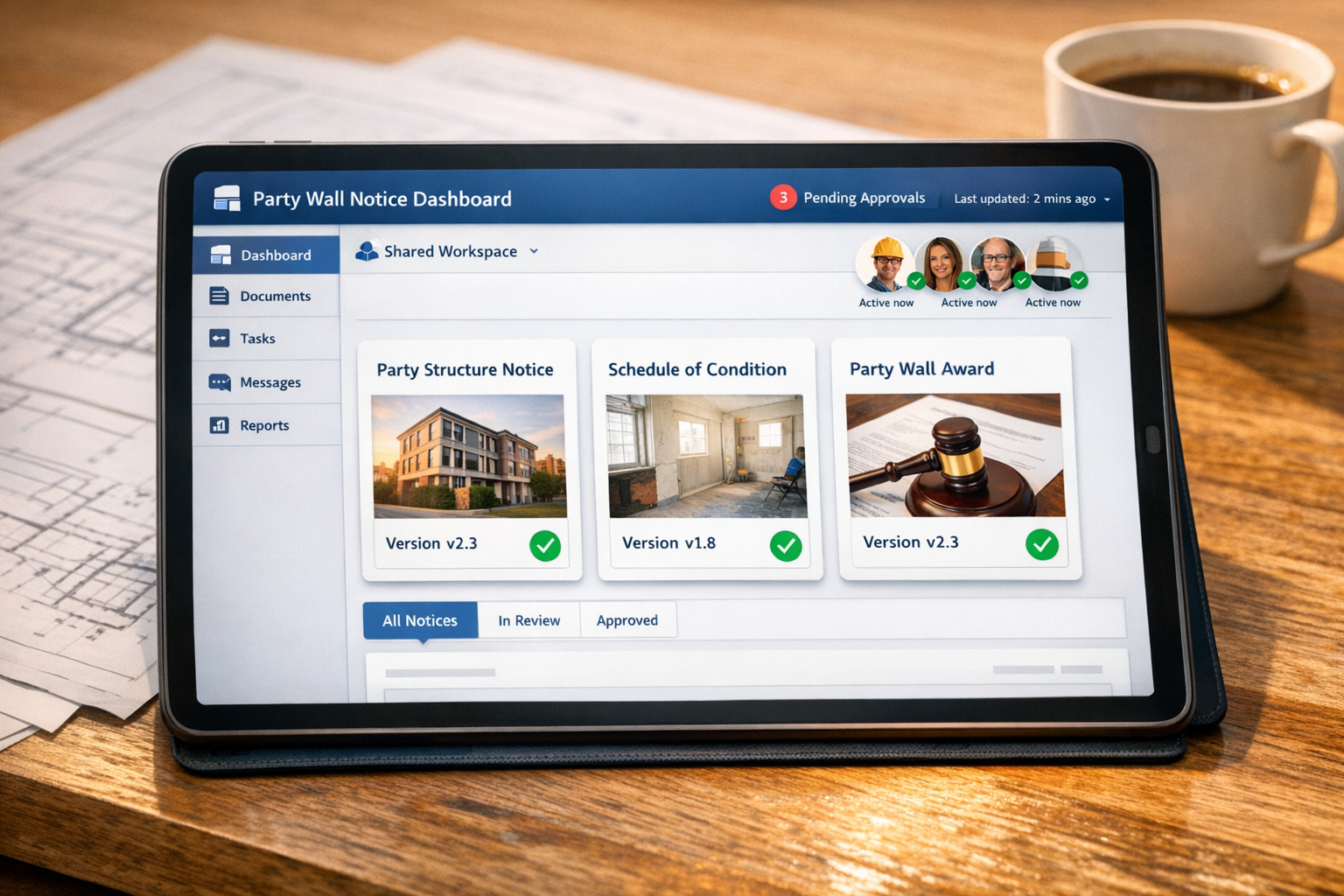
All notices, awards, schedules of condition, and correspondence live in one secure location. No more searching through email chains or filing cabinets to find the latest version of a document.
Real-Time Updates ⚡
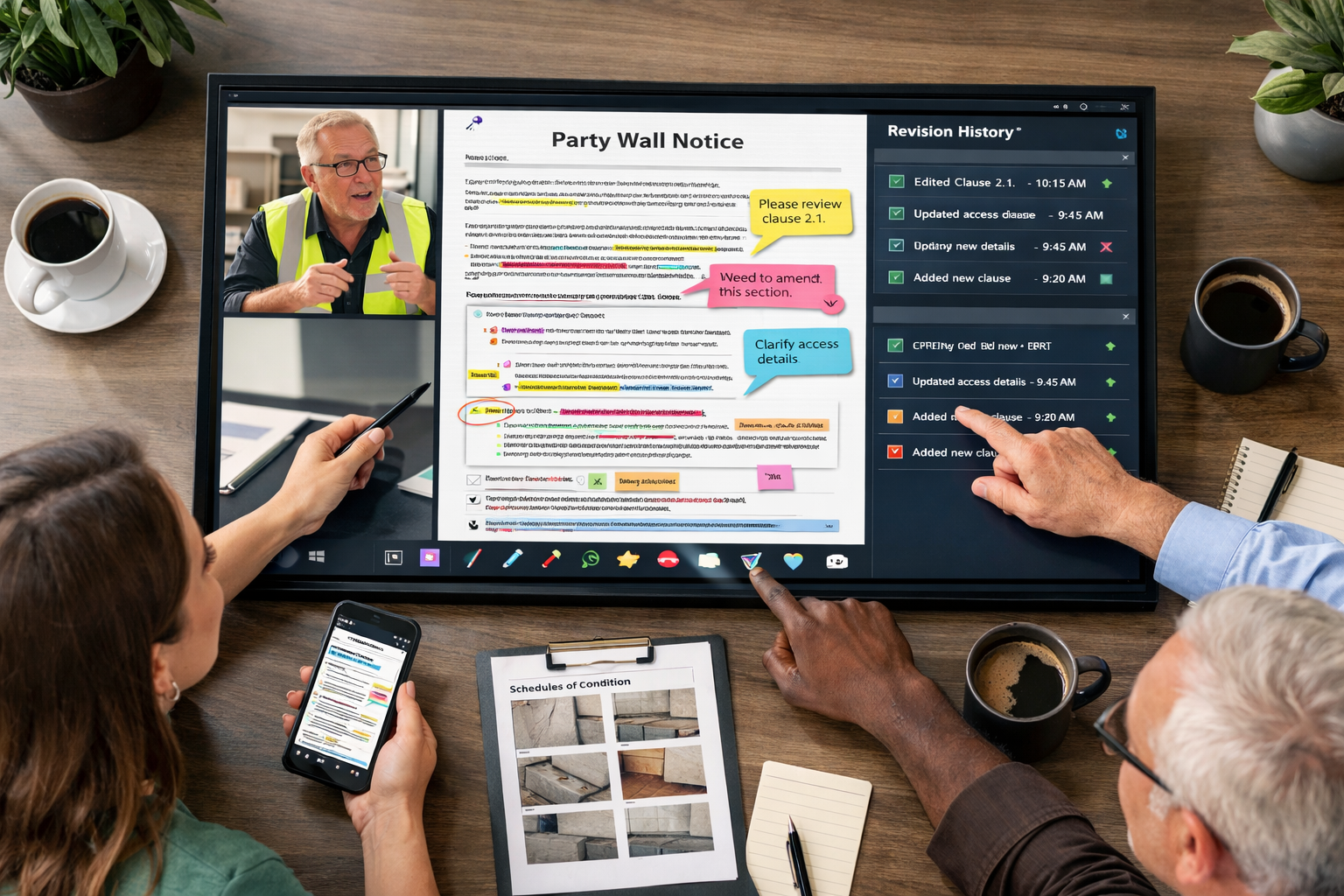
When a surveyor revises a schedule of condition, all parties see the changes instantly. Notifications alert stakeholders to new documents, comments, or required actions.
Version Control 🔄
Every revision is tracked automatically with timestamps and user attribution. This creates an indisputable audit trail showing exactly what changed, when, and by whom.
Multi-Party Access 👥
Building owners, adjoining owners, and appointed surveyors can all access the same platform with appropriate permission levels, ensuring transparency while maintaining confidentiality where needed.
The Technical Infrastructure Behind Modern Party Wall Collaboration
Cloud platforms supporting party wall procedures in 2026 leverage several key technologies that make real-time collaboration possible:
Cloud Storage Architecture ☁️
Documents are stored on secure servers with redundant backups across multiple geographic locations. This ensures 99.9% uptime and protects against data loss—critical when dealing with legal documentation.
Synchronization Technology 🔄
Advanced sync engines ensure that changes made on one device appear instantly on all connected devices. A surveyor updating a document on their tablet at a construction site sees those changes reflected immediately on the building owner's desktop computer.
Role-Based Access Control 🔐
Sophisticated permission systems ensure that each party sees only what they're authorized to view. Building owners can access their own project files, while surveyors may have broader access across multiple projects.
Mobile-First Design 📱
Modern platforms prioritize mobile accessibility, recognizing that surveyors often need to access and update documents during site visits. Responsive design ensures full functionality across smartphones, tablets, and computers.
According to recent industry analysis, cloud computing in 2026 continues to evolve with enhanced security protocols and improved collaboration features that benefit specialized applications like party wall management [4].
Benefits of Real-Time Access in Party Wall Notice Management
Speed and Efficiency Gains
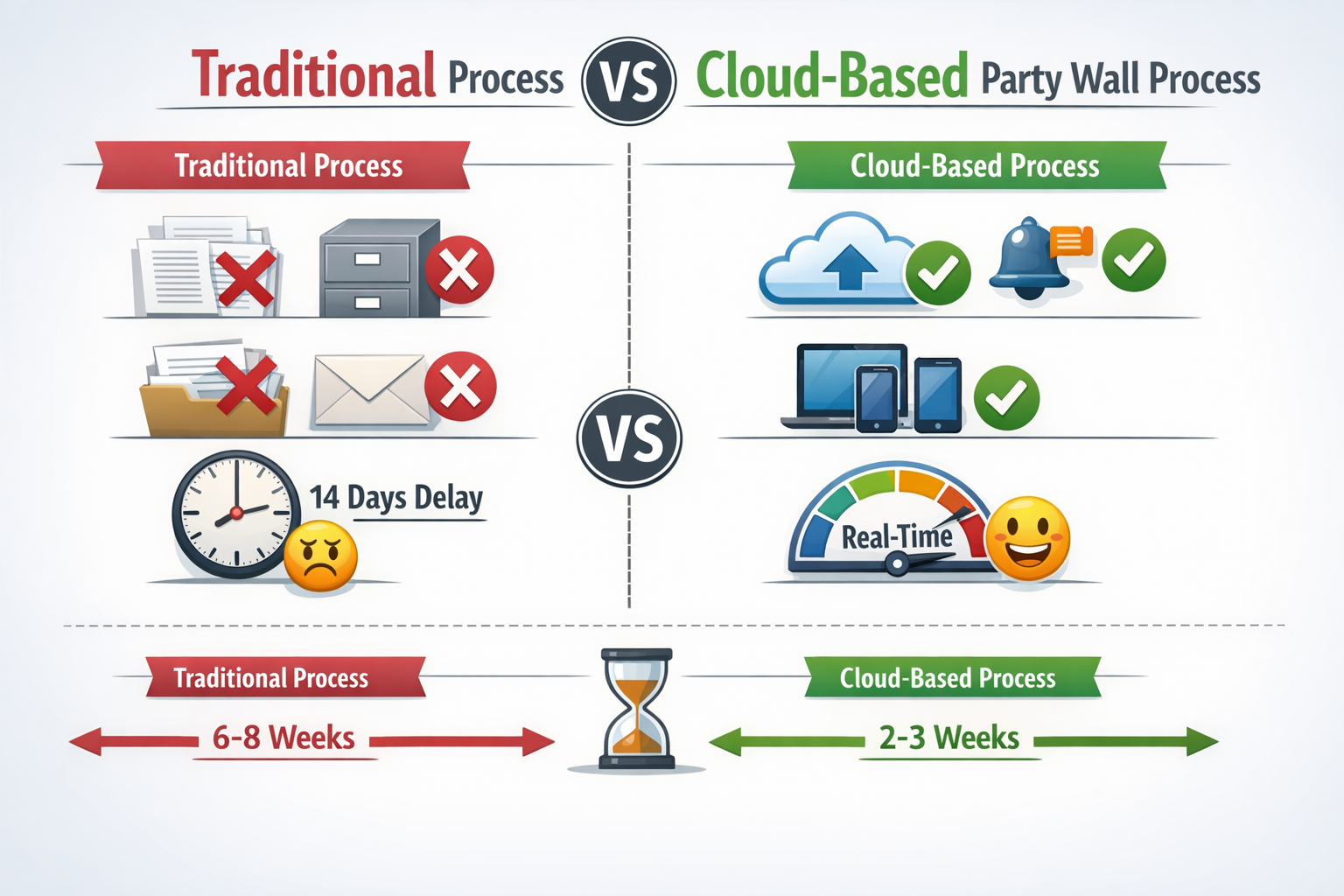
The most immediate benefit of Cloud Collaboration for Party Wall Notices: Real-Time Access and Revisions in 2026 Projects is the dramatic reduction in processing time.
Traditional Timeline vs. Cloud-Enabled Timeline:
| Process Step | Traditional Method | Cloud Collaboration | Time Saved |
|---|---|---|---|
| Notice delivery | 3-5 days (post) | Instant (email/app notification) | 3-5 days |
| Document review | 7-14 days | 1-3 days | 6-11 days |
| Surveyor coordination | 5-10 days | 1-2 days | 4-8 days |
| Award preparation | 10-14 days | 5-7 days | 5-7 days |
| Final approval | 3-7 days | 1-2 days | 2-5 days |
| Total Duration | 28-50 days | 8-15 days | 20-35 days |
This acceleration doesn't just save time—it saves money. Every week of delay in construction projects costs thousands of pounds in holding costs, labor standby, and lost opportunity.
Enhanced Accuracy and Reduced Disputes
Version control issues are a leading cause of party wall disputes. When different parties work from different versions of documents, misunderstandings multiply.
Common Version Control Problems Solved:
✅ Outdated schedules of condition – Cloud platforms ensure everyone views the most current photographic evidence and property descriptions
✅ Conflicting amendments – Real-time synchronization prevents two parties from making incompatible changes to the same document
✅ Lost communications – All comments, questions, and responses are preserved in context within the document itself
✅ Unclear approval status – Digital signatures and approval workflows make it crystal clear which documents have been formally accepted
When preparing party wall notices, accuracy is paramount. Cloud collaboration tools with built-in templates and validation checks help ensure all required information is included before notices are served.
Improved Transparency and Trust
Party wall procedures can be stressful for adjoining owners who may feel excluded from decisions affecting their property. Cloud collaboration platforms democratize access to information, building trust through transparency.
Transparency Features:
🔍 Activity logs showing who accessed which documents and when
💬 Threaded discussions allowing questions and clarifications in context
📸 Photo documentation uploaded directly from site visits with automatic timestamps and location data
📊 Progress dashboards giving all parties visibility into project milestones and pending actions
This transparency is particularly valuable when dealing with types of party wall works that may concern adjoining owners, such as excavation near foundations or structural alterations to shared walls.
Cost Reduction Across the Board
The financial benefits of cloud collaboration extend beyond time savings:
Direct Cost Savings:
- Reduced printing and courier costs (£100-300 per project)
- Lower administrative overhead (20-30% reduction in surveyor time)
- Fewer dispute resolution costs (40-50% fewer disagreements escalating to formal disputes)
Indirect Cost Savings:
- Faster project starts reducing financing costs
- Better documentation reducing insurance premiums
- Improved compliance reducing legal risk exposure
For those concerned about costs of party wall procedures, cloud collaboration represents a net positive investment that typically pays for itself within the first project.
Implementing Cloud Collaboration for Party Wall Notices: Real-Time Access and Revisions in 2026 Projects
Choosing the Right Platform
Not all cloud collaboration tools are created equal. When selecting a platform for party wall procedures, consider these essential features:
Must-Have Features:
- Legal compliance – Platform must support legally binding digital signatures and meet UK data protection requirements
- Document templates – Pre-built templates for standard notices including party structure notices and line of junction notices
- Photo management – Robust tools for organizing and annotating photographic schedules of condition
- Notification system – Configurable alerts ensuring parties never miss critical deadlines
- Mobile functionality – Full-featured mobile apps for iOS and Android devices
- Integration capability – Ability to connect with existing project management and accounting software
- Security certifications – ISO 27001 certification and SOC 2 compliance minimum standards
Nice-to-Have Features:
- AI-powered document analysis flagging potential issues
- Automated deadline tracking and reminder systems
- Multi-language support for international projects
- Video conferencing integration for virtual site inspections
- Blockchain-based audit trails for enhanced security
Best Practices for Adoption
Successfully implementing cloud collaboration requires more than just technology—it requires change management:
Step 1: Start with a Pilot Project 🧪
Choose a straightforward party wall matter to test the platform. This allows the team to learn the system without high-stakes pressure.
Step 2: Train All Stakeholders 📚
Provide comprehensive training for building owners, adjoining owners, and surveyors. Most platforms offer onboarding support and tutorial resources.
Step 3: Establish Clear Protocols 📋
Define who has permission to do what, when documents should be uploaded, and how quickly parties are expected to respond to notifications.
Step 4: Maintain Hybrid Capability 🔀
For the foreseeable future, maintain the ability to work with parties who prefer traditional methods. Cloud platforms should generate print-ready PDFs for postal delivery when needed.
Step 5: Regular Review and Optimization 🔄
Schedule quarterly reviews to assess what's working and what needs adjustment. Cloud platforms frequently add new features worth exploring.
Addressing Common Concerns
"What if the adjoining owner isn't tech-savvy?"
Most platforms offer simplified "view-only" access requiring minimal technical knowledge. Alternatively, documents can be printed and posted while still maintaining cloud-based master copies.
"Is cloud storage secure enough for legal documents?"
Leading platforms use bank-level encryption (AES-256) and store data in UK-based servers complying with GDPR. This is typically more secure than email or physical filing.
"What happens if the platform goes down?"
Reputable providers maintain 99.9% uptime guarantees and allow offline access with automatic synchronization when connectivity returns. Always maintain local backups of critical documents.
"How do we handle party wall awards requiring formal signatures?"
Digital signature technology is legally binding in the UK when properly implemented. Platforms supporting qualified electronic signatures meet all legal requirements.
Integration with Existing Workflows
Cloud collaboration platforms work best when integrated into broader project management systems:
Surveyor Workflow Integration:
- Link party wall documentation to project timelines
- Connect to invoicing systems for automated fee tracking
- Integrate with scheduling tools for site visit coordination
- Sync with contact management systems for stakeholder information
Building Owner Workflow Integration:
- Connect to construction project management platforms
- Link to contractor coordination systems
- Integrate with planning and building control documentation
- Sync with property management systems for multi-unit developments
Adjoining Owner Workflow Integration:
- Simple notification preferences (email, SMS, or app notifications)
- Optional integration with personal calendar systems
- Connection to legal representation if disputes arise
Real-World Applications and Case Studies
Large-Scale Development Projects
In high-density urban areas like Central London, large developments may require dozens of simultaneous party wall procedures with multiple adjoining owners.
Case Example: Mixed-Use Development in Westminster
A 12-story mixed-use development required party wall agreements with 23 separate adjoining properties. Using cloud collaboration:
- All 23 property owners accessed documents through a single portal
- The project surveyor uploaded weekly progress updates visible to all parties
- Schedules of condition were completed 40% faster using mobile photo uploads
- Disputes decreased by 65% due to improved transparency
- Overall party wall process completed in 6 weeks versus projected 14 weeks
Residential Extensions and Conversions
Even smaller projects benefit significantly from cloud collaboration. A typical loft conversion or basement excavation involving 1-2 adjoining owners sees substantial improvements.
Typical Benefits for Residential Projects:
- Notice service time reduced from 1 week to 1 day
- Surveyor coordination time cut by 50%
- Photo documentation completed during single site visit
- Adjoining owner questions answered within hours instead of days
- Complete audit trail protecting all parties if issues arise later
For homeowners wondering how to keep party wall costs down, cloud collaboration offers significant savings through efficiency gains.
Commercial and Industrial Applications
Commercial projects often involve complex structural work requiring detailed technical specifications and ongoing monitoring.
Industrial Renovation Example:
A warehouse conversion in East London required extensive underpinning work affecting three adjoining commercial properties. Cloud collaboration enabled:
- Real-time sharing of structural engineer reports
- Daily monitoring updates accessible to all parties
- Instant notification of any unexpected conditions
- Coordinated scheduling of inspections across multiple properties
- Comprehensive documentation for insurance and compliance purposes
The Future of Cloud Collaboration in Party Wall Procedures
Emerging Technologies
The landscape of Cloud Collaboration for Party Wall Notices: Real-Time Access and Revisions in 2026 Projects continues to evolve with several exciting developments on the horizon:
Artificial Intelligence Integration 🤖
AI algorithms are beginning to analyze party wall notices for completeness, flag potential compliance issues, and even predict likely areas of concern based on historical data.
Augmented Reality Site Inspections 🥽
AR technology allows remote surveyors to guide on-site inspections, annotating live video feeds to document conditions without physically visiting every property.
Blockchain Documentation 🔗
Blockchain-based audit trails create immutable records of all document versions and transactions, providing ultimate protection against disputes about who agreed to what and when.
Predictive Analytics 📊
Machine learning models analyze patterns across thousands of party wall procedures to predict timelines, identify risk factors, and recommend optimal approaches.
Internet of Things Monitoring 📡
IoT sensors installed during construction can automatically monitor vibration, movement, and other factors, uploading data directly to cloud platforms for real-time compliance verification.
Regulatory Developments
While the Party Wall etc. Act 1996 hasn't changed, regulatory interpretation and best practices continue to evolve. Industry bodies are increasingly recognizing digital workflows as not just acceptable but preferable for their transparency and auditability.
Potential Future Developments:
- Standardized digital templates endorsed by professional surveying bodies
- Government-backed digital signature frameworks specifically for property procedures
- Integration with Land Registry systems for automated property boundary verification
- Mandatory digital record-keeping for enhanced consumer protection
Industry Adoption Trends
Adoption of cloud collaboration for party wall procedures is accelerating across different segments:
Current Adoption Rates (2026 estimates):
- Large surveying firms: 75-85% adoption
- Independent surveyors: 40-50% adoption
- Building owners (commercial): 60-70% adoption
- Building owners (residential): 30-40% adoption
- Adjoining owners: 25-35% active users (many more passive recipients)
As younger, more tech-savvy property owners enter the market and digital natives become the majority demographic, these adoption rates are projected to exceed 80% across all categories by 2030.
Overcoming Barriers to Implementation
Technical Barriers
Limited Digital Literacy
Solution: Platforms are becoming increasingly intuitive with simplified interfaces designed for non-technical users. Many offer phone support and video tutorials.
Infrastructure Limitations
Solution: Offline-capable apps allow work to continue without internet connectivity, syncing automatically when connection is restored.
Legacy System Integration
Solution: Modern platforms offer APIs and integration tools allowing connection to older systems used by established surveying practices.
Cultural Barriers
Resistance to Change
Many surveyors have used paper-based systems successfully for decades and see no reason to change. Overcoming this requires demonstrating concrete benefits rather than just technological novelty.
Trust Concerns
Some adjoining owners worry about digital security or feel more comfortable with traditional postal notices. Hybrid approaches allowing both digital and physical delivery can ease this transition.
Professional Skepticism
Legal professionals sometimes question the enforceability of digital processes. Education about the legal validity of electronic signatures and digital audit trails addresses these concerns.
Economic Barriers
Upfront Costs
While cloud platforms typically offer subscription pricing (£30-100 per user per month), even modest costs can deter adoption. However, ROI calculations consistently show payback within 1-3 projects.
Training Investment
Time spent learning new systems represents opportunity cost. Platforms with excellent onboarding and intuitive design minimize this investment.
Competitive Disadvantage Fears
Some surveyors worry that efficiency gains will reduce billable hours. However, the ability to handle more projects simultaneously typically increases overall revenue.
Practical Tips for Building Owners and Adjoining Owners
For Building Owners Initiating Works
When planning construction requiring party wall procedures:
- Ask your surveyor about cloud collaboration capabilities early in the planning process
- Request a demonstration of the platform before committing to ensure it meets your needs
- Communicate the benefits to adjoining owners proactively, emphasizing transparency and faster resolution
- Ensure your contractors understand that documentation will be digital and real-time
- Budget for the platform costs (typically £200-500 per project) as part of overall party wall expenses
Understanding what party wall notices are and how to respond becomes easier when all documentation is accessible in one place.
For Adjoining Owners Receiving Notices
When you receive notification that your neighbor plans work affecting party walls:
- Don't be intimidated by digital platforms—most are designed for easy use with minimal technical knowledge
- Take advantage of transparency features to stay informed about project progress
- Use comment and question features to raise concerns promptly rather than waiting for formal meetings
- Keep email notifications enabled to ensure you don't miss important updates or required responses
- Request training or support if you're uncomfortable with the technology—surveyors should provide assistance
Whether you're carrying out works or your neighbor is carrying out works, cloud collaboration makes the process more manageable for everyone involved.
For Surveyors Adopting Cloud Tools
Professional surveyors implementing cloud collaboration should:
- Choose platforms with professional indemnity insurance recognition to ensure coverage isn't compromised
- Develop standardized workflows that work consistently across all projects
- Create template libraries for common notice types and award formats
- Establish clear communication protocols with clients about digital expectations
- Maintain competence through continuing professional development in digital tools
- Keep physical backup systems during the transition period for redundancy
Whether working as a building owner's surveyor or an adjoining owner's surveyor, digital competence is increasingly essential for professional practice.
Conclusion
Cloud Collaboration for Party Wall Notices: Real-Time Access and Revisions in 2026 Projects represents a fundamental shift in how party wall procedures are managed. By eliminating version control issues, accelerating timelines, reducing costs, and improving transparency, cloud-based platforms deliver tangible benefits to building owners, adjoining owners, and surveyors alike.
The technology has matured to the point where security, reliability, and legal compliance are no longer concerns. The remaining barriers are primarily cultural and economic—and both are rapidly diminishing as the clear advantages become impossible to ignore.
Key Recommendations
✅ For Building Owners: Prioritize surveyors who offer cloud collaboration capabilities. The modest additional cost delivers substantial time and money savings while reducing dispute risk.
✅ For Adjoining Owners: Embrace digital platforms when offered. The transparency and accessibility protect your interests better than traditional paper-based processes.
✅ For Surveyors: If you haven't already adopted cloud collaboration tools, 2026 is the year to make the transition. Competitive pressure and client expectations will increasingly demand digital capabilities.
✅ For the Industry: Continue developing standards, templates, and best practices that maximize the benefits of cloud technology while maintaining the legal protections the Party Wall etc. Act 1996 provides.
Next Steps
Ready to implement cloud collaboration for your next party wall project?
- Research available platforms specifically designed for party wall procedures
- Request demonstrations from multiple providers to compare features and usability
- Consult with your surveyor about their digital capabilities and willingness to adopt new tools
- Start with a pilot project to test the system before committing to large-scale adoption
- Join industry forums to learn from others' experiences and stay current on best practices
The future of party wall procedures is digital, collaborative, and transparent. By embracing Cloud Collaboration for Party Wall Notices: Real-Time Access and Revisions in 2026 Projects, all parties can experience smoother, faster, and more cost-effective compliance with the Party Wall etc. Act 1996.
For expert guidance on party wall procedures using the latest collaborative technologies, contact experienced party wall surveyors who can guide you through both the legal requirements and the technological opportunities available in 2026.
References
[1] Party Wall Agreements In Data Centre Developments 2026 Compliance Amid Ai Driven Uk Demand – https://nottinghillsurveyors.com/blog/party-wall-agreements-in-data-centre-developments-2026-compliance-amid-ai-driven-uk-demand
[2] Europes Cloud Future Is About Collaboration – https://resiliencemedia.co/europes-cloud-future-is-about-collaboration/
[3] Multi Cloud In 2026 Architecture Challenges And Best Practices – https://flolive.net/blog/glossary/multi-cloud-in-2026-architecture-challenges-and-best-practices/
[4] The Future Of Cloud Computing In 2026 A Strategic Guide For Modern Enterprises – https://systron.net/blog/the-future-of-cloud-computing-in-2026-a-strategic-guide-for-modern-enterprises/