

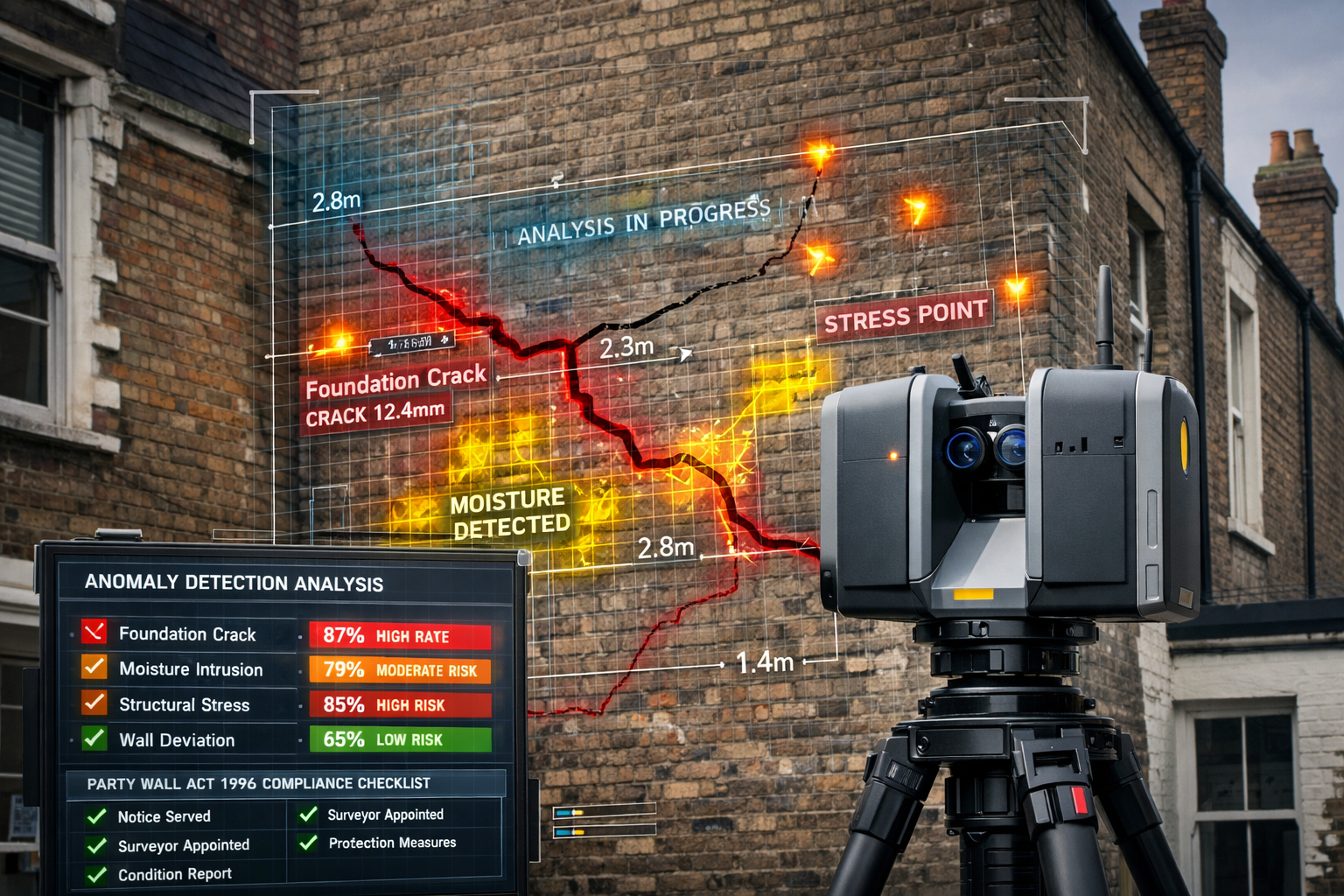
Property owners and surveyors across London are discovering a powerful advantage in 2026: artificial intelligence that spots hidden structural problems before the first party wall notice is even drafted. AI-driven anomaly detection in party wall surveys: flagging risks before notices are served represents a fundamental shift in how professionals approach the Party Wall etc. Act 1996, transforming reactive dispute resolution into proactive risk management. Instead of waiting for cracks to appear or disputes to escalate, cutting-edge AI systems now automatically classify scan data, identify foundation weaknesses, and flag boundary encroachments within hours—giving surveyors the predictive edge needed to secure compliant agreements before construction begins. 🏗️
Key Takeaways
- AI automation classifies 3D scan data and thermal imaging to detect foundation cracks, moisture intrusion, and structural anomalies in party walls up to 95% faster than manual inspections
- Predictive risk assessment identifies potential disputes before serving party wall notices, enabling proactive neighbour agreements and reduced conflict
- Boundary encroachment detection uses machine learning to automatically flag property line violations and measurement discrepancies with millimeter precision
- Act-compliant documentation generates comprehensive schedules of condition and evidence packages that meet Party Wall Act 1996 requirements
- Cost and time savings reduce survey duration by 60-70% while improving accuracy and defensibility in potential disputes
Understanding AI-Driven Anomaly Detection in Party Wall Surveys
What Is Anomaly Detection in the Party Wall Context?
Anomaly detection refers to the automated identification of unusual patterns, defects, or irregularities that deviate from expected norms. In party wall surveying, this means AI algorithms analyze building data—from laser scans to thermal images—to automatically flag structural issues, boundary discrepancies, or pre-existing damage that could affect types of party wall works or lead to neighbour disputes.
Traditional party wall surveys rely heavily on manual inspection, where surveyors visually assess walls, measure dimensions, and photograph conditions. This process is time-consuming and subject to human oversight. AI-driven systems, by contrast, process millions of data points simultaneously, comparing current conditions against baseline models and historical datasets to identify even subtle anomalies that might escape the naked eye.
How AI Technology Works in Property Surveying
Modern AI-driven anomaly detection in party wall surveys combines several advanced technologies:
| Technology | Function | Party Wall Application |
|---|---|---|
| 3D Laser Scanning | Captures precise spatial data | Creates detailed baseline models of party walls and adjoining structures |
| Machine Learning | Identifies patterns and anomalies | Classifies crack types, predicts structural risks, flags measurement inconsistencies |
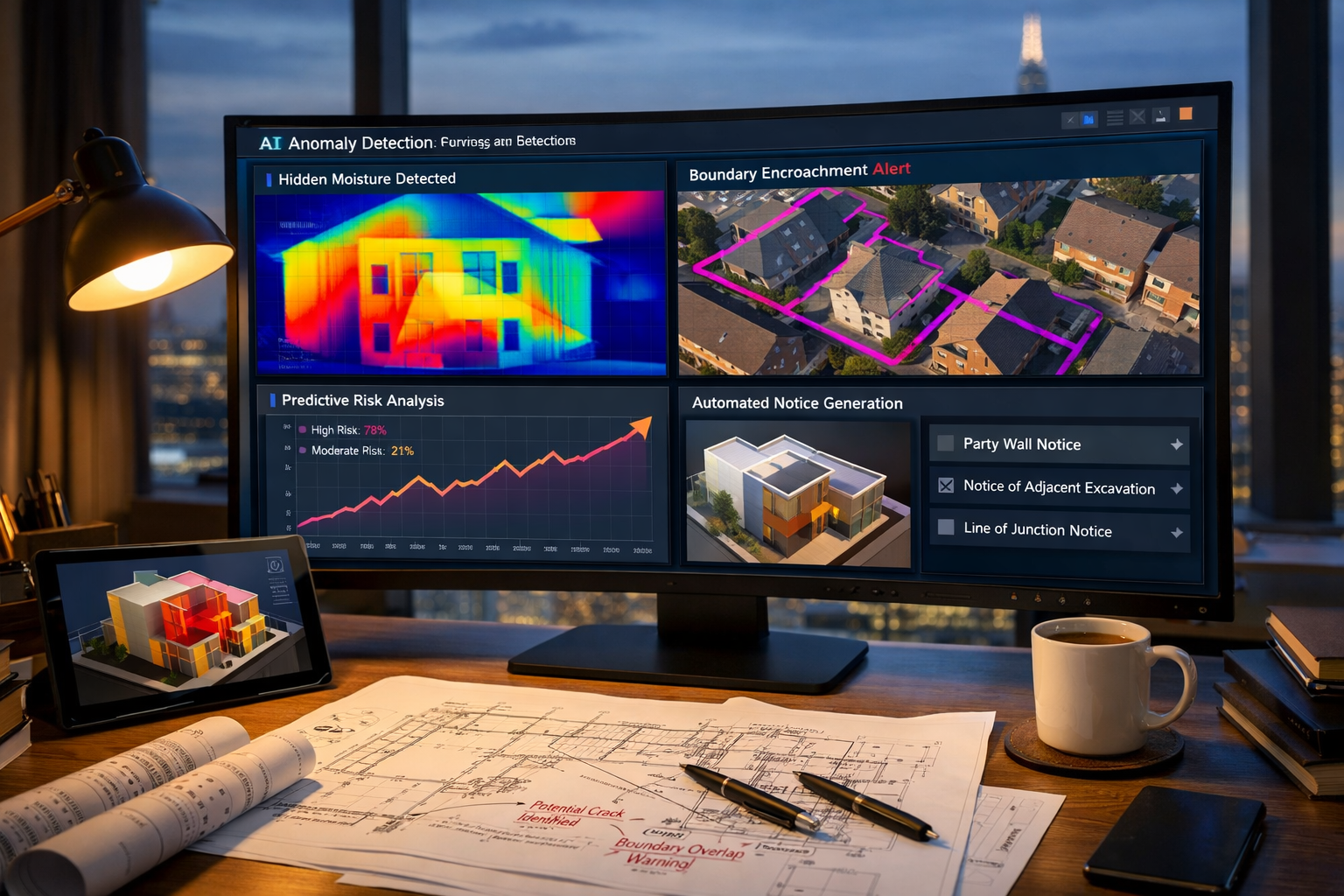
| Thermal Imaging | Detects temperature variations | Reveals hidden moisture intrusion, insulation gaps, and structural voids |
| Computer Vision | Analyzes visual data | Automatically identifies surface defects, material degradation, and boundary markers |
| Neural Networks | Processes complex datasets | Correlates multiple data sources to assess overall risk and compliance status |
According to recent industry developments, AI-driven precision in property surveying is revolutionizing workflows by automating terrain classification and anomaly detection [1]. These systems can process survey data in hours rather than days, dramatically accelerating the timeline from initial assessment to notice preparation.
The Traditional Party Wall Survey Challenge
Before AI integration, party wall surveyors faced several persistent challenges:
- Time-intensive manual inspections requiring multiple site visits
- Subjective assessments vulnerable to individual interpretation differences
- Delayed risk identification often discovering issues only after work commenced
- Documentation gaps with incomplete photographic or measurement records
- Reactive dispute management addressing problems after they escalated
These limitations frequently resulted in delayed projects, unexpected costs, and strained neighbour relations. The Party Wall etc. Act 1996 requires thorough documentation and fair treatment of all parties, but traditional methods sometimes struggled to provide the comprehensive evidence needed to prevent disputes or support party wall awards.
How AI-Driven Anomaly Detection in Party Wall Surveys Flags Risks Before Notices Are Served
Automated Foundation and Structural Risk Assessment
One of the most valuable applications of AI-driven anomaly detection in party wall surveys is the early identification of foundation issues and structural weaknesses. AI algorithms analyze 3D point cloud data from laser scans to detect:
- Subsidence indicators: Subtle wall tilts or settlement patterns measuring fractions of a degree
- Foundation cracks: Hairline fissures that might widen during excavation or construction
- Load-bearing concerns: Structural elements showing stress indicators or material fatigue
- Historical movement: Comparison with historical survey data to identify progressive deterioration
This capability proves especially critical when planning basement excavations, loft conversions, or extensions that might affect the party wall's structural integrity. By identifying these risks before serving a party structure notice, surveyors can recommend appropriate mitigation measures, adjust construction methods, or facilitate early discussions with adjoining owners about necessary protections.
Boundary Encroachment and Measurement Precision
Property boundary disputes represent a significant source of party wall conflicts. AI systems equipped with computer vision and geospatial analysis can:
✅ Cross-reference title plans with actual site measurements to identify discrepancies
✅ Detect encroachments where structures, foundations, or drainage extend beyond legal boundaries
✅ Verify party wall positioning confirming whether walls sit centrally on the boundary line
✅ Identify fence and wall ownership using historical data and construction characteristics
For property owners in dense urban areas like Central London or East London, where properties share multiple boundaries and space is at a premium, this precision prevents costly legal disputes and project delays.
Pre-Existing Condition Documentation
The schedule of condition serves as crucial evidence protecting both building owners and adjoining owners from unfair damage claims. AI-enhanced documentation provides:
- Comprehensive visual records with automated defect cataloging
- Timestamped evidence with metadata proving pre-construction conditions
- Severity classification ranking defects by risk level and repair urgency
- Comparative analysis enabling post-construction verification of new versus existing damage
This thorough documentation proves invaluable if disputes arise during or after construction. Rather than relying on memory or limited photographs, parties have detailed, algorithmically-verified evidence of pre-existing conditions.
Predictive Risk Modeling for Proactive Agreements
Perhaps the most transformative aspect of AI-driven anomaly detection in party wall surveys is its predictive capability. By analyzing patterns across thousands of previous projects, AI systems can forecast:
🔮 Dispute probability: Likelihood of neighbour objections based on work type and detected conditions
🔮 Damage risk: Probability that planned works will cause structural issues
🔮 Cost implications: Estimated expenses for protective measures or potential remediation
🔮 Timeline impacts: Expected delays from identified complications
This predictive intelligence enables surveyors to facilitate proactive discussions between building owners and adjoining owners, often reaching mutually acceptable agreements before formal notices are required. In some cases, this foresight allows parties to modify plans, implement additional protections, or establish clear expectations that prevent conflicts entirely.
Implementing AI-Driven Anomaly Detection: Practical Benefits for Surveyors and Property Owners
Accelerated Survey Timelines
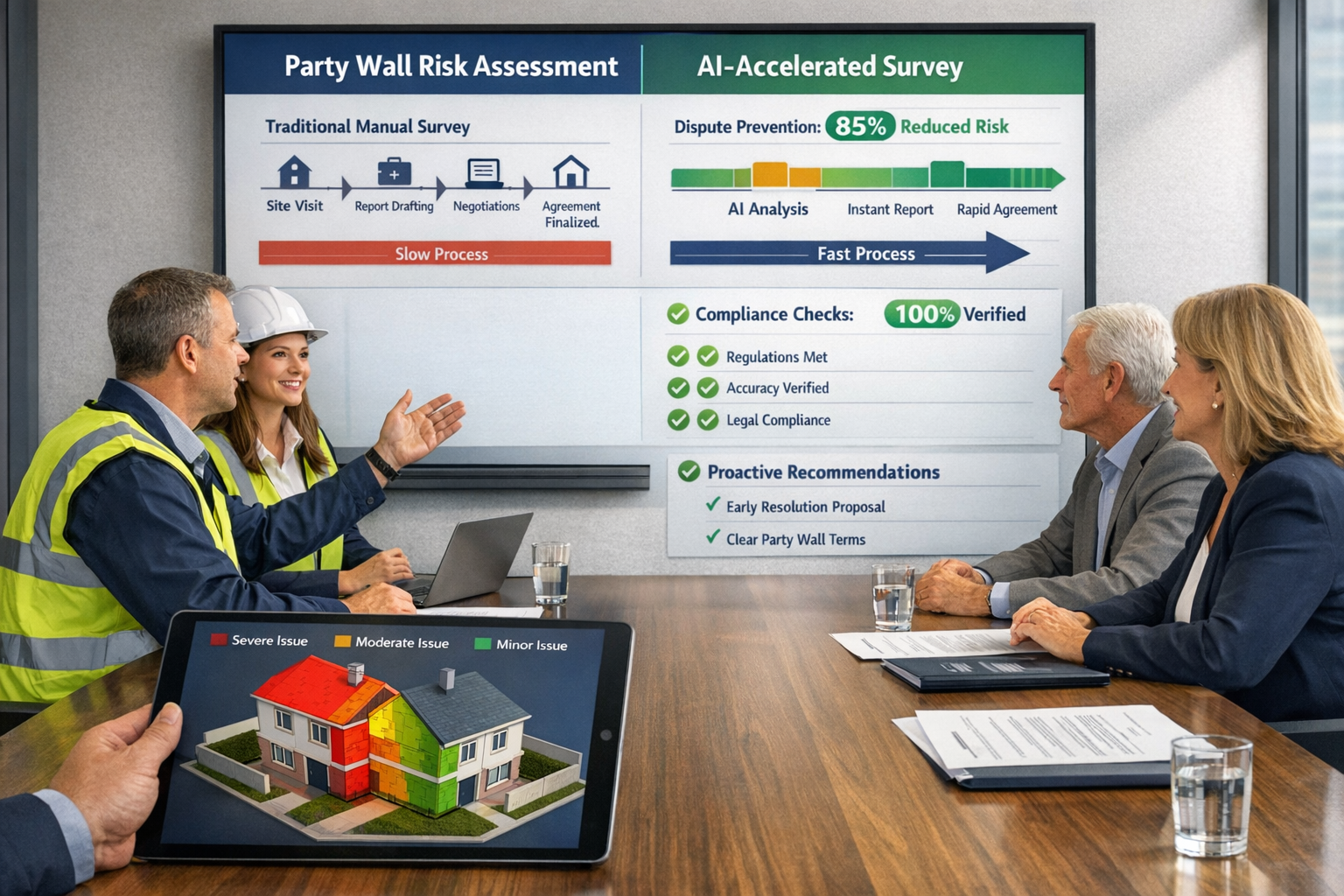
Traditional party wall surveys typically require 5-10 working days from initial inspection to report delivery. AI-driven systems reduce this timeline to 1-3 days by:
- Automating data capture through rapid 3D scanning (30-60 minutes per property)
- Instant processing of scan data with real-time anomaly flagging
- Automated report generation producing Act-compliant documentation with minimal manual input
- Simultaneous multi-property analysis assessing building owner and multiple adjoining properties concurrently
For property developers managing tight construction schedules, this acceleration means earlier notice service, faster agreement negotiation, and reduced project delays. The speed advantage proves particularly valuable in North London and South London areas where high-density development creates complex multi-party scenarios.
Enhanced Accuracy and Defensibility
AI systems eliminate common sources of human error while providing mathematically verifiable measurements. This enhanced accuracy offers:
- Millimeter-precision measurements far exceeding manual tape measure accuracy
- Complete spatial coverage capturing every surface without blind spots
- Objective classification removing subjective interpretation from defect assessment
- Audit trails documenting every data point and analytical decision
When disputes escalate to formal proceedings or legal challenges, this level of precision and documentation proves invaluable. Surveyors can demonstrate compliance with professional standards and Act requirements with comprehensive, algorithmically-verified evidence.
Cost Management and Transparency
Understanding costs of party wall procedures remains a primary concern for property owners. AI-driven surveys contribute to cost control through:
💰 Reduced survey fees from decreased labor hours and site visit requirements
💰 Early risk identification preventing expensive mid-project discoveries
💰 Dispute prevention avoiding costly legal proceedings and project delays
💰 Accurate cost forecasting providing reliable estimates for protective works and remediation
Property owners seeking to keep party wall costs down benefit from the efficiency gains and dispute prevention that AI detection provides. The technology also enables more competitive pricing from surveying firms that can complete assessments faster without sacrificing quality.
Improved Neighbour Relations and Consent Rates
When building owners serve notices backed by comprehensive AI-generated evidence, adjoining owners gain confidence in the thoroughness and objectivity of the assessment. This transparency typically results in:
- Higher consent rates as neighbours trust the technical rigor of the survey
- Faster agreement timelines with clear evidence reducing negotiation friction
- Reduced adversarial dynamics as both parties work from the same objective data
- Better long-term relationships preserving community harmony beyond the construction period
For adjoining owners receiving notices, AI-generated documentation provides reassurance that their interests are protected by thorough, impartial analysis rather than potentially biased manual assessments.
Compliance with the Party Wall etc. Act 1996
AI-driven anomaly detection enhances rather than replaces the statutory requirements of the Party Wall etc. Act 1996. The technology supports compliance by:
Comprehensive Documentation: AI systems automatically generate the detailed records required for schedules of condition and party wall awards, ensuring nothing is overlooked.
Timely Notice Preparation: Faster survey completion enables building owners to serve notices with appropriate lead time, meeting the Act's notification requirements without rushing.
Impartial Assessment: Algorithmic analysis provides objective evidence that supports fair treatment of all parties, a core principle of the Act.
Professional Standards: AI tools enhance rather than diminish the professional judgment of qualified surveyors, who remain responsible for interpreting results and advising clients.
Whether engaging a building owner's surveyor or an adjoining owner's surveyor, parties can expect AI-enhanced surveys to meet or exceed all statutory and professional requirements while providing superior risk identification and documentation.
Challenges and Considerations
Technology Adoption and Training
While AI-driven anomaly detection offers substantial benefits, successful implementation requires:
- Initial investment in scanning equipment and software licenses
- Professional training for surveyors to operate systems and interpret results
- Quality assurance protocols ensuring AI outputs meet professional standards
- Client education helping property owners understand and trust AI-generated findings
Surveying firms across West London and other areas are gradually integrating these technologies, with early adopters gaining competitive advantages through faster turnaround and enhanced service quality.
Data Privacy and Security
AI systems process detailed property information, raising important considerations around:
- Data protection compliance with UK GDPR and privacy regulations
- Secure storage of sensitive property and structural information
- Client consent for data collection and processing
- Third-party access controlling who can view detailed property scans
Reputable surveying firms implement robust data security protocols, ensuring client information remains confidential while benefiting from AI analysis capabilities.
Professional Judgment Remains Essential
AI-driven anomaly detection augments but does not replace professional surveyor expertise. Qualified surveyors must:
- Interpret AI findings within the context of property history and local conditions
- Apply regulatory knowledge ensuring compliance with building regulations and planning requirements
- Facilitate negotiations between parties with interpersonal skills AI cannot replicate
- Exercise professional judgment on complex or ambiguous situations
The technology serves as a powerful tool that enhances surveyor capabilities rather than eliminating the need for experienced professionals.
Future Developments in AI-Driven Party Wall Surveying
As we progress through 2026, several emerging trends promise to further enhance AI-driven anomaly detection in party wall surveys:
Integration with Building Information Modeling (BIM): AI systems will increasingly connect with BIM platforms, enabling real-time updates to digital building models as construction progresses and conditions change.
Predictive Maintenance Alerts: Beyond initial surveys, AI will monitor party walls over time, alerting property owners to developing issues before they require major intervention.
Automated Dispute Resolution Support: Advanced AI systems may assist in mediating disputes by analyzing comparable cases and suggesting fair resolution frameworks based on precedent and Act requirements.
Enhanced Boundary Verification: Integration with Land Registry data and historical mapping will provide even more precise boundary determination and ownership verification.
Mobile AI Applications: Smartphone-based AI analysis tools will enable preliminary assessments and instant risk flagging during initial site visits, further accelerating the survey process.
These developments will continue the trajectory toward faster, more accurate, and more cost-effective party wall surveying that benefits all stakeholders in the construction process.
Conclusion
AI-driven anomaly detection in party wall surveys: flagging risks before notices are served represents a paradigm shift in how property professionals approach the Party Wall etc. Act 1996. By automatically classifying scan data, identifying structural vulnerabilities, detecting boundary encroachments, and predicting dispute risks, AI technology transforms party wall surveying from reactive problem-solving to proactive risk management. Property owners gain faster, more accurate assessments at lower costs, while neighbours benefit from transparent, objective documentation that builds trust and facilitates agreement.
For surveyors, AI tools enhance professional capabilities, enabling more comprehensive analysis in less time while maintaining the highest standards of accuracy and compliance. The technology doesn't replace human expertise—it amplifies it, freeing professionals to focus on interpretation, negotiation, and client service while algorithms handle data processing and pattern recognition.
Next Steps for Property Owners and Surveyors
If you're planning construction work affecting a party wall, consider engaging a surveyor who utilizes AI-driven anomaly detection. Request information about their technology capabilities and how AI analysis will benefit your project timeline and cost management.
If you're receiving a party wall notice as an adjoining owner, ask whether AI surveying technology was used in the assessment. AI-generated documentation typically provides more comprehensive protection of your interests through thorough condition recording.
For surveying professionals, investigate AI platforms and training opportunities to remain competitive in 2026's evolving market. Early adoption provides significant advantages in service quality, client satisfaction, and operational efficiency.
Ready to experience the benefits of cutting-edge party wall surveying? Contact us to discuss how AI-driven anomaly detection can protect your property interests and streamline your construction project. Whether you need assistance with party wall notices, comprehensive surveys, or dispute resolution, our team combines advanced technology with deep professional expertise to deliver superior outcomes for building owners and adjoining owners throughout London.
References
[1] Ai Driven Precision In Property Surveying Revolutionizing Workflows In 2026 – https://nottinghillsurveyors.com/blog/ai-driven-precision-in-property-surveying-revolutionizing-workflows-in-2026