

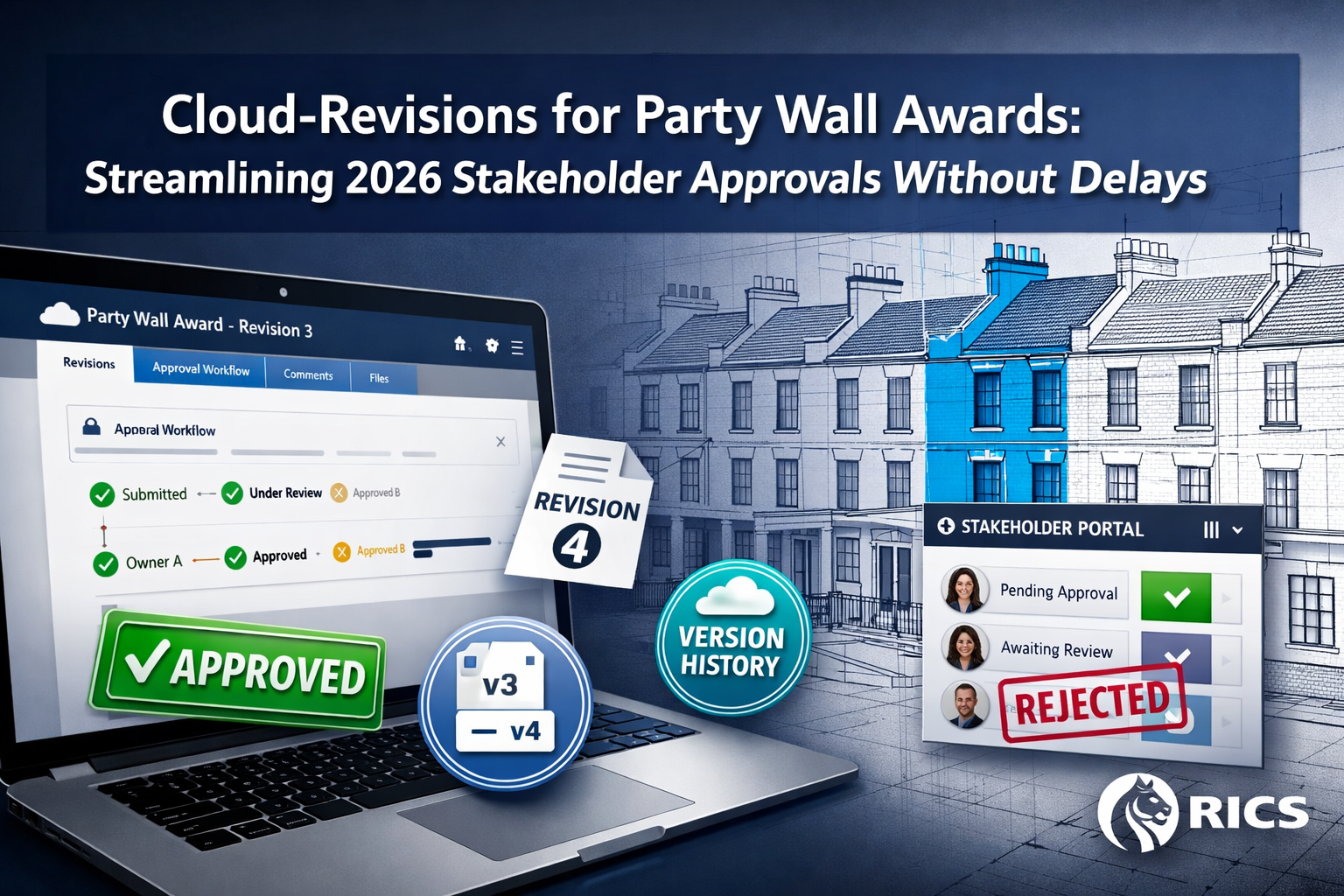
When a London property developer recently needed to revise a complex party wall award three times due to changing structural requirements, the project team feared weeks of postal delays and frustrated neighbors. Instead, cloud-based revision management delivered all approvals within 48 hours. This scenario illustrates how Cloud-Revisions for Party Wall Awards: Streamlining 2026 Stakeholder Approvals Without Delays is transforming construction projects across the UK, particularly as labor shortages and urban density create unprecedented pressure on traditional processes.
In 2026, the construction industry faces a critical challenge: party wall procedures that were designed for paper-based communication now struggle to keep pace with modern development timelines. Cloud platforms enable instant award revisions with version control and neighbor portals, cutting resolution times amid labor shortages while maintaining RICS alignment for complex urban boundary works. This technological shift represents more than simple digitization—it fundamentally reimagines how building owners, adjoining owners, and surveyors collaborate on party wall awards.
Key Takeaways
- ⚡ Cloud platforms reduce party wall award revision cycles by 60-70% through real-time collaboration and instant stakeholder notifications
- 🔒 Version control and audit trails ensure RICS compliance while eliminating confusion over which award version is current
- 👥 Neighbor portals democratize access, allowing adjoining owners to review and approve revisions without surveyor intermediaries for simple changes
- 📱 Mobile-first design addresses 2026 labor shortages by enabling surveyors to manage multiple projects remotely with full documentation access
- ✅ Automated compliance checking flags potential Party Wall Act violations before awards are finalized, reducing disputes and legal challenges
Understanding Party Wall Awards and the Revision Challenge
What Are Party Wall Awards?
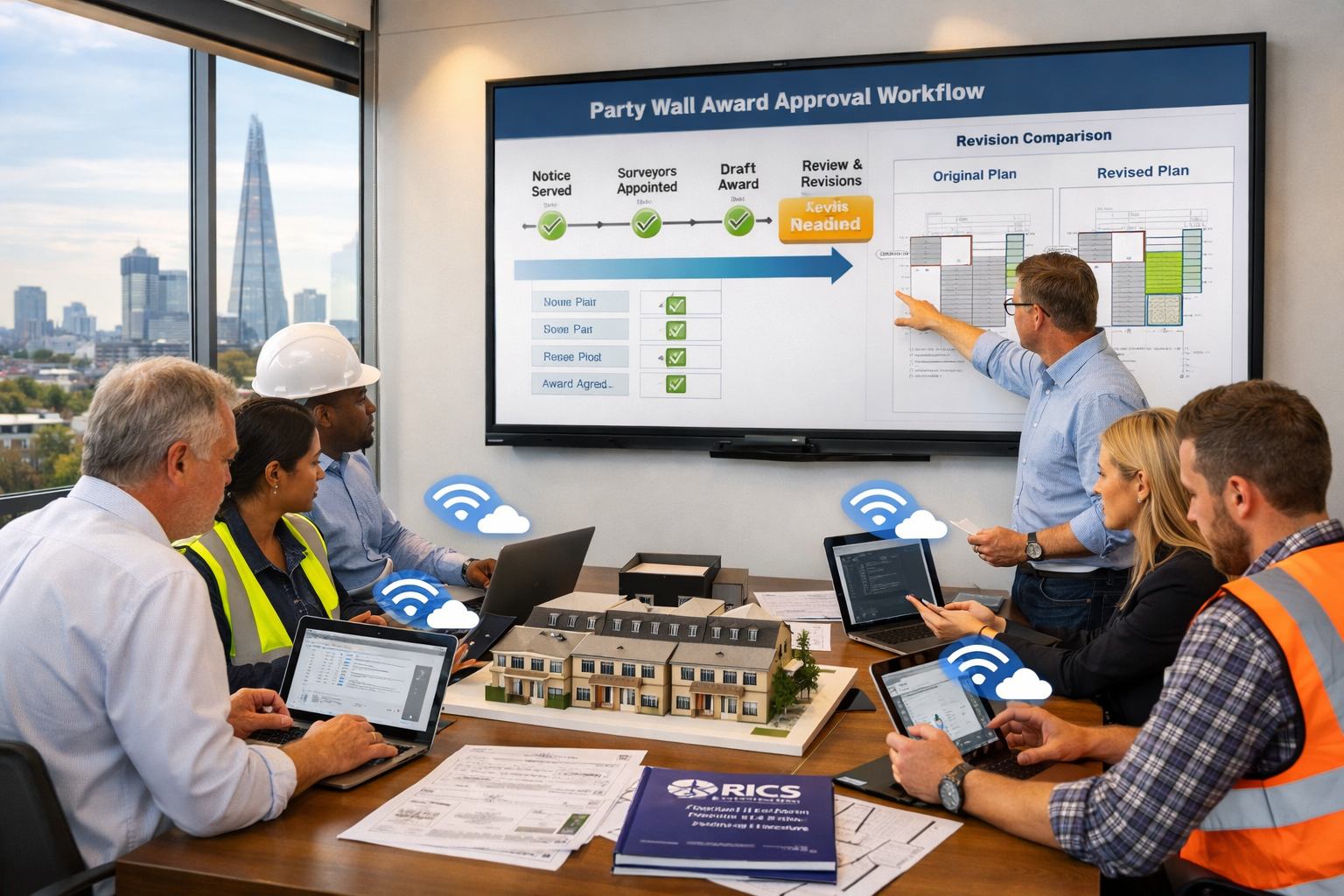
A party wall award is a legally binding document issued by surveyors under the Party Wall etc. Act 1996. This document outlines the rights and responsibilities of both building owners and adjoining owners when construction work affects shared structures. The party wall contract template typically includes:
- Scope of permitted works on the party wall or structure
- Schedule of condition documenting pre-work property status
- Working hours and access arrangements
- Cost allocation and payment terms
- Dispute resolution procedures
Awards must be precise, comprehensive, and agreed upon by all parties. Even minor errors or changing project requirements necessitate formal revisions—a process that traditionally involved printing, signing, posting, and waiting for responses from multiple stakeholders.
Why Revisions Are Inevitable in 2026 Projects
Modern construction projects encounter revision triggers that earlier generations rarely faced:
Design Evolution 🏗️
Architects frequently adjust structural plans based on engineering assessments, building control feedback, or client preferences discovered during construction.
Regulatory Updates
Building regulations continue evolving, particularly around fire safety and structural integrity following high-profile incidents. Projects spanning several months may need award updates to reflect new requirements.
Discovery of Unexpected Conditions
Hidden structural issues, asbestos, or archaeological finds can necessitate significant work scope changes that require formal award amendments.
Stakeholder Changes
Property sales, inheritance, or corporate restructuring can introduce new parties who require documentation updates and fresh approvals.
Traditional paper-based revision processes create cascading delays. A single revision cycle might require:
- Surveyor drafts revised award (1-2 days)
- Postal delivery to building owner (1-3 days)
- Building owner review and signature (2-5 days)
- Return post to surveyor (1-3 days)
- Surveyor forwards to adjoining owner (1-3 days)
- Adjoining owner review and approval (3-7 days)
- Return delivery to surveyor (1-3 days)
Total timeline: 10-26 days per revision cycle ⏰
For projects requiring multiple revisions, these delays compound exponentially, pushing construction schedules back by months and inflating costs of party wall processes.
Cloud-Revisions for Party Wall Awards: Streamlining 2026 Stakeholder Approvals Without Delays Through Digital Transformation
Core Features of Cloud-Based Party Wall Management
Modern cloud platforms designed specifically for party wall procedures integrate several critical capabilities:
1. Real-Time Document Collaboration
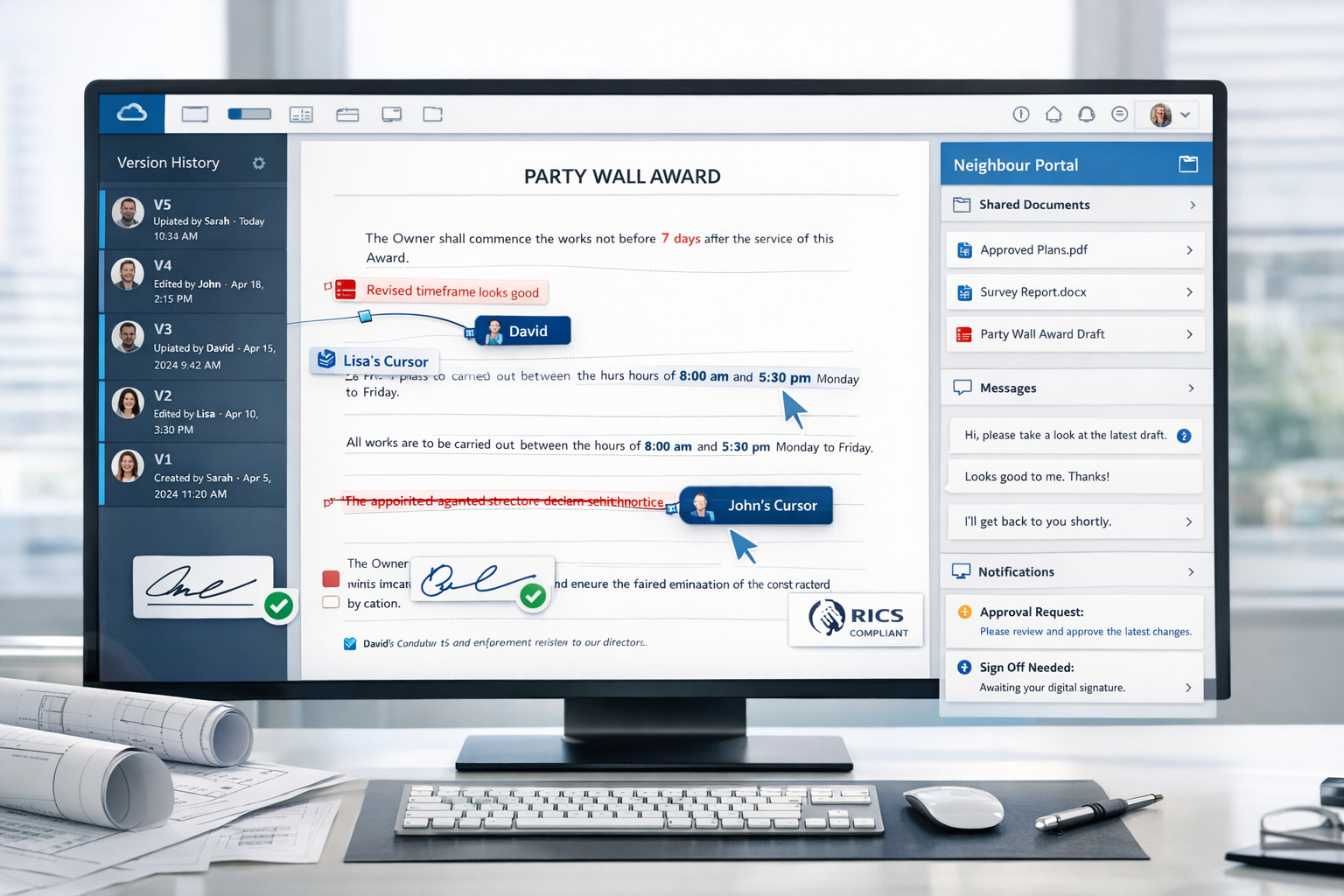
Cloud systems allow surveyors to create and edit awards while stakeholders view changes instantly. Track-changes functionality highlights exactly what has been modified between versions, eliminating confusion and building trust among parties who can see precisely what they're approving.
2. Automated Notification Workflows
When a surveyor uploads a revised award, the platform automatically:
- Sends email and SMS notifications to all relevant parties
- Creates dashboard alerts visible upon login
- Sets reminder schedules for pending approvals
- Escalates to backup contacts if primary stakeholders don't respond within set timeframes
This automation ensures no revision request gets lost in email inboxes or postal systems.
3. Secure Stakeholder Portals
Each party receives personalized portal access where they can:
- View current and historical award versions
- Compare revisions side-by-side
- Add comments or questions directly on specific clauses
- Provide digital signatures with full legal validity
- Access supporting documents like schedules of condition or structural drawings
These portals are particularly valuable for adjoining owners who previously felt disconnected from the process and dependent on surveyor intermediaries for basic information.
4. Version Control and Audit Trails
Cloud platforms maintain complete version histories showing:
- Who made each change and when
- What specific text was added, deleted, or modified
- Who approved each version and at what time
- Any comments or objections raised during review
This creates an immutable audit trail that proves invaluable if disputes arise later or if parties need to demonstrate RICS compliance during legal proceedings.
5. Mobile Accessibility
With surveyors managing multiple projects simultaneously—often while conducting site inspections—mobile apps ensure they can:
- Review and approve urgent revisions from any location
- Upload site photos directly to award documentation
- Respond to stakeholder queries in real-time
- Access complete project histories without returning to the office
This mobility addresses 2026's acute surveyor shortage by dramatically increasing individual productivity.
RICS Alignment and Legal Validity
The Royal Institution of Chartered Surveyors (RICS) provides professional standards for party wall surveyors. Cloud-based systems maintain compliance through:
Digital Signature Standards
Platforms use qualified electronic signatures that meet UK Electronic Communications Act 2000 requirements, ensuring cloud-executed awards carry the same legal weight as paper documents with wet signatures.
Data Protection Compliance
GDPR-compliant encryption and access controls protect sensitive property and personal information while maintaining the transparency required by the Party Wall Act.
Professional Practice Standards
Cloud systems incorporate RICS guidance on award content, ensuring templates and checklists help surveyors create comprehensive documents that meet professional standards.
Many platforms now feature RICS compliance checking that automatically flags potential issues before awards are finalized—such as missing clauses, unclear cost allocations, or inadequate condition schedules.
Implementing Cloud-Revisions for Party Wall Awards: Streamlining 2026 Stakeholder Approvals Without Delays in Your Practice
Selecting the Right Platform
Not all cloud collaboration tools suit party wall work. When evaluating platforms, prioritize:
| Feature | Why It Matters | Questions to Ask |
|---|---|---|
| Construction-Specific Design | Generic document platforms lack party wall terminology and workflows | Does the platform understand party wall notices and award structures? |
| Offline Capability | Site inspections often occur in areas with poor connectivity | Can surveyors access documents and make notes without internet? |
| Integration with Existing Tools | Surveyors use CAD, scheduling, and accounting software | Does the platform connect with AutoCAD, Xero, or other industry tools? |
| Scalability | Practices grow and take on larger projects | Can the platform handle 50+ stakeholders on complex developments? |
| Support and Training | Technology adoption requires ongoing assistance | Does the vendor provide dedicated construction industry support? |
| Cost Structure | Pricing must align with project economics | Is pricing per-project, per-user, or subscription-based? |
Onboarding Stakeholders Successfully
The most sophisticated platform fails if stakeholders resist adoption. Successful implementation requires:
Building Owner Education 🏠
Many building owners initially worry about technology complexity. Provide:
- Short video tutorials (2-3 minutes) showing the exact steps they'll take
- Written quick-start guides with screenshots
- Assurance that phone support is available if they encounter difficulties
- Emphasis on how the platform saves them time and money
Adjoining Owner Reassurance
Neighbors often approach party wall matters with suspicion. Address concerns by:
- Explaining that the platform gives them more visibility and control
- Demonstrating how they can review documents at their convenience rather than scheduling meetings
- Highlighting the audit trail that protects their interests
- Offering alternative access methods (phone-based approval) for those uncomfortable with technology
Surveyor Collaboration
When multiple surveyors work on a project (building owner's surveyor and adjoining owner's surveyor), establish:
- Clear protocols for who can edit which document sections
- Notification preferences to avoid alert fatigue
- Regular check-in schedules to discuss complex revisions
- Shared templates that maintain consistency
Best Practices for Cloud-Based Award Revisions
Maintain Clear Version Naming
Even with automated version control, use descriptive names:
- ❌ "Award_v3.pdf"
- ✅ "Award_Rev2_FoundationDepthChange_2026-03-15.pdf"
This helps stakeholders quickly understand what changed without reading entire documents.
Use Comments for Context
When making revisions, add explanatory comments:
"Foundation depth increased from 2.1m to 2.8m based on structural engineer's soil analysis report (attached). This change does not affect the party wall itself but requires updated underpinning methodology."
Context reduces stakeholder anxiety and prevents unnecessary questions.
Set Realistic Response Deadlines
Cloud speed doesn't eliminate the need for thoughtful review. Give stakeholders:
- Simple revisions (typo corrections, date changes): 2-3 days
- Moderate revisions (work scope adjustments): 5-7 days
- Significant revisions (major design changes): 10-14 days
Rushed approvals lead to disputes when stakeholders later claim they didn't fully understand what they approved.
Leverage Analytics
Modern platforms track engagement metrics:
- Who has viewed the document
- How long they spent reviewing it
- Which sections they focused on
- Whether they downloaded supporting materials
These insights help surveyors identify stakeholders who may need additional explanation before they'll approve.
Addressing Common Implementation Challenges
Challenge: Older Stakeholders Uncomfortable with Technology
Solution: Offer hybrid approaches where the surveyor can conduct screen-sharing sessions, walking stakeholders through the platform while on a phone call. Some platforms also allow approval via simple email reply or SMS code entry.
Challenge: Security Concerns About Cloud Storage
Solution: Explain that modern cloud platforms use bank-level encryption and are typically more secure than email attachments or physical documents that can be lost. Emphasize compliance certifications (ISO 27001, Cyber Essentials Plus).
Challenge: Internet Connectivity Issues During Site Inspections
Solution: Use platforms with robust offline modes that sync changes once connectivity is restored. Download key documents before traveling to sites with known connectivity problems.
Challenge: Resistance from Surveyors Accustomed to Traditional Methods
Solution: Start with a pilot project rather than forcing practice-wide adoption. Let early adopters demonstrate time savings and reduced administrative burden. Highlight how cloud platforms handle tedious tasks (version tracking, notification sending) so surveyors can focus on professional judgment.
Measuring Success: ROI of Cloud-Revisions for Party Wall Awards
Quantifiable Benefits
Organizations implementing cloud-based party wall management report:
Time Savings ⏱️
- Average revision cycle reduction: 60-75%
- Traditional timeline: 10-26 days per cycle
- Cloud timeline: 2-7 days per cycle
- Multi-revision projects: Savings compound (3 revisions = 24-57 days saved)
Cost Reductions 💰
- Postage and printing: £50-150 per project eliminated
- Administrative time: 3-5 hours per project reduced
- Delay-related costs: Construction holding costs (equipment rental, site security) reduced by earlier approvals
- Dispute resolution: Clearer documentation reduces costly legal proceedings
Productivity Gains 📈
- Projects per surveyor: 15-25% increase in capacity
- Response time: Stakeholder queries answered 3x faster
- Error reduction: Template-driven processes reduce award mistakes by 40-60%
Qualitative Improvements
Beyond numbers, practices report:
Enhanced Client Satisfaction
Building owners appreciate transparency and speed. They can monitor progress without constant phone calls to surveyors, and they complete projects faster.
Improved Neighbor Relations
Adjoining owners feel more respected when they have direct access to information rather than feeling like passive recipients of decisions. This reduces adversarial dynamics that can escalate into disputes.
Professional Reputation
Surveyors who adopt modern tools position themselves as forward-thinking professionals, attracting clients who value efficiency and transparency.
Reduced Stress
Automated reminders and notifications mean surveyors no longer worry about missed deadlines or lost documents. The mental load of tracking multiple projects decreases significantly.
The Future: AI and Automation in Party Wall Procedures
As cloud platforms mature, artificial intelligence is beginning to augment human expertise:
Automated Award Drafting 🤖
AI systems trained on thousands of party wall awards can generate first drafts based on project parameters, which surveyors then review and customize. This reduces drafting time from hours to minutes.
Predictive Dispute Analysis
Machine learning algorithms analyze award language and stakeholder communication patterns to flag potential disputes before they escalate, allowing proactive intervention.
Smart Scheduling
AI coordinates optimal inspection times by analyzing stakeholder calendars, weather forecasts, and project dependencies, automatically proposing times that work for all parties.
Natural Language Processing
Stakeholders can ask questions in plain English ("What happens if we find asbestos?") and receive instant answers extracted from award documents and relevant legislation.
These technologies won't replace professional judgment—party wall work requires nuanced understanding of construction, law, and human dynamics that AI cannot replicate. However, they will handle routine tasks, allowing surveyors to focus on complex problem-solving and relationship management.
Regional Considerations for London Practitioners
London's unique property landscape creates specific challenges where cloud revisions provide particular value:
High-Density Terraced Housing
Areas like South London, North London, and East London feature Victorian terraces where single projects may affect 4-6 adjoining properties. Cloud platforms excel at managing these multi-stakeholder scenarios where coordinating paper-based approvals becomes exponentially complex.
International Property Owners
Central London and West London properties are frequently owned by overseas investors. Cloud platforms eliminate international postal delays and time zone challenges, allowing owners in Singapore or New York to review and approve awards instantly.
Heritage and Conservation Areas
Projects in protected areas require frequent revisions as conservation officers request modifications. Cloud systems' ability to quickly circulate revised awards and track approval status prevents these projects from grinding to a halt.
Basement Excavations
London's basement boom creates complex party wall scenarios requiring detailed types of party wall works documentation. When ground conditions necessitate design changes, cloud platforms ensure all affected neighbors receive updated information simultaneously.
Legal and Regulatory Compliance in 2026
Party Wall Act Requirements
The Party Wall etc. Act 1996 doesn't prescribe specific documentation formats, allowing cloud-based awards provided they meet statutory requirements:
- Proper service of notices
- Appointment of surveyors
- Award content covering all necessary provisions
- Proper execution (signatures)
Cloud platforms must ensure these elements remain intact. Digital service of notices is permissible if recipients consent, though many practitioners still serve initial notices by traditional methods and use cloud platforms for subsequent award development and revisions.
Data Protection and Privacy
Party wall documentation contains sensitive information:
- Property valuations
- Financial arrangements
- Personal contact details
- Structural vulnerabilities
Cloud platforms must implement:
- End-to-end encryption for data in transit and at rest
- Role-based access controls ensuring parties only see relevant information
- Data retention policies complying with GDPR requirements
- Right to erasure allowing stakeholders to request data deletion after project completion
Surveyors remain data controllers under GDPR and must ensure their chosen platforms meet all regulatory requirements.
Professional Indemnity Insurance
Some professional indemnity insurers initially hesitated to cover cloud-based party wall work. By 2026, most insurers recognize that properly implemented cloud systems actually reduce risk through better documentation and audit trails. However, surveyors should:
- Notify insurers about technology adoption
- Confirm coverage extends to digital processes
- Maintain evidence of platform security certifications
- Document training and competency in cloud tools
Case Study: Complex Multi-Property Development
A recent West London development illustrates cloud-revision benefits:
Project: Four-story townhouse construction affecting six adjoining properties
Challenge: Initial award required three major revisions due to:
- Building control request for enhanced fire separation
- Discovery of underground utilities requiring foundation redesign
- One adjoining owner's property sale mid-project
Traditional Approach Estimate:
- 3 revision cycles × 15 days average = 45 days
- 6 adjoining owners × 3 revisions = 18 separate approval processes
- Estimated cost: £2,400 in surveyor time + £180 postage
Cloud Platform Results:
- 3 revision cycles completed in 11 days total
- Parallel approval from all six owners
- Actual cost: £720 in surveyor time + £0 postage
- Savings: £1,860 and 34 days
The property sale was handled seamlessly—the new owner received instant access to all historical documentation and current award status, providing approval within 24 hours of completion rather than the typical week-long delay while new owners "got up to speed."
Integration with Broader Construction Technology
Cloud party wall management doesn't exist in isolation. Leading practices integrate with:
Building Information Modeling (BIM)
Awards reference specific BIM elements, with links allowing stakeholders to view 3D models of proposed works rather than interpreting 2D drawings.
Project Management Platforms
Party wall milestones feed into overall construction schedules, automatically updating timelines when approvals are received.
Financial Management Systems
Cost allocations in awards sync with accounting software, streamlining invoicing and payment tracking.
Communication Tools
Platforms integrate with email, SMS, and messaging apps, meeting stakeholders where they already communicate rather than requiring separate logins.
This ecosystem approach creates a seamless experience where party wall procedures become one integrated component of overall project delivery rather than a separate administrative burden.
Conclusion
Cloud-Revisions for Party Wall Awards: Streamlining 2026 Stakeholder Approvals Without Delays represents far more than technological novelty—it addresses fundamental challenges facing construction professionals in an era of labor shortages, complex urban development, and heightened stakeholder expectations. By reducing revision cycles from weeks to days, providing unprecedented transparency, and maintaining rigorous RICS compliance, cloud platforms enable projects to proceed smoothly while building trust among all parties.
The construction industry has historically lagged behind other sectors in digital adoption, but party wall procedures present an ideal opportunity for transformation. The stakes are manageable (individual projects rather than enterprise-wide systems), the benefits are immediate and measurable, and the technology is mature and proven.
Actionable Next Steps
For surveyors and construction professionals ready to embrace cloud-based party wall management:
-
Evaluate Current Pain Points 📋
Track time spent on your next three party wall projects using traditional methods. Document delays, communication breakdowns, and administrative burden to establish a baseline for comparison. -
Research Platform Options 🔍
Request demonstrations from 2-3 construction-focused cloud platforms. Involve team members who will actually use the system in evaluation decisions. -
Start with a Pilot Project 🚀
Select a straightforward project with cooperative stakeholders for initial implementation. This builds confidence and identifies workflow adjustments before tackling complex cases. -
Invest in Training 📚
Allocate time for proper platform training. The most powerful tools deliver limited value if users only understand 20% of capabilities. -
Gather Stakeholder Feedback 💬
After your first cloud-based project, survey building owners and adjoining owners about their experience. Use insights to refine your approach. -
Monitor and Measure 📊
Track key metrics (revision cycle time, stakeholder satisfaction, cost savings) to quantify benefits and justify continued investment. -
Stay Informed 📰
Construction technology evolves rapidly. Follow industry publications and attend professional development sessions focused on digital transformation.
The transition from paper-based to cloud-based party wall procedures requires initial effort, but the long-term benefits—for surveyors, building owners, and adjoining owners alike—make this investment worthwhile. As urban development intensifies and construction timelines compress, practices that embrace these tools will find themselves better positioned to deliver excellent service while managing growing workloads.
For additional guidance on party wall procedures and best practices, explore our comprehensive resources on party wall awards, understanding party wall notices, and keeping party wall costs down. The future of party wall management is here—and it's in the cloud. ☁️