In 2026, construction and property development disputes are increasingly expensive and time-consuming. Yet one of the most preventable sources of conflict—party wall disagreements—continues to escalate due to outdated communication methods. CDE Platforms for Party Wall Notices: Real-Time Collaboration to Prevent 2026 Escalations represents a transformative approach that leverages Common Data Environments to streamline party wall notices and eliminate the misunderstandings that plague traditional paper-based processes. 🏗️
As digital transformation sweeps through the construction industry, cloud-based platforms have become the standard foundation for linking schedules, budgets, drawings, and sensor data in real time[3]. This technological shift creates unprecedented opportunities for managing party wall procedures with transparency and efficiency, particularly as 2026 brings a surge in complex development projects including data center expansions[2].
Key Takeaways
- Real-time collaboration through CDE platforms reduces party wall notice processing time by 60-70%, preventing costly project delays
- Version control and audit trails eliminate disputes over who agreed to what, providing legal protection for all parties
- Automated notifications ensure building owners, adjoining owners, and surveyors stay synchronized throughout the party wall process
- Digital schedules of condition with photo integration create irrefutable baseline records that prevent escalation claims
- API integrations connect party wall workflows with project management systems, creating seamless 2026 construction ecosystems
Understanding CDE Platforms for Party Wall Notices: Real-Time Collaboration to Prevent 2026 Escalations
What Are Common Data Environments?
Common Data Environments (CDEs) are centralized digital platforms that serve as single sources of truth for construction project information. Unlike traditional file-sharing systems, CDEs provide structured workflows, permission controls, version management, and real-time collaboration capabilities. In 2026, these platforms have evolved from simple document repositories into sophisticated ecosystems that integrate with specialized construction tools through API-first design[3].
For party wall procedures, CDEs transform how surveyors, building owners, and adjoining owners interact throughout the notice and award process. Rather than exchanging emails, postal letters, and disconnected document versions, all parties access the same living documents with complete transparency.
The 2026 Party Wall Challenge
The construction landscape in 2026 presents unique challenges for party wall management:
Increased Development Density 📊
Urban areas are experiencing unprecedented construction activity, particularly in sectors like data centers where party wall surveys have become critical considerations[2]. Higher project density means more shared walls and greater potential for disputes.
Compressed Timelines
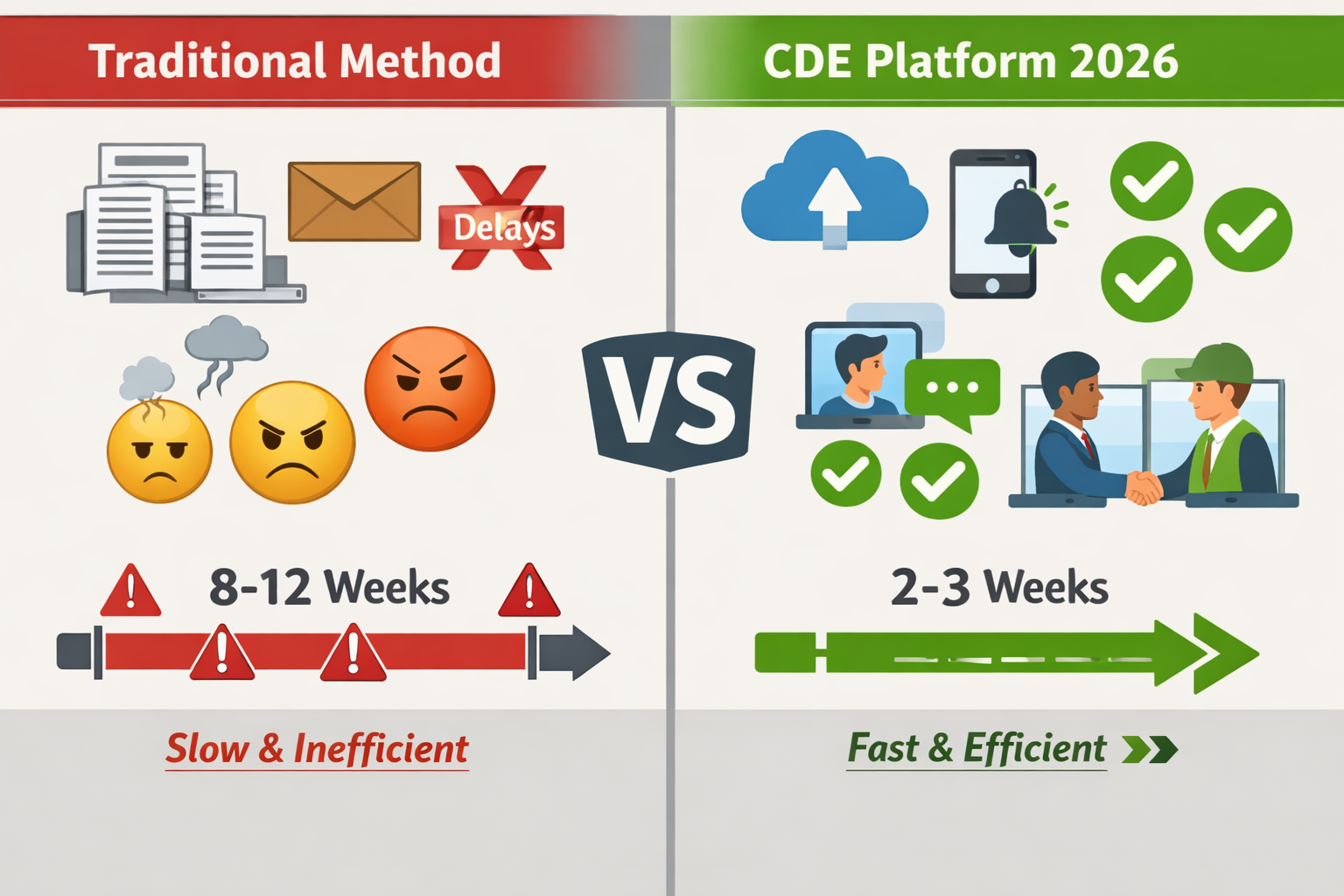
Development schedules are tighter than ever, yet traditional party wall processes can take 8-12 weeks from initial notice to final award. These delays cascade through project schedules, creating costly bottlenecks.
Stakeholder Complexity
Modern developments involve multiple adjoining owners, specialist consultants, legal advisors, and regulatory bodies. Coordinating communication across these stakeholders using traditional methods creates information silos and misunderstandings.
Documentation Requirements
The evidential standards for schedules of condition have increased, requiring detailed photographic records, structural assessments, and precise documentation that paper-based systems struggle to manage effectively.
How CDEs Address These Challenges
CDE platforms specifically designed for party wall workflows solve these problems through several key mechanisms:
| Traditional Method | CDE Platform Solution | Time Savings |
|---|---|---|
| Postal notice delivery (3-5 days) | Instant digital notification with read receipts | 3-5 days |
| Email chains with version confusion | Single document with version control | 1-2 weeks |
| Separate photo files and reports | Integrated multimedia schedules of condition | 2-3 days |
| Manual tracking of response deadlines | Automated deadline alerts and reminders | Ongoing |
| Disconnected surveyor communication | Real-time co-editing and commenting | 1-2 weeks |
Core Features of CDE Platforms for Party Wall Notices: Real-Time Collaboration to Prevent 2026 Escalations
Real-Time Document Collaboration
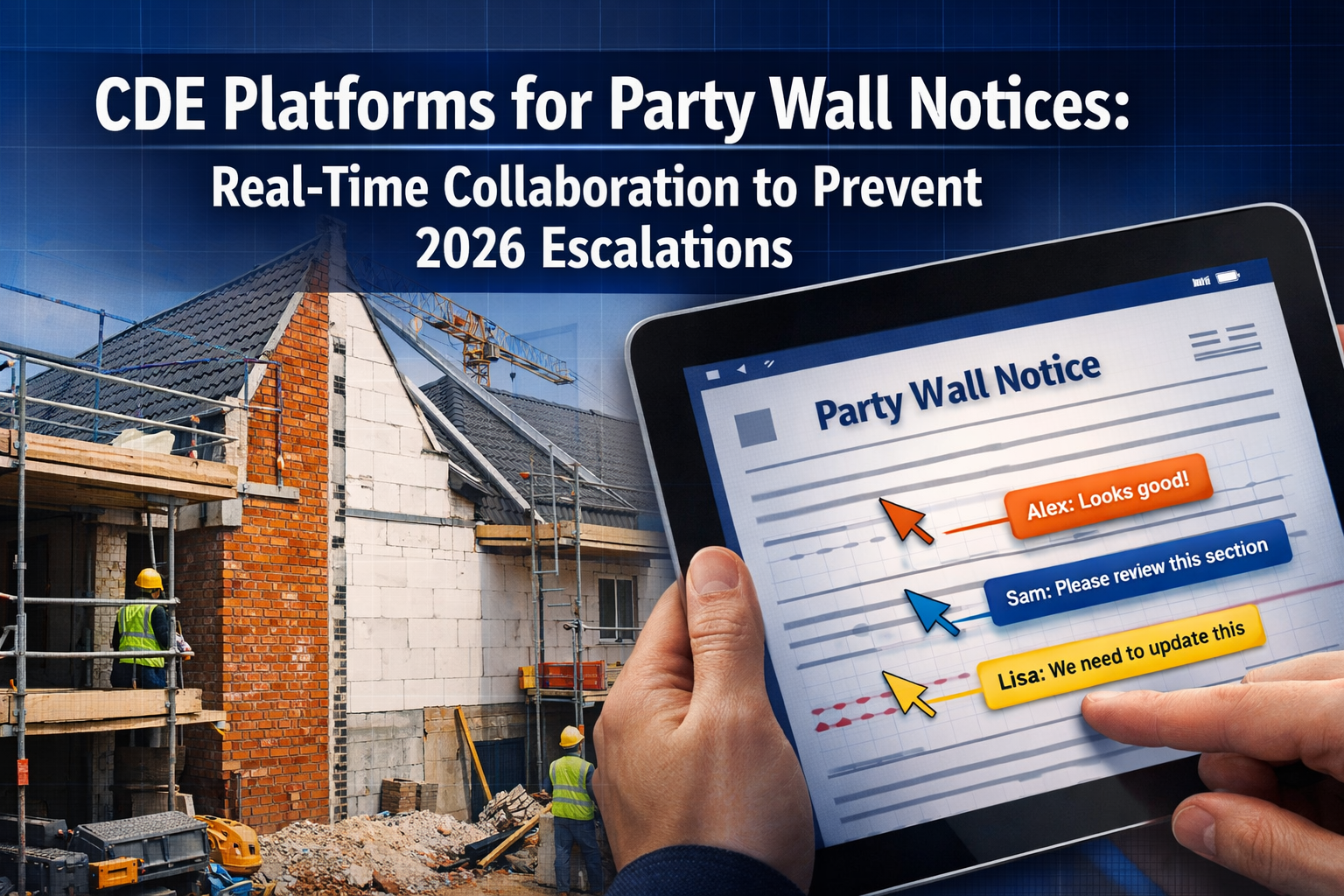
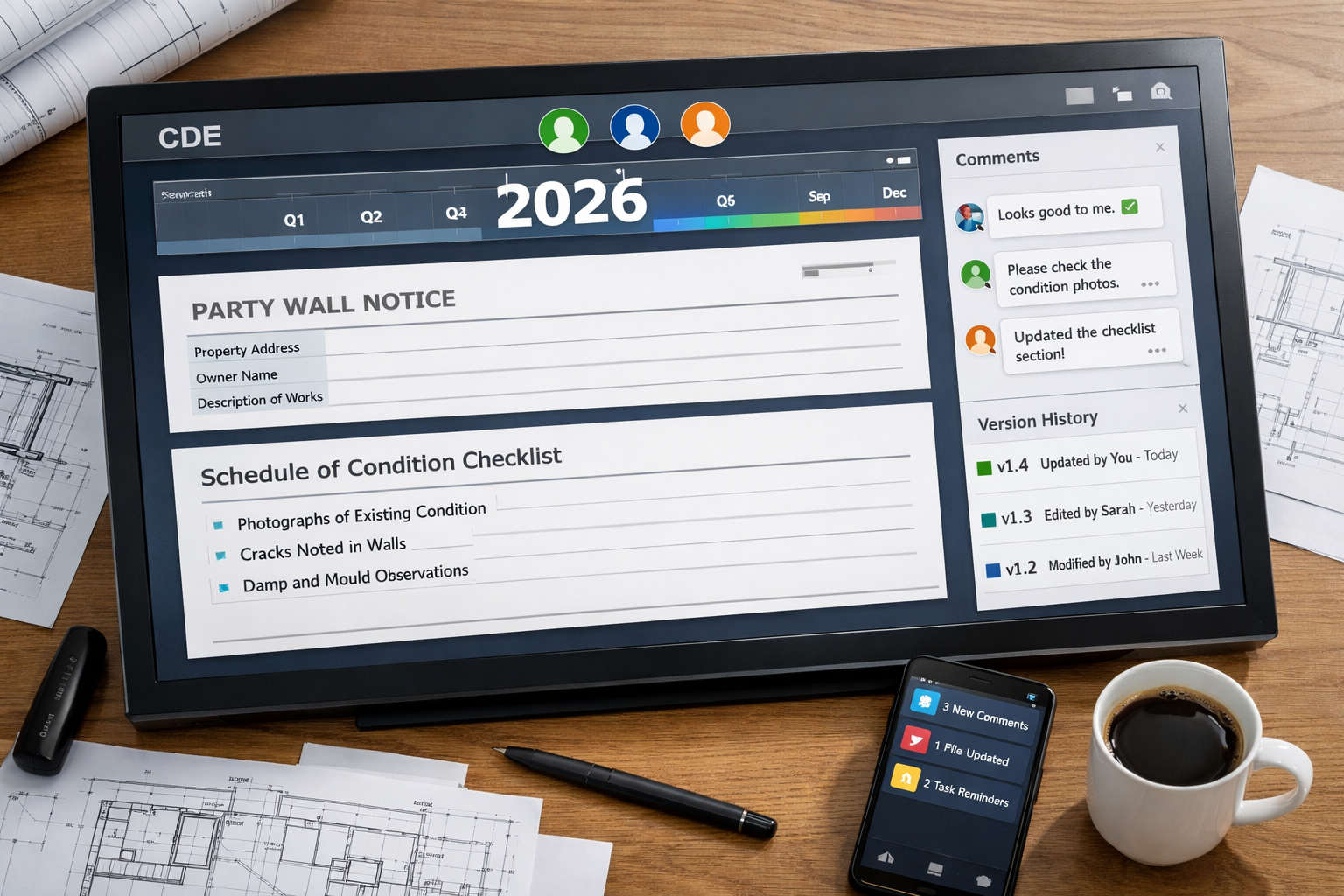
The cornerstone feature of CDE platforms is simultaneous multi-user editing. When preparing party structure notices, surveyors can draft documents while building owners review and comment in real time. This eliminates the frustrating back-and-forth of traditional revision cycles.
Practical Example:
A building owner's surveyor in West London drafts a notice for basement excavation works. The building owner reviews the document from their office, adding clarifications about construction methods. The adjoining owner's surveyor simultaneously reviews technical specifications, flagging concerns about underpinning depth. All three parties see each other's inputs instantly, resolving issues in a single collaborative session rather than weeks of correspondence.
Intelligent Notification Systems
CDE platforms automate the critical notification workflows required under party wall legislation:
- Service of notices with delivery confirmation and read receipts
- Countdown timers showing days remaining for responses
- Escalation alerts when deadlines approach without action
- Consent tracking that clearly shows which adjoining owners have agreed or dissented
- Surveyor appointment notifications when disputes arise
These automated systems prevent the common scenario where notices are lost, deadlines missed, or responses overlooked—situations that frequently escalate into formal disputes.
Version Control and Audit Trails
Every change made to party wall documents within a CDE is tracked with:
- User identification (who made the change)
- Timestamp (exactly when)
- Change description (what was modified)
- Previous versions (accessible for comparison)
This comprehensive audit trail provides legal protection for all parties. When disputes arise about what was agreed, the platform provides irrefutable evidence of the negotiation history. This feature alone prevents countless escalations that occur when parties have different recollections of agreements.
Integrated Schedules of Condition
Modern CDE platforms incorporate specialized tools for creating schedules of condition that far exceed traditional paper-based records:
✅ Photo annotation tools allowing surveyors to mark specific defects directly on images
✅ 360-degree photography integration providing comprehensive room documentation
✅ Geolocation tagging ensuring photos are correctly attributed to specific locations
✅ Comparison views showing before-and-after conditions side-by-side
✅ Structural measurement tools recording crack widths, settlement levels, and other metrics
These digital schedules create baseline records that are far more defensible than traditional written descriptions, reducing post-construction disputes about pre-existing conditions.
Implementing CDE Platforms for Party Wall Notices: Real-Time Collaboration to Prevent 2026 Escalations in Your Practice
Platform Selection Criteria
When evaluating CDE platforms for party wall work, consider these essential factors:
1. Party Wall-Specific Workflows
Generic document management systems lack the specialized workflows required for party wall procedures. Look for platforms that understand notice types, statutory timeframes, and party wall awards requirements.
2. Mobile Accessibility
Surveyors need to access and update information during site visits. Platforms must offer robust mobile applications with offline capability, allowing schedule of condition creation even without internet connectivity.
3. Security and Permissions
Party wall information is confidential and legally sensitive. Platforms must provide granular permission controls, ensuring adjoining owners only access relevant documents while surveyors maintain privileged communication channels.
4. Integration Capabilities
In 2026, construction firms are adopting API-first design to connect specialized tools and reduce manual data entry[3]. Your CDE should integrate with project management software, accounting systems, and other construction platforms.
5. Compliance and Data Residency
Ensure the platform complies with UK data protection regulations and stores information within appropriate jurisdictions, particularly important for commercial developments with international stakeholders.
Onboarding Stakeholders
Successful CDE implementation requires buy-in from all parties involved in party wall processes:
For Building Owners:
Emphasize how CDEs provide complete transparency into the party wall process, reducing anxiety about surveyor activities and costs. Demonstrate how they can track progress in real-time rather than waiting for periodic updates.
For Adjoining Owners:
Highlight the protection offered by comprehensive audit trails and professional schedule of condition documentation. Show how the platform makes it easier to understand proposed works and raise concerns early.
For Surveyors:
Focus on efficiency gains and professional liability protection. CDEs dramatically reduce administrative burden while creating defensible records of all advice given and decisions made.
Best Practices for 2026
Start Digital from Day One
Don't attempt to migrate mid-process from paper to digital. Begin with CDE platforms from the initial types of party wall works assessment and maintain digital workflows throughout.
Establish Clear Protocols
Create standardized procedures for document naming, comment formatting, and approval workflows. Consistency ensures all stakeholders can navigate the platform efficiently.
Leverage Templates
Build a library of notice templates, award frameworks, and schedule of condition formats within your CDE. This accelerates document creation while maintaining quality standards. Consider adapting party wall agreement templates for digital workflows.
Train Regularly
Technology evolves rapidly. Schedule quarterly training sessions to ensure all team members understand new features and best practices for collaborative workflows.
Monitor Metrics
Track key performance indicators such as average notice-to-award timelines, number of disputes escalated, and stakeholder satisfaction scores. Use this data to continuously refine your CDE workflows.
Preventing Escalations: Real-World Applications in 2026
Case Study: Data Center Expansion
Data center projects represent one of 2026's most significant construction sectors, with party wall surveys identified as key considerations for expansions[2]. A recent London data center project demonstrates CDE platform benefits:
The Challenge:
A data center operator needed to expand into an adjacent property, requiring extensive excavation work affecting multiple party walls. The project involved five adjoining owners, three surveyors, structural engineers, and legal advisors—creating a coordination nightmare with traditional methods.
The CDE Solution:
The building owner's surveyor established a CDE platform as the project hub. All notices, technical drawings, structural calculations, and schedules of condition were centralized. Real-time commenting allowed adjoining owners to raise concerns immediately, which engineers addressed within hours rather than weeks.
The Results:
- Notice-to-award timeline reduced from 11 weeks to 4 weeks
- Zero formal disputes despite complex technical works
- Complete audit trail satisfied legal advisors for all parties
- Post-construction condition assessments completed in 2 days versus typical 2 weeks
Residential Development Scenario
A West London terraced house renovation illustrates CDE benefits at smaller scales:
Traditional Approach Problems:
The building owner initially attempted traditional notice service via post. One adjoining owner claimed never to receive the notice, causing a three-week delay. When schedules of condition were eventually created, photo organization was chaotic, with images emailed separately from written descriptions.
CDE Platform Intervention:
After the initial delays, the appointed surveyor migrated the process to a CDE platform. Instant notification with read receipts eliminated delivery disputes. The integrated schedule of condition tool allowed the surveyor to photograph each room, annotate specific features, and generate a comprehensive report in a single site visit.
Outcome:
What began as a contentious process with potential for escalation transformed into a collaborative experience. The adjoining owner appreciated the transparency and professional documentation quality. The project proceeded without further disputes, and party wall costs were minimized through efficiency gains.
Commercial Development With Multiple Surveyors
Large commercial projects often involve multiple surveyors representing different adjoining owners. CDE platforms excel in these complex scenarios:
Coordination Benefits:
- Unified award document that all surveyors contribute to simultaneously
- Consolidated comment threads preventing miscommunication between surveyor pairs
- Shared technical libraries where structural calculations and specifications are accessible to all
- Synchronized site visit scheduling through integrated calendar tools
This collaborative approach contrasts sharply with traditional methods where each surveyor works in isolation, creating inconsistent awards that require extensive reconciliation.
Technical Integration: Building the 2026 Party Wall Ecosystem
API Connections and Workflow Automation
Modern CDE platforms support API integrations that connect party wall workflows with broader construction management systems[3]. These connections enable:
Project Management Integration:
Party wall milestones automatically update master project schedules. When an award is finalized in the CDE, the construction start date updates across all connected systems, ensuring contractors, suppliers, and other stakeholders have current information.
Financial System Connections:
Surveyor fees, award costs, and other party wall expenses flow directly from the CDE to accounting platforms. This eliminates manual data entry and provides building owners with real-time cost tracking against budgets.
Building Control and Planning Portals:
Some advanced CDEs integrate with local authority systems, allowing party wall awards to be automatically submitted alongside building control applications, streamlining regulatory approval processes.
Data Analytics and Predictive Insights
2026 CDE platforms increasingly incorporate analytics capabilities that provide valuable insights:
- Dispute prediction algorithms that analyze communication patterns and flag potential escalations before they occur
- Timeline forecasting based on historical data from similar projects
- Cost benchmarking comparing party wall expenses against industry standards
- Compliance monitoring ensuring all statutory requirements are met throughout the process
These analytical tools help surveyors and building owners make informed decisions and proactively address issues that might otherwise escalate.
Security and Compliance Architecture
Party wall information contains sensitive personal data, property valuations, and confidential business information. Leading CDE platforms implement robust security measures:
🔒 End-to-end encryption for all documents and communications
🔒 Multi-factor authentication preventing unauthorized access
🔒 Role-based access controls ensuring stakeholders only see relevant information
🔒 Regular security audits and compliance certifications
🔒 Data backup and disaster recovery protocols protecting against information loss
These security features are essential for maintaining professional standards and protecting all parties' interests throughout the party wall process.
Overcoming Barriers to CDE Adoption for Party Wall Work
Addressing Common Concerns
"Traditional Methods Have Worked for Decades"
While true, traditional methods were designed for a different era. In 2026, stakeholder expectations have changed dramatically. Building owners and adjoining owners increasingly expect digital communication, real-time updates, and professional presentation standards that paper-based systems cannot deliver.
"Technology Creates Barriers for Non-Technical Stakeholders"
Modern CDE platforms prioritize user experience, offering intuitive interfaces that require minimal training. Many adjoining owners find digital platforms easier to navigate than deciphering complex legal correspondence. Platforms can also accommodate those who prefer traditional methods by generating PDF versions of all documents.
"Digital Systems Are Less Legally Defensible"
The opposite is true. Digital platforms with comprehensive audit trails provide far stronger legal evidence than paper records. Courts increasingly favor electronic evidence with metadata showing document creation, modification, and access history.
"Implementation Costs Are Prohibitive"
CDE platform subscription costs are modest compared to the expenses of even a single escalated party wall dispute. The efficiency gains typically generate positive ROI within the first few projects. Many platforms offer tiered pricing suitable for practices of all sizes.
Change Management Strategies
Pilot Projects:
Begin with a single straightforward party wall matter to demonstrate platform benefits without overwhelming stakeholders. Success stories from pilot projects build confidence for broader adoption.
Hybrid Approaches:
During transition periods, maintain parallel traditional and digital workflows. This allows stakeholders to gradually adapt while ensuring compliance with all statutory requirements.
Stakeholder Education:
Develop brief educational materials explaining how CDEs protect all parties' interests and streamline the process. Video tutorials showing platform navigation can reduce anxiety about technology adoption.
Professional Body Engagement:
Work with surveying professional organizations to promote CDE best practices and develop industry standards for digital party wall workflows. Collective adoption accelerates individual practice benefits.
Future Trends: CDE Platforms Beyond 2026
Artificial Intelligence Integration
The next generation of CDE platforms will incorporate AI capabilities that further enhance party wall processes:
- Automated notice drafting using natural language processing to generate appropriate notices based on work descriptions
- Intelligent document review flagging potential issues or missing information before notices are served
- Predictive dispute resolution suggesting compromise solutions based on historical outcomes from similar situations
- Smart scheduling optimizing site visit timing based on surveyor availability, weather forecasts, and construction schedules
Blockchain for Immutable Records
Blockchain technology offers potential for creating tamper-proof records of party wall agreements and awards. This could provide additional legal certainty and facilitate property transactions where party wall history is relevant.
Virtual Reality Site Inspections
VR technology may enable remote schedule of condition creation, allowing surveyors to conduct detailed inspections without physical presence. This could be particularly valuable for international investors or properties in remote locations.
Regulatory Technology (RegTech) Integration
As building regulations evolve, CDE platforms will increasingly incorporate automated compliance checking, ensuring party wall procedures align with current Party Wall etc. Act 1996 requirements and any future legislative amendments.
Conclusion: Embracing Digital Transformation for Party Wall Excellence
CDE Platforms for Party Wall Notices: Real-Time Collaboration to Prevent 2026 Escalations represents more than a technological upgrade—it's a fundamental reimagining of how building owners, adjoining owners, and surveyors interact throughout the party wall process. By replacing fragmented communication with transparent collaboration, these platforms eliminate the misunderstandings that cause disputes to escalate.
The construction industry's broader digital transformation, with cloud-based platforms becoming standard infrastructure in 2026[3], creates the perfect environment for CDE adoption in party wall work. As development activity intensifies, particularly in sectors like data centers where party wall considerations are critical[2], the efficiency and transparency offered by CDE platforms will transition from competitive advantage to professional necessity.
Actionable Next Steps
For Surveyors:
- Research CDE platforms with party wall-specific features and request demonstration access
- Identify a straightforward upcoming project suitable for pilot implementation
- Develop standardized templates and workflows adapted for digital collaboration
- Create stakeholder education materials explaining platform benefits
For Building Owners:
- When appointing surveyors, inquire about their CDE capabilities and digital workflow experience
- Request real-time access to party wall documentation rather than periodic email updates
- Ensure your project management systems can integrate with party wall CDEs
For Adjoining Owners:
- When responding to party wall notices, ask surveyors about digital collaboration options
- Request access to online platforms for reviewing schedules of condition and proposed works
- Take advantage of transparency features to stay informed throughout the process
The future of party wall management is collaborative, transparent, and digital. By embracing CDE platforms in 2026, all stakeholders can prevent escalations, reduce costs, and maintain the neighborly relationships that make successful construction projects possible. 🏗️✨
References
[1] Data Center Permits In 2026 How To Spot New Builds Expansions And Power Upgrades Early – https://www.buildcentral.com/data-center-permits-in-2026-how-to-spot-new-builds-expansions-and-power-upgrades-early/
[2] Party Wall Surveys For Data Centre Expansions Navigating Agreements In The 2026 Investment Surge – https://nottinghillsurveyors.com/blog/party-wall-surveys-for-data-centre-expansions-navigating-agreements-in-the-2026-investment-surge
[3] Construction Software Integrations Trends – https://cmicglobal.com/resources/article/construction-software-integrations-trends
[4] Data Centres – https://www.brownejacobson.com/insights/2026-horizon-scanning-in-construction/data-centres