


Imagine standing in your neighbour's property, watching a three-dimensional hologram predict exactly how your basement excavation will affect their foundation—before a single shovel breaks ground. This isn't science fiction. In 2026, Real-Time Digital Twins for Party Wall Agreements: Simulating Excavation Impacts Under Section 6 are transforming how property owners, surveyors, and construction teams navigate one of the most contentious aspects of building work: excavating near adjoining properties.
Traditional party wall procedures have relied on static drawings, historical precedent, and educated guesswork. But as urban densification accelerates and sustainability demands precision, interactive 3D twins now visualize notional and special excavation effects on adjoining properties, enabling informed consent and reducing disputes. This technological leap is essential for surveyors navigating 2026's heightened expectations for accuracy, transparency, and environmental responsibility.
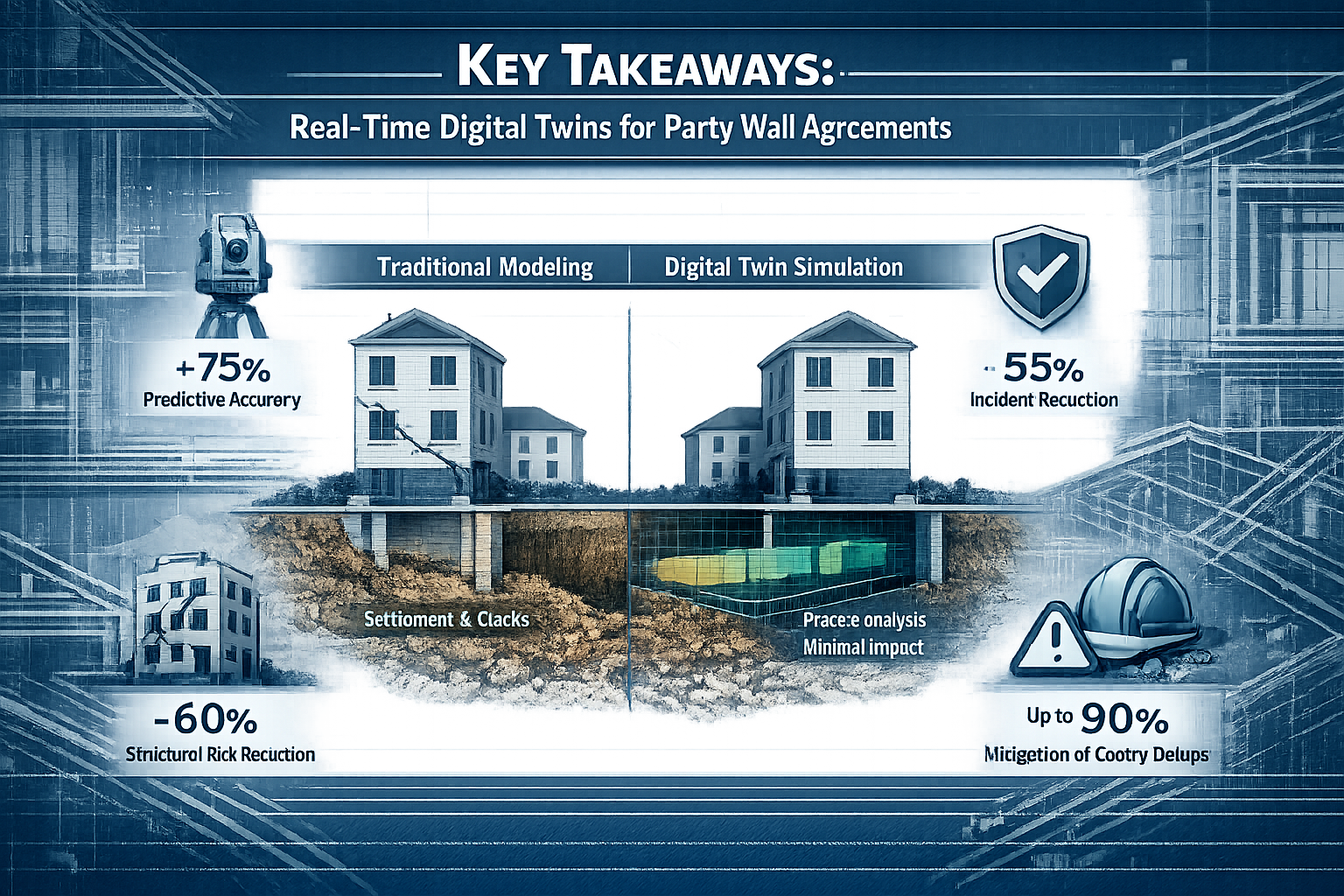
Key Takeaways
- Digital twins create interactive 3D models that simulate excavation impacts under Section 6 of the Party Wall etc. Act 1996, providing visual evidence for both building and adjoining owners
- Real-time monitoring capabilities integrate sensor data from construction sites to update predictions continuously, identifying potential issues before they become costly disputes
- Enhanced transparency and consent through visualizations help adjoining owners understand complex excavation risks, leading to faster agreement approvals
- Cost and time savings result from early identification of design problems and reduced need for reactive remediation work
- Compliance with 2026 standards for sustainability and precision construction is simplified through data-driven decision-making
Understanding Section 6 and Excavation Challenges
What Section 6 Covers
Section 6 of the Party Wall etc. Act 1996 addresses excavation work near neighbouring buildings. Specifically, it requires building owners to serve notice when:
- Excavating within three metres of a neighbour's structure and going deeper than its foundation
- Excavating within six metres of a neighbour's structure and cutting a line drawn downward at 45 degrees from the bottom of their foundation
These provisions exist because excavation can undermine adjacent properties, causing settlement, cracking, and structural damage. The legislation requires building owners to provide adequate support and protection—but determining what constitutes "adequate" has traditionally involved considerable uncertainty.
Traditional Assessment Limitations
Conventional party wall procedures under Section 6 typically involve:
- Structural calculations based on soil reports
- Two-dimensional cross-section drawings
- Written descriptions of proposed underpinning or support methods
- Schedules of condition documenting existing cracks and defects
While these methods have served the industry for decades, they present significant challenges:
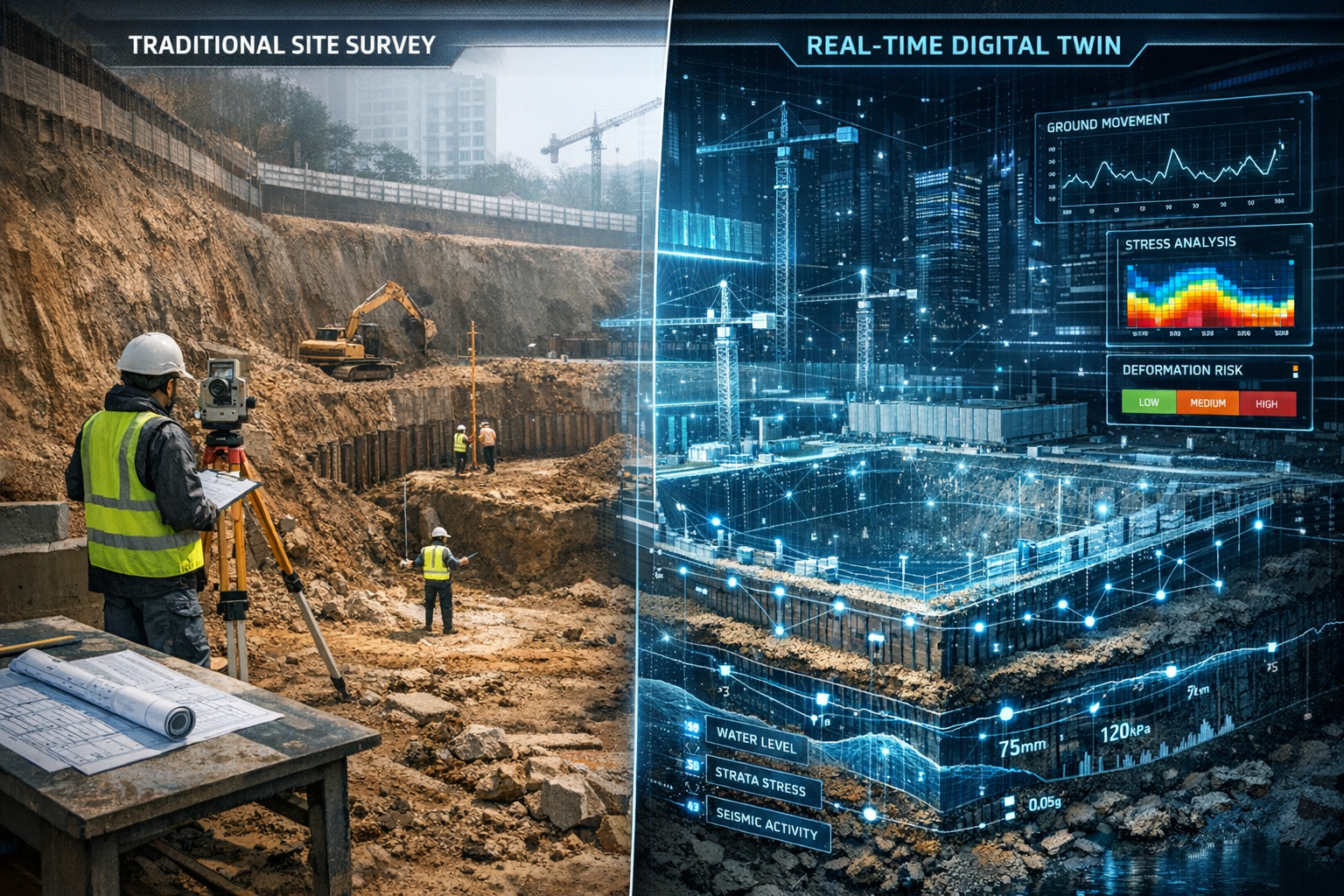
- Limited visualization makes it difficult for non-technical adjoining owners to understand risks
- Static predictions cannot account for changing site conditions during construction
- Delayed problem detection means issues often emerge only after damage occurs
- Dispute resolution costs escalate when parties disagree about causation
For those carrying out excavation works, these limitations create uncertainty and potential liability.
How Real-Time Digital Twins Transform Section 6 Excavation Planning
What Are Digital Twins?
A digital twin is a virtual replica of a physical asset, process, or system that updates in real-time based on sensor data and other inputs [1]. Originally developed for manufacturing and aerospace applications, digital twins have expanded into urban planning, infrastructure management, and now construction law compliance [3].
For party wall agreements, a digital twin creates a comprehensive 3D model incorporating:
- Precise building geometry from laser scanning and photogrammetry
- Subsurface conditions from geotechnical investigations
- Foundation details from structural surveys and historical records
- Material properties including soil bearing capacity and structural strength
- Construction sequencing showing excavation phases over time
Real-Time Digital Twins for Party Wall Agreements: Simulating Excavation Impacts
The application of digital twin technology to Section 6 excavation scenarios offers transformative capabilities:
Predictive Simulation: Before serving a party wall notice, building owners can run multiple excavation scenarios to identify the approach that minimizes risk to adjoining properties. The digital twin calculates:
- Settlement predictions at various points along the party wall
- Stress distribution changes in the adjoining owner's foundation
- Groundwater flow alterations that might affect stability
- Vibration impacts from excavation equipment
Visual Communication: Interactive 3D visualizations replace technical jargon with intuitive graphics. Adjoining owners can:
- Rotate and zoom the model to view impacts from any angle
- Toggle between "before," "during," and "after" states
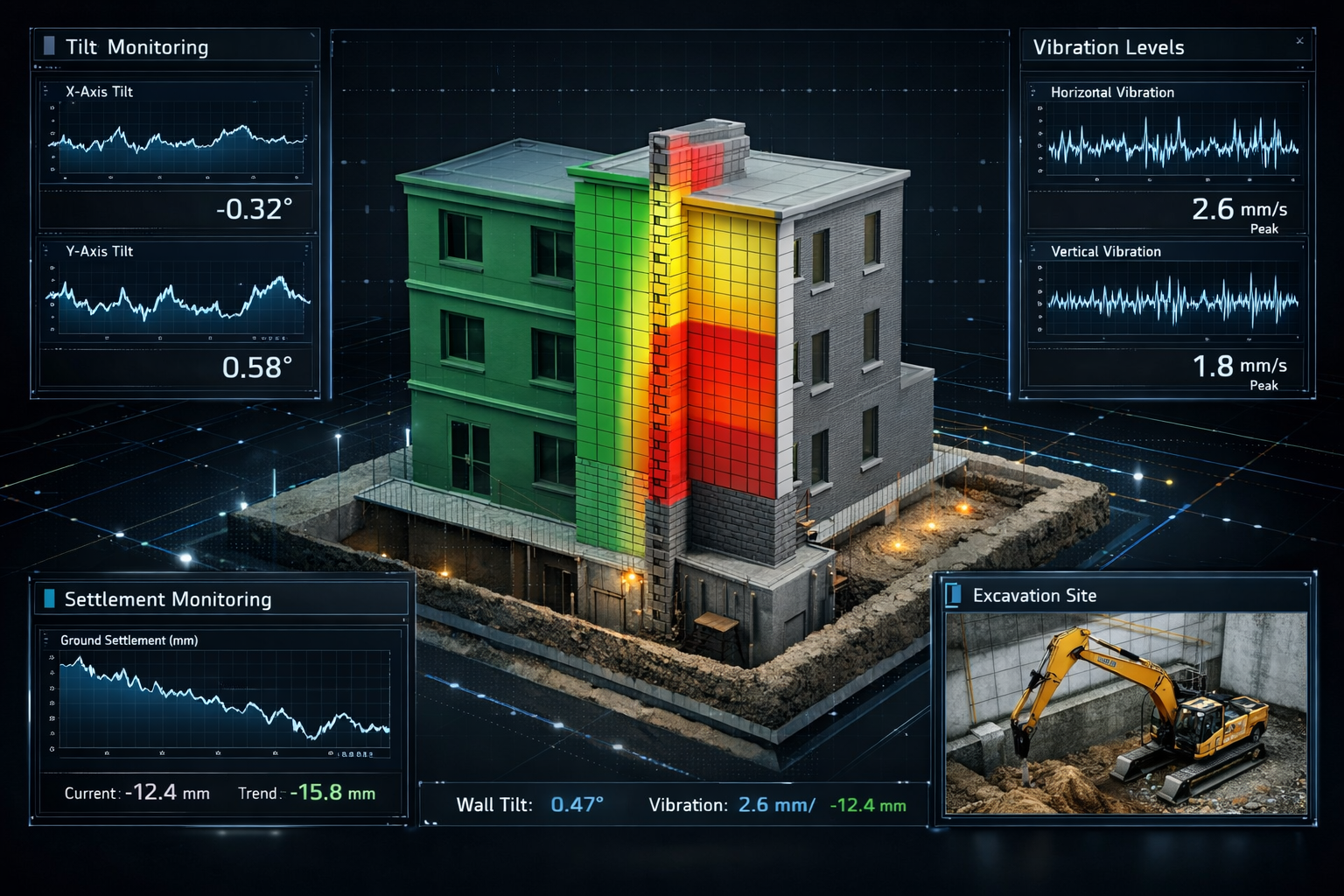
- See color-coded risk zones (green for safe, yellow for caution, red for concern)
- Watch time-lapse animations of the construction sequence
Real-Time Monitoring: Once excavation begins, the digital twin integrates live sensor data:
- Tilt sensors on the party wall detect movement in real-time
- Settlement monitors track foundation displacement
- Crack gauges measure any widening of existing defects
- Vibration sensors ensure equipment stays within safe thresholds
When sensor readings deviate from predictions, the system alerts surveyors immediately, enabling rapid intervention before minor movements become major damage [1].
Implementing Digital Twins in Party Wall Surveying Practice
Data Collection and Model Creation
Successful implementation of Real-Time Digital Twins for Party Wall Agreements: Simulating Excavation Impacts Under Section 6 requires comprehensive data gathering:
Building Survey Data:
- 3D laser scanning of both properties (accuracy within 2-5mm)
- Photogrammetry for exterior façade details
- Internal structural surveys identifying load-bearing elements
- Review of original construction drawings where available
Geotechnical Information:
- Trial pit excavations to determine soil stratification
- Standard Penetration Tests (SPT) for bearing capacity
- Groundwater level monitoring
- Adjacent building foundation depth verification
Historical Context:
- Previous schedules of condition from earlier party wall matters
- Local authority records of ground conditions
- Historical mapping showing previous development
This data feeds into specialized software that creates the baseline digital twin model. While data quality and integration present implementation challenges [1], the investment pays dividends through reduced dispute risk.
Integration with Party Wall Procedures
Digital twins enhance rather than replace traditional party wall processes:
| Traditional Step | Digital Twin Enhancement |
|---|---|
| Serve Section 6 Notice | Include link to interactive 3D model showing proposed works |
| Adjoining Owner Review | Virtual walkthrough explaining excavation impacts visually |
| Surveyor Appointment | Agreed surveyors use model to design protective measures |
| Party Wall Award Preparation | Award references specific simulation scenarios and monitoring protocols |
| Construction Phase | Real-time alerts if conditions deviate from predictions |
| Post-Construction | Final model comparison validates no unexpected damage occurred |
For adjoining owners concerned about works, this enhanced transparency provides reassurance and enables truly informed consent.
Cost-Benefit Analysis
Initial Investment:
- 3D scanning services: £1,500-£3,500 per property
- Geotechnical investigation: £2,000-£5,000
- Digital twin software and modeling: £3,000-£8,000
- Sensor installation and monitoring: £2,000-£4,000
- Total setup cost: £8,500-£20,500
Potential Savings:
- Avoided design changes during construction: £10,000-£50,000
- Reduced dispute resolution costs: £5,000-£25,000
- Faster agreement approval (time savings): £2,000-£8,000
- Insurance premium reductions: £1,000-£5,000
- Avoided remediation for unexpected damage: £15,000-£100,000+
For complex excavations in high-value areas like Central London, the return on investment becomes compelling, particularly when considering reputational benefits and reduced project delays.
Those looking to keep party wall costs down should weigh these long-term savings against upfront expenses.
Advanced Applications and Future Developments
AI-Enhanced Prediction Models
Emerging applications combine digital twins with artificial intelligence to improve prediction accuracy [4]. Machine learning algorithms trained on thousands of excavation projects can:
- Identify soil behavior patterns that traditional calculations miss
- Predict construction delays based on weather and site conditions
- Recommend optimal underpinning sequences to minimize settlement
- Flag unusual sensor readings that might indicate emerging problems
These AI enhancements are particularly valuable for types of party wall works involving complex ground conditions or unusual structural configurations.
Integration with Building Information Modeling (BIM)
As BIM adoption becomes standard in construction, digital twins for party wall agreements increasingly integrate with broader project models. This enables:
- Seamless data exchange between architects, structural engineers, and party wall surveyors
- Clash detection identifying conflicts between excavation plans and existing services
- Lifecycle management where the party wall digital twin becomes part of the building's permanent digital record
- Future planning for subsequent owners who may undertake their own Section 6 works
Regulatory Recognition and Standards
While digital twins offer clear benefits, 2026 sees ongoing development of standards and protocols:
- Professional bodies are establishing guidelines for digital twin accuracy and validation
- Courts are beginning to accept digital twin evidence in party wall disputes
- Insurance companies are developing policies that recognize reduced risk from monitored projects
- Local authorities in areas like North London and South London are exploring digital twin requirements for major excavations
Practical Considerations for Surveyors and Property Owners
When Digital Twins Add Most Value
Not every Section 6 excavation requires full digital twin implementation. Consider this technology when:
✅ Excavating more than 1.5m below adjoining foundations (high settlement risk)
✅ Working in areas with complex ground conditions (variable soil, high water table)
✅ Adjacent to high-value or historically significant structures (where damage costs are severe)
✅ Multiple adjoining owners are involved (visualization aids consensus)
✅ Previous disputes or litigation history exists (transparency reduces conflict)
✅ Building owner seeks to minimize insurance exposure (data proves due diligence)
For simpler excavations with generous clearances, traditional methods combined with a party wall agreement template may suffice.
Selecting Service Providers
The digital twin market for construction applications is rapidly evolving. When selecting providers, consider:
Technical Capabilities:
- Experience with party wall-specific applications (not just general construction)
- Software platforms used (compatibility with industry standards)
- Accuracy specifications for scanning and modeling
- Real-time data integration capabilities
Professional Qualifications:
- Chartered surveyors with party wall expertise
- Structural engineers familiar with excavation design
- Geotechnical specialists for soil behavior modeling
- Software developers with construction domain knowledge
Support and Training:
- Training for surveyors to interpret and present models
- Client support during the agreement negotiation phase
- Ongoing monitoring services during construction
- Post-project reporting and documentation
Addressing Adjoining Owner Concerns
When introducing digital twins to adjoining owners, surveyors should:
- Emphasize transparency: The technology provides them with better information, not less
- Offer demonstrations: Interactive sessions where they can explore the model themselves
- Explain monitoring benefits: Real-time alerts protect their interests during construction
- Clarify data ownership: Establish who controls and accesses the digital twin
- Provide alternatives: Ensure they can still engage with traditional documentation if preferred
Understanding how to respond to party wall notices becomes easier when visual evidence supports written descriptions.
Sustainability and Precision in 2026 Construction
Environmental Benefits
Digital twins support 2026's sustainability imperatives by:
- Reducing material waste through precise excavation planning that minimizes over-engineering
- Optimizing concrete use in underpinning by calculating exact support requirements
- Preventing damage that would require resource-intensive repairs
- Enabling adaptive reuse by documenting existing structures comprehensively
- Supporting circular economy principles through detailed building lifecycle data
Precision Construction Standards
The construction industry's shift toward precision manufacturing techniques aligns perfectly with digital twin capabilities. Benefits include:
- Millimeter-level accuracy in excavation depth control
- Quality assurance through continuous monitoring versus periodic inspections
- Predictable outcomes that reduce contingency buffers and associated costs
- Knowledge transfer as digital records document lessons learned for future projects
These precision standards are particularly important in dense urban areas like East London and West London where properties are closely spaced.
Challenges and Limitations
Technical Barriers
Despite significant advantages, Real-Time Digital Twins for Party Wall Agreements: Simulating Excavation Impacts Under Section 6 face obstacles:
Data Quality Issues: Models are only as accurate as input data. Poor geotechnical investigations or incomplete structural surveys undermine predictions [1].
Processing Requirements: Real-time analysis demands substantial computing infrastructure, potentially requiring cloud services with associated costs and data security considerations.
Interoperability: Different software platforms may not communicate effectively, creating data silos when multiple consultants are involved.
Validation Complexity: Establishing that a digital twin accurately represents reality requires calibration against physical measurements—a time-consuming process.
Legal and Regulatory Uncertainty
As an emerging technology in party wall practice, digital twins exist in a somewhat uncertain legal landscape:
- Evidential weight: How courts will treat digital twin predictions versus traditional expert testimony remains unclear
- Professional liability: Standards of care for digital twin creation and interpretation are still developing
- Data protection: GDPR and privacy considerations apply when scanning adjoining properties
- Contractual frameworks: Party wall awards need updating to reference digital monitoring protocols
Cost Accessibility
The investment required places digital twins beyond reach for many smaller projects. This creates potential inequality where:
- High-value developments benefit from advanced protection
- Modest extensions rely on traditional methods with higher uncertainty
- Adjoining owners face different levels of protection depending on their neighbour's resources
Industry efforts to develop scaled-down digital twin solutions for smaller projects are ongoing but not yet widely available.
Conclusion
Real-Time Digital Twins for Party Wall Agreements: Simulating Excavation Impacts Under Section 6 represent a significant evolution in construction law compliance and neighbour relations. By transforming abstract excavation risks into tangible, interactive visualizations, this technology bridges the communication gap between technical experts and property owners. The ability to predict, monitor, and validate excavation impacts in real-time offers unprecedented transparency and risk management.
For surveyors, digital twins provide powerful tools to design safer excavation schemes, demonstrate due diligence, and resolve disputes before they escalate. For building owners, the technology reduces liability exposure and project delays. For adjoining owners, it delivers genuine informed consent based on clear evidence rather than trust alone.
As 2026's demands for sustainability and precision intensify, digital twin adoption will likely accelerate from cutting-edge innovation to industry standard. Early adopters gain competitive advantages through enhanced service offerings and reduced risk profiles.
Next Steps for Implementation
For Building Owners Planning Excavation:
- Consult with party wall surveyors experienced in digital twin technology
- Budget for comprehensive site investigation and 3D scanning
- Include digital twin provisions when serving Section 6 notices
- Ensure contractors understand monitoring protocols
For Party Wall Surveyors:
- Invest in training on digital twin platforms and interpretation
- Develop partnerships with scanning and modeling specialists
- Create template award clauses addressing digital monitoring
- Build case studies demonstrating value to clients
For Adjoining Owners Receiving Notices:
- Ask whether building owners plan to use digital twin technology
- Request access to interactive models during the agreement process
- Ensure appointed surveyors understand the technology
- Clarify monitoring protocols and alert procedures in the award
The integration of digital twins into party wall practice is not merely a technological upgrade—it represents a fundamental shift toward evidence-based, transparent, and collaborative approaches to managing excavation risks. As the technology matures and costs decline, it promises to make Section 6 compliance more predictable, disputes less frequent, and construction safer for all parties involved.
For those navigating complex excavation scenarios in 2026, exploring digital twin solutions may prove one of the most valuable investments in project success and neighbour relations.
References
[1] Do Digital Twins Live Hype – https://www.jacobs.com/newsroom/qa/do-digital-twins-live-hype
[2] Advanced Local Digital Twins Using Ai For Early Warning And Preparedness – https://www.euro-access.eu/en/calls/2626/Advanced-Local-Digital-Twins-using-AI-for-Early-Warning-and-Preparedness
[3] Digital Twins Virtual Models Real World Impacts – https://www.nsf.gov/science-matters/digital-twins-virtual-models-real-world-impacts
[4] Swan 2026 Digital Twin Ai Workshop – https://swan-forum.com/publications/swan-2026-digital-twin-ai-workshop/
[5] Party Wall Agreements In Data Centre Developments 2026 Compliance Amid Ai Driven Uk Demand – https://nottinghillsurveyors.com/blog/party-wall-agreements-in-data-centre-developments-2026-compliance-amid-ai-driven-uk-demand