


Planning home improvements can be exciting, but when your project involves a shared wall or digging near your neighbour's property, things get complicated fast. Whether you're dreaming of a spacious loft conversion, a modern basement extension, or simply want to knock through a wall, understanding party wall rules can save you thousands of pounds and prevent neighbour disputes. In 2026, homeowners across England and Wales continue to face confusion about when notices are required, what work needs surveyor approval, and—most importantly—who foots the bill for professional fees.
This comprehensive guide addresses the most common party wall questions answered: excavations, alterations, and who pays surveyor fees, providing clear answers to help you navigate your building project with confidence.
Key Takeaways
- Building owners pay all reasonable party wall surveyor costs by default under Section 11(1) of the Party Wall etc. Act 1996, including both their own surveyor and the adjoining owner's surveyor fees
- Excavation work within 3 meters of a neighbour's structure requires party wall notices, as do alterations that cut into or raise shared walls
- Standard loft conversions cost £800–£1,500 for an agreed surveyor, while basement excavations can reach £5,000–£10,000 due to technical complexity
- Adjoining owners typically pay nothing unless they request additional work outside the standard protocol that benefits them specifically
- Appointing one agreed surveyor instead of two separate surveyors significantly reduces overall costs while maintaining impartiality
Understanding Party Wall Work: When Do You Need Surveyor Involvement?
The Party Wall etc. Act 1996 governs building work that affects shared structures or involves excavations near neighbouring properties in England and Wales. Many homeowners mistakenly believe they only need party wall agreements for major projects, but even seemingly minor alterations can trigger legal requirements.
Types of Work Requiring Party Wall Notices
Cutting into party walls is one of the most common scenarios requiring surveyor involvement. This includes:
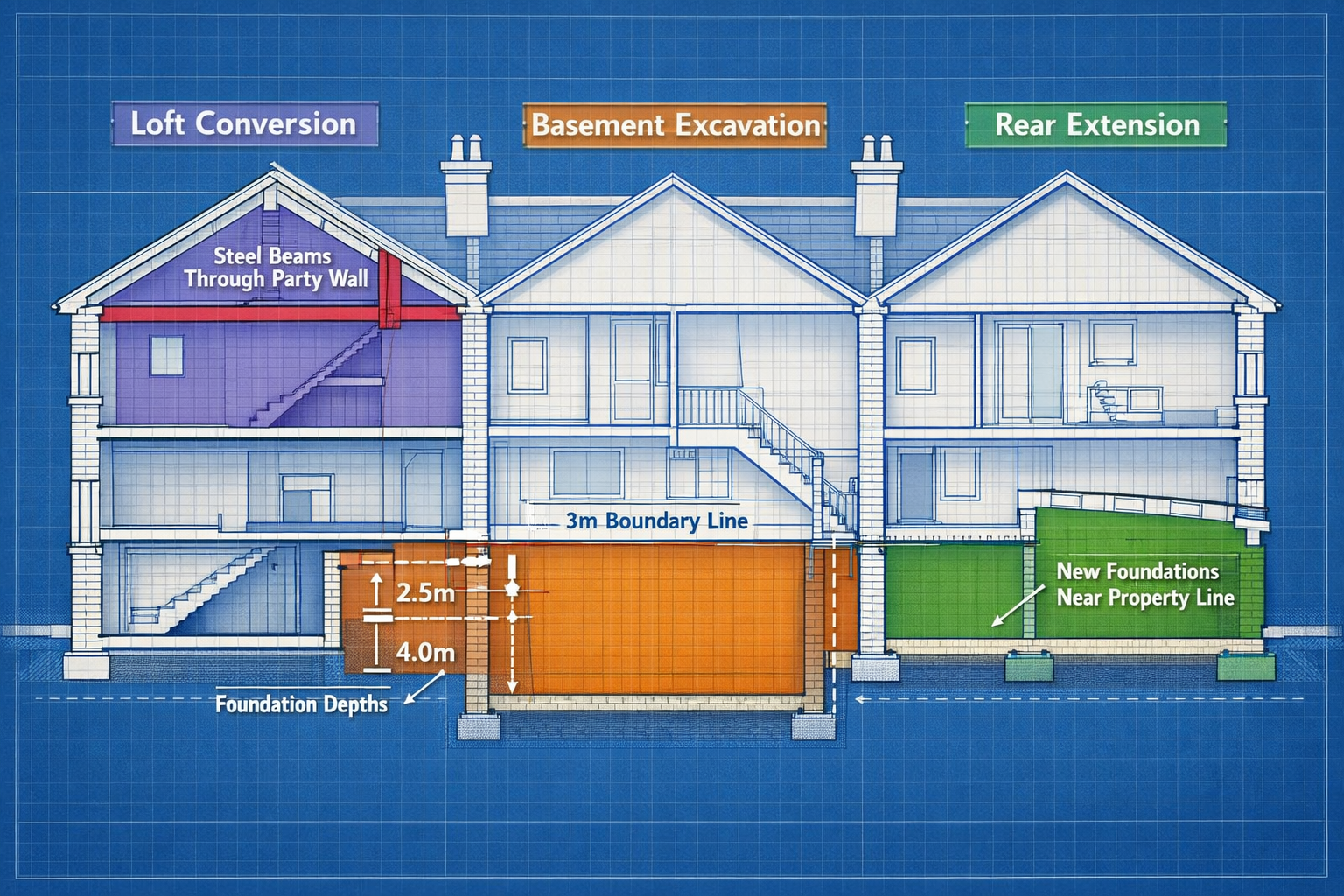
- 🏠 Loft conversions that involve cutting into the party wall to insert steel beams or create openings
- 🔨 Chimney breast removal where the chimney is attached to or forms part of the party wall
- 🚪 Creating doorways or openings through shared walls between semi-detached or terraced properties
- 📏 Raising the height of an existing party wall to accommodate additional storeys
Extension projects frequently require party wall agreements when they involve:
- Single or double storey rear extensions with new foundations
- Side extensions that require excavation near the boundary
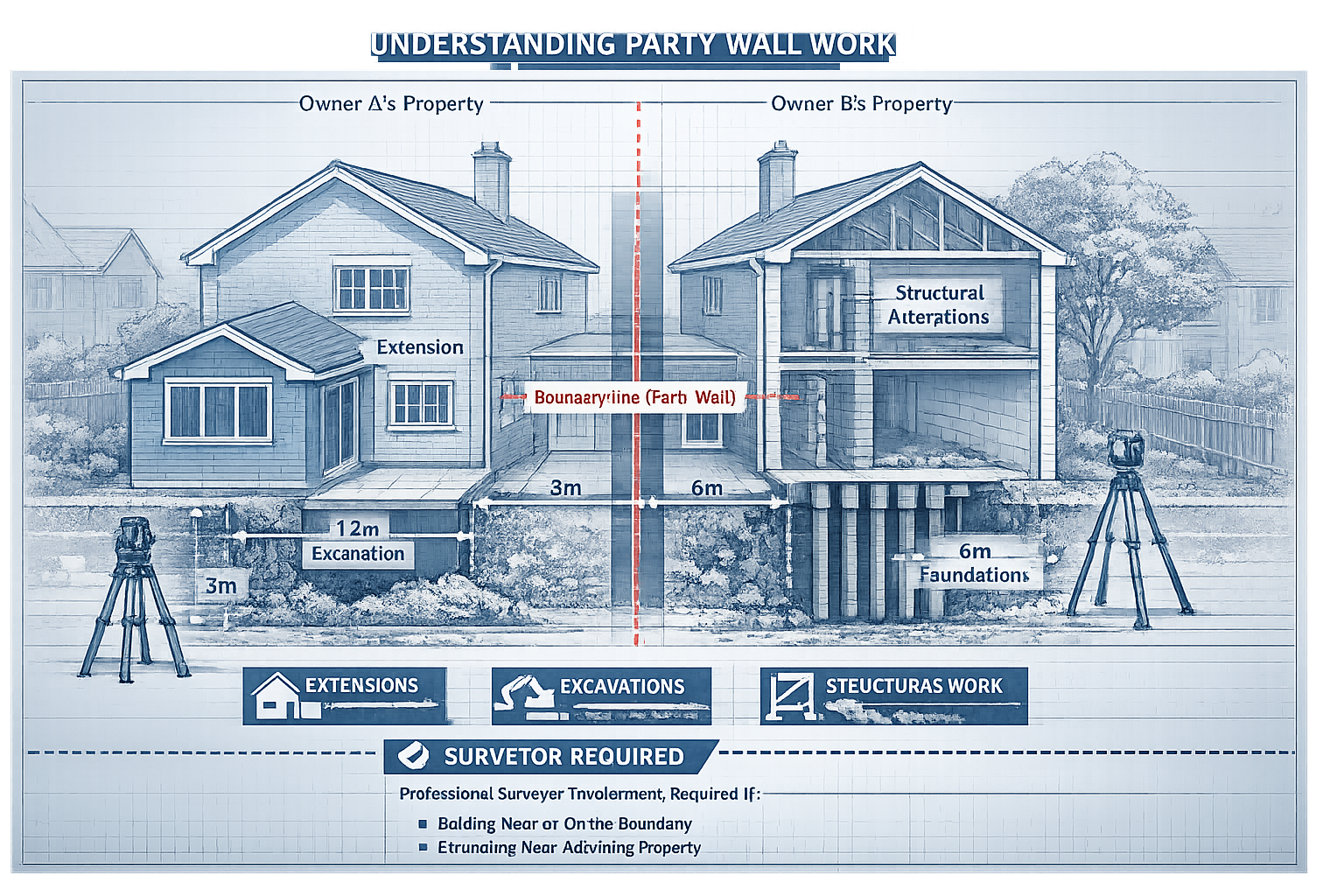
- Any foundation work within 3 meters of a neighbour's structure if digging below their foundation level
- Foundation work within 6 meters if excavating deeper than your neighbour's foundations
Basement excavations and underpinning represent the most complex category of party wall work. These projects almost always require professional surveyor involvement due to the technical risks involved, including potential subsidence or structural damage to adjoining properties[1].
For detailed information about different types of party wall works, homeowners should familiarize themselves with the three main notice types before starting any project.
The Three-Meter and Six-Meter Rules Explained
The excavation rules confuse many homeowners, but they're actually straightforward:
| Distance from Boundary | Depth Requirement | Notice Required? |
|---|---|---|
| Within 3 meters | Any excavation going below neighbour's foundation level | ✅ Yes |
| 3-6 meters | Excavation creating a 45-degree line below neighbour's foundation | ✅ Yes |
| Beyond 6 meters | Any depth | ❌ No (unless other work triggers notice) |
These rules apply regardless of whether the boundary wall is shared or not. Even if you're digging entirely on your own land, proximity to your neighbour's structure triggers the Act's requirements[2].
Common Alterations That Don't Require Notices
Not all building work near boundaries requires party wall procedures. The following typically fall outside the Act's scope:
- Plastering or decorating party walls without structural alterations
- Installing shelving or cabinets that don't penetrate the wall structure
- Minor repairs that don't affect the wall's structural integrity
- Building work more than 6 meters from any neighbour's structure
- Replacing windows or doors in external walls (unless affecting party wall structure)
However, homeowners should always consult with a qualified surveyor if uncertain, as failing to serve proper party wall notices can result in costly delays and legal disputes.
Most Common Party Wall Questions Answered: Who Pays Surveyor Fees?
The question of payment responsibility causes more confusion than any other aspect of party wall procedures. The answer is clear in legislation but often misunderstood by both building owners and their neighbours.
The Default Rule: Building Owners Pay Everything
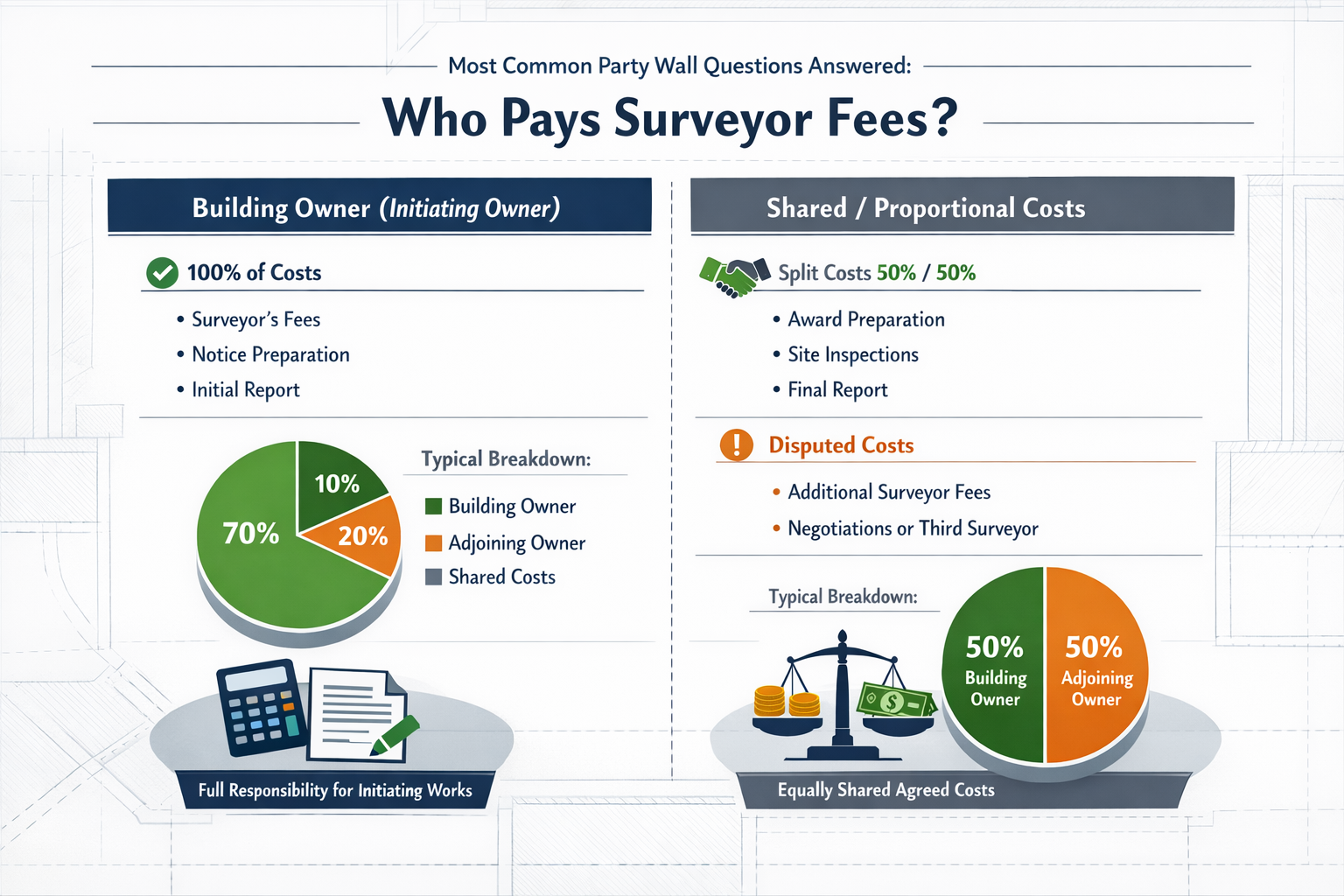
Section 11(1) of the Party Wall etc. Act 1996 establishes that the building owner pays all reasonable costs associated with the party wall process[4]. This includes:
- ✅ The building owner's surveyor fees
- ✅ The adjoining owner's surveyor fees
- ✅ The cost of preparing party wall awards
- ✅ Schedule of condition surveys
- ✅ Reasonable site inspection costs
This principle exists because the building owner initiates the work and benefits from it. The adjoining owner hasn't chosen to undertake construction but must participate in the process to protect their property rights[1].
"The building owner is responsible for all reasonable costs incurred by the adjoining owner in appointing their own surveyor, even though that surveyor has a statutory duty to act impartially for 'the wall' rather than as a personal representative." [4]
What Adjoining Owners Pay (Usually Nothing)
Adjoining owners typically pay nothing for standard party wall procedures. Their surveyor's reasonable fees are covered by the building owner. However, exceptions exist:
- Additional work requests: If an adjoining owner requests extra site visits beyond what's reasonable for protection
- Betterment work: If the adjoining owner asks for improvements that benefit their property beyond necessary protection
- Unreasonable behaviour: If an adjoining owner acts unreasonably, costs may be reallocated under the Act's flexibility provisions[3]
In practice, these exceptions rarely apply. Most adjoining owners simply appoint a surveyor, participate in the process, and pay nothing[2].
How Much Do Party Wall Surveyors Actually Cost?
Surveyor fees vary significantly based on project complexity and the number of adjoining owners affected. As of March 2026, typical costs include:
Standard loft conversions or rear extensions:
- Agreed surveyor (one surveyor for both parties): £800–£1,500 plus VAT
- Two separate surveyors: £1,500–£3,500 total (building owner pays both)[4]
Basement conversions and underpinning:
- Significantly more expensive due to technical complexity
- Total costs often reach £5,000–£10,000 or more
- Multiple adjoining owners increase costs proportionally[4]
Factors affecting costs:
- Number of adjoining properties affected
- Technical complexity of the work
- Need for specialist structural engineers
- Number of site visits required
- Geographic location (London typically costs more)
Homeowners looking to manage expenses should review guidance on how to keep party wall costs down before starting their projects.
The Agreed Surveyor Option: Saving Money
One of the best ways to reduce costs is appointing a single agreed surveyor to act for both the building owner and adjoining owner. This approach:
- ✅ Cuts surveyor fees roughly in half
- ✅ Streamlines the process with fewer coordination meetings
- ✅ Maintains impartiality through statutory duties
- ✅ Still provides full protection for both parties
The agreed surveyor must act impartially and cannot favour either party. They prepare the same party wall award and schedule of condition as two separate surveyors would, but with significantly reduced administrative overhead[3][7].
However, this option requires mutual agreement. The adjoining owner has an absolute right to appoint their own surveyor, and the building owner must respect this choice and pay the reasonable costs[4].
For homeowners wondering about alternatives, our guide on having a party wall agreement without a surveyor explores when this might be possible.
Excavation-Specific Questions and Cost Responsibilities
Excavation work generates unique concerns because of the potential for subsidence and structural damage. Understanding the specific requirements for digging projects helps homeowners budget accurately and avoid surprises.
When Excavation Triggers Party Wall Requirements
Any excavation work that meets the three-meter or six-meter rules requires a Party Structure Notice or Notice of Adjacent Excavation, depending on whether the boundary wall is shared[2].
Common excavation projects requiring notices:
- Basement conversions – Almost always require notices for multiple adjoining properties
- Underpinning existing foundations – Necessary when adding extensions or addressing subsidence
- Swimming pool installations – If excavation depth approaches neighbour's foundation level
- Underground rooms or cellars – Popular in urban areas with limited above-ground space
- Deep drainage or utility installations – When trenches extend below foundation levels
The depth and proximity calculations start from the lowest point of your neighbour's foundation, not ground level. This distinction matters significantly, as older properties often have shallow foundations that make the three-meter rule applicable for even modest excavations[1].
Who Pays for Excavation-Related Surveyor Work?
The same payment principles apply to excavation projects: the building owner pays all reasonable costs. However, basement and underpinning projects typically involve:
- Multiple adjoining owners (terraced houses may affect 2-4 neighbours)
- More complex structural calculations requiring engineer input
- Additional monitoring during construction
- More frequent site inspections due to subsidence risks
These factors explain why basement excavation surveyor costs often reach £5,000–£10,000 or more—the building owner pays for surveyors representing multiple adjoining owners, each conducting thorough due diligence[4].
Schedule of Condition: Essential Protection
For excavation projects, the schedule of condition becomes critically important. This photographic and written record documents the adjoining property's condition before work begins, establishing a baseline for any damage claims.
What schedules of condition include:
- 📸 Detailed photographs of all rooms, particularly walls adjoining the work
- 📋 Written descriptions of existing cracks, settlement, or defects
- 🔍 Close-up images of any pre-existing damage
- 📏 Measurements of significant cracks or structural issues
The building owner pays for this survey, typically £300–£800 per property depending on size and complexity. While this adds to upfront costs, it provides essential protection against unfounded damage claims[7].
Learn more about the importance of a schedule of condition before starting excavation work.
Special Cases and Exceptions to Standard Payment Rules
While the building owner pays surveyor fees in most situations, several exceptions and special circumstances can alter cost allocation.
Defective Party Walls: Shared Repair Costs
When a party wall is defective through no fault of either party, repair costs may be shared between the building owner and adjoining owner. This exception recognizes that both parties benefit from repairing a deteriorating shared structure[5].
Examples of shared-cost scenarios:
- Crumbling garden walls requiring rebuilding due to age
- Party walls with structural defects from original construction
- Damage from natural causes (weather, subsidence not caused by either party)
- Necessary repairs to maintain structural integrity
The cost split typically reflects each party's benefit from the repair. A party wall supporting both properties equally would usually result in 50/50 cost sharing[5].
Unreasonable Behaviour and Cost Reallocation
The Act provides flexibility to reallocate costs when either party behaves unreasonably. Examples include:
Building owner unreasonable behaviour:
- Refusing reasonable access for inspections
- Causing unnecessary damage during work
- Failing to follow award specifications
Adjoining owner unreasonable behaviour:
- Refusing reasonable access for necessary work
- Demanding excessive site visits without justification
- Requesting betterment work disguised as protection measures
When unreasonable behaviour occurs, surveyors can adjust cost allocation in the party wall award, potentially requiring the unreasonable party to bear additional expenses[3].
Challenging Unreasonable Surveyor Fees
Building owners paying all costs doesn't mean accepting any fee demanded. The Act specifies "reasonable costs" only[1].
How building owners can challenge excessive fees:
- Request detailed timesheets showing hours worked and hourly rates
- Compare rates against typical market rates for the area
- Question excessive travel costs or unnecessary site visits
- Negotiate through the building owner's surveyor who can reject unreasonable charges
- Seek third surveyor determination if agreement cannot be reached
The building owner's surveyor has a professional duty to review the adjoining owner's surveyor's fees and challenge anything unreasonable before payment[5].
For those concerned about costs, reviewing the costs of party wall the process provides comprehensive budget guidance.
Regional Considerations and Finding the Right Surveyor
Location significantly impacts both surveyor availability and costs. In 2026, London continues to have the highest surveyor fees due to property values and demand, but also offers the widest selection of experienced professionals.
London-Specific Considerations
The capital's dense housing stock means party wall procedures are routine. Homeowners benefit from:
- Extensive surveyor experience with complex scenarios
- Faster turnaround times due to familiarity with local authorities
- Higher costs reflecting London market rates
- Greater likelihood of multiple adjoining owners in terraced areas
Regional resources include surveyors specializing in East London, North London, South London, West London, and Central London.
Choosing Between Building Owner's and Adjoining Owner's Surveyors
Understanding surveyor roles helps both parties make informed choices:
Building owner's surveyor:
- Appointed by the party undertaking work
- Prepares initial notices and documentation
- Coordinates with adjoining owner's surveyor
- Reviews and challenges unreasonable costs
- Paid directly by building owner
Adjoining owner's surveyor:
- Appointed by the neighbour to protect their interests
- Reviews proposed work for potential damage risks
- Conducts schedule of condition surveys
- Must act impartially despite being paid by building owner
- Cannot simply represent adjoining owner's wishes without justification
Both surveyors must act in accordance with the Act, prioritizing the wall's integrity over either party's preferences. Learn more about building owner's surveyor and adjoining owner's surveyor roles.
What to Look for in a Party Wall Surveyor
Essential qualifications and characteristics:
- ✅ Member of the Faculty of Party Wall Surveyors (FPWS) or Royal Institution of Chartered Surveyors (RICS)
- ✅ Specific party wall experience (not just general surveying)
- ✅ Local knowledge of building practices and property types
- ✅ Clear fee structure explained upfront
- ✅ Professional indemnity insurance
- ✅ Good communication skills and responsiveness
- ✅ Reputation for impartiality and fairness
Avoid surveyors who:
- ❌ Promise to "fight for your side" (they must act impartially)
- ❌ Refuse to provide fee estimates
- ❌ Have no specific party wall qualifications
- ❌ Show poor communication or responsiveness during initial contact
Understanding Party Wall Awards and Documentation
Once surveyors are appointed and surveys completed, they prepare a party wall award—the legal document governing the work.
What Party Wall Awards Contain
A comprehensive party wall award typically includes:
- Description of proposed works with technical specifications
- Rights granted to the building owner for access and construction
- Protective measures required during construction
- Schedule of condition documenting pre-work property state
- Working hours and noise restrictions
- Insurance requirements and liability provisions
- Dispute resolution procedures if issues arise
- Cost allocation for surveyor fees and related expenses
The award is legally binding on both parties and remains with the property, affecting future owners. Understanding party wall awards helps homeowners know what to expect.
Timeline from Notice to Award
Typical party wall process timeline:
- Day 1: Building owner serves party wall notice
- Day 14: Adjoining owner responds (or deemed to dissent after 14 days)
- Days 15-21: Surveyors appointed if dissent or no response
- Days 22-35: Surveyors conduct inspections and prepare schedule of condition
- Days 36-56: Surveyors negotiate award terms and finalize documentation
- Day 57+: Award served, work can commence (usually 2-3 months total)
This timeline assumes no complications. Complex projects or multiple adjoining owners can extend the process to 3-4 months[2].
For detailed guidance on responding to notices, see our article on party wall act notices: what they are and how to respond.
Practical Tips for Building Owners and Adjoining Owners
For Building Owners: Minimizing Costs and Delays
Before starting:
- 📋 Serve notices early—don't wait until you're ready to start work
- 💰 Budget for surveyor fees from the project's beginning
- 🤝 Talk to neighbours informally before serving formal notices
- 📞 Appoint an experienced surveyor who can manage the process efficiently
During the process:
- ✅ Respond promptly to surveyor requests for information
- 📸 Attend schedule of condition surveys if possible
- 💬 Maintain good communication with neighbours
- 📝 Follow award specifications precisely to avoid disputes
Cost-saving strategies:
- Propose an agreed surveyor to reduce fees by roughly half
- Ensure your surveyor reviews adjoining owner's surveyor fees for reasonableness
- Complete work efficiently to minimize monitoring visits
- Maintain detailed records of all communications and work progress
For Adjoining Owners: Protecting Your Rights
Understanding your position:
- 💷 You typically pay nothing for standard party wall procedures
- 👤 You have the absolute right to appoint your own surveyor
- 🛡️ The process exists to protect your property from damage
- ⚖️ Your surveyor must act impartially, not as your advocate
Key actions:
- Respond to party wall notices within 14 days (even if agreeing)
- Appoint an experienced surveyor if you have concerns
- Attend the schedule of condition survey to point out existing issues
- Keep copies of all documentation for future reference
- Don't feel pressured to agree to work you believe is unsafe
For adjoining owners facing building work, our guide for those whose neighbour is carrying out works provides comprehensive advice.
Common Misconceptions About Party Wall Procedures
"I Don't Need Permission from My Neighbour"
Correct understanding: You don't need permission, but you must follow the Party Wall Act procedures. Your neighbour cannot veto reasonable work, but they have rights to protection and proper process[6].
"Party Walls Only Apply to Shared Walls"
Correct understanding: The Act covers three scenarios—work directly to party walls, building new walls on boundaries, and excavations near neighbouring structures. You can trigger requirements without touching any shared wall[1].
"If My Neighbour Agrees, We Don't Need Surveyors"
Correct understanding: If your neighbour consents in writing within 14 days, you can proceed without surveyors. However, most experts recommend using the formal process even with agreement to prevent future disputes[2].
For those exploring whether agreements can proceed without professional involvement, see our article on having a party wall agreement without a surveyor.
"The Cheapest Surveyor Is the Best Choice"
Correct understanding: Inexperienced or underqualified surveyors often cost more in the long run through delays, disputes, and inadequate protection. Professional competence matters more than initial fee quotes[7].
Conclusion
Understanding the most common party wall questions answered: excavations, alterations, and who pays surveyor fees empowers homeowners to navigate building projects confidently in 2026. The fundamental principle remains clear: building owners pay all reasonable surveyor costs under Section 11(1) of the Party Wall etc. Act 1996, covering both their own surveyor and the adjoining owner's surveyor fees[4].
Whether planning a loft conversion costing £800–£1,500 in surveyor fees or a complex basement excavation reaching £5,000–£10,000, budgeting for these expenses from the start prevents unwelcome surprises[4]. Appointing an agreed surveyor when possible, maintaining good neighbour relations, and working with experienced professionals streamlines the process and minimizes costs.
Next Steps for Your Project
If you're a building owner:
- Determine whether your planned work requires party wall notices
- Budget for surveyor fees as part of your total project cost
- Serve notices at least 2-3 months before planned work commencement
- Appoint a qualified surveyor with specific party wall experience
- Maintain open communication with neighbours throughout
If you're an adjoining owner:
- Respond to any party wall notices within 14 days
- Consider appointing your own surveyor if you have concerns (at no cost to you)
- Attend schedule of condition surveys to document existing issues
- Keep all documentation for future reference
- Don't hesitate to seek professional advice if uncertain
The party wall process exists to protect both parties' interests while allowing necessary building work to proceed. By understanding your rights and responsibilities—particularly regarding who pays surveyor fees—you can approach your project with confidence and maintain positive neighbour relationships.
For additional guidance, explore our general FAQs or contact us for project-specific advice.
References
[1] Party Wall Surveyor Costs Who Pays – https://simmonstaylorhall.co.uk/party-wall-surveyor-costs-who-pays/
[2] Who Pays For Party Wall Surveyors Party Wall Notice Costs Rights Explained For Adjoining Owners – https://thepartywallguru.com/who-pays-for-party-wall-surveyors-party-wall-notice-costs-rights-explained-for-adjoining-owners/
[3] Who Pays For A Party Wall Surveyor A Guide To Cost Responsibilities – https://nottinghillsurveyors.com/blog/who-pays-for-a-party-wall-surveyor-a-guide-to-cost-responsibilities
[4] Who Pays For Party Wall Surveyor – https://blackacresurveyors.com/2026/03/12/who-pays-for-party-wall-surveyor/
[5] Party Wall Surveying Fee All You Need To Know – https://arunassociates.co.uk/party-wall-surveying-fee-all-you-need-to-know/
[6] Who Pays For A Party Wall Surveyor – https://partywalldiy.com/guides/who-pays-for-a-party-wall-surveyor
[7] Party Wall Surveyor Cost – https://hoa.org.uk/advice/guides-for-homeowners/i-am-improving/party-wall-surveyor-cost/
[8] Who Pays For A Party Wall Surveyor – https://www.wlbuildingsurveyors.co.uk/2019/03/who-pays-for-a-party-wall-surveyor/
[9] Party Wall Common Questions – https://www.hsa-surveyors.com/party-wall-common-questions/