

Planning construction work that affects a shared wall with your neighbour? You're about to enter the world of party wall procedures—a legal framework that protects both property owners while enabling essential building projects. For first-time builders in 2026, understanding The Full Party Wall Process Explained: From Notice Service to Award Enforcement can mean the difference between a smooth construction experience and costly legal disputes.
The party wall process might seem daunting at first, but it follows a logical sequence designed to protect everyone's interests. Whether you're extending your kitchen, adding a loft conversion, or underpinning foundations, knowing each step—from serving the initial notice to enforcing the final award—empowers you to navigate this legal requirement confidently. This comprehensive guide demystifies the entire journey, providing clear timelines, explaining neighbour responses, and clarifying when professional surveyors become necessary.
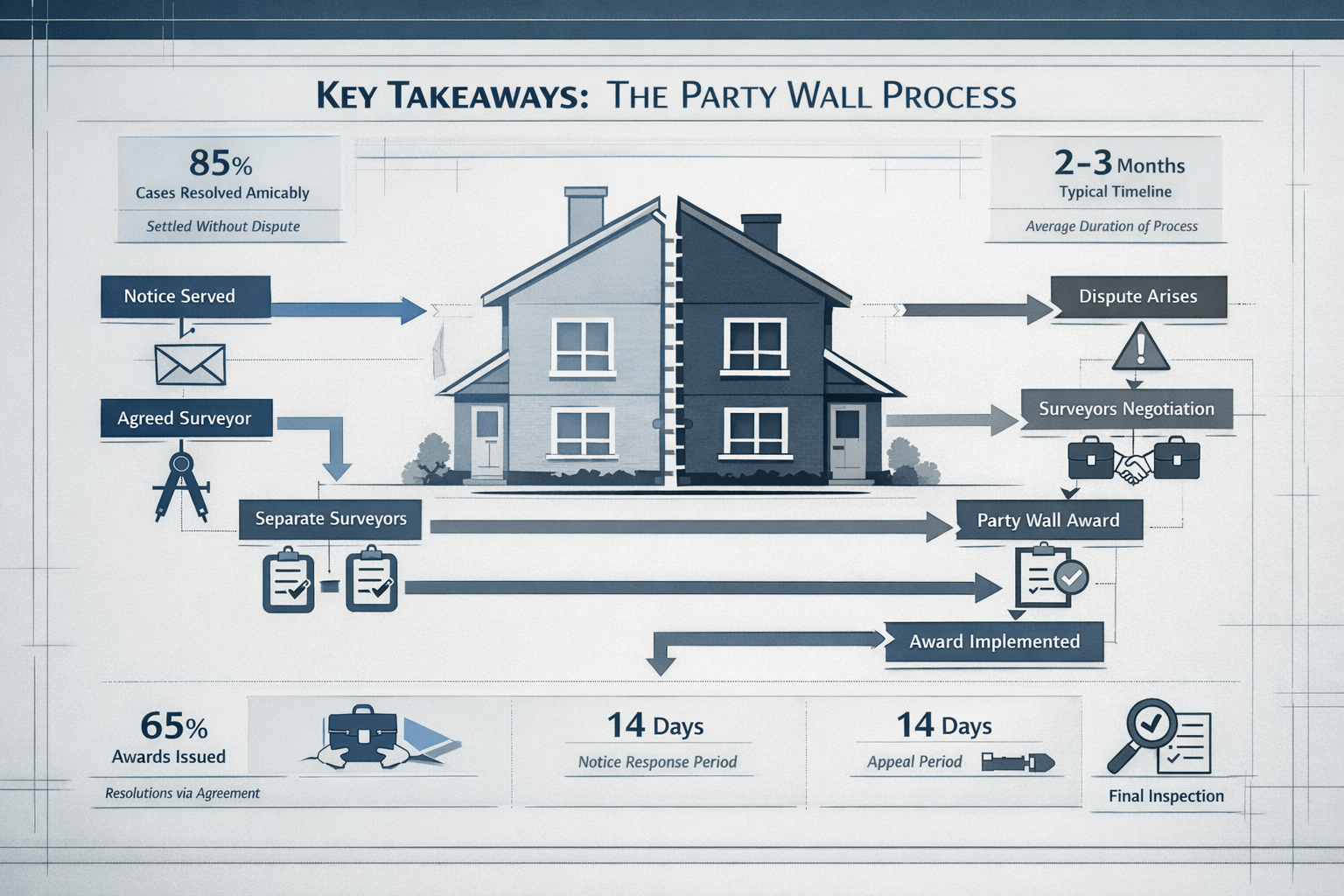
Key Takeaways
- Notice periods matter: You must serve party wall notices 2 months before starting work (or 1 month for certain types), giving neighbours time to respond and protecting your legal position
- Three possible outcomes: Neighbours can consent in writing, dissent (triggering surveyor appointments), or ignore the notice (treated as automatic dissent after 14 days)
- Surveyors create binding awards: Once appointed, party wall surveyors produce legally enforceable awards that specify work conditions, cost responsibilities, and dispute resolution mechanisms
- Timeline planning is critical: The full process from notice service to starting work typically takes 6-12 weeks, requiring early planning before your construction schedule
- Awards are legally enforceable: Party wall awards can be enforced through county courts if either party fails to comply with the agreed terms
Understanding the Party Wall Process: What It Covers
The Party Wall etc. Act 1996 governs construction work affecting shared structures between properties. Before diving into The Full Party Wall Process Explained: From Notice Service to Award Enforcement, it's essential to understand what situations trigger these legal requirements.
When Does the Party Wall Act Apply? 🏗️
The Act covers three main scenarios:
- Work directly to an existing party wall (Section 2) – modifications, repairs, or structural changes to walls shared between properties
- Building on the boundary line (Section 1) – constructing new walls at the property boundary
- Excavation near neighbouring properties (Section 6) – digging within 3-6 meters of an adjoining structure
Property owners can perform 13 permitted actions on party walls, including underpinning party walls, raising them, removing sections, installing beams, and various other modifications[2]. However, each action requires proper notification and, in many cases, formal consent from affected neighbours.
What Exactly Is a Party Wall?
A party wall is shared by two adjoining properties, but the boundary doesn't necessarily run through the centre of the wall. The boundary can be located anywhere along the wall's thickness, with the wall considered a party wall only to the extent it is enclosed and shared between properties[2]. This distinction becomes crucial when determining rights and responsibilities during construction.
Understanding types of party wall works helps clarify which procedures apply to your specific project. Different work types trigger different notice requirements and timelines.
Step 1: Serving Party Wall Notices – The Starting Point
The first critical stage in The Full Party Wall Process Explained: From Notice Service to Award Enforcement involves properly serving notice to your neighbours. This formal notification isn't merely a courtesy—it's a legal requirement that protects both parties' interests.
Types of Party Wall Notices 📋
Three distinct notice types exist, each corresponding to different work categories:
| Notice Type | Purpose | Notice Period | Section |
|---|---|---|---|
| Party Structure Notice | Work directly affecting the party wall | 2 months | Section 2 |
| Line of Junction Notice | Building a new wall on the boundary | 1 month | Section 1 |
| Notice of Adjacent Excavation | Digging within 3-6m of neighbour's foundation | 1 month | Section 6 |
What Must Your Notice Include?
A valid party wall notice must contain specific information:
- Your details as the building owner
- Adjoining owner's details (your neighbour)
- Detailed description of proposed works with drawings or plans
- Proposed start date for construction
- Statement of rights explaining the neighbour's options
"When party wall work is confirmed, the proper course of action is to obtain written acceptance from the adjoining owner before construction begins."[4]
How to Serve the Notice Correctly
Proper service is crucial—incorrectly served notices can invalidate the entire process:
✅ Hand delivery with signed acknowledgment
✅ Recorded delivery postal service with tracking
✅ Email if the neighbour agrees to electronic service
✅ Service to the property if the owner cannot be located
For detailed guidance on serving different notice types, review our guide on party wall act notices and how to respond.
Common Notice Mistakes to Avoid ⚠️
First-time builders often stumble at this stage:
- Insufficient notice period – counting days incorrectly or starting work too soon
- Incomplete work descriptions – vague details that don't specify the full scope
- Missing adjoining owners – failing to notify all affected neighbours
- Incorrect property identification – wrong addresses or boundary descriptions
The Party Wall Act is a critical consideration that property developers in London cannot defer until late in their project planning[5]. Starting the notice process early prevents construction delays and maintains positive neighbour relations.
Step 2: Neighbour Responses – Three Possible Outcomes
After serving your party wall notice, the adjoining owner has 14 days to respond. This response period is a crucial component of The Full Party Wall Process Explained: From Notice Service to Award Enforcement, as it determines whether you proceed with simple consent or require formal surveyor involvement.
Option 1: Written Consent (The Simplest Route) ✅
When your neighbour agrees in writing to your proposed works, the process becomes straightforward:
- No surveyors needed
- No party wall award required
- Work can proceed after the notice period expires
- Neighbour retains rights to claim for any damage
Important: Verbal consent isn't sufficient. You need documented written agreement that specifically references the notice and proposed works. This protects both parties if disputes arise later.
Option 2: Dissent (Triggering the Award Process) 📝
If your neighbour dissents (disagrees) or has concerns about the proposed work, the formal dispute resolution process begins:
- Surveyor appointments become mandatory
- Party wall award must be prepared
- Additional costs for surveyor fees apply
- Timeline extends by several weeks
Section 1 of the Party Wall Act requires descent from neighbours, while other sections require formal consent, with different notice periods applying to each action type[2]. Understanding these distinctions helps manage expectations.
Dissent doesn't mean your project stops—it simply means professional surveyors will create a formal agreement protecting everyone's interests. Many neighbours dissent not from opposition but from wanting professional documentation of the property's pre-work condition.
Option 3: No Response (Deemed Dissent) ⏰
If your neighbour fails to respond within 14 days, the law treats this silence as automatic dissent:
- Same process as formal dissent
- Surveyor appointments required
- You cannot assume consent from silence
- The 14-day clock starts from proven notice service
This provision prevents building owners from claiming implied consent when neighbours simply didn't receive or understand the notice.
What Happens Next After Each Response?
If consent granted: Wait until the notice period expires, then commence work while remaining liable for any damage caused.
If dissent or no response: Move immediately to Step 3—appointing party wall surveyors to prepare the award. Time is critical here, as surveyor appointments and award preparation add 4-8 weeks to your timeline.
For adjoining owners uncertain about how to respond, professional advice helps protect their interests without unnecessarily delaying reasonable construction projects.
Step 3: Appointing Party Wall Surveyors
When dissent occurs (or is deemed to occur), The Full Party Wall Process Explained: From Notice Service to Award Enforcement enters its most technical phase: surveyor appointments. This stage requires careful attention to legal procedures and strategic decisions.

Three Surveyor Appointment Options
The Party Wall Act provides three distinct appointment structures:
Option 1: Agreed Surveyor (Most Common)
Both parties jointly appoint a single surveyor to act impartially:
- ✅ Most cost-effective approach
- ✅ Faster award preparation
- ✅ Single fee shared between parties
- ⚠️ Requires mutual trust in the surveyor's impartiality
Option 2: Two Surveyors + Third Surveyor
Each party appoints their own surveyor, who together select a third surveyor:
- ✅ Each party has dedicated representation
- ✅ Greater protection for complex disputes
- ⚠️ Higher costs (three surveyors' fees)
- ⚠️ Longer timeline for coordination
Option 3: Building Owner Appoints for Both Parties
If the adjoining owner doesn't appoint a surveyor within 10 days, the building owner can appoint on their behalf:
- Ensures process continues despite neighbour inaction
- Appointed surveyor must still act impartially
- Neighbour retains right to challenge appointment
The Surveyor Selection Process 🔍
Choosing the right surveyor significantly impacts the outcome. Consider these factors:
Essential qualifications:
- Member of Faculty of Party Wall Surveyors (FPWS) or similar professional body
- Proven experience with similar work types
- Local knowledge of construction practices
- Professional indemnity insurance
Questions to ask potential surveyors:
- How many party wall awards have you prepared?
- What's your typical timeline from appointment to award?
- How do you handle fee disputes?
- Can you provide references from recent cases?
Whether you're the building owner initiating work or the adjoining owner responding to a notice, selecting an experienced professional protects your interests throughout the process.
Understanding Surveyor Fees 💷
Surveyor costs represent a significant consideration in the party wall process:
| Scenario | Typical Cost Range | Who Pays? |
|---|---|---|
| Agreed surveyor (simple case) | £700-£1,500 | Building owner |
| Two surveyors (standard) | £1,500-£3,500 total | Building owner |
| Complex disputes | £3,000-£8,000+ | Building owner (usually) |
The building owner typically bears all reasonable surveyor costs, including the adjoining owner's surveyor fees. This principle encourages building owners to maintain good neighbour relations and serve clear, reasonable notices.
For strategies on managing expenses, see our guide on how to keep party wall costs down. Early planning and clear communication significantly reduce overall costs.
What Surveyors Actually Do
Once appointed, party wall surveyors undertake several critical tasks:
- Inspect both properties to document existing conditions
- Prepare schedule of condition with photographs and detailed notes
- Review proposed works for compliance and reasonableness
- Negotiate terms between parties if disputes exist
- Draft the party wall award with binding terms
- Serve the award on both parties
This professional oversight ensures work proceeds safely while protecting both properties from damage or disputes.
Step 4: The Party Wall Award – Your Binding Agreement
The party wall award represents the culmination of The Full Party Wall Process Explained: From Notice Service to Award Enforcement. This legal document transforms informal agreements into enforceable obligations, providing clarity and protection for all parties involved.
What Is a Party Wall Award?
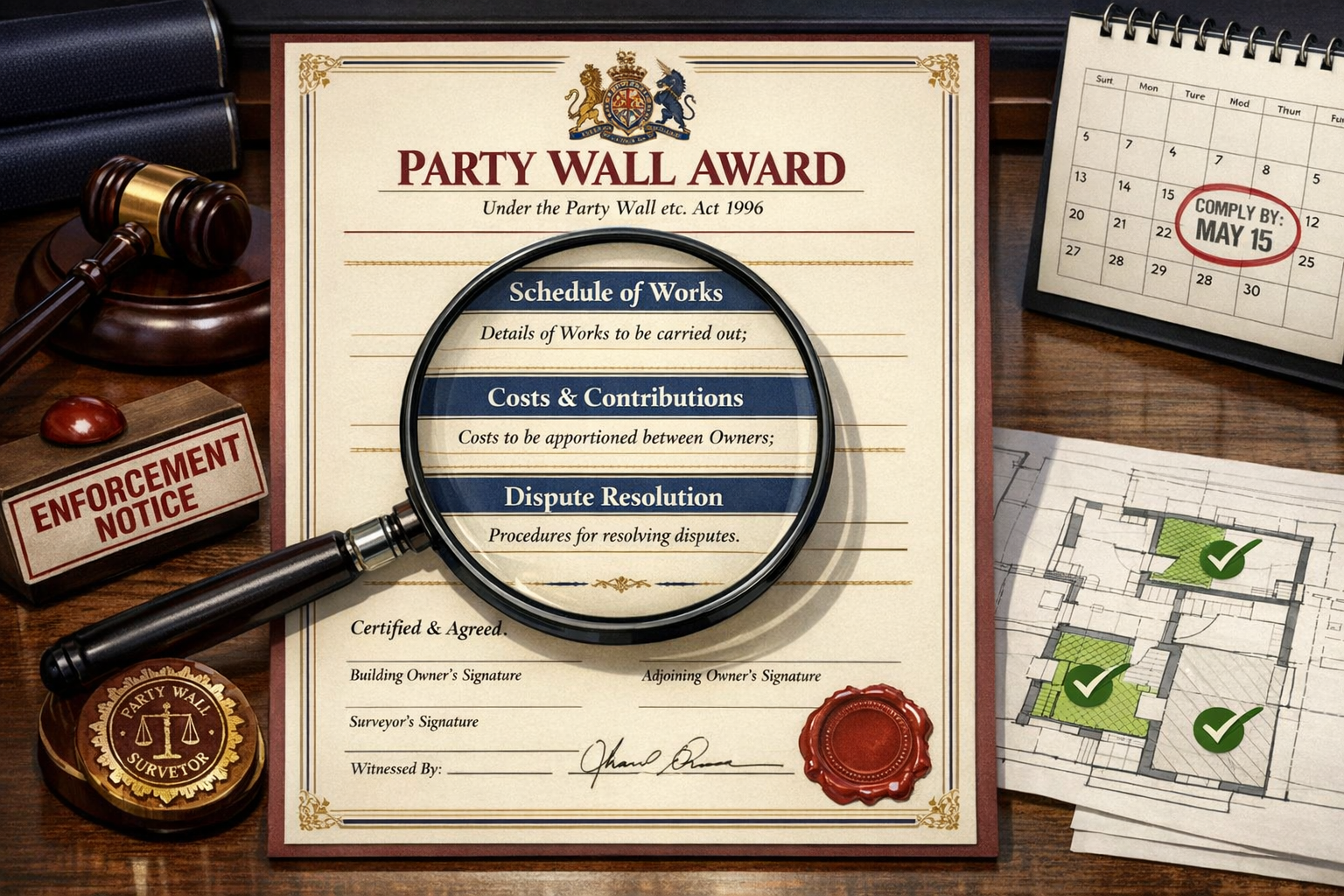
A party wall award is a legally binding document prepared by the appointed surveyor(s) that:
- Authorizes specific works with detailed descriptions
- Sets conditions for how work must be carried out
- Allocates costs between building and adjoining owners
- Establishes monitoring procedures during construction
- Provides dispute resolution mechanisms if issues arise
Think of it as a comprehensive contract that nobody can ignore—it has the same legal standing as a court order.
Essential Components of a Party Wall Award 📄
Every properly prepared award must include:
1. Parties and Properties
- Full names and addresses of building and adjoining owners
- Legal descriptions of affected properties
- Surveyor details and appointment dates
2. Work Description
- Detailed specifications of permitted works
- Architectural drawings and technical plans
- Materials and construction methods
- Timeline and working hours restrictions
3. Conditions and Protections
- Access requirements for inspections
- Protective measures during construction
- Noise and dust control provisions
- Emergency contact procedures
4. Schedule of Condition
- Photographic record of existing property state
- Documentation of pre-existing cracks, defects, or damage
- Baseline for assessing any construction-related damage
5. Cost Allocation
- Who pays surveyor fees (typically building owner)
- Responsibility for making good any damage
- Dispute resolution costs if they arise
6. Rights and Obligations
- Building owner's right to access
- Adjoining owner's right to inspect work
- Procedures for variations or additional works
- Enforcement mechanisms
For those interested in the technical details, our party wall contract template guide provides deeper insight into award structure.
Timeline for Award Preparation ⏱️
From surveyor appointment to award service typically takes:
- Simple cases: 3-4 weeks
- Standard cases: 4-6 weeks
- Complex disputes: 6-12 weeks
Factors affecting timeline include:
- Property access for inspections
- Complexity of proposed works
- Level of dispute between parties
- Surveyor workload and responsiveness
Receiving and Responding to the Award
Once prepared, the award is served on both parties simultaneously. You then have 14 days to:
✅ Accept the award and proceed with work
⚠️ Appeal to the Third Surveyor if you disagree with terms
🏛️ Appeal to the County Court within 14 days on specific legal grounds
Important: The 14-day appeal window is strict. Missing this deadline means accepting the award as written, with no further recourse except for enforcement issues.
Most awards are accepted without appeal, as professional surveyors balance both parties' interests fairly. Appeals typically arise only when:
- Costs seem unreasonably allocated
- Work restrictions appear excessive
- Technical specifications are unclear or impractical
Can You Proceed Without an Award?
If your neighbour consented in writing to your original notice, you don't need a formal award. However, many building owners still commission a schedule of condition to document the property's pre-work state—this protects against future damage claims.
For those wondering about having a party wall agreement without a surveyor, it's possible with written consent, but professional documentation often proves invaluable if disputes emerge during construction.
Step 5: Commencing Work Under the Award
With the party wall award in place, you're finally ready to begin construction. However, The Full Party Wall Process Explained: From Notice Service to Award Enforcement doesn't end when you receive the award—compliance during construction is equally critical.
Pre-Construction Requirements ✅
Before the first hammer swings, ensure:
1. Award acceptance period expired (14 days from service)
2. Schedule of condition completed and shared with adjoining owner
3. Insurance documentation provided to neighbours if required
4. Access arrangements confirmed for any necessary inspections
5. Contractor briefing on award terms and restrictions
Working Within Award Terms
The award specifies exact conditions you must follow:
Working hours – Typically limited to:
- Monday-Friday: 8:00 AM – 6:00 PM
- Saturday: 8:00 AM – 1:00 PM
- Sunday and bank holidays: No noisy work
Access provisions – The adjoining owner or their surveyor may:
- Inspect work at reasonable times with notice
- Photograph progress for documentation
- Request surveyor visits if concerns arise
Protective measures – Required safeguards might include:
- Protective boarding over adjoining property features
- Dust suppression systems
- Vibration monitoring equipment
- Structural support during excavation
Monitoring and Inspections 🔍
Throughout construction, the appointed surveyor(s) may conduct periodic inspections to verify:
- Work matches award specifications
- No unauthorized additional work occurs
- Protective measures remain in place
- No damage to adjoining property develops
Building owner responsibilities:
- Provide reasonable access for inspections
- Notify surveyor before key construction stages
- Document work progress with photographs
- Report any unexpected issues immediately
Adjoining owner rights:
- Request surveyor inspections if concerned
- Document any perceived damage or issues
- Require work stoppage if award terms violated
- Claim compensation for any proven damage
Handling Variations and Additional Works
Sometimes construction reveals unexpected conditions requiring work changes:
Minor variations – Small adjustments within the award's scope may proceed with surveyor notification
Significant changes – Substantial deviations require:
- Immediate work stoppage in affected areas
- Surveyor notification and assessment
- Supplemental award or written agreement
- Adjoining owner consent to changes
Never proceed with work beyond the award's scope without proper authorization—this exposes you to legal liability and potential injunctions.
Step 6: Award Enforcement and Dispute Resolution
The final stage of The Full Party Wall Process Explained: From Notice Service to Award Enforcement addresses what happens when parties don't comply with award terms or disputes arise during construction.
When Enforcement Becomes Necessary ⚖️
Enforcement issues typically arise in these scenarios:
Building owner non-compliance:
- Working outside permitted hours
- Causing damage and refusing to repair
- Blocking surveyor access for inspections
- Performing unauthorized additional work
Adjoining owner obstruction:
- Refusing reasonable access required by award
- Interfering with lawful construction
- Making false damage claims
- Preventing surveyor inspections
Enforcement Mechanisms
Party wall awards carry legal weight equivalent to court orders, providing several enforcement routes:
1. Surveyor Intervention (First Step)
Contact the appointed surveyor(s) immediately when issues arise:
- Surveyors can mediate disputes informally
- Issue written directions to non-complying parties
- Prepare supplemental awards if needed
- Document violations for potential legal action
2. County Court Enforcement
If informal resolution fails, awards are enforceable through county courts:
Process:
- File application to enforce the award
- Court reviews award terms and alleged breach
- Hearing scheduled (typically 4-8 weeks)
- Court orders compliance and may award costs
Remedies available:
- Injunction to stop unauthorized work
- Order for specific performance (compelling compliance)
- Damages for breach of award terms
- Cost orders against non-complying party
3. Appeal Process
Dissatisfied parties can appeal awards, but grounds are limited:
Valid appeal grounds:
- Procedural errors in award preparation
- Surveyor exceeded their authority
- Award contains factual errors or ambiguities
- Unreasonable cost allocations
Appeal timeline:
- 14 days from award service to appeal to Third Surveyor
- 14 days from Third Surveyor decision to appeal to County Court
- Missing these deadlines typically bars appeals
Common Enforcement Scenarios 📋
Scenario 1: Damage During Construction
If construction causes damage to the adjoining property:
- Document damage immediately with photographs
- Notify surveyor within 7 days
- Surveyor assesses whether damage resulted from works
- Building owner must make good damage at their expense
- If dispute arises, surveyor determines liability
The schedule of condition becomes critical evidence distinguishing pre-existing conditions from construction-related damage.
Scenario 2: Access Denial
When the adjoining owner refuses access required by the award:
- Provide written notice requesting access with specific dates/times
- Allow reasonable time for response (7 days)
- If refused, notify surveyor who can issue formal direction
- As last resort, apply to county court for access order
Scenario 3: Work Beyond Award Scope
If the building owner performs work not covered by the award:
- Adjoining owner should document unauthorized work
- Notify surveyor immediately
- Surveyor can order work stoppage
- New notice and award may be required
- Building owner liable for any resulting damage
Costs of Enforcement 💷
Who pays enforcement costs?
Generally, the non-complying party bears costs:
- If building owner breaches award: they pay legal and surveyor costs
- If adjoining owner obstructs unreasonably: they may pay costs
- If disputes arise from ambiguous award terms: costs may be shared
Typical enforcement costs:
- Surveyor dispute resolution: £500-£2,000
- County court applications: £1,500-£5,000+
- Full litigation: £5,000-£20,000+
These costs underscore the importance of compliance and good-faith cooperation throughout the process. For comprehensive information on financial considerations, review our guide on costs of the party wall process.
Preventing Enforcement Issues
Best practices for building owners:
- ✅ Brief contractors thoroughly on award terms
- ✅ Maintain open communication with neighbours
- ✅ Document all work with photographs
- ✅ Address concerns immediately when raised
- ✅ Keep surveyor informed of construction progress
Best practices for adjoining owners:
- ✅ Raise concerns promptly and in writing
- ✅ Allow reasonable access as required by award
- ✅ Document issues with dates and photographs
- ✅ Work through surveyor before escalating
- ✅ Distinguish between inconvenience and actual breach
Post-Construction: Completing the Process
After construction finishes, several final steps complete The Full Party Wall Process Explained: From Notice Service to Award Enforcement:
Final Inspection and Sign-Off 🔍
1. Building owner notifies completion
- Inform surveyor when work finishes
- Request final inspection appointment
- Ensure site is clean and accessible
2. Surveyor conducts final inspection
- Compares completed work to award specifications
- Assesses any damage requiring repair
- Photographs final condition
- Prepares completion report
3. Making good any damage
- Building owner must repair all construction-related damage
- Repairs should restore property to pre-work condition
- Surveyor verifies repair quality
- Costs borne by building owner per award terms
Documentation and Record Keeping 📁
Maintain comprehensive records for future reference:
- Original notices and responses
- Party wall award and any supplemental awards
- Schedule of condition (before and after)
- Construction progress photographs
- Surveyor correspondence and reports
- Receipts for all costs incurred
These documents prove invaluable if:
- Future owners question previous work
- Delayed damage claims arise
- Additional work is planned
- Property sales require disclosure
Limitation Periods for Claims ⏰
Understanding time limits for claims protects both parties:
Damage claims: Generally within 6 years of damage occurring (or discovery)
Award enforcement: No specific limitation, but prompt action advised
Contractual claims: 6 years from breach under standard limitation rules
Practical Tips for First-Time Builders
Navigating The Full Party Wall Process Explained: From Notice Service to Award Enforcement successfully requires strategic planning and attention to detail. These practical tips help first-time builders avoid common pitfalls:
Timeline Planning 📅
Start early: Begin the party wall process at least 3-4 months before your intended construction start date:
- Week 1-2: Prepare and serve notices
- Week 3-4: Await neighbour responses
- Week 5-10: Surveyor appointments and award preparation
- Week 11-12: Award service and appeal period
- Week 13+: Construction can commence
Buffer for delays: Add 2-4 weeks buffer for:
- Neighbour communication delays
- Surveyor scheduling conflicts
- Unexpected disputes requiring resolution
- Award revisions or appeals
Communication Strategies 💬
Before serving formal notice:
- Discuss plans informally with neighbours
- Explain benefits and minimize concerns
- Show preliminary drawings or plans
- Establish goodwill and trust
During the process:
- Keep neighbours informed of progress
- Respond promptly to questions or concerns
- Provide contact information for contractor and surveyor
- Offer reasonable accommodations for special circumstances
Pro tip: Good neighbour relations often mean the difference between smooth consent and contentious disputes requiring expensive surveyor involvement.
Cost Management 💰
Typical total costs for party wall process:
- Simple consent (no surveyors): £0-£500 (notice preparation)
- Agreed surveyor: £700-£1,500
- Two surveyors: £1,500-£3,500
- Complex disputes: £3,000-£8,000+
Cost-saving strategies:
- Seek written consent to avoid surveyor fees
- Choose agreed surveyor over two-surveyor approach
- Provide clear, detailed work descriptions upfront
- Address neighbour concerns before formal dissent
- Commission schedule of condition even with consent
Common Mistakes to Avoid ⚠️
❌ Starting work before notice period expires
- Even with consent, respect minimum notice periods
- Premature work can invalidate entire process
❌ Inadequate work descriptions
- Vague notices lead to disputes and supplemental awards
- Include detailed drawings and specifications
❌ Ignoring award terms
- Every condition exists for good reason
- Non-compliance exposes you to legal liability
❌ Poor contractor briefing
- Ensure contractors understand award restrictions
- Provide written copy of relevant award terms
❌ Neglecting documentation
- Photograph everything before, during, and after
- Document all communications in writing
Regional Considerations 🗺️
Party wall procedures may vary slightly by location. If you're working in specific areas, consider consulting local specialists:
- Party Wall Surveyor North London
- Party Wall Surveyor East London
- Party Wall Surveyor West London
- Party Wall Surveyor South London
- Party Wall Surveyor Central London
Local surveyors understand regional construction practices, typical costs, and area-specific considerations that affect the party wall process.
Conclusion
The Full Party Wall Process Explained: From Notice Service to Award Enforcement represents a comprehensive legal framework designed to balance property owners' construction rights with neighbours' protection interests. While the process may initially seem complex, it follows a logical sequence that, when properly executed, facilitates construction projects while preventing disputes.
Key Steps Recap
- Serve proper notice 1-2 months before construction with detailed work descriptions
- Await neighbour response within 14 days (consent, dissent, or deemed dissent)
- Appoint surveyors if dissent occurs, choosing between agreed or separate surveyors
- Obtain party wall award with binding terms, conditions, and cost allocations
- Commence work in compliance with award specifications and restrictions
- Complete construction with final inspections and making good any damage
Taking Action: Your Next Steps 🚀
If you're planning construction work:
✅ Assess whether party wall procedures apply to your project
✅ Identify all affected neighbours who require notice
✅ Prepare detailed work descriptions and architectural drawings
✅ Build timeline buffer of 3-4 months before construction start
✅ Consider professional advice from experienced party wall surveyors
✅ Communicate proactively with neighbours before formal notices
If you've received a party wall notice:
✅ Review the notice carefully within the 14-day response period
✅ Seek professional advice if you have concerns about proposed work
✅ Respond in writing whether consenting or dissenting
✅ Appoint a surveyor if you dissent or want professional representation
✅ Document your property's condition with photographs before work begins
The Value of Professional Guidance
While the party wall process is legally structured, professional surveyor involvement provides invaluable benefits:
- Expertise in technical construction and legal requirements
- Impartiality that facilitates fair agreements
- Documentation that protects all parties
- Dispute resolution that avoids costly litigation
- Peace of mind throughout the construction process
The costs of professional surveyor involvement typically represent a small fraction of overall construction budgets while providing significant protection against disputes, delays, and damage claims that could cost exponentially more.
Final Thoughts
Understanding The Full Party Wall Process Explained: From Notice Service to Award Enforcement empowers property owners to approach construction projects confidently and legally. The process exists not to obstruct development but to ensure that building work proceeds safely, fairly, and with proper consideration for all affected parties.
By starting early, communicating clearly, following proper procedures, and respecting award terms, you can navigate the party wall process smoothly—transforming what might seem like a bureaucratic obstacle into a structured framework that protects your investment and maintains positive neighbour relations.
Whether you're extending your home, developing a property portfolio, or undertaking commercial construction, mastering the party wall process is an essential skill for successful building projects in 2026 and beyond.
References
[2] Watch – https://www.youtube.com/watch?v=LSTVHcPimTc
[4] Development Along Old Party Walls – https://www.structuremag.org/article/development-along-old-party-walls/
[5] What London Property Developers Need To Know About The Party Wall Act Before They Break Ground – https://dailybusinessgroup.co.uk/2026/03/what-london-property-developers-need-to-know-about-the-party-wall-act-before-they-break-ground/