


More than 60% of adjoining owners who receive party structure notices never realise they possess a powerful legal tool to negotiate better terms. This oversight costs property owners thousands in missed opportunities to secure structural improvements at their neighbour's expense. Counter notices under the Party Wall Act remain one of the most underutilised yet strategically valuable rights available to adjoining owners in 2026.
Understanding counter notices under Party Wall Act: adjoining owner strategies to protect rights in 2026 has become essential as property development intensifies across urban areas. This comprehensive guide reveals how adjoining owners can leverage counter notices to secure structural enhancements, protect future development potential, and ensure their interests receive proper consideration during neighbouring construction projects.
Key Takeaways
- Counter notices apply exclusively to party structure works – they cannot be served in response to line of junction or excavation notices
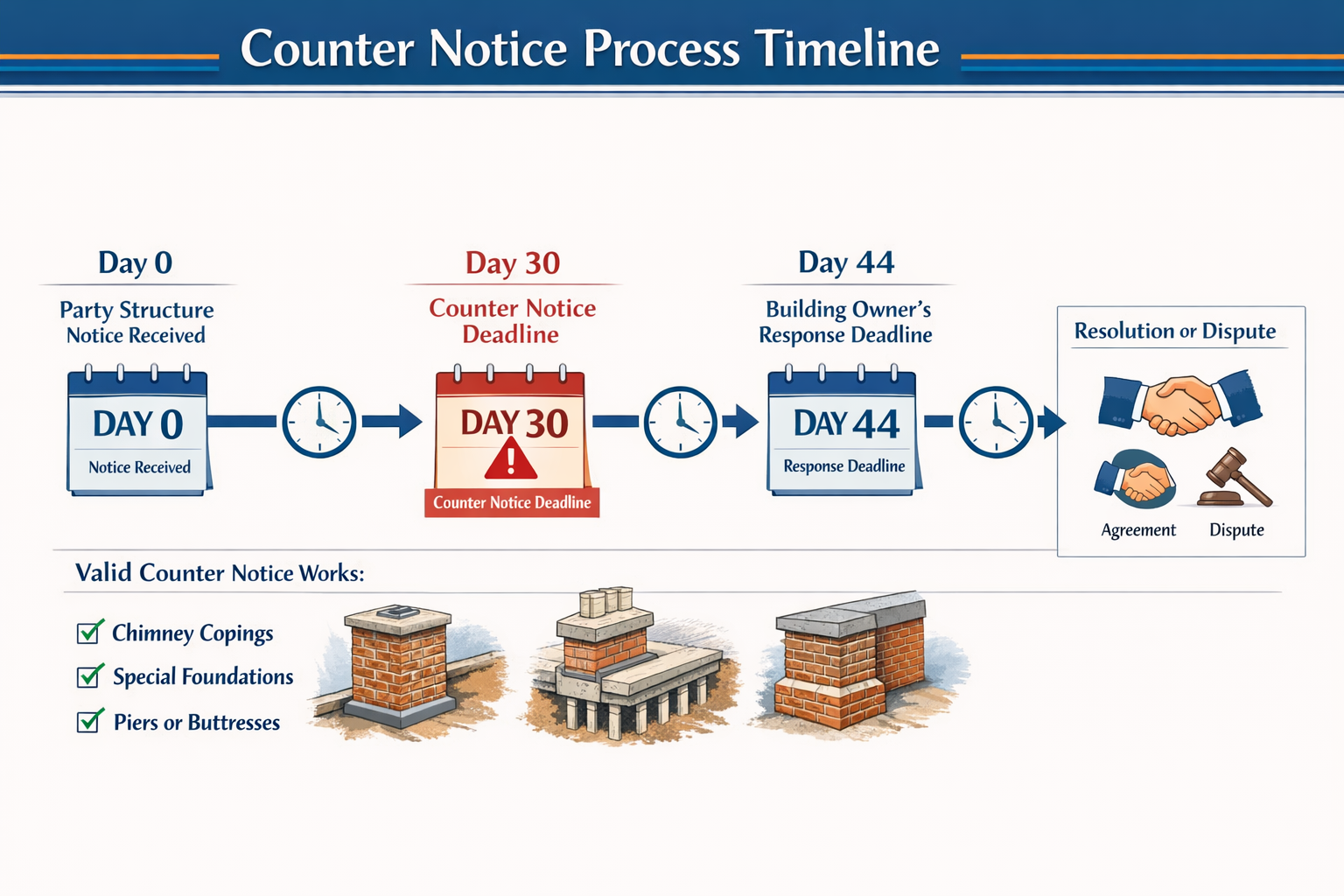
- Strict 30-day deadline – adjoining owners must serve counter notices within one month of receiving the party structure notice or lose this right permanently
- Strategic specifications only – counter notices must detail what works are required (foundations, piers, chimney breasts) but never how they should be executed
- Building owner has limited grounds for refusal – rejection is only valid if compliance causes injury to interests, unnecessary inconvenience, or unreasonable delay
- Automatic dispute resolution triggers – failure by either party to respond within statutory timeframes immediately escalates matters to surveyor determination
Understanding Counter Notices Under Party Wall Act: Foundation for Adjoining Owner Strategies in 2026
Counter notices represent a unique statutory mechanism that empowers adjoining owners to require building owners to incorporate additional structural features during party wall works. Unlike standard responses to party wall notices, counter notices actively shape the scope of construction rather than merely consenting or dissenting.
What Distinguishes Counter Notices from Standard Responses
When a building owner serves a party structure notice for works affecting an existing party wall, the adjoining owner typically has three options:
- Consent in writing – agreeing to the proposed works
- Dissent or remain silent – triggering the surveyor appointment process
- Serve a counter notice – requiring additional works for the adjoining owner's benefit
The third option remains dramatically underutilised despite offering substantial strategic advantages. Counter notices transform the adjoining owner from a passive recipient of construction impacts into an active participant who can secure structural improvements without bearing the construction costs[1].
Strict Limitation: Counter Notices Apply Only to Party Structure Works
A critical constraint that many property owners overlook: counter notices can only be served in response to Section 2 party structure notices. This means works affecting existing party walls, party fence walls, or party structures[1].
Counter notices cannot be served for:
- ❌ Section 1 notices (new building at the line of junction)
- ❌ Section 6 notices (excavation within 3 or 6 metres of neighbouring structures)
This limitation reflects the legislative intent that counter notices should allow adjoining owners to benefit from works already being undertaken on shared structures, not to impose entirely new obligations on building owners conducting separate construction[1].
The One-Month Deadline: Critical Timing for Counter Notice Service
The Party Wall etc. Act 1996 establishes an unforgiving timeline. Adjoining owners have exactly one month from the date of receiving the party structure notice to serve their counter notice[1][3].
This deadline is absolute. Missing it by even a single day eliminates the adjoining owner's right to require additional works, leaving only the options to consent or dissent to the building owner's original proposal.
Key timing considerations for 2026:
- 📅 Calculate the deadline from the date you received the notice, not when it was sent
- 📅 Serve the counter notice with sufficient time buffer (registered post or hand delivery with receipt)
- 📅 Weekends and bank holidays count toward the 30-day period
- 📅 Consider instructing a solicitor early if complex counter notice works are contemplated
Strategic Counter Notice Content: What Adjoining Owners Can Require in 2026
The substance of a counter notice determines its effectiveness. The Act specifies particular types of works that adjoining owners may require, each serving distinct strategic purposes for future development or structural enhancement.
Specific Works Permitted Under Counter Notices
Section 2(2)(m) of the Party Wall etc. Act 1996 authorises adjoining owners to require building owners to execute specific additional works. The permitted categories include[1]:
Structural Elements:
- 🏗️ Chimney copings, breasts, jambs, and flues – particularly valuable for properties planning future fireplace installations
- 🏗️ Piers or recesses – creating structural support points for future extensions or loft conversions
- 🏗️ Special foundations – requiring greater depth or strength than the building owner originally proposed
Strategic Application Example:
If a building owner plans to raise a party wall to accommodate a loft conversion, the adjoining owner might serve a counter notice requiring:
- Special foundations of increased depth to support a potential future extension on the adjoining property
- Piers at specific intervals to facilitate future structural connections
- Additional wall thickness to accommodate future flue installation
These requirements become part of the building owner's obligation, with costs allocated according to the benefit each party receives[1].
The "What" vs "How" Distinction: Avoiding Invalid Counter Notices
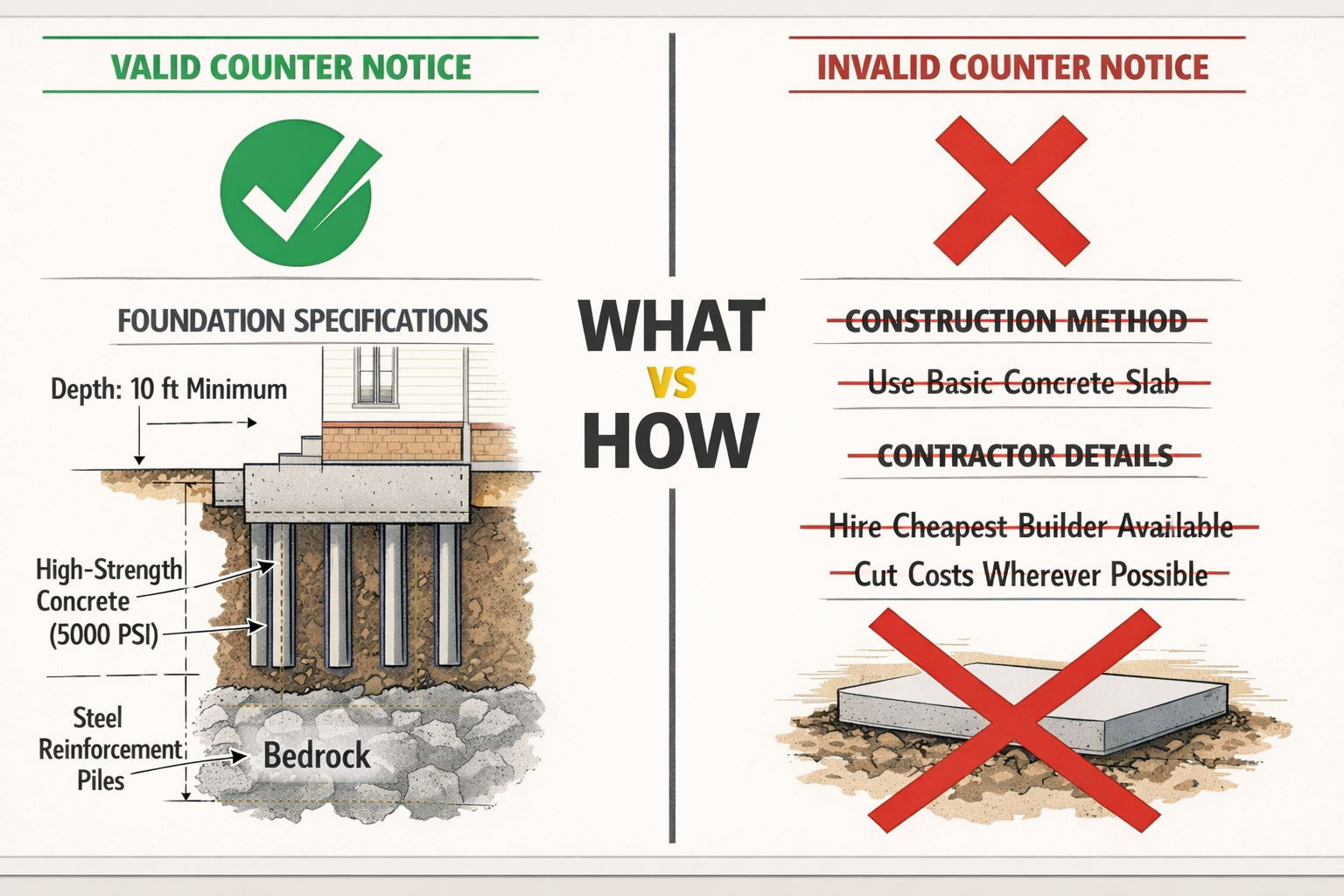
A fundamental principle governs counter notice validity: adjoining owners may specify what works are required but never how they should be executed[1].
Valid counter notice specifications:
✅ "Install special foundations of 1.5 metres depth beneath the party wall"
✅ "Construct piers at 2-metre intervals along the party wall"
✅ "Include provision for chimney breast on adjoining owner's side"
Invalid counter notice specifications:
❌ "Use concrete mix ratio of 1:2:4 for foundations"
❌ "Employ steel reinforcement bars of 16mm diameter"
❌ "Excavate foundations using hand-digging methods"
The distinction reflects a sensible policy: adjoining owners have legitimate interests in the structural outcomes but lack the right to dictate construction methodology, which remains the building owner's prerogative (subject to building regulations and surveyor oversight)[1].
Counter notices that attempt to specify construction methods are invalid and unenforceable. Building owners receiving such notices should reject them on this basis, and surveyors determining disputes will disregard method specifications[1].
Who Must Serve the Counter Notice
An often-misunderstood procedural requirement: the adjoining owner themselves (or their legal representative) must serve the counter notice – not their surveyor[1].
While surveyors play crucial roles in:
- Advising on appropriate counter notice content
- Assessing technical feasibility
- Negotiating terms with the building owner's surveyor
- Determining disputes through party wall awards
The actual service of the counter notice remains the adjoining owner's responsibility. Surveyors cannot serve counter notices on behalf of their appointing owners[1].
Best practice for 2026: Instruct a solicitor or adjoining owner's surveyor to draft the counter notice, but ensure the adjoining owner (or their solicitor as legal representative) serves it directly on the building owner.
Building Owner Response and Dispute Resolution: Protecting Adjoining Owner Rights in 2026
Once served, a counter notice triggers specific obligations for the building owner and establishes pathways for dispute resolution that adjoining owners must understand to protect their interests effectively.
The Building Owner's 14-Day Response Window
After receiving a counter notice, the building owner faces their own strict deadline: 14 days to provide written consent or rejection[1][3].
During this fortnight, the building owner must evaluate whether the requested works:
- Are technically feasible given the planned construction
- Would cause injury to the building owner's interests
- Would create unnecessary inconvenience
- Would cause unreasonable delay to the original works
If the building owner consents within 14 days, the counter notice works become incorporated into the project scope, and the parties proceed to agree on a party wall award addressing costs, timing, and specifications.
If the building owner rejects the counter notice (wholly or partially), they must provide written notice of rejection within 14 days, automatically triggering the dispute resolution process[1].
If the building owner fails to respond within 14 days, this silence is treated as dissent, equally triggering dispute resolution[1][3].
Three Legitimate Grounds for Building Owner Rejection
The Act restricts the building owner's ability to refuse counter notice requirements to three specific circumstances[1][3]:
- Injury to interests – The requested works would materially harm the building owner's property or development plans
- Unnecessary inconvenience – Compliance would create difficulties beyond those reasonably expected from the original works
- Unreasonable delay – The additional works would postpone completion beyond acceptable timeframes
Building owners cannot reject counter notices merely because:
- ❌ The additional works increase costs
- ❌ They prefer different structural solutions
- ❌ They find the requirements inconvenient (unless "unnecessary" inconvenience)
This limited rejection framework reflects the Act's policy of balancing both parties' interests while favouring structural improvements that benefit adjoining owners when building owners are already conducting party wall works[1].
Automatic Escalation to Surveyor Determination
When disputes arise over counter notices – whether through explicit rejection or failure to respond – the matter automatically proceeds to surveyor determination under Section 10 of the Act[1].
The dispute resolution process:
- Surveyor appointment – Each party appoints a surveyor (or jointly appoint an agreed surveyor)
- Site inspection – Surveyors examine the party wall and proposed works
- Technical assessment – Surveyors evaluate the feasibility and reasonableness of counter notice requirements
- Award preparation – Surveyors prepare a party wall award determining the dispute
- Award service – The award is served on both parties, creating binding obligations
The surveyors' determination addresses:
- Which counter notice works (if any) the building owner must execute
- Cost allocation between the parties
- Timing and sequencing of works
- Access arrangements and working hours
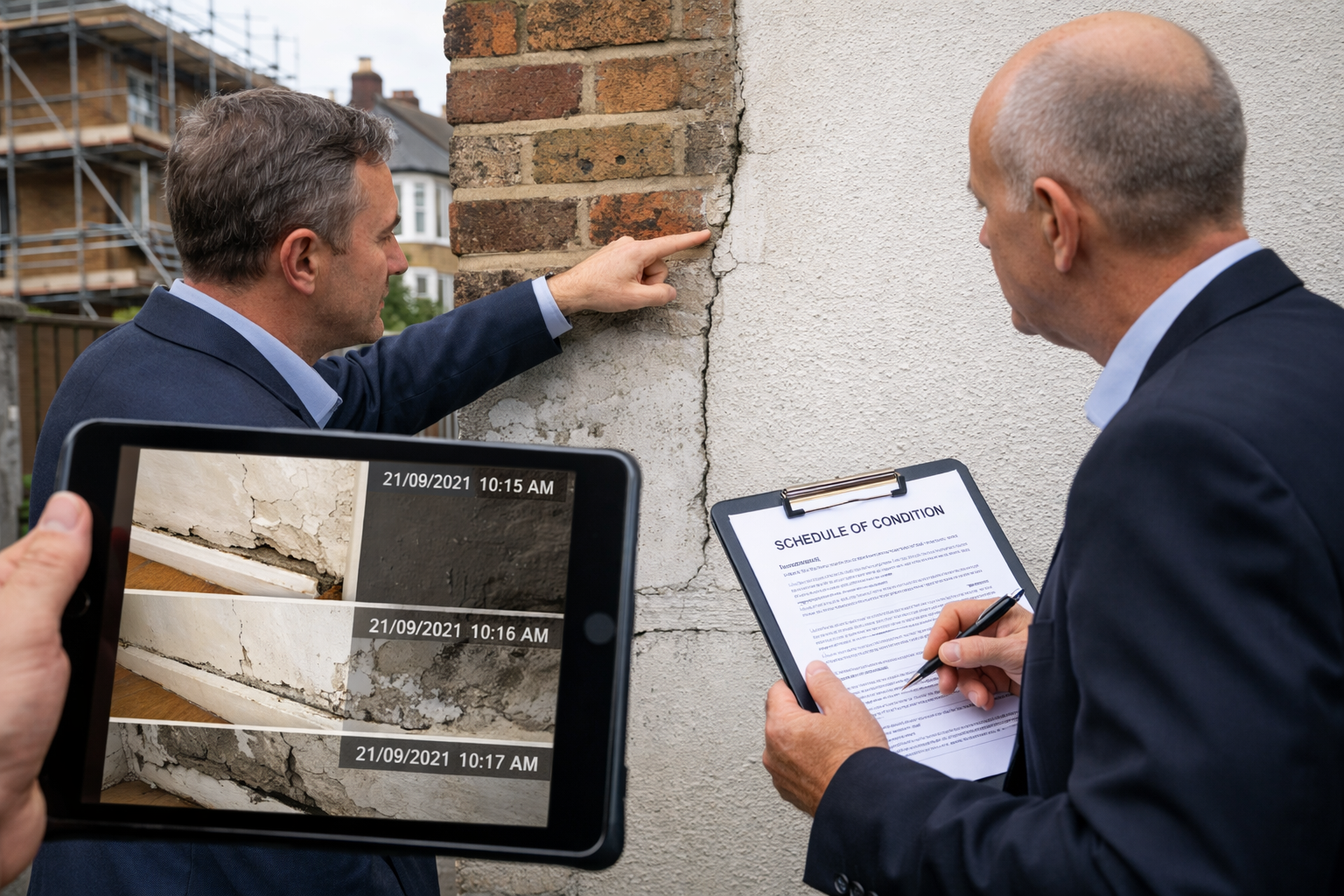
- Protection measures and schedules of condition
Critical point for adjoining owners: The surveyors' decision is binding and can only be challenged through appeal to the County Court within 14 days of receiving the award[1].
Cost Allocation Principles for Counter Notice Works
A common concern for building owners considering counter notice compliance: "Who pays for these additional works?"
The Act establishes a benefit-based cost allocation principle:
- 💷 Works benefiting only the adjoining owner – Costs borne entirely by the adjoining owner
- 💷 Works benefiting only the building owner – Costs borne entirely by the building owner
- 💷 Works benefiting both parties – Costs shared proportionally to the benefit each receives
Example scenario:
An adjoining owner's counter notice requires special foundations of increased depth. The building owner's original design required 1-metre foundations; the counter notice specifies 1.5-metre foundations to support the adjoining owner's future extension plans.
Cost allocation:
- Building owner pays for the first 1 metre (required for their works regardless)
- Adjoining owner pays for the additional 0.5 metres (exclusively for their future benefit)
This equitable framework prevents counter notices from imposing unfair financial burdens while ensuring adjoining owners can secure necessary structural provisions[1].
Practical Strategies for Adjoining Owners: Maximising Counter Notice Benefits in 2026
Beyond understanding the legal framework, adjoining owners should adopt strategic approaches to maximise the protective and developmental benefits counter notices offer.
Conduct Early Property Assessment
Before the 30-day deadline expires, adjoining owners should:
- Review development potential – Assess whether future extensions, loft conversions, or structural modifications might benefit from enhanced party wall provisions
- Consult structural engineers – Obtain professional advice on foundation depths, pier placements, or other structural elements that would facilitate future works
- Examine building owner's plans – Request detailed drawings to understand the full scope of proposed works and identify counter notice opportunities
- Calculate long-term value – Compare the cost of counter notice works now versus undertaking separate structural works later
Many adjoining owners discover that securing enhanced foundations or structural provisions through a counter notice costs a fraction of what similar works would require as a standalone project[4].
Document Existing Conditions Thoroughly
Regardless of whether you serve a counter notice, comprehensive documentation of the party wall's pre-works condition is essential:
📸 Photographic evidence – Take dated, high-resolution photographs of:
- All party wall surfaces (both sides if accessible)
- Existing cracks, stains, or defects
- Junction points with external walls
- Adjacent structures and finishes
📝 Written records – Create detailed notes describing:
- Crack locations, lengths, and widths
- Material conditions
- Any existing movement or settlement evidence
Best practice for 2026: Engage a professional surveyor to prepare a formal schedule of condition with professional photographs and technical descriptions. This document becomes invaluable if damage claims arise during or after construction[5].
Understand the Limits of Counter Notices
Strategic adjoining owners recognise what counter notices cannot achieve:
- ⚠️ Cannot stop works entirely – Counter notices modify work scope but don't prevent the building owner from proceeding
- ⚠️ Cannot address Section 1 or Section 6 notices – Limited to party structure works only
- ⚠️ Cannot impose unreasonable requirements – Surveyors will reject counter notice provisions that fail the reasonableness test
- ⚠️ Cannot dictate construction methods – Only structural outcomes may be specified
Adjoining owners with concerns beyond counter notice scope should explore:
- Formal dissent to trigger surveyor involvement for protective conditions
- Building control notifications if the works appear to violate building regulations
- Legal advice regarding restrictive covenants, easements, or other property rights
- Negotiated agreements addressing access, working hours, or damage prevention
Leverage Professional Surveyor Expertise
While adjoining owners must serve counter notices themselves, professional surveyors provide invaluable support:
Pre-counter notice services:
- Evaluating whether counter notice requirements are appropriate
- Drafting technically sound specifications
- Assessing the likelihood of building owner consent
- Calculating potential cost implications
Post-counter notice services:
- Negotiating with the building owner's surveyor
- Preparing party wall awards incorporating counter notice works
- Monitoring construction compliance
- Assessing damage claims
Engaging an experienced party wall surveyor early in the process significantly improves counter notice outcomes and ensures adjoining owner rights receive proper protection[2].
Consider Alternative Negotiation Approaches
In some circumstances, direct negotiation with the building owner may achieve better outcomes than formal counter notices:
When to consider negotiation:
- The building owner appears cooperative and reasonable
- Counter notice requirements are modest
- Both parties would benefit from modified work scope
- Avoiding surveyor fees is a priority for both parties
Negotiation strategies:
- Propose mutually beneficial modifications to the building owner's plans
- Offer to share costs of enhanced structural elements both parties would use
- Agree to expedited approval processes in exchange for specific provisions
- Document all agreements in writing through a party wall agreement
However, negotiation carries risks. Without formal counter notice service within the 30-day window, adjoining owners lose their statutory right to require specific works[3].
Recommended approach: Serve the counter notice within the deadline to preserve rights, then pursue negotiation. If negotiations succeed, the parties can agree to modify or withdraw the counter notice; if negotiations fail, the counter notice remains enforceable.
Common Counter Notice Scenarios and Case Applications
Understanding how counter notices apply in typical situations helps adjoining owners recognise opportunities to protect their interests.
Scenario 1: Neighbouring Loft Conversion with Party Wall Raising
Situation: The building owner serves a party structure notice proposing to raise the party wall by 1.5 metres to accommodate a loft conversion.
Adjoining owner's position: Currently has a single-storey rear extension but plans a future loft conversion requiring similar party wall raising.
Strategic counter notice: Require the building owner to:
- Install special foundations of increased depth to support future party wall raising on the adjoining side
- Construct the raised party wall section with sufficient thickness to accommodate future structural connections
- Include tie-in provisions at specific intervals
Outcome: The adjoining owner secures structural provisions for their future loft conversion at a fraction of what standalone foundation works would cost. The building owner bears costs for their original foundation depth; the adjoining owner pays only for the incremental enhancement.
Scenario 2: Party Wall Underpinning for Basement Excavation
Situation: The building owner serves a party structure notice for underpinning the party wall to facilitate basement excavation.
Adjoining owner's position: No current basement plans but wants to preserve the option for future excavation.
Strategic counter notice: Require special foundations of greater depth than the building owner's minimum requirement, creating a foundation system that would support future basement excavation on the adjoining side without requiring further underpinning.
Outcome: The adjoining owner preserves future development potential. Cost allocation reflects that the building owner pays for foundation depth required for their works, while the adjoining owner pays for additional depth exclusively benefiting their potential future project.
Scenario 3: Party Wall Rebuilding After Fire Damage
Situation: Fire damage requires complete party wall rebuilding. The building owner serves a party structure notice proposing reconstruction to original specifications.
Adjoining owner's position: Original party wall lacked adequate fire resistance and sound insulation. Future plans include converting the property to multiple residential units requiring enhanced acoustic performance.
Strategic counter notice: Require:
- Enhanced wall thickness beyond the original specification
- Provisions for improved fire resistance ratings
- Structural elements facilitating future internal reconfiguration
Outcome: The rebuilding project incorporates modern performance standards benefiting both properties. Surveyors determine appropriate cost sharing based on the benefit each party receives from various enhancements.
Protecting Your Rights: Essential Actions for Adjoining Owners in 2026
Counter notices represent just one component of comprehensive adjoining owner protection. Effective rights preservation requires coordinated action across multiple fronts.
Immediate Actions Upon Receiving a Party Structure Notice
⏰ Within 48 hours:
- Record the exact date and time you received the notice
- Read the notice carefully to confirm it's a Section 2 party structure notice (counter notices don't apply to other notice types)
- Photograph the notice and all accompanying documents
- Store original documents securely
📞 Within one week:
- Consult with a qualified party wall surveyor or solicitor
- Request copies of the building owner's detailed plans and specifications
- Arrange for a schedule of condition if not already completed
- Begin assessing whether counter notice requirements would benefit your property
📝 Within three weeks:
- Finalise counter notice content with professional advice
- Prepare counter notice document with precise specifications
- Arrange for proper service on the building owner (registered post or hand delivery with receipt)
⚡ Before day 30:
- Serve the counter notice with time to spare
- Retain proof of service (postal receipts, delivery confirmation, witness statements)
- Notify your surveyor that counter notice has been served
Ongoing Protection Throughout the Construction Period
Counter notice service begins the protection process but doesn't complete it. Adjoining owners should maintain vigilance throughout construction:
Regular monitoring:
- Conduct weekly site visits to observe work progress
- Document any deviations from agreed specifications
- Photograph significant construction stages
- Maintain communication with the appointed surveyor
Immediate reporting:
- Notify surveyors immediately if damage appears
- Document damage with dated photographs and descriptions
- Avoid DIY repairs before professional assessment
- Preserve evidence of causation links between works and damage
Compliance verification:
- Ensure counter notice works are executed as specified in the award
- Request surveyor inspections at critical construction stages
- Verify that special foundations, piers, or other required elements meet specifications
- Obtain as-built drawings showing actual construction details
Understanding Your Rights Under Dispute
If disputes arise during construction, adjoining owners possess specific rights:
✅ Right to surveyor representation – Your appointed surveyor must act impartially but should advocate for proper award compliance
✅ Right to site access – Surveyors can access both properties to assess compliance and investigate damage claims
✅ Right to award enforcement – Party wall awards are enforceable through County Court injunctions if building owners fail to comply
✅ Right to compensation – Damage caused by party wall works must be repaired or compensated at the building owner's expense
✅ Right to appeal – Awards can be appealed to the County Court within 14 days of service (though success requires demonstrating surveyor error)
When to seek legal advice:
- Building owner refuses to comply with the party wall award
- Significant damage occurs and causation is disputed
- The appointed surveyor appears to favour the building owner
- Works proceed without required notices or awards
- Trespass or unauthorised access occurs
For complex disputes or high-value properties, engaging solicitors specialising in party wall matters provides additional protection beyond surveyor representation[2].
Conclusion
Counter notices under Party Wall Act: adjoining owner strategies to protect rights in 2026 offer powerful tools for property owners seeking to maximise structural benefits and preserve future development options. By understanding the strict 30-day service deadline, specifying appropriate structural requirements, and leveraging professional surveyor expertise, adjoining owners can transform neighbouring construction projects into opportunities for property enhancement.
The key principles bear repeating:
🎯 Act quickly – The one-month deadline is absolute and unforgiving
🎯 Specify outcomes, not methods – Detail what structural elements are required, never how they should be built
🎯 Think strategically – Consider future development plans and how counter notice works could facilitate them
🎯 Document everything – Photographic evidence and schedules of condition protect against damage disputes
🎯 Engage professionals early – Surveyors and solicitors provide invaluable guidance through complex procedures
Your Next Steps
If you've received a party structure notice or anticipate neighbouring construction:
- Calculate your deadline – Mark the 30-day counter notice deadline prominently in your calendar
- Arrange professional consultation – Contact experienced party wall surveyors for strategic advice
- Assess your property's potential – Consider how enhanced structural provisions might benefit future development
- Prepare documentation – Commission a schedule of condition before works commence
- Review the building owner's plans – Understand the full scope of proposed works to identify counter notice opportunities
Counter notices represent a unique intersection of property rights, construction law, and strategic planning. Adjoining owners who understand and effectively deploy these mechanisms secure substantial benefits while ensuring their interests receive proper protection during neighbouring development projects.
The Party Wall etc. Act 1996 creates a balanced framework that respects both building owners' development rights and adjoining owners' protective interests. Counter notices exemplify this balance, offering adjoining owners meaningful participation in works affecting shared structures while preventing unreasonable obstruction of legitimate construction projects.
For adjoining owners navigating party wall matters in 2026, knowledge truly equals power. Understanding counter notice procedures, deadlines, and strategic applications transforms what might otherwise be a passive, reactive experience into an opportunity for proactive property enhancement and rights protection.
References
[1] Party Wall Counter Notices – https://grahamkinnear.com/party-wall-counter-notices/
[2] All You Need To Know About Party Wall Notices – https://www.stephensons.co.uk/site/blog/consumer-law-blog/all-you-need-to-know-about-party-wall-notices
[3] An Introductory Guide To The Party Wall Etc Act 1996 – https://www.parklaneplowden.co.uk/an-introductory-guide-to-the-party-wall-etc-act-1996/
[4] Party Wall Agreements What You Need To Know – https://www.fmb.org.uk/find-a-builder/ultimate-guides-to-home-renovation/party-wall-agreements-what-you-need-to-know.html
[5] Party Wall Agreement – https://hoa.org.uk/advice/guides-for-homeowners/i-am-improving/party-wall-agreement/