

Construction activity in London has surged by 15% in early 2026, creating unprecedented pressure on party wall procedures. With developers racing to capitalize on the housing boom and homeowners eager to expand properties, understanding the precise Timeline for Party Wall Notices to Awards: Avoiding Delays in 2026 Fast-Track Projects has become critical for project success. The difference between a smooth two-week approval and a three-month legal quagmire often hinges on knowing exactly when to serve notices, how neighbours must respond, and which strategies can legitimately accelerate the award process without compromising legal compliance.
Key Takeaways
- ⏱️ Statutory notice periods require 2 months for party wall work and 1 month for excavation/boundary work before starting construction
- 📋 Standard awards take 2-4 weeks for simple projects but can extend to 6-10+ weeks when disputes arise or documentation is incomplete
- 🚀 Fast-track awards can be achieved in as little as one week with agreed surveyors, cooperative neighbours, and complete documentation
- 💰 Expedited services typically cost £950+ (plus VAT) and require all parties to prioritize the project
- ✅ Awards remain valid for 12 months from issuance, providing flexibility for project scheduling
Understanding Statutory Notice Periods Under the Party Wall Act
The foundation of any party wall timeline begins with serving proper notice to adjoining owners. The Party Wall etc. Act 1996 establishes clear timeframes that cannot be shortened, regardless of how urgent your project may be.
Two-Month Notice for Party Wall Work
Any work directly affecting a party wall or structure on the boundary line requires two months' advance notice [1]. This includes:
- Building on or cutting into an existing party wall
- Underpinning a party wall
- Raising or thickening a party wall
- Demolishing and rebuilding a party wall
- Installing damp-proof courses or flashings
The two-month period gives neighbours adequate time to review plans, consult professionals, and raise legitimate concerns about how the work might affect their property [3].
One-Month Notice for Excavation and New Boundaries
A shorter one-month notice period applies to excavation work within 3-6 metres of neighbouring structures and building new walls directly on the boundary line [3][4]. This abbreviated timeframe recognizes that these works typically have less direct impact on the adjoining property.
Understanding which notice period applies to your specific project is crucial for accurate scheduling. Many developers make the costly mistake of assuming all party wall work requires the same notice period, leading to unexpected delays when they discover they've served the wrong type of notice.
The Critical 14-Day Response Window
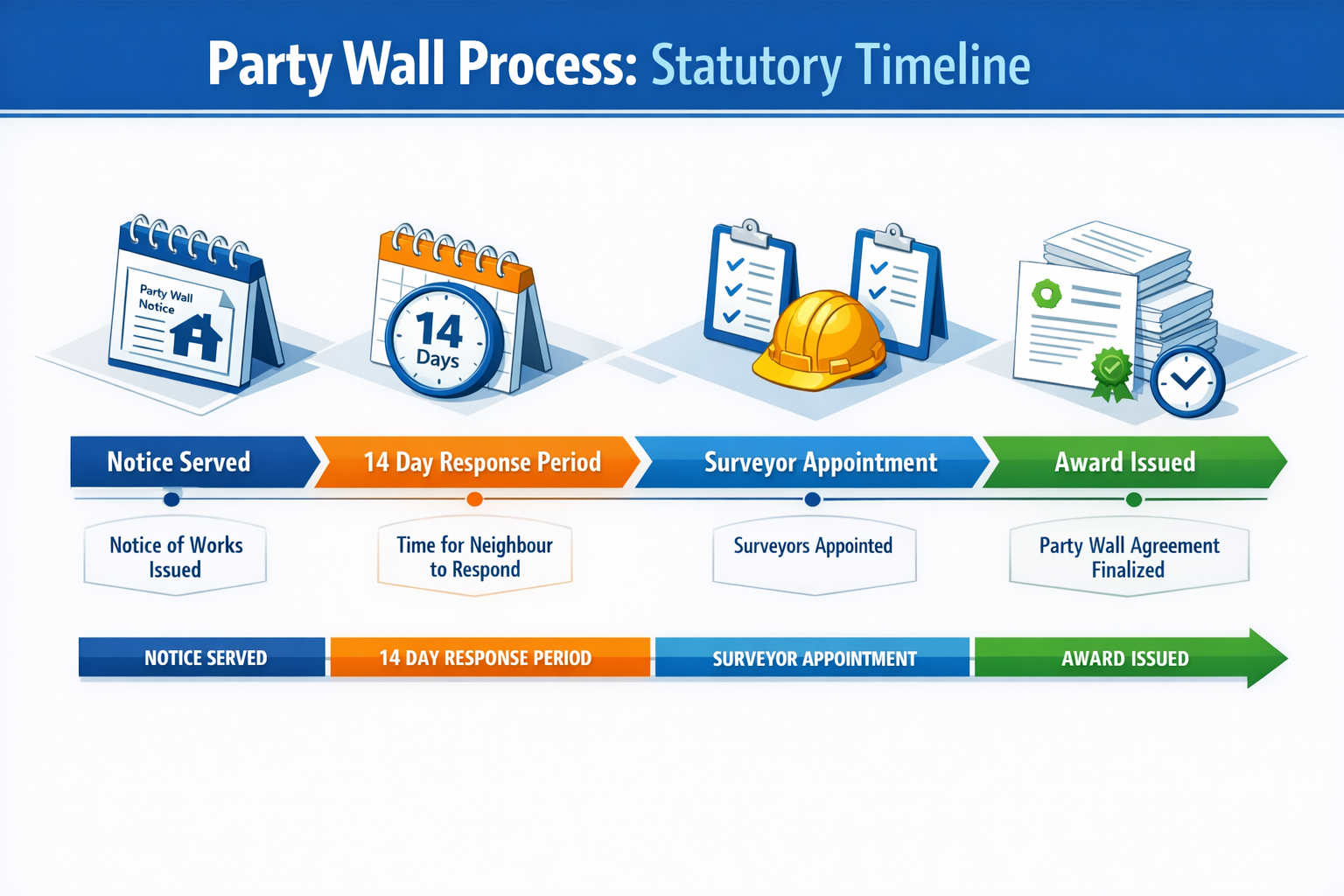
Once you've served party wall notices properly, adjoining owners have exactly 14 calendar days to respond in writing [3]. This response period is non-negotiable and represents a critical juncture in the timeline.
Neighbours have three options:
- Consent in writing – Work can proceed without a formal award (though a written agreement is still advisable)
- Dissent or fail to respond – Triggers the surveyor appointment process
- Request additional information – Can extend the timeline if initial notices lack sufficient detail
The Party Wall Award Process: From Dissent to Issuance
When an adjoining owner dissents or simply doesn't respond within 14 days, the formal dispute resolution process begins. This is where timelines can vary dramatically based on cooperation levels, documentation quality, and surveyor efficiency.
Surveyor Appointment: The 10-Day Deadline
Following dissent, surveyors must be appointed within 10 days [1]. Building owners and adjoining owners can either:
- Appoint a single agreed surveyor to act impartially for both parties
- Each appoint their own surveyor, who then work together to produce the award
The choice between these approaches significantly impacts timeline. An agreed surveyor arrangement typically accelerates the process by 2-4 weeks compared to having two separate surveyors who must coordinate schedules and potentially appoint a third surveyor to resolve disagreements [2].
Standard Award Timeline: 2-4 Weeks for Simple Projects
For straightforward projects with cooperative parties and complete documentation, party wall awards typically take 2-4 weeks from surveyor appointment to final issuance [1][3]. This assumes:
✅ Detailed architectural drawings are already prepared
✅ Structural calculations are complete and accurate
✅ Both parties respond promptly to surveyor requests
✅ The schedule of condition is conducted without delays
✅ No significant disputes arise about the proposed work
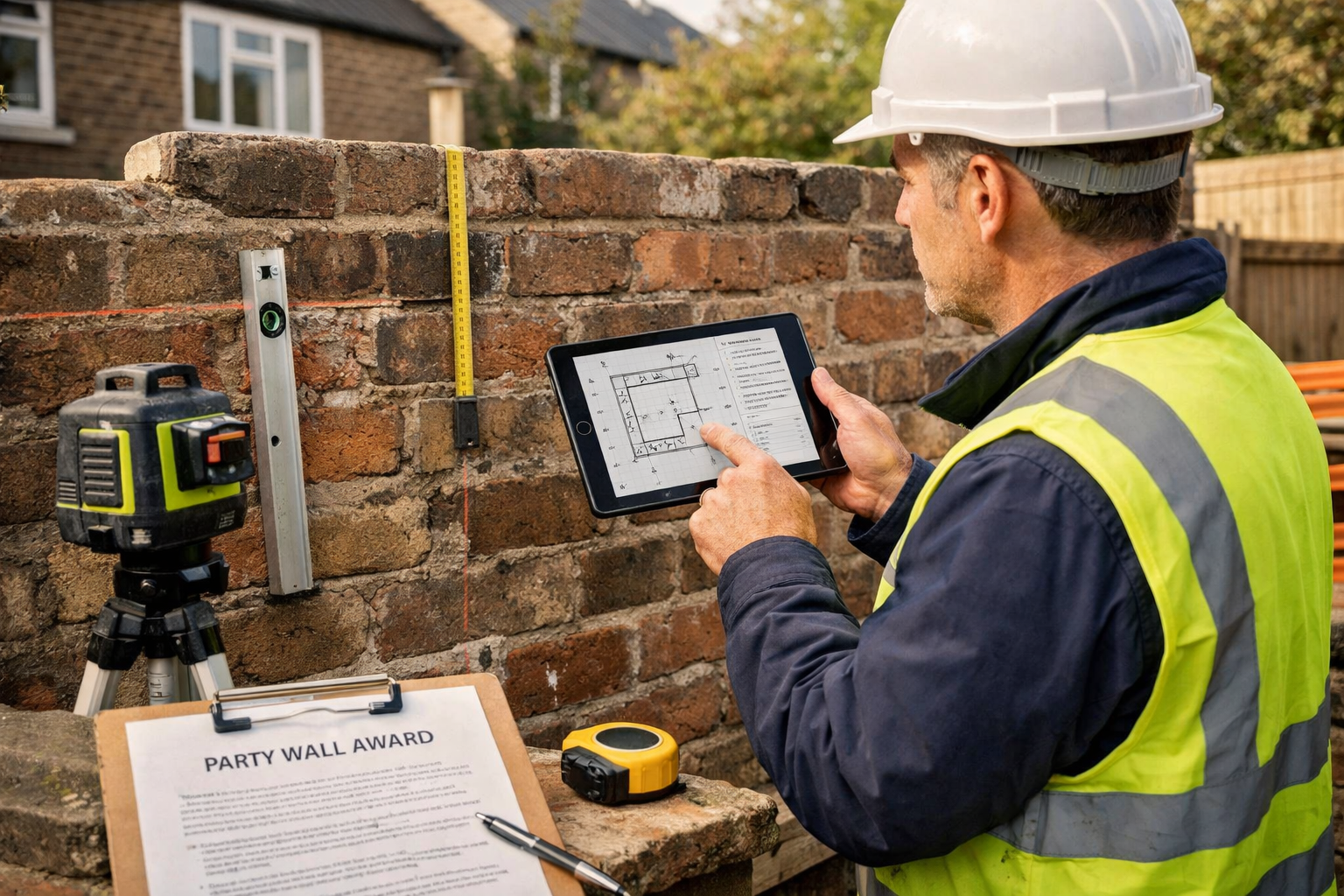
During this period, the surveyor will:
- Review all technical documentation
- Conduct site visits to both properties
- Prepare a schedule of condition documenting the adjoining property's current state
- Draft the award document with specific conditions and protections
- Obtain signatures from both parties
- Issue the final award
Complex Disputes: 6-10+ Weeks for Resolution
When complications arise, award timelines can extend to 6-10 weeks or longer [2][3]. Common delay factors include:
- Inadequate drawings requiring revisions and resubmission
- Disputed work scope necessitating negotiations between parties
- Multiple surveyors with conflicting schedules
- Technical concerns requiring additional structural assessments
- Uncooperative parties who delay responses or refuse access
One surveyor reported a case where incomplete structural calculations required three rounds of revisions, extending what should have been a 3-week process into a 12-week ordeal that nearly derailed the entire project [3].
Award Issuance and Validity Period
Once all parties reach agreement, the surveyor formally issues the award document within 1-2 weeks [1]. This document becomes legally binding and authorizes the specified work to proceed.
Importantly, party wall awards remain valid for 12 months from the date of issuance [2][3][4]. This provides valuable flexibility if your project start date shifts due to contractor availability, materials delays, or other factors. However, if you don't commence work within that year, you'll need to restart the entire notice and award process.
Timeline for Party Wall Notices to Awards: Avoiding Delays in 2026 Fast-Track Projects Through Strategic Planning
With construction demand at record levels in 2026, many developers and homeowners need accelerated timelines. While statutory notice periods cannot be shortened, several proven strategies can minimize delays during the award phase.
The Agreed Surveyor Advantage
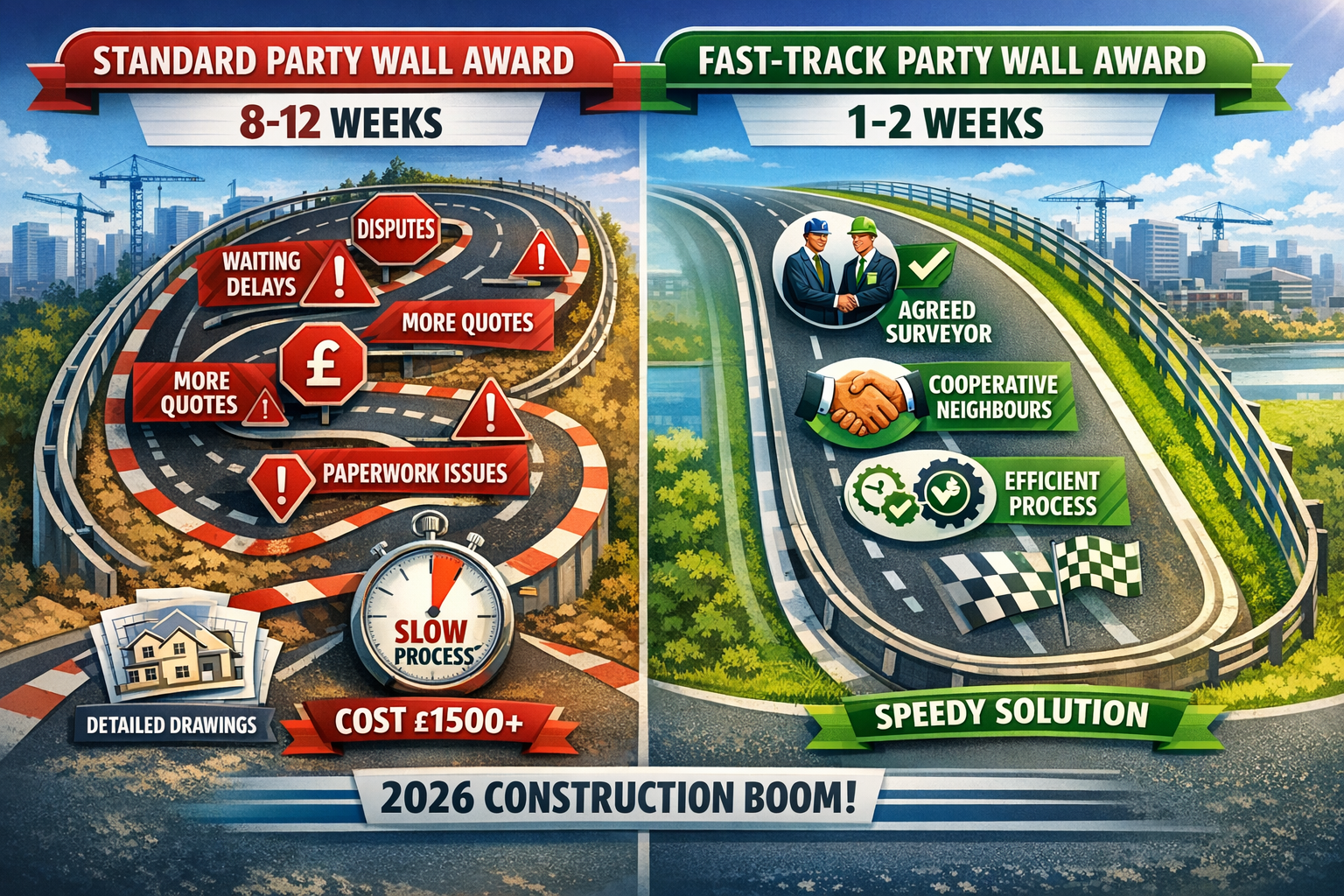
Appointing a single agreed surveyor represents the single most effective strategy for expediting the process. This approach:
- Eliminates coordination delays between multiple surveyors
- Reduces costs by avoiding duplicate site visits and assessments
- Streamlines decision-making with one impartial professional
- Prevents the need for a third surveyor to resolve disputes
Industry data shows agreed surveyor arrangements complete awards 30-40% faster than dual-surveyor appointments [2]. However, both parties must trust the surveyor's impartiality, which requires selecting an experienced professional with strong credentials.
Fastest Possible Timeline: One Week Minimum
While some firms claim 24 or 48-hour turnarounds, realistic expectations for expedited awards are at least one week even under optimal conditions [2]. This minimum timeline assumes:
- The agreed surveyor is immediately available
- All technical drawings and calculations are complete and accurate
- Both parties respond to requests within hours, not days
- The schedule of condition can be conducted immediately
- No disputes or technical concerns arise during review
In exceptional cases, some surveyors have completed awards in a single day when all conditions align perfectly, though this remains extremely rare [2].
Fast-Track Award Costs and Requirements
Achieving accelerated timelines requires surveyors to prioritize your project over their other work. Expect to pay £950+ (plus VAT) for expedited service [2], which typically includes:
- Immediate surveyor availability and prioritization
- Same-day or next-day site visits
- Rapid document review and drafting
- Expedited schedule of condition preparation
- Direct communication channels for immediate responses
For context, standard party wall costs typically range from £500-£800 per surveyor for straightforward projects, making fast-track services a 20-30% premium.
Critical Success Factors for Avoiding Delays
To minimize timeline extensions regardless of whether you're pursuing standard or expedited processing, focus on these essential elements:
1. Complete Documentation Before Notice Service
Prepare comprehensive architectural drawings, structural calculations, and method statements before serving notices. Incomplete documentation is the leading cause of delays [2][3].
2. Engage Neighbours Early
Informal conversations before formal notice service can identify concerns early and build goodwill. Understanding what matters to your neighbour allows you to address issues proactively in your initial notice.
3. Serve Notices Correctly
Errors in notice service restart the entire statutory period. Ensure notices include all required information and are served via appropriate methods. Review our guide on party wall act notices and how to respond for detailed requirements.
4. Respond Immediately to Surveyor Requests
Every day of delay in providing requested information or access extends the overall timeline. Designate a single point of contact who can respond to surveyor queries within hours.
5. Schedule Conditions Promptly
The schedule of condition documenting the adjoining property's current state often creates bottlenecks when access cannot be arranged quickly. Coordinate with neighbours to schedule this within 48 hours of surveyor appointment [2].
6. Consider Professional Representation
Working with experienced building owners' surveyors who understand fast-track procedures can significantly reduce delays through their established processes and relationships with other surveyors.
Regional Considerations for London Projects in 2026
London's diverse neighbourhoods present unique challenges that can impact party wall timelines. Understanding regional factors helps set realistic expectations.
High-Density Areas Require Extra Diligence
Projects in areas like Central London, West London, and North London often involve terraced properties with multiple adjoining owners. Each owner requires separate notice and has independent response rights, potentially multiplying timeline complexity.
A basement extension in a Victorian terrace might require serving notices to 2-3 adjoining owners, each with their own surveyor and concerns. If even one neighbour dissents while others consent, you'll need to proceed through the full award process.
New Development Areas Face Unique Pressures
Rapidly developing areas in East London and South London see heightened scrutiny of party wall work due to construction fatigue among residents. Neighbours who have already endured multiple nearby projects may be less cooperative, extending timelines [6].
Conservation Areas Add Complexity
Properties in conservation areas or listed buildings require additional approvals beyond party wall procedures. While these don't technically extend party wall timelines, they create parallel approval processes that must be coordinated carefully to avoid overall project delays.
Common Timeline Pitfalls and How to Avoid Them
Even experienced developers encounter preventable delays. Learning from common mistakes helps keep projects on schedule.
Pitfall #1: Starting Work Before Award Issuance
The most costly mistake is commencing work before receiving the formal award. This constitutes a breach of the Party Wall Act and can result in:
- Injunctions halting all work immediately
- Legal costs for both parties
- Damage claims from adjoining owners
- Complete timeline restart with damaged neighbour relationships
Solution: Never begin work until you have the signed award in hand, regardless of verbal assurances or informal agreements.
Pitfall #2: Inadequate Notice Information
Vague or incomplete notices trigger requests for clarification, restarting the statutory response period [3]. Common deficiencies include:
- Missing technical drawings or specifications
- Unclear work descriptions
- Omitted start dates or work duration
- Incomplete building owner contact information
Solution: Review notice requirements thoroughly and consider having a surveyor review your notice before service. Our party wall contract template guide provides comprehensive checklists.
Pitfall #3: Assuming Consent Equals No Award Needed
Even when neighbours consent, proceeding without a written agreement creates risk. If damage occurs or disputes arise during construction, you'll lack the protections and procedures an award provides [4].
Solution: Consider obtaining a formal award even when neighbours consent, or at minimum, document the consent and agreed work scope in a detailed written agreement. Learn more about having a party wall agreement without a surveyor.
Pitfall #4: Ignoring Schedule of Condition Importance
Rushing through or skipping the schedule of condition creates liability if pre-existing damage is later attributed to your work. This document provides essential protection for both parties [2].
Solution: Allocate adequate time for thorough photographic and written documentation of the adjoining property's condition. Never pressure surveyors to abbreviate this critical step.
Pitfall #5: Poor Communication with Neighbours
Adversarial relationships with adjoining owners guarantee maximum timelines and potential disputes. Neighbours who feel disrespected or ignored are far more likely to dissent and raise objections [3].
Solution: Maintain respectful, transparent communication throughout the process. Provide regular updates, address concerns promptly, and demonstrate genuine consideration for how the work impacts them.
Integrating Party Wall Timelines into Overall Project Planning
Party wall procedures don't exist in isolation. Successful project management requires integrating these timelines with planning permission, building control, contractor scheduling, and financing arrangements.
Backward Planning from Target Start Date
Work backward from your desired construction start date:
- Construction start date (target)
- Minus 1-2 weeks: Award issuance and final preparations
- Minus 2-4 weeks: Award drafting and negotiation
- Minus 1 week: Surveyor appointment and initial assessments
- Minus 2 weeks: Neighbour response period
- Minus 2 months: Notice service date
- Minus 2-4 weeks: Documentation preparation
This backward timeline reveals you should begin party wall procedures 3-4 months before your target construction start date for standard projects, or 2-3 months for fast-track scenarios with cooperative neighbours [1][3].
Parallel Processing with Other Approvals
While party wall procedures progress, simultaneously pursue:
- Planning permission (8-13 weeks for most applications)
- Building control approval (4-8 weeks)
- Contractor procurement (4-8 weeks)
- Materials ordering (lead times vary by product)
Understanding which approvals can proceed in parallel versus sequentially optimizes overall project timelines.
Contingency Planning for Timeline Extensions
Build 3-4 weeks of contingency into your schedule for party wall procedures [3]. This buffer accommodates:
- Unexpected neighbour concerns requiring additional negotiation
- Document revisions or supplementary information requests
- Surveyor scheduling conflicts during peak construction season
- Technical issues identified during condition assessments
Projects without adequate contingency often face costly contractor rescheduling fees or lost booking slots when party wall timelines extend.
2026 Market Conditions Impacting Party Wall Timelines
The current construction boom creates unique pressures on party wall procedures that didn't exist in previous years.
Surveyor Availability Constraints
High demand for party wall surveyors in 2026 means experienced professionals are booking 2-3 weeks out for new appointments [6]. This availability gap can add significant time to the process unless you engage surveyors early.
Strategy: Contact potential surveyors before serving notices to understand their current availability and ensure they can accommodate your timeline.
Increased Neighbour Sensitivity
With construction activity at record levels, many London residents have experienced multiple party wall procedures in recent years. This "construction fatigue" makes neighbours more likely to dissent and scrutinize proposed work carefully [6].
Strategy: Acknowledge this reality in your initial conversations and demonstrate how your project minimizes disruption through careful planning and consideration.
Rising Costs for Expedited Services
Premium pricing for fast-track awards has increased 15-20% since 2024 due to high demand [2]. Budget accordingly if accelerated timelines are essential for your project.
Strategy: Evaluate whether expedited service genuinely provides value or if standard timelines with proper planning achieve the same result at lower cost.
Best Practices for Different Project Types
Different types of party wall works present unique timeline considerations.
Loft Conversions and Extensions
These common projects typically involve straightforward party wall procedures with predictable timelines. Key considerations:
- Serve notices to all adjoining properties, including diagonal neighbours if work extends to shared boundaries
- Provide detailed drawings showing how new structures interface with party walls
- Address concerns about increased loading on shared walls through structural calculations
Typical Timeline: 10-14 weeks from initial notice to award for standard processing.
Basement Excavations
Underpinning and excavation work raises more concerns from neighbours, potentially extending timelines. Critical factors:
- Detailed method statements explaining excavation approach and temporary support measures
- Clear communication about vibration monitoring and damage prevention
- Comprehensive schedule of condition given higher risk profile
Typical Timeline: 12-16 weeks due to technical complexity and heightened neighbour concerns.
Boundary Walls and Fencing
New walls built directly on the boundary line require shorter notice periods but can still generate disputes. Important considerations:
- Clarify exact boundary location through survey if any uncertainty exists
- Understand boundary wall rules and differences between party fence walls and boundary walls
- Address height restrictions and how high you can build walls between neighbours
Typical Timeline: 8-10 weeks from initial notice to award.
Commercial and Multi-Unit Developments
Large-scale projects involving multiple adjoining properties create the most complex timelines. Essential strategies:
- Stagger notice service to manage multiple response periods
- Consider appointing a single agreed surveyor to coordinate across all affected parties
- Build substantial contingency given the increased probability of at least one dissenting owner
Typical Timeline: 14-20 weeks for projects affecting 3+ adjoining properties.
Conclusion
Successfully navigating the Timeline for Party Wall Notices to Awards: Avoiding Delays in 2026 Fast-Track Projects requires understanding both the inflexible statutory requirements and the flexible elements you can optimize. The two-month notice period for party wall work and one-month period for excavation cannot be shortened, but the 2-10 week award process can be dramatically accelerated through strategic planning.
The key differentiators between projects that complete awards in 2-3 weeks versus those that drag on for 3+ months are:
✅ Complete documentation prepared before notice service
✅ Agreed surveyor appointments eliminating coordination delays
✅ Proactive neighbour communication building cooperation
✅ Immediate responses to surveyor requests and information needs
✅ Realistic budgeting for expedited services when timelines are critical
Next Steps for Your Project
- Calculate your timeline: Work backward from your target construction start date using the frameworks outlined above
- Prepare documentation: Ensure architectural drawings, structural calculations, and method statements are complete and accurate
- Engage neighbours: Have informal conversations before formal notice service to identify concerns early
- Select surveyors: Research and contact potential agreed surveyors to confirm availability aligns with your schedule
- Serve notices: Follow proper procedures with complete information to avoid restarts
- Monitor progress: Maintain regular communication with surveyors and respond immediately to requests
The construction boom of 2026 creates both opportunities and challenges for party wall procedures. Projects that begin with clear understanding of timelines, build adequate contingency, and prioritize cooperation over confrontation will navigate the process efficiently and begin construction on schedule.
For complex projects or situations requiring expedited timelines, consider engaging experienced professionals who understand the nuances of fast-track procedures and have established relationships within the surveyor community. The modest investment in expert guidance often pays for itself many times over through avoided delays and optimized timelines.
References
[1] Timescales For Party Wall Notices – https://iconsurveyors.co.uk/blog/timescales-for-party-wall-notices/
[2] Fast Party Wall Award – https://collier-stevens.co.uk/advice-hub/party-wall/fast-party-wall-award/
[3] Timescales For Party Wall Notices What Homeowners Need To Know – https://www.adamjoseph.co.uk/timescales-for-party-wall-notices-what-homeowners-need-to-know
[4] Party Wall Agreement – https://hoa.org.uk/advice/guides-for-homeowners/i-am-improving/party-wall-agreement/
[6] Party Wall Awards In New Build Adjoining Projects Surveyor Guide For 2026s 2 5 Price Growth Era – https://nottinghillsurveyors.com/blog/party-wall-awards-in-new-build-adjoining-projects-surveyor-guide-for-2026s-2-5-price-growth-era