
Recent Court of Appeal rulings have fundamentally reshaped how party wall surveyors navigate their professional obligations, with the 2023 Power and another v Shah decision establishing that adjoining owners cannot unilaterally invoke the Party Wall Act 1996—a ruling that has created unprecedented tension between statutory procedures and common law remedies. As 2026 progresses, surveyors face mounting pressure to balance impartiality with client duties while navigating increasingly complex case law conflicts that challenge traditional assumptions about their role in boundary disputes.
The landscape of Party Wall Surveyors' Duties to Building vs Adjoining Owners: Resolving 2026 Case Law Conflicts has become a critical concern for construction professionals, property owners, and legal practitioners across England and Wales. Understanding these evolving responsibilities is essential for anyone involved in party wall matters.
Key Takeaways
- 🏛️ Building owners hold exclusive trigger rights under the Party Wall Act 1996—adjoining owners cannot unilaterally invoke the Act or appoint surveyors without proper notice service
- ⚖️ Surveyors must establish genuine disputes before issuing awards, particularly for compensation claims under section 7(2) following the Evans v Paterson precedent
- 📋 Jurisdictional validity depends entirely on proper notice service—awards issued without building owner notice have no legal standing
- 🛡️ Adjoining owners must pursue common law remedies (injunctions, nuisance claims, trespass) when building owners fail to serve notice
- 💼 Surveyors face dual accountability to both parties while maintaining statutory impartiality, requiring careful documentation and transparent communication

Understanding the Fundamental Framework of Party Wall Surveyors' Duties to Building vs Adjoining Owners
The Party Wall Act 1996 establishes a unique statutory framework that governs how surveyors operate when disputes arise between neighboring property owners. However, recent case law has clarified—and in some cases, dramatically restricted—the scope of these duties.
The Statutory Role and Its Limitations
Party wall surveyors occupy a distinctive position in property law. Unlike traditional expert witnesses or advocates, they serve a quasi-judicial function that requires them to act impartially while being appointed by (and paid by) one party or the other [2]. This inherent tension has been the subject of considerable judicial scrutiny in recent years.
The building owner's surveyor and the adjoining owner's surveyor must both recognize that their authority derives exclusively from the proper service of notices under sections 1, 2, or 6 of the Act. Without this foundational step, no jurisdiction exists [3].
The Power v Shah Revolution: Building Owner Primacy
The 2023 Court of Appeal decision in Power and another v Shah fundamentally altered the understanding of Party Wall Surveyors' Duties to Building vs Adjoining Owners: Resolving 2026 Case Law Conflicts by establishing several critical principles:
Key Holdings from Power v Shah:
- 🚫 Adjoining owners cannot unilaterally invoke the Party Wall Act procedures
- 📝 The Act grants rights exclusively to building owners who must serve notice
- ⚖️ Section 10 dispute resolution is not a "free-standing" remedy available to adjoining owners
- 🏗️ Even when boundary works have been undertaken, surveyors lack jurisdiction without proper notice
This ruling has created significant practical challenges. When a building owner proceeds with notifiable works without serving the required notices, the adjoining owner cannot simply appoint a surveyor and demand an award [1].
Common Law Remedies When Party Wall Procedures Fail
The Power v Shah decision has forced adjoining owners and their legal advisors to reconsider their strategic options when building owners fail to comply with notice requirements. The available remedies include:
| Remedy Type | Application | Advantages | Disadvantages |
|---|---|---|---|
| Injunction | Prevent unauthorized works or compel compliance | Immediate protective effect | Expensive; requires court application |
| Nuisance Claim | Damages for interference with property enjoyment | Established legal framework | Requires proof of unreasonable interference |
| Trespass Action | Direct physical encroachment on property | Clear liability standard | Limited to physical intrusions |
| Breach of Statutory Duty | Failure to serve required notices | Statutory foundation | Uncertain damages calculation |
These common law routes typically involve higher costs and longer timescales than the streamlined Party Wall Act procedures, creating a perverse incentive for non-compliance by unscrupulous building owners [3].
Navigating Party Wall Surveyors' Duties to Building vs Adjoining Owners: The Impartiality Requirement
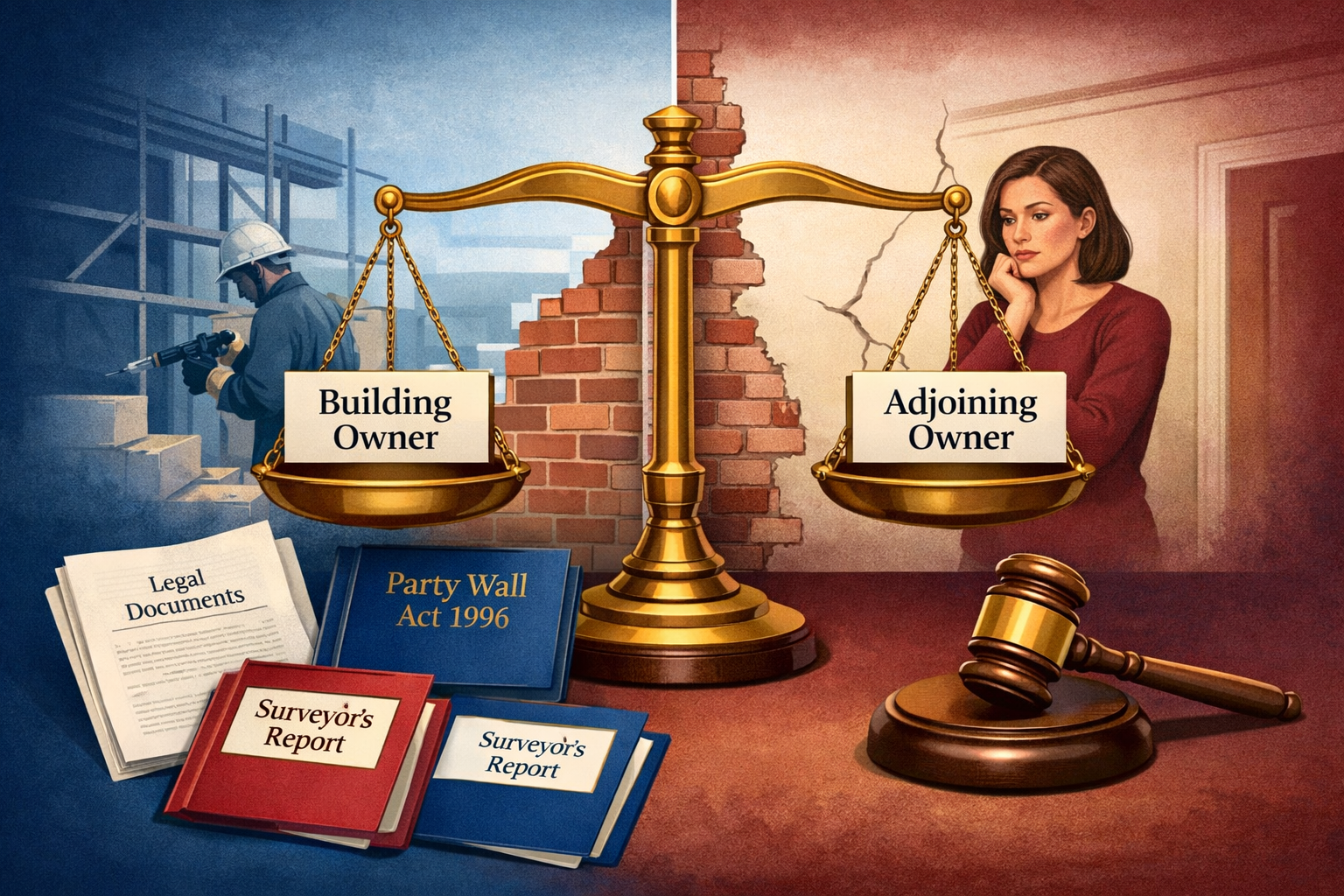
The concept of surveyor impartiality sits at the heart of Party Wall Surveyors' Duties to Building vs Adjoining Owners: Resolving 2026 Case Law Conflicts. While surveyors are appointed and paid by one party, they must act fairly toward both parties when determining disputes and drafting awards.
The Dual Nature of Surveyor Responsibilities
Party wall surveyors must navigate two distinct phases of responsibility:
Phase 1: Pre-Dispute Advisory Role
- Surveyors may provide partisan advice to their appointing owner
- No duty of impartiality exists during initial consultation
- Focus on protecting appointing party's interests within statutory framework
Phase 2: Quasi-Judicial Dispute Resolution
- Impartiality becomes mandatory once formal dispute arises
- Must consider both parties' interests fairly
- Decisions must be based on statutory criteria and professional judgment
This dual nature creates practical challenges, particularly when surveyors have provided extensive pre-dispute advice that may have shaped their appointing party's expectations [2].
The Evans v Paterson Genuine Dispute Requirement
The 2021 Evans v Paterson judgment introduced a critical procedural safeguard that directly impacts Party Wall Surveyors' Duties to Building vs Adjoining Owners: Resolving 2026 Case Law Conflicts. The court established that surveyors cannot issue compensation awards under section 7(2) unless:
- ✅ The building owner has been made aware of the alleged damage
- ✅ The building owner has been given opportunity to respond
- ✅ A genuine dispute has crystallized between the parties
This requirement prevents surveyors from issuing "surprise" compensation awards without proper notice to building owners. The practical implications are significant:
Before Evans v Paterson:
- Adjoining owner's surveyor could inspect, identify damage, and issue award
- Building owner might first learn of claim upon receiving award
- Limited opportunity for building owner to contest damage attribution
After Evans v Paterson:
- Adjoining owner's surveyor must notify building owner of damage claim
- Building owner must have reasonable time to investigate and respond
- Award can only be issued if genuine disagreement persists [5]
This development has substantially strengthened building owner protections while requiring adjoining owner surveyors to follow more rigorous procedural steps before claiming compensation.
Practical Guidance for Maintaining Impartiality
Professional surveyors operating in 2026 should implement these best practices to navigate the impartiality requirement:
Documentation Standards:
- 📸 Maintain comprehensive photographic records of pre-work conditions
- 📝 Document all communications with both parties
- 🗓️ Create detailed timelines of notice service and responses
- 📊 Prepare thorough technical justifications for all award provisions
Communication Protocols:
- Clearly explain the shift from advisory to quasi-judicial role
- Provide equal access to information for both parties
- Respond to queries from both sides within consistent timeframes
- Avoid ex parte communications once dispute resolution begins
Technical Assessments:
- Base decisions on objective evidence rather than party preferences
- Obtain independent expert opinions for complex technical matters
- Consider proportionality when specifying works or compensation
- Ensure party wall awards provide clear implementation guidance
For surveyors working in busy metropolitan areas, understanding local precedents is essential. Whether operating as a party wall surveyor in Central London or a party wall surveyor in West London, consistent application of these principles maintains professional credibility.
Resolving 2026 Case Law Conflicts: Emerging Principles and Practical Solutions
As case law continues to evolve, several emerging principles are reshaping how surveyors approach Party Wall Surveyors' Duties to Building vs Adjoining Owners: Resolving 2026 Case Law Conflicts in practical situations.

Award Specification Requirements: The Masters and Welter Legacy
Two significant cases have established that party wall awards must provide detailed implementation specifications rather than vague directives:
Masters v 6 Bolton Road Limited (2016):
This case established that awards must explicitly specify how remedial works are to be carried out. Surveyors cannot simply order "make good the damage" without defining the scope, method, and standards for such works [4].
Welter v McKeeve (2018-2019):
Building on Masters, this case reinforced that awards leaving parties with undefined obligations are defective. The judgment also established that adjoining owners bear duties to mitigate their losses when damage occurs during authorized works [4].
The Mitigation Principle in Party Wall Disputes
The mitigation requirement from Welter v McKeeve represents a significant shift in Party Wall Surveyors' Duties to Building vs Adjoining Owners: Resolving 2026 Case Law Conflicts. Adjoining owners cannot simply allow damage to worsen and then claim maximum compensation.
Practical Mitigation Obligations:
- 🔧 Taking reasonable temporary protective measures
- 💧 Preventing water ingress from escalating damage
- 🏗️ Allowing building owner reasonable access for remedial works
- 📞 Promptly notifying building owner of emerging issues
Surveyors must now consider whether adjoining owners have fulfilled these mitigation duties when assessing compensation claims. Failure to mitigate may reduce or eliminate compensation entitlements [4].
Judicial Control Mechanisms: Preventing Rogue Awards
Courts have developed several mechanisms to control surveyors who exceed their jurisdiction or act improperly:
Injunctive Relief:
Courts can issue injunctions to prevent surveyors from publishing unauthorized awards or escalating fee charges. This is particularly relevant when surveyors attempt to proceed without proper notice service [4].
Recognition of Owner Agreements:
When building and adjoining owners reach written agreements on disputed matters, courts will recognize these agreements as extinguishing the surveyors' authority to determine those issues. This prevents surveyors from undermining negotiated settlements [4].
Award Challenges:
The Party Wall etc. Act 1996 provides appeal mechanisms through county courts, allowing parties to challenge awards that exceed jurisdiction or fail to follow proper procedures.
Fee Recovery and Cost Allocation Conflicts
One of the most contentious aspects of Party Wall Surveyors' Duties to Building vs Adjoining Owners: Resolving 2026 Case Law Conflicts involves who pays surveyor fees when disputes arise about jurisdiction or procedural compliance.
General Principles:
- 💰 Building owners typically bear all reasonable surveyor fees for notifiable works
- ⚖️ Fees must be proportionate to the complexity and value of works
- 🚫 Fees for work outside surveyor jurisdiction are not recoverable
- 📉 Excessive or unreasonable fees may be challenged
The Power v Shah ruling has created particular complications: when a building owner fails to serve notice and an adjoining owner appoints a surveyor who then discovers the lack of jurisdiction, who pays for that surveyor's wasted time? Current case law suggests the adjoining owner bears this risk, though this may seem inequitable [3].
For guidance on managing these costs effectively, property owners should review strategies for keeping party wall costs down.
Practical Conflict Resolution Strategies for 2026
Given the complex and sometimes contradictory pressures on party wall surveyors, these strategies can help resolve conflicts while maintaining professional standards:
1. Jurisdictional Due Diligence
Before accepting any appointment, surveyors should:
- Verify that proper party wall notices have been served
- Confirm notice service dates and response periods
- Review notice content for statutory compliance
- Document the jurisdictional foundation in writing
Understanding what party wall notices are and how to respond is essential for both surveyors and property owners.
2. Early Communication Protocols
Establishing clear communication at the outset prevents many conflicts:
- Hold initial joint meeting with both parties when possible
- Explain surveyor roles, duties, and limitations
- Set realistic expectations about timescales and outcomes
- Clarify fee structures and payment responsibilities
3. Transparent Decision-Making
When drafting awards, surveyors should:
- Provide detailed reasoning for each determination
- Reference specific statutory provisions and case law
- Explain technical assessments in accessible language
- Offer clear implementation timelines and specifications
4. Third Surveyor Engagement
When appointed surveyors cannot agree, the third surveyor mechanism provides resolution. However, surveyors should:
- Make genuine efforts to reach agreement before invoking third surveyor
- Clearly define the specific issues requiring third surveyor determination
- Provide the third surveyor with complete documentation
- Respect third surveyor determinations as final
5. Alternative Dispute Resolution
Before conflicts escalate to formal awards or court proceedings, consider:
- Mediation between owners with surveyor facilitation
- Technical expert consultation on disputed matters
- Negotiated settlements with surveyor guidance
- Phased implementation allowing for adjustments
Regional Considerations Across London
The application of Party Wall Surveyors' Duties to Building vs Adjoining Owners: Resolving 2026 Case Law Conflicts can vary based on regional property characteristics and local construction patterns.
Surveyors operating as a party wall surveyor in North London may encounter different typical disputes than those working as a party wall surveyor in South London, particularly regarding:
- Victorian terraced properties with complex shared structures
- Modern developments with engineered party walls
- Conservation area restrictions affecting remedial options
- Local authority requirements for types of party wall works
Similarly, a party wall surveyor in East London may handle more new-build developments, while surveyors in established residential areas deal primarily with renovation and extension projects.
The Future Trajectory: Anticipated Developments Beyond 2026
As case law continues to evolve, several trends are likely to shape Party Wall Surveyors' Duties to Building vs Adjoining Owners: Resolving 2026 Case Law Conflicts in coming years:
Increased Procedural Formality:
Expect courts to impose more rigorous procedural requirements on surveyors, particularly regarding notice, disclosure, and opportunity to respond.
Enhanced Adjoining Owner Protections:
While Power v Shah limited adjoining owner procedural rights, courts are likely to develop enhanced substantive protections through common law remedies and statutory duty claims.
Technology Integration:
Digital notice service, electronic awards, and virtual inspections will require case law development addressing their validity and procedural compliance.
Professional Standards Evolution:
RICS and other professional bodies are likely to update guidance documents to reflect recent case law, creating clearer practice standards for surveyors.
Fee Dispute Resolution:
Expect more litigation around reasonable fee levels and recovery mechanisms, particularly in complex cases involving jurisdictional challenges.
Conclusion
The landscape of Party Wall Surveyors' Duties to Building vs Adjoining Owners: Resolving 2026 Case Law Conflicts has been fundamentally reshaped by recent judicial decisions, particularly the Power v Shah ruling establishing building owner primacy and the Evans v Paterson genuine dispute requirement. These developments have created a more complex operating environment for surveyors who must balance statutory impartiality with client duties while navigating increasingly technical jurisdictional requirements.
Key principles for professional practice in 2026:
✅ Verify jurisdictional foundations before accepting appointments—proper notice service is non-negotiable
✅ Establish genuine disputes before issuing compensation awards, following Evans v Paterson protocols
✅ Provide detailed award specifications that give parties clear implementation guidance
✅ Document everything thoroughly to demonstrate impartial decision-making processes
✅ Recognize mitigation duties when assessing adjoining owner damage claims
✅ Communicate transparently with both parties throughout the dispute resolution process
Actionable Next Steps
For Building Owners:
- Ensure proper party wall notice service before commencing notifiable works
- Appoint experienced surveyors who understand current case law
- Respond promptly to damage notifications to establish genuine dispute status
- Consider whether having a party wall agreement without a surveyor might be appropriate for straightforward cases
For Adjoining Owners:
- Verify that building owners have served proper notices before appointing surveyors
- Understand that common law remedies may be necessary when notices are absent
- Fulfill mitigation duties to preserve compensation entitlements
- Document pre-work conditions thoroughly through schedules of condition
For Party Wall Surveyors:
- Update professional knowledge regularly as case law evolves
- Implement robust jurisdictional verification procedures
- Maintain clear documentation of the shift from advisory to quasi-judicial roles
- Develop standardized communication protocols ensuring equal treatment of both parties
- Consider professional indemnity insurance coverage for jurisdictional challenges
The tension between building owner procedural primacy and adjoining owner substantive protections will continue to generate case law conflicts. Surveyors who understand these dynamics, maintain rigorous professional standards, and communicate transparently with all parties will successfully navigate this complex landscape while fulfilling their unique statutory duties.
For property owners facing party wall matters, seeking early professional advice from qualified surveyors who understand these evolving legal principles is essential for protecting interests and avoiding costly disputes. The Party Wall Act 1996 remains a valuable framework for resolving boundary disputes—but only when its procedures are properly followed and its limitations are clearly understood.
References
[1] Court Of Appeal Rules That Party Wall Act Awards Cannot Be Imposed On Building Owners By Adjoining Owners – https://cornerstonebarristers.com/court-of-appeal-rules-that-party-wall-act-awards-cannot-be-imposed-on-building-owners-by-adjoining-owners/
[2] The Unique Role Of A Party Wall Surveyor – https://dwfgroup.com/en/news-and-insights/insights/2017/4/the-unique-role-of-a-party-wall-surveyor
[3] Party Wall Etc Act 1996 Surveyors Beware No Notice No Jurisdiction – https://www.wardhadaway.com/insights/updates/party-wall-etc-act-1996-surveyors-beware-no-notice-no-jurisdiction/
[4] Party Walls In Case Law – https://ww3.rics.org/uk/en/journals/property-journal/party-walls-in-case-law.html
[5] Practice Changing Party Wall Case Law Evans V Paterson 2021 – https://www.peterbarry.co.uk/blog/practice-changing-party-wall-case-law-evans-v-paterson-2021/