


During 2026's unprecedented construction boom, surveyors across London are reporting a 47% increase in neighbour objections to excavation and new wall projects compared to previous years. This surge reflects growing anxiety about foundation works in high-density urban areas where properties sit mere inches apart. Understanding Party Wall Act Scenarios for New Walls Close to Neighbors: Surveyor Checks and Award Clauses in 2026 has become essential for anyone planning construction work near property boundaries.
The Party Wall etc. Act 1996 establishes strict legal requirements when building new walls at or near boundary lines, with specific thresholds that trigger mandatory notification procedures. Property owners who fail to navigate these requirements properly face injunctions, costly delays, and potential compensation claims from affected neighbours.
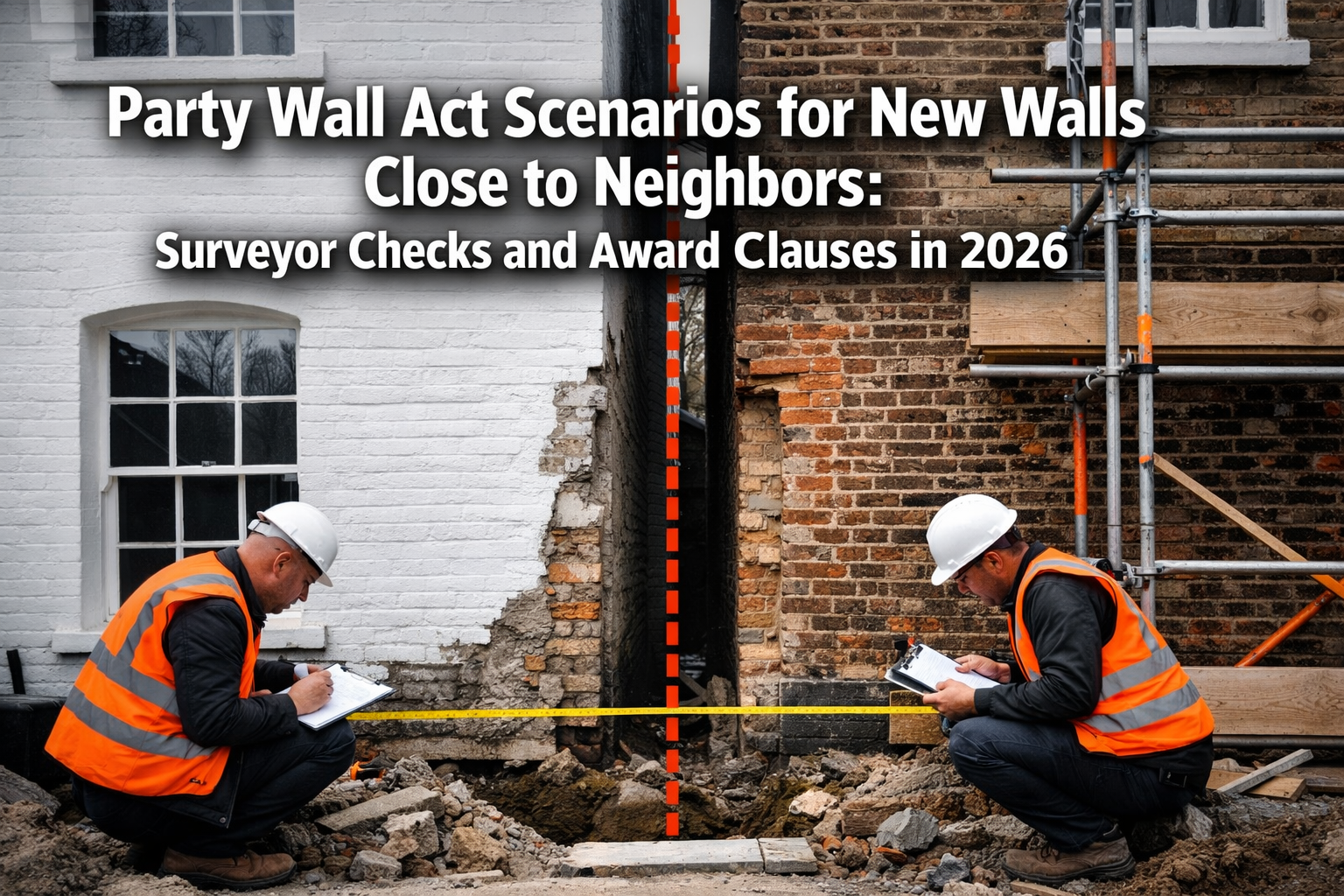
Key Takeaways
- Formal written notice is legally required when building new walls on or up to the boundary line between properties, with excavation work within 3-6 metres of a neighbour's structure triggering additional compliance requirements
- Party Wall Awards cost approximately £1,000 total in 2026, with building owners typically responsible for both their own and the adjoining owner's surveyor fees
- Schedule of condition documentation is mandatory in all Party Wall Awards, providing photographic evidence of pre-construction property conditions to prevent disputes
- Written neighbour consent eliminates surveyor requirements in most cases, though building owners remain liable for any damage caused during construction
- Non-compliance carries serious legal consequences including court injunctions and compensation claims that can halt construction projects indefinitely
Understanding Party Wall Act Scenarios for New Walls Close to Neighbors in 2026
The Party Wall etc. Act 1996 creates specific scenarios where property owners must follow formal procedures before commencing construction work. These scenarios become particularly complex when building new walls in the tight confines of modern urban developments.
When New Wall Construction Triggers Party Wall Requirements
Building a new wall on the line of junction (the exact boundary between two properties) represents one of the most common Party Wall Act scenarios. This situation requires serving a formal Party Wall Notice to adjoining owners, regardless of whether the wall will be shared or sits entirely on your property [1].
The legislation distinguishes between several wall types:
- Party fence walls: Free-standing walls on the boundary line
- Walls astride the boundary: Structures that straddle the property line
- Walls up to the boundary: New walls built entirely on your land but positioned directly against the boundary
Property owners planning any of these constructions must provide written notification to neighbours at least two months before work begins. This timeline allows adjoining owners adequate time to review plans and respond appropriately.
The 3-Metre and 6-Metre Excavation Rules
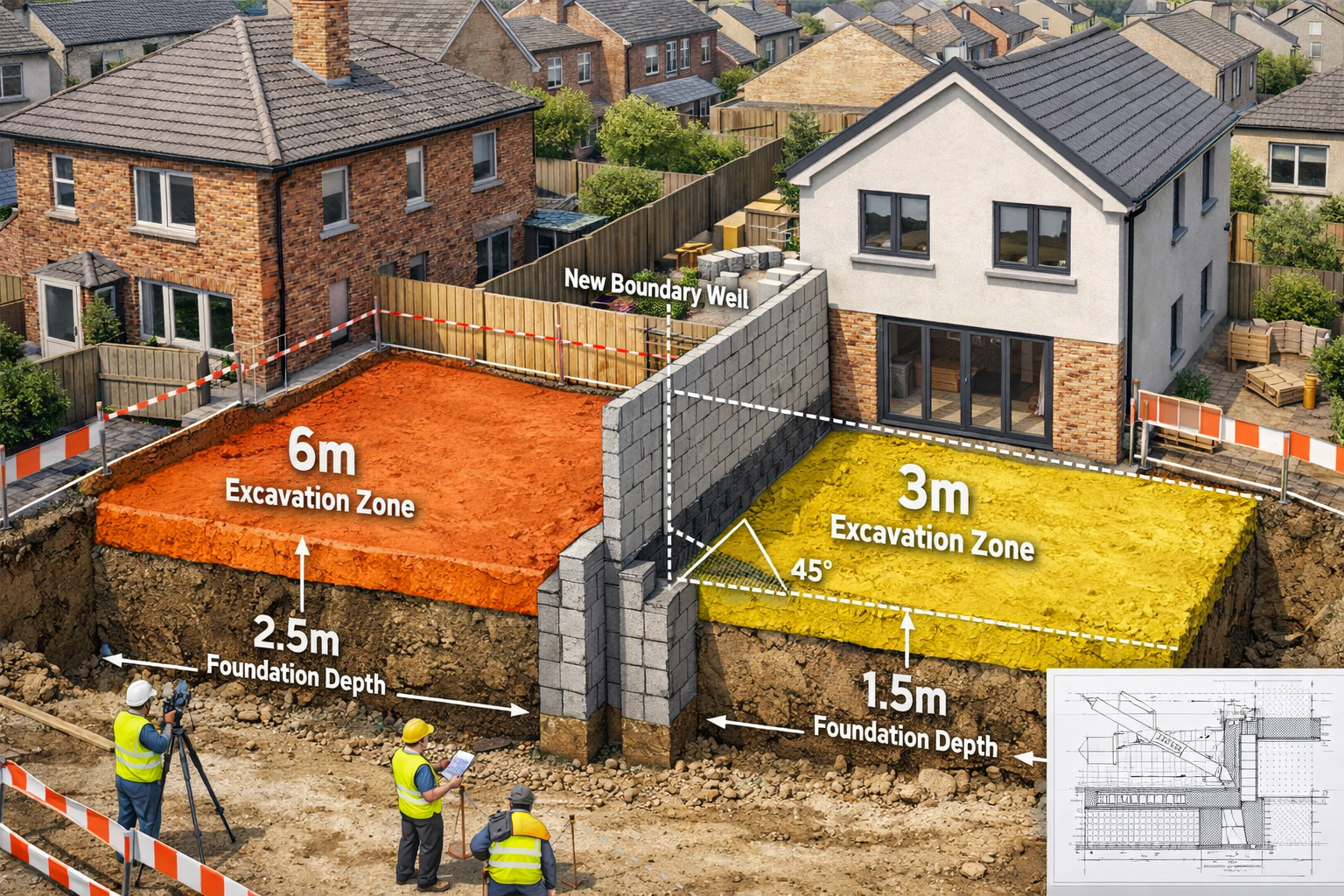
Excavation work near boundaries introduces additional complexity through distance-based thresholds. The Act establishes two critical zones that determine when notification becomes mandatory [1][2]:
3-Metre Zone: Excavation within 3 metres of a neighbour's structure that extends deeper than the neighbour's foundations requires formal Party Wall Notice procedures.
6-Metre Zone: Excavation within 6 metres of a neighbour's structure that extends below a line drawn downwards at 45 degrees from the bottom of the neighbour's foundations triggers notification requirements.
These geometric rules reflect engineering principles about how excavation affects adjacent structures. In 2026's high-density developments, where properties frequently sit within these critical zones, understanding these thresholds prevents costly compliance failures.
| Distance from Neighbour's Structure | Depth Threshold | Notice Required? |
|---|---|---|
| Within 3 metres | Deeper than neighbour's foundations | ✅ Yes |
| Within 6 metres | Below 45° line from foundation bottom | ✅ Yes |
| Beyond 6 metres | Any depth | ❌ No |
| Within 3 metres | Shallower than neighbour's foundations | ❌ No |
Common Pitfalls in High-Density 2026 Builds
The current construction boom has exposed several recurring compliance mistakes that delay projects and strain neighbour relationships:
❌ Assuming verbal agreements suffice: Neighbour consent must be documented in writing. Verbal agreements hold no legal weight under the Party Wall Act.
❌ Measuring distances incorrectly: Property owners frequently miscalculate the 3-metre and 6-metre zones, particularly when dealing with irregular property boundaries or extensions that extend beyond the main building footprint.
❌ Ignoring basement conversions: Excavating for basements almost always triggers Party Wall requirements in urban settings, yet many property owners overlook this until construction begins.
❌ Starting work before notice periods expire: Even with neighbour agreement, the mandatory notice periods must elapse before construction commences [3].
For guidance on boundary wall rules and differences between party fence walls and boundary walls, property owners should consult detailed resources before finalizing construction plans.
Surveyor Checks and Requirements in Party Wall Act Scenarios for New Walls Close to Neighbors
When neighbours dissent to Party Wall Notices—or when property owners want professional guidance—party wall surveyors become essential participants in the process. Understanding their role, selection criteria, and checking procedures helps property owners navigate 2026's complex construction landscape.
The Three Surveyor Appointment Options
The Party Wall Act provides three distinct pathways for surveyor involvement [4]:
1. Agreed Surveyor (Single Surveyor): Both parties appoint one impartial surveyor to act for everyone. This appointment should occur within 10 days and typically represents the most cost-effective option. The agreed surveyor must maintain independence regardless of who initially appointed them.
2. Two Surveyors: The building owner appoints one surveyor, the adjoining owner appoints another, and these two surveyors work together to produce the Party Wall Award. This option provides each party with dedicated representation but increases costs.
3. Two Surveyors Plus Third Surveyor: In complex or contentious cases, the two appointed surveyors may select a third surveyor to resolve disagreements. This scenario remains relatively rare but provides a dispute resolution mechanism.
Important Note: The agreed surveyor should not be the same professional the building owner uses for their general construction works, as adjoining owners are unlikely to view such a surveyor as truly neutral [4].
What Surveyors Check Before Issuing Awards
Party wall surveyors conduct comprehensive examinations before drafting awards. Their checks ensure construction plans comply with legal requirements while protecting adjoining owners' interests.
Foundation and Structural Assessment 🏗️
Surveyors examine:
- Existing foundation depths on both properties
- Soil conditions and load-bearing capacity
- Structural integrity of walls near proposed work
- Potential impact of excavation on neighbouring foundations
- Need for temporary support during construction
Schedule of Condition Documentation 📸
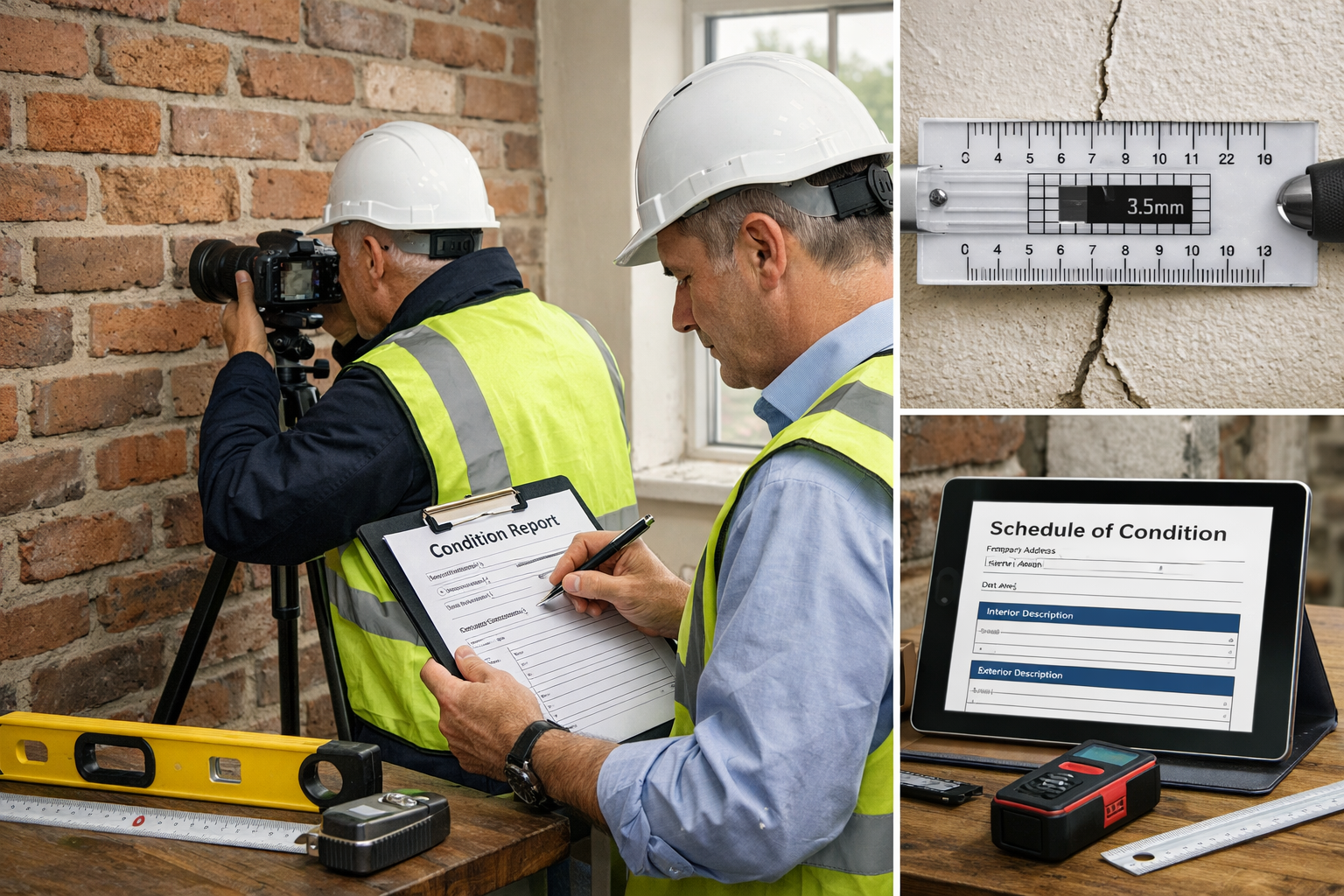
Creating a detailed schedule of condition represents one of the surveyor's most critical responsibilities. This documentation includes:
- Comprehensive photographs of adjoining properties (interior and exterior)
- Written descriptions of existing cracks, settlement, or defects
- Measurements and precise locations of pre-existing damage
- Video footage in complex cases
- Time-stamped digital records
This schedule serves as irrefutable evidence of pre-construction conditions, protecting both parties from false damage claims. Without this documentation, disputes about whether damage resulted from construction become nearly impossible to resolve fairly [1][4].
Access and Working Hours Verification
Surveyors confirm:
- Reasonable access arrangements for construction workers
- Appropriate working hours that minimize disruption
- Adequate notice periods for accessing adjoining properties
- Special provisions for vulnerable occupants (elderly residents, young children)
Surveyor Independence and Impartiality Standards
Professional surveyors operating under the Party Wall Act must adhere to strict impartiality standards, particularly when serving as agreed surveyors. The Royal Institution of Chartered Surveyors (RICS) provides guidance emphasizing that surveyors must:
- Disclose any conflicts of interest before appointment
- Act fairly between both parties regardless of who pays their fees
- Base decisions on technical merit rather than client preferences
- Maintain professional indemnity insurance covering party wall work
- Follow established precedent from party wall case law
For property owners seeking professional assistance, working with experienced party wall surveyors in South London, East London, or other areas ensures compliance with these professional standards.
Cost Considerations for Surveyor Appointments in 2026
Party Wall Awards currently cost approximately £1,000 total according to industry data, though complex projects may incur higher fees [3]. The building owner typically bears responsibility for:
- Their own surveyor's fees
- The adjoining owner's surveyor's fees
- The agreed surveyor's fees (if using single surveyor option)
- Third surveyor's fees (in rare disputed cases)
This cost structure reflects the principle that those initiating construction should bear the administrative expenses. However, property owners can minimize these costs through several strategies outlined in guides on how to keep party wall costs down.
Fee Breakdown Example (Typical 2026 Scenario):
| Service Component | Approximate Cost |
|---|---|
| Building Owner's Surveyor | £400-£600 |
| Adjoining Owner's Surveyor | £400-£600 |
| Schedule of Condition | Included |
| Award Drafting | Included |
| Total | £800-£1,200 |
Award Clauses and Safeguards in Party Wall Act Scenarios for New Walls Close to Neighbors
The Party Wall Award represents the formal legal document that authorizes construction work while establishing protections for all parties. Understanding the key clauses within these awards helps property owners recognize their rights and obligations in 2026's complex construction environment.
Essential Components of Party Wall Awards
A comprehensive Party Wall Award must include several mandatory elements that govern the construction process [1][4]:
1. Work Description and Specifications
The award provides detailed descriptions of:
- Exact location and dimensions of proposed walls
- Construction methods and materials
- Foundation depths and specifications
- Excavation procedures and safeguards
- Timeline for completion
2. Schedule of Condition
As discussed earlier, this photographic and written record documents pre-construction property conditions. The schedule becomes legally binding evidence should disputes arise about construction-related damage.
3. Access Rights and Restrictions
Awards specify:
- When and how building owners may access adjoining properties
- Required notice periods before access (typically 14 days)
- Restrictions on access timing (working hours, weekends)
- Compensation for access disruption in exceptional cases
4. Working Hours and Methods
To minimize disruption, awards establish:
- Permitted construction hours (typically 8 AM to 6 PM weekdays)
- Weekend and holiday work restrictions
- Noise limitation requirements
- Dust and debris control measures
5. Security and Insurance Provisions
Modern awards increasingly include:
- Proof of adequate construction insurance
- Security measures for exposed walls or excavations
- Temporary weatherproofing requirements
- Emergency contact information
Safeguard Clauses That Protect Adjoining Owners
Party Wall Awards incorporate several protective clauses designed to safeguard adjoining owners' interests during construction:
Damage Compensation Provisions 💰
Awards explicitly state that building owners remain fully liable for any damage caused by their construction work, regardless of whether neighbours consented to the work [4]. This liability includes:
- Structural damage to walls, foundations, or roofs
- Cosmetic damage to interior finishes
- Damage to gardens, driveways, or outbuildings
- Consequential losses (temporary accommodation if property becomes uninhabitable)
Monitoring and Inspection Rights
Adjoining owners retain rights to:
- Inspect work progress at reasonable intervals
- Request surveyor site visits if concerns arise
- Halt work immediately if dangerous practices are observed
- Obtain independent structural assessments
Foundation Protection Measures
When excavation occurs near neighbouring foundations, awards mandate specific safeguards:
- Underpinning requirements where necessary
- Shoring and temporary support systems
- Phased excavation to minimize settlement risk
- Continuous monitoring of adjacent structures
Award Dispute Resolution and Appeal Mechanisms
Despite surveyors' best efforts, disputes occasionally arise regarding Party Wall Awards. The Act provides formal resolution pathways [3]:
14-Day Appeal Window
Dissatisfied parties have 14 days from the award date to appeal by filing an "appellant's notice" at county court. Appeals must specify:
- Specific award provisions being challenged
- Legal or technical grounds for disagreement
- Desired modifications or remedies
Third Surveyor Determination
Before resorting to court appeals, parties may request the appointed third surveyor to resolve specific disagreements between the two party-appointed surveyors.
County Court Proceedings
Court appeals involve:
- Formal legal representation (recommended but not mandatory)
- Technical expert testimony
- Review of surveyor qualifications and procedures
- Judicial determination of appropriate award terms
Appeals remain relatively rare, with most disputes resolved through surveyor negotiation or third surveyor determination.
Special Award Clauses for 2026 High-Density Developments
The current construction boom has prompted surveyors to incorporate additional protective clauses addressing modern building challenges:
Vibration Monitoring 📊
Awards now frequently require:
- Baseline vibration measurements before work begins
- Continuous monitoring during excavation and piling
- Immediate work cessation if vibration exceeds safe thresholds
- Regular reporting to adjoining owners
Digital Documentation Requirements
Modern awards leverage technology:
- Digital schedule of condition with cloud storage
- Real-time construction progress photographs
- Electronic notification systems for access requests
- Video documentation of sensitive work phases
Sustainability and Environmental Provisions
Contemporary awards address:
- Dust suppression measures protecting air quality
- Noise reduction technologies
- Waste management and disposal procedures
- Protection of mature trees and landscaping
For detailed information about types of party wall works and how awards address different construction scenarios, property owners should consult specialized resources before finalizing construction plans.
When Awards Aren't Required: The Written Consent Alternative
If adjoining owners respond to Party Wall Notices with written consent, no formal award becomes necessary in most cases [4]. However, building owners should understand that:
- Written consent doesn't eliminate liability for damage
- Verbal agreements hold no legal weight
- Consent can specify conditions (working hours, access restrictions)
- Building owners should still document pre-construction conditions
Many property owners find that having a party wall agreement without a surveyor remains possible through clear communication and proper documentation, though professional guidance often prevents misunderstandings.

Practical Steps for Navigating Party Wall Act Scenarios in 2026
Successfully managing Party Wall Act compliance requires systematic planning and attention to procedural details. These practical steps guide property owners through the process from initial planning to construction completion.
Step 1: Determine Whether Party Wall Act Applies
Before serving notices, confirm whether your project triggers Party Wall requirements:
✅ Projects Requiring Compliance:
- Building new walls on or up to the boundary line
- Excavating within 3 metres deeper than neighbour's foundations
- Excavating within 6 metres below the 45° line from neighbour's foundations
- Cutting into party walls for beam installation
- Raising party wall heights
- Underpinning party walls or adjacent structures
❌ Projects Exempt from Requirements:
- Internal plastering or electrical work
- Drilling internal walls for shelving or kitchen units
- Painting or decorating party walls
- Minor repairs not affecting structural integrity [4]
Understanding what is a party structure notice and how to serve it helps clarify which specific notice type your project requires.
Step 2: Serve Appropriate Party Wall Notices
The Act requires different notice types depending on work proposed:
Party Structure Notice: For work directly affecting existing party walls (cutting in, raising height, underpinning)
Line of Junction Notice: For building new walls on or up to the boundary
Notice of Adjacent Excavation: For excavation work within the 3-metre or 6-metre zones
Notices must include:
- Detailed work descriptions with drawings
- Proposed start date (at least 2 months future for new walls, 1 month for other work)
- Building owner's contact information
- Clear statement of adjoining owner's response options
Property owners can serve Party Wall Notices themselves using standard templates, or engage surveyors to handle this process professionally.
Step 3: Respond to Neighbour Feedback
Adjoining owners have three response options within 14 days:
1. Written Consent: Work proceeds without surveyor involvement (though liability remains)
2. Written Dissent: Triggers surveyor appointment and Party Wall Award process
3. No Response: Legally treated as dissent after 14 days, requiring surveyor appointment
Building owners should maintain written records of all communications, including:
- Proof of notice delivery (recorded delivery receipts)
- Neighbour responses or consent letters
- Follow-up correspondence
- Photographs of notice delivery
Step 4: Appoint Surveyors and Obtain Party Wall Award
If neighbours dissent or fail to respond:
- Appoint your surveyor (building owner's surveyor)
- Notify adjoining owner of your surveyor's details
- Allow adjoining owner to appoint their surveyor or agree to use yours
- Surveyors conduct inspections and prepare schedule of condition
- Receive Party Wall Award (typically within 4-8 weeks)
- Review award carefully before signing
For those seeking professional assistance, building owner's surveyors and adjoining owner's surveyors provide specialized expertise throughout this process.
Step 5: Comply with Award Terms During Construction
Once the award is issued:
Before Starting Work:
- Provide required insurance documentation
- Confirm schedule of condition accuracy
- Establish communication protocols with neighbours
- Arrange any required access permissions
During Construction:
- Adhere strictly to permitted working hours
- Implement dust and noise control measures
- Allow surveyor inspections as specified
- Document progress with photographs
- Address neighbour concerns promptly
After Completion:
- Conduct final inspection with surveyor
- Address any damage identified
- Provide completion documentation
- Return any temporary access areas to original condition
Step 6: Handle Disputes Professionally
If disagreements arise during construction:
- Document the issue thoroughly with photographs and written descriptions
- Contact your surveyor immediately for guidance
- Attempt informal resolution through surveyor mediation
- Request third surveyor involvement if needed
- Consider formal appeal only as last resort
Most disputes resolve through professional surveyor intervention without requiring court proceedings.
Conclusion
Party Wall Act Scenarios for New Walls Close to Neighbors: Surveyor Checks and Award Clauses in 2026 present complex challenges for property owners navigating today's high-density construction environment. The Act's strict requirements—particularly the 3-metre and 6-metre excavation thresholds—demand careful attention to compliance procedures that protect both building owners and their neighbours.
Understanding when formal Party Wall Notices become mandatory, how surveyors conduct essential checks, and what protective clauses Party Wall Awards should contain empowers property owners to avoid costly delays and legal complications. The current construction boom has intensified scrutiny of these requirements, with surveyors reporting significantly increased neighbour objections to boundary construction projects.
Key action steps for property owners in 2026:
- Assess compliance requirements early in the planning process, ideally before finalizing construction contracts
- Serve proper written notices using appropriate templates and maintaining proof of delivery
- Engage qualified party wall surveyors when neighbours dissent or when project complexity warrants professional guidance
- Ensure comprehensive schedule of condition documentation to prevent false damage claims
- Budget appropriately for Party Wall Award costs (approximately £1,000 total)
- Maintain open communication with neighbours throughout the construction process
The Party Wall Act exists to balance property owners' development rights against neighbours' legitimate interests in protecting their properties. By following proper procedures, documenting thoroughly, and engaging professional surveyors when needed, property owners can navigate these requirements efficiently while maintaining positive neighbour relationships.
For complex projects or situations where neighbours raise concerns, consulting experienced professionals who understand local construction patterns—whether in North London, West London, Central London, or other areas—provides invaluable peace of mind and helps ensure construction proceeds smoothly from initial notice through project completion.
References
[1] Party Walls – https://www.rics.org/consumer-guides/party-walls
[2] Understanding Party Wall Issues And How Surveyors Save You Thousands – https://www.houricanassociates.com/party-wall-news/understanding-party-wall-issues-and-how-surveyors-save-you-thousands/
[3] Party Wall Agreements What You Need To Know – https://www.fmb.org.uk/find-a-builder/ultimate-guides-to-home-renovation/party-wall-agreements-what-you-need-to-know.html
[4] Party Wall Agreement – https://hoa.org.uk/advice/guides-for-homeowners/i-am-improving/party-wall-agreement/
[5] Party Wall Surveys Amid 2026 Construction Boom Handling Disputes In High Demand Uk Housing Markets – https://nottinghillsurveyors.com/blog/party-wall-surveys-amid-2026-construction-boom-handling-disputes-in-high-demand-uk-housing-markets
