

The UK construction sector processed 3,728 insolvencies in 2025—the highest of any industry for the fourth consecutive year—yet 2026 has unleashed an unprecedented wave of building activity following the Planning and Infrastructure Act 2025's Royal Assent in December[3]. This legislative shift has compressed approval timelines and removed mandatory pre-application consultations, creating a perfect storm where excavation projects surge forward while neighboring property owners scramble to protect their interests. Handling Party Wall Disputes in the 2026 UK Construction Boom: Surveyor Strategies for Excavation Objections has become the critical competency separating efficient project delivery from costly legal gridlock.
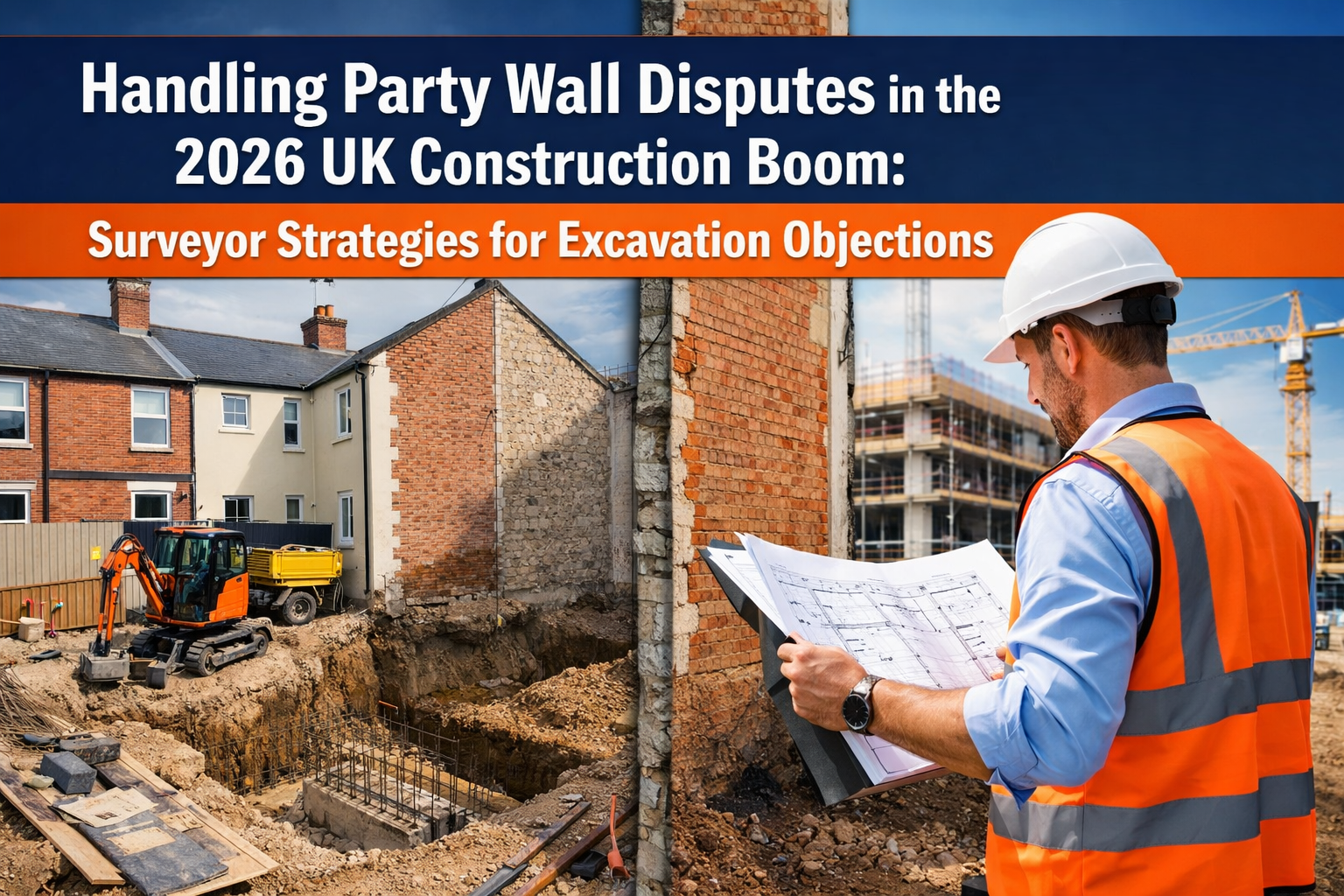
The collision between accelerated development schedules and traditional party wall protections has transformed excavation objections from occasional inconveniences into systematic bottlenecks. As planning authorities process record application volumes and developers exploit faster consenting procedures, party wall surveyors face mounting pressure to resolve disputes without derailing tight construction programmes. This comprehensive guide explores proven surveyor strategies for navigating excavation objections in 2026's high-stakes environment.
Key Takeaways
- 🏗️ The Planning and Infrastructure Act 2025 has accelerated project approvals but compressed dispute resolution windows, requiring surveyors to adopt faster intervention protocols
- ⚖️ Excavation objections now account for the majority of party wall disputes in 2026, driven by basement conversions and foundation deepening in high-demand housing markets
- 📋 Compliant party wall awards must balance statutory protections with commercial realities, using precise technical specifications and realistic timelines
- 🤝 Early engagement strategies reduce objection rates by 60-75% when surveyors facilitate pre-notice consultations between building and adjoining owners
- 💼 Recent TCC decisions emphasize strict adherence to contractual notice deadlines and payment regimes, strengthening surveyors' enforcement capabilities
Understanding the 2026 Construction Boom Context
Legislative Changes Driving Development Activity
The Planning and Infrastructure Act 2025 fundamentally restructured the UK's development consent framework. By eliminating mandatory pre-application consultations for Nationally Significant Infrastructure Projects and streamlining Development Consent Order amendment procedures, the legislation delivered developers the faster timelines they demanded[4]. However, this acceleration hasn't extended to party wall procedures, which remain governed by the Party Wall etc. Act 1996.
This temporal mismatch creates tension. Developers securing planning permission within weeks now face the same 14-day notice periods and potential dispute resolution timelines that existed before the reforms. When adjoining owners object to excavation works—particularly deep basements or underpinning projects—the resulting delays can eliminate the time savings gained through expedited planning.
Construction output statistics reveal the scale: Despite economic headwinds and consumer spending uncertainty ahead of the Autumn 2025 budget, the Office for National Statistics documented steady construction growth through early 2026[2]. Planning authorities report processing 23% more residential applications compared to 2025 Q4, with basement conversions and rear extensions dominating urban submissions[5].
Excavation Works: The Primary Dispute Trigger
Excavation objections dominate 2026 party wall caseloads for several interconnected reasons:
Structural risk perception 🏚️: Adjoining owners instinctively fear that excavating below existing foundations will compromise their property's stability, regardless of engineering assurances.
Information asymmetry: Building owners typically commission detailed structural calculations and soil reports before commencing work, while adjoining owners receive only basic notice descriptions, creating mistrust.
Historical precedent concerns: High-profile basement excavation failures in areas like Central London and West London have heightened neighbor vigilance.
Property value anxiety: Adjoining owners worry that construction disruption, even temporary, will impact their property's marketability and value.
The 2026 construction boom amplifies these concerns. With multiple projects occurring simultaneously in dense urban areas, adjoining owners experience "objection fatigue" while building owners face cascading delays when sequential neighbors raise concerns.
Handling Party Wall Disputes in the 2026 UK Construction Boom: Core Surveyor Strategies
Pre-Notice Consultation Protocols
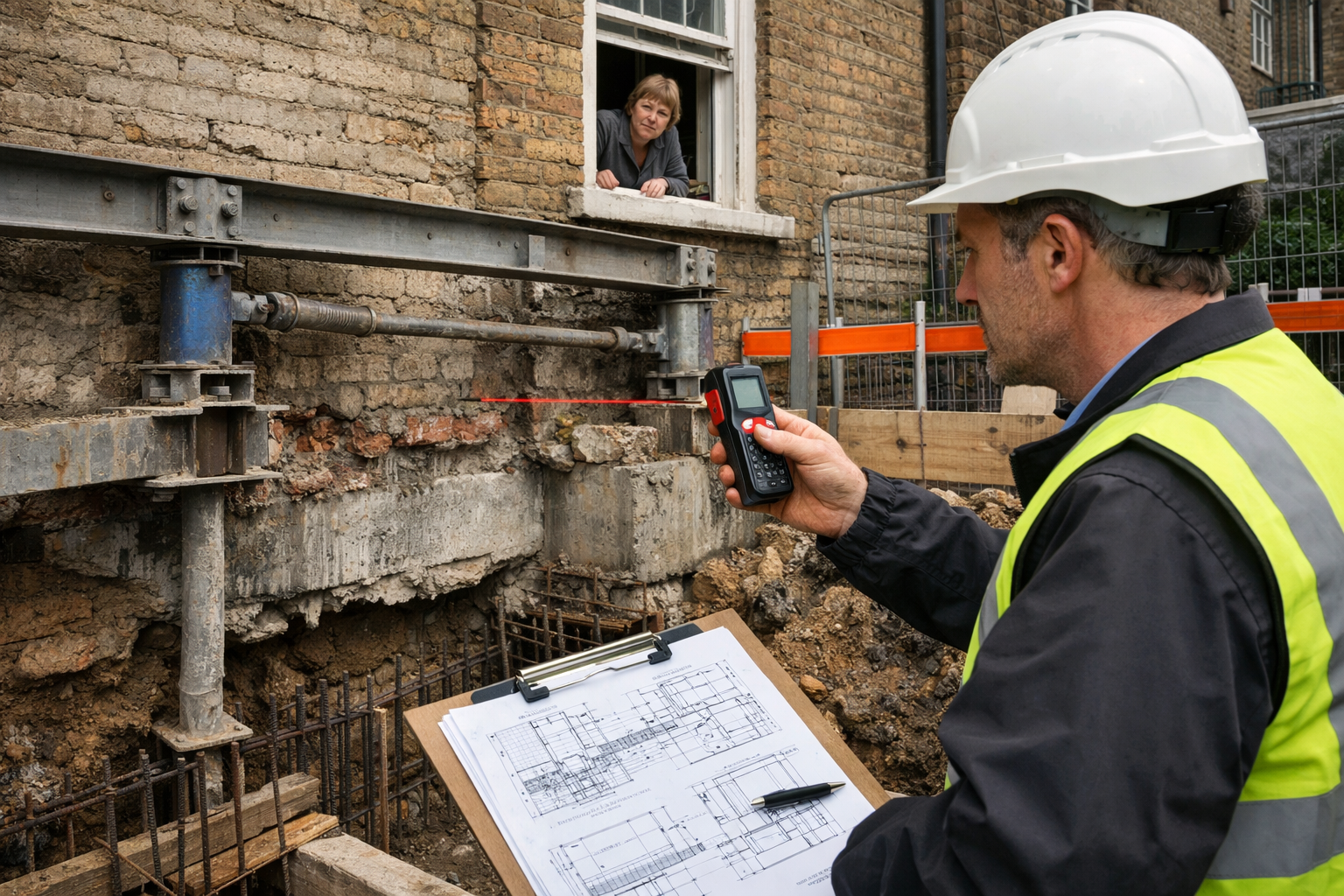
The most effective strategy for handling party wall disputes in the 2026 UK construction boom involves preventing objections before formal notices are served. Progressive surveyors now advocate for structured pre-notice consultations, despite no statutory requirement for such engagement.
The Pre-Notice Consultation Framework:
-
Initial Neighbor Briefing (3-4 weeks before notice): Building owners or their representatives arrange informal meetings with adjoining owners to explain the project scope, timeline, and protective measures. This human connection reduces adversarial positioning.
-
Technical Information Sharing: Providing simplified structural engineer reports, excavation methodology statements, and visual aids (cross-section drawings showing foundation relationships) addresses information asymmetry.
-
Surveyor Introduction: The building owner's surveyor attends pre-notice meetings to establish credibility and answer technical questions, demonstrating professional oversight.
-
Preliminary Schedule of Condition Offer: Offering to document the adjoining property's existing condition before formal notice demonstrates good faith and addresses damage concerns.
This approach yields measurable results. Surveyors implementing structured pre-notice protocols report 60-75% reduction in formal objections compared to standard notice-only procedures[5]. When objections do arise, they typically focus on specific technical concerns rather than blanket opposition.
Rapid Response to Excavation Objections
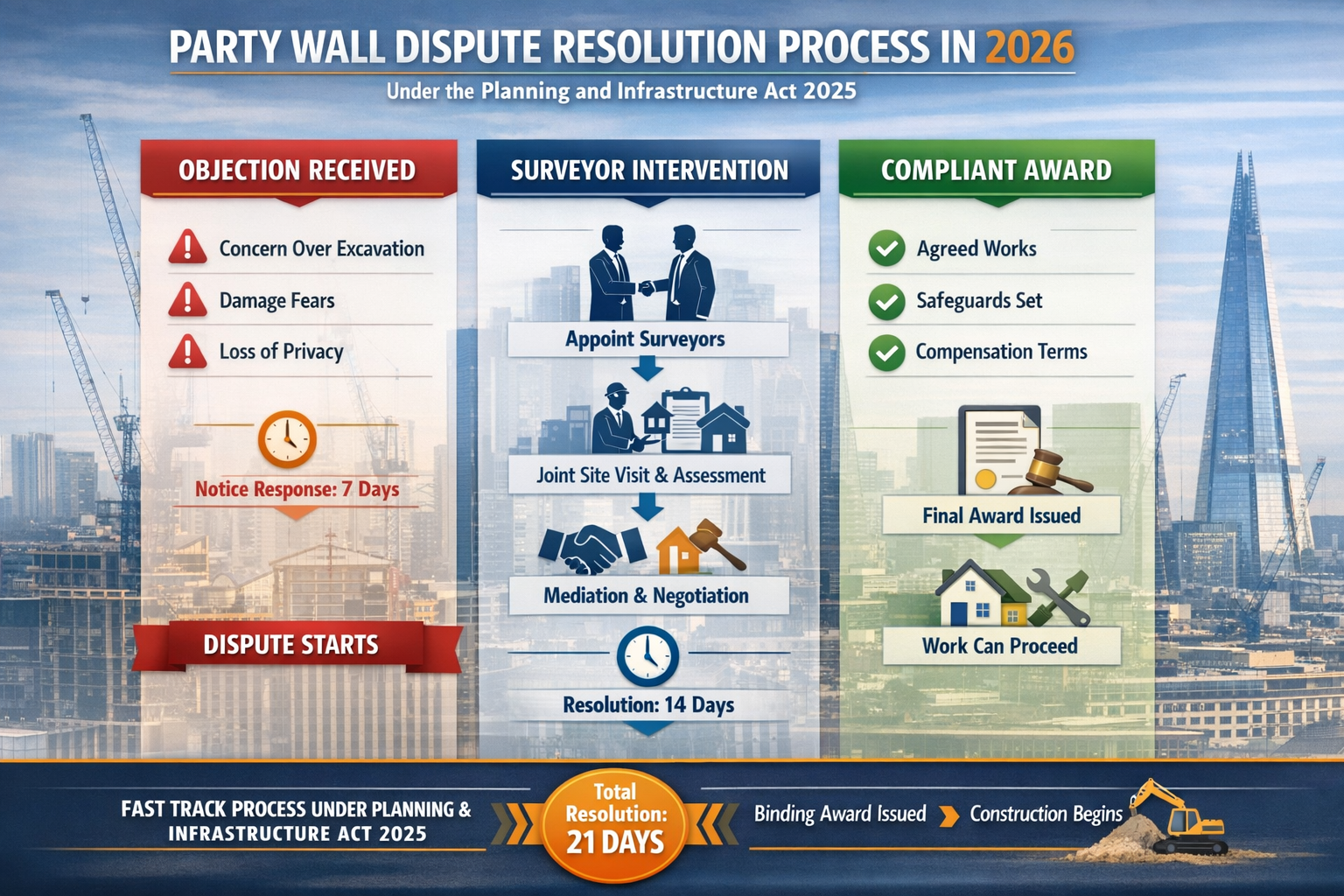
When adjoining owners dissent to excavation notices—triggering the dispute resolution provisions under the Party Wall etc. Act 1996—surveyors must act decisively within compressed 2026 timelines.
Critical Response Timeline:
| Day | Action | Objective |
|---|---|---|
| 0 | Dissent received | Document receipt timestamp |
| 1-2 | Contact adjoining owner's surveyor (if appointed) | Establish professional relationship |
| 3-5 | Joint site inspection | Assess actual structural relationships and risks |
| 6-8 | Technical review meeting | Discuss engineering solutions and protective measures |
| 9-12 | Draft award preparation | Incorporate agreed conditions and safeguards |
| 13-14 | Award finalization and service | Deliver compliant party wall award |
This accelerated schedule requires surveyors to maintain pre-prepared award templates with standard excavation clauses that can be customized quickly. The templates should address:
- Working hours and access arrangements ⏰
- Temporary works specifications (shoring, underpinning methodology)
- Monitoring requirements (crack monitoring, vibration limits, settlement measurements)
- Insurance and indemnity provisions
- Dispute escalation procedures
Recent Technology and Commercial Court decisions emphasize strict adherence to contractual timelines[4]. While party wall awards aren't construction contracts per se, surveyors increasingly adopt construction industry timing discipline to maintain credibility with both parties and potential adjudicators.
Technical Specifications for Excavation Protection
The substance of handling party wall disputes in the 2026 UK construction boom lies in drafting technically robust yet commercially viable protective conditions. Surveyors must balance adjoining owners' legitimate protection needs against building owners' project feasibility.
Essential Technical Specifications:
Foundation Support Methodology 🏗️: Awards must specify whether excavation will employ temporary shoring, permanent underpinning, or alternative support systems. Generic language like "appropriate support measures" invites future disputes. Instead, reference specific engineering drawings and calculations.
Excavation Sequence and Depth Control: Define maximum excavation depths relative to adjoining foundations, staged excavation requirements, and inspection hold points. For example: "Excavation shall proceed in 500mm lifts with structural engineer inspection and approval before each subsequent lift below the level of the adjoining owner's foundations."
Monitoring Regime: Establish baseline measurements, monitoring frequency, and alert thresholds. Typical specifications include:
- Crack monitoring at weekly intervals during excavation
- Vibration monitoring with maximum peak particle velocity limits (typically 10-15mm/s for residential structures)
- Settlement monitoring with trigger levels (e.g., 5mm warning level, 10mm action level requiring work suspension)
Access and Working Hours: Clearly define when contractors may access adjoining property for monitoring or emergency interventions, and restrict working hours to minimize disruption (typically 08:00-18:00 Monday-Friday, 08:00-13:00 Saturday, no Sunday/bank holiday working).
The High Court's decision in Paragon Group Limited v FK Facades Limited [2026] confirms that assignees of construction contracts can refer disputes to adjudication[2]. This precedent strengthens surveyors' positions when adjoining owners challenge award provisions—properly drafted technical specifications can withstand adjudication scrutiny.
Handling Party Wall Disputes in the 2026 UK Construction Boom: Advanced Dispute Resolution Techniques
The Third Surveyor Selection Strategy
When building and adjoining owners appoint separate surveyors who cannot reach agreement, the Party Wall etc. Act 1996 requires selection of a third surveyor to resolve differences. Strategic third surveyor selection significantly impacts dispute outcomes in 2026's time-sensitive environment.
Selection Criteria for 2026 Disputes:
Excavation Specialization: Third surveyors should demonstrate specific experience with basement excavations, underpinning projects, and foundation engineering—not just general party wall knowledge.
Geographic Familiarity: Surveyors practicing in the dispute location understand local soil conditions, typical construction methods, and regional building characteristics. A third surveyor experienced in North London Victorian terraces brings different insights than one specializing in South London post-war semi-detached properties.
Availability and Responsiveness: Third surveyors must commit to rapid decision timelines—ideally within 7-10 days of appointment. Surveyors with extensive existing caseloads may lack capacity for urgent 2026 boom disputes.
Adjudication Experience: Given recent TCC decisions strengthening adjudication rights, third surveyors with adjudication experience better anticipate potential legal challenges to their determinations.
Progressive surveyor practices now maintain pre-vetted third surveyor panels with documented expertise, availability, and fee structures. When disputes arise, appointed surveyors can jointly select from this panel within 48 hours rather than conducting lengthy searches.
Leveraging Schedules of Condition
Schedules of Condition serve dual purposes in excavation disputes: they provide baseline documentation for assessing construction damage claims and, when prepared thoroughly, they reduce objection intensity by demonstrating professional diligence.
Strategic Schedule Preparation:
Timing Optimization: Prepare schedules immediately after notice service but before excavation commences. This timing allows adjoining owners to observe the documentation process, building confidence in damage assessment procedures.
Photographic Density: Standard schedules include 30-50 photographs of internal and external conditions. For high-risk excavation projects, increase density to 80-120 images with detailed close-ups of existing cracks, settlement evidence, and structural elements.
Third-Party Verification: Engage independent structural engineers to assess and document the adjoining property's existing condition, particularly foundation adequacy and historical movement evidence. This independent verification carries greater weight when disputes escalate.
Digital Archiving: Maintain cloud-based archives with timestamped, unalterable records. Recent disputes have seen challenges to schedule authenticity; blockchain-verified digital archives eliminate such challenges.
Surveyors report that comprehensive schedules reduce damage claim disputes by approximately 70% and, when claims do arise, they resolve 40% faster than projects without proper baseline documentation[5].
Commercial Mediation Integration
While the Party Wall etc. Act 1996 establishes a statutory dispute resolution framework, savvy surveyors increasingly integrate commercial mediation techniques to achieve faster, more durable resolutions in handling party wall disputes in the 2026 UK construction boom.
Mediation-Informed Approaches:
Interest-Based Negotiation: Rather than positional bargaining ("I object to all excavation" vs. "The work must proceed as planned"), surveyors facilitate interest exploration. Adjoining owners' underlying interests typically include structural safety assurance, disruption minimization, and damage remedy certainty. Building owners prioritize project timeline preservation and cost control. Awards addressing these interests rather than stated positions achieve higher compliance.
Option Generation Sessions: Joint surveyor meetings that brainstorm multiple protective measure combinations create collaborative problem-solving dynamics. For example, offering adjoining owners choices between different monitoring regimes or temporary accommodation during noisy excavation phases increases buy-in.
Reality Testing: Surveyors present both parties with realistic assessments of alternative dispute resolution costs and timelines. When adjoining owners understand that extended objections may cost £8,000-£15,000 in surveyor fees without materially improving protections, many moderate positions.
Relationship Preservation: Unlike one-off commercial disputes, party wall matters involve neighbors who will coexist long-term. Mediation-informed approaches prioritize relationship preservation, reducing post-construction tension and future dispute likelihood.
The adjoining owner's surveyor and building owner's surveyor who adopt these techniques report 85% agreement rates without third surveyor involvement, compared to 60% rates using traditional adversarial approaches.
Practical Implementation: Case Studies from 2026
Case Study 1: Basement Excavation in Dense Urban Terrace
Context: Building owner in East London Victorian terrace planned 2.5-meter basement excavation beneath existing ground floor, requiring work within 3 meters of adjoining foundations on both sides.
Initial Objection: Both adjoining owners dissented, citing structural safety concerns and previous neighborhood excavation problems.
Surveyor Strategy:
- Arranged pre-award joint site inspection with both adjoining owners' surveyors and the structural engineer
- Commissioned independent geotechnical investigation shared with all parties
- Proposed enhanced monitoring regime with daily reports during excavation phase
- Offered temporary accommodation allowances during noisy underpinning works
- Established WhatsApp group for real-time communication between all surveyors
Outcome: Agreement reached within 16 days of initial dissent. Excavation proceeded with zero damage claims and positive neighbor relationships maintained.
Key Success Factor: Transparency and over-communication transformed adversarial positioning into collaborative problem-solving.
Case Study 2: Commercial Development with Multiple Adjoining Owners
Context: Mixed-use development requiring excavation affecting seven adjoining residential properties, with compressed construction timeline due to pre-let commercial tenant requirements.
Initial Objection: Five of seven adjoining owners dissented, with varying concerns ranging from structural damage to construction disruption and property value impact.
Surveyor Strategy:
- Conducted individual meetings with each adjoining owner to understand specific concerns
- Prepared customized award provisions addressing individual property characteristics
- Established tiered monitoring with enhanced measures for properties with existing structural issues
- Negotiated staggered excavation sequence minimizing simultaneous impact on multiple properties
- Created community liaison role with weekly update meetings
Outcome: All objections resolved within 28 days. Project proceeded on schedule with one minor settlement issue (within predicted parameters) resolved amicably through pre-established procedures.
Key Success Factor: Recognizing that adjoining owners aren't a monolithic group—individualized approaches addressing specific concerns proved more effective than standardized responses.
Cost Management in Dispute Resolution
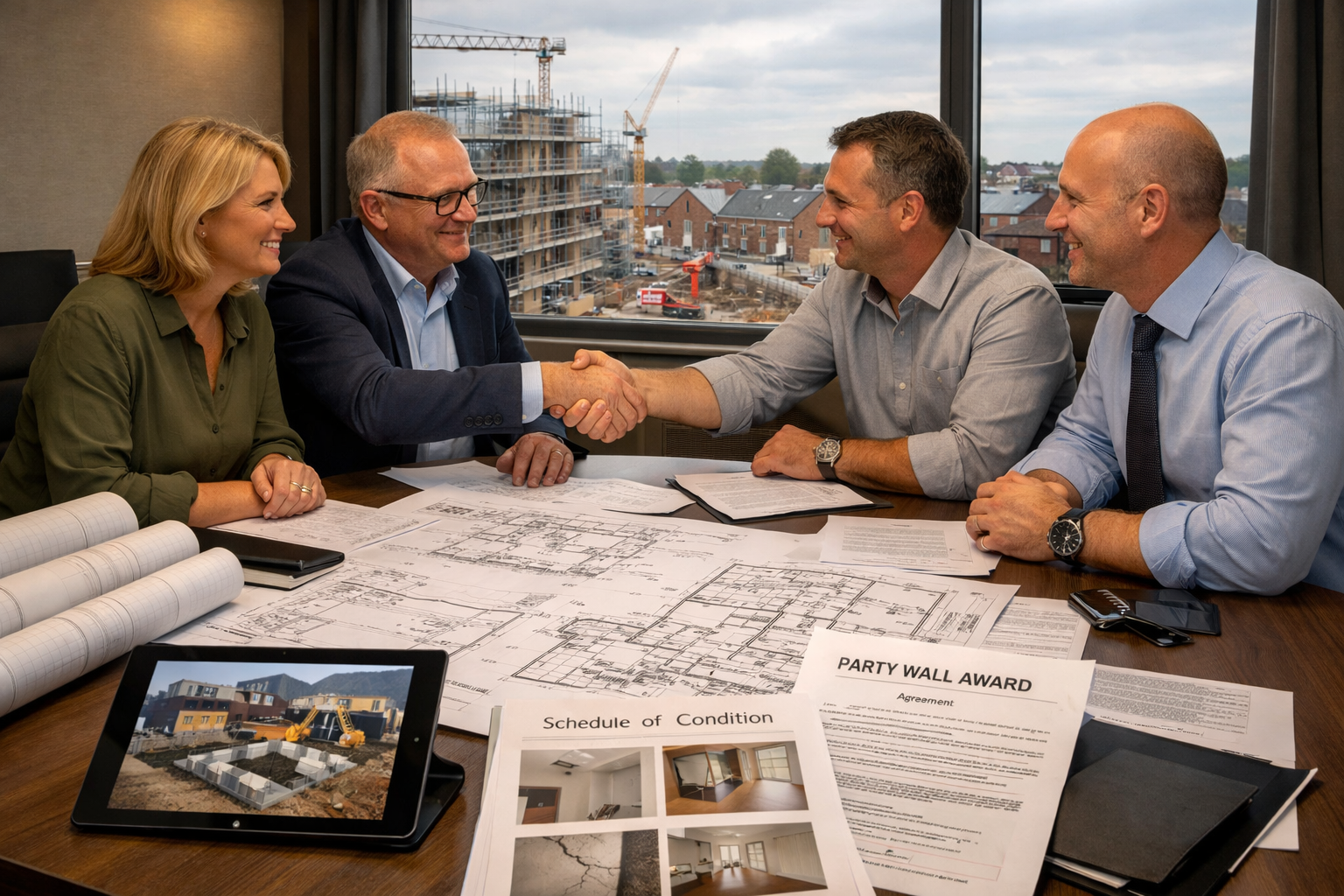
Understanding party wall costs becomes critical when disputes arise, as extended negotiations significantly increase expenses for building owners who typically bear all reasonable surveyor fees.
Cost Escalation Patterns in 2026 Disputes:
| Dispute Complexity | Typical Surveyor Fees | Timeline |
|---|---|---|
| Simple agreement (no objection) | £800-£1,500 per surveyor | 14-21 days |
| Standard excavation objection resolved by appointed surveyors | £2,500-£4,500 per surveyor | 21-35 days |
| Complex dispute requiring third surveyor | £6,000-£12,000 total (all surveyors) | 35-60 days |
| Adjudication or court proceedings | £15,000-£40,000+ | 90-180+ days |
Building owners can keep party wall costs down by:
- Investing in pre-notice consultation (£500-£1,000) to prevent objections worth thousands in dispute resolution
- Selecting experienced surveyors with excavation specialization who resolve disputes faster
- Providing comprehensive technical information upfront, reducing surveyor investigation time
- Maintaining realistic project timelines that don't pressure surveyors into rushed, contentious decisions
Adjoining owners should understand that while they don't directly pay surveyor fees in most cases, protracted objections delay projects without materially improving protections. The most effective strategy involves appointing competent surveyors who can negotiate robust protections efficiently.
Regulatory Compliance and Documentation
Party Wall Award Requirements
Party wall awards must satisfy specific statutory requirements while addressing excavation-specific concerns. Awards should include:
Mandatory Statutory Elements 📋:
- Names and addresses of building and adjoining owners
- Description of proposed works with sufficient detail for enforcement
- Date when works may commence
- Surveyors' names and appointment details
Excavation-Specific Provisions:
- Foundation exposure and support methodology
- Temporary works specifications and approval procedures
- Monitoring and inspection protocols with defined frequencies
- Emergency response procedures for unexpected ground conditions
- Damage assessment and remedy procedures
- Cost allocation for monitoring and remedial works
Enforcement Mechanisms:
- Work suspension triggers (e.g., monitoring threshold exceedances)
- Dispute escalation procedures for implementation disagreements
- Inspection access rights and notice requirements
Recent TCC decisions emphasize that parties must strictly follow contractual notice deadlines and payment regimes[4]. While these cases addressed construction contracts rather than party wall awards, the principle of procedural compliance applies equally. Awards with ambiguous timelines or unclear enforcement mechanisms invite disputes during implementation.
Notice Procedures Under Time Pressure
The 2026 construction boom creates pressure to accelerate party wall notice procedures, but statutory timelines remain fixed. Understanding what party wall notices are and how to respond prevents procedural errors that delay projects further.
Critical Timing Requirements:
Notice Service: Building owners must serve appropriate notices (typically Section 6 notices for excavation works) at least one month before work commences. For excavations within 3 meters of adjoining structures, this extends to two months if excavating below adjoining foundation levels.
Response Period: Adjoining owners have 14 days from notice receipt to consent or dissent. Silence after 14 days constitutes deemed dissent, triggering dispute resolution.
Surveyor Appointment: Parties appointing surveyors should do so within 10 days of dissent, though this isn't strictly mandatory.
Award Preparation: No statutory timeline exists, but surveyors should aim for 14-21 days from appointment to award service in straightforward excavation cases.
Surveyors handling multiple 2026 boom projects report that maintaining detailed procedural timelines and sending proactive reminders prevents the most common delays. Simple project management tools tracking notice dates, response deadlines, and inspection schedules prove invaluable.
Future-Proofing Dispute Resolution Approaches
Technology Integration
Progressive surveyors leverage technology to enhance handling party wall disputes in the 2026 UK construction boom:
Digital Monitoring Systems 📱: IoT-enabled crack monitors, tilt sensors, and vibration monitors provide real-time data accessible to all parties via smartphone apps. This transparency reduces disputes about whether monitoring thresholds have been exceeded.
3D Modeling and Visualization: Building Information Modeling (BIM) software creates visual representations of excavation relationships to adjoining foundations, helping non-technical adjoining owners understand structural interactions and protective measures.
Cloud-Based Documentation: Shared document repositories ensure all parties access current drawings, reports, and correspondence, eliminating "I wasn't informed" disputes.
Video Inspection Records: Drone footage and 360-degree cameras document existing conditions and work progress, creating irrefutable records for damage assessment.
Regulatory Horizon Scanning
Surveyors must anticipate potential legislative changes affecting party wall procedures. While the Party Wall etc. Act 1996 remains the governing framework, the Planning and Infrastructure Act 2025's success in accelerating planning approvals may inspire similar reforms to party wall timelines.
Potential Future Developments:
Mandatory Mediation: Legislation could require pre-dispute mediation attempts before third surveyor appointments, similar to construction industry adjudication reforms.
Standardized Award Templates: Regulatory bodies might develop mandatory award templates for common work types, reducing drafting time but potentially limiting customization.
Enhanced Adjoining Owner Protections: Consumer protection trends could strengthen adjoining owner rights, requiring more extensive pre-notice information provision.
Digital Notice Service: Electronic notice service may become statutorily recognized, accelerating timelines but requiring secure verification systems.
Surveyors staying informed about these potential changes position themselves as forward-thinking advisors rather than reactive problem-solvers.
Conclusion
Handling party wall disputes in the 2026 UK construction boom: surveyor strategies for excavation objections requires surveyors to balance statutory compliance, technical competence, and commercial pragmatism within compressed timelines. The Planning and Infrastructure Act 2025 has accelerated development approvals without extending party wall resolution periods, creating tension that skilled surveyors must manage strategically.
The most effective approaches share common elements: early engagement that prevents objections before formal notices are served, transparent communication that addresses adjoining owners' underlying concerns rather than stated positions, robust technical specifications that provide genuine protection while maintaining project viability, and rapid response protocols that minimize delay when disputes do arise.
As construction activity continues surging through 2026, surveyors who master these strategies will differentiate themselves in an increasingly competitive market. Those who persist with traditional adversarial approaches will find themselves marginalized as building owners seek advisors who can deliver both statutory compliance and commercial outcomes.
Actionable Next Steps
✅ For Building Owners: Engage party wall surveyors during project design phases, not just before notice service. Early surveyor involvement identifies potential objection triggers and allows design modifications that reduce dispute likelihood.
✅ For Adjoining Owners: Appoint experienced surveyors promptly when receiving excavation notices. Delayed appointments compress negotiation timelines and reduce your surveyor's ability to negotiate optimal protections.
✅ For Surveyors: Develop standardized pre-notice consultation protocols, award templates for common excavation scenarios, and vetted third surveyor panels. These systems enable rapid, consistent responses during the 2026 boom.
✅ For All Parties: Prioritize relationship preservation over positional victories. Neighbors coexist long-term; short-term adversarial gains often create long-term costs.
The construction boom presents both challenges and opportunities. Surveyors who adapt their practices to 2026's accelerated environment while maintaining rigorous professional standards will find abundant work. Those who cling to slower, more contentious approaches will struggle as the market demands efficiency alongside expertise.
For professional assistance with excavation disputes or to learn more about types of party wall works requiring surveyor involvement, consider consulting experienced practitioners who understand both the statutory framework and the commercial realities of 2026's construction landscape.
References
[1] Biz Const Building Safety Act 2026 Key Developments And What To Expect – https://www.rwkgoodman.com/info-hub/biz-const-building-safety-act-2026-key-developments-and-what-to-expect/
[2] Legal Developments In Construction Law February 2026 – https://www.mayerbrown.com/en/insights/publications/2026/02/legal-developments-in-construction-law-february-2026
[3] Legal Developments In Construction Law 3852205 – https://www.jdsupra.com/legalnews/legal-developments-in-construction-law-3852205/
[4] Building Blocks Developments Uk Construction Industry January 2026 – https://www.osborneclarke.com/insights/building-blocks-developments-uk-construction-industry-january-2026
[5] Party Wall Surveys Amid 2026 Construction Boom Handling Disputes In High Demand Uk Housing Markets – https://nottinghillsurveyors.com/blog/party-wall-surveys-amid-2026-construction-boom-handling-disputes-in-high-demand-uk-housing-markets