

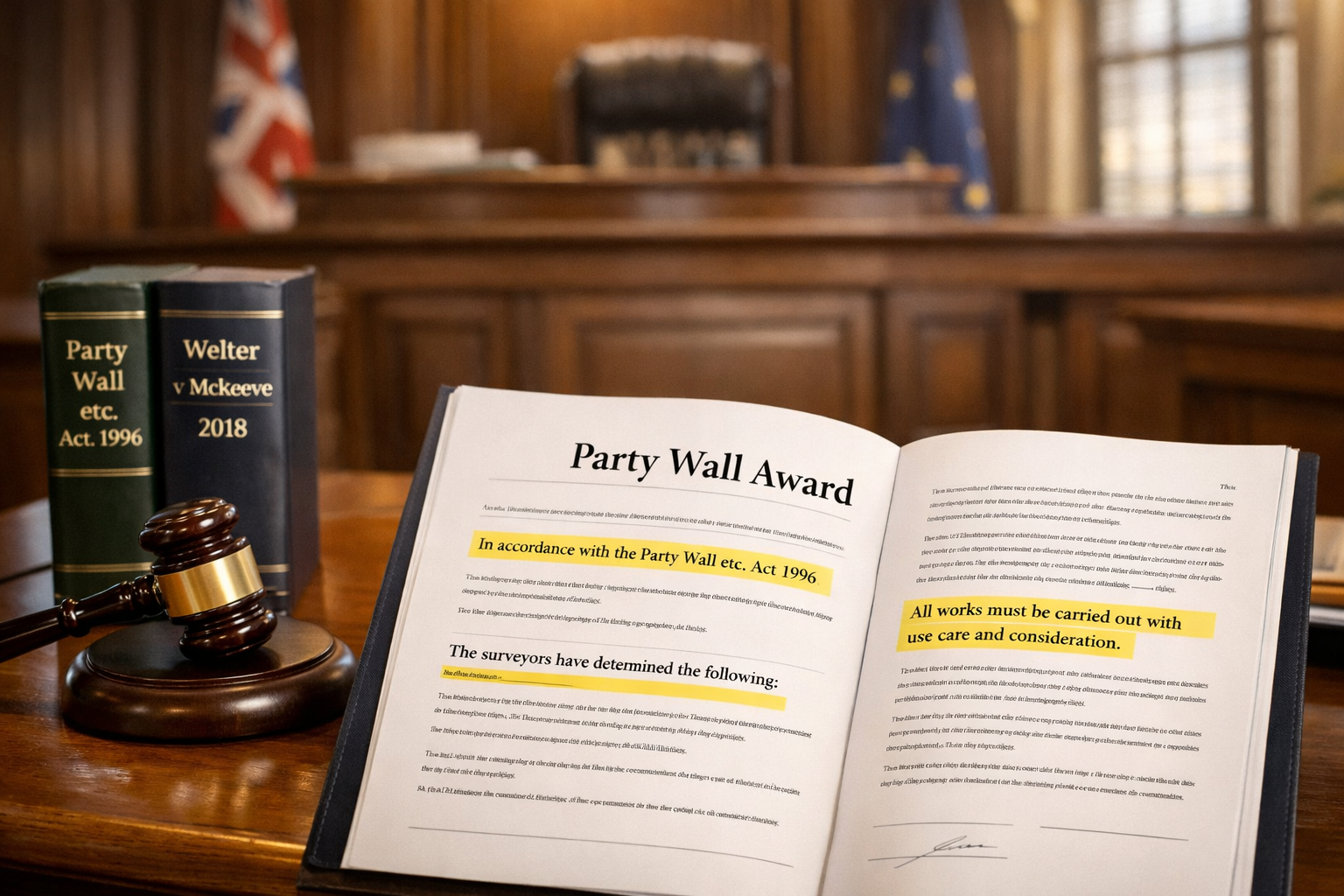
Recent court rulings have fundamentally reshaped how party wall surveyors must operate in 2026. The landmark 2018 Welter v McKeeve case established that surveyors must act with complete impartiality "whatever the circumstances"—a legal standard that has triggered increasing judicial scrutiny of award decisions and procedural compliance. This shift has created a complex professional landscape where surveyors must simultaneously serve their appointing owners while maintaining the detachment of an impartial tribunal. The Duties of Party Wall Surveyors: Balancing Impartiality with Client Interests in Award Decisions now face unprecedented legal examination, with courts specifically recognizing when surveyors have been "unduly influenced" by clients or contractors.[2]
Understanding these obligations is critical for property owners, construction professionals, and surveyors themselves. The consequences of failing to maintain proper impartiality extend beyond invalid awards—surveyors increasingly face exposure to adverse costs orders when their procedural compliance falls short.[6]
Key Takeaways
- Legal impartiality is mandatory: Party wall surveyors must act impartially regardless of who appointed them or pays their fees, as established by the Welter v McKeeve judgment
- Decision-making cannot be delegated: While administrative tasks may be assigned, the core decision-making process for producing awards must remain with the appointed surveyor
- Courts actively scrutinize surveyor conduct: Judicial review now specifically examines whether surveyors have been unduly influenced by appointing owners or contractors
- Awards are binding statutory determinations: Party wall awards under section 10 serve as legally enforceable expert determinations that authorize notifiable works
- Procedural failures invalidate awards: Recent case law shows awards can be declared invalid for procedural non-compliance, exposing surveyors to legal costs
Understanding the Legal Framework for Surveyor Impartiality
The Party Wall etc. Act 1996 establishes the statutory foundation for party wall procedures, but the true depth of surveyor obligations emerged through subsequent case law. The Act itself creates a unique professional role that differs fundamentally from traditional client-professional relationships.
The Welter v McKeeve Precedent
Judge Edward Bailey's 2018 judgment in Welter v McKeeve transformed the professional landscape for party wall surveyors. The ruling established that impartiality is a legal requirement regardless of appointment source, payment arrangements, or client pressure.[2] This precedent means surveyors must maintain "proper detachment required for an impartial tribunal" while exercising professional care.
The judgment specifically addressed scenarios where surveyors had been unduly influenced by their appointing owners or clients, establishing procedural impartiality as the key distinguishing factor in judicial review.[2] This creates a clear standard: financial pressure and time constraints can never excuse failure to act in the proper manner.
Statutory vs. Common Law Obligations
Party wall surveyors operate under a hybrid framework combining:
| Obligation Type | Source | Key Requirements |
|---|---|---|
| Statutory Duties | Party Wall etc. Act 1996 | Serve awards under section 10, determine disputes, authorize notifiable works |
| Common Law Duties | Case law precedents | Maintain impartiality, exercise professional care, avoid undue influence |
| Professional Standards | RICS/FPWS guidance | Conflict of interest disclosure, competence requirements, procedural compliance |
Whether appointed as an "Agreed Surveyor" under section 10(1)(a) or as a party-appointed surveyor under section 10(1)(b), surveyors must "endeavour to remain impartial" and may determine matters that find against their appointing owner.[3] This non-adversarial design distinguishes party wall work from traditional advocacy roles.
The Sui Generis Nature of Party Wall Awards
Party wall awards serve as "sui generis" determinations—unique legal instruments that are "more in the nature of an expert determination" than arbitration awards.[4] This classification carries significant implications:
✅ Awards are legally binding on both parties once properly served
✅ Awards remain valid retrospectively even after work completion
✅ Awards authorize commencement of notifiable works
✅ Awards cannot be served until complete and properly prepared[5]
The binding nature of these determinations underscores why impartiality matters. Unlike advisory opinions, awards create enforceable legal obligations that directly impact property rights and construction timelines.
Core Duties of Party Wall Surveyors: Balancing Impartiality with Client Interests in Award Decisions
The practical challenge facing surveyors involves maintaining statutory impartiality while providing competent professional service to appointing owners. This balance requires conscious awareness of multiple, sometimes competing, obligations.
Non-Delegable Decision-Making Responsibilities
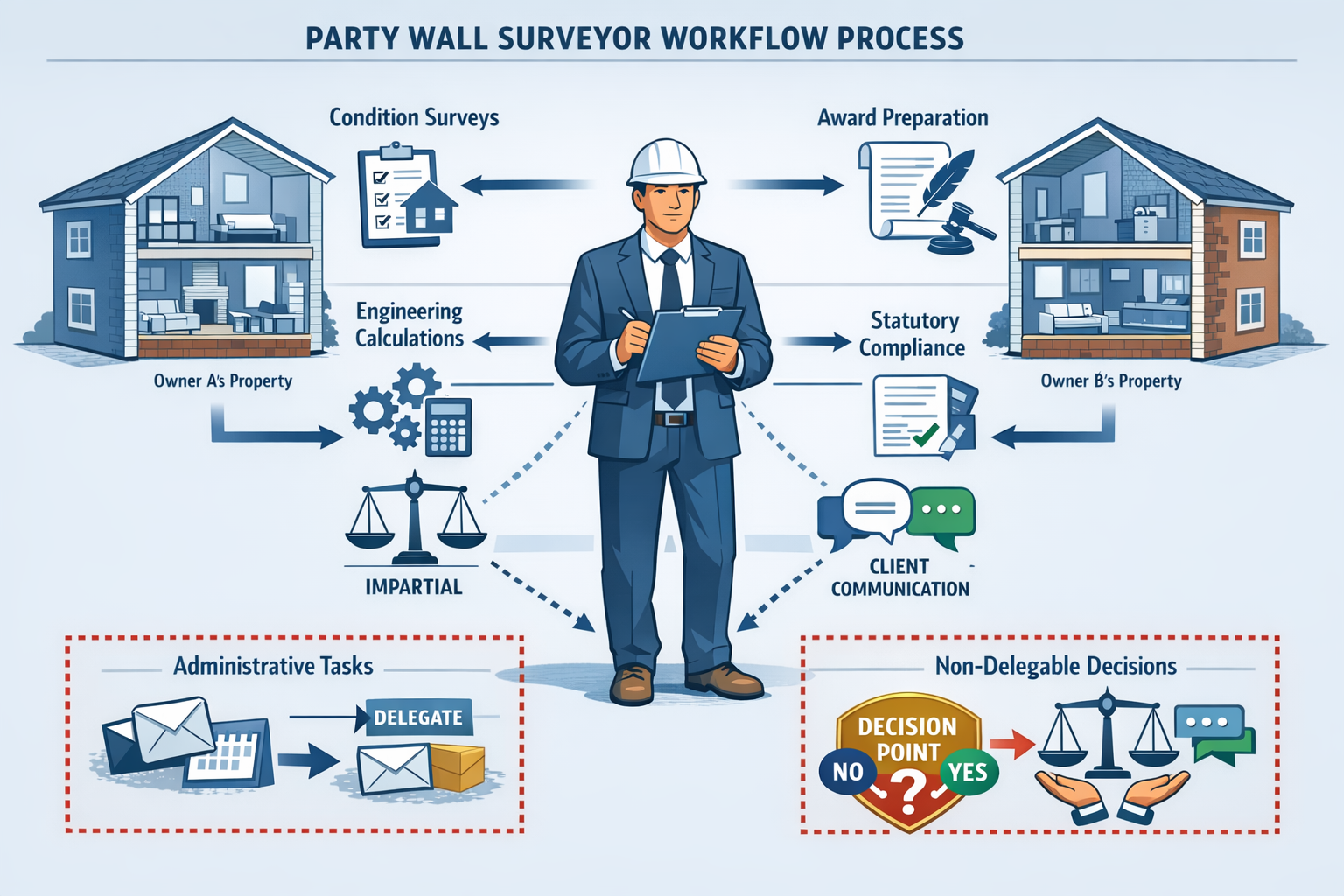
Recent judicial guidance establishes clear boundaries around what surveyors may delegate. While administrative functions and preliminary work can be assigned to assistants, the decision-making process for producing an award cannot be delegated by the party wall surveyor.[6]
Delegable tasks include:
- Condition surveys and photographic documentation
- Engineering calculations and structural assessments
- Preparation of drawings and technical specifications
- Administrative correspondence and scheduling
Non-delegable responsibilities include:
- Final award determinations
- Resolution of disputes between parties
- Authorization of works to proceed
- Determination of reasonable costs and expenses
This distinction ensures that qualified, experienced professionals make the critical decisions affecting property rights. A qualified and experienced surveyor is more likely to remain impartial and make fair, unbiased decisions.[1]
Maintaining Proper Detachment from Owners and Contractors
The Welter v McKeeve judgment requires surveyors to maintain "proper detachment required for an impartial tribunal" while exercising professional care.[2] This creates specific operational requirements:
🔍 Conscious awareness of representation: Surveyors must maintain clarity about which party they represent in multi-procedure situations
🔍 Resistance to undue influence: Pressure from appointing owners or contractors to produce awards speedily can never excuse improper conduct
🔍 Independent professional judgment: Decisions must be based on technical merit and statutory requirements, not client preferences
🔍 Transparent communication: Both parties should understand the basis for surveyor determinations
Some practitioners find it helpful to consider "the wall structure itself as the client" to ensure agreements serve the property's best interests rather than individual owner interests.[2] This conceptual approach helps maintain the non-adversarial nature of the role.
Conflict of Interest Management
The Faculty of Party Wall Surveyors guidance (June 2021) recommends that party-appointed surveyors should raise any perceived conflicts of interest with owners before appointment.[7] The instruction should proceed only when the other party does not view it as a conflict.
Common conflict scenarios include:
- Prior professional relationships with one party
- Financial interests in the outcome
- Multiple appointments in the same geographic area
- Previous disputes with involved parties
Early disclosure allows parties to make informed decisions about surveyor selection. For property owners seeking representation, consulting a building owner's surveyor or adjoining owner's surveyor with transparent conflict management practices is essential.
Duty of Care to Both Parties
Regardless of appointment type, surveyors owe a duty of care to both parties. This bilateral obligation means surveyors must:
- Consider the legitimate interests of both building and adjoining owners
- Ensure awards provide adequate protection for adjoining properties
- Authorize only works that comply with statutory requirements
- Determine reasonable timeframes and working methods
- Address concerns raised by either party with equal consideration
This duty extends beyond the appointing owner, creating a professional responsibility to the entire party wall process. Understanding types of party wall works helps surveyors assess the appropriate level of protection required for different scenarios.
Recent Case Law Trends and Best Practices for Transparent Decision-Making
The legal landscape surrounding party wall procedures continues to evolve, with courts applying increasingly rigorous standards to surveyor conduct and award validity. Understanding these trends is essential for maintaining professional compliance in 2026.

Increasing Judicial Scrutiny of Procedural Compliance
Recent case law establishes that "the manner in which [surveyors] operate and arrive at their awards is coming under ever increasing judicial scrutiny, with awards being declared invalid for any number of procedural reasons."[6] This heightened scrutiny has several practical implications:
Courts now examine:
- Whether proper party wall notices were served with adequate detail
- Whether surveyors conducted sufficient investigations before issuing awards
- Whether both parties received adequate opportunity to present concerns
- Whether awards contain sufficient reasoning for determinations
- Whether surveyors maintained independence from undue influence
Surveyors are increasingly made parties to legal actions, with exposure to adverse costs orders when procedural compliance fails.[6] This financial risk underscores the importance of meticulous procedural adherence.
Emphasis on Adjoining Owner Protections
Recent judicial decisions emphasize the protective purpose of the Party Wall Act. Courts recognize that the legislation exists primarily to safeguard adjoining owners from potential damage caused by building works. This recognition has strengthened requirements for:
✅ Comprehensive condition surveys: Detailed schedules of condition documenting pre-work property status
✅ Adequate protective measures: Awards must specify reasonable precautions to prevent damage
✅ Monitoring provisions: Regular inspections during works to identify emerging issues
✅ Remediation mechanisms: Clear procedures for addressing damage if it occurs
For adjoining owners concerned about neighboring construction, understanding these protections is crucial. Resources on what to do when your neighbour is carrying out works provide valuable guidance for protecting property interests.
Surveyor Obligations for Thorough Investigations
Courts expect surveyors to conduct adequate investigations before issuing awards. Superficial assessments or reliance solely on building owner representations are insufficient. Best practice investigations include:
- Physical site inspections of both properties
- Review of structural documentation including plans and engineering reports
- Assessment of proposed working methods and their potential impacts
- Consultation with technical specialists when complex issues arise
- Consideration of alternative approaches that may reduce risk or inconvenience
The depth of investigation should be proportionate to the complexity and risk profile of the proposed works. Simple repairs to an existing party wall require less extensive investigation than major structural alterations or basement excavations.
Transparent Communication and Reasoning
Modern best practice emphasizes transparent communication throughout the award process. Surveyors should:
📋 Document all site visits and inspections
📋 Provide written summaries of key findings
📋 Explain the reasoning behind award determinations
📋 Address specific concerns raised by either party
📋 Maintain accessible records of the decision-making process
This transparency serves multiple purposes: it demonstrates impartiality, provides a defensible record if awards are challenged, and helps parties understand and accept determinations. For those navigating the process, reviewing a party wall contract template guide on party wall awards can clarify what to expect.
Managing Time Pressure Without Compromising Standards
Construction schedules often create pressure to expedite award preparation. However, the Welter v McKeeve judgment explicitly states that pressure to produce awards speedily can never excuse failure to act properly.[2] Surveyors must:
- Set realistic timelines that allow for thorough investigation
- Communicate clearly about procedural requirements that cannot be rushed
- Resist client pressure to skip essential steps
- Maintain professional independence regarding timing decisions
Property owners planning construction should account for reasonable party wall timelines in their project schedules. Understanding how to keep party wall costs down while maintaining proper procedures can help balance efficiency with compliance.
Retrospective Awards and Ongoing Obligations
Courts have confirmed that party wall awards remain valid even when issued retrospectively after work completion.[4] This principle addresses situations where:
- Works proceeded without proper party wall procedures
- Disputes arose during or after construction
- Damage occurred requiring formal determination
However, retrospective awards do not excuse procedural failures. Surveyors issuing retrospective awards must still conduct thorough investigations and maintain impartiality standards. The retrospective nature may actually increase scrutiny, as courts examine whether the surveyor adequately investigated completed works and their impacts.
Regional Considerations and Local Expertise
While the Party Wall etc. Act 1996 applies uniformly across England and Wales, practical application varies by region. Surveyors with local expertise understand:
- Typical construction methods in the area
- Common property types and structural characteristics
- Local contractor practices and capabilities
- Regional cost benchmarks for party wall works
Property owners benefit from engaging surveyors with relevant geographic experience. Whether seeking a party wall surveyor in East London, West London, Central London, North London, or South London, local knowledge enhances the quality of surveyor determinations.
Practical Guidance for Property Owners
Understanding surveyor obligations helps property owners make informed decisions and set appropriate expectations when party wall matters arise.
Selecting a Qualified Surveyor
Before appointing a party wall surveyor, property owners should verify:
🎓 Professional qualifications: RICS membership or Faculty of Party Wall Surveyors membership
🎓 Relevant experience: Track record with similar property types and work scopes
🎓 Independence: Absence of conflicts of interest
🎓 Professional indemnity insurance: Adequate coverage for potential liabilities
🎓 Clear fee structures: Transparent pricing and scope of services
Qualifications and experience directly correlate with impartiality—a qualified and experienced surveyor is more likely to remain impartial and make fair decisions.[1]
Understanding Your Rights and Obligations
Whether you're a building owner planning works or an adjoining owner receiving notice, understanding your position is essential:
Building owners should:
- Serve proper party wall act notices with adequate detail
- Allow reasonable time for responses
- Cooperate with surveyor investigations
- Budget for party wall costs in project planning
- Understand that costs of party wall procedures are typically borne by the building owner
Adjoining owners should:
- Respond promptly to notices received
- Consider appointing their own surveyor rather than agreeing to a single agreed surveyor
- Participate in condition surveys and inspections
- Raise concerns clearly and specifically
- Understand that reasonable objections must be addressed in awards
Resources for building owners and adjoining owners provide detailed guidance for each position.
When to Challenge an Award
Awards can be challenged through the dispute resolution mechanisms in section 10(17) of the Act. Grounds for challenge may include:
- Procedural irregularities in award preparation
- Evidence of surveyor bias or undue influence
- Failure to address specific concerns raised
- Technical errors in determinations
- Inadequate protective measures specified
However, challenges should be based on substantive procedural or technical grounds, not mere disagreement with determinations. Legal advice is typically necessary before pursuing formal challenges.
Alternative Approaches: Proceeding Without Surveyors
In some cases, parties may consider having a party wall agreement without a surveyor. While this approach can reduce costs, it requires:
- Mutual trust and cooperation between neighbors
- Relatively straightforward works with minimal risk
- Clear written agreements documenting terms
- Understanding that informal agreements lack the legal protection of formal awards
For complex projects or where relationships are strained, formal surveyor involvement provides essential protection for both parties.
Conclusion
The Duties of Party Wall Surveyors: Balancing Impartiality with Client Interests in Award Decisions have evolved significantly through recent case law, establishing clear legal standards that prioritize procedural integrity and bilateral protection. The Welter v McKeeve precedent fundamentally reshaped professional expectations, requiring surveyors to maintain complete impartiality regardless of appointment source, payment arrangements, or client pressure.
In 2026, surveyors face unprecedented judicial scrutiny of their procedural compliance, with courts actively examining whether undue influence has compromised decision-making. The non-delegable nature of core award determinations, combined with increasing exposure to adverse costs orders, creates a professional environment where meticulous adherence to statutory and common law obligations is essential.
For property owners, understanding these surveyor obligations enables informed decision-making when party wall matters arise. Whether planning construction works or responding to a neighbor's notice, engaging qualified surveyors who demonstrate commitment to impartiality and procedural transparency protects property interests and ensures legally valid outcomes.
Next Steps for Property Owners
If you're planning building works:
- Engage a qualified party wall surveyor early in project planning
- Serve proper notices with adequate detail and reasonable timelines
- Budget for party wall costs as part of overall project expenses
- Cooperate fully with surveyor investigations and requests
- Understand that proper procedures protect both you and your neighbors
If you've received a party wall notice:
- Respond within the statutory 14-day period
- Consider appointing your own surveyor to represent your interests
- Participate in condition surveys to document pre-work property status
- Raise specific concerns clearly and in writing
- Understand your rights to adequate protective measures
For all parties:
- Maintain realistic expectations about timelines—proper procedures cannot be rushed
- Recognize that surveyor impartiality serves everyone's long-term interests
- Document all communications and site conditions thoroughly
- Seek professional advice when complex issues arise
- Remember that party wall procedures exist to facilitate construction while protecting property rights
The party wall framework, when properly implemented by impartial surveyors, enables necessary construction works while safeguarding the interests of all affected parties. Understanding the balance surveyors must maintain between client service and statutory impartiality helps property owners navigate these procedures effectively and achieve fair, legally sound outcomes.
References
[1] Analysis Of Party Wall Surveyors Impartiality – https://iconsurveyors.co.uk/blog/analysis-of-party-wall-surveyors-impartiality/
[2] Party Wall Surveyors Impartiality – https://ww3.rics.org/uk/en/journals/built-environment-journal/party-wall-surveyors-impartiality.html
[3] The Role Of The Party Wall Surveyor – https://www.partywallconsultancy.co.uk/the-role-of-the-party-wall-surveyor
[4] Navigating The Party Wall Act Retrospective Awards And Surveyors Role In Settling Disputes – https://www.tayross.com/blogs/navigating-the-party-wall-act-retrospective-awards-and-surveyors-role-in-settling-disputes
[5] Party Wall Awards – https://www.murrins.co.uk/services/party-walls/party-wall-awards/
[6] The Unique Role Of A Party Wall Surveyor – https://dwfgroup.com/en/news-and-insights/insights/2017/4/the-unique-role-of-a-party-wall-surveyor
[7] 2021 06 29 005 Guide To Code Of Conduct – https://fpws.org.uk/wp-content/uploads/2021/07/2021-06-29-005-Guide-to-Code-of-Conduct.pdf