


The Court of Appeal's recent confirmation that steps laid down by the Party Wall Act 1996 must be "scrupulously followed" has fundamentally reshaped how surveyors approach their statutory duties.[1] This heightened judicial scrutiny represents a critical turning point in the Evolution of Party Wall Surveyor Duties: Case Law Insights and Best Practices for Impartial Awards, forcing practitioners to reconsider long-standing practices and prioritize procedural precision over convenience. For property owners navigating construction projects in 2026, understanding these evolving standards has never been more essential.
The tension between serving clients and protecting adjoining owners' rights has intensified as courts increasingly examine the technical validity of surveyor appointments, awards, and procedural compliance. Recent rulings have left homeowners facing disproportionate legal costs due to procedural technicalities, while surveyors grapple with the reality that their quasi-judicial powers carry unprecedented accountability requirements.
Key Takeaways
- Quasi-judicial status demands strict procedural compliance: Party wall surveyors must follow statutory requirements scrupulously, with courts now invalidating awards for technical procedural failures
- Non-delegable duties strengthen personal accountability: Recent case law confirms surveyors cannot delegate their quasi-judicial responsibilities except in exceptional circumstances
- Appointment validity faces increased scrutiny: Multiple 2026 cases have examined Section 10 technicalities, creating significant financial consequences for homeowners when appointments are deemed invalid
- RICS guidance update emphasizes independence: The 2026 consultation reinforces that surveyor appointments are personal and statutory, independent of client instruction
- Transparent decision-making protects all parties: Best practices now require documented reasoning, clear communication, and balanced consideration of both building and adjoining owner interests
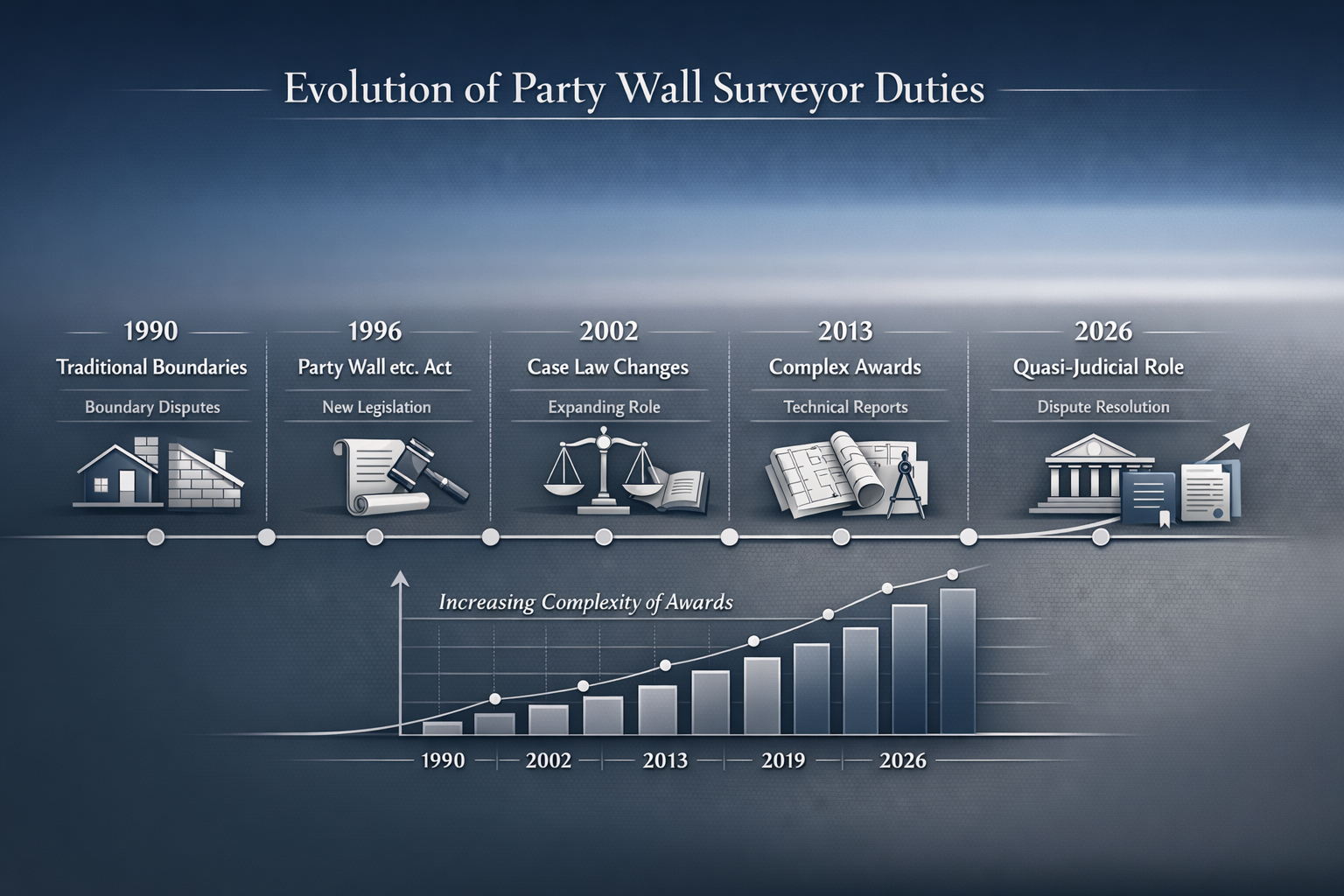
Understanding the Quasi-Judicial Role in the Evolution of Party Wall Surveyor Duties
The Statutory Foundation of Surveyor Authority
Party wall surveyors occupy a unique position within construction law, operating with quasi-judicial powers that distinguish them from ordinary professional consultants. Unlike typical building surveyors who serve client interests exclusively, party wall surveyors must balance competing interests while exercising statutory authority under the Party Wall etc. Act 1996.[1]
This quasi-judicial status means surveyors function similarly to arbitrators or adjudicators, making binding decisions that affect property rights and construction activities. The Court of Appeal has confirmed that this elevated position carries corresponding responsibilities, with procedural missteps potentially invalidating entire awards.[1]
Recent Case Law Reshaping Professional Standards
The landscape of party wall practice has transformed dramatically through recent judicial decisions. Courts have increasingly examined:
- ✅ Appointment validity: Technical compliance with Section 10 notification requirements
- ✅ Resignation procedures: Proper protocols for surveyors withdrawing from appointments
- ✅ Award formulation: Sufficiency of reasoning and consideration of both parties' interests
- ✅ Cost determinations: Fairness and proportionality in fee allocations
These cases have created what some practitioners describe as an "unintended consequence trap," where homeowners become liable for substantial legal costs arising from procedural technicalities that could have been avoided with proper guidance.[1]
The Non-Delegable Nature of Surveyor Duties
One of the most significant developments in the Evolution of Party Wall Surveyor Duties: Case Law Insights and Best Practices for Impartial Awards concerns the principle of non-delegation. Courts have established that surveyors holding quasi-judicial powers may not delegate their core responsibilities except in exceptional circumstances.[1]
This principle has practical implications for:
- 📋 Site inspections: Personal attendance requirements for critical assessments
- 📋 Award drafting: Direct involvement in formulating findings and conditions
- 📋 Decision-making: Non-transferable responsibility for professional judgments
- 📋 Communication: Personal engagement with both building and adjoining owners
The RICS consultation on updated party wall practice guidance emphasizes this point, noting that a party wall surveyor's appointment is "personal and statutory, independent of client instruction."[3] This reinforces that surveyors cannot simply act as agents for the appointing owner but must maintain independence throughout the process.
Navigating the Tension Between Client Duties and Adjoining Owner Protections
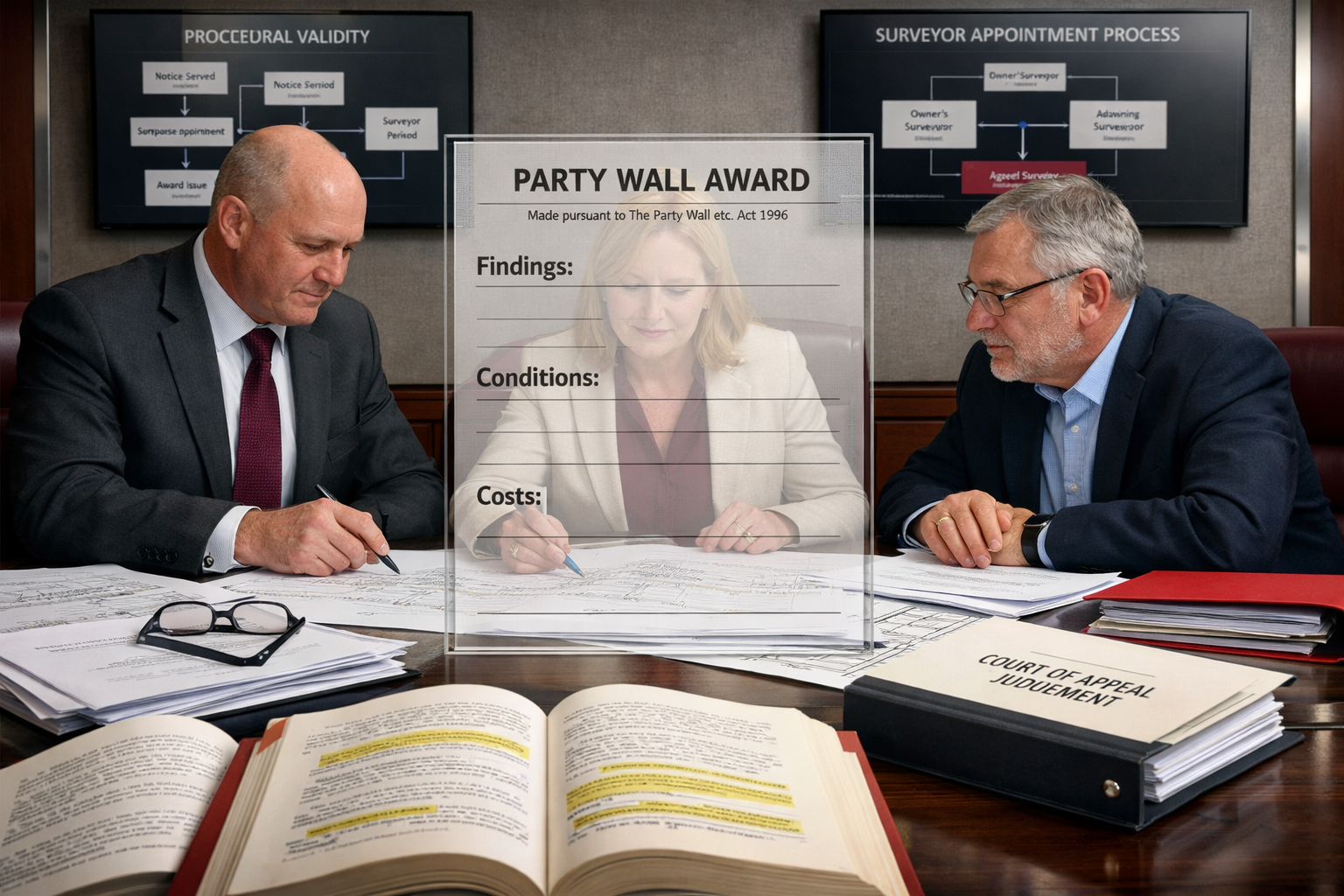
The Dual Responsibility Challenge
The central challenge in modern party wall practice involves reconciling two potentially conflicting obligations:
- Duty to the appointing owner: Facilitating legitimate construction works efficiently
- Duty to statutory fairness: Protecting adjoining owners' rights and property interests
This tension has intensified as judicial scrutiny increases. Surveyors appointed by building owners cannot simply advocate for their client's position—they must consider adjoining owner concerns with equal weight when formulating party wall awards.
Procedural Validity: The New Battleground
Recent case law has transformed procedural compliance from a formality into a critical vulnerability. Multiple cases in 2026 have addressed technical issues surrounding:
Section 10 Appointment Requirements 📌
The Act requires specific steps for appointing surveyors, including proper notification to all parties. Courts have invalidated appointments where:
- Building owners failed to serve proper notice before appointing their surveyor
- Adjoining owners weren't given adequate opportunity to appoint their own surveyor
- Appointment letters contained ambiguous or incomplete information
- Timelines prescribed by the Act weren't strictly observed
Award Formulation Standards 📌
Courts now examine whether awards contain sufficient reasoning and demonstrate balanced consideration of both parties' interests. Inadequate awards may be set aside if they:
- Lack detailed findings supporting conditions imposed
- Fail to address specific concerns raised by adjoining owners
- Contain arbitrary or unexplained cost allocations
- Demonstrate bias toward the appointing owner's preferences
Strategies for Maintaining Impartiality
To navigate these challenges successfully, leading practitioners in 2026 have adopted several key strategies:
🔹 Documentation Excellence
Maintaining comprehensive records of all communications, site observations, and decision-making rationales provides crucial protection if awards face judicial review. This includes:
- Detailed attendance notes from meetings with both parties
- Photographic evidence supporting condition assessments
- Written explanations for each condition included in awards
- Clear audit trails showing consideration of alternative approaches
🔹 Transparent Communication
Regular, balanced communication with both building and adjoining owners helps prevent misunderstandings and demonstrates impartiality. Best practices include:
- Copying both parties on all substantive correspondence
- Explaining the quasi-judicial role at the outset
- Setting clear expectations about decision-making processes
- Providing opportunities for both parties to present concerns
🔹 Independent Professional Judgment
Resisting pressure from appointing owners to prioritize their interests over statutory fairness requires professional courage. This involves:
- Declining instructions that compromise independence
- Imposing reasonable conditions to protect adjoining properties
- Allocating costs fairly based on statutory principles
- Refusing to rubber-stamp building owner proposals without proper assessment
For property owners seeking guidance on party wall agreement processes without surveyors, understanding these impartiality requirements helps explain why professional surveyor involvement often proves essential for complex projects.
The Cost Consequences of Procedural Failures
The financial stakes of procedural errors have escalated dramatically. When awards are invalidated due to technical failures, the resulting consequences can include:
| Consequence | Typical Cost Impact | Party Affected |
|---|---|---|
| Legal challenge costs | £15,000-£50,000+ | Building owner |
| Work stoppage delays | £500-£2,000 per day | Building owner |
| Re-appointment process | £2,000-£5,000 | Building owner |
| Additional surveyor fees | £3,000-£8,000 | Building owner |
| Adjoining owner legal fees | £10,000-£30,000 | Building owner (if liable) |
These figures underscore why understanding the Evolution of Party Wall Surveyor Duties: Case Law Insights and Best Practices for Impartial Awards matters not just for surveyors but for property owners planning construction projects.
Best Practices for Impartial Awards in 2026

The RICS Consultation and Updated Guidance
The Royal Institution of Chartered Surveyors launched a comprehensive consultation in 2026 to update party wall practice guidance, responding directly to the evolving case law landscape.[3] The consultation emphasizes several critical principles:
Independence Over Advocacy 🎯
The updated guidance reinforces that party wall surveyors must maintain independence from the appointing owner's commercial interests. This represents a shift from earlier interpretations where some practitioners viewed their role as primarily facilitating the building owner's objectives.
Personal Statutory Appointment 🎯
The consultation clarifies that surveyor appointments are personal and statutory, not contractual arrangements subject to client instruction. This distinction has profound implications for how surveyors approach their duties and resist inappropriate pressure.
Procedural Scrupulousness 🎯
Building on recent Court of Appeal language, the guidance stresses that statutory procedures must be followed scrupulously, not merely substantially. This eliminates previous tolerance for minor procedural shortcuts.
Practical Framework for Impartial Decision-Making
Implementing these principles requires a structured approach to award formulation. Leading practitioners in 2026 follow this framework:
Phase 1: Comprehensive Assessment
Step 1: Independent Site Inspection 🔍
Conduct thorough inspections of both properties, documenting existing conditions with photographs, measurements, and detailed notes. This provides objective evidence supporting award conditions.
Step 2: Technical Analysis 🔍
Review architectural drawings, structural calculations, and construction methodologies to understand proposed works' potential impacts. Consult specialist engineers when necessary for complex structural matters.
Step 3: Risk Identification 🔍
Systematically identify potential risks to adjoining properties, including:
- Structural stability concerns
- Damage from vibration or excavation
- Water ingress vulnerabilities
- Access and working space requirements
- Temporary support needs
Phase 2: Balanced Condition Formulation
Protective Conditions ⚖️
Include conditions necessary to protect adjoining owners' property interests, such as:
- Working hours restrictions to minimize disturbance
- Protective measures during excavation or structural work
- Access provisions for monitoring and inspection
- Insurance requirements covering potential damage
- Schedule of condition requirements documenting pre-existing conditions
Reasonable Facilitation ⚖️
Ensure conditions don't unnecessarily impede legitimate construction activities:
- Avoid overly restrictive requirements without clear justification
- Consider practical construction sequencing needs
- Balance protection with proportionality
- Allow reasonable flexibility for unforeseen circumstances
Phase 3: Transparent Documentation
Award Reasoning 📝
Modern best practice requires awards to include:
- Clear findings of fact based on site inspections
- Explicit reasoning for each condition imposed
- Explanation of how competing interests were balanced
- Reference to relevant statutory provisions and case law
- Transparent cost allocation methodology
Communication Records 📝
Maintain comprehensive records demonstrating:
- Both parties received equal opportunities to present concerns
- All substantive issues were considered and addressed
- Decision-making processes followed proper procedures
- Independence was maintained throughout
Managing Common Conflict Scenarios
Certain situations frequently test surveyors' impartiality. Here's how best practices address common challenges:
Scenario: Building Owner Pressure to Minimize Conditions 💼
When building owners request fewer protective conditions to reduce costs or expedite work:
- Explain the statutory duty to protect adjoining property
- Document the technical justification for each condition
- Offer alternatives that achieve protection more efficiently
- Stand firm on essential protections despite client pressure
Scenario: Adjoining Owner Unreasonable Demands 💼
When adjoining owners request excessive conditions or compensation:
- Distinguish legitimate concerns from unreasonable demands
- Base decisions on objective technical assessment, not emotional appeals
- Explain statutory limitations on what awards can require
- Consider whether types of party wall works genuinely justify proposed conditions
Scenario: Cost Allocation Disputes 💼
When parties disagree about who should bear various costs:
- Apply statutory cost principles consistently
- Document reasoning for cost allocations clearly
- Consider proportionality and fairness to both parties
- Refer to party wall costs guidance for standard approaches
The Role of Third Surveyor Selection
When building and adjoining owner surveyors cannot reach agreement, appointing an impartial third surveyor becomes necessary. The selection process itself reflects evolving best practices:
Selection Criteria 🏆
- Demonstrated expertise in party wall matters
- No prior relationship with either party or their surveyors
- Reputation for impartial decision-making
- Understanding of current case law developments
- Availability to resolve disputes promptly
Third Surveyor Responsibilities 🏆
- Review submissions from both appointed surveyors objectively
- Conduct independent assessment of technical issues
- Make binding determinations that cannot be appealed except through courts
- Ensure procedural fairness throughout dispute resolution
- Issue awards that comply with statutory requirements and case law principles
Technology and Modern Practice
The Evolution of Party Wall Surveyor Duties: Case Law Insights and Best Practices for Impartial Awards extends to embracing technology while maintaining personal accountability:
Digital Documentation 💻
- Cloud-based case management systems tracking compliance milestones
- Digital photography with metadata confirming inspection dates
- Electronic service of notices with delivery confirmation
- Secure client portals providing transparent access to case information
Virtual Inspections 💻
While maintaining the principle of personal involvement, technology enables:
- Video conferencing for preliminary discussions
- Virtual condition surveys where physical access proves difficult
- Digital collaboration between appointed surveyors
- Remote monitoring of ongoing construction work
However, the non-delegable nature of surveyor duties means technology supplements rather than replaces personal professional judgment and physical site attendance for critical assessments.
Continuing Professional Development
Given the rapid evolution of case law and practice standards, surveyors must prioritize ongoing education:
- Regular review of new court decisions affecting party wall practice
- Participation in professional development courses addressing recent cases
- Engagement with RICS consultation processes and guidance updates
- Networking with peers to discuss challenging scenarios and emerging issues
- Subscription to legal updates tracking construction and property law developments
Conclusion
The Evolution of Party Wall Surveyor Duties: Case Law Insights and Best Practices for Impartial Awards represents a fundamental shift toward heightened accountability and procedural rigor. The Court of Appeal's confirmation that statutory steps must be "scrupulously followed" has eliminated tolerance for procedural shortcuts, while the principle of non-delegable duties reinforces personal responsibility for quasi-judicial functions.[1]
For surveyors, this evolution demands a renewed commitment to independence, transparent decision-making, and balanced consideration of both building and adjoining owner interests. The tension between client service and statutory impartiality requires professional courage—standing firm on essential protections despite pressure, while facilitating legitimate construction efficiently.
For property owners planning construction projects in 2026, understanding these evolving standards helps explain why proper party wall notice procedures and professional surveyor involvement prove essential. The financial consequences of procedural failures—potentially exceeding £50,000 in legal costs and delays—far outweigh the investment in proper compliance from the outset.
Actionable Next Steps
For Party Wall Surveyors: 🎯
- Review all current cases for procedural compliance with recent case law standards
- Implement comprehensive documentation systems tracking decision-making rationales
- Participate in RICS consultation processes and continuing professional development
- Develop template award language incorporating sufficient reasoning and findings
- Establish clear communication protocols ensuring balanced engagement with both parties
For Building Owners Planning Works: 🏗️
- Engage experienced party wall surveyors early in project planning stages
- Ensure proper party wall notice service before appointing surveyors
- Budget appropriately for professional fees and potential protective measures
- Understand that surveyors must maintain impartiality despite your appointment
- Consider whether party wall agreement templates suit simple projects or professional involvement proves necessary
For Adjoining Owners Receiving Notices: 🏘️
- Respond promptly to party wall notices to protect your rights
- Consider appointing your own surveyor for significant or complex works
- Document existing property conditions thoroughly before works commence
- Understand that appointed surveyors must act impartially, not as advocates
- Seek professional advice if concerned about proposed works' potential impacts
The construction boom continuing through 2026 ensures party wall matters will remain prominent in property development across London and beyond.[4] By embracing the evolving standards established through recent case law and implementing best practices for impartial awards, surveyors can fulfill their quasi-judicial duties effectively while property owners can navigate the party wall process with confidence and compliance.
The future of party wall practice lies in recognizing that procedural precision and genuine impartiality serve everyone's interests—protecting adjoining owners' property rights while facilitating legitimate construction efficiently. As judicial scrutiny intensifies, those who adapt to these higher standards will thrive, while those clinging to outdated practices face increasing vulnerability to costly legal challenges.
References
[1] The Unique Role Of A Party Wall Surveyor – https://dwfgroup.com/en/news-and-insights/insights/2017/4/the-unique-role-of-a-party-wall-surveyor
[2] Party Wall Agreement – https://hoa.org.uk/advice/guides-for-homeowners/i-am-improving/party-wall-agreement/
[3] Rics Launches Consultation On Updated Party Wall Practice Guidance – https://www.rics.org/news-insights/rics-launches-consultation-on-updated-party-wall-practice-guidance
[4] Party Wall Surveys Amid 2026 Construction Boom Handling Disputes In High Demand Uk Housing Markets – https://nottinghillsurveyors.com/blog/party-wall-surveys-amid-2026-construction-boom-handling-disputes-in-high-demand-uk-housing-markets
[5] Legal Developments In Construction Law 3852205 – https://www.jdsupra.com/legalnews/legal-developments-in-construction-law-3852205/