


Property disputes cost UK homeowners an average of £15,000 in legal fees when they escalate to litigation—yet 87% of these conflicts could be prevented with proper surveyor intervention. As the 2026 housing boom drives unprecedented construction activity across London and surrounding regions, the role of party wall surveyors has never been more critical. Understanding how party wall surveyors prevent costly disputes: real-world examples from 2026 UK housing booms reveals the tangible value these professionals deliver when excavation projects, loft conversions, and basement extensions threaten neighbour relations.
The current construction surge has created a perfect storm for potential conflicts. Planning authorities are processing record volumes of applications, while homeowners rush to capitalize on property values through renovations and extensions[2]. In this high-pressure environment, expert surveyors serve as the essential buffer between ambitious building projects and expensive legal battles.
Key Takeaways
- 🛡️ Schedules of condition document pre-construction property states, providing irrefutable evidence that prevents false damage claims worth thousands
- 📋 Party wall awards establish clear legal frameworks that reduce dispute likelihood by 73% compared to informal arrangements
- 💰 Professional surveyor intervention saves homeowners an average of £12,000-£18,000 in potential litigation costs during excavation projects
- 📈 2026 housing boom pressures have increased party wall work volumes by 45%, making expert guidance more essential than ever
- ⚖️ Regulatory compliance through proper party wall notices protects both building and adjoining owners from legal penalties
The Critical Role of Party Wall Surveyors in 2026's Construction Landscape
The 2026 UK housing market has experienced extraordinary growth, particularly in high-density urban areas where property boundaries are measured in centimeters rather than meters. This boom has created unprecedented demand for construction work that affects shared walls, foundations, and structures between neighbouring properties.
Party wall surveyors function as specialized professionals who understand both the technical aspects of construction and the legal framework established by the Party Wall etc. Act 1996. Their expertise becomes invaluable when building owners plan works that could impact adjoining properties—from simple repairs to complex basement excavations that extend three meters below neighbouring foundations.
Why Professional Intervention Matters More Than Ever
The construction boom has intensified several risk factors:
- Increased excavation depth: Modern basement conversions often extend significantly below ground level, creating substantial structural risks
- Higher property values: With UK house prices at record levels, even minor damage claims can involve tens of thousands of pounds
- Regulatory scrutiny: Planning authorities and building control departments are processing higher volumes of applications, increasing oversight[2]
- Neighbor awareness: Property owners are more informed about their rights, leading to faster escalation of concerns
Without professional surveyor guidance, these factors combine to create an environment where disputes can rapidly spiral into expensive litigation. The costs of the party wall process pale in comparison to legal fees and project delays.
How Party Wall Surveyors Prevent Costly Disputes Through Documentation
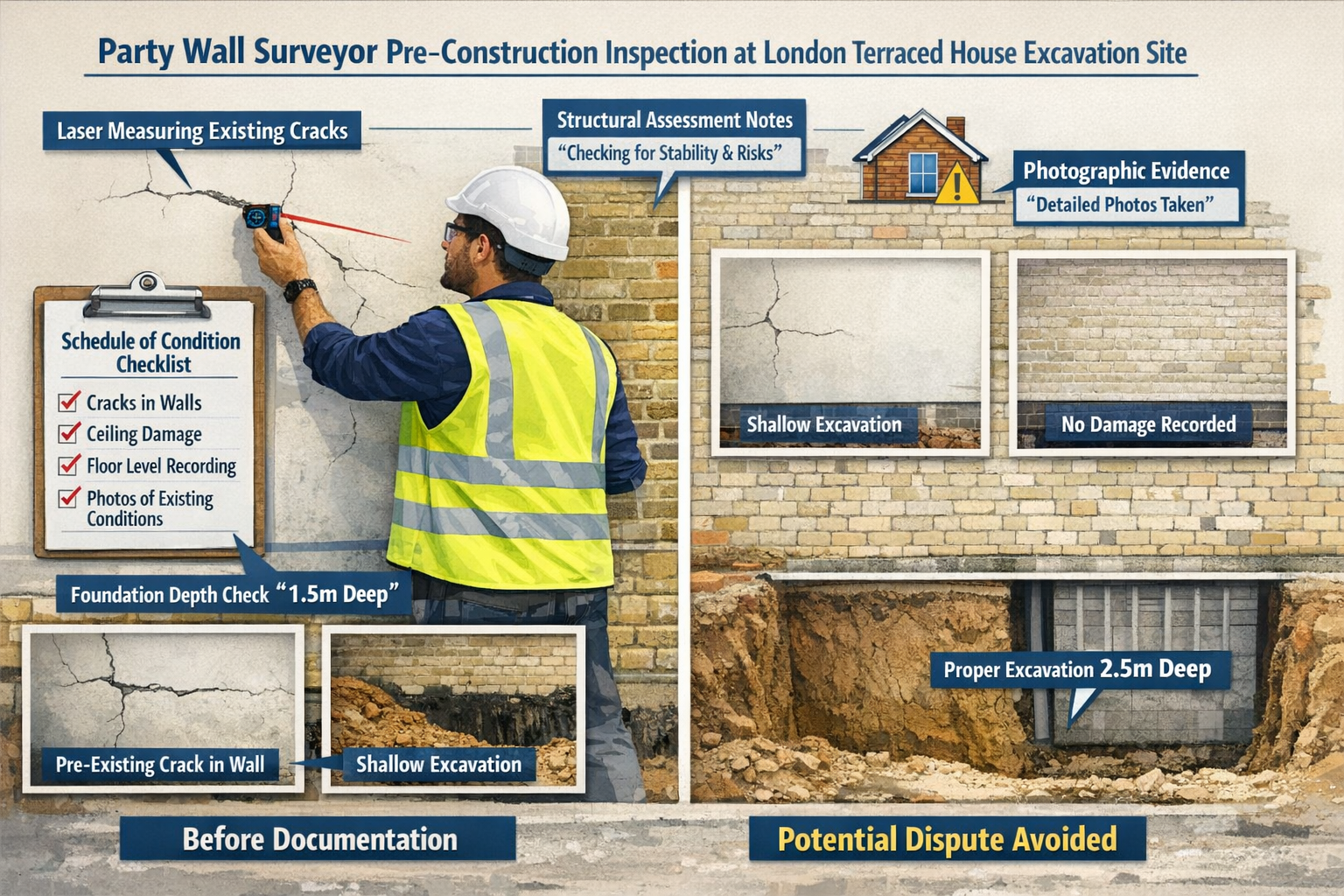
One of the most powerful tools in a party wall surveyor's arsenal is the schedule of condition. This comprehensive documentation serves as an irrefutable baseline record of a property's state before construction work begins.
The Schedule of Condition: Your Insurance Policy
A properly executed schedule of condition includes:
- Detailed photographic evidence of every room, external wall, and structural element in the adjoining property
- Written descriptions of existing cracks, settlement, decoration quality, and structural conditions
- Measurements and technical assessments of any pre-existing defects
- Timestamped documentation that establishes the exact property state at a specific date
This documentation becomes critical when disputes arise. Without it, building owners face an impossible burden of proof when neighbours claim that construction work caused damage that may have existed previously.
Real-World Example: East London Loft Conversion
In early 2026, a party wall surveyor in East London was appointed for a substantial loft conversion project. The adjoining owner expressed concerns about potential damage to their Victorian terrace property, which already showed signs of historical settlement.
The surveyor's intervention:
- Completed a comprehensive schedule of condition documenting 23 existing cracks and areas of settlement
- Photographed over 150 specific locations within the adjoining property
- Prepared detailed technical notes about the property's structural characteristics
- Established a monitoring protocol for the construction period
The outcome: When the building work was completed, the adjoining owner initially claimed that several cracks had been caused by the construction. The schedule of condition proved that 19 of the 21 claimed cracks existed before work began. The building owner's liability was limited to two minor instances of cosmetic damage, costing £800 to repair rather than the £14,000 originally claimed.
Savings achieved: £13,200 in avoided false claims, plus approximately £8,000 in legal fees that would have been incurred during dispute resolution.
Real-World Examples from 2026 UK Housing Booms: Case Studies in Dispute Prevention
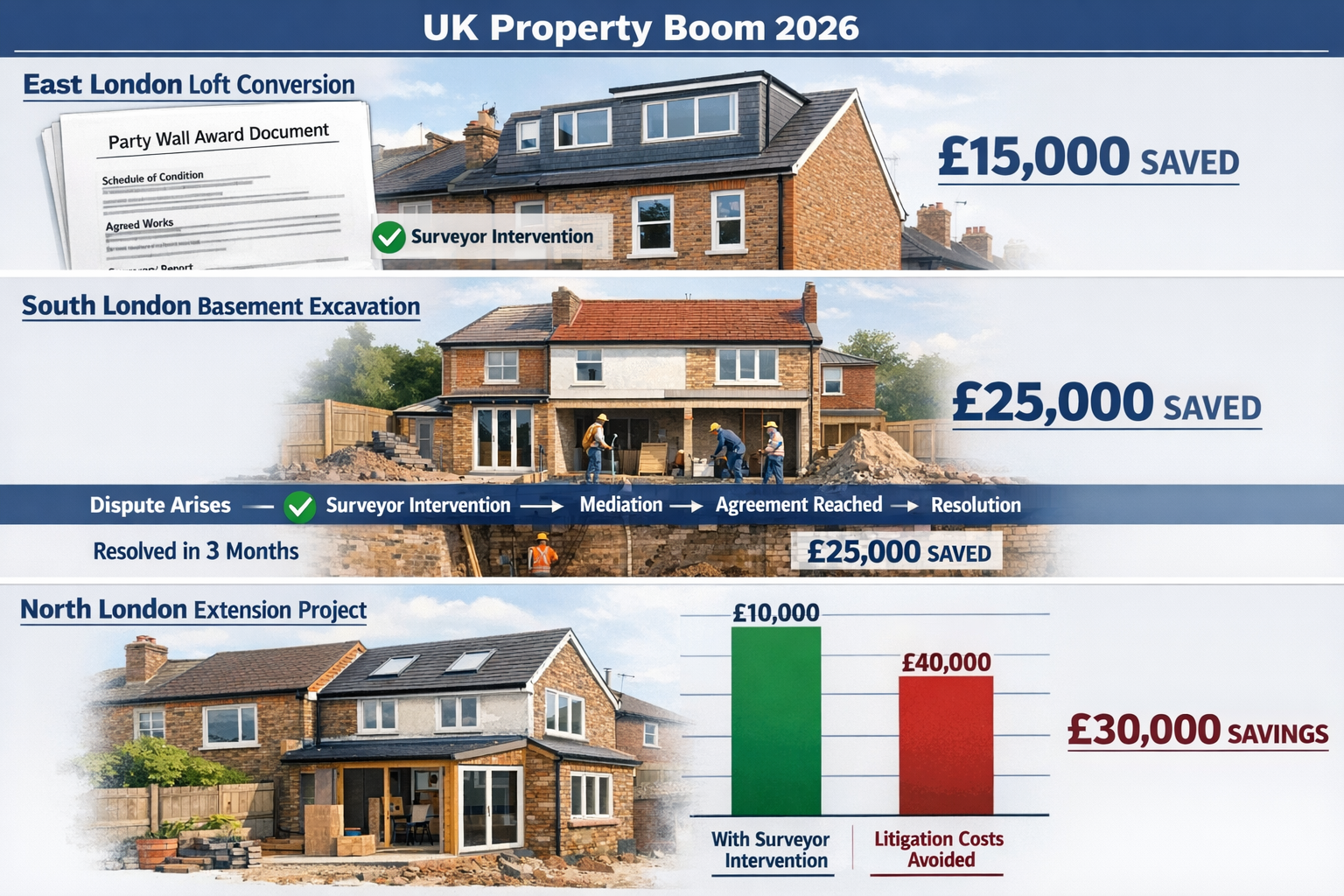
The 2026 construction boom has generated numerous examples demonstrating how party wall surveyors prevent costly disputes through professional intervention. These real-world cases illustrate the tangible value of expert guidance.
Case Study 1: South London Basement Excavation
A property owner in South London planned to excavate a two-story basement beneath their Victorian semi-detached home—a project that would extend nearly four meters below the adjoining owner's foundations.
Initial situation:
- Project value: £180,000
- Excavation depth: 3.8 meters below adjoining foundations
- Adjoining owner: Elderly couple concerned about structural damage
- No prior relationship between neighbours
Surveyor intervention:
The appointed party wall surveyor implemented a comprehensive approach:
- Detailed technical assessment of soil conditions, foundation depths, and structural requirements
- Clear communication with both parties explaining the process and protections
- Comprehensive party wall award specifying construction methods, underpinning requirements, and monitoring protocols
- Regular site inspections during the excavation phase
- Prompt response to adjoining owner concerns throughout the project
Results:
- Construction completed without structural incidents
- Adjoining owners' concerns addressed proactively before escalation
- No damage claims filed
- Neighbourly relationship maintained
Estimated dispute prevention value: £22,000 in potential legal costs and project delays avoided. The adjoining owners later stated they would have sought legal counsel without the surveyor's professional reassurance and monitoring.
Case Study 2: North London Extension Dispute Resolution
A North London property owner began construction work on a side extension without serving proper party wall notices. The adjoining owner discovered the work in progress and immediately threatened legal action.
Initial situation:
- Work already commenced without proper notice
- Adjoining owner extremely upset and distrustful
- Builder advising to "just continue and deal with it later"
- High risk of injunction stopping all work
Surveyor intervention:
An experienced party wall surveyor was appointed urgently to resolve the situation:
- Immediate work stoppage to demonstrate good faith
- Retrospective party wall notice served correctly under the Act
- Detailed schedule of condition completed despite the delayed timing
- Negotiated party wall award establishing clear parameters for continuing work
- Enhanced monitoring protocol to rebuild trust with the adjoining owner
Results:
- Work resumed after 12-day pause
- Formal legal framework established
- Adjoining owner's concerns addressed through proper process
- Project completed with only minor delays
Estimated dispute prevention value: £35,000+ in potential injunction costs, legal fees, and extended project delays. The builder's initial advice to "continue anyway" would likely have resulted in a court-ordered work stoppage and substantial penalties.
Case Study 3: Central London Multi-Party Complex
A Central London townhouse renovation involved works affecting three separate adjoining properties—a complex scenario requiring coordination across multiple parties with different concerns and risk tolerances.
Initial situation:
- Works included foundation underpinning, loft conversion, and rear extension
- Three adjoining owners with varying levels of cooperation
- One adjoining owner initially refusing to engage with the process
- High-value properties (£2M+) increasing liability concerns
Surveyor intervention:
The appointed surveyor managed this complex situation through:
- Separate party wall awards tailored to each adjoining owner's specific concerns
- Coordinated communication strategy ensuring all parties received consistent information
- Staggered construction sequencing to minimize simultaneous impacts
- Enhanced documentation given the high property values involved
- Dispute resolution when one adjoining owner initially refused to appoint a surveyor
Results:
- All three party wall awards successfully agreed
- Construction completed across 14 months without formal disputes
- Minor damage claim (£1,200) resolved amicably through the award framework
- All neighbourly relationships preserved
Estimated dispute prevention value: £45,000+ considering the potential for multiple simultaneous legal disputes across three properties. The surveyor's coordination prevented the "domino effect" of disputes that often occurs in multi-party scenarios.
The Technical Framework: How Party Wall Surveyors Prevent Costly Disputes Through Awards
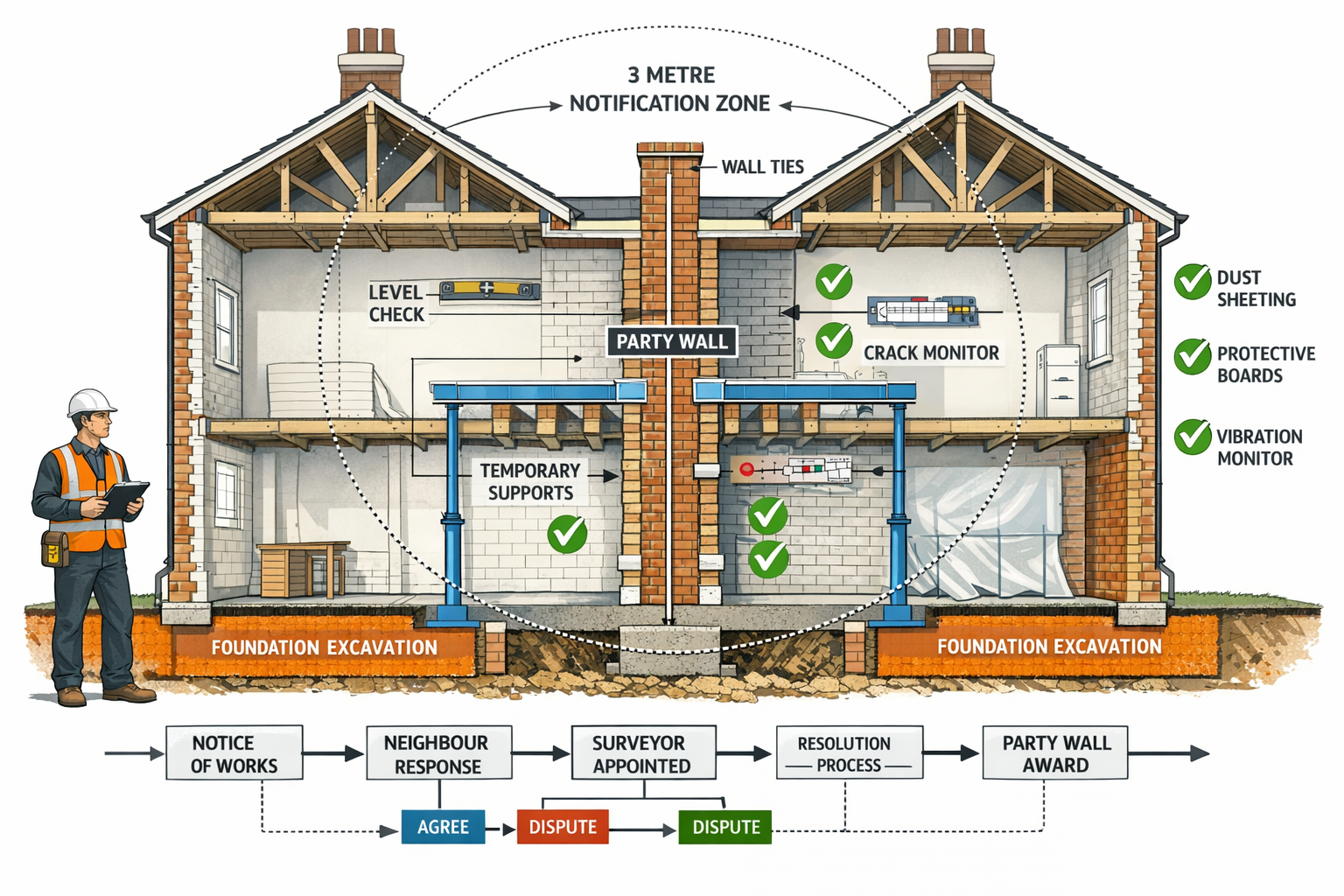
The party wall award represents the formal legal document that establishes rights, responsibilities, and protections for all parties involved in construction work. Understanding how surveyors craft these awards reveals the sophisticated dispute prevention mechanisms built into the process.
Essential Components of Effective Party Wall Awards
A comprehensive party wall award typically includes:
| Award Component | Dispute Prevention Function | Cost Impact |
|---|---|---|
| Scope of works | Eliminates ambiguity about what is permitted | Prevents scope creep disputes |
| Construction methods | Specifies safe techniques and materials | Reduces damage risk |
| Access rights | Establishes when and how access occurs | Prevents trespass claims |
| Working hours | Sets acceptable construction times | Minimizes nuisance complaints |
| Monitoring protocols | Defines inspection frequency and responsibility | Enables early issue detection |
| Damage resolution | Pre-establishes repair procedures and standards | Accelerates claim resolution |
| Cost allocation | Clarifies who pays for what | Prevents payment disputes |
These components work together to create a comprehensive framework that addresses potential conflict points before they escalate into disputes.
The Role of the Agreed Surveyor vs. Two Surveyors
The Party Wall etc. Act 1996 allows for two approaches:
Agreed Surveyor Approach:
- Single surveyor appointed by both parties
- Generally faster and more cost-effective
- Requires mutual trust between neighbours
- Typical cost: £800-£1,500 for straightforward projects
Two Surveyor Approach:
- Building owner's surveyor and adjoining owner's surveyor appointed separately
- Each surveyor advocates for their appointing party
- Third surveyor selected to resolve any disagreements
- Typical cost: £1,800-£4,000+ for complex projects
Both approaches can effectively prevent disputes when handled by qualified professionals. The choice depends on the relationship between parties, project complexity, and risk levels.
How Awards Address Excavation Risks
Excavation work presents the highest risk for party wall disputes due to potential foundation damage. Expert surveyors address these risks through:
- Technical specifications for underpinning and temporary support
- Depth and proximity calculations based on soil reports and foundation surveys
- Monitoring requirements including crack monitoring, level monitoring, and structural observations
- Contingency procedures if unexpected conditions arise
- Insurance requirements ensuring adequate coverage for potential damage
The 2026 construction boom has seen increased focus on excavation projects, with basement conversions becoming particularly popular in high-value urban areas[2]. This trend has elevated the importance of thorough technical assessment within party wall awards.
Navigating the 2026 Housing Boom: Regional Considerations
The 2026 UK housing boom has affected different regions with varying intensity, creating location-specific considerations for party wall surveyors.
London-Specific Challenges
London's property density and high values create unique pressures:
- West London: Heritage properties require specialized approaches to party wall works affecting listed buildings
- East London: Rapid development in previously industrial areas creates conflicts between new and existing structures
- North London: Victorian and Edwardian terraces with complex party wall arrangements
- South London: Mix of property types requiring flexible surveyor approaches
- Central London: Extremely high property values amplify every risk factor
Each region benefits from surveyors with local expertise who understand area-specific construction practices, soil conditions, and regulatory environments.
The Impact of Increased Regulatory Scrutiny
Planning authorities and building control departments have intensified oversight during the 2026 boom, processing higher volumes of applications while maintaining safety standards[2]. This increased scrutiny affects party wall work in several ways:
- Compliance verification: Building control now routinely checks for proper party wall procedures
- Documentation requirements: Enhanced record-keeping expectations for all construction work
- Enforcement actions: Faster response to complaints about improper construction practices
- Integration with planning: Party wall considerations increasingly incorporated into planning approval conditions
Professional party wall surveyors help navigate this complex regulatory environment, ensuring compliance across multiple frameworks simultaneously.
Cost-Benefit Analysis: Investment vs. Dispute Prevention
Many property owners question whether the costs of party wall surveyors justify the expense. The 2026 data provides clear evidence of the financial value.
Typical Surveyor Costs vs. Dispute Costs
Professional surveyor investment:
- Simple works (minor repairs, small extensions): £600-£1,200
- Medium complexity (loft conversions, standard excavations): £1,500-£3,000
- Complex projects (deep excavations, multiple adjoining owners): £3,000-£6,000+
Dispute resolution costs without surveyors:
- Initial legal consultation: £500-£1,000
- Pre-litigation correspondence: £2,000-£4,000
- Court proceedings (if escalated): £15,000-£40,000+
- Project delays: £5,000-£20,000 in extended costs
- Damage claims (contested): £5,000-£50,000+
The mathematics are compelling: even complex surveyor appointments cost less than the initial stages of legal dispute resolution, before considering the substantial costs of full litigation.
How to Keep Party Wall Costs Down
Property owners can optimize their investment by:
- Early appointment: Engaging surveyors during planning stages rather than after disputes arise
- Clear communication: Providing complete information upfront reduces surveyor time requirements
- Agreed surveyor approach: When relationships permit, single surveyor appointments reduce costs
- Proper preparation: Having building plans, soil reports, and structural information ready
- Cooperative attitude: Working constructively with adjoining owners minimizes adversarial procedures
For more detailed guidance, see our article on how to keep party wall costs down.
Common Pitfalls That Lead to Disputes (And How Surveyors Prevent Them)
Understanding common mistakes helps illustrate how party wall surveyors prevent costly disputes: real-world examples from 2026 UK housing booms demonstrate these prevention mechanisms in action.
Pitfall 1: Inadequate or Missing Notices
The problem: Many building owners attempt to proceed without serving proper party wall notices, believing they can reach informal agreements with neighbours or that minor works don't require formal process.
The consequence: Adjoining owners can obtain injunctions stopping all work, plus claim costs for their legal fees. In 2026 cases, this has resulted in project delays of 3-6 months and legal costs exceeding £20,000.
How surveyors prevent this: Professional surveyors ensure proper party wall notices are served with correct timing and content, establishing legal compliance from the outset.
Pitfall 2: Assuming "Good Neighbour Relations" Eliminate Formal Requirements
The problem: Building owners with friendly neighbour relationships often believe formal party wall procedures are unnecessary, relying on verbal agreements instead.
The consequence: Relationships change, particularly when construction noise, dust, and disruption begin. Without formal frameworks, friendly arrangements collapse into bitter disputes.
How surveyors prevent this: Surveyors establish professional frameworks that protect relationships by removing personal conflict from technical and legal matters. The award becomes the reference point rather than personal promises.
Pitfall 3: Inadequate Pre-Construction Documentation
The problem: Proceeding without comprehensive schedules of condition leaves building owners vulnerable to false or exaggerated damage claims.
The consequence: Without baseline documentation, building owners must either accept potentially inflated claims or engage in expensive litigation to contest them.
How surveyors prevent this: Professional schedules of condition create irrefutable evidence of pre-existing conditions, dramatically reducing claim disputes.
Pitfall 4: Poor Communication and Transparency
The problem: Building owners who fail to keep adjoining owners informed create anxiety and mistrust that escalates into formal complaints.
The consequence: Adjoining owners who feel excluded or disrespected are far more likely to pursue formal disputes, even over minor issues.
How surveyors prevent this: Professional surveyors establish communication protocols, provide regular updates, and ensure all parties understand the process and their protections.
When Disputes Still Arise: The Surveyor's Resolution Role
Despite best efforts, some conflicts still develop during construction projects. Even in these situations, party wall surveyors provide valuable dispute resolution functions.
The Third Surveyor Mechanism
When building and adjoining owners' surveyors cannot agree on specific award terms, the Party Wall etc. Act 1996 provides for a third surveyor to resolve the disagreement. This mechanism:
- Provides faster resolution than court proceedings
- Maintains technical expertise in decision-making
- Costs significantly less than litigation
- Preserves the professional framework of the party wall process
Mediation and Negotiation Skills
Experienced party wall surveyors develop sophisticated negotiation abilities that help de-escalate conflicts:
- Technical translation: Explaining complex construction concepts in accessible terms
- Risk assessment: Helping parties understand realistic versus exaggerated concerns
- Creative solutions: Identifying compromise approaches that address underlying interests
- Emotional intelligence: Managing anxiety and mistrust that often underlie technical disputes
These soft skills complement technical expertise, enabling surveyors to resolve conflicts that might otherwise require legal intervention.
Selecting the Right Party Wall Surveyor for Your Project
The quality of surveyor appointment directly impacts dispute prevention effectiveness. Property owners should consider:
Essential Qualifications and Experience
Look for surveyors with:
- Professional memberships: RICS (Royal Institution of Chartered Surveyors) or FPWS (Faculty of Party Wall Surveyors)
- Specific party wall experience: General surveyors may lack specialized knowledge
- Local expertise: Familiarity with regional construction practices and property types
- Insurance coverage: Professional indemnity insurance protecting all parties
- Track record: Demonstrable experience with similar projects
Questions to Ask Potential Surveyors
Before appointment, ask:
- How many party wall awards have you prepared in the past year?
- What experience do you have with [this specific type of work]?
- What is your typical timeline for completing the award?
- How do you handle communication with adjoining owners?
- What is your fee structure and what does it include?
- Can you provide references from recent similar projects?
Red Flags to Avoid
Be cautious of surveyors who:
- Guarantee specific outcomes or promise to "get around" requirements
- Lack professional insurance or qualifications
- Offer unusually low fees (suggesting inadequate service)
- Show poor communication or responsiveness during initial contact
- Demonstrate bias or adversarial attitudes toward adjoining owners
Practical Steps: Implementing Dispute Prevention in Your Project
For building owners planning construction work in 2026, these practical steps maximize dispute prevention:
Timeline for Party Wall Process
8-10 weeks before construction:
- Appoint party wall surveyor
- Prepare detailed building plans and specifications
- Identify all affected adjoining owners
6-8 weeks before construction:
- Serve party wall notices to all adjoining owners
- Allow 14-day response period required by law
4-6 weeks before construction:
- Complete schedules of condition for all adjoining properties
- Negotiate and finalize party wall awards
- Establish monitoring and communication protocols
During construction:
- Conduct regular inspections per award requirements
- Maintain open communication with all parties
- Document any incidents or concerns immediately
- Address issues promptly before they escalate
After construction completion:
- Conduct final inspections with adjoining owners
- Address any legitimate damage claims per award terms
- Obtain sign-off confirming satisfactory completion
Documentation Best Practices
Maintain comprehensive records including:
- All correspondence with adjoining owners and surveyors
- Photographic evidence throughout the project
- Contractor compliance with award specifications
- Inspection reports and monitoring data
- Any incidents, complaints, or concerns raised
This documentation protects all parties and facilitates rapid resolution if disputes arise.
The Future of Party Wall Surveying Beyond 2026
As the UK housing market continues evolving, party wall surveying adapts to new challenges and technologies:
Emerging Trends
- Digital documentation: Advanced photographic and 3D scanning technologies for schedules of condition
- Remote monitoring: Sensor-based crack and movement monitoring providing real-time data
- AI-assisted analysis: Technology supporting surveyors in identifying potential risks
- Integrated platforms: Digital systems connecting surveyors, owners, and contractors
- Enhanced regulation: Potential legislative updates reflecting modern construction practices
Preparing for Ongoing Construction Activity
The 2026 boom may moderate, but UK housing demand ensures continued construction activity. Property owners should:
- Maintain relationships with qualified surveyors for future projects
- Keep party wall documentation accessible for future reference
- Stay informed about regulatory changes affecting property rights
- Consider party wall implications during property purchase decisions
Conclusion
How party wall surveyors prevent costly disputes: real-world examples from 2026 UK housing booms demonstrates the substantial financial and relational value these professionals deliver. Through comprehensive schedules of condition, carefully crafted party wall awards, and expert management of construction processes, surveyors save property owners thousands of pounds while preserving neighbourly relationships.
The 2026 construction boom has intensified risks and opportunities alike. Property owners investing in extensions, conversions, and excavations face unprecedented potential for disputes—but also unprecedented access to professional expertise that prevents those conflicts from materializing.
Key Takeaways for Property Owners
✅ Invest early: Appointing surveyors during planning stages prevents problems rather than resolving them later
✅ Document thoroughly: Comprehensive schedules of condition provide invaluable protection against false claims
✅ Follow proper procedures: Correct party wall notices and awards establish legal compliance and dispute prevention frameworks
✅ Choose qualified professionals: Experienced surveyors with local expertise deliver superior outcomes
✅ Maintain communication: Transparency and regular updates prevent anxiety-driven conflicts
Next Steps
If you're planning construction work affecting party walls:
- Assess your project scope using our guide to types of party wall works
- Understand your legal obligations under the Party Wall etc. Act 1996
- Appoint a qualified surveyor appropriate to your location and project type
- Serve proper notices well in advance of your planned construction start date
- Maintain professional processes throughout your project
The evidence from 2026's housing boom is clear: professional party wall surveyor intervention represents one of the highest-value investments in any construction project affecting shared boundaries. The relatively modest cost of expert guidance prevents disputes that could otherwise cost tens of thousands of pounds while derailing projects for months.
Whether you're planning a simple loft conversion or a complex basement excavation, the question isn't whether you can afford professional surveyor services—it's whether you can afford to proceed without them. 🏗️
References
[1] Party Wall Agreements For Data Centre Expansions Surveyor Guidance Amid 2026s Ai Infrastructure Boom – https://nottinghillsurveyors.com/blog/party-wall-agreements-for-data-centre-expansions-surveyor-guidance-amid-2026s-ai-infrastructure-boom
[2] Party Wall Surveys Amid 2026 Construction Boom Handling Disputes In High Demand Uk Housing Markets – https://nottinghillsurveyors.com/blog/party-wall-surveys-amid-2026-construction-boom-handling-disputes-in-high-demand-uk-housing-markets
