


Rising construction activity across England and Wales has pushed party wall surveyor demand to unprecedented levels in 2026, with building owners facing fees that can range from under £1,000 to over £10,000 depending on project complexity. Understanding the Costs of Party Wall Surveyors in 2026: Who Pays and Factors Influencing Fees for Awards and Notices has become essential for anyone planning construction work that affects shared walls, boundaries, or adjacent properties. With hourly rates climbing to £400 in premium London locations and no statutory fee caps in place, property owners must navigate a landscape where transparency and planning are crucial to avoiding budget overruns.
The Party Wall etc. Act 1996 establishes clear payment responsibilities but leaves fee determination to market forces and professional judgment. This comprehensive guide breaks down every cost component, explains who bears financial responsibility, and reveals the factors that can double or triple your surveyor expenses.

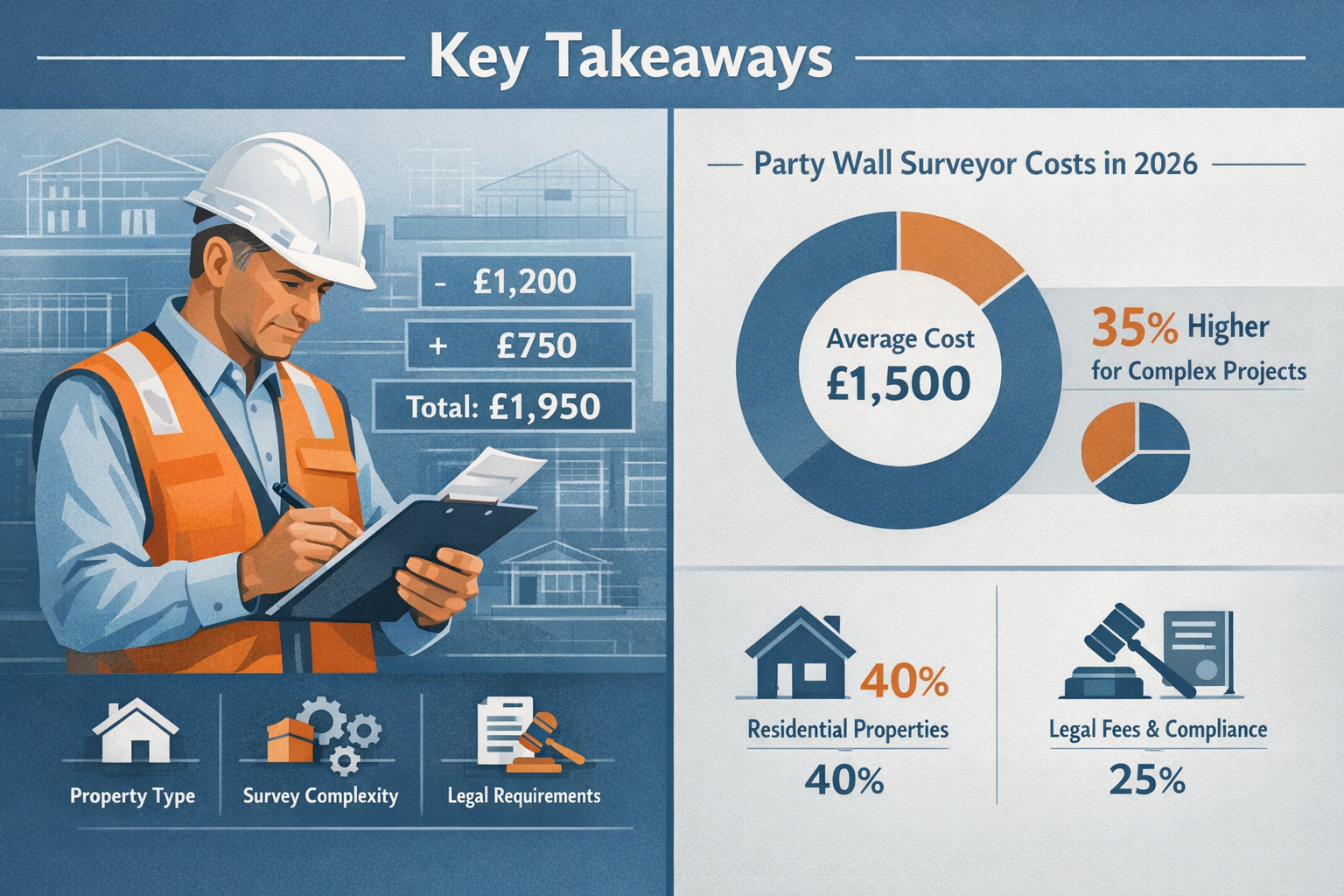
Key Takeaways
- Building owners pay all reasonable surveyor costs, including both their own surveyor's fees and the adjoining owner's surveyor fees, as mandated by Section 11(1) of the Party Wall Act 1996
- Total costs range from £900 for straightforward single-surveyor appointments to £10,000+ for complex basement conversions with multiple adjoining properties
- Hourly rates vary significantly by location, from £150–£300 nationally to £400 per hour in central London areas in 2026
- Hidden costs including schedule of condition assessments (£300–£600), structural engineer reviews (£500+), and third surveyor appointments (£1,000–£2,500) can substantially increase initial quotes
- Project complexity, number of adjoining owners, type of construction work, and surveyor experience are the primary factors influencing final fees
Understanding Who Pays for Party Wall Surveyor Costs in 2026
The financial responsibility for party wall awards falls squarely on the shoulders of the building owner—the person or entity initiating the construction work. This fundamental principle, enshrined in Section 11(1) of the Party Wall etc. Act 1996, means that adjoining owners pay nothing under normal circumstances[1][4].
Building Owner's Financial Obligations
When planning construction that requires party wall notices, building owners must budget for:
- Their own surveyor's professional fees for preparing awards, conducting site visits, and managing the process
- The adjoining owner's surveyor fees in full, regardless of how much time that surveyor spends on the matter
- Award preparation and documentation costs including drafting, revisions, and formal service
- Schedule of condition assessments documenting the pre-construction state of adjoining properties
- Third surveyor fees if the two appointed surveyors cannot reach agreement on specific matters
- Administrative costs such as postage, copying, and formal notice service
This comprehensive payment obligation exists regardless of whether the adjoining owner consents to the work or disputes aspects of the proposal[6]. The rationale is straightforward: the building owner benefits from the construction work and therefore bears the associated procedural costs.
When Adjoining Owners Might Pay
While rare, certain circumstances can shift payment responsibility:
🔴 Unreasonable behavior: If an adjoining owner appoints a surveyor who acts unreasonably, charges excessive fees, or deliberately delays the process without justification, courts may order that owner to bear their surveyor's costs[7].
🔴 Frivolous objections: Adjoining owners who raise groundless disputes purely to obstruct legitimate work may face cost orders.
🔴 Separate legal advice: If an adjoining owner seeks independent legal counsel beyond the surveyor's role, those legal fees typically fall to that owner[4].
For most residential projects following standard procedures, however, building owners should plan to cover all surveyor-related expenses. Understanding how to keep party wall costs down becomes essential budget management.
Breaking Down Party Wall Surveyor Fee Structures and Typical Costs
The Costs of Party Wall Surveyors in 2026: Who Pays and Factors Influencing Fees for Awards and Notices vary dramatically based on appointment type, project scope, and geographic location. Unlike many professional services, party wall surveyors operate without statutory fee schedules, charging "reasonable fees" based on time, expertise, and work complexity[5].
Hourly Rate Structures
Most party wall surveyors charge on an hourly basis, with 2026 rates reflecting increased demand and inflation pressures:
| Location | Typical Hourly Rate Range |
|---|---|
| National Average | £150–£250 per hour |
| London (Outer Boroughs) | £200–£300 per hour |
| Central London | £250–£400 per hour |
| Regional Cities | £150–£220 per hour |
These rates apply to both building owner surveyors and adjoining owner surveyors, though individual practitioners set their own fees[2][4]. Senior surveyors with specialized expertise in complex projects command premium rates, particularly in high-demand areas like central London and north London.
Single Agreed Surveyor Appointments
The most cost-effective approach involves appointing one agreed surveyor who acts impartially for both parties. This arrangement works well for straightforward projects where neighbors maintain good relationships:
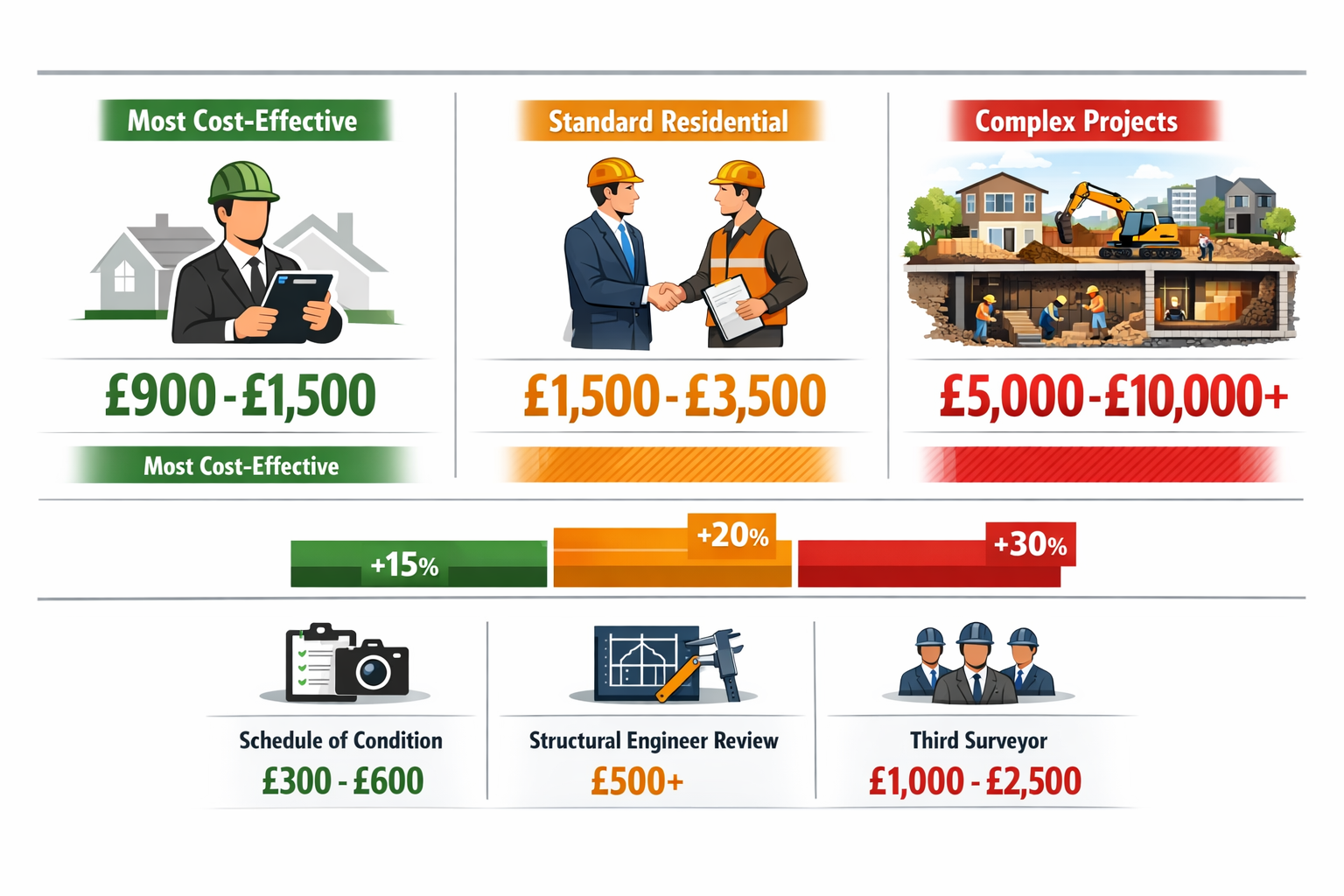
💰 Typical cost range: £900–£1,500 for standard residential work
💰 Includes: Initial consultation, site inspection, award preparation, and basic follow-up
💰 Best for: Loft conversions, single-story extensions, simple party wall works
This option eliminates duplication of effort and reduces overall expenses, making it attractive for budget-conscious building owners tackling uncomplicated projects[1][2].
Two-Surveyor Appointments (Standard Approach)
When adjoining owners prefer independent representation or disputes seem likely, each party appoints their own surveyor. These two professionals then collaborate to produce the party wall award:
💰 Typical cost range: £1,500–£3,500 for standard residential projects
💰 Building owner's surveyor: £800–£1,800
💰 Adjoining owner's surveyor: £700–£1,700
💰 Best for: Rear extensions, side returns, standard basement work affecting one or two neighbors
Remember that building owners pay both surveyors' fees. The adjoining owner's surveyor may charge similar or even higher rates than the building owner's surveyor, particularly if they conduct extensive investigations or multiple site visits[7].
Complex Project Cost Ranges
Large-scale or technically challenging projects generate substantially higher fees:
🏗️ Basement conversions with underpinning: £5,000–£10,000+
🏗️ Multi-story developments: £8,000–£15,000+
🏗️ Commercial projects: £10,000–£25,000+
🏗️ Projects affecting multiple adjoining owners: Add £1,000–£2,500 per additional neighbor
These figures reflect the extensive time required for structural assessments, detailed scheduling, ongoing monitoring, and coordination among multiple parties[4]. For guidance on types of party wall works that trigger different cost levels, property owners should consult specialists early in the planning process.
Additional Cost Components Often Overlooked
Beyond basic surveyor fees, several supplementary expenses frequently catch building owners off guard:
📋 Schedule of Condition: £300–£600 per property
- Photographic documentation of adjoining property's pre-construction state
- Essential for protecting both parties against spurious damage claims
- May require multiple visits for comprehensive coverage
🔧 Structural Engineer Reviews: £500–£1,200+
- Technical assessment of proposed construction methods
- Verification of calculations for underpinning, steel beam installations
- Often required for basement conversions or significant structural alterations
⚖️ Third Surveyor Appointments: £1,000–£2,500
- Appointed when the two surveyors cannot agree on specific award terms
- Acts as arbitrator on disputed points
- Relatively rare but adds significant cost when needed
🔍 Monitoring Visits During Construction: £150–£400 per visit
- Periodic inspections to ensure work complies with the award
- Typically 2–4 visits for standard projects
- More frequent for complex or high-risk work
Understanding the complete costs of party wall process requires accounting for these ancillary expenses from the outset.
Key Factors Influencing Party Wall Surveyor Fees in 2026
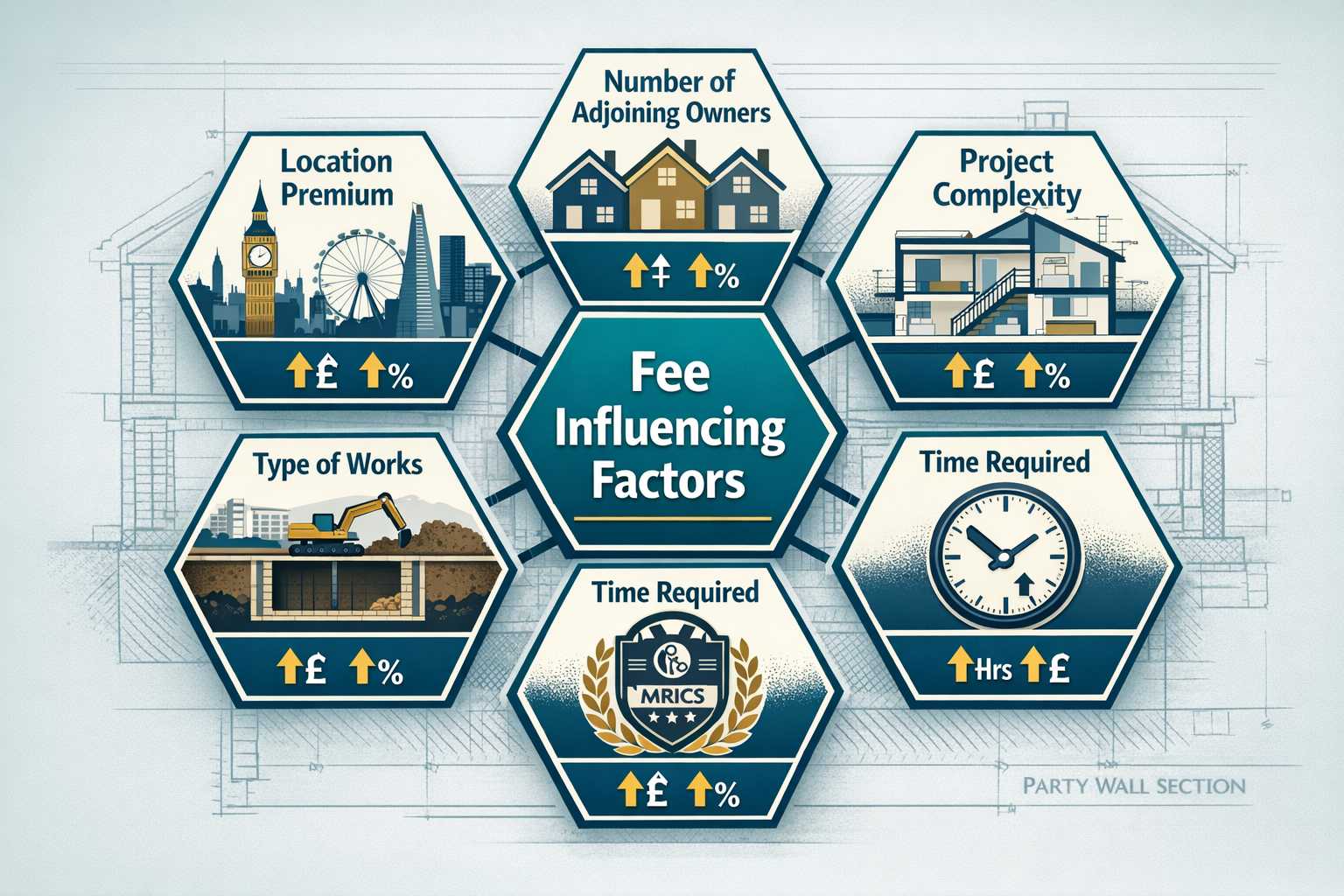
The Costs of Party Wall Surveyors in 2026: Who Pays and Factors Influencing Fees for Awards and Notices depend on numerous variables that building owners must evaluate when budgeting. Understanding these factors enables more accurate cost forecasting and helps identify opportunities for expense management.
Project Complexity and Scope
The single largest fee determinant is the technical complexity of the proposed work:
Low Complexity (£900–£1,500 total):
- Single-story rear extensions not affecting foundations
- Loft conversions with minimal structural changes
- Internal alterations to party walls
- Straightforward chimney breast removal
Medium Complexity (£1,500–£4,000 total):
- Two-story extensions requiring foundation work
- Rear extensions with basement elements
- Party wall rebuilding or significant repairs
- Installation of steel beams affecting party structures
High Complexity (£5,000–£10,000+ total):
- Full basement excavations with underpinning
- Multi-level developments affecting multiple party walls
- Commercial projects with complex structural requirements
- Historic buildings requiring specialized assessment
Complex projects demand more surveyor time for technical review, detailed scheduling, structural calculations verification, and ongoing monitoring[4][5]. Each additional technical challenge adds hours to the surveyor's workload, directly increasing fees.
Number of Adjoining Owners Affected
Party wall costs multiply when construction affects multiple neighboring properties:
🏘️ Single adjoining owner: Base cost range applies
🏘️ Two adjoining owners: Add 60–80% to base costs
🏘️ Three adjoining owners: Add 120–150% to base costs
🏘️ Four or more adjoining owners: Add 180–250% to base costs
Each adjoining owner has the right to appoint their own surveyor, and the building owner pays all appointed surveyors. For example, a mid-terrace property owner planning a basement conversion might face surveyor fees from:
- Their own building owner's surveyor
- The left neighbor's surveyor
- The right neighbor's surveyor
- The rear neighbor's surveyor
This scenario could generate £8,000–£15,000 in total surveyor fees even for a relatively standard project[2][7].
Geographic Location and Local Market Rates
Regional variations in surveyor fees reflect local demand, cost of living, and property values:
Premium London Locations (£250–£400/hour):
- West London boroughs (Kensington, Chelsea, Westminster)
- Central London areas with high development activity
- East London regeneration zones
Standard London Areas (£200–£300/hour):
- South London residential boroughs
- Outer London suburbs with moderate development
Regional Markets (£150–£220/hour):
- Major cities (Manchester, Birmingham, Bristol)
- Suburban and rural areas with lower demand
Location also affects the availability of experienced surveyors. In high-demand areas, building owners may face longer wait times and premium rates for qualified professionals[5].
Type of Construction Work
Different types of party wall works trigger varying levels of surveyor involvement:
Notice Type and Associated Costs:
| Notice Type | Typical Work | Cost Impact |
|---|---|---|
| Party Structure Notice | Building on/near party wall, cutting into party wall | Medium–High |
| Line of Junction Notice | New wall on boundary line | Low–Medium |
| 3-Meter/6-Meter Notice | Excavation near neighboring foundations | Medium–High |
Projects requiring multiple notice types generate higher fees due to increased documentation, assessment requirements, and coordination complexity. A basement conversion, for instance, typically requires both a Party Structure Notice and a 3-Meter Notice, doubling the administrative burden[4].
Surveyor Experience and Specialization
Professional qualifications and track record significantly influence fee levels:
✅ Junior Surveyors (£150–£200/hour):
- Recently qualified or limited party wall experience
- Suitable for straightforward residential projects
- May require senior oversight for complex matters
✅ Mid-Level Surveyors (£200–£280/hour):
- 5–10 years party wall experience
- Handle most residential and light commercial work
- Balance cost and expertise for standard projects
✅ Senior Surveyors (£280–£400/hour):
- 10+ years specialized party wall practice
- Expert in complex structural matters, dispute resolution
- Essential for high-value or technically challenging projects
Choosing the appropriate surveyor level for your project type optimizes the cost-benefit equation. Overpaying for senior expertise on simple work wastes money, while underinvesting in surveyor quality for complex projects risks costly errors or disputes[5].
Timeline and Urgency
Rushed timelines increase surveyor costs:
⏰ Standard timeline (8–12 weeks): Normal fee rates apply
⏰ Expedited service (4–6 weeks): 15–25% premium typical
⏰ Emergency appointments (under 4 weeks): 30–50% premium possible
Building owners who serve party wall notices late in their planning process often face premium charges for accelerated service. Early engagement with surveyors—ideally 3–4 months before construction start—avoids urgency premiums[6].
Dispute Complexity and Resolution Needs
When disagreements arise between parties, costs escalate:
🔺 Straightforward agreement: Base fees apply
🔺 Minor disputes requiring negotiation: Add 20–40% to base costs
🔺 Significant disputes requiring detailed technical assessment: Add 50–100%
🔺 Third surveyor appointment: Add £1,000–£2,500
Maintaining positive neighbor relationships and addressing concerns proactively minimizes dispute-related cost increases. Understanding how to respond to party wall notices helps both building owners and adjoining owners navigate the process constructively.
Practical Strategies for Managing Party Wall Surveyor Costs
While building owners cannot avoid their legal obligation to pay surveyor fees, several strategies help control expenses without compromising quality or compliance:
1. Obtain Multiple Quotes Early
Request detailed fee estimates from at least three surveyors before making appointments:
- Ask for itemized breakdowns showing hourly rates, estimated hours, and additional costs
- Clarify what services are included versus extra (schedules of condition, monitoring visits)
- Verify whether quotes include VAT (some surveyors are VAT-registered, adding 20%)
- Check if fees are fixed or estimates subject to variation
Comparing quotes reveals market rates and helps identify outliers—either suspiciously low (potentially inexperienced) or excessively high (potentially overcharging)[3].
2. Consider an Agreed Surveyor for Simple Projects
When relationships with neighbors are good and work is straightforward, proposing a single agreed surveyor can cut costs nearly in half:
✅ Advantages:
- Single fee instead of two separate surveyors
- Faster process with one point of coordination
- Reduced communication overhead
- Typically £900–£1,500 for standard work
❌ Limitations:
- Requires adjoining owner consent
- Less suitable when disputes are likely
- May not provide adequate independent representation for complex matters
Approach neighbors early, explain the cost benefits to all parties, and propose an agreed surveyor with strong credentials and impartiality[1][2].
3. Serve Notices Promptly and Accurately
Delays and errors in notice service increase costs:
- Serve notices at least 2 months before construction to avoid urgency premiums
- Ensure notices are technically accurate to prevent re-service requirements
- Include clear drawings and descriptions reducing surveyor clarification time
- Follow proper service methods as required by the Party Wall Act
Proper notice service streamlines the surveyor's work, minimizing billable hours spent on administrative corrections[6].
4. Maintain Open Communication with Neighbors
Good neighbor relations reduce dispute-related costs:
💬 Discuss plans informally before serving formal notices
💬 Address concerns proactively and show willingness to accommodate reasonable requests
💬 Keep neighbors informed of construction schedules and progress
💬 Respond promptly to surveyor inquiries and requests for information
When neighbors feel respected and informed, they're less likely to raise objections that require extensive surveyor negotiation and technical assessment[4].
5. Choose the Right Surveyor for Your Project Type
Match surveyor expertise to project complexity:
- Simple extensions: Mid-level local surveyor (£150–£220/hour)
- Standard basements: Experienced residential specialist (£220–£280/hour)
- Complex commercial work: Senior specialist (£280–£400/hour)
Overpaying for unnecessary expertise or underpaying for inadequate experience both waste money—the former through inflated hourly rates, the latter through inefficiency and potential errors requiring correction[5].
6. Request Fixed Fee Arrangements Where Possible
Some surveyors offer fixed fees for standard project types:
- Loft conversions: Fixed fee £1,200–£1,800
- Single-story rear extensions: Fixed fee £1,000–£1,500
- Standard basement work: Fixed fee £2,500–£4,000
Fixed fees provide budget certainty and incentivize efficient surveyor work. However, ensure the fixed fee agreement clearly defines what's included and what circumstances might trigger additional charges[2][5].
7. Understand What's Included in Quotes
Clarify scope to avoid surprise charges:
❓ Does the quote include schedule of condition preparation?
❓ Are monitoring visits during construction included or extra?
❓ What happens if disputes arise—is additional negotiation time covered?
❓ Are structural engineer fees separate?
❓ Is third surveyor appointment risk covered?
Comprehensive initial quotes that address these questions prevent budget overruns and disputes over fees[3][7].
8. Consider Timing and Market Conditions
Surveyor availability and rates fluctuate with construction market cycles:
- Winter months (November–February) often see lower demand and potentially more competitive rates
- Spring/summer (March–August) peak construction season may limit surveyor availability
- Economic downturns can reduce rates as demand softens
- Construction booms (like 2026's elevated activity) push rates higher
Flexible timing can yield modest cost savings, though this factor typically matters less than project complexity and surveyor selection[5].
Understanding Fee Structures: Hourly vs. Fixed vs. Award Fees
Party wall surveyors employ various charging models, each with distinct advantages and considerations:
Hourly Rate Billing
How it works: Surveyors track time spent on all activities (site visits, correspondence, award preparation, negotiations) and bill at their hourly rate.
Advantages:
- Transparent connection between work performed and charges
- Flexibility for projects with uncertain scope
- Fair pricing if work proves simpler than anticipated
Disadvantages:
- Open-ended cost exposure if complications arise
- Incentivizes longer rather than efficient work
- Difficult to budget accurately in advance
Best for: Complex or unusual projects where scope is hard to predict[5].
Fixed Fee Arrangements
How it works: Surveyor quotes a single price covering all standard services for a defined project type.
Advantages:
- Budget certainty from the outset
- Incentivizes surveyor efficiency
- Simpler financial planning and approval
Disadvantages:
- May not cover unexpected complications
- Surveyors may pad fixed fees to cover worst-case scenarios
- Scope limitations can trigger additional charges
Best for: Standard residential projects with predictable requirements[2].
Award Fee Model
How it works: Surveyors charge a percentage (typically 1–2%) of the construction project value or a fee based on award complexity.
Advantages:
- Scales with project significance
- Aligns surveyor compensation with project scale
- Common in commercial contexts
Disadvantages:
- Can be expensive for high-value projects with simple party wall matters
- Less common in residential contexts
- May not reflect actual work required
Best for: Large commercial developments or high-value residential projects[5].
Hybrid Approaches
Many surveyors combine models:
- Fixed fee for core services + hourly rate for disputes or additional work
- Capped hourly billing with maximum total fee
- Tiered fixed fees based on project complexity categories
Hybrid models balance budget predictability with flexibility for unforeseen circumstances[3].
The Role of VAT and Additional Charges
When budgeting for party wall surveyor costs, remember that VAT (Value Added Tax) at 20% applies to most surveyor services if the surveyor is VAT-registered. A £2,000 surveyor fee becomes £2,400 including VAT—a significant addition that quotes may or may not include[4].
Other Potential Additional Charges
Beyond core surveyor fees, budget for:
💷 Travel expenses: Particularly for surveyors traveling significant distances
💷 Parking and congestion charges: Relevant in central London locations
💷 Printing and documentation: Physical award copies, plans, photographs
💷 Postage and service costs: Recorded delivery for formal documents
💷 Expert consultant fees: Structural engineers, specialist assessors
Most professional surveyors include these minor costs in their overall fee, but clarify this in advance to avoid disputes[6].
Legal Framework: What the Party Wall Act Says About Costs
The Party Wall etc. Act 1996 establishes the legal foundation for cost allocation:
Section 11(1) states: "The building owner shall pay all reasonable costs incurred by the adjoining owner in consequence of the service of a notice under section 1(2) or 3(2)."
This includes:
- Fees for the adjoining owner's surveyor
- Costs of professional advice related to the party wall matter
- Expenses associated with responding to notices and participating in the process
"Reasonable costs" is the key phrase. While no statutory fee schedule exists, surveyors must charge fees that are:
- Proportionate to the work required
- Consistent with professional standards
- Justified by time spent and expertise applied
- Comparable to market rates for similar work[1][6]
Challenging Unreasonable Fees
If building owners believe surveyor fees are excessive, they can:
- Request detailed fee breakdowns showing hours, rates, and activities
- Seek independent assessment from another surveyor regarding reasonableness
- Negotiate directly with the surveyor to reduce charges
- Apply to the county court for determination of reasonable fees (though this is expensive and rare)
Courts have ruled that surveyors cannot charge fees that are "wholly disproportionate" to the work involved, but they grant substantial discretion to professionals exercising judgment in complex matters[7].
Common Cost Pitfalls and How to Avoid Them
Building owners frequently encounter these expensive mistakes:
❌ Pitfall 1: Underestimating Total Costs
Problem: Focusing only on initial surveyor quotes without accounting for schedules of condition, monitoring visits, and potential dispute resolution.
Solution: Request comprehensive quotes covering all anticipated services and add 20–30% contingency for unforeseen complications[4].
❌ Pitfall 2: Delaying Notice Service
Problem: Serving party wall notices too close to planned construction start, forcing rushed surveyor appointments at premium rates.
Solution: Serve notices 3–4 months before construction begins, allowing standard timelines and normal fee rates[6].
❌ Pitfall 3: Choosing Surveyors Based Solely on Price
Problem: Appointing the cheapest surveyor who may lack experience, leading to errors, delays, and ultimately higher costs through rework.
Solution: Balance cost with qualifications, experience, and professional reputation. Mid-range fees often represent best value[3].
❌ Pitfall 4: Poor Communication Creating Disputes
Problem: Failing to keep neighbors informed, leading to objections and disputes that require extensive surveyor negotiation.
Solution: Maintain open dialogue with neighbors throughout the process, addressing concerns proactively[4].
❌ Pitfall 5: Not Clarifying Scope in Advance
Problem: Vague fee agreements leading to disputes over what's included when surveyors bill for "extras."
Solution: Obtain written fee agreements specifying exactly what services are covered, what triggers additional charges, and billing procedures[5].
❌ Pitfall 6: Ignoring Geographic Cost Variations
Problem: Expecting regional rates in premium London locations or vice versa.
Solution: Research typical rates for your specific area and project type before engaging surveyors[2].
Looking Ahead: Party Wall Surveyor Fee Trends in 2026
Several factors are influencing party wall surveyor costs in 2026:
📈 Increased construction activity: Post-pandemic development boom maintains high demand for surveyor services, supporting elevated fee levels[5].
📈 Inflation pressures: General cost-of-living increases affect professional service rates, with 2026 rates up approximately 15–20% from 2023 levels[5].
📈 Regulatory complexity: Evolving building regulations and increased scrutiny of construction methods require more detailed surveyor assessments, adding time and cost.
📈 Professional indemnity insurance costs: Rising insurance premiums for surveyors translate to higher fees passed to clients[5].
📈 Technology adoption: Some surveyors are implementing digital tools for schedules of condition and documentation, potentially improving efficiency but requiring technology investment.
Despite upward pressure on fees, competition among surveyors and increased consumer awareness of party wall processes may moderate rate increases in some markets. Building owners should expect 2026 costs to remain at or slightly above current levels, with significant regional variation[5].
Conclusion
The Costs of Party Wall Surveyors in 2026: Who Pays and Factors Influencing Fees for Awards and Notices reflect a complex interplay of legal requirements, market forces, project characteristics, and professional expertise. Building owners must recognize their comprehensive financial responsibility—covering not just their own surveyor but also all adjoining owners' surveyors and associated costs—while understanding that fees can range from under £1,000 for simple projects to £10,000 or more for complex work.
Strategic planning makes the difference between manageable costs and budget-busting surprises. Serve notices early, choose surveyors whose expertise matches your project complexity, maintain positive neighbor relationships, and request detailed fee agreements that clarify scope and pricing structure. Consider agreed surveyor appointments for straightforward work, obtain multiple quotes for comparison, and budget for often-overlooked expenses like schedules of condition and monitoring visits.
While party wall surveyor fees represent a necessary cost of construction affecting shared boundaries, informed building owners can control expenses through careful planning, appropriate surveyor selection, and proactive communication. The investment in proper party wall procedures protects all parties, prevents costly disputes, and ensures construction proceeds legally and smoothly.
Next Steps
✅ Assess your project: Determine which types of party wall works apply to your construction plans
✅ Research local rates: Contact party wall surveyors in your area for fee estimates specific to your location
✅ Budget comprehensively: Include surveyor fees, schedules of condition, monitoring visits, and 20–30% contingency in your construction budget
✅ Serve notices promptly: Allow 3–4 months before construction start to avoid urgency premiums
✅ Engage neighbors early: Discuss plans informally before formal notice service to identify and address concerns proactively
By understanding the cost landscape and implementing these strategies, building owners can navigate the party wall process efficiently while controlling expenses and maintaining positive neighbor relationships throughout their construction project.
References
[1] Who Pays For A Party Wall Surveyor A Guide To Cost Responsibilities – https://nottinghillsurveyors.com/blog/who-pays-for-a-party-wall-surveyor-a-guide-to-cost-responsibilities
[2] Party Wall Surveyor Cost – https://getpine.co.uk/guides/party-wall-surveyor-cost
[3] Surveyors Fees For A Party Wall – https://www.oakfieldsurveyors.co.uk/surveyors-fees-for-a-party-wall/
[4] Who Pays For Party Wall Surveyor – https://blackacresurveyors.com/2026/03/12/who-pays-for-party-wall-surveyor/
[5] Will Party Wall Surveyor Fees Go Up In 2026 – https://www.simplesurvey.co.uk/article/will-party-wall-surveyor-fees-go-up-in-2026/
[6] Who Pays The Party Wall Surveyors Fees – https://www.peterbarry.co.uk/blog/who-pays-the-party-wall-surveyors-fees/
[7] How Much Will Your Neighbours Party Wall Surveyor Charge – https://taylor-mitchell.co.uk/blog/how-much-will-your-neighbours-party-wall-surveyor-charge/