


When agreed surveyors fail to fulfill their statutory duties under the Party Wall etc. Act 1996, property owners face immediate risks: stalled construction projects, mounting legal costs, and potential structural damage disputes. In 2026, with RICS launching formal consultation on updated party wall guidance, understanding the transition to independent surveyors has never been more critical for protecting your property rights and project timelines.
Appointing independent party wall surveyors when agreed surveyors fail requires navigating complex statutory procedures, understanding enforcement mechanisms, and managing unexpected costs. This comprehensive guide explains exactly when and how to proceed with independent appointments, ensuring your construction project stays on track while maintaining legal compliance.
Key Takeaways
- Surveyor independence is statutory: Party wall surveyor appointments are personal and independent of client instruction, establishing critical accountability standards [1]
- Failed agreements trigger specific procedures: When agreed surveyors fail, property owners must follow precise statutory steps within defined timeframes to appoint independent alternatives
- Third Surveyor mechanism provides recourse: The Party Wall etc. Act 1996 includes built-in escalation procedures for resolving surveyor failures and disputes
- 2026 guidance updates address enforcement gaps: RICS consultation specifically targets awards challenged due to surveyors acting without proper jurisdiction [1]
- Cost implications require advance planning: Transitioning to independent surveyors carries financial consequences that differ significantly from agreed surveyor arrangements
Understanding When Agreed Surveyors Fail: Recognition and Documentation
Defining Surveyor Failure Under the Party Wall etc. Act 1996
Agreed surveyor failure occurs when the appointed professional cannot or will not fulfill their statutory obligations under the Party Wall etc. Act 1996. Recognizing failure early prevents project delays and protects both building and adjoining owners from legal complications.
Common failure scenarios include:
- Conflict of interest emergence: When surveyors discover undisclosed relationships with one party that compromise independence
- Non-responsiveness: Failure to respond to correspondence within reasonable timeframes (typically 10-14 days)
- Jurisdictional overreach: Acting without genuine dispute between parties, a concern specifically addressed in the draft 8th edition guidance [1]
- Professional misconduct: Breach of RICS standards, fee irregularities, or failure to maintain impartiality
- Capacity issues: Illness, retirement, or business closure preventing completion of duties
The updated RICS guidance emphasizes that party wall surveyor appointments are personal and statutory, independent of client instruction [1]. This principle establishes that surveyors cannot simply defer to client preferences when professional judgment conflicts with statutory requirements.
Documentation Requirements for Establishing Failure
Before transitioning to independent surveyors, property owners must document the failure comprehensively. This documentation serves multiple purposes: justifying the appointment change, supporting potential fee disputes, and protecting against future legal challenges.
Essential documentation includes:
| Document Type | Purpose | Retention Period |
|---|---|---|
| Appointment letters | Prove original agreement | Entire project + 6 years |
| Correspondence log | Demonstrate non-responsiveness | Entire project + 6 years |
| Dated communication attempts | Establish timeline of failure | Entire project + 6 years |
| Conflict disclosure notices | Evidence impartiality concerns | Entire project + 6 years |
| Fee dispute records | Support cost recovery claims | Entire project + 6 years |
Property owners should maintain chronological records with timestamps, delivery confirmations, and response deadlines. When surveyors fail to meet obligations, written notices specifying the failure and requesting remedy within 7-14 days create clear evidence for subsequent independent appointments.
The 2026 RICS consultation addresses enhanced guidance on regulatory and conduct matters including fee practices [1], suggesting that documentation of fee irregularities will carry increased weight in justifying surveyor replacement.
The Statutory Timeline: When to Act
⏰ Time-sensitive action is critical when agreed surveyors fail. The Party Wall etc. Act 1996 contains specific timeframes that, if missed, can delay projects by months.
Critical timeline markers:
- Initial failure recognition: Document immediately upon identifying non-compliance
- Remedy period: Allow 7-14 days for surveyor to address concerns
- Notification to both parties: Inform building and adjoining owners within 3 days of confirmed failure
- Independent appointment initiation: Begin within 10 days of failed remedy period
- Third Surveyor selection: Must occur within 10 days if parties cannot agree on replacement
For urgent 2026 projects, particularly those with scheduled construction starts, proactive monitoring of surveyor performance prevents timeline disruptions. Building owners should establish milestone checkpoints (notice service, schedule of condition completion, award drafting) with expected completion dates.
When working with party wall surveyors across London, understanding regional variations in response times and workload capacity helps set realistic expectations and identify potential failures earlier.
Appointing Independent Party Wall Surveyors: When Agreed Surveyors Fail – The Procedural Framework
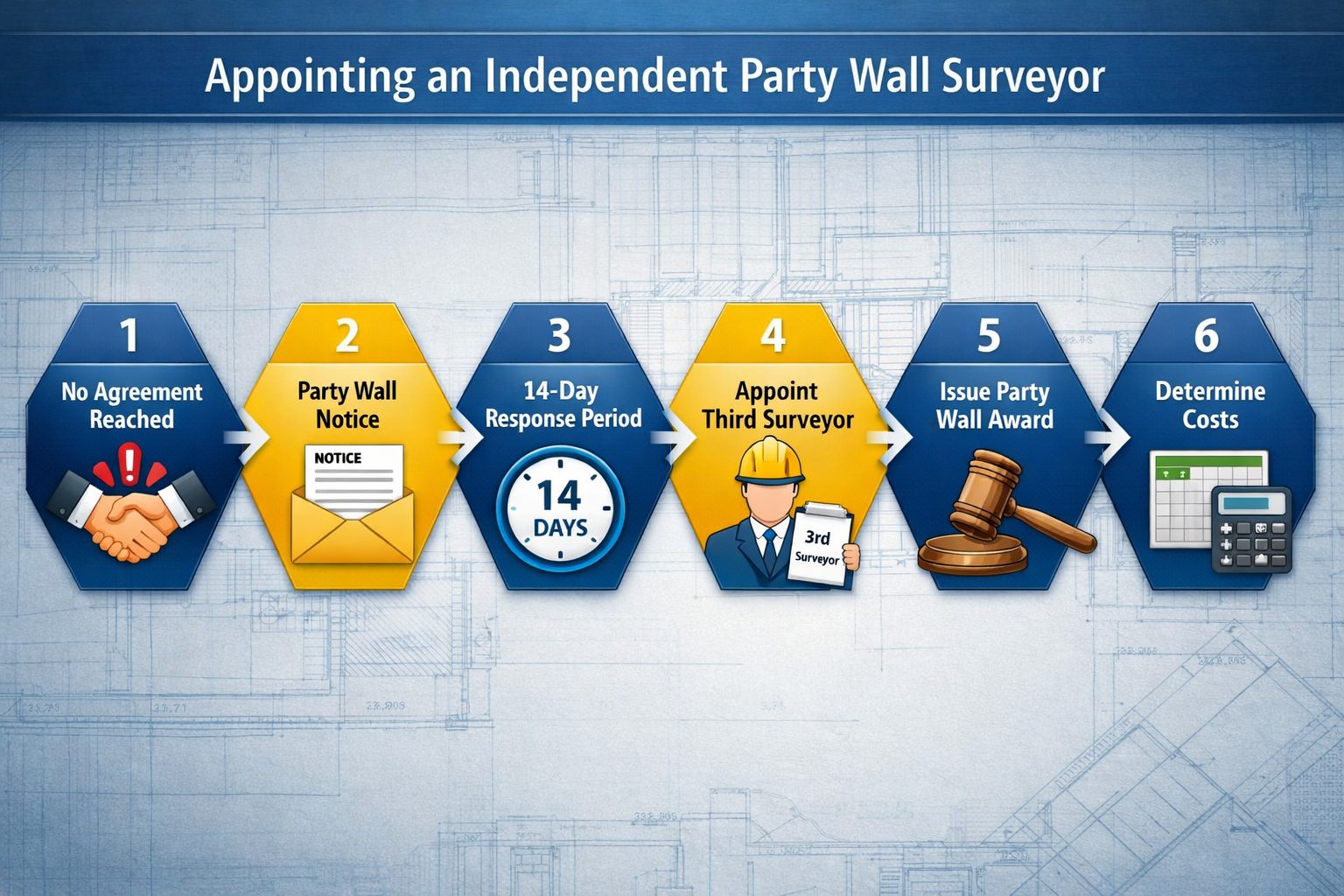
Step 1: Formal Notification of Surveyor Withdrawal or Removal
When agreed surveyor failure is confirmed, formal notification initiates the transition process. This notification must reach all parties simultaneously to maintain transparency and statutory compliance.
Notification must include:
- Clear statement of surveyor failure with specific examples
- Reference to relevant statutory provisions (Section 10, Party Wall etc. Act 1996)
- Timeline of documented failure attempts
- Declaration of intent to appoint independent surveyor
- Deadline for response (typically 10 days)
The notification should be served via recorded delivery or hand delivery with signed receipt. Email alone is insufficient for statutory purposes, though it may supplement physical service.
Building owners must send notifications to:
- The failed agreed surveyor (professional courtesy and record)
- The adjoining owner(s)
- Any previously appointed Third Surveyor (if applicable)
The 2026 RICS consultation specifically addresses service of notices [1], suggesting updated templates and methods will emerge from the guidance revision. Property owners should consult current party wall notice requirements to ensure compliance.
Step 2: The Independent Surveyor Appointment Mechanism
Following notification, parties have two pathways for appointing independent surveyors:
Option A: Mutual Agreement on New Surveyor
If building and adjoining owners can agree on a replacement, this represents the fastest resolution. The new agreed surveyor assumes all responsibilities of the failed appointment, continuing from the point of interruption.
Benefits include:
- ✅ Lower costs (single surveyor fee structure)
- ✅ Faster resolution (no Third Surveyor involvement)
- ✅ Continued relationship management
- ✅ Simplified communication
Option B: Separate Surveyor Appointments
When agreement fails, each party appoints their own surveyor—a building owner's surveyor and an adjoining owner's surveyor. These two surveyors then work together to produce the party wall award.
This pathway involves:
- 📋 Each party selecting and appointing their own professional
- 📋 Exchange of surveyor contact details within 10 days
- 📋 Joint surveyor meeting to establish procedures
- 📋 Coordinated schedule of condition and award preparation
- 📋 Potential Third Surveyor selection for dispute resolution
The enhanced guidance on use of the Third Surveyor [1] in the 2026 consultation suggests clearer procedures for this escalation mechanism, addressing previous ambiguities in the selection and authority of Third Surveyors.
Step 3: Updated Letters of Appointment and Terms of Engagement
The 2026 RICS consultation introduces revised letters of appointment and terms of engagement [1], replacing 7th edition templates with updated procedures addressing surveyor accountability.
New appointment letters should specify:
| Section | Required Content | Purpose |
|---|---|---|
| Scope of appointment | Specific works covered under notice | Prevent jurisdictional disputes |
| Independence declaration | Conflicts of interest disclosure | Ensure impartiality |
| Fee structure | Detailed breakdown with payment terms | Prevent fee disputes |
| Timeline commitments | Milestone dates for deliverables | Enable performance monitoring |
| Termination provisions | Conditions for appointment end | Facilitate future transitions |
| Third Surveyor provisions | Pre-agreed selection mechanism | Expedite dispute resolution |
Property owners should request written confirmation of RICS membership and professional indemnity insurance before finalizing appointments. The consultation's emphasis on supporting high standards of competence, conduct and consistency [1] suggests increased scrutiny of surveyor qualifications in 2026.
When appointing independent surveyors, consider geographical expertise. Surveyors familiar with North London, South London, or other specific areas bring valuable local knowledge of construction practices and common dispute patterns.
Step 4: The Third Surveyor Selection Process
When independent surveyors disagree or when the original agreed surveyor failure creates ongoing disputes, the Third Surveyor provides statutory resolution. This appointment represents the highest level of party wall dispute resolution short of court proceedings.
Third Surveyor appointment occurs when:
- Two appointed surveyors cannot agree on award terms
- Disputes arise regarding scope, methodology, or compensation
- Either surveyor requests Third Surveyor involvement
- Parties cannot agree on replacement for failed surveyor
Selection mechanisms:
- Mutual agreement: Building and adjoining owners jointly select Third Surveyor (preferred method)
- Surveyor agreement: The two appointed surveyors jointly select Third Surveyor
- Appointing Officer: If no agreement within 10 days, either party may request appointment by the local authority's Appointing Officer
The Third Surveyor's decision is binding and final, with the same legal weight as a court judgment. Their fees are typically shared equally between parties unless the award specifies otherwise.
The 2026 consultation's focus on enhanced guidance covering use of the Third Surveyor [1] addresses previous inconsistencies in this mechanism, suggesting clearer procedures for selection, scope of authority, and fee arrangements.
Cost Implications and Award Enforcement When Transitioning to Independent Surveyors

Understanding the Financial Impact of Surveyor Transition
Transitioning from agreed to independent surveyors significantly increases costs for party wall procedures. Property owners must budget for these increases, particularly when projects face unexpected surveyor failures mid-process.
Cost comparison:
| Scenario | Typical Cost Range | Payment Responsibility |
|---|---|---|
| Single agreed surveyor | £700-£1,500 | Building owner pays all |
| Two independent surveyors | £1,400-£3,000 | Building owner pays both initially |
| Third Surveyor involvement | Additional £1,000-£2,500 | Shared or as award directs |
| Failed surveyor replacement | Potential double fees | May recover from failed surveyor |
Building owners bear initial financial responsibility for all surveyor fees under the Act, though awards may allocate costs differently based on circumstances. When surveyor failure results from misconduct or negligence, property owners may pursue cost recovery through professional complaints or legal action.
The 2026 RICS consultation specifically addresses fee practices [1], suggesting updated guidance on reasonable fee structures and transparency requirements. This may provide stronger grounds for challenging excessive fees or recovering costs from failed surveyors.
For strategies to manage expenses, review guidance on how to keep party wall costs down and understand the full costs of the party wall process.
Award Enforcement When Surveyors Have Failed
The 2026 RICS consultation reveals a critical concern: awards have been challenged in cases where surveyors acted without proper jurisdiction [1], including circumstances where no genuine dispute existed between parties. This enforcement gap creates risks when transitioning from failed surveyors.
Award validity requirements:
✓ Proper jurisdiction: Genuine dispute or dissent must exist
✓ Correct notice service: All statutory notices properly served
✓ Surveyor authority: Valid appointments with proper terms
✓ Procedural compliance: All Act requirements followed
✓ Impartiality maintained: No conflicts of interest affecting decisions
When previous surveyor failures compromise these requirements, newly appointed independent surveyors must validate the entire process from the beginning. This may require:
- Re-serving notices if original service was defective
- Conducting new schedules of condition if previous ones are compromised
- Extending timelines to ensure proper procedures
- Documenting all remedial steps for award validity
Enforcement mechanisms for valid awards:
Party wall awards are enforceable as legal documents. When parties fail to comply:
- Initial enforcement: Written notice of non-compliance with 14-day remedy period
- Formal demand: Solicitor's letter demanding compliance
- County Court proceedings: Application for enforcement order
- Injunctive relief: Court order compelling compliance
- Damages claim: Financial compensation for non-compliance losses
The updated guidance's emphasis on helping practitioners navigate the statutory process with greater clarity and confidence [1] suggests improved enforcement procedures and clearer remedies for award breaches.
Managing Costs and Timelines for Urgent 2026 Projects
For construction projects with imminent start dates, surveyor failure creates dual pressures of cost and time. Strategic management of both factors determines whether projects proceed on schedule or face expensive delays.
Urgent project strategies:
🚀 Parallel processing: Initiate independent surveyor appointments while attempting agreed surveyor resolution
🚀 Pre-identified alternatives: Maintain list of qualified backup surveyors before issues arise
🚀 Expedited schedules: Request accelerated timelines with premium fees if necessary
🚀 Conditional construction starts: Begin non-notifiable works while party wall procedures complete
🚀 Insurance review: Verify coverage for party wall dispute delays and additional costs
Building owners should establish clear milestone dates with penalties for non-performance when appointing new surveyors. While the Act doesn't specify surveyor performance timelines, contractual terms of engagement can create accountability.
Consider the types of party wall works involved in your project. Some works have greater urgency or seasonal constraints (excavations before winter, for example), justifying expedited procedures and associated costs.
Recovery of Additional Costs from Failed Surveyors
When surveyor failure results from professional negligence, misconduct, or breach of contract, building owners may recover additional costs incurred during the transition to independent surveyors.
Recoverable costs may include:
- Fees paid to failed surveyor for incomplete work
- Additional fees for replacement surveyors
- Project delay costs (contractor standby time, storage, financing)
- Legal costs for enforcing rights or pursuing complaints
- Third Surveyor fees attributable to original surveyor failure
Recovery mechanisms:
- Direct negotiation: Request refund or cost contribution from failed surveyor
- RICS complaint: File professional conduct complaint with potential disciplinary action
- Professional indemnity claim: Claim against surveyor's insurance for negligence
- Small claims court: Pursue costs up to £10,000 through simplified procedure
- County Court action: Full legal proceedings for larger cost recovery
The 2026 consultation's focus on regulatory and conduct matters [1] suggests strengthened professional accountability standards, potentially improving cost recovery prospects for property owners affected by surveyor failures.
Document all additional costs meticulously with invoices, correspondence, and timeline evidence. Expert witness testimony from replacement surveyors regarding the original failure may support recovery claims.
Preventing Future Surveyor Failures: Due Diligence and Selection Criteria
Pre-Appointment Vetting for Independent Surveyors
Thorough due diligence prevents repeat failures when appointing independent surveyors. The 2026 RICS guidance updates emphasize competence and conduct standards [1], providing clearer benchmarks for surveyor selection.
Essential vetting criteria:
📋 Professional qualifications
- Current RICS membership (MRICS or FRICS)
- Specialist party wall accreditation
- Continuing professional development records
- Professional indemnity insurance (minimum £1 million)
📋 Experience verification
- Minimum 5 years party wall practice
- Similar project experience (scale, complexity, location)
- Reference checks from recent clients
- Awards available for review
📋 Capacity assessment
- Current workload and availability
- Committed timeline for key milestones
- Support staff and resources
- Backup arrangements for absence
📋 Independence confirmation
- No conflicts of interest with either party
- No previous relationship with properties involved
- Arms-length fee arrangements
- Clear complaints procedure
Request written responses to specific questions about experience, methodology, and timeline commitments. Verbal assurances alone provide insufficient protection when surveyor failures occur.
Red Flags Indicating Potential Surveyor Problems
Identifying warning signs early enables proactive replacement before failures disrupt projects. Common red flags include:
🚩 Communication issues: Delayed responses, missed meetings, unclear explanations
🚩 Fee irregularities: Vague fee structures, unexpected charges, payment demands before work completion
🚩 Procedural shortcuts: Skipping statutory steps, inadequate documentation, rushed assessments
🚩 Impartiality concerns: Appearing to favor one party, dismissing legitimate concerns, conflicts of interest
🚩 Professional conduct: RICS complaints history, insurance lapses, business instability
When red flags appear, document concerns immediately and raise them formally with the surveyor. If responses are unsatisfactory, initiate replacement procedures before failures become critical.
The updated guidance's emphasis on consistency [1] suggests standardized procedures that make deviations more identifiable. Surveyors who resist following standard protocols may indicate future reliability problems.
Building Contingency Plans for Surveyor Transitions
Proactive contingency planning minimizes disruption when surveyor transitions become necessary. Smart property owners establish backup procedures before issues arise.
Effective contingency elements:
- Alternative surveyor list: Pre-vetted professionals who can step in quickly
- Flexible project timelines: Built-in buffer periods for unexpected delays
- Enhanced documentation: Comprehensive records enabling seamless handover
- Clear termination clauses: Appointment terms allowing efficient transitions
- Financial reserves: Budget allocation for potential additional surveyor costs
For complex projects or situations where neighbors are carrying out works, contingency planning becomes even more critical given reduced control over surveyor selection and procedures.
Conclusion: Navigating Surveyor Failures with Confidence in 2026
Appointing independent party wall surveyors when agreed surveyors fail requires understanding statutory procedures, managing costs strategically, and acting within critical timeframes. The 2026 RICS consultation on updated party wall guidance [1] addresses key enforcement gaps and professional standards, providing clearer pathways for property owners facing surveyor failures.
Key action steps for property owners:
- Document thoroughly: Maintain comprehensive records of all surveyor interactions and performance issues
- Act promptly: Initiate replacement procedures within 10 days of confirmed failure
- Understand options: Choose between new agreed surveyor or separate independent appointments based on relationship dynamics
- Budget appropriately: Allocate funds for potential transition costs and Third Surveyor involvement
- Verify qualifications: Conduct thorough due diligence on replacement surveyors before appointment
- Protect timelines: Build contingency periods into project schedules for potential surveyor transitions
The updated RICS guidance emphasizes that party wall surveyor appointments are personal and statutory, independent of client instruction [1]. This principle protects property owners by establishing clear accountability standards and professional obligations that surveyors cannot compromise.
For urgent 2026 projects, early recognition of surveyor failures and immediate action on independent appointments prevents costly construction delays. Understanding the Third Surveyor mechanism and award enforcement procedures ensures that even complex disputes reach resolution without derailing projects.
Whether you're carrying out works or responding to neighbor construction, knowing how to transition from failed agreed surveyors to independent professionals protects your property rights and project investment.
Ready to appoint an independent party wall surveyor? Consult with qualified professionals who understand the 2026 regulatory landscape and can guide you through surveyor transitions with minimal disruption to your construction timeline.
References
[1] Rics Launches Consultation On Updated Party Wall Practice Guidance – https://www.rics.org/news-insights/rics-launches-consultation-on-updated-party-wall-practice-guidance
[2] Rics Opens Consultation On Party Wall Guidance Update – https://www.propertywire.com/news/uk/rics-opens-consultation-on-party-wall-guidance-update/
[3] Rics Launches Consultation On Party Wall Guidance – https://thenegotiator.co.uk/news/regulation-law-news/rics-launches-consultation-on-party-wall-guidance/
[4] Rics Consults On Updated Party Wall Practice Guidance – https://www.lexisnexis.co.uk/legal/news/rics-consults-on-updated-party-wall-practice-guidance
[5] Party Wall Surveys And Neighbour Disputes During 2026s Construction Uptick Rics Compliance Framework – https://nottinghillsurveyors.com/blog/party-wall-surveys-and-neighbour-disputes-during-2026s-construction-uptick-rics-compliance-framework