

Recent judicial decisions have fundamentally reshaped how party wall surveyors navigate their dual obligations—serving the appointing owner while maintaining strict impartiality. Between 2018 and 2024, courts have consistently emphasized that surveyors are "not an agent of or mouthpiece for the owner who appointed them," establishing a clear trend toward protecting adjoining owners' rights[6]. This evolution in case law creates a complex professional landscape where Party Wall Surveyor Duties to Appointing Owners: Balancing Impartiality Amid Evolving Case Law demands careful navigation of competing interests within the framework of the Party Wall etc. Act 1996.
Understanding these evolving duties has become essential for property owners, surveyors, and legal professionals alike. The tension between appointment and impartiality represents one of the most nuanced aspects of party wall practice in 2026.
Key Takeaways
- 🏛️ Surveyors must act as impartial tribunals despite being appointed and paid by one party, as established in landmark cases since 2018
- ⚖️ Case law increasingly protects adjoining owners' rights, creating heightened duties of care beyond traditional client-surveyor relationships
- 📋 Decision-making authority cannot be delegated except in exceptional circumstances, reflecting quasi-judicial responsibilities
- 💰 Building owners must be informed of disputes before compensation awards are issued, preventing surprise financial obligations
- 🎯 Surveyor jurisdiction is limited strictly to matters arising under the Party Wall Act, excluding general property disputes
The Fundamental Paradox: Appointed Yet Impartial
Understanding the Surveyor's Unique Position
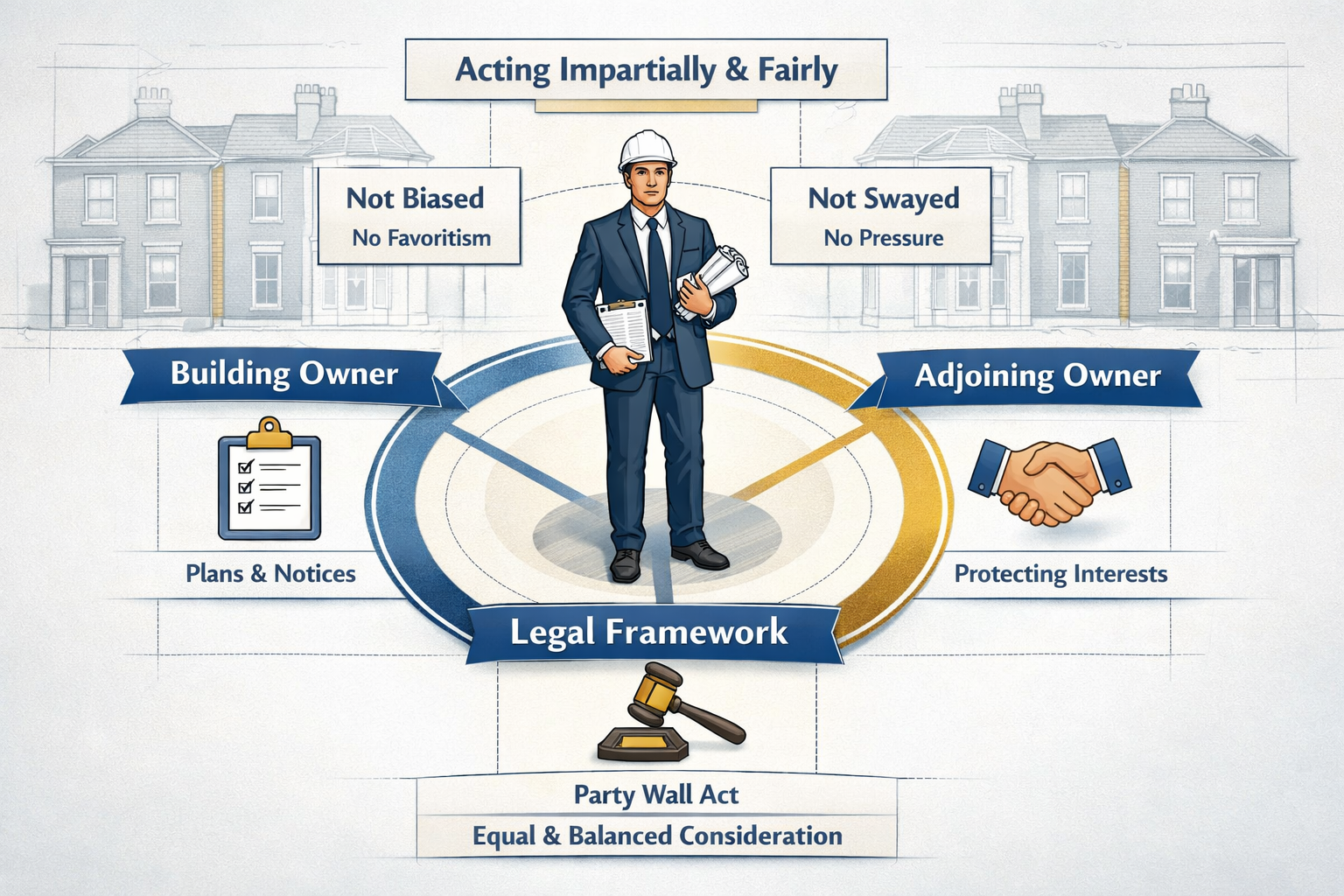
The role of a party wall surveyor presents an inherent contradiction that confuses many property owners. When a building owner appoints a surveyor, the natural expectation is that this professional will advocate for their interests. However, the legal reality differs significantly.
Party wall surveyors occupy a quasi-judicial position that requires them to act as an impartial tribunal[1]. This means they must:
- ✅ Consider both parties' interests equally
- ✅ Make decisions based on statutory requirements and fairness
- ✅ Remain independent from the appointing owner's preferences
- ✅ Protect the adjoining owner's rights under the Act
This unique status distinguishes party wall surveyors from typical professional advisors. They are neither arbitrators in the traditional sense nor expert witnesses—their awards are described as "sui generis," meaning they occupy their own distinct legal category[1].
The Welter v McKeeve Watershed Moment
The 2018 case Welter v McKeeve fundamentally clarified surveyor impartiality requirements[6]. The court emphasized that surveyors cannot simply rubber-stamp their appointing owner's wishes. Instead, they must:
- Independently assess all evidence presented by both parties
- Apply professional judgment without bias toward the appointing owner
- Consider the adjoining owner's legitimate concerns with equal weight
- Issue awards based on statutory compliance rather than client preference
This decision sent shockwaves through the party wall surveying profession, forcing many practitioners to reassess their approach to appointments. The message was clear: appointment does not equal advocacy.
Party Wall Surveyor Duties to Appointing Owners: Recent Case Law Developments
The Trend Toward Adjoining Owner Protection
A comprehensive analysis of party wall case law reveals "a trend in case law on party wall surveyors' duties of having particular regard to the rights and interests of the adjoining owner"[2]. This shift represents a significant evolution in how courts interpret surveyor responsibilities.
Key cases demonstrating this trend include:
| Case Name | Year | Key Principle Established |
|---|---|---|
| Welter v McKeeve | 2018 | Surveyors must maintain strict impartiality despite appointment |
| Evans v Paterson | 2021 | Building owners must be informed before compensation awards |
| Walsh v PSB Management | 2022 | Enhanced protection for adjoining owners' statutory rights |
| Lea Valley v Derbyshire | 2017 | Clarified surveyor jurisdiction and award validity requirements |
Evans v Paterson: Transparency in Compensation Awards
The 2021 Evans v Paterson case established a critical procedural requirement that affects how party wall awards are issued[7]. The court ruled that surveyors cannot make compensation awards under section 7(2) without the building owner's knowledge of the dispute.
This decision requires surveyors to:
- 📢 Notify building owners when compensation claims arise
- 📋 Provide opportunity for response before determining compensation
- 💬 Document the dispute clearly in all communications
- ⏰ Allow reasonable time for building owners to address claims
This ruling prevents "surprise" compensation awards that building owners only discover when receiving the final award document. It reinforces the principle that while surveyors must be impartial, they cannot operate in secrecy from their appointing owners.
Walsh v PSB Management: Strengthening Adjoining Owner Rights
The 2022 Walsh v PSB Management case further emphasized surveyor duties regarding adjoining owner protections[2]. This decision highlighted that surveyors must actively consider whether proposed works adequately protect adjoining owners' properties, rather than simply accepting the building owner's proposals.
Practical implications include:
- 🔍 Surveyors must independently verify that proposed methods are appropriate
- 🛡️ Additional protective measures may be required even if not initially proposed
- 📸 Schedules of condition must be thorough and comprehensive
- ⚠️ Surveyors can reject inadequate protection proposals from building owners

Navigating Party Wall Surveyor Duties to Appointing Owners Without Breaching Impartiality
Best Practice Framework for Maintaining Balance
Professional guidance suggests that party wall surveyors should "act as impartially as possible commensurate with the surveyor's duties to their appointing owner, keeping the parties reasonably informed, but at all times retaining control over the decision-making process"[2].
This framework creates a practical approach to balancing competing obligations:
Communication Standards:
- Keep both parties informed of significant developments
- Explain decisions clearly to both building and adjoining owners
- Document all communications thoroughly
- Avoid ex parte communications that exclude one party
Decision-Making Process:
- Base conclusions on statutory requirements and professional standards
- Consider all evidence from both parties equally
- Apply consistent standards regardless of who appointed you
- Document reasoning for all significant decisions
Relationship Management:
- Maintain professional distance from appointing owners
- Resist pressure to favor the appointing party
- Educate clients about impartiality requirements upfront
- Set clear expectations during initial appointment
The Limits of Surveyor Authority
Understanding jurisdictional boundaries is crucial for properly exercising Party Wall Surveyor Duties to Appointing Owners: Balancing Impartiality Amid Evolving Case Law. Surveyors cannot rule on matters beyond the Party Wall Act's scope[3].
Matters WITHIN surveyor jurisdiction:
- ✅ Notifiable works under sections 1, 2, and 6 of the Act
- ✅ Compensation for damage caused by notified works
- ✅ Timing and methods of notified works
- ✅ Protective measures during construction
- ✅ Access requirements for notified works
Matters OUTSIDE surveyor jurisdiction:
- ❌ General trespass claims unrelated to notified works
- ❌ Planning permission disputes
- ❌ Building regulation compliance issues
- ❌ Boundary disputes not involving party walls
- ❌ Nuisance claims beyond statutory works
This limitation protects surveyors from overstepping their authority while clarifying what building owners can reasonably expect from the party wall process.
Ongoing Jurisdiction for Related Disputes
An important principle established in case law is that surveyors retain jurisdiction for disputes arising from the same notified works[4]. This means that once appointed to resolve the principal dispute, the surveyor remains appointed should further issues emerge from those specific works.
Practical applications:
- 🔄 Surveyors can address additional issues discovered during construction
- 📋 New awards can be issued for unforeseen complications
- 💰 Compensation claims arising later from the same works remain within jurisdiction
- ⏳ Jurisdiction continues until works are substantially complete
This ongoing authority ensures continuity and prevents the need for repeated surveyor appointments for the same project.
The Non-Delegation Principle and Its Implications
Quasi-Judicial Powers Cannot Be Transferred
A fundamental principle affecting Party Wall Surveyor Duties to Appointing Owners: Balancing Impartiality Amid Evolving Case Law is that quasi-judicial powers cannot be delegated except in exceptional circumstances[1].
When a surveyor appointed by a party becomes incapable of acting, the appointing party must select a replacement rather than allowing the original surveyor to delegate responsibilities. This reflects the personal nature of the quasi-judicial role.
Reasons for the non-delegation rule:
- 🎯 Personal judgment is central to the surveyor's role
- ⚖️ Parties rely on specific expertise of the appointed surveyor
- 📜 Statutory framework assumes personal exercise of duties
- 🔒 Accountability requires identifiable decision-makers
Practical Consequences for Surveyor Practice
This principle has significant implications for surveying firms and individual practitioners:
When surveyors become unavailable:
- The appointing owner must make a new appointment
- Work completed by the original surveyor may need review
- Timelines may be affected by the replacement process
- Costs of the party wall process may increase
Preventive measures:
- Surveyors should ensure availability for the project duration
- Firms should clarify who specifically will handle the appointment
- Contingency arrangements should be discussed upfront
- Professional indemnity insurance should cover replacement scenarios
Cost Implications and Risk Management
Why Proper Procedure Prevents Litigation
Case law consistently demonstrates that following correct procedures is more cost-effective than defending litigation[3]. The key lessons for building owners include:
Why correct party wall notices are essential:
- Invalid notices can void entire awards
- Procedural errors create grounds for appeal
- Correcting mistakes mid-process is expensive
- Litigation costs far exceed proper initial compliance
Why surveyor neutrality matters:
- Biased awards are vulnerable to legal challenge
- Courts will overturn awards showing partiality
- Defending challenged awards involves substantial legal fees
- Reputation damage affects future projects
Why doing it properly is always cheaper:
- Upfront compliance costs are predictable and manageable
- Litigation involves unpredictable costs and outcomes
- Court challenges create project delays
- Professional fees for appeals exceed initial surveyor costs
Managing Expectations with Appointing Owners
One of the most important aspects of Party Wall Surveyor Duties to Appointing Owners: Balancing Impartiality Amid Evolving Case Law is educating clients about what they can and cannot expect.
Initial appointment discussions should cover:
- Impartiality requirements and what they mean in practice
- Limitations on advocacy for the appointing owner's position
- Adjoining owner rights that must be protected
- Potential outcomes that may not favor the building owner
- Cost allocation under the Act's provisions
Setting realistic expectations prevents disappointment and reduces the risk of complaints about surveyor conduct. Many disputes arise from misunderstandings about the surveyor's role rather than actual professional misconduct.
Regional Considerations and Local Practice
Geographic Variations in Party Wall Work
While the Party Wall etc. Act 1996 applies uniformly across England and Wales, practical considerations vary by location. Property density, construction types, and local building practices influence how surveyors apply their duties.
Urban areas like Central London, North London, South London, East London, and West London present unique challenges:
- 🏘️ Higher density increases frequency of party wall matters
- 🏗️ Complex construction requires sophisticated technical assessment
- 💷 Property values make compensation claims more significant
- ⚖️ Litigation rates tend to be higher in urban areas
Selecting Surveyors with Appropriate Expertise
Given the evolving case law and complex impartiality requirements, selecting a qualified surveyor is crucial. Building owners should seek professionals who:
- 📚 Stay current with case law developments
- 🎓 Hold relevant qualifications (RICS, FPWS, etc.)
- 💼 Have substantial experience with similar projects
- 🗣️ Communicate clearly about their impartial role
- 📋 Maintain professional indemnity insurance
The appointing owner's surveyor selection significantly influences project success and compliance with evolving legal standards.
Future Directions in Party Wall Surveyor Duties
Anticipated Legal Developments
As we progress through 2026, several trends suggest continued evolution in Party Wall Surveyor Duties to Appointing Owners: Balancing Impartiality Amid Evolving Case Law:
Emerging issues likely to reach courts:
- 🌍 Climate adaptation works and their classification under the Act
- 🔋 Renewable energy installations on party walls
- 🏢 Permitted development rights interaction with party wall procedures
- 💻 Digital documentation standards for awards and notices
Potential regulatory changes:
- Professional body guidance updates reflecting recent case law
- Standardized training requirements for party wall surveyors
- Enhanced consumer protection measures
- Clearer fee structure guidelines
Technology and Modern Practice
Modern surveying practice increasingly incorporates technology that affects how duties are discharged:
Digital tools enhancing impartiality:
- 📸 Photographic evidence with metadata verification
- 📊 Standardized assessment templates
- 🔐 Secure document sharing with both parties
- 📱 Real-time communication platforms
Challenges requiring careful management:
- Ensuring equal access to technology for all parties
- Maintaining confidentiality in digital communications
- Verifying authenticity of digital evidence
- Preserving records for potential appeals
Practical Guidance for Different Stakeholders
For Building Owners Initiating Works
If you're planning works requiring party wall notices, understanding surveyor impartiality helps set realistic expectations:
Do:
- ✅ Choose surveyors based on expertise and professionalism
- ✅ Provide complete, accurate information
- ✅ Accept that some decisions may not favor your preferences
- ✅ Budget for reasonable protective measures
- ✅ Understand that keeping party wall costs down means proper compliance, not cutting corners
Don't:
- ❌ Expect your surveyor to advocate against the adjoining owner
- ❌ Pressure surveyors to compromise impartiality
- ❌ Withhold information that might affect the award
- ❌ Assume appointment guarantees favorable outcomes
- ❌ Skip proper notice procedures to save time
For Adjoining Owners Receiving Notices
If you've received party wall notices, understanding surveyor duties protects your interests:
Your rights include:
- 🛡️ Impartial assessment even from the building owner's surveyor
- 📋 Proper consideration of your concerns and evidence
- 💰 Fair compensation for any damage caused
- 🔍 Adequate protective measures during construction
- ⚖️ Appeal rights if awards are unreasonable
Consider appointing your own surveyor when:
- Works are extensive or complex
- Your property has special vulnerabilities
- You lack technical expertise to assess proposals
- The building owner's surveyor seems biased
- Significant compensation claims may arise
The role of the adjoining owner's surveyor provides additional protection and expertise.
For Surveyors Navigating Duties
Professional surveyors must continuously adapt their practice to evolving case law:
Essential practices for 2026:
- Regular CPD on recent case law developments
- Clear engagement letters explaining impartiality requirements
- Documented decision-making showing balanced consideration
- Transparent communication with both parties
- Professional skepticism toward appointing owner proposals
Red flags requiring special attention:
- ⚠️ Pressure from appointing owners to favor their position
- ⚠️ Inadequate protective measures proposed
- ⚠️ Insufficient evidence to support claims
- ⚠️ Attempts to exclude adjoining owners from information
- ⚠️ Unreasonable timelines that compromise thoroughness
Conclusion
The landscape of Party Wall Surveyor Duties to Appointing Owners: Balancing Impartiality Amid Evolving Case Law has transformed significantly since the watershed 2018 Welter v McKeeve decision. Courts have consistently reinforced that surveyors occupy a unique quasi-judicial position requiring strict impartiality despite being appointed and paid by one party. The trend toward enhanced protection of adjoining owners' rights, exemplified by cases like Evans v Paterson (2021) and Walsh v PSB Management (2022), has created a more balanced framework that better serves the Act's underlying purposes.
For building owners, this evolution means accepting that appointment does not guarantee favorable outcomes. Surveyors must independently assess evidence, protect adjoining owners' statutory rights, and base decisions on professional judgment rather than client preference. The most cost-effective approach remains proper compliance from the outset—correct notices, qualified surveyors, and realistic expectations about impartiality requirements.
For adjoining owners, recent case law provides stronger protections and clearer rights to fair treatment. Even surveyors appointed by building owners must give equal weight to adjoining owners' legitimate concerns and evidence.
For surveyors, maintaining impartiality while serving appointing owners requires careful navigation of competing obligations. Clear communication, thorough documentation, and unwavering professional standards remain essential. The quasi-judicial nature of the role cannot be compromised by client pressure or commercial considerations.
Actionable Next Steps
If you're planning building works:
- Serve proper party wall notices before commencing
- Appoint qualified surveyors with current case law knowledge
- Budget realistically for protective measures and potential compensation
- Understand your surveyor's impartiality obligations from the outset
If you've received party wall notices:
- Respond within the statutory 14-day period
- Consider appointing your own surveyor for complex works
- Document your property's pre-works condition thoroughly
- Understand your rights to impartial treatment and fair compensation
If you're a party wall surveyor:
- Update your knowledge of 2018-2024 case law developments
- Review engagement letters to clarify impartiality requirements
- Implement robust documentation systems for decision-making
- Maintain professional distance from appointing owners' commercial interests
The evolution of party wall surveyor duties reflects a maturing legal framework that better balances the interests of all parties. By understanding these obligations and working within the established framework, building owners, adjoining owners, and surveyors can navigate party wall matters efficiently while minimizing disputes and ensuring compliance with both statutory requirements and evolving case law principles.
References
[1] The Unique Role Of A Party Wall Surveyor – https://dwfgroup.com/en/news-and-insights/insights/2017/4/the-unique-role-of-a-party-wall-surveyor
[2] How To Play Nicely The Current Law Of Party Wall S – https://hstalks.com/article/8478/how-to-play-nicely-the-current-law-of-party-wall-s/
[3] The Top Party Wall Case Laws Every Building Owner Should Know – https://www.simplesurvey.co.uk/article/the-top-party-wall-case-laws-every-building-owner-should-know/
[4] Does An Appointed Party Wall Surveyor Have Ongoing Jurisdiction – https://taylor-mitchell.co.uk/blog/does-an-appointed-party-wall-surveyor-have-ongoing-jurisdiction/
[6] Party Wall Surveyors Impartiality – https://ww3.rics.org/uk/en/journals/built-environment-journal/party-wall-surveyors-impartiality.html
[7] Practice Changing Party Wall Case Law Evans V Paterson 2021 – https://www.peterbarry.co.uk/blog/practice-changing-party-wall-case-law-evans-v-paterson-2021/