


Building owners planning construction work in 2026 face a critical financial decision that could double their party wall costs: choosing between an agreed surveyor or independent appointees. The difference between these two approaches can mean paying £900-£2,700 versus £1,800-£5,400, yet most property owners don't understand the trade-offs until they've already committed to a more expensive path[1].
Understanding Agreed Surveyors vs Independent Appointees: Cost Savings and Risks in Party Wall Awards is essential for anyone planning extensions, loft conversions, or basement excavations that trigger the Party Wall etc. Act 1996. This decision affects not only your budget but also your relationship with neighbours, project timelines, and the level of protection each party receives throughout the construction process.

Key Takeaways
- Agreed surveyors cost 50% less than independent appointees, with fees ranging from £900-£2,700 compared to £1,800-£5,400 for separate appointments[1]
- Building owners pay all surveyor costs regardless of which appointment method is chosen, making cost efficiency a priority consideration
- Independent appointees provide stronger protection for adjoining owners who have concerns about the proposed works or relationship tensions with their neighbour
- Third surveyor appointments can escalate costs even further when two independent surveyors cannot reach agreement on the party wall award
- Relationship quality and project complexity should guide your decision more than cost savings alone
Understanding the Two Appointment Methods Under the Party Wall Act
The Party Wall etc. Act 1996 establishes two distinct pathways for appointing surveyors to prepare party wall awards. Each method serves different purposes and suits different circumstances.
What Is an Agreed Surveyor? 🤝
An agreed surveyor is a single impartial professional who acts for both the building owner and the adjoining owner simultaneously. This surveyor has a duty to remain neutral and fair to both parties throughout the process.
The agreed surveyor approach works when:
- Both neighbours have a good working relationship
- The proposed works are straightforward and non-contentious
- Both parties trust the same professional to protect their interests
- Cost efficiency is a priority for the building owner
- Neither party anticipates significant disputes
What Are Independent Appointees? 👥
Independent appointees involve each party selecting their own surveyor. The building owner appoints one surveyor, and the adjoining owner appoints a separate surveyor. These two professionals then work together to produce the party wall award.
This approach is appropriate when:
- There are existing tensions between neighbours
- The adjoining owner has concerns about the proposed works
- The project involves complex structural issues
- Either party wants dedicated representation
- Previous disputes suggest the need for separate advocacy
When independent surveyors cannot agree on certain matters, they may appoint a third surveyor to resolve the dispute, adding another layer of cost and complexity[1].
Cost Analysis: Agreed Surveyors vs Independent Appointees in Party Wall Awards
The financial implications of surveyor selection extend far beyond the initial appointment fees. Understanding the complete cost structure helps building owners make informed decisions.
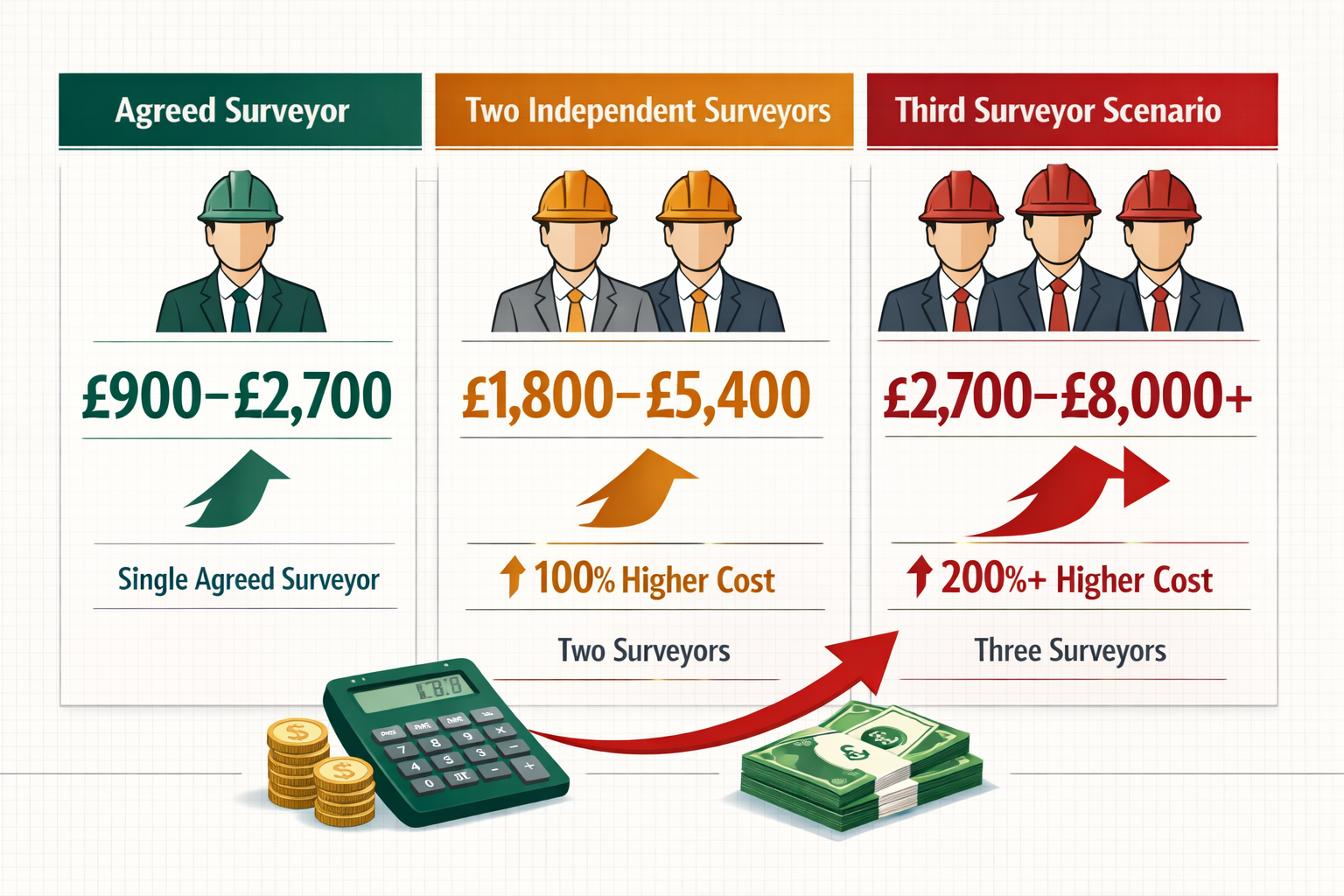
Agreed Surveyor Cost Breakdown
An agreed surveyor typically charges between £900 and £2,700 for standard party wall matters[1]. This single fee covers:
- Initial consultation and site inspection
- Preparation of schedules of condition
- Drafting the party wall award
- Serving the award on both parties
- Post-award administration and correspondence
Cost factors that increase agreed surveyor fees:
- Number of adjoining properties affected
- Complexity of proposed works
- Extent of required surveys and documentation
- Geographic location (London typically costs more)
- Property size and construction type
For detailed guidance on managing these expenses, review our resource on how to keep party wall costs down.
Independent Appointee Cost Structure
When both parties appoint separate surveyors, costs typically range from £1,800 to £5,400[1]. This represents the combined fees of both surveyors, which the building owner must pay in full.
| Cost Component | Agreed Surveyor | Independent Appointees | Potential Savings |
|---|---|---|---|
| Basic fee range | £900-£2,700 | £1,800-£5,400 | Up to 50% |
| Number of professionals | 1 | 2 | N/A |
| Coordination overhead | Minimal | Moderate | Time savings |
| Dispute resolution | Included | May require third surveyor | £800-£2,000+ additional |
Who Pays for Party Wall Surveyors?
The building owner (the person planning the works) bears responsibility for all surveyor costs, including[1]:
- Their own surveyor's fees
- The adjoining owner's surveyor's fees
- Any third surveyor fees if appointed
- All associated disbursements and expenses
Exception: In rare circumstances where a shared wall is in disrepair and both parties share responsibility for the defect, costs may be split proportionally[1].
Understanding the costs of party wall the process helps building owners budget appropriately from the project's outset.
The Third Surveyor Factor 💰
When two independent surveyors cannot reach consensus on specific matters within the party wall award, they must appoint a third surveyor to make the final determination. This adds:
- Additional fees of £800-£2,000+ depending on complexity
- Extended timelines for award completion
- Increased administrative burden
- Potential for further relationship strain
The third surveyor scenario represents the most expensive outcome and typically occurs when significant technical disagreements arise or when the relationship between the two appointed surveyors breaks down.
Risk Assessment: When Cost Savings Become False Economy
While the financial benefits of an agreed surveyor appear compelling, certain situations make independent appointees the wiser choice despite higher costs.
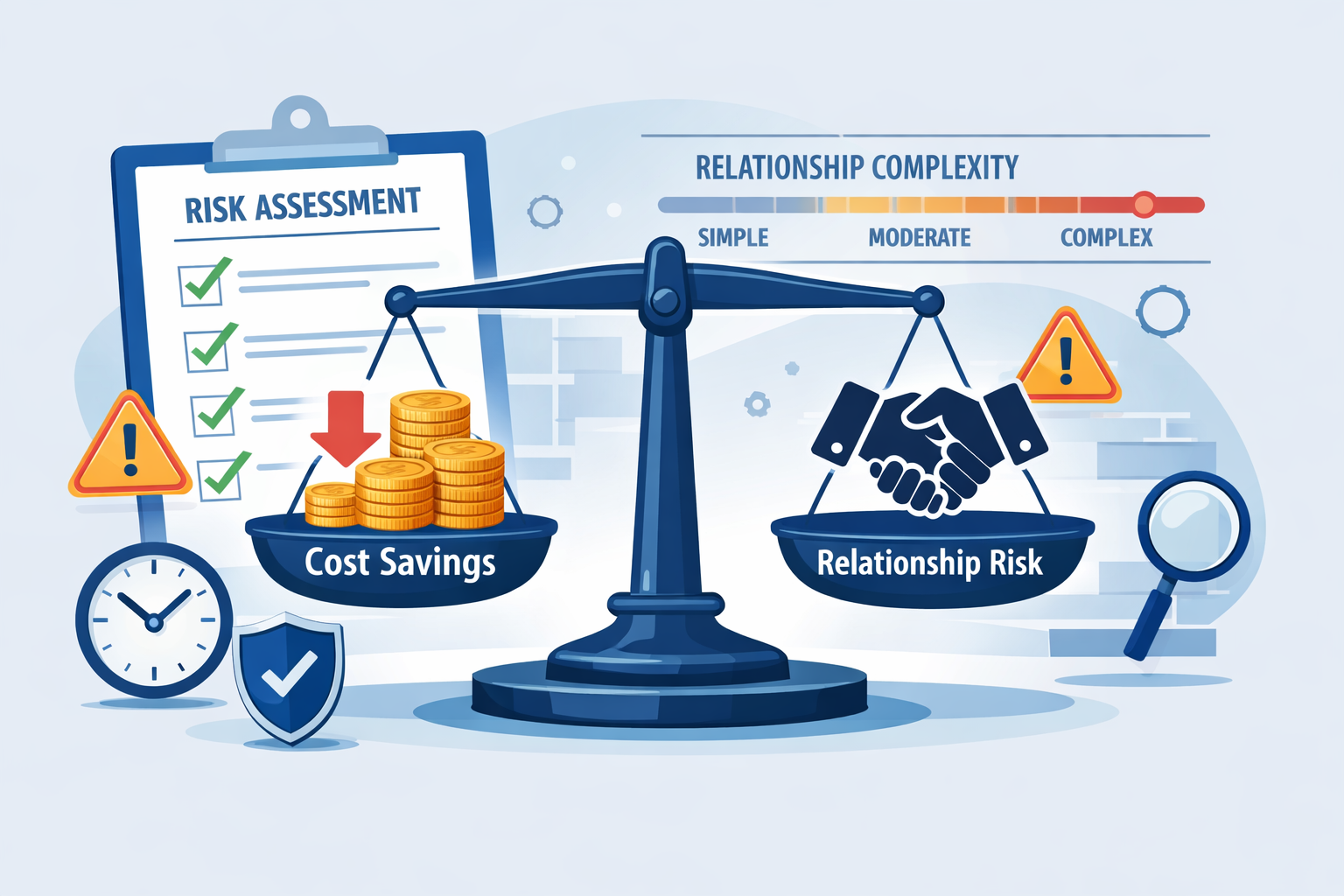
Risks of Choosing an Agreed Surveyor
For adjoining owners:
- ⚠️ Reduced advocacy: The surveyor cannot prioritize your interests over the building owner's
- ⚠️ Perceived bias: Even with professional obligations, adjoining owners may feel underrepresented
- ⚠️ Limited scrutiny: One surveyor may miss issues that two independent professionals would catch
- ⚠️ Relationship dependency: Success relies on the building owner selecting a truly impartial professional
For building owners:
- ⚠️ Neighbour dissatisfaction: Adjoining owners may feel pressured into accepting an agreed surveyor
- ⚠️ Award challenges: Dissatisfied neighbours may dispute the award, causing delays
- ⚠️ Reputation risk: If issues arise, both parties may blame the single surveyor
When Independent Appointees Protect Your Investment
Independent surveyors provide valuable protection in these scenarios:
Complex structural works: Basement excavations, significant underpinning, or major structural alterations benefit from dual professional oversight. Each surveyor brings specialized expertise and catches potential issues the other might miss.
High-value properties: When properties are worth substantial sums, the additional cost of independent surveyors represents a small percentage of the total investment while providing significantly enhanced protection.
Contentious relationships: Pre-existing disputes, previous construction conflicts, or strained neighbour relations make independent representation essential. The cost of independent surveyors is minimal compared to potential litigation expenses.
Multiple adjoining owners: Projects affecting several neighbours create complexity that benefits from dedicated representation. An adjoining owner's surveyor can coordinate multiple parties' interests effectively.
Commercial properties: Business premises often require more rigorous protection due to operational disruption risks, making independent surveyors worthwhile.
Factors That Increase Dispute Risk
Several warning signs suggest independent appointees will provide better value despite higher upfront costs:
- 🚩 Previous disagreements with neighbours about property matters
- 🚩 Adjoining owner has expressed concerns about your proposed works
- 🚩 Complex or unusual construction methods planned
- 🚩 Properties have different construction types or ages
- 🚩 Significant excavation or foundation work required
- 🚩 Commercial or mixed-use properties involved
- 🚩 Adjoining owner is a landlord with multiple tenants
- 🚩 Previous party wall issues at either property
Practical Decision Framework: Choosing Between Agreed Surveyors and Independent Appointees
Making the right choice requires evaluating your specific circumstances against clear criteria. Use this framework to guide your decision.
Checklist: When to Choose an Agreed Surveyor ✅
Select an agreed surveyor when all of these conditions apply:
- You have a positive, communicative relationship with your neighbour
- Your neighbour has expressed no concerns about the proposed works
- The works are relatively straightforward (standard extension, loft conversion)
- No complex structural elements are involved
- Your neighbour trusts your choice of surveyor
- Cost efficiency is important for your project budget
- You can identify a genuinely impartial professional both parties respect
- Neither party anticipates significant technical disputes
- The property types and construction methods are similar and conventional
- No previous party wall issues exist between the properties
If you checked all boxes: An agreed surveyor likely offers the best balance of cost savings and adequate protection.
Checklist: When to Choose Independent Appointees 🛡️
Select independent appointees when any of these conditions apply:
- Your neighbour has expressed concerns or objections to your plans
- There is tension or poor communication between you and your neighbour
- The works involve complex structural elements (deep excavations, significant underpinning)
- Your neighbour wants their own representation
- High-value properties are involved (£1M+)
- Multiple adjoining owners are affected
- Commercial properties or mixed-use buildings are involved
- Previous disputes or legal issues exist between parties
- The adjoining owner is a landlord with tenants who may be affected
- You want maximum protection against future claims
- Your neighbour has explicitly requested their own surveyor
- The project timeline can accommodate slightly longer award preparation
If you checked any box: Independent appointees provide worthwhile protection despite higher costs.
The Conversation with Your Neighbour 💬
Before making any surveyor appointment, have an open discussion with your neighbour:
Key questions to ask:
- "Have you reviewed the party wall notice I served?"
- "Do you have any concerns about the proposed works?"
- "Would you be comfortable with us appointing a single agreed surveyor?"
- "Is there a surveyor you know and trust we could both use?"
- "Would you prefer to appoint your own surveyor?"
Best practices for this conversation:
- Have it in person rather than by letter or email
- Bring drawings and specifications to explain your plans clearly
- Listen carefully to any concerns or questions
- Don't pressure your neighbour into accepting an agreed surveyor
- Offer to share information about potential agreed surveyors
- Respect their decision if they want independent representation
Understanding party wall act notices and how to respond helps both parties navigate this initial communication effectively.
Regional Considerations and RICS Guidance Updates for 2026
Geographic location and evolving professional standards influence the agreed surveyor versus independent appointee decision.
London-Specific Considerations
Party wall matters in London present unique challenges:
- Higher costs: Both agreed surveyors and independent appointees charge premium rates in London
- Complex properties: Victorian terraces, mansion blocks, and mixed-use buildings are common
- Multiple adjoining owners: Terraced properties often affect neighbours on both sides
- Professional availability: Larger pool of qualified surveyors but also higher demand
Whether you're working with a party wall surveyor in North London, South London, Central London, West London, or East London, understanding regional cost variations helps set realistic budgets.
RICS Guidance Updates
The Royal Institution of Chartered Surveyors (RICS) launched a consultation in 2026 to update guidance for professionals working under the Party Wall etc. Act 1996[2]. This consultation addresses evolving best practices and may influence future recommendations regarding agreed surveyors versus independent appointees[3].
Key areas under review:
- Professional conduct standards for party wall surveyors
- Fee transparency and cost disclosure requirements
- Conflict of interest management
- Best practices for agreed surveyor appointments
- Dispute resolution procedures
Building owners and adjoining owners should ensure their chosen surveyors follow current RICS guidance and maintain appropriate professional indemnity insurance.
Common Misconceptions About Agreed Surveyors vs Independent Appointees
Several myths persist about party wall surveyor appointments that can lead to poor decision-making.
Myth 1: "Agreed surveyors always favor the building owner"
Reality: Professional surveyors have a legal duty to act impartially regardless of who initially suggests their appointment. Surveyors who demonstrate bias risk professional sanctions and insurance claims.
Myth 2: "You must accept your neighbour's choice of agreed surveyor"
Reality: Both parties must genuinely agree on the surveyor. Either party can decline and appoint their own surveyor instead. There is no obligation to accept an agreed surveyor arrangement.
Myth 3: "Independent appointees always cause delays"
Reality: While two surveyors require coordination, experienced professionals work efficiently together. The additional time is typically 1-2 weeks, not months.
Myth 4: "Adjoining owners can refuse to pay their surveyor"
Reality: The building owner pays all surveyor costs, including the adjoining owner's surveyor fees[1]. Adjoining owners receive professional representation at no cost to themselves.
Myth 5: "You can change from agreed surveyor to independent appointees mid-process"
Reality: While technically possible, changing appointment types after work has commenced creates complications and additional costs. Make the right choice initially.
Alternative Approaches: Can You Avoid Surveyors Entirely?
Some building owners wonder whether they can bypass surveyor appointments altogether to save costs.
Party Wall Agreements Without Surveyors
In limited circumstances, neighbours can reach agreement without formal surveyor involvement. Learn more about having a party wall agreement without a surveyor.
This approach works only when:
- Works are extremely minor and low-risk
- Both parties have construction expertise to understand implications
- There is complete trust and agreement between neighbours
- Both parties understand they forfeit professional protection
- The works involve no structural elements
Significant risks include:
- ⚠️ No professional record of pre-existing conditions
- ⚠️ No formal award to define rights and responsibilities
- ⚠️ No protection if disputes arise during or after works
- ⚠️ Potential insurance complications if damage occurs
- ⚠️ No mechanism for resolving disagreements
For most party wall matters, this approach represents false economy. The cost savings of avoiding surveyors pale compared to potential dispute resolution costs if issues arise.
Using Template Agreements
Some building owners consider using template party wall agreements. While resources like a party wall contract template guide or sample party wall agreement template provide helpful starting points, they cannot replace professional surveyor input for most projects.
Templates lack:
- Site-specific condition surveys
- Professional assessment of proposed works
- Technical specifications tailored to your project
- Legal enforceability equivalent to surveyor-prepared awards
- Professional indemnity insurance backing
Maximizing Value Regardless of Your Choice
Whether you select an agreed surveyor or independent appointees, these strategies help maximize value and minimize risks.
Questions to Ask Any Surveyor Before Appointment
Experience and qualifications:
- How many party wall awards have you prepared?
- Are you a member of the Faculty of Party Wall Surveyors?
- Do you carry professional indemnity insurance?
- Have you worked on similar projects in this area?
Process and timeline:
- What is your typical timeline for preparing an award?
- How will you communicate with both parties?
- What is included in your fee quote?
- Are there potential additional costs I should anticipate?
Approach and philosophy:
- How do you balance the interests of both parties? (for agreed surveyors)
- How will you protect my interests? (for independent appointees)
- What is your approach to dispute resolution?
- Can you provide references from recent clients?
Red Flags to Watch For 🚩
Avoid surveyors who:
- Refuse to provide clear fee quotes in writing
- Cannot demonstrate relevant experience
- Show bias toward one party during initial discussions
- Lack professional indemnity insurance
- Have poor communication or responsiveness
- Cannot explain the party wall process clearly
- Pressure you toward a particular appointment method
Documentation Best Practices
Regardless of appointment method:
- Keep copies of all correspondence and notices
- Photograph your property before works commence
- Review draft awards carefully before they're finalized
- Understand all conditions and requirements in the award
- Maintain records of compliance throughout construction
- Document any deviations from the award immediately
Case Studies: Real-World Outcomes
Understanding how different choices play out in practice helps inform your decision.
Case Study 1: Successful Agreed Surveyor Appointment
Scenario: Two-storey rear extension on a Victorian terrace in South London
Relationship: Neighbours had lived side-by-side for 8 years with friendly relationship
Outcome: Agreed surveyor charged £1,200, prepared award within 3 weeks, works completed without disputes
Key success factors:
- Open communication from project outset
- Simple, well-designed extension
- Experienced surveyor both parties trusted
- Clear schedule of condition protected both properties
Case Study 2: Independent Appointees Prevent Costly Dispute
Scenario: Basement excavation under Victorian property affecting three adjoining owners
Relationship: Building owner new to area, limited relationship with neighbours
Outcome: Independent surveyors identified structural concerns the building owner's engineer had missed. Award included enhanced protection measures. Works completed successfully with no damage claims.
Key success factors:
- Adjoining owners' surveyors provided thorough scrutiny
- Technical expertise caught potential issues early
- Clear communication between three surveyors
- Additional £2,800 surveyor cost prevented potential £50,000+ damage claims
Case Study 3: Agreed Surveyor Becomes Contentious
Scenario: Loft conversion with party wall works
Relationship: Cordial but not close neighbours
Outcome: Adjoining owner felt the agreed surveyor favored building owner. Relationship deteriorated. Works completed but neighbours no longer speaking.
Lessons learned:
- Agreed surveyor approach requires genuine mutual trust
- Cost savings not worth damaged neighbour relationships
- Independent appointees would have provided reassurance worth the additional £1,500
Conclusion
The choice between Agreed Surveyors vs Independent Appointees: Cost Savings and Risks in Party Wall Awards represents a critical decision point that affects your budget, timeline, and neighbour relationships. While agreed surveyors offer compelling cost savings of 50% or more, ranging from £900-£2,700 compared to £1,800-£5,400 for independent appointees[1], this financial benefit only delivers value when circumstances support the approach.
Choose an agreed surveyor when: you have a strong, trusting relationship with your neighbour, straightforward works are planned, both parties are comfortable with shared representation, and cost efficiency is a priority.
Choose independent appointees when: any relationship tension exists, complex structural works are involved, high-value properties require maximum protection, or your neighbour expresses preference for their own representation.
Remember that as the building owner, you pay all surveyor costs regardless of appointment method[1]. The question isn't whether to invest in professional party wall services, but rather which investment structure best protects all parties while maintaining good neighbour relations.
Your Next Steps 🎯
- Review your project plans and assess complexity level
- Have an honest conversation with your neighbour about their preferences
- Use the decision checklists in this guide to evaluate your situation
- Request quotes from qualified surveyors for both appointment methods
- Make your decision based on relationship quality and project complexity, not cost alone
- Serve proper party wall notices and begin the formal process
- Maintain open communication throughout the award preparation and construction phases
For complex projects or uncertain situations, the additional investment in independent appointees typically proves worthwhile. The cost difference of £1,000-£2,000 represents a small percentage of most construction budgets while providing significantly enhanced protection and peace of mind.
The party wall process exists to protect both building owners and adjoining owners. Choosing the appropriate surveyor appointment method ensures this protection functions as intended, preventing disputes, preserving relationships, and facilitating successful construction projects that benefit everyone involved.
References
[1] Party Wall Surveyor Cost – https://hoa.org.uk/advice/guides-for-homeowners/i-am-improving/party-wall-surveyor-cost/
[2] Rics Launches Consultation On Party Wall Guidance – https://thenegotiator.co.uk/news/regulation-law-news/rics-launches-consultation-on-party-wall-guidance/
[3] Rics Consults On Updated Party Wall Practice Guidance – https://www.lexisnexis.co.uk/legal/news/rics-consults-on-updated-party-wall-practice-guidance