

Nearly 40% of party wall disputes in London stem from poorly drafted awards that fail to address critical access provisions and safeguarding measures. As RICS launches its consultation on the draft 8th edition of "Party Wall Legislation and Procedure" in April 2026, surveyors face heightened expectations for producing enforceable, dispute-proof documentation [2]. The new guidance emphasizes regulatory compliance, professional conduct, and enhanced clarity—making it essential for practitioners to understand the fundamental clause requirements that transform standard awards into legally robust instruments.
Drafting Bulletproof Party Wall Awards Under New RICS Guidance: Clause Essentials for 2026 Works requires mastery of both statutory obligations and professional best practices. With the consultation period running through May 2026, now is the critical moment to align award drafting techniques with emerging standards that prioritize independence, thorough documentation, and clear communication [4].
Key Takeaways
- Enhanced RICS guidance includes revised award structures, updated appointment terms, and strengthened regulatory emphasis on fees, Third Surveyor use, and professional independence [2]
- Essential award clauses must comprehensively address access rights, working hours, safeguarding measures, and dispute resolution mechanisms to prevent future challenges
- Schedules of condition remain critical evidence requirements, demanding detailed photographic documentation and property descriptions before works commence [1]
- Surveyor independence is emphasized as a personal and statutory appointment, separate from client instruction, with increased scrutiny on jurisdictional authority [2]
- Consultation feedback from the draft 8th edition will shape enforceable documentation standards for years to come, making current awareness essential for practitioners
Understanding the 2026 RICS Guidance Updates
The Royal Institution of Chartered Surveyors launched its consultation on the draft 8th edition of "Party Wall Legislation and Procedure" in early April 2026, marking a significant evolution in professional standards [2]. This update replaces the 7th edition with enhanced appendices, revised letters of appointment, and a comprehensively updated draft award structure designed to support RICS members with greater clarity and consistency.
What's Changed in the 8th Edition?
The draft guidance introduces several critical updates that directly impact how practitioners approach party wall awards:
Regulatory and Conduct Emphasis 🔍
The strengthened guidance now places significant weight on regulatory and conduct matters, including:
- Fee practices and transparency requirements
- Proper use of the Third Surveyor mechanism
- Service of notices and procedural compliance
- Enhanced public engagement expectations
Personal and Statutory Appointment Clarity
A key development highlights that a party wall surveyor's appointment is personal and statutory, operating independently of client instruction [2]. This addresses previous challenges where awards were contested due to surveyors acting without proper jurisdiction or appearing to favor the appointing party.
Enhanced Documentation Standards
The guidance identifies thorough documentation, clear communication, and professional expertise as fundamental elements for successful awards [4]. This aligns with the growing emphasis on creating dispute-proof documentation that can withstand legal scrutiny.
Why These Updates Matter for 2026 Works
For surveyors handling types of party wall works in 2026, these guidance updates translate into practical requirements:
| Guidance Area | Impact on Practice | Action Required |
|---|---|---|
| Independence | Must demonstrate clear separation from building owner interests | Document appointment process, avoid conflicts |
| Documentation | Higher standards for schedules of condition and photographic evidence | Invest in quality recording equipment and procedures |
| Fee Transparency | Clear explanation of charging structures required | Develop standardized fee schedules and explanations |
| Award Clauses | More comprehensive coverage of access, safeguards, and dispute resolution | Use updated templates aligned with 8th edition |
The consultation period running through May 2026 provides an opportunity for practitioners to contribute feedback and prepare for final implementation [2]. Understanding these changes now enables surveyors to draft awards that meet both current statutory requirements under the Party Wall etc. Act 1996 and emerging professional standards.
Essential Clauses for Bulletproof Party Wall Awards
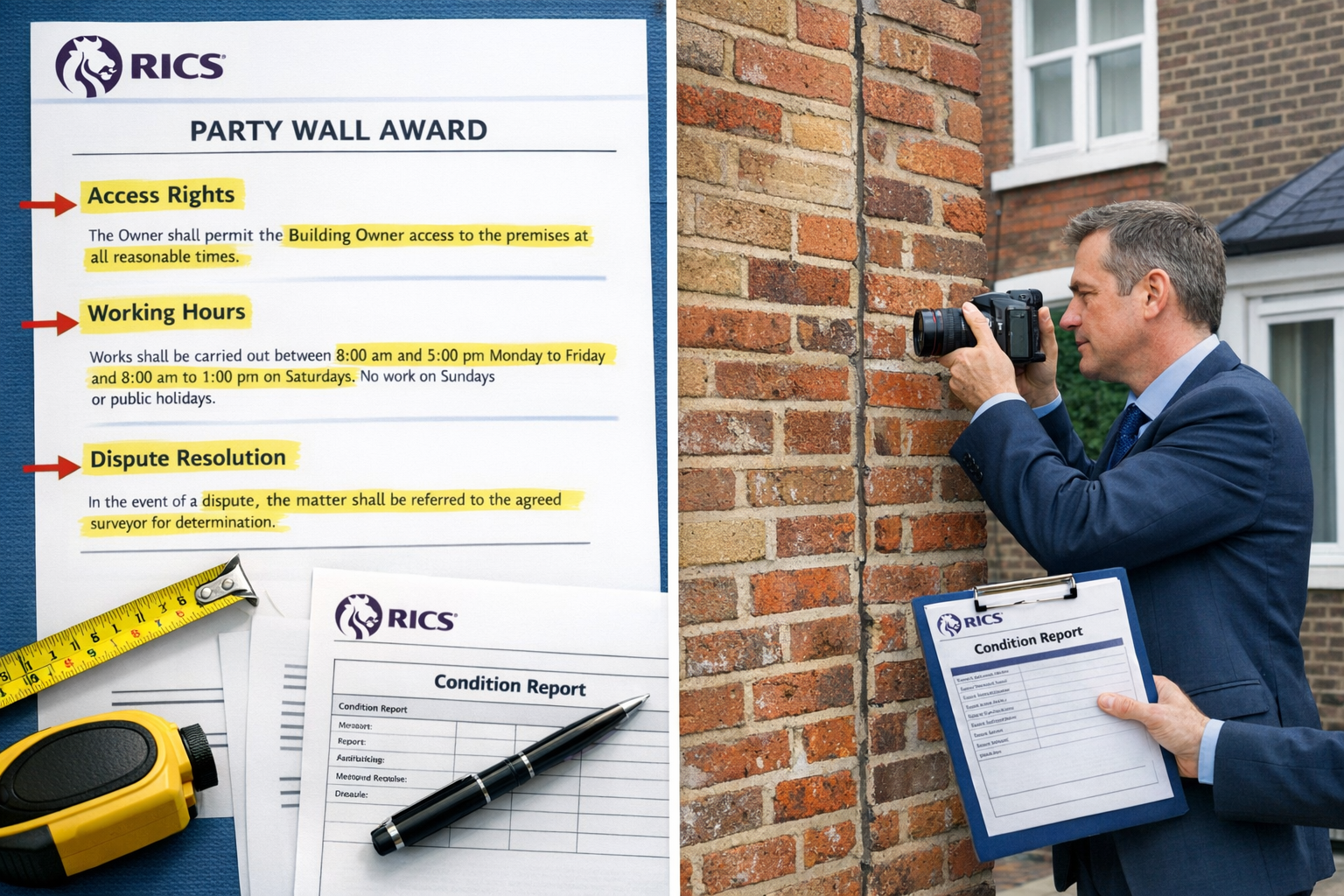
Creating enforceable party wall awards requires meticulous attention to specific clause categories that address every aspect of the proposed works and their potential impact. Drafting Bulletproof Party Wall Awards Under New RICS Guidance: Clause Essentials for 2026 Works demands comprehensive coverage across five critical areas.
1. Access Rights and Permissions ⚡
Access provisions form the backbone of enforceable awards. These clauses must specify:
Timing and Duration
- Specific working hours (typically 8:00 AM to 6:00 PM weekdays)
- Weekend and bank holiday restrictions
- Total duration of access required
- Notice period before accessing adjoining property
Scope of Access
- Exact areas of the adjoining property requiring access
- Purpose of each access requirement (scaffolding, inspection, repairs)
- Number of workers permitted on site
- Equipment and materials storage locations
The agreed surveyor must be independent and different from any surveyor the homeowner uses for their own works [1]. This independence ensures access provisions remain fair and balanced between both parties' interests.
2. Safeguarding and Protection Measures 🛡️
Comprehensive safeguarding clauses protect the adjoining owner's property throughout the works:
Physical Protection Requirements
- Floor and staircase covering specifications
- Wall and ceiling protection during access
- Dust containment and ventilation measures
- Security arrangements for open access points
Structural Safeguards
- Temporary support specifications for party structures
- Monitoring requirements for movement or settlement
- Underpinning depth and methodology (where applicable)
- Vibration limits for mechanical equipment
Insurance and Indemnity
- Minimum insurance coverage amounts
- Policy holder details and validity periods
- Indemnity provisions for damage claims
- Claims notification procedures
3. Schedule of Condition Requirements 📸
A schedule of condition must include pictures and documentation of the adjoining property's current state before works begin [1]. This serves as essential evidence in case of future disputes about work impact.
Comprehensive Documentation Standards:
✅ Photographic Evidence
- High-resolution color photographs of all relevant areas
- Multiple angles for each room or external feature
- Close-up shots of existing defects or damage
- Date and time stamps on all images
✅ Written Descriptions
- Room-by-room condition assessments
- Existing crack patterns with measurements
- Decoration and finish quality descriptions
- Structural element condition notes
✅ Technical Measurements
- Crack width measurements using appropriate gauges
- Level readings for floors and ceilings
- Plumb measurements for walls
- Baseline readings for ongoing monitoring
The schedule of condition provides the benchmark against which any alleged damage will be assessed, making thorough initial documentation absolutely critical for both parties.
4. Dispute Resolution Mechanisms ⚖️
Even well-drafted awards benefit from clear dispute resolution procedures:
Staged Resolution Process
- Direct Communication: Initial concerns raised between surveyors
- Joint Inspection: On-site review of disputed matters
- Third Surveyor Referral: Formal referral process and timelines
- Award Variation: Procedures for amending awards when necessary
Third Surveyor Provisions
- Selection process and timeline
- Scope of matters that can be referred
- Decision-making authority and finality
- Cost allocation for Third Surveyor fees
5. Financial and Cost Provisions 💰
Clear financial clauses prevent disputes over payment obligations:
Fee Structures
- Surveyor fee amounts and payment schedules
- Basis for fees (fixed, hourly, or percentage)
- Additional cost triggers and approval processes
- Payment timelines and methods
For guidance on managing expenses, see our resource on how to keep party wall costs down.
Damage and Repair Costs
- Process for assessing damage claims
- Repair specification and approval procedures
- Payment timelines for approved repairs
- Retention provisions pending completion
6. Works Specification and Limitations 🔧
Detailed works descriptions prevent scope creep and unauthorized activities:
Permitted Works Detail
- Exact nature of works authorized by the award
- Technical specifications and methodologies
- Materials specifications where relevant
- Prohibited activities and exclusions
Notification Requirements
- Notice period before commencing works
- Progress update frequency
- Completion notification procedures
- Variation request processes
7. Monitoring and Inspection Provisions 🔍
Ongoing oversight ensures compliance and early problem detection:
Inspection Schedule
- Pre-commencement inspection timing
- Regular monitoring intervals during works
- Post-completion final inspection
- Access arrangements for inspections
Reporting Requirements
- Inspection report formats and recipients
- Photographic update requirements
- Incident reporting procedures
- Compliance certification process
By incorporating these essential clauses with appropriate detail and clarity, surveyors create awards that anticipate potential disputes and provide clear mechanisms for resolution. The emphasis in Drafting Bulletproof Party Wall Awards Under New RICS Guidance: Clause Essentials for 2026 Works is on comprehensive coverage that leaves no ambiguity about rights, responsibilities, and procedures.
Incorporating Consultation Feedback for Enforceable Documents
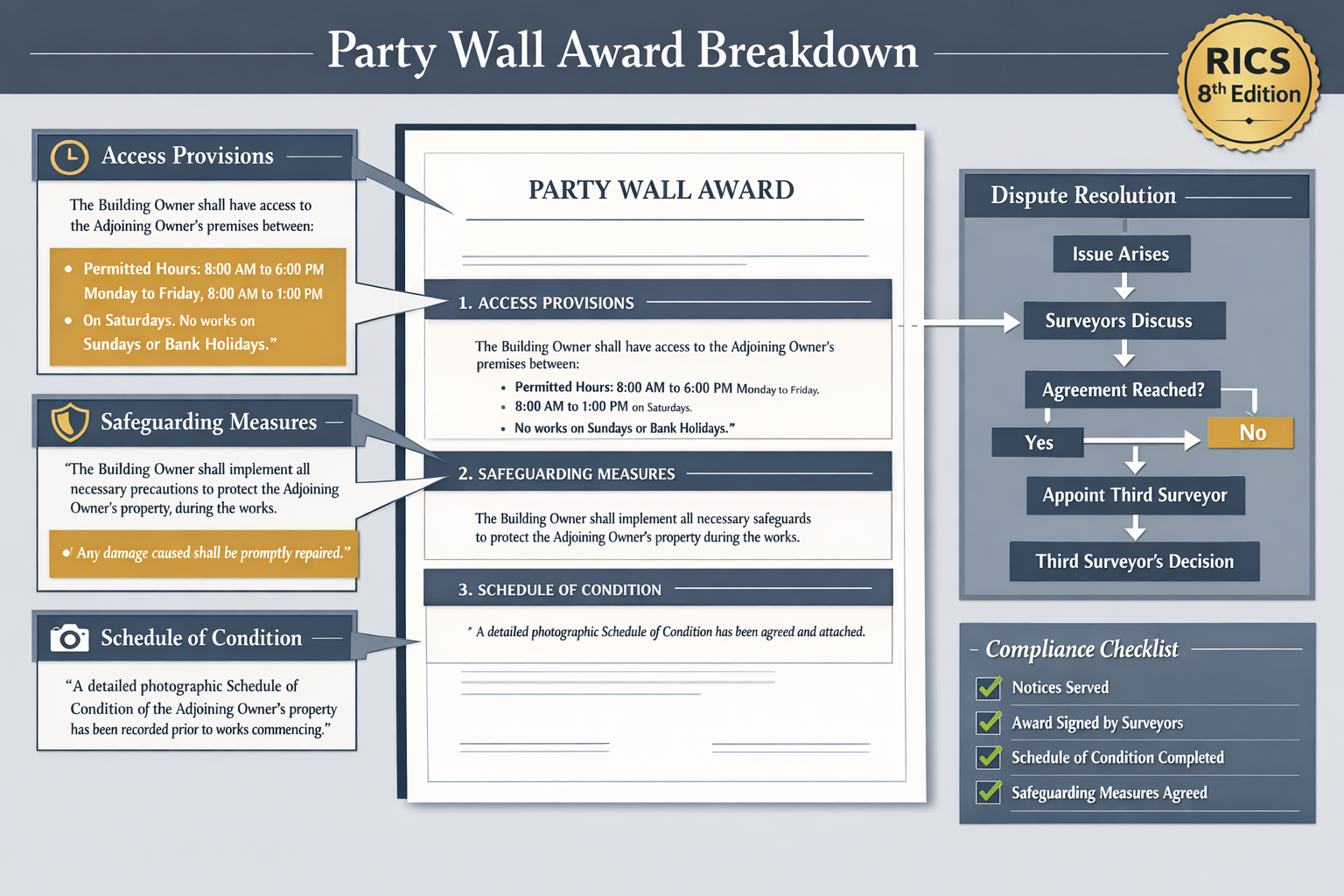
The RICS consultation period running through May 2026 provides valuable insights into emerging best practices and regulatory expectations [2]. Incorporating feedback from this consultation process strengthens award enforceability and aligns documentation with professional consensus.
Key Consultation Themes Affecting Award Drafting
Enhanced Independence Requirements
The consultation emphasizes that party wall surveyors must maintain clear independence from client interests. This affects award drafting in several ways:
- Appointment Letters: Must explicitly state the statutory nature of the appointment and independence from client instruction
- Award Language: Should avoid language suggesting advocacy for either party
- Decision Justification: Include clear reasoning for determinations to demonstrate impartial judgment
Improved Fee Transparency
Responding to consultation feedback on fee practices, awards should now include:
- Detailed breakdown of fee components (inspection, drafting, administration)
- Clear explanation of charging basis (hourly rates, fixed fees, or hybrid)
- Circumstances triggering additional fees
- Payment schedules aligned with work stages
For context on typical expenses, review information about costs of the party wall process.
Practical Application of Consultation Insights
Standardized Award Templates
The draft 8th edition includes updated award structure templates [2]. Practitioners should:
- Review the consultation draft templates carefully
- Adapt existing precedents to align with proposed structures
- Maintain flexibility for property-specific requirements
- Document deviations from standard templates with clear justification
Enhanced Communication Protocols
Consultation feedback emphasizes clear communication throughout the process. Awards should specify:
- Notification Methods: Acceptable communication channels (email, post, hand delivery)
- Response Timelines: Reasonable periods for parties to respond to requests
- Language Accessibility: Plain English explanations of technical terms
- Document Distribution: Who receives copies of awards, schedules, and correspondence
Regional Considerations for London Works
London's dense urban environment creates unique challenges requiring specialized award provisions. Practitioners working across party wall surveyor locations in London should address:
Urban-Specific Clauses:
🏙️ Access in Terraced Properties
- Multiple adjoining owners requiring coordination
- Shared access routes through properties
- Parking and material delivery restrictions
- Noise considerations in high-density areas
🏙️ Heritage and Conservation Areas
- Additional planning constraints affecting methodologies
- Materials specifications matching existing character
- Enhanced protection requirements for historic fabric
- Specialist contractor requirements
🏙️ Basement and Excavation Works
- Detailed underpinning specifications
- Ground investigation requirements
- Dewatering and drainage provisions
- Party wall foundation exposure protocols
Building Enforceability Through Precision
Drafting Bulletproof Party Wall Awards Under New RICS Guidance: Clause Essentials for 2026 Works requires attention to linguistic precision:
Mandatory vs. Permissive Language
- Use "shall" for mandatory requirements
- Use "may" for permissive provisions
- Avoid ambiguous terms like "should" or "ought"
- Define technical terms in a glossary section
Measurable Standards
- Specify quantifiable limits (decibel levels, vibration limits, crack widths)
- Include time-specific deadlines with calendar dates
- Define clear completion criteria
- Establish objective assessment methods
Conditional Provisions
- Use "if-then" structures for contingent requirements
- Specify trigger events clearly
- Define response obligations when conditions occur
- Include fallback provisions for unforeseen circumstances
Quality Assurance Before Finalizing Awards
Before serving awards to parties, implement a systematic review process:
Technical Review Checklist ✅
- All statutory requirements addressed
- Works description matches party wall notices served
- Schedule of condition completed and attached
- Access provisions comprehensive and reasonable
- Financial provisions clear and enforceable
- Dispute resolution mechanisms included
- Signatures and dates properly executed
Legal Review Considerations
- Compliance with Party Wall etc. Act 1996 requirements
- Consistency with RICS guidance (7th edition until 8th finalized)
- No ultra vires provisions beyond statutory authority
- Proper service procedures followed
- Limitation periods and timescales appropriate
Practical Enforceability Assessment
- Can provisions be objectively verified?
- Are timelines realistic and achievable?
- Do parties have clear understanding of obligations?
- Are consequences of non-compliance specified?
- Can the award be practically implemented?
Learning from Award Challenges
Previous cases where awards were challenged often involved:
- Surveyors acting without proper jurisdiction [2]
- Insufficient detail in works descriptions
- Inadequate schedules of condition
- Unclear or contradictory provisions
- Failure to address foreseeable issues
By studying these common pitfalls and incorporating consultation feedback, practitioners can draft awards that withstand scrutiny and provide effective frameworks for managing types of party wall works throughout 2026 and beyond.
The consultation process itself demonstrates RICS's commitment to continuous improvement in professional standards. Engaging with the draft 8th edition—whether through formal consultation responses or informal study—positions surveyors to deliver higher quality, more enforceable awards that serve all parties' interests effectively.
Common Pitfalls to Avoid in 2026 Award Drafting

Even experienced surveyors can fall into traps that compromise award enforceability. Understanding these common mistakes helps ensure Drafting Bulletproof Party Wall Awards Under New RICS Guidance: Clause Essentials for 2026 Works achieves its protective purpose.
Jurisdictional Errors ⚠️
Acting Beyond Statutory Authority
Party wall surveyors possess specific powers under the Party Wall etc. Act 1996, but these are limited. Common jurisdictional errors include:
- Attempting to resolve boundary disputes (outside party wall scope)
- Including provisions for works not covered by valid notices
- Making determinations about planning permission compliance
- Addressing matters better suited to building control or planning
Solution: Clearly limit award scope to matters properly within party wall jurisdiction. For boundary-related questions, refer parties to appropriate resources on boundary wall rules and differences.
Inadequate Works Descriptions 📝
Vague or Generic Specifications
Awards that describe works as "loft conversion" or "basement excavation" without detail create enforcement problems. Specific issues include:
- No dimensions or depths specified
- Materials not identified
- Methodologies left to contractor discretion
- Temporary works not addressed
Best Practice: Include detailed works descriptions with:
- Precise measurements and depths
- Specific materials and specifications
- Construction methodology requirements
- Temporary support and protection measures
- Phasing and sequencing where relevant
Schedule of Condition Deficiencies 📷
Insufficient Documentation
The most common and costly mistake involves inadequate schedules of condition. Deficiencies include:
- Too few photographs or poor quality images
- Missing rooms or external areas
- No written descriptions accompanying photos
- Failure to document existing defects
- No baseline measurements for cracks or movement
Comprehensive Approach: Follow the standard that a schedule of condition must include pictures and documentation of the adjoining property's current state [1]. This means:
- Minimum 50-100 photographs for typical residential property
- High-resolution images with proper lighting
- Written room-by-room descriptions
- Crack width measurements with gauges
- External elevations from multiple angles
- Utility installations and finishes documented
For templates and examples, see our party wall contract template guide.
Independence and Impartiality Issues 🤝
Appearing to Favor the Appointing Party
The guidance emphasizes that appointments are personal and statutory, independent of client instruction [2]. Awards can be challenged when they:
- Use language suggesting advocacy ("our client" vs. "the building owner")
- Impose unreasonable restrictions on adjoining owner
- Fail to adequately protect adjoining owner's interests
- Show insufficient consideration of concerns raised
Maintaining Independence:
- Use neutral, objective language throughout
- Balance provisions fairly between parties
- Document reasoning for all determinations
- Address all concerns raised, even if ultimately rejected
- Remember the agreed surveyor must be independent [1]
Financial Provision Gaps 💷
Unclear Cost Allocation
Awards often fail to clearly specify who pays for what, leading to disputes:
- Surveyor fees not clearly allocated
- Repair cost responsibility ambiguous
- Additional inspection costs not addressed
- Third Surveyor fee allocation unclear
Clear Financial Clauses Should Include:
- Specific fee amounts or calculation methods
- Payment schedules with dates
- Responsibility for each cost category
- Process for approving additional costs
- Consequences of non-payment
Timing and Access Ambiguities ⏰
Insufficient Detail on Working Hours
Generic provisions like "reasonable working hours" create disputes. Awards should specify:
- Exact start and end times for weekdays
- Weekend and bank holiday permissions or restrictions
- Notice periods before accessing adjoining property
- Duration of access rights
- Seasonal or weather-related modifications
Access Route Clarity
Particularly important for party wall works in terraced properties:
- Specific routes through adjoining property
- Areas that remain off-limits
- Protection requirements for access routes
- Restoration obligations after works complete
Missing Monitoring and Compliance Provisions 🔍
No Ongoing Oversight Mechanism
Awards that authorize works but include no monitoring provisions create enforcement vacuums:
- No inspection schedule specified
- No reporting requirements for building owner
- No process for addressing non-compliance
- No variation mechanism for unforeseen issues
Robust Monitoring Framework:
- Pre-commencement inspection date
- Regular progress inspections (frequency specified)
- Reporting requirements and recipients
- Non-compliance notification procedures
- Variation request and approval process
- Post-completion final inspection and sign-off
Dispute Resolution Deficiencies ⚖️
Inadequate Third Surveyor Provisions
The strengthened RICS guidance emphasizes proper use of the Third Surveyor mechanism [2]. Common deficiencies include:
- No clear process for selecting Third Surveyor
- Ambiguous scope of matters that can be referred
- Unclear timelines for referral and determination
- No provision for Third Surveyor costs
Comprehensive Dispute Clauses:
- Step-by-step referral process
- Selection method (agreement or professional body appointment)
- Matters subject to Third Surveyor determination
- Timelines for each stage
- Finality of Third Surveyor decisions
- Cost allocation provisions
Template Over-Reliance Without Customization 📋
One-Size-Fits-All Approach
While templates provide useful starting points, awards must be tailored to specific circumstances:
- Property-specific risks not addressed
- Local considerations ignored
- Unique access challenges not accommodated
- Special construction methodologies not specified
Customization Requirements:
- Adapt templates to actual site conditions
- Address property-specific vulnerabilities
- Consider neighborhood characteristics
- Account for building age and construction type
- Reflect actual works methodology
For those managing works, review guidance for building owners and adjoining owners to understand both perspectives.
Service and Procedural Errors 📮
Improper Award Service
Awards must be properly served to be enforceable:
- Incorrect service addresses
- Inadequate proof of service
- Insufficient time for appeal
- Missing signatures or dates
- Copies not provided to all relevant parties
Proper Service Protocol:
- Verify current addresses for all parties
- Use tracked delivery methods
- Maintain proof of service records
- Allow statutory 14-day appeal period
- Provide complete copies including all appendices
- Ensure all surveyors sign and date appropriately
By systematically avoiding these common pitfalls, practitioners ensure their awards meet the enhanced standards emerging from the 2026 RICS consultation and provide robust frameworks for managing construction works affecting party structures.
Conclusion
Drafting Bulletproof Party Wall Awards Under New RICS Guidance: Clause Essentials for 2026 Works represents both a professional responsibility and a practical necessity in an increasingly complex regulatory environment. The RICS consultation on the draft 8th edition signals a clear direction toward enhanced independence, comprehensive documentation, and transparent professional conduct [2].
Effective awards in 2026 must balance statutory requirements with practical enforceability, incorporating essential clauses that address access rights, safeguarding measures, schedules of condition, dispute resolution, and financial provisions. The emphasis on surveyor independence as a personal and statutory appointment—separate from client instruction—fundamentally shapes how practitioners approach their role and draft their determinations [2].
Key Success Factors
✅ Comprehensive Documentation: High-quality schedules of condition with extensive photographic evidence and detailed written descriptions [1]
✅ Precise Language: Clear, measurable provisions using mandatory language for requirements and avoiding ambiguity
✅ Balanced Protection: Fair provisions that protect both building owner's right to build and adjoining owner's property interests
✅ Practical Enforceability: Realistic timelines, achievable standards, and clear compliance mechanisms
✅ Professional Independence: Neutral language and objective decision-making throughout the award
Actionable Next Steps
For surveyors and property professionals navigating party wall matters in 2026:
-
Review the Draft 8th Edition: Engage with the RICS consultation materials before the May 2026 deadline to understand emerging standards [2]
-
Update Award Templates: Align existing precedents with the enhanced appendices and revised award structures in the draft guidance
-
Invest in Documentation: Upgrade photographic equipment and establish systematic procedures for comprehensive schedules of condition
-
Enhance Independence Protocols: Review appointment processes and award language to demonstrate clear separation from client advocacy
-
Seek Professional Development: Participate in training on the updated guidance and emerging best practices
-
Consult Specialists: For complex projects or challenging situations, engage experienced party wall surveyors who understand both statutory requirements and practical implementation
The consultation period represents a unique opportunity to shape professional standards while preparing for enhanced expectations. By mastering the clause essentials outlined in this guide and incorporating consultation feedback, practitioners can draft awards that withstand scrutiny, prevent disputes, and facilitate successful construction projects while protecting all parties' legitimate interests.
Whether you're carrying out works or your neighbor is undertaking a project, understanding these award essentials ensures smoother processes and better outcomes for everyone involved in party wall matters throughout 2026 and beyond.
References
[1] Party Wall Agreement – https://hoa.org.uk/advice/guides-for-homeowners/i-am-improving/party-wall-agreement/
[2] Rics Launches Consultation On Updated Party Wall Practice Guidance – https://www.rics.org/news-insights/rics-launches-consultation-on-updated-party-wall-practice-guidance
[4] Evergreen Guide To Party Wall Awards Drafting Enforceable Agreements Under 2026 Regulatory Updates – https://nottinghillsurveyors.com/blog/evergreen-guide-to-party-wall-awards-drafting-enforceable-agreements-under-2026-regulatory-updates