


More than 60% of party wall disputes in 2026 stem from property owners serving the wrong type of notice for their specific wall structure. This costly mistake delays construction projects by months and triggers unnecessary legal complications that could have been avoided with proper classification from the outset.
Understanding Type A vs Type B Party Walls: Notice Requirements and Surveyor Assessment Protocols is essential for anyone planning building work that affects shared boundaries. The Party Wall etc. Act 1996 establishes distinct legal frameworks for these two wall categories, each with specific notice periods, documentation requirements, and surveyor assessment procedures that property owners must follow to maintain compliance in 2026.
This comprehensive guide clarifies the critical distinctions between load-bearing and non-structural party walls, providing tailored notice templates and surveyor checklists for each classification under the 1996 Act, with emphasis on 2026 compliance updates.
Key Takeaways
- Type A walls stand on lands of different owners and require 2-month notice periods for structural work, while Type B walls stand wholly on one owner's land with party rights limited to the enclosure area
- Notice requirements vary significantly: structural party wall work needs 2 months' notice, boundary wall construction requires 1 month, and excavation work follows Section 6 rules with specific distance thresholds
- Surveyor assessment protocols differ based on wall type, with Type A walls requiring comprehensive structural evaluation and Type B walls focusing on enclosure boundaries and trespass prevention
- Invalid notices due to incorrect owner names, work descriptions, or missing statements can halt projects entirely—accuracy is legally critical
- 2026 compliance updates emphasize enhanced documentation standards and automated dispute protocols that trigger after 14 days of neighbour non-response
Understanding Type A and Type B Party Wall Classifications
The Party Wall etc. Act 1996 recognizes fundamentally different party wall structures, each with distinct ownership patterns, structural characteristics, and legal implications. Proper classification determines which notice procedures apply and how surveyors must assess proposed work.
What Defines a Type A Party Wall?
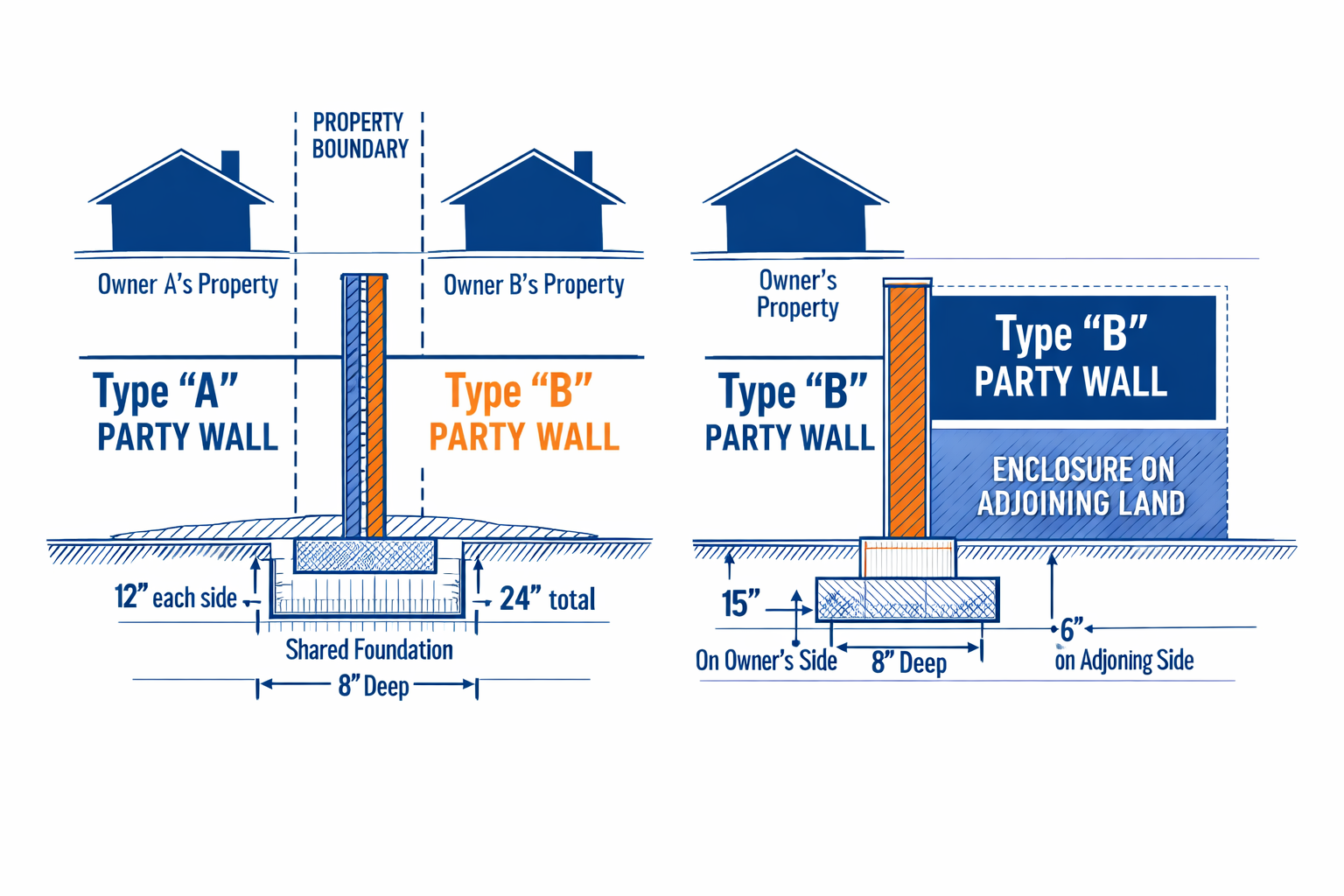
A Type A party wall forms part of a building and stands on the lands of different owners—not necessarily centrally positioned, and not just with its footings extending across the boundary [1]. Both property owners hold legal entitlement to make use of the wall throughout its entire height and length, creating shared structural responsibility.
Key characteristics of Type A walls include:
- Shared foundation structure that crosses the property boundary line
- Load-bearing capacity supporting both adjoining buildings
- Equal usage rights extending vertically through all floors
- Joint structural responsibility for maintenance and repairs
- Bilateral consent requirements for major alterations
Type A walls commonly appear in terraced housing, semi-detached properties, and buildings constructed simultaneously as part of planned developments. The wall's structural integrity directly affects both properties, making comprehensive surveyor assessment essential before any types of party wall works commence.
What Defines a Type B Party Wall?
A Type B party wall stands wholly on one owner's land but is used by two or more owners to separate their buildings [7]. Party rights extend only as far as the enclosure, and critically, the wall may not have been originally constructed as a party wall [1].
Distinguished features of Type B walls include:
- Single-property foundation entirely within one owner's boundary
- Enclosure-based party rights rather than ownership-based rights
- Asymmetric structural responsibility with primary owner bearing maintenance duties
- Limited modification rights for the enclosing neighbour
- Potential trespass issues if enclosure occurred without consent
Type B walls frequently result from property development where one owner builds against an existing boundary wall. Without agreement with the neighbour to enclose upon their wall, the owner may be able to prove trespass through the courts and force removal [1]. Once the other side is enclosed, it becomes a party wall throughout the area of enclosure, creating complex legal relationships.
Critical Differences for 2026 Compliance
The distinction between Type A and Type B walls carries significant implications for 2026 compliance protocols:
| Aspect | Type A Party Wall | Type B Party Wall |
|---|---|---|
| Ownership Pattern | Shared across boundary | Single owner with enclosure rights |
| Structural Load | Typically load-bearing | May be non-structural |
| Foundation Position | Crosses property line | Wholly on one property |
| Modification Rights | Equal for both owners | Primary owner has priority |
| Surveyor Focus | Structural integrity assessment | Enclosure boundary verification |
| Dispute Complexity | Moderate (shared interests) | High (asymmetric rights) |
Understanding these classifications prevents the most common error property owners make: serving generic notices that fail to address the specific legal requirements for their wall type. This mistake invalidates the entire notice process, requiring owners to restart the timeline and potentially face party wall injunctions [2].
Type A vs Type B Party Walls: Notice Requirements and Documentation Standards
Notice requirements under the Party Wall etc. Act 1996 vary substantially based on wall classification and work type. Serving the correct notice with accurate documentation is not merely administrative—it's a legal prerequisite that determines whether construction can proceed.
Notice Periods for Type A Party Walls
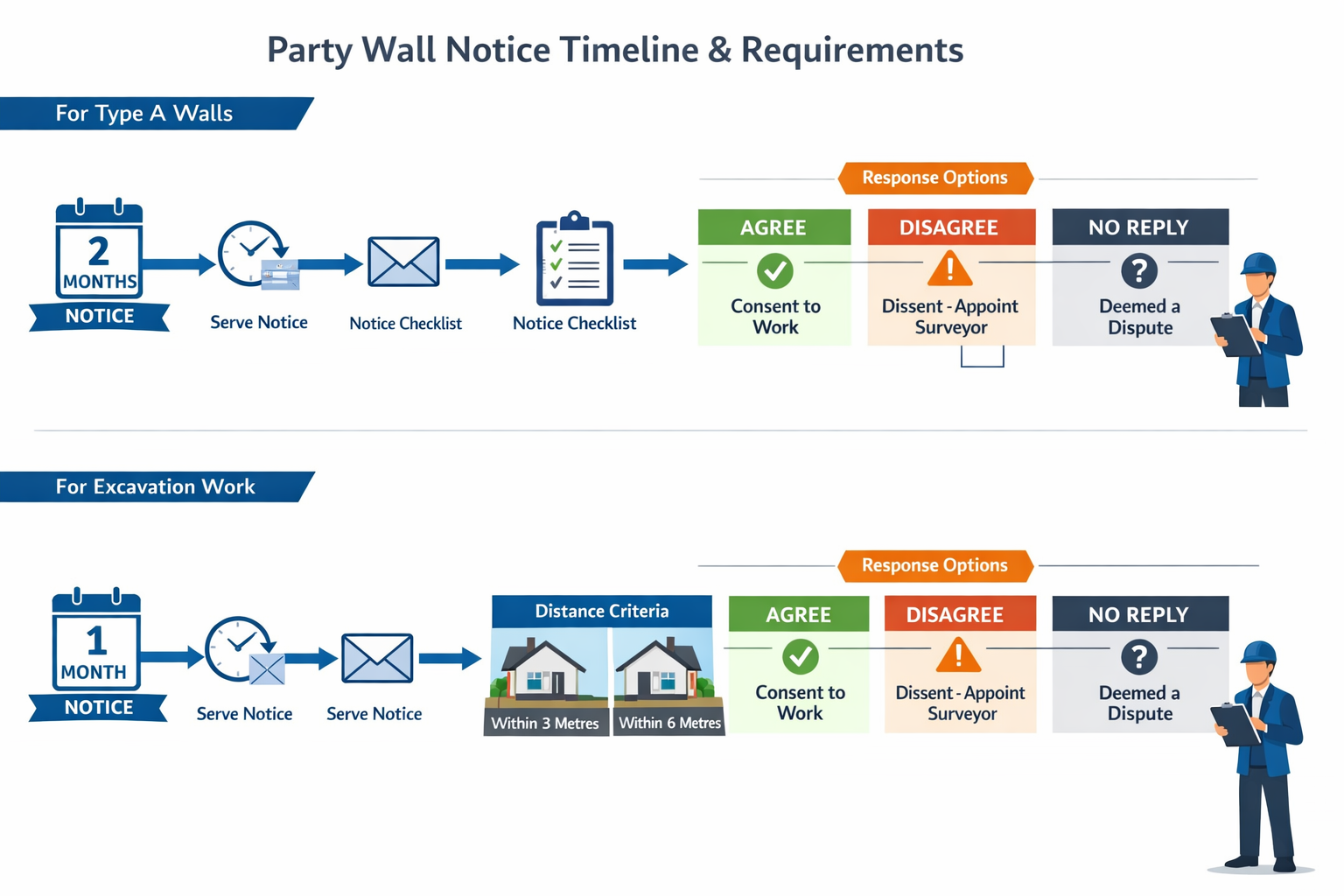
Work affecting Type A party walls requires a 2-month minimum notice period [2]. This extended timeframe reflects the shared structural responsibility and allows sufficient time for neighbours to:
- Review detailed work specifications
- Consult with independent surveyors
- Assess potential impact on their property
- Raise legitimate concerns or objections
- Negotiate protective measures or scheduling
The 2-month period begins when the notice is properly served, not when it's drafted or posted. For work scheduled to begin in spring 2026, property owners should serve notices no later than January to ensure compliance. Importantly, once notice has been served, the homeowner has up to a year to start work [2], providing flexibility for project scheduling.
Notice Periods for Type B Party Walls
Type B party walls follow the same 2-month notice requirement for building works that affect the party structure [6]. However, the assessment focus differs significantly:
- Enclosure verification: Confirming the extent of existing party rights
- Trespass prevention: Ensuring work doesn't exceed enclosure boundaries
- Primary owner authority: Recognizing asymmetric modification rights
- Non-structural considerations: Addressing aesthetic and functional impacts
Property owners must clearly specify whether proposed work extends beyond the current enclosure area. Expanding the enclosure requires explicit neighbour consent or court determination, as the primary wall owner retains rights to prevent unauthorized use [1].
Excavation Work and Section 6 Notice Requirements
Excavation near party walls or boundaries follows distinct protocols under Section 6 of the Act, regardless of whether the adjacent wall is Type A or Type B. The notice period reduces to 1 month for excavation work [2], but triggers when specific distance and depth thresholds are met:
The 3-Metre Rule: Applies when excavating within 3 metres of a neighbour's structure and digging deeper than their foundation level [4]. This rule protects against undermining adjacent foundations through direct excavation.
The 6-Metre Rule: Applies when excavating within 6 metres of a neighbour's structure, provided the excavation depth would intersect a 45-degree line drawn downward from the bottom of the neighbour's foundation [4]. This rule addresses indirect foundation instability from nearby deep excavations.
Section 6 Notices must be accompanied by plans and sections detailing the excavation so the neighbour or their surveyor can accurately assess risk and necessary protective measures [4]. Missing or inadequate excavation documentation is a primary cause of notice rejection in 2026.
Boundary Wall Construction Notices
Building a new wall directly on the boundary line—not affecting an existing party wall—requires 1-month notice [2]. This shorter period reflects the reduced structural interdependency, though neighbours retain rights to:
- Object to the wall's height or materials
- Request specific construction methods
- Require foundation depth specifications
- Demand protective measures during construction
For comprehensive guidance on boundary wall regulations, property owners should review boundary wall rules and differences between party fence walls and boundary walls.
Critical Documentation Requirements for Valid Notices
Party Wall Notices are legal documents where accuracy is critical. Errors in owner names, work descriptions, or missing required statements can invalidate the notice, leading to delays and extra costs [3]. Valid notices must include:
✅ Accurate property owner identification (legal names, not trading names)
✅ Precise work descriptions with technical specifications
✅ Proposed start date (must allow full notice period)
✅ Structural drawings and plans showing extent of work
✅ Building Owner contact information for formal responses
✅ Statement of rights informing neighbours of their options
For Type A walls specifically, notices should detail:
- Load transfer implications
- Temporary support requirements
- Foundation work affecting both properties
- Structural modification specifications
- Access requirements to adjoining property
For Type B walls specifically, notices should clarify:
- Current enclosure boundaries
- Any proposed enclosure expansion
- Work location relative to property line
- Primary owner's existing wall modifications
- Impact on non-structural wall functions
Property owners can reference party wall act notices and how to respond for detailed templates and response procedures. Additionally, reviewing what is a party structure notice and how to serve it provides London-specific guidance for 2026 compliance.
Automatic Dispute Protocols in 2026
When serving a Section 2 Notice (work to existing party wall), if the neighbour ignores it, a dispute is automatically deemed to arise after 14 days [3]. This automatic trigger represents a significant 2026 compliance update, streamlining the dispute resolution process by eliminating ambiguity about neighbour consent.
Once the 14-day automatic dispute period expires without written consent, the surveyor appointment procedures immediately activate:
- Building Owner must notify Adjoining Owner of surveyor appointment
- Adjoining Owner has 10 days to appoint their own surveyor or agree to a single Agreed Surveyor
- If Adjoining Owner doesn't respond, Building Owner may appoint a surveyor on their behalf
- Appointed surveyors must prepare a Party Wall Award within reasonable timeframe
Understanding these automatic protocols prevents property owners from incorrectly assuming neighbour silence equals consent—a costly mistake that can invalidate subsequent construction work.
Type A vs Type B Party Walls: Surveyor Assessment Protocols and Award Preparation
Professional surveyor assessment forms the cornerstone of lawful party wall work. The protocols surveyors follow differ substantially based on wall classification, with Type A walls requiring comprehensive structural evaluation and Type B walls demanding careful enclosure boundary analysis.
Surveyor Appointment Requirements
Before party wall building works can start, property owners must secure either written party wall agreement from all affected neighbours or appoint a party wall surveyor to prepare a Party Wall Award and schedule of condition [2]. The Act provides three appointment pathways:
🏗️ Agreed Surveyor: Both parties jointly appoint a single surveyor who acts impartially
🏗️ Two Surveyors: Each party appoints their own surveyor, who then appoint a Third Surveyor
🏗️ Deemed Appointment: Building Owner appoints surveyor for non-responding Adjoining Owner
For property owners seeking qualified professionals, specialized services are available across central London, north London, south London, east London, and west London.
Type A Wall Assessment Protocols
Surveyor assessment of Type A party walls follows rigorous structural evaluation protocols designed to protect both properties' integrity:
Pre-Work Structural Assessment:
- Foundation depth and condition verification
- Load-bearing capacity analysis
- Existing crack patterns and settlement documentation
- Moisture ingress evaluation
- Structural movement monitoring baseline
Proposed Work Evaluation:
- Load transfer calculations for modifications
- Temporary support requirements specification
- Construction methodology review
- Access logistics planning
- Risk mitigation strategy development
Schedule of Condition Preparation:
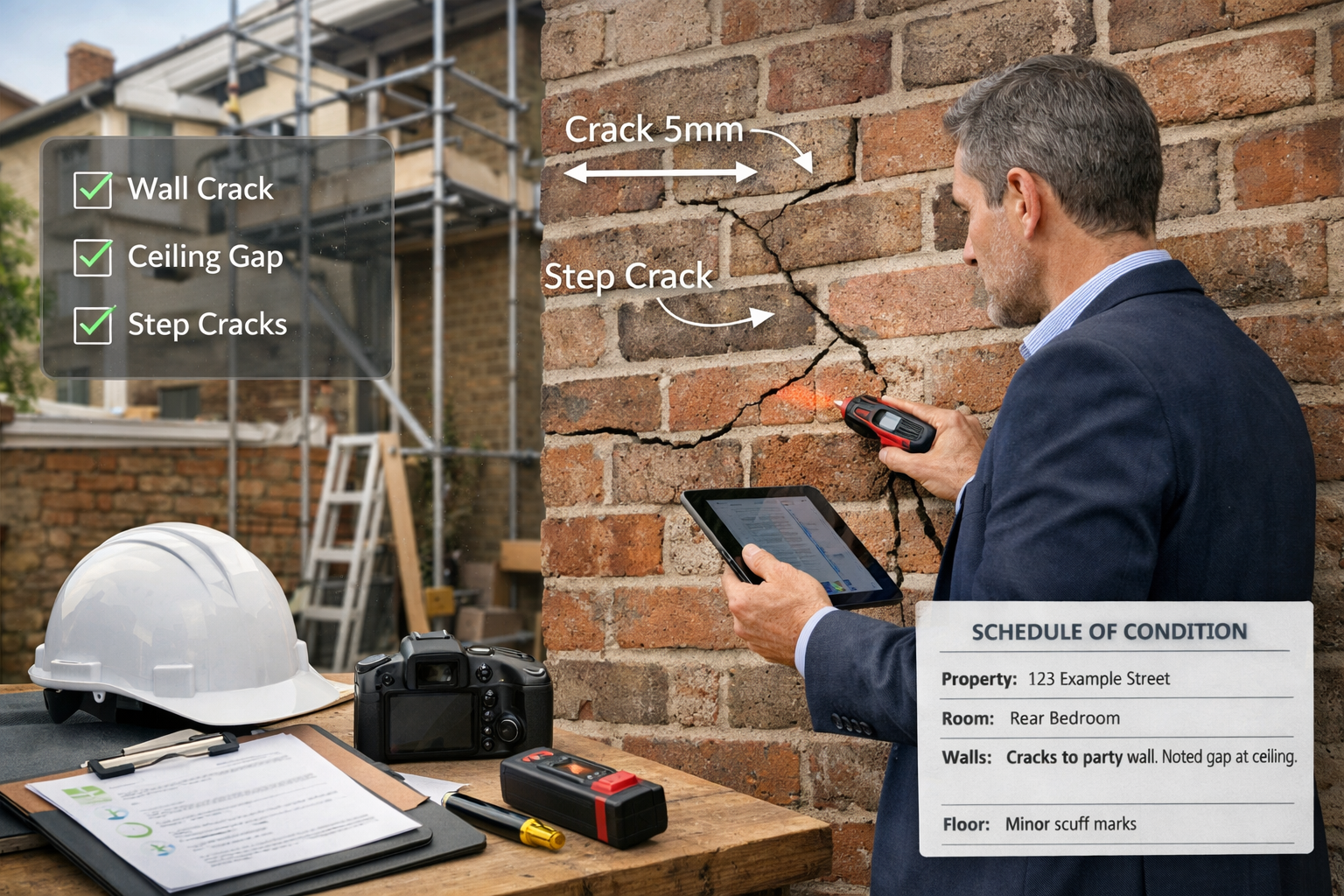
The schedule of condition represents critical evidence documenting the property's state before work commences. Without an independent expert Schedule of Condition produced before building work started, it becomes very difficult to establish which damage was caused by the works versus what was already present [2].
For Type A walls, schedules must include:
- Comprehensive photographic documentation (interior and exterior)
- Detailed crack width measurements with date stamps
- Floor level surveys identifying existing settlement
- Decorative condition records for affected rooms
- Structural element condition assessments
Party Wall Award Specifications:
The Award for Type A wall work must precisely define:
- Permitted work scope and construction methods
- Working hours and noise restrictions
- Temporary support installation procedures
- Access rights and notification requirements
- Damage compensation mechanisms
- Dispute resolution procedures
Property owners can explore party wall awards for detailed examples and standard clauses included in compliant 2026 Awards.
Type B Wall Assessment Protocols
Type B party wall surveyor assessments focus on boundary verification and enclosure rights rather than shared structural concerns:
Enclosure Boundary Verification:
- Survey confirmation of wall position relative to property line
- Documentation of existing enclosure extent
- Verification of original wall construction date
- Assessment of historical party rights establishment
- Evaluation of any trespass claims or concerns
Primary Owner Rights Assessment:
Since Type B walls stand wholly on one owner's land, surveyors must clarify:
- Primary owner's modification authority
- Enclosing owner's limited rights
- Consent requirements for work beyond enclosure area
- Aesthetic impact considerations
- Maintenance responsibility allocation
Non-Structural Impact Evaluation:
Type B wall work often involves non-structural modifications requiring assessment of:
- Weather protection integrity
- Sound insulation performance
- Fire resistance maintenance
- Thermal efficiency impacts
- Visual appearance changes
Schedule of Condition for Type B Walls:
Documentation focuses on:
- Enclosure area condition (both sides)
- Surface finishes and treatments
- Existing damage or deterioration
- Boundary marker positions
- Access point conditions
Excavation Work Assessment Protocols
When Section 6 notices trigger excavation assessments, surveyors follow specialized protocols regardless of adjacent wall type:
Foundation Protection Analysis:
- Existing foundation depth verification through trial pits or records
- Soil type and bearing capacity assessment
- Groundwater level evaluation
- Excavation method impact analysis
- Underpinning necessity determination
3-Metre and 6-Metre Rule Application:
Surveyors must precisely calculate whether proposed excavations breach statutory thresholds and specify protective measures:
- Temporary shoring requirements
- Underpinning specifications
- Foundation monitoring protocols
- Excavation sequence restrictions
- Emergency response procedures
For detailed excavation guidance, property owners should consult resources on Section 6 excavation rules and foundation protection [4].
Cost Implications and Fee Structures
Surveyor fees for Type A vs Type B party walls vary based on assessment complexity:
| Assessment Component | Type A Wall Cost Range | Type B Wall Cost Range |
|---|---|---|
| Initial Notice Review | £150-£300 | £100-£200 |
| Schedule of Condition | £300-£600 | £200-£400 |
| Party Wall Award | £500-£1,200 | £400-£800 |
| Dispute Resolution | £800-£2,000+ | £600-£1,500+ |
The Building Owner typically bears surveyor costs for both parties under the "polluter pays" principle. However, property owners can implement strategies to keep party wall costs down through early engagement and clear communication.
For comprehensive cost breakdowns, review the costs of party wall process guide covering 2026 fee structures.
2026 Compliance Updates for Surveyor Protocols
Recent regulatory developments in 2026 have enhanced surveyor assessment standards:
Enhanced Documentation Requirements: Digital photographic evidence must now include metadata timestamps and GPS coordinates for schedule of condition documentation, preventing disputes over documentation timing.
Accelerated Award Timelines: Surveyors must now issue Party Wall Awards within 21 days of final property inspection, reducing project delays from protracted award preparation.
Standardized Risk Assessment Matrices: New 2026 protocols require surveyors to complete standardized risk scoring for proposed work, improving consistency across different surveyor assessments.
Mandatory Pre-Work Meetings: For complex Type A wall modifications, surveyors must now facilitate pre-commencement meetings between Building Owners, contractors, and Adjoining Owners to review Award conditions.
Digital Award Distribution: Party Wall Awards must now be distributed electronically with read receipts, eliminating disputes over whether parties received the Award.
These 2026 updates reflect the construction industry's evolution toward digital documentation and accelerated project timelines while maintaining robust neighbour protection standards.
When Surveyor Assessment Isn't Required
In limited circumstances, property owners may proceed without formal surveyor appointment. If the Adjoining Owner provides written consent to the proposed work within the notice period, parties can execute a party wall agreement without a surveyor.
However, this approach carries significant risks:
⚠️ No independent condition documentation before work starts
⚠️ Ambiguous work scope leading to mid-project disputes
⚠️ Unclear damage liability if problems arise
⚠️ No enforcement mechanism for work quality standards
⚠️ Potential invalidation if consent was improperly obtained
Most property professionals recommend formal surveyor appointment even when neighbours initially consent, as the modest upfront cost prevents exponentially larger dispute resolution expenses later.
Enforcement and Injunction Consequences
If required party wall notice is not served, neighbours may apply for a party wall injunction to stop work [2]. Injunctions represent the most severe enforcement mechanism available, typically granted when:
- No notice was served before work commenced
- Invalid notice was served (incorrect information or format)
- Work exceeds scope specified in Party Wall Award
- Surveyor-specified protective measures weren't implemented
- Significant damage occurred due to non-compliance
Injunctions immediately halt construction, often for months while parties resolve disputes through surveyor re-assessment or court proceedings. The financial impact includes:
- Construction crew demobilization costs
- Project financing carrying costs during delay
- Legal fees for injunction defense
- Surveyor fees for retrospective assessment
- Potential damage compensation claims
- Contractor delay claims
For property owners facing neighbour construction work, understanding what to do when neighbours are carrying out works provides essential guidance on protecting property rights.
Practical Checklists for Type A vs Type B Party Walls
Implementing systematic checklists ensures compliance with Type A vs Type B Party Walls: Notice Requirements and Surveyor Assessment Protocols throughout the project lifecycle.
Type A Party Wall Work Checklist
Pre-Notice Phase (8-12 weeks before work):
- Confirm wall classification through title deed review
- Commission structural engineer assessment of proposed work
- Prepare detailed architectural drawings showing modifications
- Identify all Adjoining Owners requiring notice
- Research surveyor options for potential appointment
Notice Service Phase (2+ months before work):
- Draft Type A party wall notice with complete specifications
- Verify Adjoining Owner legal names and addresses
- Serve notice via recorded delivery or hand delivery with receipt
- Document exact service date for timeline tracking
- Prepare to respond to neighbour questions within 48 hours
Response Period (14-60 days after service):
- Monitor for written consent or dispute notification
- If no response by day 14, initiate automatic dispute protocol
- Appoint surveyor or propose Agreed Surveyor to neighbour
- Provide surveyor with all technical documentation
- Coordinate schedule of condition inspection dates
Award Preparation Phase (3-6 weeks):
- Facilitate surveyor property access for condition assessment
- Review draft Party Wall Award for accuracy
- Confirm Award addresses all proposed work elements
- Verify Award includes adequate damage compensation provisions
- Obtain signed Award from all parties
Construction Phase:
- Provide contractor with Party Wall Award copy
- Implement all Award-specified protective measures
- Maintain work within Award-defined scope
- Document any unexpected conditions requiring Award variation
- Notify surveyors of work completion for final inspection
Type B Party Wall Work Checklist
Pre-Notice Phase (8-12 weeks before work):
- Verify wall stands wholly on one property through boundary survey
- Document extent of existing enclosure area
- Assess whether proposed work extends beyond current enclosure
- Confirm primary owner identity and modification authority
- Evaluate potential trespass claims or historical disputes
Notice Service Phase (2+ months before work):
- Draft Type B party wall notice clarifying enclosure boundaries
- Specify whether work expands enclosure area (requires explicit consent)
- Detail non-structural modifications and aesthetic impacts
- Serve notice with boundary survey documentation
- Prepare evidence of historical enclosure establishment if disputed
Response and Assessment Phase:
- Address neighbour concerns about enclosure expansion
- Appoint surveyor to verify boundary and enclosure rights
- Provide surveyor with title deeds and historical documents
- Confirm maintenance responsibility allocation in Award
- Negotiate aesthetic considerations for visible modifications
Construction and Completion:
- Respect enclosure boundary limitations during work
- Maintain weather protection and structural integrity
- Document completion condition for both sides of wall
- Obtain final surveyor sign-off confirming Award compliance
- Archive all documentation for future reference
Excavation Work Checklist (Section 6)
Assessment Phase (2+ months before work):
- Measure exact distance from excavation to neighbour's structure
- Determine neighbour's foundation depth through records or trial pits
- Calculate whether 3-metre or 6-metre rule applies
- Commission structural engineer foundation protection design
- Prepare detailed excavation plans and sections
Notice Phase (1+ month before work):
- Draft Section 6 Notice with complete excavation specifications
- Include foundation protection methodology drawings
- Specify excavation sequence and temporary support measures
- Serve notice with all required technical documentation
- Prepare for surveyor-specified additional protective measures
Protection Implementation:
- Install foundation monitoring equipment before excavation
- Implement underpinning or temporary shoring as specified
- Maintain excavation face stability throughout work
- Document daily monitoring readings
- Notify surveyors immediately of any unexpected conditions
For property owners navigating these complex procedures, consulting general FAQs provides additional clarification on common scenarios.
Conclusion
Understanding Type A vs Type B Party Walls: Notice Requirements and Surveyor Assessment Protocols represents the difference between smooth construction projects and costly legal disputes in 2026. Type A walls, standing on lands of different owners with shared structural responsibility, demand comprehensive 2-month notice periods and rigorous surveyor assessment of load-bearing implications. Type B walls, standing wholly on one owner's land with limited enclosure rights, require equally careful boundary verification and enclosure extent documentation despite their non-shared foundation structure.
The critical compliance factors for 2026 include:
✅ Accurate wall classification before drafting any notices
✅ Precise documentation with complete work specifications and owner details
✅ Appropriate notice periods: 2 months for structural work, 1 month for excavation and boundary walls
✅ Professional surveyor engagement for Schedule of Condition and Party Wall Award preparation
✅ Automatic dispute protocol awareness triggering after 14 days of neighbour non-response
Property owners must recognize that party wall compliance is not optional—it's a legal prerequisite enforced through injunctions that can halt construction entirely. The modest investment in proper notices and professional surveyor assessment prevents exponentially larger costs from disputes, damage claims, and project delays.
Actionable Next Steps
For Building Owners planning work in 2026:
- Classify your party wall using title deeds and boundary surveys—don't assume classification
- Engage a qualified surveyor early (8-12 weeks before work) for preliminary assessment
- Serve notices with complete accuracy—use professional templates and verify all details
- Budget appropriately for surveyor fees, typically £1,000-£2,500 for standard residential projects
- Maintain open communication with neighbours throughout the process to minimize disputes
For Adjoining Owners receiving notices:
- Respond within 14 days to avoid automatic dispute designation
- Appoint your own surveyor to protect your interests (costs covered by Building Owner)
- Request comprehensive Schedule of Condition before any work commences
- Review Party Wall Awards carefully before signing—negotiate unclear provisions
- Document any damage immediately and notify surveyors within Award-specified timeframes
The Party Wall etc. Act 1996 provides a balanced framework protecting both building owners' development rights and adjoining owners' property interests. Success requires understanding the nuanced differences between Type A and Type B walls, serving appropriate notices with complete accuracy, and engaging qualified surveyors who follow proper assessment protocols.
For property owners seeking expert guidance on their specific circumstances, professional party wall surveyors provide invaluable support navigating these complex requirements. Whether undertaking building owner responsibilities or managing adjoining owner concerns, proper compliance protects all parties and enables construction projects to proceed smoothly in 2026.
References
[1] devonpartywalls – https://www.devonpartywalls.com/docs/pw.pdf
[2] Party Wall Agreement – https://hoa.org.uk/advice/guides-for-homeowners/i-am-improving/party-wall-agreement/
[3] Party Wall Notices Explained A Simple Guide For Home Extensions – https://www.prideroad.co.uk/party-wall-notices-explained-a-simple-guide-for-home-extensions/
[4] Excavation And The Party Wall Act Navigating The 3 And 6 Metre Rules For Foundations – https://www.partywallslimited.com/blog/excavation-and-the-party-wall-act-navigating-the-3–and-6-metre-rules-for-foundations
[6] When How Tell Them – https://www.gov.uk/party-walls-building-works/when-how-tell-them
[7] Different Types Of Party Walls – https://stokemont.com/advice/different-types-of-party-walls/