
More than 60% of chimney breast removal projects in terraced and semi-detached properties require formal party wall agreements, yet countless homeowners begin demolition work without understanding their legal obligations. This oversight can trigger costly disputes, structural damage claims, and even court injunctions that halt construction indefinitely.
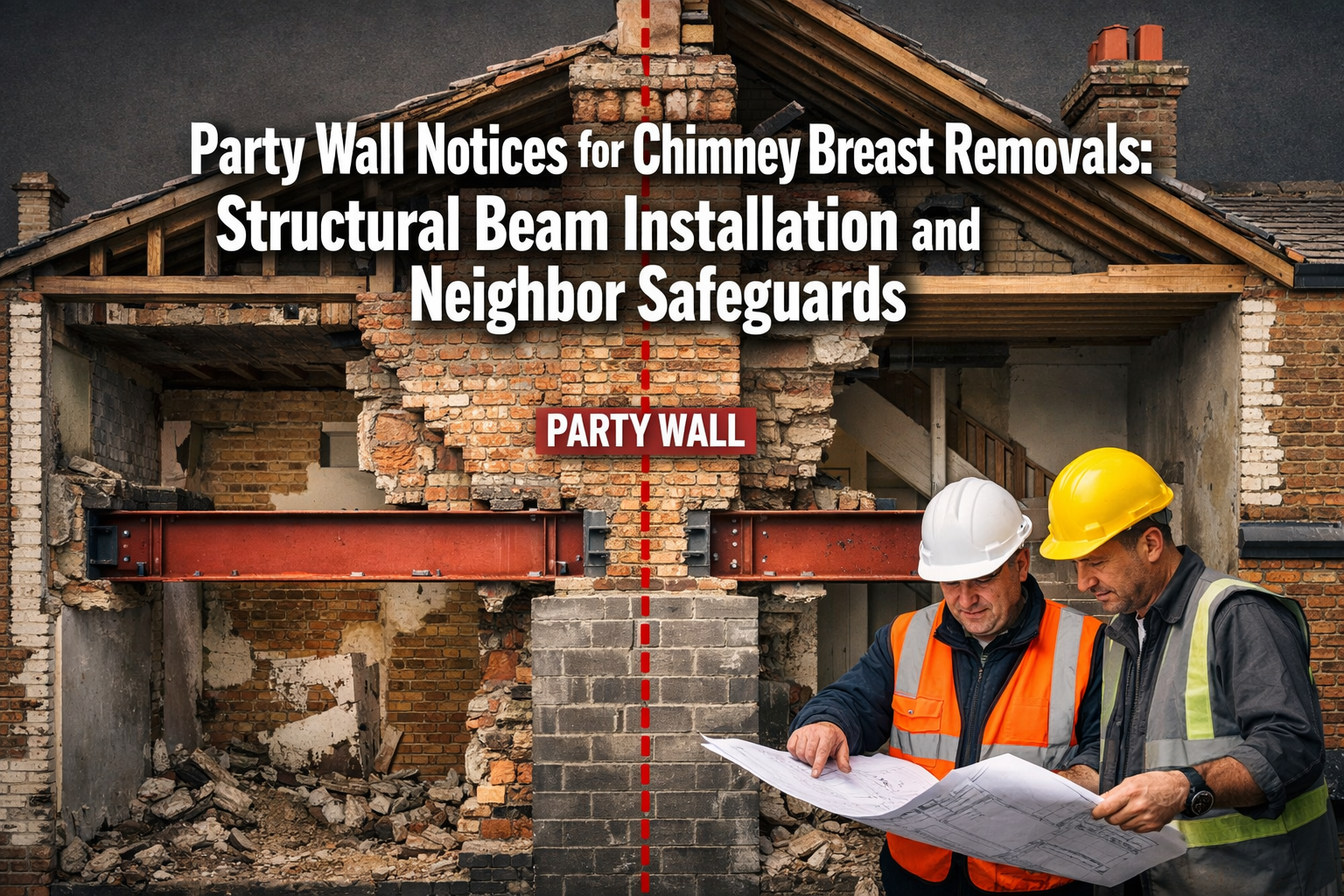
Party Wall Notices for Chimney Breast Removals: Structural Beam Installation and Neighbor Safeguards represent a critical legal framework that protects both building owners undertaking renovation work and adjoining owners whose properties share structural elements. When a chimney stack sits on or against a party wall—the shared boundary between two properties—removing the chimney breast becomes "quite major structural work" that demands full compliance with the Party Wall etc. Act 1996 [2].
This comprehensive guide outlines the specific notice types, mandatory timelines, structural engineering requirements, and surveyor inspection protocols that ensure safe RSJ (Rolled Steel Joist) beam installations. Whether you're planning to create additional living space or your neighbour has just served notice of their intentions, understanding these safeguards prevents disputes and protects property values.
Key Takeaways
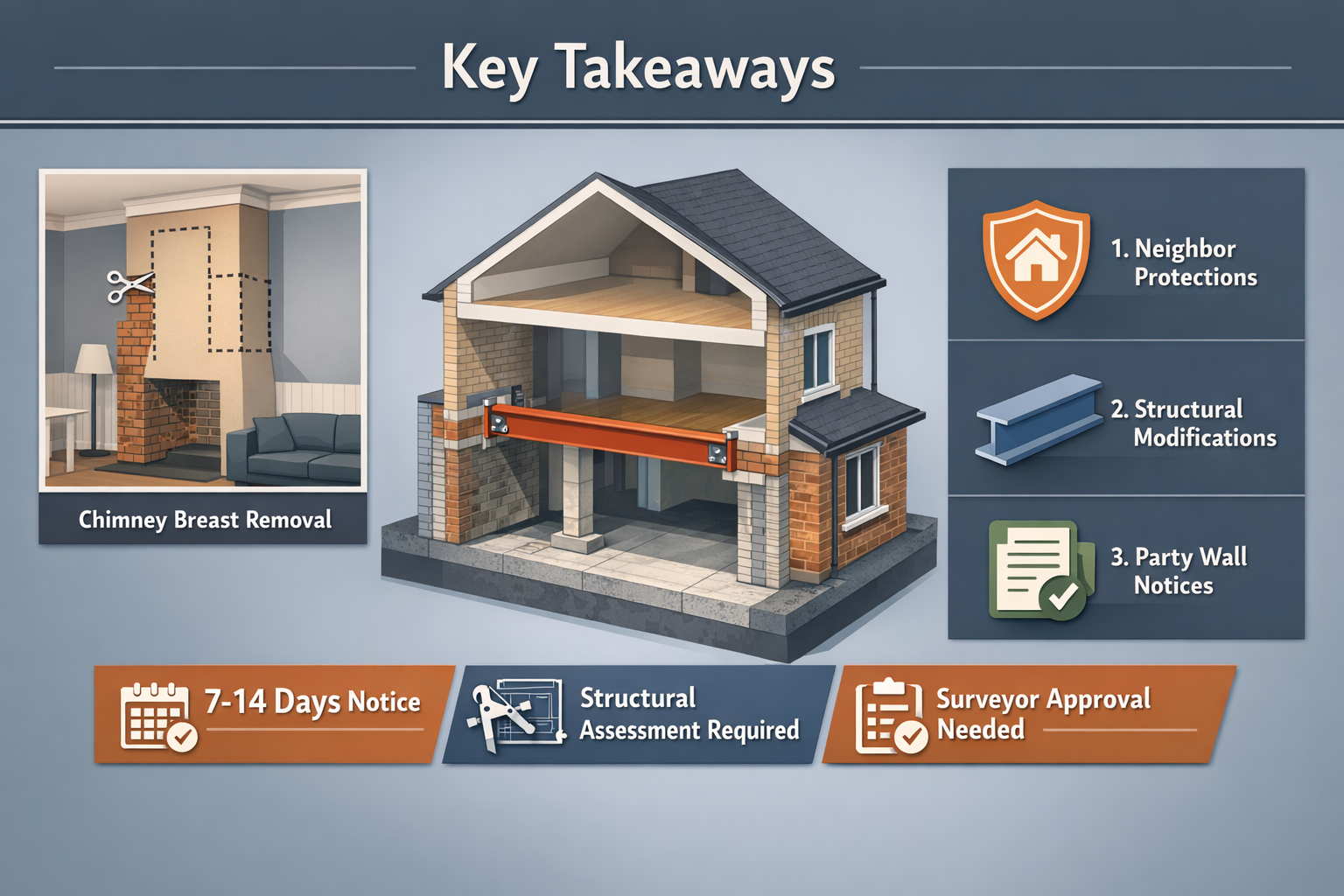
- Two-month minimum notice period is legally required before starting chimney breast removal work on party walls [1]
- RSJ beam installation perpendicular to the party wall is the only support method consistently approved by structural engineers, surveyors, and mortgage lenders [4]
- Structural engineer assessment is mandatory for designing support structures and obtaining building control approval [5]
- Party Wall Awards become necessary when neighbours dissent or fail to respond within the statutory timeframe [1]
- Professional surveyor inspections document pre-work conditions and monitor construction to prevent damage disputes
Understanding Party Wall Notices for Chimney Breast Removals: Structural Beam Installation and Neighbor Safeguards
What Qualifies as Party Wall Work?
Chimney breast removal becomes party wall work when the chimney stack is built on, against, or astride the boundary line between two properties. The Party Wall etc. Act 1996 classifies this scenario under Section 2 (works to existing party structures), requiring formal notification to adjoining owners [2].
The legislation applies specifically to:
- Chimney stacks on party walls between semi-detached or terraced houses
- Shared flues running through the party wall structure
- Structural alterations that affect the stability of the shared wall
- Beam installations that rest on or penetrate the party wall
Importantly, if the chimney breast is entirely within your property and doesn't share structural connection with your neighbour's chimney, party wall procedures may not apply—though building control approval remains mandatory [5].
Why Legal Compliance Matters
Proceeding without proper party wall notices creates several serious risks:
⚠️ Legal breach consequences: Neighbours can obtain court injunctions to halt work immediately, forcing costly project delays [7]
💰 Financial liability: Building owners become responsible for any damage caused to adjoining properties, including repair costs and diminished property values
🏠 Property sale complications: Absence of party wall documentation and building control certificates can derail future sales, as solicitors and surveyors flag non-compliant structural alterations
📋 Insurance invalidation: Many home insurance policies exclude coverage for work undertaken without proper legal compliance
Understanding what is a party structure notice and how to serve it prevents these complications and establishes a framework for resolving disputes professionally.
Notice Types, Timelines, and Serving Requirements for Chimney Breast Removal
Section 2 Notice: The Primary Document
For chimney breast removal affecting party walls, building owners must serve a Section 2 Notice (Party Structure Notice) under the Party Wall etc. Act 1996. This formal document must include:
✅ Detailed work description: Specify chimney breast removal, RSJ beam installation dimensions, and support methodology
✅ Structural engineer's drawings: Include technical specifications showing beam sizes, load calculations, and fixing methods
✅ Proposed start date: Must allow minimum two-month notice period from service date [1]
✅ Building owner's details: Full name, address, and contact information
✅ Property identification: Clear description of which chimney breast and party wall section
Mandatory Two-Month Timeline
The minimum two-month notice period is non-negotiable and begins from the date the notice is properly served to the adjoining owner [1]. This timeline allows neighbours adequate opportunity to:
- Review the proposed work with their own advisors
- Appoint a party wall surveyor if they choose
- Request modifications to the work methodology
- Document existing property conditions
Important timing consideration: If your neighbour consents in writing within 14 days, work can theoretically proceed sooner, though structural preparations typically require the full period anyway [1].
Who Must Receive Notice?
Serve the Party Wall Notice specifically to the adjoining owner who directly shares the party wall where the chimney breast sits [3]. This precision matters because:
- Neighbours above or below different levels don't require notice unless their structure is affected
- Multiple adjoining owners may exist in converted flats or maisonettes
- Leaseholders and freeholders may both need separate service in some circumstances
For properties in East London, West London, or other areas with complex ownership structures, professional guidance ensures proper service to all relevant parties.
Neighbour Response Options
After receiving notice, adjoining owners have three response paths:
| Response | Timeline | Outcome |
|---|---|---|
| Written consent | Within 14 days | Work proceeds as planned; document consent carefully |
| Dissent or counter-notice | Within 14 days | Triggers Party Wall Award process with surveyor(s) |
| No response | After 14 days | Deemed dissent; Award process becomes mandatory [1] |
The Party Wall Award Process
When neighbours dissent or don't respond, the Party Wall Award becomes the governing document. This legally binding agreement:
📋 Specifies exactly what work can proceed and under what conditions
📸 Incorporates photographic schedule of condition documenting pre-work state
⏰ Sets working hours and access arrangements
💷 Determines who pays surveyor fees (typically the building owner)
🔍 Establishes inspection protocols during construction
Professional party wall surveyors prepare the Award, which both parties must follow. The process typically adds 2-4 weeks to project timelines but provides essential legal protection for everyone involved.
Structural Beam Installation Requirements and Engineering Checklists
Why RSJ Beams Are the Gold Standard
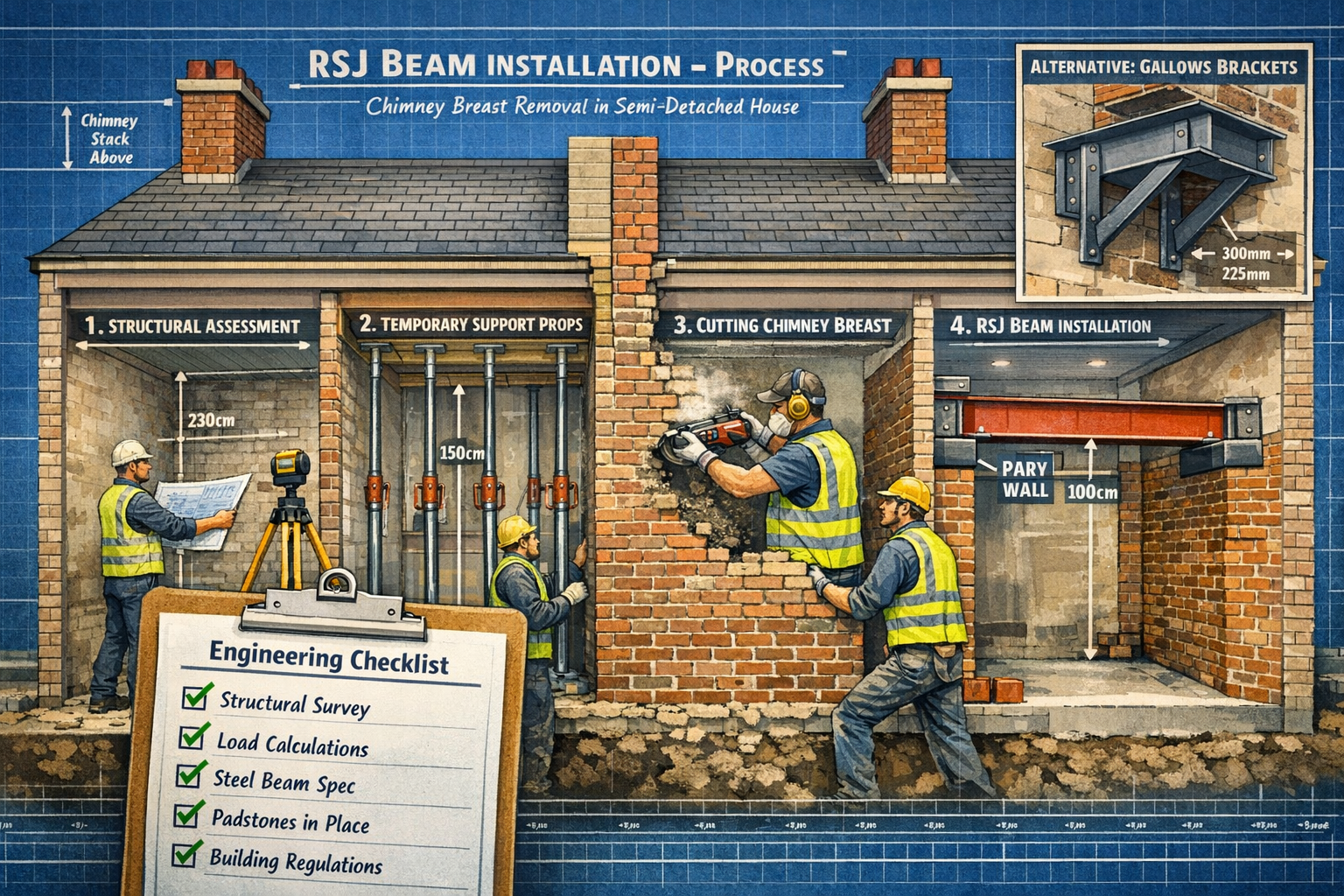
The RSJ (Rolled Steel Joist) beam represents the only support solution consistently approved by structural engineers, building control officers, mortgage lenders, and surveyors [4]. This steel beam must be installed directly under the long leading edge of the remaining chimney stack to transfer the load safely.
Alternative support methods exist, but face significant limitations:
Gallows brackets: Metal brackets that support the stack from below may receive building control approval in specific circumstances, but many lenders refuse to mortgage properties with this solution [2]. Always verify acceptability with your local building control office before proceeding.
Concrete lintels: Generally inadequate for the substantial loads imposed by chimney stacks, particularly in older properties with heavy Victorian brickwork.
Mandatory Structural Engineer Assessment
Before serving party wall notices or applying for building control, commission a structural engineer's assessment [5]. This professional evaluation determines:
🔧 Beam specifications: Size, grade, and type of RSJ required based on load calculations
📐 Support methodology: Whether beams rest on the party wall or require alternative load paths
🏗️ Temporary support requirements: Propping systems needed during removal work
⚡ Load transfer implications: Impact on party wall and foundations
The engineer's report and calculations become essential attachments to your party wall notice and building control application. This documentation costs typically £300-£800 depending on project complexity and regional rates [1].
Engineering Checklist for Safe Installation
Professional structural engineers follow systematic protocols to ensure safe beam installation:
Pre-Installation Phase
- Load calculation verification: Confirm beam specifications match actual chimney stack weight and roof loads
- Party wall load capacity assessment: Verify the party wall can support additional beam bearing loads
- Temporary support design: Specify Acrow props or needling systems to support stack during removal
- Access route planning: Ensure beam delivery and installation won't damage property
- Services location survey: Identify electrical, gas, and water services near work area
During Installation
- Temporary support installation: Secure props before any removal work begins
- Controlled removal methodology: Use hand tools or oscillating saws to minimize vibration [3]
- Beam positioning accuracy: Ensure beam sits level and square with proper bearing length
- Padstone installation: Place concrete or steel padstones to distribute loads on party wall
- Fire protection compliance: Apply intumescent coatings or boxing to maintain fire rating
Post-Installation Verification
- Building control inspection: Obtain sign-off before concealing structural work
- Party wall surveyor inspection: Document completed work matches approved plans
- Completion certificate: Secure formal documentation for property records
- Neighbour notification: Inform adjoining owner of work completion
Vibration and Damage Prevention
Chimney breast removal ranks among the higher-risk party wall works because cutting through brick and masonry generates vibration that can crack plaster, disturb foundations, and damage neighbouring properties [3]. Professional contractors mitigate these risks through:
Controlled cutting techniques: Oscillating multi-tools and hand saws rather than aggressive demolition hammers
Phased removal: Taking down the chimney breast in sections rather than wholesale demolition
Continuous monitoring: Watching for cracks or movement in adjoining property during work
Dust suppression: Protecting neighbour's property from debris and particulate matter
The schedule of condition prepared by party wall surveyors provides baseline documentation that proves whether any damage existed before work commenced.
Surveyor Inspections, Dispute Resolution, and Neighbor Protection Protocols
The Role of Party Wall Surveyors
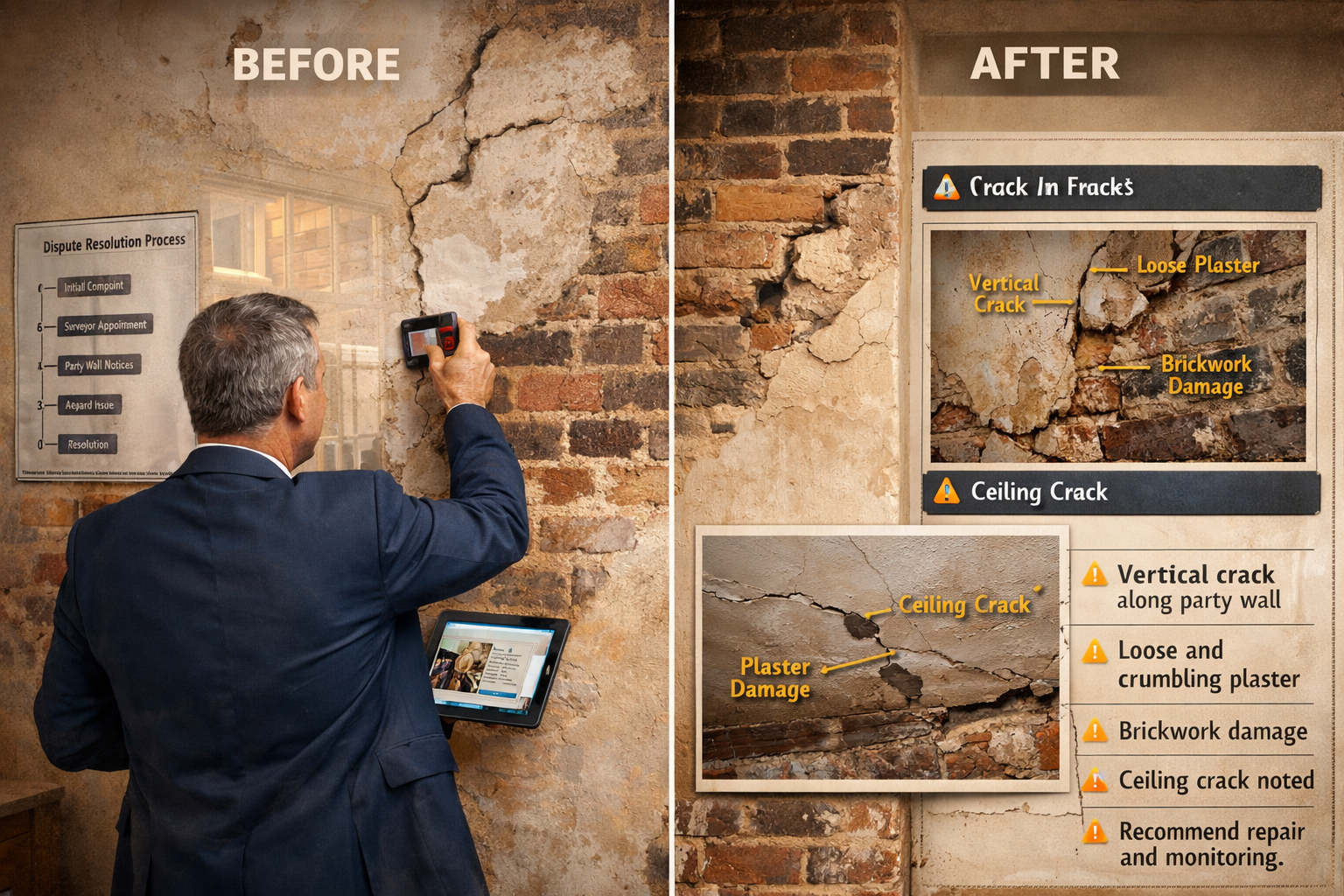
Professional party wall surveyors serve as impartial technical experts who protect both building owners and adjoining owners throughout the chimney breast removal process. Their responsibilities include:
Pre-work documentation: Creating comprehensive photographic and written records of both properties' condition before any work begins
Award preparation: Drafting the legally binding Party Wall Award that governs work methodology, access, and safeguards
Specification review: Verifying that structural engineer's designs comply with building regulations and party wall legislation
Ongoing monitoring: Conducting inspections during critical work phases to ensure compliance with Award terms
Dispute mediation: Resolving disagreements about work methodology, timing, or damage claims
Appointing Surveyors: Three Scenarios
The Party Wall etc. Act 1996 allows three surveyor appointment structures:
1. Agreed Surveyor (Most Cost-Effective)
Both parties jointly appoint a single surveyor who acts impartially. This approach:
- ✅ Reduces total fees (typically £700-£1,500 for straightforward chimney removal) [1]
- ✅ Streamlines communication and decision-making
- ✅ Works well when neighbours have good relationships
- ❌ Requires mutual trust in the surveyor's impartiality
2. Two Surveyors (Standard Approach)
Each party appoints their own surveyor, who then work together to prepare the Award:
- ✅ Provides independent advocacy for each party's interests
- ✅ Standard practice for complex or contentious projects
- ✅ Offers reassurance to cautious adjoining owners
- ❌ Higher combined fees (£1,500-£3,000+) [1]
The building owner typically pays both surveyors' fees, though Awards can specify different arrangements.
3. Third Surveyor (Dispute Resolution)
When the two appointed surveyors disagree on specific matters, they select a third surveyor to make binding decisions:
- Used only for resolving specific technical disputes
- Adds additional fees and time to the process
- Relatively rare in straightforward chimney breast cases
Inspection Protocols and Schedules
Professional surveyors follow structured inspection schedules that align with critical construction phases:
Initial condition survey (before work starts):
- Comprehensive photography of both properties
- Detailed written descriptions of existing cracks, defects, and finishes
- Video documentation of party wall condition
- Measurements and technical observations
Mid-work inspections (during construction):
- Verification that temporary supports are properly installed
- Monitoring for vibration damage or unexpected movement
- Checking that work matches approved specifications
- Ensuring contractor follows Award conditions
Completion inspection (after work finishes):
- Comparing current condition against baseline documentation
- Identifying any damage attributable to the works
- Verifying building control sign-off obtained
- Confirming proper reinstatement of finishes
This systematic approach provides clear evidence if damage disputes arise, protecting both parties from unfounded claims.
Dispute Resolution Tips for Building Owners
Even with proper procedures, disagreements occasionally emerge. These strategies help resolve issues efficiently:
💬 Maintain open communication: Regular updates to neighbours prevent misunderstandings and build goodwill
📧 Document everything: Keep written records of all conversations, agreements, and concerns raised
🤝 Show flexibility: Accommodating reasonable requests about working hours or access demonstrates good faith
⚖️ Trust the Award process: The Party Wall Award provides legal framework for resolving technical disagreements
🏗️ Hire reputable contractors: Experienced professionals minimize damage risk and handle neighbour interactions professionally
For guidance on keeping party wall costs down while maintaining proper compliance, consider consulting specialists early in your planning process.
Neighbor Safeguards Built Into the Process
The party wall framework includes multiple protection mechanisms for adjoining owners:
Right to independent advice: Neighbours can appoint their own surveyor at the building owner's expense
Condition documentation: Photographic evidence protects against false damage claims
Work specification control: Awards can mandate specific methodologies to minimize risk
Access rights: Surveyors can inspect work progress to ensure compliance
Compensation provisions: Awards specify remedies if damage occurs despite proper procedures
Appeal mechanisms: Dissatisfied parties can appeal Award terms to county court within 14 days
These safeguards explain why understanding party wall act notices and how to respond benefits adjoining owners significantly. The legislation balances property owners' rights to improve their homes with neighbours' rights to protection from damage.
Building Control Requirements and Completion Documentation
Separate But Parallel Approval Process
Party wall compliance and building control approval represent two distinct legal requirements that run in parallel [2]. Both must be satisfied for lawful chimney breast removal:
Party Wall etc. Act 1996: Governs the relationship between neighbours and protects adjoining owners from damage
Building Regulations: Ensures structural safety, fire protection, and construction standards meet national requirements
Crucially, building control officers assess whether the work is structurally sound and safe, while party wall surveyors focus on protecting neighbour interests and documenting conditions.
Building Control Application Timeline
Submit your building control application (Full Plans or Building Notice) before starting any demolition work. The process typically involves:
- Application submission with structural engineer's calculations and drawings (£200-£500 fee)
- Plan review by building control officer (1-3 weeks)
- Approval or requested modifications issued
- Notification before work starts (48 hours minimum)
- Inspection at foundation/beam stage (mandatory site visit)
- Final inspection after completion
- Completion certificate issued for property records
Essential Documentation to Retain
Future property sales require comprehensive documentation proving compliant work. Maintain permanent records of:
📄 Structural engineer's report and calculations
📄 Building control completion certificate
📄 Party Wall Award (if applicable)
📄 Contractor invoices and warranties
📄 Photographic evidence of completed work before concealment
📄 Written consent from neighbour (if no Award was required)
Solicitors conducting property searches specifically request this documentation. Missing paperwork can reduce property value, delay sales, or require expensive retrospective indemnity insurance.
Cost Considerations and Budget Planning
Typical Project Cost Breakdown
Chimney breast removal costs vary significantly based on structural complexity, property location, and neighbour cooperation. Budget for these typical expenses:
| Cost Component | Typical Range | Notes |
|---|---|---|
| Structural engineer | £300-£800 | Report, calculations, and drawings [1] |
| Building control fees | £200-£500 | Varies by local authority |
| Party wall surveyor(s) | £700-£3,000+ | Depends on agreed vs. two-surveyor approach [1] |
| RSJ beam materials | £150-£400 | Size-dependent |
| Construction work | £1,500-£4,000+ | Access, complexity, and contractor rates [1] |
| Plastering/finishing | £300-£800 | Making good after removal |
| Contingency | 10-15% | Unexpected complications |
Total project budget: £3,000-£9,000+ for typical semi-detached or terraced property chimney breast removal [1].
Factors That Increase Costs
Certain circumstances drive expenses higher:
🏠 Difficult access: Upper floor removals requiring scaffolding
🧱 Large chimney stacks: Victorian properties with substantial brickwork
⚖️ Contentious neighbours: Extended surveyor involvement and multiple inspections
🏗️ Complex structural solutions: Multiple beams or unusual load transfer requirements
📍 Location premiums: Higher professional fees in Central London, North London, and South London
Who Pays Party Wall Costs?
The building owner (person undertaking the work) typically bears all party wall surveyor fees, including the adjoining owner's surveyor if two are appointed [1]. This cost allocation reflects the principle that those benefiting from improvements should fund the necessary safeguards.
However, if an adjoining owner makes unreasonable demands or appoints unnecessarily expensive surveyors, Awards can specify cost-sharing arrangements. Professional surveyors ensure fees remain proportionate to project complexity.
Common Mistakes to Avoid
Starting Work Before Proper Notice
The most frequent and costly error involves beginning demolition before the two-month notice period expires or before obtaining neighbour consent [1]. This breach can result in:
- Immediate court injunctions halting work
- Liability for all neighbour legal costs
- Forced reinstatement of removed structures
- Criminal prosecution in extreme cases
Solution: Serve notices early in your planning process, allowing ample time for responses and Award preparation.
Assuming Consent Means No Documentation
Even when neighbours verbally agree to your work, obtain written consent that specifically references the party wall notice and work description [1]. Verbal agreements provide no legal protection if disputes emerge later or if the property changes ownership.
Neglecting Building Control Notification
Some homeowners mistakenly believe party wall compliance substitutes for building control approval. These are separate legal requirements—both are mandatory [2]. Missing building control sign-off creates serious complications for future property sales.
Using Inadequate Structural Support
Attempting to save money by installing undersized beams or using gallows brackets without proper engineering assessment risks catastrophic structural failure. Mortgage lenders routinely refuse to lend on properties with non-standard chimney support solutions [4].
Solution: Always commission a qualified structural engineer's assessment and follow their specifications exactly.
Failing to Document Pre-Work Conditions
Without comprehensive photographic evidence of conditions before work starts, distinguishing pre-existing defects from work-related damage becomes impossible. This ambiguity leads to expensive disputes and potential legal liability.
Solution: Engage party wall surveyors to prepare professional schedules of condition, or at minimum, take detailed photographs and videos yourself with date stamps.
Conclusion
Party Wall Notices for Chimney Breast Removals: Structural Beam Installation and Neighbor Safeguards form an essential legal framework that protects property owners, maintains structural integrity, and preserves neighbourhood relationships during significant renovation work. The two-month minimum notice period, mandatory structural engineer assessments, and professional surveyor inspections create a systematic approach that prevents disputes and ensures safe RSJ beam installations.
Compliance requires careful coordination of multiple legal requirements: serving proper Section 2 notices under the Party Wall etc. Act 1996, obtaining building control approval, commissioning structural engineering designs, and following Award conditions if neighbours dissent. While these procedures add time and cost to projects, they provide invaluable protection against legal liability, structural damage, and property devaluation.
Your Next Steps
If you're planning chimney breast removal in a property with party walls:
- Commission a structural engineer's assessment to determine beam requirements and feasibility
- Prepare and serve Section 2 Party Wall Notice at least two months before your intended start date
- Submit building control application with structural calculations and drawings
- Appoint party wall surveyor(s) if your neighbour dissents or requests formal Award
- Engage experienced contractors familiar with party wall work protocols
- Maintain comprehensive documentation throughout the project for future property records
For expert guidance on types of party wall works and professional support navigating the notice process, consult qualified party wall surveyors early in your planning. Their expertise prevents costly mistakes and ensures your renovation proceeds smoothly while protecting everyone's interests.
The investment in proper compliance pays dividends through avoided disputes, maintained property values, and the peace of mind that comes from knowing your structural alterations meet all legal requirements. Whether you're carrying out works or your neighbour is undertaking construction, understanding these safeguards empowers informed decision-making and protects your property investment.
References
[1] Removing A Chimney Breast On A Party Wall Costs Process Legal Requirements – https://thepartywallguru.com/removing-a-chimney-breast-on-a-party-wall-costs-process-legal-requirements/
[2] Removing Chimney Breast Party Wall Agreement – https://collier-stevens.co.uk/advice-hub/party-wall/removing-chimney-breast-party-wall-agreement/
[3] Taking Out A Chimney Breast – https://stokemont.com/advice/taking-out-a-chimney-breast/
[4] Chimney Breast Removal – https://www.structuralengineersreports.org/chimney-breast-removal/
[5] Chimney%20breast%20removal – https://www.designingbuildings.co.uk/wiki/Chimney%20breast%20removal
[6] Party Wall Agreement For Wall Removal Chimney Breast Removal In Stockport Warrington 2026 Complete Guide – https://guardianstructuralltd.co.uk/party-wall-agreement-for-wall-removal-chimney-breast-removal-in-stockport-warrington-2026-complete-guide
[7] Neighbour Removed Chimney Breast – https://www.thelocalchimneysweep.co.uk/neighbour-removed-chimney-breast/