


More than 60% of underpinning projects involving shared walls face legal disputes or work stoppages due to improper notice procedures. When foundation work extends beneath or near a party wall, the legal and structural stakes multiply exponentially. Underpinning Party Walls in 2026: Notice Protocols, Risk Assessments, and Surveyor Safeguards has become a critical framework for property owners navigating complex excavation requirements while protecting both their investment and their neighbor's structural integrity.
The consequences of non-compliance are severe. Neighbors can obtain immediate injunctions to halt construction, leaving expensive equipment idle and contractors unpaid. Without proper Party Wall Awards, building owners assume full liability for any damage—a risk that can cost tens of thousands of pounds in emergency repairs and legal fees.
This comprehensive guide examines the statutory requirements, risk mitigation strategies, and professional safeguards that protect all parties when underpinning work affects shared structures.
Key Takeaways
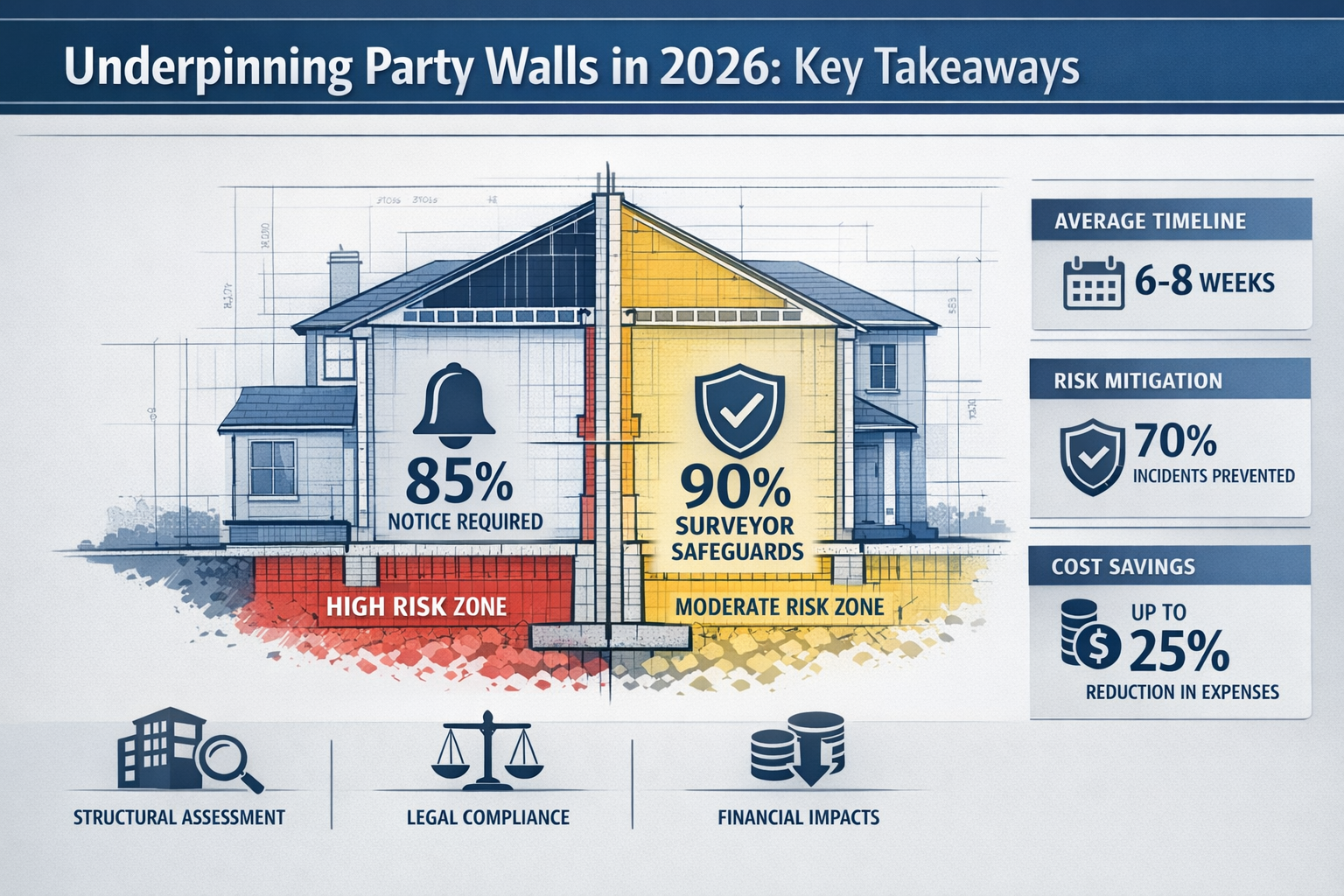
- ⚖️ Statutory notice requirements: One-month minimum for excavations within 3-6 meters; two months for direct party wall structural work
- 📋 Mandatory documentation: All notices must include foundation depth specifications, excavation locations, and detailed plans for neighbor assessment
- 🛡️ Legal protection: Party Wall Awards shield building owners from unlimited liability while establishing clear damage resolution protocols
- 👷 Surveyor oversight: Independent professionals create binding agreements that protect both properties during high-risk foundation work
- 💰 Financial implications: Non-compliance can trigger injunctions, work stoppages, and full liability for structural damage
Understanding Party Wall Act Triggers for Underpinning Work
The Party Wall etc. Act 1996 establishes precise thresholds that determine when formal notification becomes legally mandatory. These triggers protect adjoining owners from unexpected structural risks while giving building owners clear procedural pathways.
The 3-Meter and 6-Meter Excavation Rules
Section 6 of the Party Wall Act creates two distinct notification zones based on excavation proximity and depth [2]:
| Distance from Neighbor's Foundation | Depth Requirement | Notice Required |
|---|---|---|
| Within 3 meters | Going deeper than neighbor's foundation | ✅ Yes – 1 month minimum |
| 3 to 6 meters | Within 45-degree plane from neighbor's foundation base | ✅ Yes – 1 month minimum |
| Beyond 6 meters | Any depth | ❌ No (unless other factors apply) |
The 45-degree plane rule requires careful calculation. If your neighbor's foundation sits 2 meters deep, and you plan to excavate 3 meters deep at a distance of 4 meters from their property line, you must draw an imaginary 45-degree line from the base of their foundation. If your excavation intersects this plane, you trigger the notice requirement [2].
Direct Party Wall Underpinning Requirements
When underpinning work directly affects the shared wall structure itself—not just adjacent excavation—different timeline rules apply. Building owners must serve notice at least two months before work commences [1]. This extended period allows neighbors adequate time to:
- Appoint their own surveyor or agree to use a single agreed surveyor
- Review detailed structural plans and methodology
- Conduct pre-construction condition surveys
- Negotiate protective measures and monitoring protocols
For comprehensive guidance on notice procedures, review our detailed resource on Party Wall Act notices and response protocols.
Building Regulations Compliance
Beyond Party Wall Act requirements, all underpinning work constitutes notifiable work under Building Regulations [3]. This dual compliance requirement means building owners must:
- Serve appropriate Party Wall notices to neighbors
- Submit building control applications to local authorities
- Ensure structural engineers certify the underpinning design
- Allow building control inspectors to verify work at key stages
Failure to obtain building control approval can result in enforcement notices, requirements to expose completed work for inspection, or even demolition orders in extreme cases.
Notice Protocols for Underpinning Party Walls in 2026
Proper notice service forms the legal foundation for all party wall work. The content, timing, and delivery method of notices determine whether building owners gain lawful authority to proceed or face immediate legal challenges.
Essential Notice Content Requirements
A Notice of Adjacent Excavation and Construction must contain specific technical information to satisfy statutory requirements [2]:
Required Elements:
- ✅ Proposed foundation depth with precise measurements in meters
- ✅ Exact location of new structure relative to property boundaries
- ✅ Detailed plans and sections showing excavation extent and methodology
- ✅ Commencement date for the proposed work
- ✅ Building owner's contact information and appointed surveyor details (if applicable)
Vague or incomplete notices provide grounds for neighbors to reject the proposal, triggering the dispute resolution process and delaying project timelines.
Timeline Compliance and Service Methods
The Act specifies minimum notice periods, but smart building owners often provide additional time to foster cooperation:
Standard Timelines:
- 📅 One month minimum for Section 6 excavation notices
- 📅 Two months minimum for Section 2 notices (direct party wall work)
- 📅 Additional time recommended for complex projects or multiple neighbors
Acceptable Service Methods:
- Hand delivery to the property owner
- Registered or recorded delivery mail
- Service through the neighbor's appointed agent or surveyor
For projects in densely populated areas, coordinating multiple notices requires careful planning. Property owners working in Central London or East London often benefit from professional surveyor assistance to ensure simultaneous, compliant service to all affected neighbors.
Consequences of Non-Compliance
The legal penalties for proceeding without proper notice create existential risks for construction projects:
Immediate Risks:
- ⚠️ Injunction applications: Neighbors can seek court orders stopping all work immediately [2]
- ⚠️ Unlimited liability: Building owners become solely responsible for any damage, losing Act protections [2]
- ⚠️ Contractor disputes: Builders may refuse to continue work or demand additional payment for delays
- ⚠️ Insurance complications: Professional indemnity and construction insurance may not cover non-compliant work
"If you begin digging foundations without serving a required notice, neighbors can legally seek an injunction to stop the work immediately, leading to massive delays and increased costs." [2]
One case study from 2024 involved a London property owner who began underpinning without serving Section 6 notices. The adjoining owner obtained a High Court injunction within 72 hours. The resulting work stoppage lasted four months while surveyors negotiated a retrospective agreement, costing the building owner over £45,000 in legal fees, contractor standby charges, and enhanced monitoring requirements.
Working Without Formal Agreements
Some property owners consider proceeding informally with neighbor consent. While having a party wall agreement without a surveyor is technically possible, it creates significant risks for underpinning work:
- No binding dispute resolution mechanism if damage occurs
- Unclear liability allocation for structural issues
- Absence of professional condition surveys documenting pre-existing defects
- Potential insurance coverage gaps
For high-risk work like underpinning, formal Party Wall Awards provide essential legal protection that informal arrangements cannot replicate.
Risk Assessments for Underpinning Party Walls in 2026
Structural risk assessment forms the technical core of party wall underpinning projects. Professional surveyors and structural engineers identify potential failure modes, establish monitoring protocols, and design protective measures that safeguard both properties.
Pre-Construction Condition Surveys
Comprehensive condition documentation creates an objective baseline that protects all parties from false damage claims or genuine structural concerns:
Schedule of Condition Components:
- 📸 Photographic evidence: High-resolution images of all wall surfaces, ceilings, floors, and external elevations
- 📹 Video documentation: Walkthrough recordings capturing room-by-room conditions
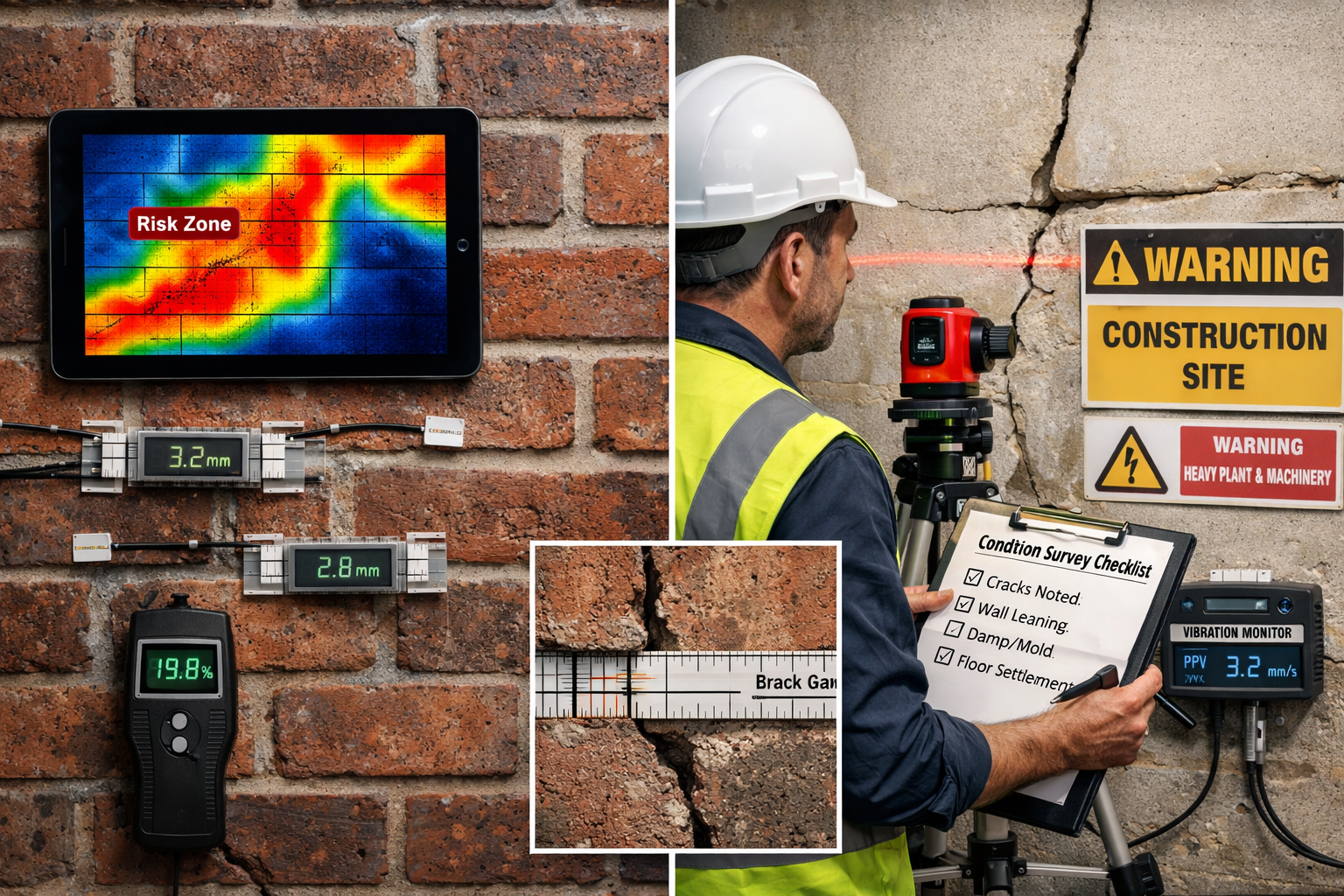
- 📏 Crack monitoring: Precise measurements of existing cracks with dated photographs and width measurements
- 🔍 Structural defect identification: Documentation of pre-existing settlement, dampness, or deterioration
- 📊 Detailed written descriptions: Room-by-room condition narratives with specific defect locations
Professional third-party surveyors should conduct these surveys to ensure impartiality [4]. The schedule of condition becomes a legal reference document attached to the Party Wall Award, establishing clear evidence of pre-work conditions.
Structural Vulnerability Analysis
Engineers assess multiple risk factors when evaluating underpinning impacts on party walls:
Critical Risk Factors:
- Foundation depth differential: Large differences between existing and new foundation depths create uneven load distribution
- Soil type and bearing capacity: Clay soils prone to shrinkage pose higher settlement risks than stable substrates
- Wall construction quality: Older lime mortar walls exhibit different movement characteristics than modern cement-bonded masonry
- Existing structural defects: Pre-existing cracks, settlement, or moisture damage amplify underpinning risks
- Building age and heritage status: Victorian and Edwardian properties require specialized approaches due to construction methods and materials
Engineers use these assessments to specify underpinning methodology—whether traditional mass concrete, mini-piled systems, or resin injection techniques best suit the specific conditions.
Vibration and Movement Monitoring
Active monitoring during construction provides early warning of potential structural issues before they become serious damage:
Monitoring Technologies:
| Equipment Type | Purpose | Typical Placement |
|---|---|---|
| Crack gauges | Track movement in existing cracks | Across major cracks on party walls |
| Vibration monitors | Measure ground-borne vibration from excavation | On party wall foundations |
| Tilt meters | Detect angular movement or rotation | Corners of adjoining buildings |
| Settlement markers | Track vertical movement | External walls at multiple levels |
| Laser scanning | Create 3D displacement maps | Entire building facades (periodic) |
Party Wall Awards typically specify trigger levels that require work cessation if exceeded. For example, crack movement beyond 2mm or vibration levels exceeding 10mm/s peak particle velocity might mandate immediate work stoppage and structural review [1].
Case Study: Preventing Structural Failure
A 2025 underpinning project in West London demonstrates the value of comprehensive risk assessment:
Project Details:
- Victorian terrace requiring 1.2-meter foundation deepening
- Existing party wall foundation at 0.8 meters depth
- Clay soil with high shrinkage potential
- Adjoining property showing pre-existing settlement cracks
Risk Mitigation Measures:
- Pre-construction condition survey documented 15 existing cracks with precise measurements
- Vibration monitors set with 8mm/s trigger threshold
- Crack gauges installed on three major existing cracks
- Sequential underpinning methodology (alternate bays) to minimize movement
- Daily monitoring reports shared with both surveyors
Outcome:
During week three, crack gauges detected 1.5mm movement in one monitored crack. Work immediately stopped. Structural engineers revised the excavation sequence and added temporary propping. The modification prevented what could have been significant structural damage. The adjoining owner expressed gratitude for the monitoring system, and the project completed without disputes or claims.
This case illustrates how proactive risk assessment converts potential disasters into manageable technical challenges.
Building Control Integration
Local authority building control officers verify that underpinning work meets structural safety standards. Their inspection schedule typically includes:
- Foundation excavation depth verification before concrete placement
- Reinforcement inspection and certification
- Concrete mix design approval and placement supervision
- Final structural certification upon completion
Coordinating Party Wall surveyor visits with building control inspections creates efficiency and ensures all stakeholders observe the same work stages.
Surveyor Safeguards for Underpinning Party Walls in 2026
Professional surveyors transform potentially adversarial neighbor relationships into structured, legally binding agreements that protect everyone's interests. Their role extends far beyond paperwork—they design practical safeguards that prevent damage while enabling necessary construction work.
The Three-Surveyor Model
When neighbors dissent to proposed work, the Act establishes a formal surveyor appointment process:
Surveyor Roles:
- Building Owner's Surveyor: Represents the person undertaking the work, designs protective measures, ensures compliance
- Adjoining Owner's Surveyor: Protects the neighbor's interests, reviews proposals, negotiates safeguards
- Third Surveyor (if needed): Resolves disagreements between the two appointed surveyors
This structure creates checks and balances. Building owners cannot simply impose their plans—adjoining owner surveyors scrutinize proposals and demand modifications to protect their client's property [1].
For property owners managing construction projects, understanding the building owner's surveyor role helps set realistic expectations for the process.
Party Wall Award Components
The Party Wall Award functions as a binding contract between neighbors, supervised by impartial professionals. Well-drafted awards include:
Standard Award Provisions:
- 📋 Detailed work description: Precise specifications of underpinning methodology, depths, and techniques
- ⏰ Working hours restrictions: Typically 8am-6pm weekdays, limited Saturday work, no Sundays or bank holidays
- 🔊 Noise mitigation requirements: Acoustic barriers, equipment specifications, complaint response protocols
- 👷 Safety protocols: Site security, dust suppression, vibration limits, access arrangements
- 📸 Condition survey attachment: Pre-work documentation establishing baseline conditions
- 🔧 Damage resolution procedures: Clear process for reporting, investigating, and repairing any damage
- 💰 Cost allocation: Clarification of who pays for various aspects (typically building owner covers all costs)
Awards also specify inspection rights, allowing adjoining owners or their surveyors to visit the site at reasonable times to verify compliance.
Our guide to party wall awards provides additional detail on award structure and enforcement mechanisms.
Protection Methods Specified in Awards
Surveyors design specific technical safeguards tailored to each project's risk profile:
Common Protective Measures:
✅ Temporary support systems: Steel props or needling to support party walls during excavation
✅ Sequential excavation: Alternate bay methodology to maintain wall stability
✅ Underpinning depth limitations: Restrictions on excavation depth near party wall junctions
✅ Concrete curing periods: Mandatory waiting times between excavation phases
✅ Access restrictions: Limitations on heavy equipment proximity to party walls
✅ Weather-dependent work: Prohibitions on excavation during heavy rain or freeze conditions
These specifications transform general construction practices into enforceable legal requirements. Contractors who violate award terms expose building owners to breach of statutory duty claims.
Dispute Resolution Mechanisms
Even with comprehensive awards, disagreements sometimes arise during construction. The Act provides structured resolution pathways:
Escalation Process:
- Site meeting: Surveyors and contractors discuss the issue on-site
- Surveyor negotiation: The two appointed surveyors attempt to reach agreement
- Third Surveyor determination: If surveyors cannot agree, the Third Surveyor makes a binding decision
- Appeal to County Court: Only available on limited grounds (procedural errors, jurisdictional issues)
This system resolves most disputes within days or weeks, avoiding the lengthy court proceedings that would otherwise halt construction for months.
For neighbors receiving notices about underpinning work, understanding the adjoining owner's surveyor role helps protect their interests while maintaining reasonable relationships.
Cost Management and Fee Structures
Building owners bear the financial burden of the Party Wall process, including:
- Their own surveyor's fees
- The adjoining owner's surveyor's fees
- Third Surveyor fees (if appointed)
- Condition survey costs
- Monitoring equipment expenses
Typical surveyor fees for underpinning projects range from £800-£2,500 per property, depending on project complexity and property value. For strategies to minimize expenses, see our guide on keeping party wall costs down.
While these costs seem substantial, they pale compared to the potential expenses of injunctions, work stoppages, or unlimited damage liability. The Party Wall Award essentially functions as legal insurance—a relatively modest investment that prevents catastrophic financial exposure.
Regional Considerations
Surveyor practices vary slightly across London regions due to local construction patterns and property types:
- North London: Higher proportion of semi-detached properties with simpler party wall arrangements
- South London: Mix of Victorian terraces and modern developments requiring varied approaches
- Central London: Complex multi-story buildings with basement conversions driving underpinning demand
- East London: Rapid development areas with frequent new construction adjacent to older properties
Experienced local surveyors understand these regional patterns and adjust their risk assessments accordingly.
Financial and Timeline Implications
Understanding the complete cost picture and realistic timelines helps property owners plan underpinning projects effectively.
Comprehensive Cost Breakdown (2026)
Underpinning Project Costs:
| Cost Component | Typical Range (GBP) | Notes |
|---|---|---|
| Underpinning work itself | £8,000-£25,000 | Depends on linear meters and depth [5] |
| Structural engineer fees | £800-£2,000 | Design and certification |
| Party Wall surveyor fees | £800-£2,500 per property | Multiple neighbors multiply this |
| Condition surveys | £400-£800 per property | Professional documentation |
| Building control fees | £500-£1,200 | Local authority charges |
| Monitoring equipment | £300-£1,000 | Crack gauges, vibration monitors |
| Contingency (10-15%) | Variable | For unexpected issues |
Total project cost for a typical single-property underpinning with one shared wall: £11,000-£32,000.
Projects involving multiple party walls or complex structural conditions can exceed £50,000. The foundation underpinning cost varies significantly based on the number of piers required and the specific methodology employed [5].
Timeline Expectations
Realistic Project Schedule:
- Pre-planning and design: 2-4 weeks
- Party Wall notice service: Immediate
- Neighbor response period: 14 days (can consent or dissent)
- Surveyor appointment and Award preparation: 4-8 weeks (if disputed)
- Building control application: 2-4 weeks
- Condition surveys: 1 week
- Actual underpinning work: 2-6 weeks (depending on extent)
- Final inspections and certification: 1-2 weeks
Minimum total timeline: 3-4 months from initial planning to completion
Realistic timeline with disputes: 5-8 months
Property owners who attempt to rush the process by skipping notice requirements or pressuring neighbors typically experience longer delays than those who follow proper procedures from the outset.
Insurance Considerations
Standard building insurance policies often exclude underpinning work or impose significant restrictions. Building owners should:
- ✅ Notify insurers before commencing work
- ✅ Obtain specific underpinning coverage endorsements
- ✅ Ensure contractors carry adequate public liability insurance (minimum £5 million)
- ✅ Verify that Party Wall Awards are in place before coverage begins
Some insurers reduce premiums when professional Party Wall Awards document proper procedures and monitoring protocols.
Practical Implementation Checklist
Property owners planning underpinning work near party walls should follow this systematic approach:
Phase 1: Pre-Planning (Weeks 1-2)
- Engage structural engineer to assess foundation requirements
- Determine whether work triggers Section 2 or Section 6 notices
- Identify all affected neighbors (including those diagonally adjacent)
- Appoint experienced party wall surveyor
- Obtain preliminary cost estimates for full project scope
Phase 2: Notice Service (Week 3)
- Prepare detailed plans and sections showing excavation
- Draft compliant Party Wall notices with all required information
- Serve notices via appropriate methods with proof of delivery
- Document exact service dates for each neighbor
- Submit building control application simultaneously
Phase 3: Negotiation Period (Weeks 4-10)
- Await neighbor responses (14-day statutory period)
- Appoint surveyors if neighbors dissent
- Conduct comprehensive condition surveys
- Negotiate Party Wall Award terms
- Finalize working hour restrictions and monitoring protocols
- Obtain signed Award from all parties
Phase 4: Pre-Construction (Weeks 11-12)
- Install monitoring equipment (crack gauges, vibration monitors)
- Establish baseline readings for all instruments
- Brief contractors on Award requirements and restrictions
- Set up communication protocols with neighbors
- Arrange building control inspection schedule
Phase 5: Construction (Weeks 13-18)
- Conduct daily monitoring checks
- Maintain detailed site diary documenting compliance
- Provide regular updates to surveyors and neighbors
- Respond immediately to any monitoring trigger exceedances
- Facilitate surveyor and building control inspections
Phase 6: Completion (Weeks 19-20)
- Conduct final condition survey comparison
- Address any damage claims promptly through Award procedures
- Obtain building control final certificate
- Provide completion documentation to all parties
- Archive all records for future reference
This systematic approach minimizes disputes, reduces delays, and protects all parties' interests throughout the underpinning process.
Common Pitfalls and How to Avoid Them
Learning from others' mistakes prevents costly errors:
Pitfall #1: Assuming Informal Neighbor Agreement Suffices
❌ Problem: Verbal agreements provide no legal protection
✅ Solution: Always formalize arrangements through proper Party Wall Awards, even with cooperative neighbors
Pitfall #2: Underestimating Timeline Requirements
❌ Problem: Contractors booked before notices expire, causing schedule conflicts
✅ Solution: Add 2-4 weeks buffer beyond minimum notice periods before scheduling contractors
Pitfall #3: Incomplete Notice Documentation
❌ Problem: Missing plans or vague descriptions allow neighbors to reject notices
✅ Solution: Engage surveyors to review notice content before service
Pitfall #4: Neglecting Pre-Construction Surveys
❌ Problem: No baseline documentation leads to disputed damage claims
✅ Solution: Commission professional third-party condition surveys for all adjoining properties
Pitfall #5: Poor Contractor Briefing
❌ Problem: Builders unaware of Award restrictions violate working hours or vibration limits
✅ Solution: Require contractors to sign acknowledgment of Award terms before commencing
Pitfall #6: Inadequate Monitoring
❌ Problem: Structural movement goes undetected until serious damage occurs
✅ Solution: Install comprehensive monitoring and assign responsibility for daily checks
Pitfall #7: Delayed Response to Issues
❌ Problem: Small problems escalate into major disputes
✅ Solution: Establish immediate communication protocols when monitoring triggers activate
Conclusion
Underpinning Party Walls in 2026: Notice Protocols, Risk Assessments, and Surveyor Safeguards represents a comprehensive legal and technical framework that protects property owners, neighbors, and shared structures during high-risk foundation work. The statutory requirements under the Party Wall etc. Act 1996 are not bureaucratic obstacles—they are essential safeguards that prevent structural failures, resolve disputes efficiently, and establish clear liability boundaries.
The key principles bear repeating:
🔑 Serve proper notices with complete technical documentation at least one month (Section 6) or two months (Section 2) before commencing work
🔑 Commission professional condition surveys to establish objective baseline evidence of pre-existing conditions
🔑 Engage experienced surveyors who understand both the legal framework and the technical risks of underpinning work
🔑 Implement comprehensive monitoring with clear trigger levels that mandate work cessation if exceeded
🔑 Maintain detailed documentation throughout the process to demonstrate compliance and protect against false claims
The financial investment in proper Party Wall procedures—typically £2,000-£5,000 for surveyor fees and monitoring—provides enormous value compared to the catastrophic costs of injunctions, work stoppages, or unlimited damage liability. Property owners who view these requirements as protective insurance rather than burdensome regulation achieve better outcomes, maintain neighborly relationships, and complete projects on schedule.
Next Steps
For property owners planning underpinning work:
- Consult a structural engineer to determine foundation requirements and confirm Party Wall Act triggers
- Appoint an experienced party wall surveyor before serving any notices—their expertise prevents costly procedural errors
- Engage neighbors early with informal discussions about your plans, even before formal notice service
- Budget realistically for the complete process, including surveyor fees, monitoring equipment, and contingency funds
- Plan timelines conservatively, allowing adequate time for the statutory process to unfold
For neighbors receiving underpinning notices:
- Respond within 14 days to preserve your rights under the Act
- Appoint your own surveyor to protect your interests—the building owner pays their fees
- Request comprehensive condition surveys to document your property's current state
- Negotiate reasonable restrictions on working hours, noise, and access
- Maintain communication with surveyors throughout the construction period
The Party Wall framework succeeds when all parties understand their rights and obligations. Professional surveyors bridge the gap between legal requirements and practical construction realities, creating workable solutions that enable necessary building work while protecting everyone's property interests.
For additional guidance on your specific situation, explore our comprehensive resources on types of party wall works or review the Party Wall etc. Act 1996 provisions in detail. When underpinning work affects shared structures, professional guidance isn't optional—it's essential protection for your most valuable asset.
References
[1] Underpinning And Structural Repairs Under The Party Wall Act 1996 – https://www.adamjoseph.co.uk/underpinning-and-structural-repairs-under-the-party-wall-act-1996
[2] Excavation And The Party Wall Act Navigating The 3 And 6 Metre Rules For Foundations – https://www.partywallslimited.com/blog/excavation-and-the-party-wall-act-navigating-the-3–and-6-metre-rules-for-foundations
[3] Underpinning Existing Foundations – https://www.labc.co.uk/news/underpinning-existing-foundations
[4] Party Wall Agreement Underpinning Toronto – https://strongbasements.com/party-wall-agreement-underpinning-toronto/
[5] How Much Underpinning Foundation Cost – https://www.angi.com/articles/how-much-underpinning-foundation-cost.htm