


Nearly 40% of party wall disputes in England and Wales escalate to formal proceedings due to inadequate pre-work documentation. As construction activity surges across London and beyond in 2026, the schedule of condition has emerged as the single most critical protective mechanism within party wall awards. Understanding how surveyors create robust schedules of condition in party wall awards: protecting all parties in 2026 disputes has become essential for both building owners and their neighbors.
The Party Wall etc. Act 1996 provides a framework for preventing and resolving disputes between neighbors when building work affects shared walls, boundaries, or excavations near adjoining properties. Yet the law's effectiveness hinges entirely on proper documentation—specifically, the schedule of condition that establishes an irrefutable baseline before hammers start swinging.
Key Takeaways
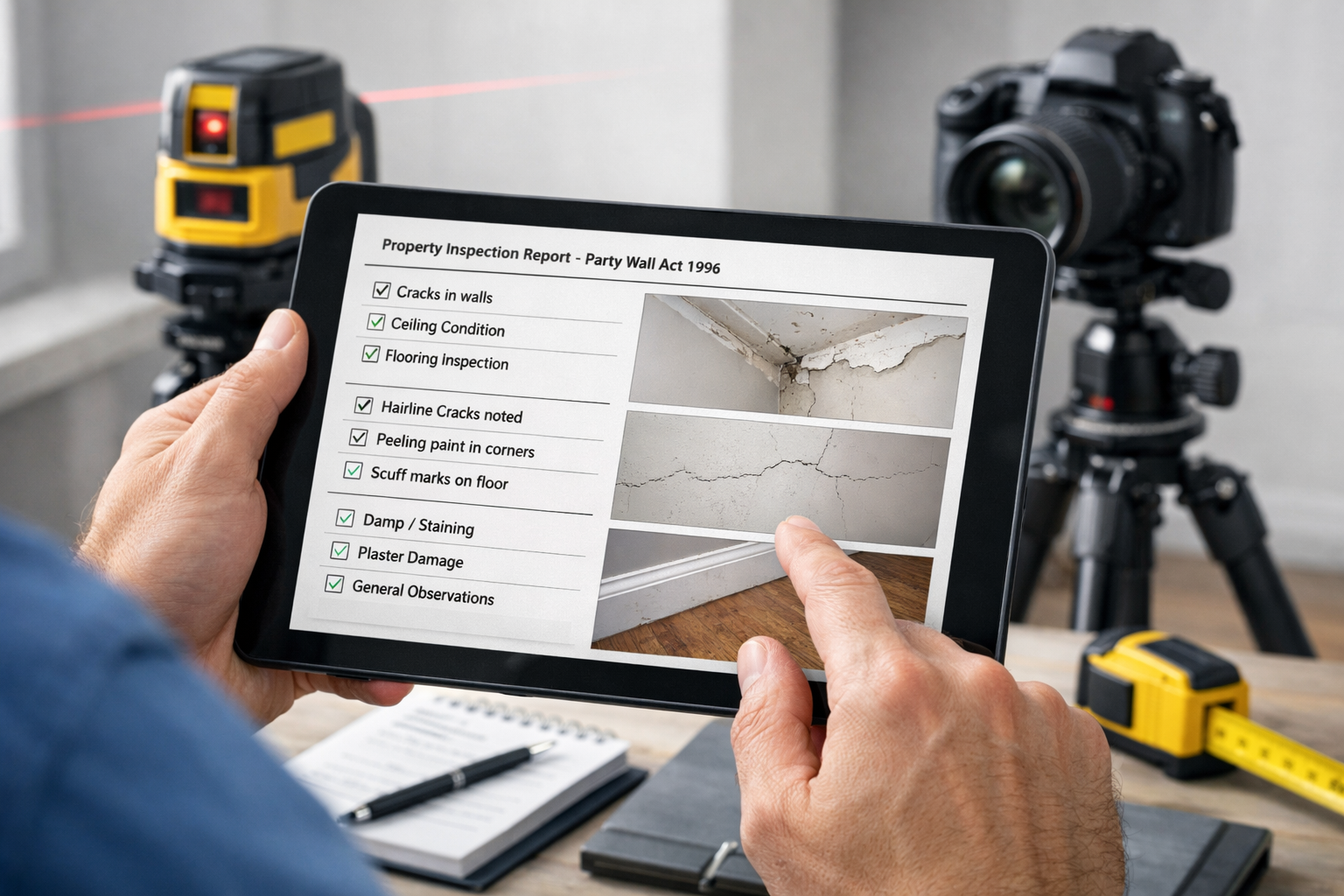
- Schedules of condition are legally mandatory documentation under the Party Wall Act 1996 that record the pre-work state of adjoining properties through photographs, videos, and written descriptions [3]
- Without independent expert schedules, proving construction-related damage becomes nearly impossible, leaving both parties vulnerable to costly disputes and potential litigation [2]
- Comprehensive documentation must include specific elements: detailed photographic evidence, written descriptions of all defects, timestamps, and clear methodology to withstand legal scrutiny
- Building owners must serve party wall notices 2 months before works commence for party wall projects, with adjoining owners having 14 days to respond [2]
- Professional surveyors follow standardized protocols in 2026 to create defensible schedules that protect all parties and facilitate swift damage attribution if issues arise
Understanding Schedules of Condition in Party Wall Awards: Protecting All Parties in 2026 Disputes
A schedule of condition serves as a forensic snapshot of a property's state before construction begins. This document becomes the cornerstone of any party wall award, providing objective evidence that can definitively answer the question: "Was this damage here before, or did the building work cause it?"
What Makes a Schedule of Condition Legally Robust?
The Party Wall Act 1996 applies exclusively to England and Wales—not Scotland or Northern Ireland [2]. Within this jurisdiction, a legally defensible schedule must contain several critical components:
📋 Essential Documentation Elements:
- Comprehensive photographic evidence showing every room, wall, ceiling, and floor surface
- High-resolution video walkthroughs capturing the property's overall condition
- Written descriptions detailing existing defects, cracks, stains, and wear patterns
- Precise measurements of existing cracks or structural issues
- Timestamp verification proving documentation occurred before works commenced
- External elevations showing the condition of facades, rooflines, and boundary features
Without an independent expert schedule of condition produced before building work begins, establishing which damage resulted from construction versus pre-existing conditions becomes extraordinarily difficult [2]. This ambiguity frequently leads to protracted disputes, strained neighbor relationships, and expensive legal proceedings.
The Role of Schedules Within Party Wall Awards
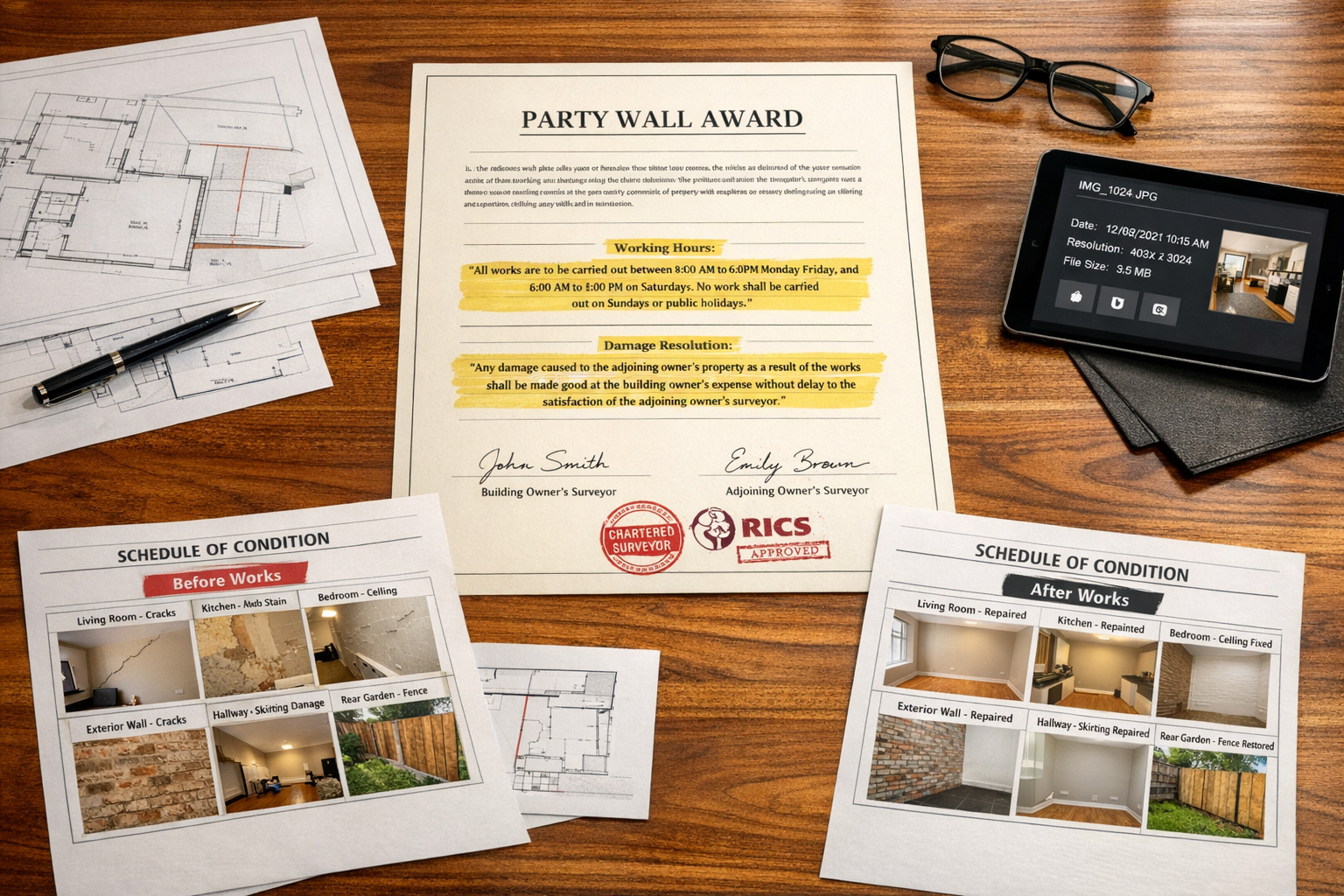
A party wall award represents the formal agreement produced by appointed surveyors that details the proposed works and establishes protective measures. The schedule of condition forms an integral component of this award, working alongside other provisions [1]:
| Award Component | Purpose | Protection Provided |
|---|---|---|
| Schedule of Condition | Documents pre-work property state | Enables damage attribution |
| Working Hours Restrictions | Limits construction timeframes | Minimizes disruption |
| Access Provisions | Defines entry rights for inspections | Ensures monitoring capability |
| Damage Resolution Procedures | Establishes repair protocols | Clarifies remediation responsibilities |
| Surveyor Responsibilities | Defines professional duties | Ensures impartial oversight |
| Compensation Details | Outlines financial provisions | Addresses losses where applicable |
The schedule of condition acts as the evidentiary foundation upon which all other award provisions rest. If damage occurs during construction, surveyors can compare the current state against the documented baseline to determine causation with confidence.
How Professional Surveyors Create Comprehensive Schedules in 2026
The construction landscape in 2026 demands increasingly sophisticated documentation methodologies. Professional surveyors now employ advanced techniques that far exceed basic photography, creating multi-layered evidence packages designed to withstand rigorous legal scrutiny.
Modern Documentation Protocols
Today's surveyors follow standardized protocols when preparing schedules of condition, ensuring consistency and defensibility across all projects [4]:
🔍 Step-by-Step Survey Methodology:
- Pre-inspection planning – Review proposed works and identify vulnerable areas
- External assessment – Document facades, rooflines, chimneys, and boundary features
- Systematic room-by-room survey – Photograph from multiple angles with consistent lighting
- Defect cataloging – Measure and describe all existing cracks, stains, and damage
- Video documentation – Create continuous walkthrough footage with audio narration
- Metadata preservation – Ensure all digital files retain timestamp and location data
- Written report compilation – Synthesize visual evidence with detailed written descriptions
- Quality assurance review – Verify completeness before finalizing documentation
This methodical approach ensures that no detail escapes documentation. Surveyors pay particular attention to areas most susceptible to construction vibration, such as ceiling corners, door frames, and plaster finishes near the party wall.
Technology Integration in 2026 Schedules
Modern surveyors leverage cutting-edge technology to enhance schedule accuracy and accessibility:
- High-resolution digital cameras (minimum 20 megapixels) capturing fine detail
- Laser measuring devices providing millimeter-accurate crack measurements
- Thermal imaging cameras identifying hidden moisture or structural issues
- 3D scanning technology creating comprehensive spatial models
- Cloud-based storage systems ensuring secure, accessible documentation
- Comparison software enabling side-by-side analysis of before/after conditions
These technological advances have transformed schedules of condition from simple photo albums into sophisticated forensic tools. When disputes arise, this enhanced documentation provides surveyors with irrefutable evidence for damage attribution.
The Legal Framework: Notice Periods and Response Requirements
Understanding the timeline requirements within the Party Wall Act 1996 remains crucial for both building and adjoining owners. The framework establishes specific notice periods that must be observed to ensure proper schedule preparation.
Mandatory Notice Periods
Property owners planning works covered by the Act must serve party wall notices well in advance of construction commencement [2][5]:
⏰ Critical Timeline Requirements:
- Two months before works commence – For projects affecting a party wall or boundary structure
- One month before works commence – For excavation-only projects or new boundary walls
- 14 days for neighbor response – Adjoining owners must respond within this window after receiving notice
- 14 days for award appeals – Both parties can appeal to County Court if dissatisfied with the award
These extended notice periods serve a vital purpose: they provide sufficient time for surveyors to conduct thorough schedule of condition inspections before any potentially damaging work begins. Rushing this process undermines the entire protective framework.
What Happens When Neighbors Consent or Dissent
When an adjoining owner receives a party wall notice, they face a critical decision within the 14-day response window [2]:
Consent Scenario:
- Adjoining owner agrees to the proposed works in writing
- No formal party wall award required
- Risk: Without a schedule of condition, proving future damage becomes extremely difficult
- Best practice: Even with consent, both parties benefit from documenting pre-work conditions
Dissent or Non-Response Scenario:
- Formal dispute triggers surveyor appointment process
- Building owner appoints their surveyor; adjoining owner appoints theirs (or the building owner's surveyor acts for both if agreed)
- Surveyors prepare comprehensive party wall award including schedule of condition
- Protection: Formal documentation safeguards both parties' interests
Many property owners mistakenly believe that neighbor consent eliminates the need for documentation. In reality, schedules of condition in party wall awards: protecting all parties in 2026 disputes remain equally important whether formal awards are required or neighbors agree informally.
Damage Attribution: How Schedules Protect All Parties
The true value of a comprehensive schedule becomes apparent when construction damage occurs. Without baseline documentation, disputes devolve into "he said, she said" arguments that strain relationships and often require costly expert testimony.
The Attribution Process
When an adjoining owner reports potential construction damage, surveyors follow a systematic attribution process:
🔎 Damage Assessment Protocol:
- Immediate inspection – Surveyor examines reported damage promptly
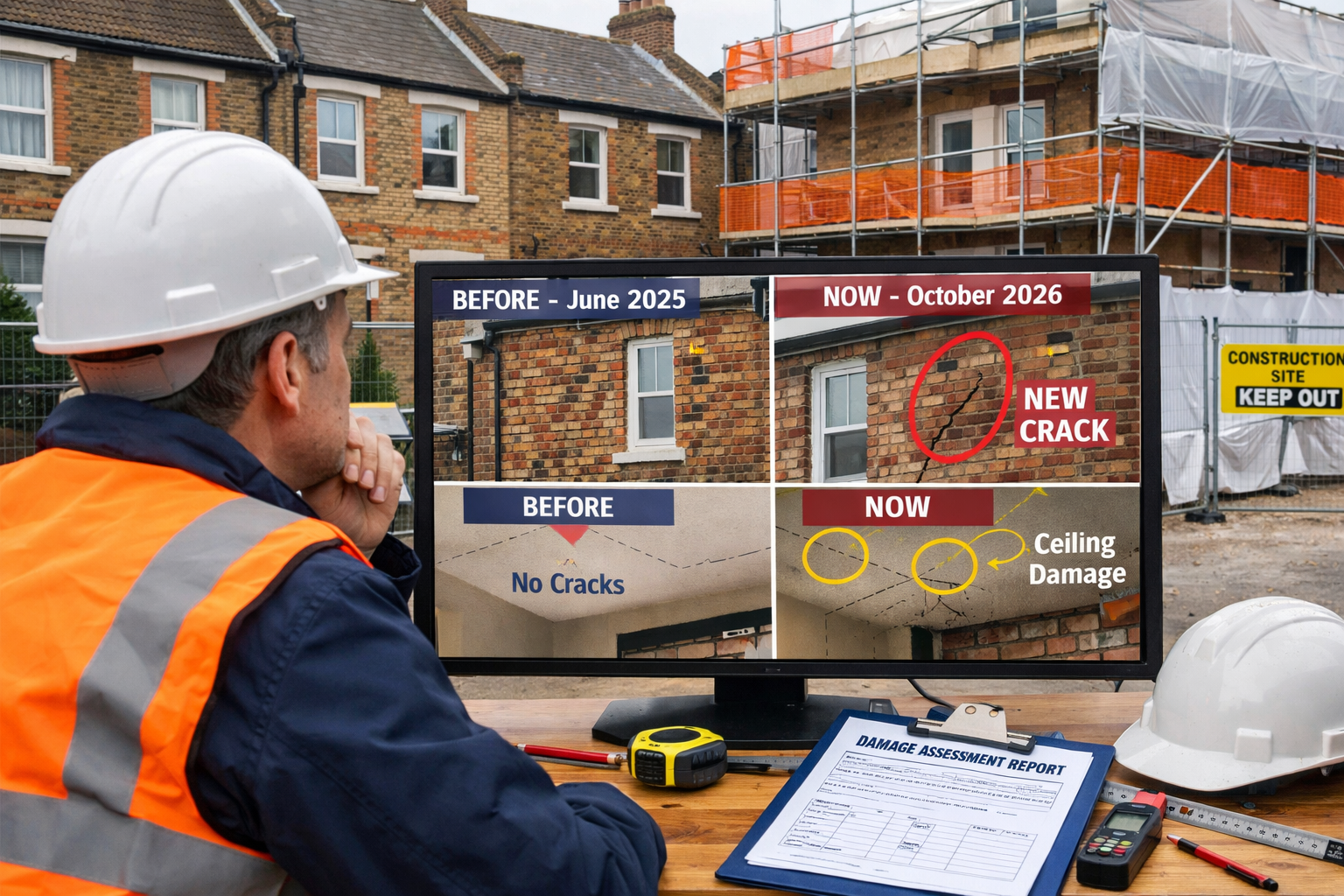
- Schedule comparison – Current condition compared against pre-work documentation
- Photographic matching – Specific locations matched to baseline images
- Defect analysis – Characteristics assessed (crack pattern, width, location)
- Causation determination – Professional judgment on construction-related origin
- Remediation specification – Appropriate repairs identified if damage confirmed
- Cost assessment – Repair expenses calculated
- Resolution implementation – Building owner arranges and funds necessary repairs
This process relies entirely on the quality and comprehensiveness of the original schedule. Ambiguous or incomplete documentation creates gray areas that complicate attribution and prolong disputes.
Common Damage Attribution Scenarios
Real-world examples illustrate how schedules protect both parties:
Scenario 1: Pre-existing Crack
A homeowner claims construction caused a ceiling crack. The schedule of condition clearly shows the same crack in pre-work photographs, measuring 2mm wide. Current measurement: 2mm. Result: No construction-related damage; claim dismissed.
Scenario 2: New Structural Damage
An adjoining owner reports wall cracks near the party wall. Schedule shows pristine plaster in that location. Current inspection reveals multiple fresh cracks radiating from the party wall junction. Result: Construction-related damage confirmed; building owner funds repairs.
Scenario 3: Exacerbated Existing Issue
Schedule documents a hairline crack measuring 0.5mm. Post-construction, the same crack measures 3mm and shows fresh plaster separation. Result: Pre-existing defect worsened by construction; building owner responsible for restoring to original condition.
These scenarios demonstrate why schedules of condition in party wall awards: protecting all parties in 2026 disputes function as essential insurance policies—they prevent false claims while ensuring legitimate damage receives proper remediation.
Best Practices for Building and Adjoining Owners in 2026
Both parties share responsibility for ensuring adequate protection through comprehensive schedules. Following established best practices minimizes dispute risk and facilitates smooth construction projects.
For Building Owners Planning Works
Property owners initiating construction covered by the Party Wall etc. Act 1996 should prioritize these protective measures:
✅ Building Owner Best Practices:
- Serve notices early – Allow maximum time for schedule preparation beyond minimum legal requirements
- Engage qualified surveyors – Select experienced professionals with proven party wall expertise
- Request comprehensive schedules – Ensure documentation covers all potentially affected areas, not just rooms adjacent to the party wall
- Maintain open communication – Keep neighbors informed throughout the process
- Review schedule completeness – Verify documentation quality before works commence
- Implement protective measures – Follow award conditions regarding vibration monitoring, working hours, and access
- Budget for contingencies – Set aside funds for potential damage remediation
Understanding types of party wall works helps building owners anticipate which projects require formal procedures and comprehensive schedules.
For Adjoining Owners Receiving Notices
Neighbors receiving party wall notices should take these protective steps:
🛡️ Adjoining Owner Best Practices:
- Respond within 14 days – Don't let the deadline pass, as non-response triggers formal dispute procedures
- Appoint your own surveyor – Independent representation protects your interests (or agree to a single agreed surveyor if comfortable)
- Request thorough schedules – Ensure documentation extends beyond immediately adjacent rooms to include the entire property
- Participate in inspections – Be present when surveyors document your property's condition
- Review draft schedules – Check that all existing defects are properly recorded
- Understand award terms – Ensure you comprehend damage resolution procedures and your rights
- Monitor works progress – Conduct periodic inspections during construction to identify issues early
Many adjoining owners benefit from consulting resources on having a party wall agreement without a surveyor to understand when professional representation becomes essential versus when informal arrangements suffice.
Cost Considerations and Management
The costs of party wall processes typically fall to the building owner, including surveyor fees for both parties and schedule preparation expenses. However, these costs represent prudent investment in dispute prevention:
| Cost Component | Typical Range (2026) | Value Provided |
|---|---|---|
| Schedule of Condition | £300-£800 per property | Damage attribution evidence |
| Surveyor Fees (Building Owner) | £700-£1,500 | Professional award preparation |
| Surveyor Fees (Adjoining Owner) | £700-£1,500 | Independent interest protection |
| Award Preparation | Included in surveyor fees | Legal framework and protections |
| Total Typical Cost | £1,700-£3,800 | Complete dispute prevention |
Compare these costs against potential litigation expenses (£10,000-£50,000+) and the value of maintaining positive neighbor relationships. Comprehensive schedules represent exceptional value for money.
Building owners can explore strategies for keeping party wall costs down while still ensuring adequate protection through quality documentation.
Regional Considerations Across London and Beyond
While the Party Wall Act 1996 applies uniformly across England and Wales, practical implementation varies by region based on construction density, property types, and local surveyor availability.
London-Specific Considerations
London's dense terraced housing and high construction activity create unique challenges:
Central London – Older properties with complex histories require especially thorough schedules. Party wall surveyors in Central London frequently encounter properties with multiple previous alterations requiring detailed documentation.
South London – Victorian and Edwardian terraces dominate many neighborhoods. Party wall surveyors in South London often document properties with characteristic plasterwork and decorative features requiring careful recording.
East London – Rapid development and property renovation create high demand. Party wall surveyors in East London balance new construction projects with protecting existing residential properties.
North London – Diverse property stock from Georgian townhouses to modern developments. Party wall surveyors in North London adapt documentation approaches to varied architectural styles.
West London – High-value properties demand meticulous documentation. Party wall surveyors in West London often document premium finishes and specialized features requiring expert assessment.
Beyond London: Regional Variations
Outside London, construction patterns and property types influence schedule requirements:
- Historic city centers – Conservation areas and listed buildings require specialized documentation approaches
- Suburban developments – Modern semi-detached properties with standardized construction may allow streamlined schedules
- Rural areas – Lower construction density but potentially limited surveyor availability
- Coastal regions – Environmental factors (salt exposure, moisture) require additional documentation attention
Regardless of location, the fundamental principle remains constant: comprehensive schedules of condition in party wall awards protecting all parties in 2026 disputes provide essential protection for everyone involved.
Common Pitfalls and How to Avoid Them
Even experienced property owners and surveyors occasionally encounter challenges that undermine schedule effectiveness. Awareness of common pitfalls enables proactive prevention.
Documentation Inadequacies
❌ Insufficient photographic coverage – Skipping rooms or areas "unlikely" to be affected creates documentation gaps. Solution: Document the entire property systematically, including external elevations and outbuildings.
❌ Poor image quality – Blurry, poorly lit, or low-resolution photographs lack evidentiary value. Solution: Use professional equipment with adequate lighting and minimum 20-megapixel resolution.
❌ Missing written descriptions – Photographs alone don't capture all defects or provide context. Solution: Accompany every image with detailed written descriptions of visible conditions.
❌ Inadequate defect measurement – Describing cracks as "small" or "large" lacks precision. Solution: Measure all defects with calibrated tools and record specific dimensions.
Procedural Errors
❌ Late schedule preparation – Conducting surveys after works commence eliminates baseline value. Solution: Complete all documentation before any construction activity begins, including preliminary excavation.
❌ Inaccessible documentation – Storing schedules in formats that become corrupted or inaccessible. Solution: Maintain multiple copies in different formats (digital and physical) with cloud backup.
❌ Single surveyor bias – Relying solely on the building owner's surveyor without independent verification. Solution: Adjoining owners should appoint their own surveyor or carefully review agreed surveyor credentials.
❌ Incomplete award integration – Treating schedules as standalone documents rather than award components. Solution: Ensure schedules are formally incorporated into the party wall award with clear reference protocols.
Communication Breakdowns
❌ Limited neighbor engagement – Excluding adjoining owners from the documentation process. Solution: Invite neighbors to participate in schedule inspections and review draft documentation.
❌ Technical jargon overload – Using specialized terminology without explanation. Solution: Provide plain-language summaries alongside technical documentation.
❌ Delayed issue reporting – Waiting weeks or months to report suspected damage. Solution: Establish clear communication channels and encourage immediate reporting of concerns.
Understanding these pitfalls helps both building and adjoining owners navigate the party wall process successfully, ensuring schedules of condition in party wall awards protecting all parties in 2026 disputes fulfill their protective purpose.
The Future of Party Wall Documentation
As 2026 progresses, several emerging trends are reshaping how surveyors create and utilize schedules of condition:
🚀 Technological Innovations:
- Artificial intelligence analysis – AI systems comparing before/after images to identify subtle changes invisible to human observation
- Blockchain verification – Immutable timestamp verification preventing documentation tampering allegations
- Virtual reality walkthroughs – Immersive 3D environments enabling remote inspection and comparison
- Automated defect detection – Machine learning algorithms identifying and cataloging existing defects from photographic evidence
- Real-time monitoring systems – Vibration sensors and cameras providing continuous documentation throughout construction
These innovations enhance rather than replace traditional surveyor expertise. Professional judgment remains essential for interpreting evidence and resolving complex attribution questions.
📊 Regulatory Developments:
While the Party Wall Act 1996 framework remains stable, practice standards continue evolving. Professional bodies increasingly emphasize:
- Standardized reporting formats for consistency across the industry
- Enhanced training requirements for party wall surveyors
- Quality assurance protocols ensuring documentation adequacy
- Ethical guidelines governing surveyor conduct and impartiality
These developments strengthen the protective value of schedules, benefiting all parties involved in construction projects.
Conclusion: Essential Protection for All Parties
Schedules of condition in party wall awards: protecting all parties in 2026 disputes represent far more than bureaucratic paperwork—they function as essential insurance policies that prevent costly disputes, preserve neighbor relationships, and ensure fair treatment when construction damage occurs.
The comprehensive documentation process creates a definitive baseline against which any subsequent changes can be objectively assessed. Without this foundation, damage attribution becomes speculative, disputes become protracted, and relationships become strained. The modest investment in professional schedule preparation delivers enormous value through dispute prevention and swift resolution when issues arise.
Actionable Next Steps
For Building Owners:
- Engage qualified party wall surveyors early in project planning
- Serve party wall notices with adequate lead time
- Budget appropriately for comprehensive schedule preparation
- Review documentation quality before works commence
- Maintain open communication with neighbors throughout the project
For Adjoining Owners:
- Respond promptly to party wall notices within the 14-day window
- Consider appointing your own surveyor for independent representation
- Participate actively in schedule of condition inspections
- Review draft documentation carefully and request clarifications
- Understand your rights under the party wall award
For Both Parties:
- Prioritize relationship preservation alongside legal protection
- View comprehensive schedules as mutual protection, not adversarial tools
- Maintain copies of all documentation in accessible formats
- Report concerns promptly if damage is suspected during works
- Consult professional surveyors rather than attempting DIY approaches for significant projects
The Party Wall Act 1996 provides an excellent framework for managing construction projects affecting shared structures. When combined with thorough schedules of condition prepared by qualified professionals, this framework protects everyone's interests while facilitating necessary building works. As construction activity continues expanding across England and Wales in 2026, understanding and implementing these protective measures has never been more important.
Whether you're planning a loft conversion, basement excavation, or any other types of party wall works, investing in comprehensive documentation through proper schedule of condition preparation represents the single most effective step you can take to protect your interests and maintain positive relationships with your neighbors.
References
[1] Difference Between Schedule Of Condition Report And Party Wall Award – https://www.expresspartywall.com/difference-between-schedule-of-condition-report-and-party-wall-award/
[2] Party Wall Agreement – https://hoa.org.uk/advice/guides-for-homeowners/i-am-improving/party-wall-agreement/
[3] Party Wall Implications Of Renters Rights Act 2026 Survey Protocols For Prs Database And Section 8 Notice Compliance – https://nottinghillsurveyors.com/blog/party-wall-implications-of-renters-rights-act-2026-survey-protocols-for-prs-database-and-section-8-notice-compliance
[4] Schedule Of Condition – https://thepartywallguru.com/schedule-of-condition/
[5] Schedules Of Condition In Party Wall Works Best Practices To Prevent Post Construction Claims In 2026 – https://nottinghillsurveyors.com/blog/schedules-of-condition-in-party-wall-works-best-practices-to-prevent-post-construction-claims-in-2026