


Nearly 68% of UK homeowners embarking on extensions or loft conversions fail to properly identify when the Party Wall etc. Act 1996 applies to their project—a costly oversight that can lead to legal disputes, construction delays, and unexpected surveyor fees running into thousands of pounds.[4] As the 2026 construction boom continues to reshape London's housing landscape, understanding the precise triggers that mandate professional party wall surveyor involvement has never been more critical for building owners planning structural work.
When Do You Really Need a Party Wall Surveyor? 2026 Triggers Beyond the Basics goes far beyond the simple "you're working on a shared wall" advice. This comprehensive guide breaks down the specific scenarios, excavation depths, and structural alterations that legally require formal notices and professional surveyor appointments under the 1996 Act, complete with current cost-benefit analysis to help building owners make informed decisions.
Key Takeaways
- Foundation excavation within 3 meters of a neighboring building triggers mandatory party wall notices, with deeper excavations requiring notices up to 6 meters away[1]
- Loft conversions become notifiable work when they involve structural changes to party walls, including steel beam installations or cutting into shared structures[1]
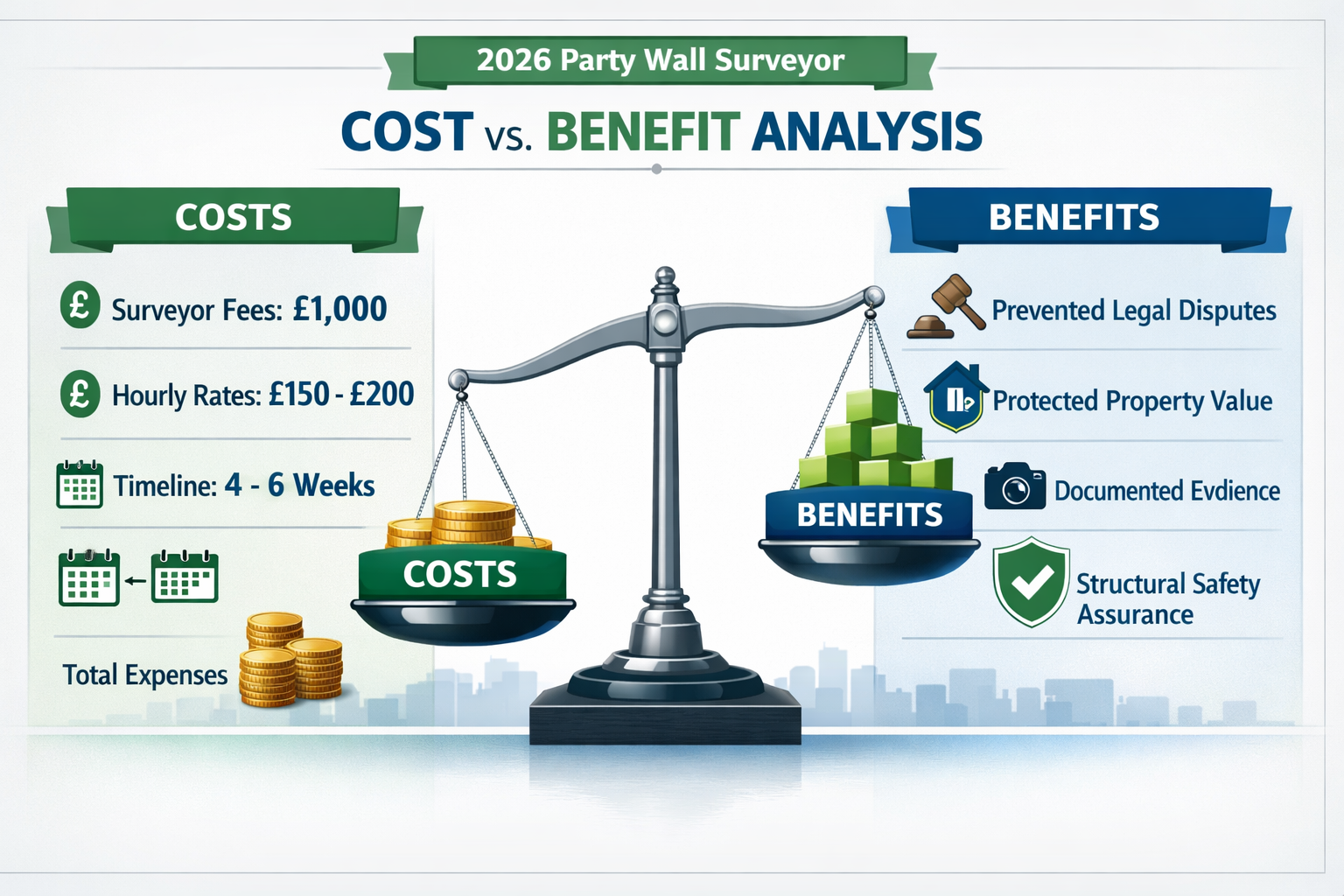
- Professional surveyor costs average £1,000 in 2026, with hourly rates between £150-£200, but building owners pay all fees for both their own and the adjoining owner's surveyor[1]
- Minor works like plastering, electrical installations, and shelf mounting are exempt from party wall procedures, saving homeowners unnecessary costs[1]
- The Party Wall Award process typically takes 4-6 weeks when both parties cooperate, though disputes can extend timelines to 3 months[3]
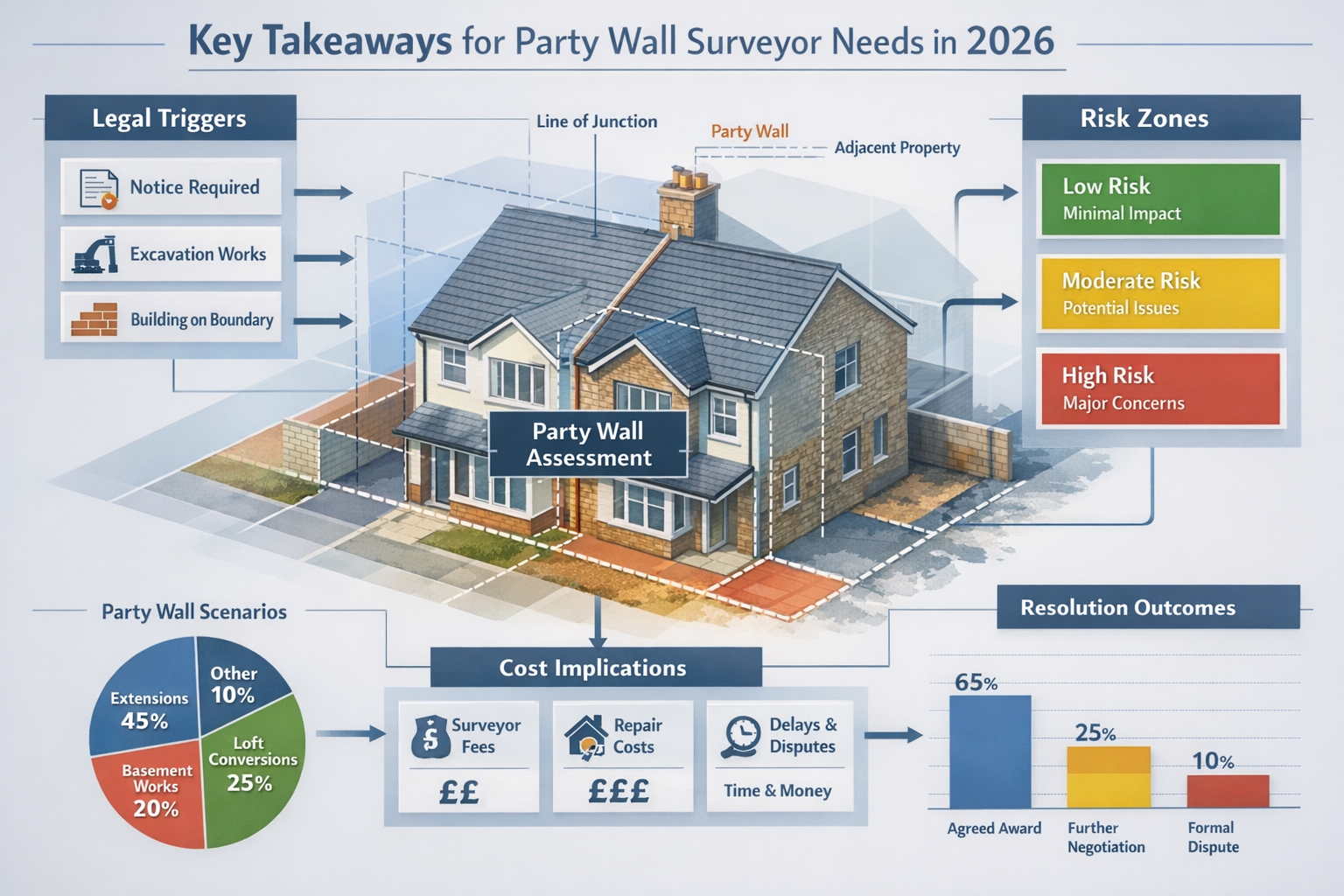
Understanding the Three Core Triggers Under the Party Wall Act 1996
The Party Wall etc. Act 1996 applies exclusively to England and Wales, establishing three distinct categories of work that require formal notification and potential surveyor involvement.[3] Many homeowners mistakenly believe that only work directly on a shared wall triggers the Act, but the reality encompasses far more scenarios.
Category 1: Work Directly on Existing Party Walls
This category covers any structural modification to walls, floors, or structures shared between properties. The types of party wall works that fall under this trigger include:
- Cutting into party walls for steel beam installation during loft conversions or extensions
- Inserting damp proof courses that affect the structural integrity of shared walls[1]
- Raising or rebuilding party walls to accommodate additional storeys
- Underpinning party walls to strengthen foundations
- Removing chimney breasts that form part of the party wall structure
Important exemption: Drilling to attach shelves, mounting televisions, or installing electrical outlets does not require party wall notices, as these are considered minor works that don't compromise structural integrity.[1]
Category 2: New Building at or Astride the Boundary Line
Constructing new walls directly on the property boundary line—even if not touching the neighbor's structure—triggers notification requirements. This includes:
- Building a new party fence wall along the boundary between gardens
- Constructing extensions where the outer wall sits exactly on the boundary line
- Erecting garage structures that straddle or sit on the legal property division
Understanding boundary wall rules and the difference between party fence walls and boundary walls becomes critical here, as many homeowners confuse these distinct legal concepts.
Category 3: Excavation Within Specified Distances
This trigger catches many building owners off-guard. Foundation excavation for extensions, basements, or new buildings requires party wall notices when digging occurs:[1]
| Excavation Depth | Distance from Neighbor's Foundation | Notice Required? |
|---|---|---|
| Within 3 meters | Any depth below neighbor's foundation | ✅ Yes |
| Between 3-6 meters | Depth reaches imaginary 45° line from neighbor's foundation base | ✅ Yes |
| Beyond 6 meters | Any depth | ❌ No |
Real-world example: If your neighbor's house foundation sits 1.2 meters below ground level, and you're building an extension 2.5 meters from their property with foundations going 1.5 meters deep, you must serve a party wall notice because you're excavating within 3 meters AND going deeper than their foundation level.
For detailed guidance on serving these notices correctly, review our comprehensive resource on party wall notices.
When Do You Really Need a Party Wall Surveyor? The Decision Matrix for 2026

Not every party wall notice automatically requires hiring a professional surveyor. The decision hinges on several factors that building owners should carefully evaluate before committing to surveyor fees.
Scenario 1: Your Neighbor Consents in Writing Within 14 Days ✅
When you serve a party wall notice and your adjoining owner responds with written consent within the statutory 14-day period, you can potentially proceed without surveyors. However, this path requires:
- Complete trust and good neighborly relations
- Simple, straightforward work with minimal structural impact
- Willingness to document pre-work conditions with photographs and videos
- Clear written agreement on access, working hours, and damage remediation
Many homeowners explore having a party wall agreement without a surveyor to save costs, but this approach carries significant risks if disputes arise later.
Scenario 2: Your Neighbor Doesn't Respond or Dissents ⚠️
You absolutely need a surveyor when:
- No response arrives within 14 days of serving the notice (deemed dissent)[3]
- Your neighbor explicitly dissents to the proposed work
- Your neighbor raises concerns about structural damage or property devaluation
- The work involves complex structural alterations like underpinning or major excavations
In these situations, the Act mandates appointing either an Agreed Surveyor (one professional acting for both parties) or two separate surveyors (one for each owner).[3] The building owner bears all surveyor costs regardless of which appointment structure is used.[1]
Scenario 3: High-Value Properties or Complex Projects 🏗️
Even with neighborly consent, professional surveyor involvement becomes prudent when:
- Property values exceed £500,000 and potential damage claims could be substantial
- Structural work involves load-bearing walls, steel installations, or foundation modifications
- Basement excavations go deeper than 2 meters below neighboring foundations
- Listed buildings or conservation areas add regulatory complexity
- Multiple adjoining properties are affected by a single project
The costs of the party wall process should be weighed against potential legal expenses if disputes arise without proper documentation.
The 2026 Cost-Benefit Analysis
| Scenario | Surveyor Cost | Risk Without Surveyor | Recommendation |
|---|---|---|---|
| Simple extension, consenting neighbor | £1,000-£1,500 | Low-Medium | Consider DIY agreement |
| Loft conversion with beam work | £1,200-£2,000 | Medium-High | Hire surveyor |
| Basement excavation >2m depth | £1,500-£3,000 | Very High | Always hire surveyor |
| Raising party wall height | £1,000-£1,800 | Medium | Hire surveyor if property value >£400k |
Current 2026 surveyor rates typically range between £150-£200 per hour, with complete Party Wall Award preparation averaging £1,000 for straightforward cases.[1] Complex projects involving multiple properties or extensive excavation can push costs to £3,000 or beyond.
Professional Insight: "The £1,000 you spend on a party wall surveyor in 2026 is insurance against £20,000+ in legal fees and construction delays if your neighbor later claims structural damage without proper documentation." – Industry Standard Practice[4]
Beyond the Basics: Hidden Triggers and Edge Cases in 2026
Several lesser-known scenarios trigger party wall requirements that catch even experienced builders by surprise.
🔧 Damp Proof Course Insertion
Installing or replacing a damp proof course (DPC) in a party wall requires formal notification because it involves cutting into the wall structure.[1] This work often accompanies renovation projects and gets overlooked in party wall planning.
🏠 Internal Alterations Affecting Party Structures
While plastering a party wall doesn't require notice, removing plaster to expose and repair structural brickwork crosses into notifiable territory. Similarly, installing internal insulation systems that require drilling or fixing into party walls may need assessment.
📏 The "Straddling" Boundary Complication
When existing boundary walls or fences sit partially on both properties (straddling the line), any replacement or modification requires party wall procedures—even if you're only working on "your half." Understanding what constitutes a party fence wall prevents costly mistakes.
🏗️ Permitted Development and Party Walls
Having permitted development rights for your extension does not exempt you from party wall requirements. These are separate legal frameworks:
- Planning permission (or permitted development) = what you can build
- Party Wall Act compliance = how you must notify and protect neighbors
Many homeowners wrongly assume permitted development means they can skip party wall procedures entirely.
Regional Considerations Across London
Party wall requirements remain consistent across London, but local surveyor availability and costs vary by area. Building owners should research qualified professionals in their specific location:
- Party wall surveyors in North London
- Party wall surveyors in East London
- Party wall surveyors in Central London
- Party wall surveyors in West London
- Party wall surveyors in South London
The Schedule of Condition: Non-Negotiable Documentation
Regardless of whether you hire a surveyor, creating a comprehensive schedule of condition before work commences is essential. This photographic and written record documents:
- Existing cracks, settlement, or structural issues in neighboring properties
- Current condition of shared walls, floors, and structures
- Baseline measurements and structural assessments
Without this documentation, you may be held liable for pre-existing damage that your neighbor claims resulted from your work.
The Party Wall Award: What It Contains and Why It Matters
When surveyors are appointed, they prepare a Party Wall Award—a legally binding document that governs how work proceeds.[3] Understanding party wall awards and contract templates helps building owners know what to expect.
Essential Components of a Party Wall Award
✅ Detailed description of proposed works with technical specifications
✅ Access arrangements specifying when and how workers can enter neighboring property
✅ Working hours and noise restrictions
✅ Schedule of condition documenting pre-work property status
✅ Dispute resolution procedures if disagreements arise during construction
✅ Security for expenses (rare, but can be required if major risk exists)
✅ Special foundations provisions for deep excavations
The Award typically takes 4-6 weeks to complete when both parties cooperate and building owners have architectural drawings ready.[3] Delays occur when:
- Building owners lack detailed construction plans
- Adjoining owners are slow to respond to surveyor communications
- Disputes arise requiring additional negotiation
- Multiple properties require coordination
In contentious cases, the process can extend to 3 months or longer, potentially delaying construction starts and increasing holding costs for building owners.[3]
Strategies to Keep Party Wall Costs Down in 2026
While the building owner must pay all surveyor fees, several approaches minimize expenses without compromising legal compliance.
💰 Cost-Reduction Tactics
1. Serve notices yourself: Using free templates and standard forms saves the £200-£400 flat fee many surveyors charge for notice preparation.[1] Download a free party wall agreement template to handle this step independently.
2. Propose an Agreed Surveyor: One surveyor acting for both parties costs significantly less than two separate appointments. However, your neighbor must consent to this arrangement.[3]
3. Provide complete documentation upfront: Having detailed architectural drawings, structural calculations, and construction methodology ready when appointing surveyors accelerates the Award preparation, reducing billable hours.
4. Maintain good neighbor relations: Informal discussions before serving formal notices can prevent dissent and the mandatory surveyor appointment that follows.
5. Bundle multiple works: If planning several projects over 12-18 months, consider combining them into a single party wall notice and Award to avoid duplicate surveyor fees.
For comprehensive guidance, review our detailed article on how to keep party wall costs down.
⚠️ False Economies to Avoid
Don't appoint unqualified friends or family as surveyors. The Act requires surveyors to be independent and free from conflicts of interest.[3] Using someone with financial or personal connections to either party invalidates the Award and creates legal vulnerabilities.
Don't skip the process entirely. Proceeding without proper party wall compliance exposes you to:
- Court injunctions halting construction
- Mandatory surveyor appointment at the neighbor's choice (potentially selecting expensive professionals)
- Legal costs for both parties
- Damage claims without the protection of an Award
The £1,000 surveyor investment prevents £10,000+ in legal complications.
Responding as an Adjoining Owner: Your Rights in 2026
Understanding party wall requirements from the adjoining owner's perspective is equally important, as many people receive notices without understanding their options.
Your Three Response Options
When you receive a party wall notice, you have 14 days to respond with one of three choices:[3]
Option 1: Consent in Writing ✅
Agreeing to the work doesn't mean you forfeit protection rights. You can still:
- Request a schedule of condition
- Negotiate working hours
- Require the building owner to repair any damage caused
Option 2: Dissent or Not Respond ⚠️
This triggers the surveyor appointment process. You can:
- Appoint your own surveyor (fees paid by building owner)
- Agree to an Agreed Surveyor acting for both parties
- Request specific protections in the Party Wall Award
Option 3: Request Modifications 🔄
You can consent subject to conditions, such as:
- Different working hours
- Additional structural protections
- More frequent inspections
For detailed guidance on these options, see our resource on what to do when your neighbor is carrying out works.
Choosing Your Surveyor as an Adjoining Owner
You have the right to appoint an adjoining owner's surveyor who will protect your interests throughout the process. Select someone who:
- Has extensive party wall experience (not just general surveying)
- Demonstrates independence with no connection to the building owner
- Communicates clearly and responds promptly
- Provides transparent fee estimates (remember, the building owner pays)
Common Misconceptions About Party Wall Surveyors in 2026
Myth 1: "I need planning permission, so party walls are covered."
Reality: Planning permission and party wall compliance are completely separate legal requirements.[1]
Myth 2: "My builder can handle the party wall notice."
Reality: While builders can serve notices, they cannot act as surveyors unless properly qualified and independent.[3]
Myth 3: "Party walls only apply to attached houses."
Reality: Excavation triggers apply even to detached properties when digging near boundary lines.[1]
Myth 4: "I can refuse my neighbor's reasonable construction work."
Reality: The Act gives building owners the right to proceed with notifiable works; adjoining owners can only ensure proper protections are in place, not veto projects.[3]
Myth 5: "Surveyors always side with whoever appointed them."
Reality: Surveyors have a legal duty to act impartially and can face professional sanctions for bias.[3]
Conclusion: Making Informed Decisions About Party Wall Surveyors in 2026
When Do You Really Need a Party Wall Surveyor? 2026 Triggers Beyond the Basics ultimately depends on your specific project scope, neighbor relations, and risk tolerance. The mandatory triggers—excavation within 3-6 meters, structural work on party walls, and new boundary construction—are non-negotiable under the Party Wall etc. Act 1996.
However, the decision to hire professional surveyors versus attempting DIY agreements requires careful cost-benefit analysis. For complex projects involving deep excavations, structural alterations, or high-value properties, the £1,000-£3,000 surveyor investment provides essential legal protection and professional documentation that prevents far costlier disputes.
Actionable Next Steps
✅ Assess your project against the three core triggers outlined in this guide
✅ Measure excavation distances from neighboring foundations using the 3-meter and 6-meter rules
✅ Initiate neighbor conversations early, before formal notices, to gauge cooperation levels
✅ Obtain detailed construction drawings to provide surveyors if appointment becomes necessary
✅ Research qualified party wall surveyors in your area before you need them
✅ Serve formal notices at least 2 months before planned construction start dates
✅ Document everything with photographs and written communications
For building owners planning work, consult our building owner's surveyor guide to understand how to select the right professional for your project. If you're ready to begin the process, review our comprehensive overview of what to expect when carrying out works.
The 2026 construction boom presents both opportunities and challenges for London property owners. By understanding precisely when party wall surveyors become necessary—and when you might safely proceed without them—you can make informed decisions that protect your investment while maintaining positive neighbor relations throughout your building project.
References
[1] Party Wall Agreement – https://hoa.org.uk/advice/guides-for-homeowners/i-am-improving/party-wall-agreement/
[2] When Do You Need A Party Wall Agreement – https://westvilleassociates.com/blog/when-do-you-need-a-party-wall-agreement
[3] Party Wall Common Questions – https://www.hsa-surveyors.com/party-wall-common-questions/
[4] Party Wall Surveys Amid 2026 Construction Boom Handling Disputes In High Demand Uk Housing Markets – https://nottinghillsurveyors.com/blog/party-wall-surveys-amid-2026-construction-boom-handling-disputes-in-high-demand-uk-housing-markets