


Basement extensions account for nearly 40% of all party wall disputes in urban areas, with the majority stemming from inadequate notice procedures and insufficient protective documentation. When excavation work extends below neighbouring foundations, the stakes—and the legal complexities—multiply exponentially. Understanding the precise timelines and safeguards required under the Party Wall etc. Act 1996 can mean the difference between a smooth project and a costly legal battle.
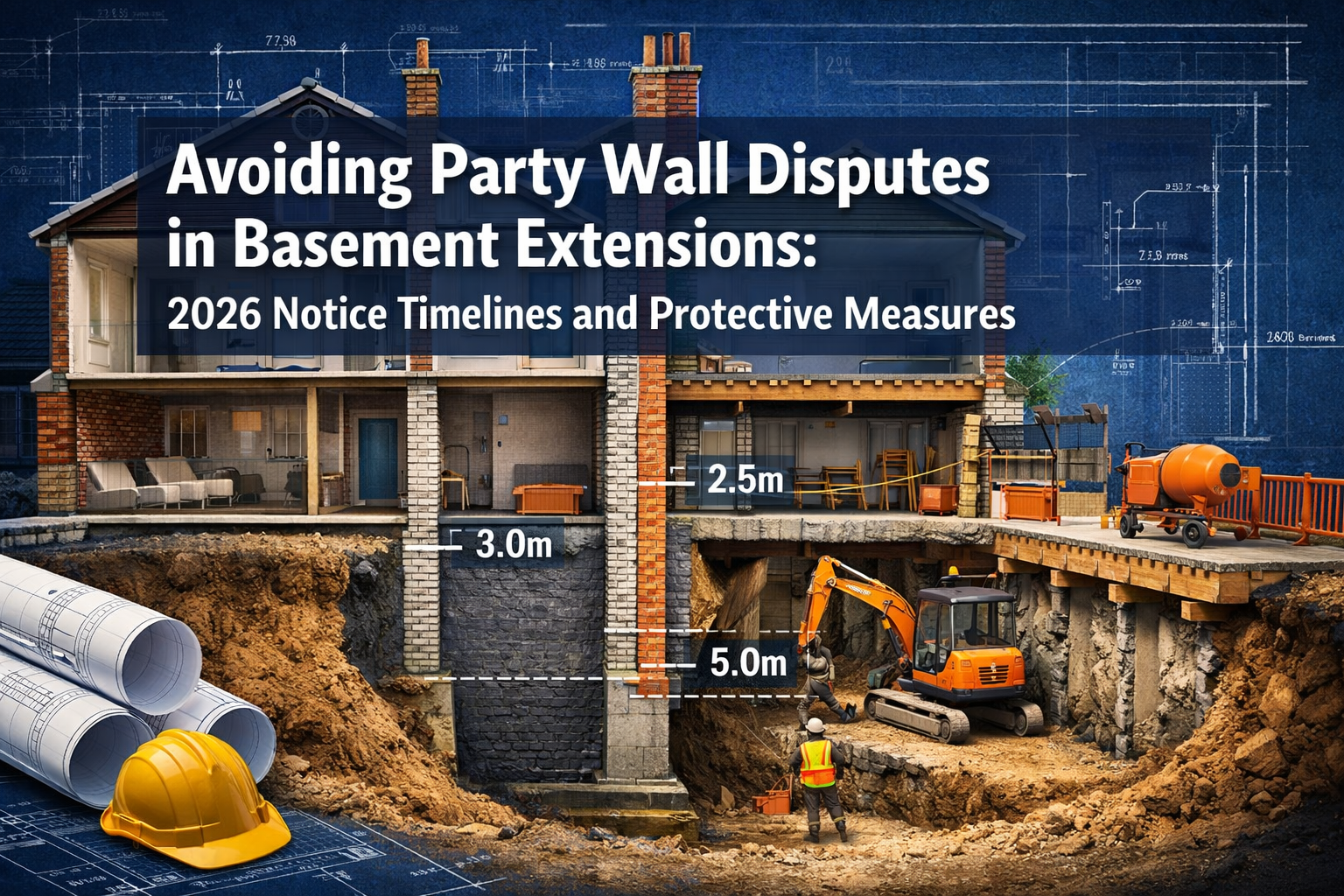
Avoiding party wall disputes in basement extensions requires meticulous attention to 2026 notice timelines and protective measures, particularly when excavation depths trigger mandatory surveyor involvement. This comprehensive guide outlines the excavation depth rules, statutory notice requirements, and essential safeguards like underpinning that prevent structural damage and legal conflicts.
Key Takeaways
- Two-month notice period is mandatory for basement work affecting party walls structurally; one-month notice applies to excavation-only projects
- Excavation depth thresholds at 3 meters and 6 meters trigger specific notice requirements under the Party Wall Act
- Schedule of condition documentation must be completed before work begins, even with written neighbour consent
- Fourteen-day response window automatically triggers dispute procedures if neighbours fail to respond
- Professional surveyor safeguards including underpinning assessments protect both properties from structural damage
Understanding Excavation Depth Rules for Basement Extensions
The 3-Meter and 6-Meter Thresholds 📏
Basement excavation work operates under specific depth regulations that determine notice requirements. The Party Wall etc. Act 1996 establishes two critical thresholds:
3-Meter Rule: When excavating within 3 meters of a neighbouring building's foundation and going deeper than that foundation, formal notice becomes mandatory. This applies to most terraced and semi-detached properties where basements extend beneath the existing foundation level.
6-Meter Rule: For excavations between 3 and 6 meters from a neighbour's foundation, notice is required only if the excavation extends below a 45-degree line drawn downward from the bottom of the neighbour's foundation.
These measurements aren't arbitrary—they represent the zone where excavation work can potentially affect neighbouring structural stability through ground movement, soil displacement, or foundation undermining.
Why Depth Matters for Structural Integrity
Deeper excavations create greater risks:
- Soil pressure redistribution affecting adjacent foundations
- Groundwater flow changes potentially causing settlement
- Lateral ground movement creating structural stress
- Foundation exposure requiring temporary support systems
Properties built on clay soil face heightened risks, as clay shrinks when dried and swells when wet, amplifying movement concerns during basement construction. Understanding these types of party wall works helps homeowners identify which regulations apply to their specific project.
Mandatory Notice Requirements: Avoiding Party Wall Disputes in Basement Extensions
Two-Month Notice for Structural Work
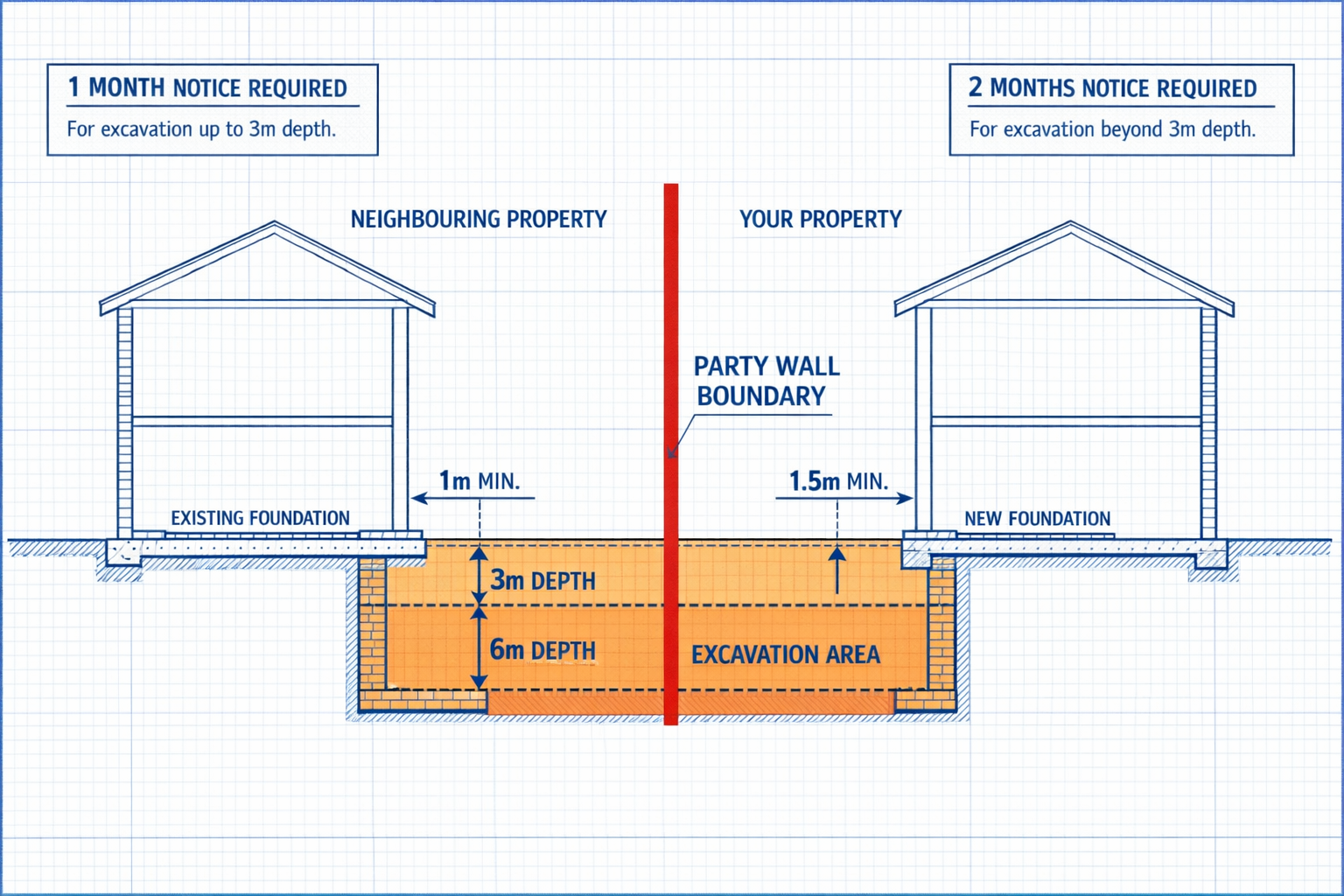
Basement extensions affecting party walls or boundaries require formal notice served at least 2 months before work commences.[2] This extended timeline allows adjoining owners adequate time to:
- Review detailed construction plans
- Consult with independent advisors
- Raise legitimate concerns about methodology
- Arrange surveyor appointments if needed
The two-month period applies when the work involves:
- Cutting into or underpinning party walls
- Building new walls on or astride boundary lines
- Structural modifications to existing party structures
- Installation of damp-proof courses affecting shared walls
One-Month Notice for Excavation-Only Projects
When basement work involves only excavation without structural modifications to the party wall itself, the notice period reduces to 1 month before work begins.[1][2] This shorter timeline still provides neighbours sufficient opportunity to:
- Assess potential ground movement risks
- Request protective measures
- Arrange condition surveys
- Respond formally within the statutory window
Understanding the distinction between these notice periods is crucial for project planning. Serving the wrong notice type or using incorrect timelines can invalidate the entire process, forcing restart and causing significant delays.
Valid Notice Components: What Must Be Included
A legally valid party wall notice requires specific mandatory information to prevent disputes:[4]
✅ Property owner's full name and address
✅ Clear description of planned work with technical details
✅ Specified start date (respecting minimum notice periods)
✅ Outlined response options for adjoining owners
✅ Plans and drawings showing excavation depths and proximity
✅ Contact information for further queries
Missing any of these elements can render the notice invalid, particularly for complex basement schemes that activate multiple sections of the Party Wall Act 1996 simultaneously.[3]
The Critical 14-Day Response Window
Three Possible Neighbour Responses
After receiving notice, adjoining owners have exactly 14 calendar days to respond in writing.[1][4] Three outcomes are possible:
1. Written Consent ✅
The neighbour agrees to the work, allowing the project to proceed with proper documentation. Even with consent, comprehensive condition surveys remain essential.
2. Written Dissent ⚠️
The neighbour objects to the work or specific aspects, triggering mandatory surveyor appointment to prepare a Party Wall Award.
3. No Response 🚫
Failure to respond within 14 days automatically constitutes dissent, requiring surveyor involvement exactly as if formal objection had been lodged.[1][4]
Why Non-Response Triggers Automatic Dispute
This automatic dispute mechanism protects both parties. It prevents building owners from claiming implied consent through neighbour silence while ensuring adjoining owners' interests receive professional consideration even if they fail to respond promptly.
Once the 14-day window closes without written consent, the building owner must appoint a party wall surveyor. The neighbour can either:
- Agree to use the same surveyor (agreed surveyor approach)
- Appoint their own separate surveyor (two surveyor approach)
- Allow the building owner's surveyor to appoint on their behalf after 10 additional days
For detailed guidance on responding to notices, review our article on party wall act notices and how to respond.
Essential Protective Measures for Basement Excavations
Schedule of Condition: Your First Line of Defense
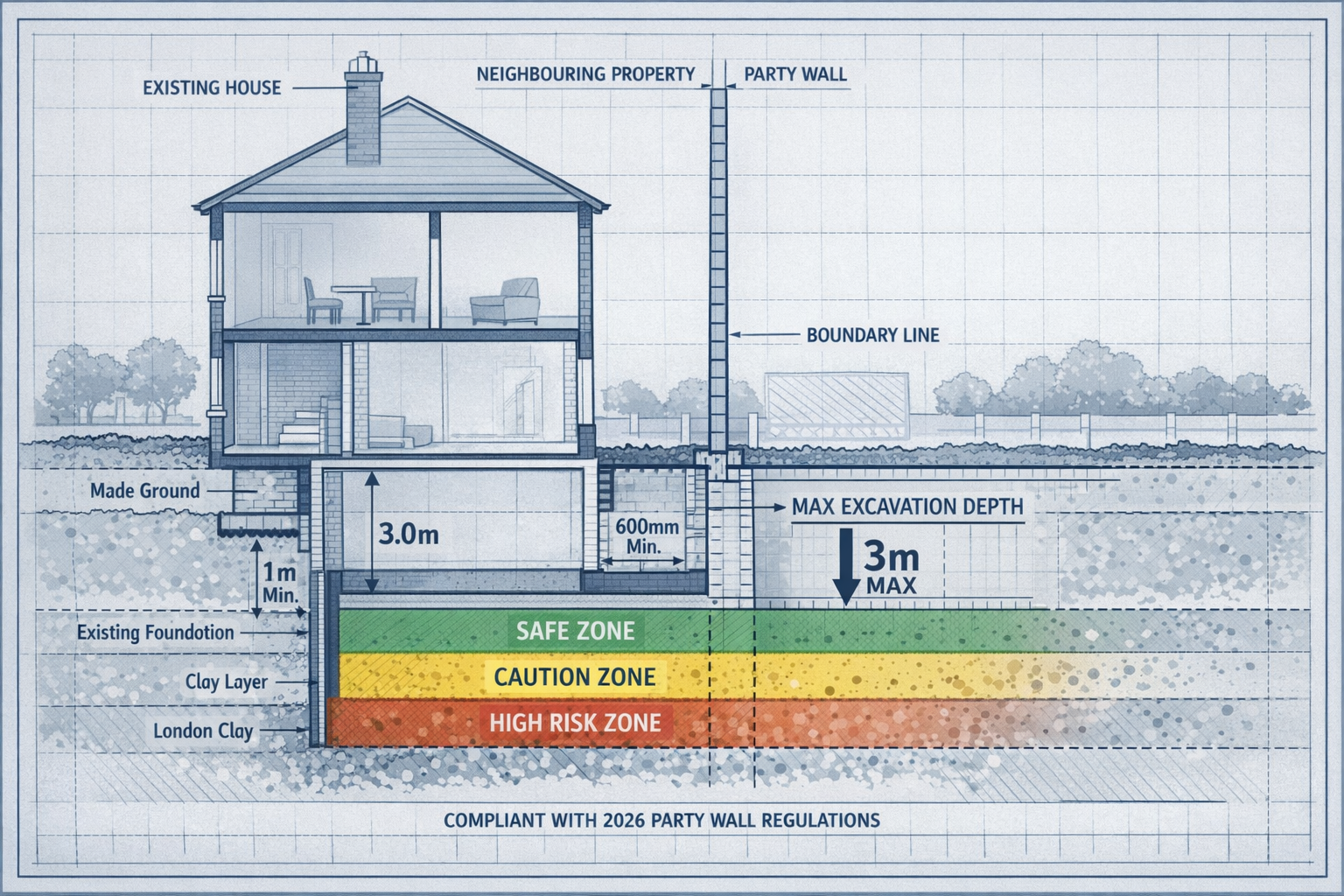
Schedule of condition documentation remains mandatory even when neighbours provide written consent.[1][2] This comprehensive record establishes baseline property conditions before work begins, protecting both parties from false damage claims.
A thorough schedule includes:
📸 Dated photographs of all rooms in adjacent properties
📝 Written descriptions of existing cracks, defects, or damage
📊 Crack width measurements using specialized gauges
🗺️ Floor plans marking photograph locations
📄 Duplicate copies provided to both parties
For basement projects, particular attention should focus on:
- Foundation areas and basement spaces
- Ground floor rooms most susceptible to settlement
- External walls facing the excavation
- Ceiling corners where movement cracks typically appear
Professional surveyors often use crack monitoring devices to track any movement during construction, providing objective evidence if disputes arise. Learn more about schedule of condition best practices for comprehensive protection.
Underpinning: When and Why It's Required
Underpinning involves strengthening existing foundations to prevent settlement when excavating nearby. This protective measure becomes necessary when:
- Excavating deeper than neighbouring foundations
- Soil conditions indicate high settlement risk
- Party wall foundations show existing weakness
- Structural engineers identify stability concerns
The underpinning process typically involves:
- Excavating beneath existing foundations in controlled sections
- Installing concrete or steel supports to transfer loads
- Working in sequential stages to maintain structural integrity
- Monitoring adjacent properties throughout the process
Underpinning costs vary significantly based on foundation depth, soil conditions, and access constraints, but this investment prevents far more expensive structural repairs and legal liabilities later.
Temporary Support Systems and Monitoring
Beyond permanent underpinning, basement excavations require:
Shoring and Propping 🏗️
Temporary support structures preventing ground collapse during excavation phases.
Vibration Monitoring 📊
Electronic sensors tracking ground movement in real-time, alerting teams to concerning shifts.
Crack Monitoring 📏
Regular measurements comparing current conditions against baseline schedules.
Structural Engineer Oversight 👷
Professional supervision ensuring work proceeds according to approved methodologies.
These safeguards aren't optional extras—they represent industry-standard protective measures that party wall awards typically mandate for basement projects.
Surveyor Appointments and Party Wall Awards
When Professional Surveyors Become Mandatory
Party wall surveyor appointment becomes legally required unless written consent is obtained.[1][2] The surveyor's role involves:
- Inspecting both properties before work begins
- Preparing comprehensive schedules of condition
- Drafting a Party Wall Award specifying work parameters
- Monitoring construction progress
- Resolving disputes between parties
- Assessing any damage claims after completion
Building owners typically bear surveyor costs for both parties, though awards can specify different arrangements. Understanding how to keep party wall costs down helps manage these expenses without compromising protection.
The Party Wall Award Document
A Party Wall Award serves as a legally binding document specifying:
📋 Detailed work descriptions and methodologies
⏰ Permitted working hours and noise restrictions
🛡️ Protective measures required during construction
📸 Schedule of condition establishing baseline
💰 Cost allocation for surveyor fees
⚙️ Access arrangements for monitoring visits
⚖️ Dispute resolution procedures if issues arise
Awards typically take 2-4 weeks to prepare after surveyor appointment, adding to overall project timelines. This makes early notice service crucial for maintaining construction schedules.
The 14-Day Appeal Period
Neighbours can appeal a party wall surveyor's award to the County Court within 14 days of service.[1] This appeal right provides important protection against unreasonable awards but can cause further project delays if exercised.
Appeals typically address:
- Inadequate protective measures
- Unreasonable working hour restrictions
- Disputed cost allocations
- Insufficient access provisions
Most appeals settle through negotiation rather than formal court proceedings, but the possibility underscores the importance of reasonable, well-documented awards that balance both parties' interests.
Planning Timelines: Beyond Minimum Notice Periods
Recommended Timeline for Basement Projects
While statutory minimums are 1-2 months, prudent planning allows 4-6 months from initial notice to work commencement:[1]
Month 1: Serve formal notices with complete documentation
Month 2: Neighbour response period and initial surveyor appointments
Month 3: Schedule of condition preparation and site inspections
Month 4: Party Wall Award drafting and review
Month 5: Award finalization and any appeal period
Month 6: Work commencement with all protections in place
This extended timeline accommodates:
- Neighbour vacation schedules affecting response times
- Surveyor availability during busy construction seasons
- Additional investigations if initial surveys reveal concerns
- Planning permission coordination
- Contractor scheduling
Coordinating Multiple Regulatory Requirements
Basement extensions typically require:
🏛️ Planning permission (4-8 weeks processing)
🏗️ Building regulations approval (ongoing inspections)
🤝 Party wall procedures (2-6 months)
🚧 Construction phase (3-9 months typically)
Coordinating these parallel processes prevents costly delays. Starting party wall procedures early—even before planning permission approval—ensures all legal requirements align with construction schedules.
Common Pitfalls and How to Avoid Them
Invalid Notices: The Most Expensive Mistake
Basement schemes trigger multiple Act sections simultaneously, making them frequent sources of invalid notices.[3] Common errors include:
❌ Serving only excavation notice when structural work is planned
❌ Incorrect start dates violating minimum notice periods
❌ Insufficient technical detail about excavation depths
❌ Missing plans showing proximity to boundaries
❌ Failing to identify all affected adjoining owners
Invalid notices provide no legal protection. Work proceeding under invalid notices exposes building owners to:
- Injunction applications halting construction
- Mandatory work removal or modification
- Damage liability without award protections
- Legal costs for all parties
- Significant project delays
Inadequate Condition Documentation
Many disputes arise from insufficient baseline documentation. Neighbours claiming new damage can succeed if building owners cannot prove pre-existing conditions.
Comprehensive schedules must:
✅ Document every room in adjacent properties
✅ Photograph all four walls of each room
✅ Capture ceiling and floor conditions
✅ Include close-ups of existing cracks
✅ Measure crack widths precisely
✅ Date and timestamp all documentation
Professional photographers or surveyors provide superior documentation compared to smartphone photos, offering better legal protection if disputes reach court.
Starting Work Before Award Completion
Never commence work before receiving a finalized Party Wall Award when surveyor appointment is required. Premature work commencement:
- Violates statutory procedures
- Invalidates award protections
- Creates liability for any damage
- May trigger injunction applications
- Damages neighbour relationships irreparably
Patience during the award process prevents far more serious problems later. For guidance on working without surveyors when appropriate, see our article on having a party wall agreement without a surveyor.
Regional Considerations Across London
Area-Specific Challenges
Different London areas present unique basement extension challenges:
Central London 🏙️
Historic buildings, conservation areas, and complex ownership structures require enhanced documentation. Find specialized support through party wall surveyors in Central London.
North London 🌳
Clay soil predominance increases settlement risks, making underpinning assessments critical. Connect with North London party wall surveyors familiar with local conditions.
East London 🏗️
Rapid development and mixed property ages create varying foundation types requiring careful investigation. Consult East London specialists for area expertise.
South London 🏘️
Victorian terraces with shallow foundations often require extensive underpinning for basement projects. Work with South London party wall surveyors experienced in period properties.
West London 💎
High-value properties demand premium documentation standards and enhanced protective measures. Engage West London party wall surveyors for luxury property expertise.
Soil Conditions and Foundation Types
London's geological diversity significantly impacts basement extension requirements:
| Soil Type | Characteristics | Basement Implications |
|---|---|---|
| London Clay | Shrinks/swells with moisture | High settlement risk; extensive underpinning often required |
| Gravel/Sand | Good drainage; stable | Lower settlement risk; simpler excavation |
| Made Ground | Variable fill material | Unpredictable behavior; thorough investigation essential |
| Chalk | Porous bedrock | Groundwater concerns; specialized drainage needed |
Professional soil investigations inform protective measure design, ensuring adequate safeguards for specific ground conditions.
Cost Implications of Proper Procedures
Investment in Prevention vs. Dispute Resolution
Proper party wall procedures involve upfront costs but prevent far greater expenses:
Typical Costs for Compliant Approach:
- Party wall surveyor fees: £1,000-£3,000
- Schedule of condition: £500-£1,500
- Underpinning (if required): £10,000-£50,000+
- Monitoring systems: £500-£2,000
Potential Costs of Non-Compliance:
- Legal proceedings: £10,000-£50,000+
- Work stoppage delays: £5,000-£20,000
- Damage repairs: £10,000-£100,000+
- Injunction compliance: Variable, potentially project-ending
The mathematics strongly favor proper procedures. Understanding the full costs of party wall processes helps budget appropriately from project inception.
Who Pays for What?
Building Owner Responsibilities:
- Own surveyor fees
- Neighbour's surveyor fees (typically)
- Schedule of condition costs
- Protective measure implementation
- Monitoring system installation
- Legitimate damage repairs
Adjoining Owner Responsibilities:
- Generally none for basic procedures
- Costs for unreasonable objections (rare)
- Own legal advice fees (optional)
This cost allocation explains why building owners benefit from maintaining positive neighbour relationships and pursuing consent rather than dispute procedures when possible.
Practical Steps for Homeowners in 2026
Before Serving Notice
1. Conduct Preliminary Assessments 🔍
Engage structural engineers to evaluate excavation requirements, foundation depths, and potential underpinning needs before formal notice.
2. Prepare Comprehensive Documentation 📋
Develop detailed plans, technical specifications, and excavation methodologies that demonstrate professional approach and safety consciousness.
3. Informal Neighbour Discussion 💬
While not legally required, courteous advance conversation often smooths formal procedures and identifies concerns early.
4. Identify All Affected Properties 🏘️
Basement excavations may affect multiple neighbours, requiring separate notices to each.
During the Notice Period
5. Serve Notices Correctly 📬
Use recorded delivery or hand delivery with signed receipt to prove service date and content.
6. Remain Available for Questions 📞
Prompt, professional responses to neighbour queries demonstrate good faith and may facilitate consent.
7. Prepare for Either Outcome ⚖️
Have surveyor contacts ready for appointment if consent isn't forthcoming.
8. Document All Communications 📝
Maintain written records of all interactions, agreements, and decisions.
After Response or Surveyor Appointment
9. Cooperate Fully with Surveyors 🤝
Provide requested information promptly and facilitate property inspections.
10. Review Awards Carefully 📄
Ensure awards accurately reflect agreed work and include appropriate protections.
11. Implement All Required Measures 🛡️
Follow award specifications precisely, documenting compliance throughout construction.
12. Maintain Communication 💬
Keep neighbours informed of progress, addressing concerns promptly and professionally.
Conclusion
Avoiding party wall disputes in basement extensions through proper 2026 notice timelines and protective measures represents essential due diligence for any homeowner undertaking below-ground construction. The excavation depth rules—particularly the 3-meter and 6-meter thresholds—determine specific notice requirements that must be followed precisely to maintain legal protection.
The two-month notice period for structural work and one-month period for excavation-only projects provide neighbours adequate time to review plans and respond, while the automatic 14-day response window ensures all interests receive professional consideration. Comprehensive schedule of condition documentation, professional underpinning assessments, and proper surveyor involvement create multiple layers of protection against structural damage and legal liability.
Key Action Steps:
✅ Start early: Begin party wall procedures 4-6 months before planned construction
✅ Serve valid notices: Include all mandatory information with complete technical documentation
✅ Document everything: Create thorough baseline condition records before work commences
✅ Engage professionals: Appoint experienced surveyors familiar with basement excavation complexities
✅ Implement protections: Follow all award specifications for underpinning, monitoring, and support systems
✅ Maintain communication: Keep neighbours informed throughout the construction process
The investment in proper procedures—while requiring time and money upfront—prevents exponentially more expensive disputes, legal battles, and structural repairs later. Basement extensions offer tremendous value addition to London properties, but only when executed with full compliance to party wall regulations and genuine respect for neighbouring property interests.
For homeowners planning basement projects in 2026, understanding these timelines and protective measures isn't optional—it's the foundation of successful construction that enhances property value while maintaining positive community relationships. Whether you're carrying out works or your neighbour is carrying out works, proper procedures protect everyone involved.
References
[1] Timescales For Party Wall Notices What Homeowners Need To Know – https://www.adamjoseph.co.uk/timescales-for-party-wall-notices-what-homeowners-need-to-know
[2] Party Wall Agreement – https://hoa.org.uk/advice/guides-for-homeowners/i-am-improving/party-wall-agreement/
[3] What Makes A Party Wall Notice Valid – https://www.houricanassociates.com/party-wall-news/what-makes-a-party-wall-notice-valid/
[4] Timescales For Party Wall Notices – https://iconsurveyors.co.uk/blog/timescales-for-party-wall-notices/
[5] Schedules Of Condition In Party Wall Works Best Practices To Prevent Post Construction Claims In 2026 – https://nottinghillsurveyors.com/blog/schedules-of-condition-in-party-wall-works-best-practices-to-prevent-post-construction-claims-in-2026