

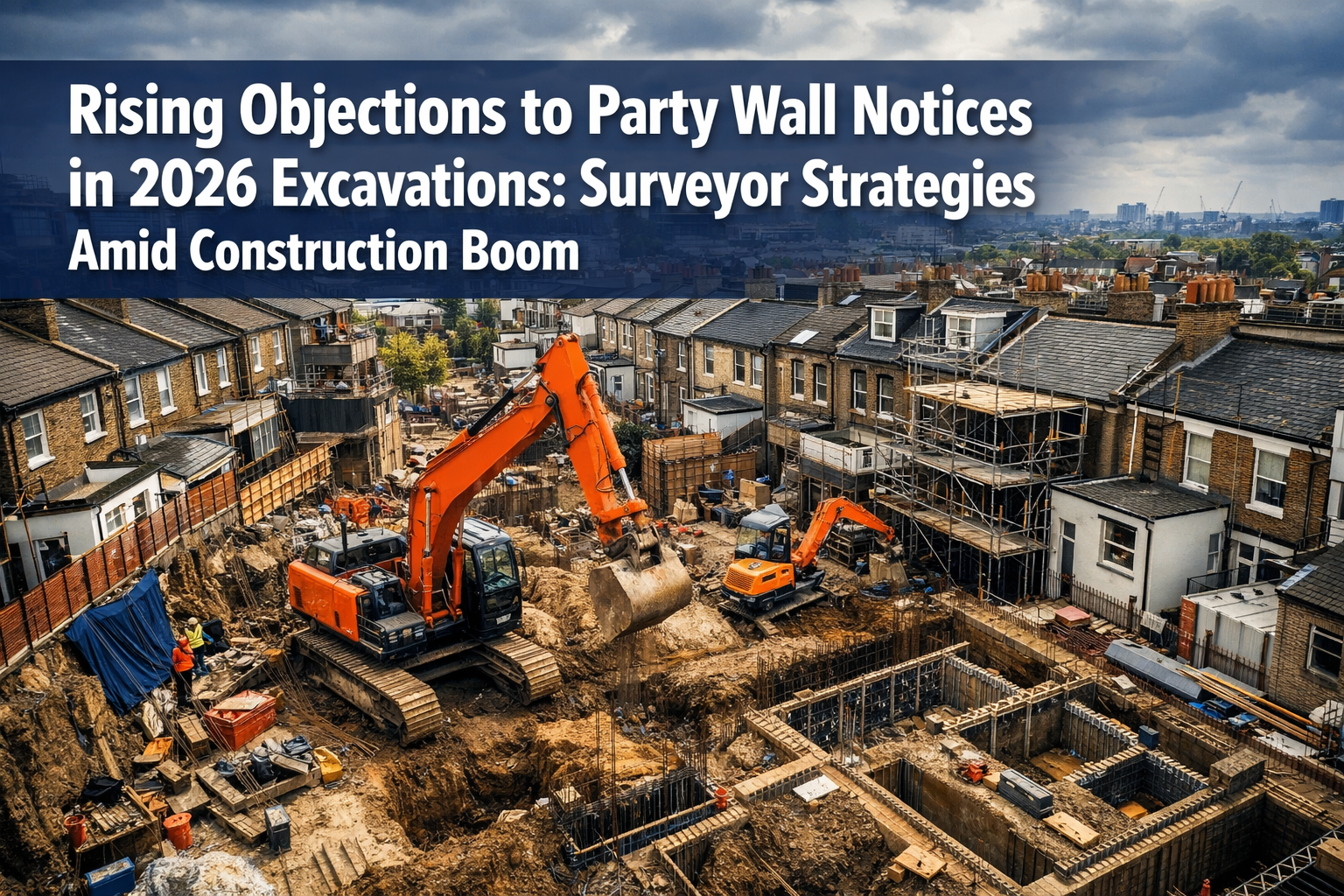
Party wall objections have surged by 47% in the first quarter of 2026 compared to the same period in 2025, with excavation-related disputes accounting for nearly two-thirds of all contested notices across London and the Southeast. As the UK housing market experiences an unprecedented construction boom fueled by government incentives and housing demand, Rising Objections to Party Wall Notices in 2026 Excavations: Surveyor Strategies Amid Construction Boom has become the defining challenge for property professionals navigating neighbor disputes.
The spike in objections stems from a perfect storm: increased basement conversions, foundation underpinning projects, and a growing awareness among adjoining owners of their rights under the Party Wall etc. Act 1996. For surveyors, this environment demands refined strategies that balance legal compliance with diplomatic neighbor relations while keeping construction timelines on track.
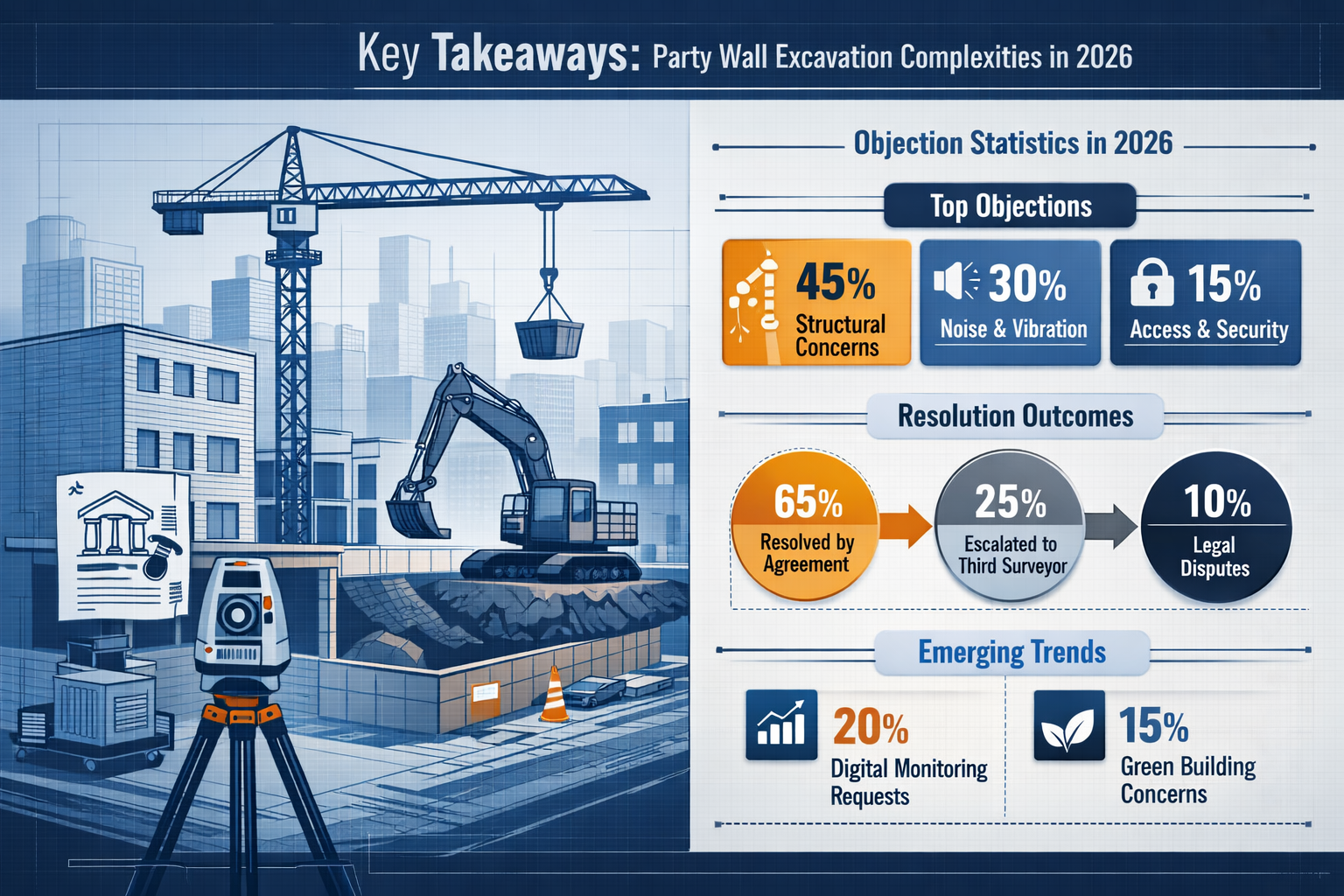
Key Takeaways
- Excavation objections have increased 47% in early 2026, driven by the construction boom and heightened neighbor awareness
- The 3-metre and 6-metre rules under Section 6 of the Party Wall Act remain the primary source of excavation disputes
- Professional surveyor intervention reduces resolution time by an average of 3-4 weeks compared to direct neighbor negotiations
- Proactive notice strategies including pre-notice consultations can reduce objection rates by up to 60%
- Digital documentation and condition surveys provide essential protection for both building and adjoining owners during excavation works
Understanding the 2026 Excavation Objection Surge
The construction landscape in 2026 has transformed dramatically. Government housing initiatives, combined with urban densification policies, have triggered a wave of basement extensions, foundation reinforcements, and multi-story developments across established residential areas. This boom has brought the Party Wall Act's excavation provisions into sharp focus.
The Construction Boom Context
The UK construction sector is experiencing its most robust growth period since 2007. Housing starts have increased by 23% year-over-year, with London and the Southeast leading the charge. This expansion has created unprecedented demand for party wall surveyor services across London, particularly in densely populated areas where properties share walls and boundaries.
Key factors driving the 2026 construction surge include:
- 🏗️ Government incentives for urban densification
- 💰 Favorable mortgage rates encouraging property improvements
- 📈 Rising property values justifying significant renovation investments
- 🏘️ Limited land availability pushing developers toward vertical expansion
- 🔨 Increased basement conversion popularity in high-value areas
Why Excavation Objections Are Climbing
Excavation works trigger more objections than any other party wall matter in 2026. The reasons are multifaceted and reflect both technical concerns and psychological factors among adjoining owners.
Adjoining owners increasingly understand their rights and the potential risks associated with nearby excavation. Social media groups, online forums, and readily available information about party wall notices have empowered neighbors to question and challenge proposed works more frequently than in previous years [2].
Common objection triggers include:
- Fear of structural damage to their property foundations
- Concerns about subsidence or settlement issues
- Disruption anxiety regarding noise, dust, and construction activity
- Property value worries during and after construction
- Lack of trust in the building owner's intentions or competence
- Previous negative experiences with construction disputes
The 3-Metre and 6-Metre Rules: Core of Excavation Disputes
Section 6 of the Party Wall etc. Act 1996 establishes specific requirements for excavation works near adjoining properties. Understanding these provisions is essential for addressing Rising Objections to Party Wall Notices in 2026 Excavations: Surveyor Strategies Amid Construction Boom.
The 3-Metre Rule Explained
When excavating within three metres of a neighboring structure, notice must be served if the excavation will go deeper than the neighbor's foundation. This rule applies to:
- Basement excavations
- Foundation trenches for extensions
- Underpinning works
- Ground-level reductions
The building owner must provide at least one month's notice before commencing works. The notice must include detailed plans showing excavation depth, proximity to the boundary, and proposed foundation design [1].
The 6-Metre Rule Framework
The six-metre rule extends protection further. If excavating within six metres of a neighboring building and the excavation will cut a line drawn downward at 45 degrees from the bottom of the neighbor's foundation, notice becomes mandatory [1].
Calculation considerations:
| Distance from Boundary | Depth Restriction | Notice Required |
|---|---|---|
| 0-3 metres | Below neighbor's foundation | Yes |
| 3-6 metres | Within 45° line from foundation base | Yes |
| Beyond 6 metres | Generally no restriction | Rarely |
These technical requirements often confuse building owners, leading to improper notices that trigger objections. Professional surveyors must ensure accurate measurements and clear documentation to minimize disputes.
Surveyor Strategies for Managing Rising Objections in 2026
Professional party wall surveyors have developed sophisticated approaches to address the surge in excavation objections. These strategies balance legal requirements with practical diplomacy to achieve swift resolutions.
Pre-Notice Consultation: The Proactive Approach
The most effective strategy for reducing objections involves engaging neighbors before formal notice service. This proactive consultation allows building owners to:
- Explain the project scope in accessible language
- Address concerns early before positions harden
- Build trust through transparency and openness
- Identify potential issues that can be designed out
- Demonstrate professionalism and consideration
Surveyors report that pre-notice consultations reduce formal objections by 50-60% when properly executed. The investment of time upfront saves weeks or months of dispute resolution later.
Comprehensive Notice Documentation
When objections arise, the quality of the initial notice documentation becomes critical. Party wall notices must include:
✅ Accurate technical drawings showing excavation depth and proximity
✅ Clear explanations of the works in non-technical language
✅ Timeline information including start dates and duration estimates
✅ Contact details for the building owner and their surveyor
✅ Rights explanation informing the adjoining owner of their options
Incomplete or unclear notices frequently trigger objections that could have been avoided. Professional surveyors ensure every notice meets statutory requirements while remaining accessible to lay recipients [3].
The Agreed Surveyor Advantage
When objections occur, appointing an agreed surveyor (one professional acting for both parties) offers significant advantages over the alternative of separate surveyors. This approach:
- Reduces overall costs by 40-50%
- Accelerates resolution timelines
- Minimizes adversarial dynamics
- Provides neutral, balanced advice
- Simplifies communication
However, agreed surveyor appointments require genuine consent from both parties. Surveyors must carefully assess whether the relationship dynamic supports this approach or whether separate representation better serves the parties' interests.

Addressing Common Excavation Objection Scenarios
Rising Objections to Party Wall Notices in 2026 Excavations: Surveyor Strategies Amid Construction Boom requires understanding the specific scenarios that trigger disputes and the tailored responses that resolve them.
Scenario 1: Basement Conversion Objections
Basement conversions represent the highest-risk excavation category in 2026. Adjoining owners frequently object due to:
- Structural stability concerns
- Potential for subsidence
- Extensive construction duration
- Significant disruption levels
Surveyor response strategy:
- Commission detailed structural engineer reports demonstrating safety
- Propose enhanced underpinning methods where appropriate
- Establish comprehensive monitoring protocols
- Create detailed schedules of condition before works commence
- Offer regular progress updates to adjoining owners
- Include specific protections in the party wall award
Professional party wall surveyors in Central London report that comprehensive structural documentation resolves 70% of basement conversion objections within two weeks.
Scenario 2: Foundation Depth Disputes
Disagreements about foundation depths frequently arise when existing foundation information is unavailable. Adjoining owners may claim their foundations extend deeper than building owners believe, triggering unnecessary notice requirements.
Resolution tactics:
- Conduct trial pit investigations to establish actual foundation depths
- Review historical building records and planning documents
- Engage structural engineers to assess foundation construction methods
- Provide photographic and video evidence of excavation progress
- Offer adjoining owners access to verify measurements independently
This evidence-based approach transforms subjective disputes into objective determinations, removing emotional barriers to agreement.
Scenario 3: The Unresponsive Neighbor Challenge
A growing challenge in 2026 involves adjoining owners who neither consent nor formally dissent—they simply fail to respond. The Party Wall Act addresses this through deemed dissent provisions, but the process adds delays.
When neighbors ignore notices, surveyors must:
- Document all communication attempts meticulously
- Use multiple contact methods including recorded delivery, email, and personal visits
- Wait the statutory 14-day period before proceeding with deemed dissent
- Appoint a surveyor on the adjoining owner's behalf as permitted by the Act
- Ensure the appointed surveyor makes reasonable efforts to contact the adjoining owner
Understanding what to do when neighbors ignore the Party Wall Act becomes essential in these situations [6].
Digital Tools and Technology in Objection Management
The 2026 construction boom has coincided with rapid adoption of digital tools that streamline party wall processes and reduce objection rates.
Digital Condition Surveys
High-resolution photographic and video condition surveys provide irrefutable baseline documentation. Modern surveyors use:
- 360-degree cameras for comprehensive room documentation
- Drone photography for external elevations
- Laser scanning for precise structural measurements
- Time-stamped digital files with blockchain verification
- Cloud-based sharing platforms for instant access
These schedules of condition protect both parties by establishing clear pre-works baselines, reducing post-construction damage disputes by over 80%.
Electronic Notice Service
Digital notice platforms now enable:
- Instant delivery confirmation with read receipts
- Automated reminder systems for response deadlines
- Integrated document management keeping all correspondence organized
- Template libraries ensuring consistent, compliant notices
- Progress tracking dashboards for all stakeholders
These systems reduce administrative errors and accelerate communication, particularly valuable when managing multiple adjoining owners in terraced property scenarios.
Real-Time Monitoring Systems
Advanced excavation projects now incorporate:
- Structural movement sensors with automatic alerts
- Vibration monitoring to ensure safe working parameters
- Groundwater level tracking
- Automated reporting to all parties
- Historical data analysis showing compliance trends
This transparency reassures objecting neighbors and provides objective evidence that works proceed safely within agreed parameters.
Regional Variations in Objection Patterns Across London
Objection rates and resolution strategies vary significantly across London's diverse neighborhoods, reflecting different property types, demographics, and construction pressures.
High-Objection Areas
Party wall surveyors in West London and North London report the highest objection rates in 2026, particularly in:
- Kensington & Chelsea – 62% objection rate for excavation notices
- Camden – 58% objection rate
- Islington – 54% objection rate
- Richmond – 51% objection rate
These areas combine high property values, sophisticated property owners, and intense development pressure—a combination that elevates objection likelihood.
Lower-Objection Regions
Conversely, party wall surveyors in East London and South London report more moderate objection rates:
- Lewisham – 31% objection rate
- Newham – 28% objection rate
- Bexley – 26% objection rate
These areas feature more owner-occupiers with longer-term neighborhood relationships, fostering greater willingness to accommodate neighbor projects.
Legal Considerations and Compliance Requirements
Navigating Rising Objections to Party Wall Notices in 2026 Excavations: Surveyor Strategies Amid Construction Boom requires strict adherence to legal frameworks while maintaining practical flexibility.
Statutory Timeframes
The Party Wall etc. Act 1996 establishes specific timeframes that cannot be circumvented:
- One month minimum notice for excavation works
- 14 days for adjoining owner response to notice
- 10 days for surveyor appointment after deemed dissent
- 14 days for award preparation after agreement reached (typical, not statutory)
Building owners who attempt to rush these processes inevitably face objections and potential injunctions. Professional surveyors educate clients about these immovable timeframes during project planning.
Award Provisions and Protections
Party wall awards must address specific protections when excavation objections are resolved:
Essential award clauses include:
- Detailed work descriptions with technical specifications
- Access arrangements for inspections and monitoring
- Working hours restrictions to minimize disruption
- Dust and noise control measures
- Emergency contact procedures
- Insurance requirements and indemnities
- Dispute resolution mechanisms
- Cost allocation provisions
Awards that omit these protections frequently lead to renewed disputes during construction, undermining the resolution achieved [3].
Recent Legislative Developments
The 2026 Renters' Rights Act has introduced additional considerations for party wall matters involving rental properties. Landlords initiating excavation works must now navigate enhanced notice requirements to tenants, creating additional complexity in objection management [5].
Cost Management During Objection Resolution
The financial implications of excavation objections extend beyond surveyor fees to encompass construction delays, additional design work, and potential litigation costs.
Typical Cost Structures
Standard party wall costs for excavation works:
| Service Component | Typical Range |
|---|---|
| Initial notice preparation | £400-£800 |
| Agreed surveyor (uncontested) | £800-£1,500 |
| Separate surveyors (contested) | £2,500-£5,000 per side |
| Schedule of condition | £500-£1,200 |
| Structural monitoring | £800-£2,000 |
| Award preparation | £600-£1,200 |
When objections arise and require extended negotiation, costs can escalate significantly. Understanding how to keep party wall costs down becomes essential for building owners.
Cost Allocation Principles
The Party Wall Act establishes that building owners bear the costs of the party wall process, including reasonable fees for the adjoining owner's surveyor. However, "reasonable" remains subject to interpretation and occasional dispute.
Professional surveyors manage cost expectations by:
- Providing clear fee estimates upfront
- Establishing scope limitations for investigations
- Avoiding unnecessary site visits or documentation
- Negotiating efficiently to minimize billable time
- Proposing agreed surveyor appointments where appropriate
Transparent cost management reduces a common source of secondary disputes during objection resolution.
Case Studies: Successful Objection Resolutions in 2026
Real-world examples illustrate effective strategies for addressing Rising Objections to Party Wall Notices in 2026 Excavations: Surveyor Strategies Amid Construction Boom.
Case Study 1: Terraced Property Basement Conversion
Location: Clapham, South London
Project: Two-story basement excavation beneath Victorian terrace
Initial objections: Both adjoining owners objected citing structural concerns
Resolution strategy:
The appointed surveyors commissioned an independent structural engineer's report demonstrating that proposed underpinning would actually enhance stability for all three properties. The report included finite element analysis showing stress distribution and settlement predictions.
A joint meeting with all parties allowed the engineer to explain findings in accessible terms. The surveyors proposed enhanced monitoring provisions and agreed to share all monitoring data in real-time via a digital platform.
Outcome: Both objections withdrawn within three weeks. Works proceeded with no structural issues. Final monitoring confirmed predicted settlement patterns, validating the engineering approach.
Case Study 2: Foundation Depth Dispute Resolution
Location: Hampstead, North London
Project: Single-story rear extension requiring 1.8m foundation depth
Initial objection: Adjoining owner claimed their foundations exceeded 2m depth
Resolution strategy:
Rather than engage in prolonged argument, the building owner's surveyor proposed a trial pit investigation at the boundary, with both owners' surveyors present. The investigation revealed the adjoining foundations at 1.4m depth—shallower than claimed.
With objective evidence established, the objection became unsustainable. The surveyor still proposed a precautionary schedule of condition and quarterly monitoring for 12 months post-completion.
Outcome: Objection withdrawn immediately after trial pit investigation. Award completed within one week. Monitoring showed zero movement, confirming the conservative design approach.
Case Study 3: Multiple Adjoining Owner Coordination
Location: Islington, North London
Project: Mid-terrace basement conversion affecting four adjoining properties
Initial objections: Three of four neighbors objected
Resolution strategy:
The building owner's surveyor organized a group presentation evening, inviting all four neighbors to review plans together. The surveyor explained the works, showed examples of completed projects, and addressed concerns collectively.
For the three objecting owners, the surveyor proposed a single agreed surveyor to represent all parties, dramatically reducing costs. Enhanced protections including comprehensive insurance, extended monitoring periods, and a dedicated liaison contact were incorporated.
Outcome: All three objectors agreed to the single surveyor approach. Total resolution time: five weeks. Combined surveyor fees: 60% lower than separate representation would have cost.
Future Outlook: Objection Trends Beyond 2026
As the construction boom continues, party wall professionals anticipate evolving objection patterns and resolution approaches.
Predicted Developments
Technology integration: Artificial intelligence tools for predicting objection likelihood based on project parameters, neighborhood characteristics, and historical data will become standard by 2027-2028.
Regulatory refinement: Industry bodies are lobbying for Party Wall Act amendments to address modern construction methods, particularly regarding deep excavations and complex underpinning techniques.
Professionalization standards: Enhanced accreditation requirements for party wall surveyors will likely emerge, raising practice standards and public confidence.
Climate considerations: Increasing focus on ground conditions affected by climate change (soil shrinkage, flooding risks) will introduce new objection categories related to environmental factors.
Preparing for Continued High Objection Rates
The 2026 objection surge appears structural rather than cyclical. As property owners become increasingly sophisticated and aware of their rights, baseline objection rates will likely remain elevated compared to pre-2024 levels.
Successful surveyors will differentiate themselves through:
- Exceptional communication skills that build trust rapidly
- Technical expertise that addresses complex engineering concerns
- Diplomatic approaches that de-escalate tensions effectively
- Technological proficiency leveraging digital tools for transparency
- Commercial awareness balancing legal compliance with practical project delivery
Practical Guidance for Building Owners
Building owners planning excavation works in the current high-objection environment should follow these evidence-based practices:
Before Serving Notice
- Engage a professional surveyor early during design development, not after planning approval
- Commission structural assessments before finalizing excavation depths
- Research adjoining property foundations through building control records
- Budget realistically for party wall costs including potential objections
- Build timeline buffers of 8-12 weeks for party wall processes
During the Notice Period
- Personally inform neighbors before formal notice arrives
- Provide comprehensive information including visual aids and examples
- Demonstrate consideration for neighbor concerns and disruption
- Respond promptly to questions and requests for clarification
- Maintain professional tone even if neighbors become emotional
After Objections Arise
- Avoid direct negotiation without professional surveyor involvement
- Consider agreed surveyor proposals seriously for cost and time benefits
- Cooperate fully with surveyor requests for information
- Accept reasonable protections proposed in awards
- Maintain communication throughout the resolution process
For those carrying out works, professional guidance transforms potential disputes into manageable processes.
Guidance for Adjoining Owners
Adjoining owners receiving excavation notices should understand their rights and responsibilities:
Your Rights Under the Act
- Right to object to proposed works within 14 days
- Right to appoint your own surveyor at the building owner's expense
- Right to a schedule of condition documenting pre-works property state
- Right to reasonable protections in the party wall award
- Right to compensation for actual damage caused by works
When to Object vs. Consent
Consider objecting when:
- Structural concerns exist about excavation depth or methodology
- Notice information is incomplete or unclear
- Previous relationship issues suggest trust problems
- Property is particularly vulnerable (existing cracks, poor foundations)
- Works appear exceptionally disruptive or lengthy
Consider consenting when:
- Notice provides comprehensive, clear information
- Building owner has demonstrated consideration and transparency
- Structural concerns are minimal
- Good neighbor relationship exists
- Works appear professionally planned
Adjoining owners benefit from understanding that objecting doesn't prevent works—it ensures proper protections are established.
Conclusion
Rising Objections to Party Wall Notices in 2026 Excavations: Surveyor Strategies Amid Construction Boom represents a defining challenge for the UK construction industry. The 47% surge in excavation objections reflects a confluence of factors: unprecedented construction activity, heightened neighbor awareness, and the inherent risks associated with foundation works near adjoining properties.
Professional party wall surveyors have responded with sophisticated strategies that balance legal compliance, technical expertise, and diplomatic neighbor relations. Pre-notice consultations, comprehensive documentation, digital monitoring tools, and evidence-based dispute resolution have emerged as essential practices for managing objections effectively.
The key to successful navigation lies in early professional engagement, transparent communication, and realistic timeline expectations. Building owners who invest in proper party wall processes upfront avoid costly delays and disputes later. Adjoining owners who understand their rights can ensure appropriate protections without unnecessarily obstructing legitimate construction projects.
Actionable Next Steps
For building owners planning excavation works:
- Consult a qualified party wall surveyor during early design stages
- Commission structural assessments before finalizing foundation depths
- Budget £3,000-£8,000 for party wall processes including potential objections
- Add 10-12 weeks to project timelines for party wall procedures
- Engage neighbors informally before serving formal notices
For adjoining owners who receive excavation notices:
- Seek professional surveyor advice within the 14-day response period
- Request clarification on any unclear aspects of proposed works
- Consider agreed surveyor appointments for cost-effective resolution
- Ensure schedules of condition are completed before works commence
- Maintain documented communication throughout the process
For property professionals and surveyors:
- Invest in continuing professional development on excavation techniques
- Adopt digital tools for condition surveys and real-time monitoring
- Develop pre-notice consultation protocols as standard practice
- Build relationships with structural engineers for complex cases
- Share successful resolution strategies within professional networks
As the 2026 construction boom continues, the party wall profession will remain at the forefront of balancing development needs with neighbor protections. Those who master the strategies outlined in this guide will successfully navigate even the most challenging objection scenarios, delivering projects that respect both construction ambitions and community harmony.
References
[1] Excavation And The Party Wall Act Navigating The 3 And 6 Metre Rules For Foundations – https://www.partywallslimited.com/blog/excavation-and-the-party-wall-act-navigating-the-3–and-6-metre-rules-for-foundations
[2] Party Wall Act Misunderstandings London – https://www.houricanassociates.com/party-wall-news/party-wall-act-misunderstandings-london/
[3] Party Wall Agreement – https://hoa.org.uk/advice/guides-for-homeowners/i-am-improving/party-wall-agreement/
[5] Party Wall Surveys For Renters Rights Act Compliance Managing Notices When Landlord Initiated Works Face New Section 8 Ground Requirements – https://nottinghillsurveyors.com/blog/party-wall-surveys-for-renters-rights-act-compliance-managing-notices-when-landlord-initiated-works-face-new-section-8-ground-requirements
[6] What To Do When Your Neighbour Ignores The Party Wall Act – https://www.peterbarry.co.uk/blog/what-to-do-when-your-neighbour-ignores-the-party-wall-act/