

London's housing shortage has pushed developers to construct 47% more high-density urban extensions in 2026 compared to 2024, creating unprecedented complexity in party wall procedures. When a single development involves 15 adjoining properties sharing multiple walls, the traditional notice-and-award process transforms from straightforward to labyrinthine—and surveyors who fail to coordinate these multi-party scenarios risk costly delays, legal disputes, and project paralysis.
Understanding Party Wall Awards in High-Density Urban Extensions: Navigating Complex Notices for 2026 Housing Projects has become essential for surveyors managing modern urban developments. The 2026 legislative changes have repositioned tenant rights as central to all party wall notices and procedures [1], adding another layer of complexity to already intricate multi-property scenarios. This guide provides surveyors with practical frameworks for coordinating notices, managing shared awards, and mitigating risks in dense neighborhood developments.
Key Takeaways
- 🏘️ Multi-party coordination requires systematic notice sequencing and centralized documentation to prevent procedural failures in high-density developments
- 📋 Shared party wall awards can reduce costs by 40-60% compared to individual awards when properly structured across multiple properties
- ⚡ 2026 legislative changes mandate tenant notification and consent procedures that extend standard notice periods by 14-21 days
- 🎯 Risk mitigation strategies including pre-construction neighbor engagement reduce dispute rates by up to 65% in urban extension projects
- 💼 Coordinated surveyor appointments streamline the award process and ensure consistent condition surveys across adjoining properties
Understanding Party Wall Awards in High-Density Urban Extensions
High-density urban extensions present unique challenges that distinguish them from traditional single-property developments. These projects typically involve terraced housing, apartment blocks, or mixed-use developments where multiple properties share walls, foundations, and structural elements. The complexity multiplies when considering that each adjoining owner has distinct rights under the Party Wall etc. Act 1996.
What Defines a High-Density Urban Extension?
High-density urban extensions are characterized by:
- Multiple shared boundaries: Properties sharing two or more party walls with different neighbors
- Vertical stacking: Multi-story developments where party structures exist both horizontally and vertically
- Mixed tenure arrangements: Combinations of freehold, leasehold, and rental properties requiring different notice procedures
- Phased construction: Developments built in stages, creating ongoing party wall obligations
A party wall award is the formal document produced by appointed surveyors that sets out the rights and responsibilities of all parties involved in works affecting shared structures [2]. In high-density scenarios, a single award may govern works affecting 5-10 or more adjoining properties simultaneously.
The 2026 Legislative Landscape
The 2026 legislative changes have fundamentally altered how party wall procedures operate in rental properties and mixed-tenure developments. These changes mandate that:
- Tenant rights must be considered alongside owner rights in all party wall notices
- Landlord-initiated works face new Section 8 ground requirements that affect notice timing [1]
- Notice periods may extend beyond standard timeframes when tenant consultations are required
- Documentation standards have increased to ensure transparency for all stakeholders
For surveyors working in Central London or other high-density areas, understanding these legislative nuances is critical to avoiding procedural failures.
Types of Notices in Urban Extensions
High-density projects typically require multiple notice types under the Party Wall etc. Act 1996:
| Notice Type | Standard Period | Application in Urban Extensions |
|---|---|---|
| Party Structure Notice | 2 months | Required for works to existing shared walls between properties [4] |
| Line of Junction Notice | 1 month | Needed when building new walls on boundary lines in terraced developments |
| Adjacent Excavation Notice | 1 month | Critical for basement extensions affecting multiple neighboring foundations |
Understanding what party wall notices are and how to respond becomes exponentially more important when a single development requires serving 30+ individual notices across different property types.
Coordinating Complex Notices Across Multiple Properties
The greatest challenge in Party Wall Awards in High-Density Urban Extensions: Navigating Complex Notices for 2026 Housing Projects lies in the coordination logistics. When a development affects 10 adjoining properties, each with different owners, tenants, and legal representatives, the notice process can quickly become chaotic without systematic management.

Systematic Notice Sequencing
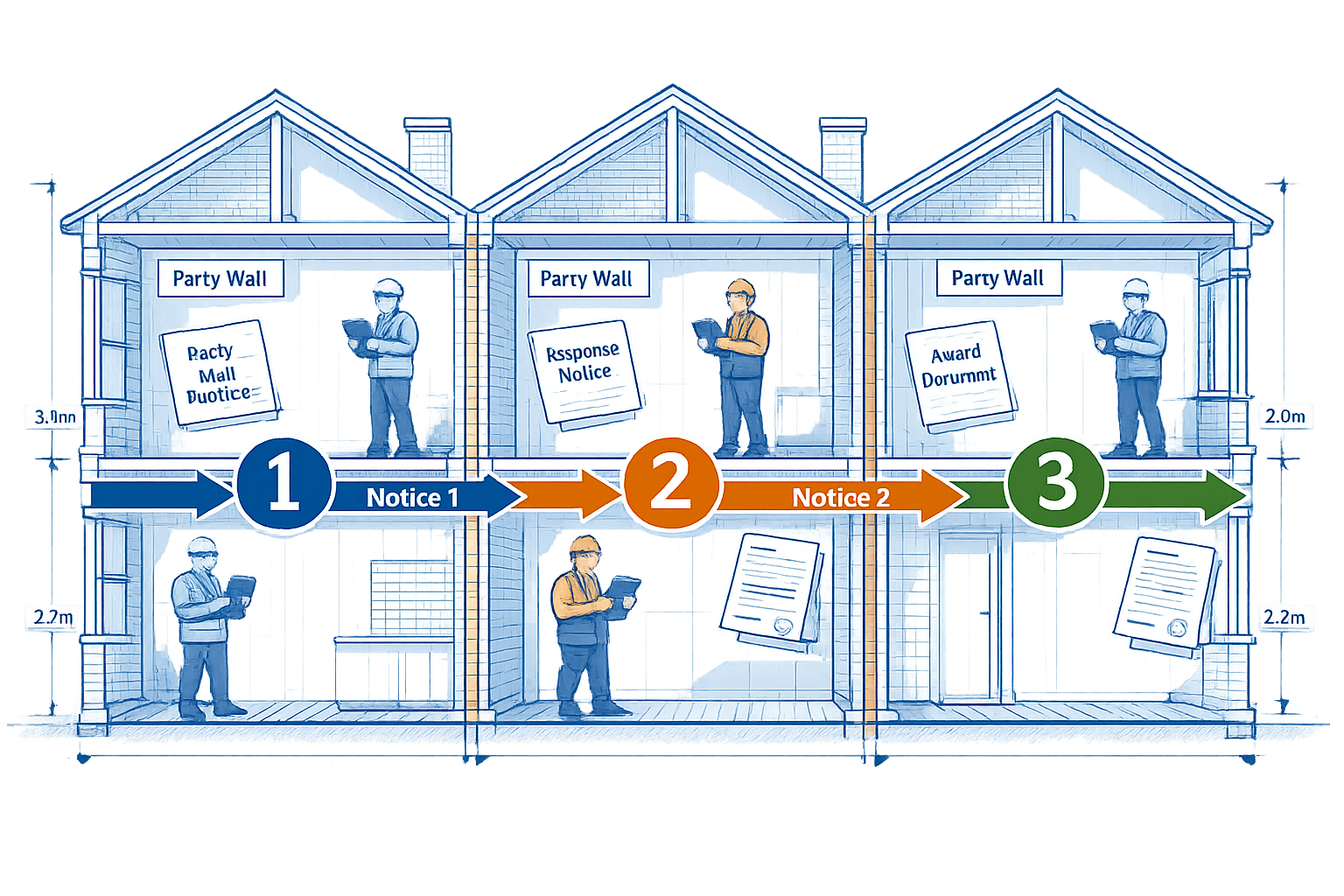
Sequential notice serving is essential for managing multi-party scenarios effectively. The recommended approach includes:
Phase 1: Pre-Notice Assessment (Weeks 1-2)
- Conduct comprehensive boundary surveys to identify all affected properties
- Research land registry records to determine ownership structures
- Identify tenant occupancy and landlord contacts for rental properties
- Map party wall relationships showing which properties share which structures
Phase 2: Coordinated Notice Service (Weeks 3-4)
- Serve all notices simultaneously on the same date to maintain consistent timelines
- Use tracked delivery methods to document service dates for each property
- Provide standardized notice packages including explanatory letters and project details
- Establish single point of contact for all adjoining owners to direct queries
Phase 3: Response Management (Weeks 5-12)
- Track consent and dissent responses in centralized database
- Coordinate surveyor appointments for dissenting owners
- Facilitate agreed surveyor appointments where multiple owners consent to single representation
- Manage extended timelines for properties requiring tenant consultations under 2026 legislation
Leveraging Agreed Surveyor Appointments
One of the most effective strategies for simplifying Party Wall Awards in High-Density Urban Extensions is the use of agreed surveyors. When multiple adjoining owners consent to appointing the same surveyor to act impartially for all parties, the process becomes significantly more streamlined.
Benefits of agreed surveyor arrangements:
- ✅ Reduced costs: Single surveyor fee split among parties instead of multiple appointments
- ✅ Faster timelines: Coordinated inspections and unified award production
- ✅ Consistent standards: Single schedule of condition for all affected properties
- ✅ Simplified communication: One surveyor managing all stakeholder relationships
According to industry data, agreed surveyor arrangements can reduce overall party wall award costs by 40-60% in multi-property scenarios [4]. However, this approach requires careful management to ensure all parties understand their rights and the surveyor maintains genuine impartiality.
Managing Dissent and Dispute Resolution
Not all adjoining owners will consent to works or agreed surveyor appointments. In high-density developments, even a single dissenting owner can complicate the entire process. Effective dispute resolution strategies include:
Early engagement protocols:
- Host pre-construction neighbor meetings to explain works and address concerns
- Provide detailed work schedules showing timing, duration, and mitigation measures
- Offer direct access to project managers and surveyors for ongoing communication
Surveyor selection procedures:
- Maintain pre-approved surveyor lists for East London, West London, and other areas
- Ensure geographic familiarity with local construction practices and property types
- Verify experience with multi-party awards and high-density developments
Dispute escalation frameworks:
- Document all communication attempts and responses
- Engage third-party mediators before formal dispute procedures
- Prepare for appointed surveyor scenarios where the building owner must appoint on behalf of non-responsive neighbors
Understanding party structure notices and how to serve them properly is foundational, but managing the human dynamics of multiple stakeholders requires additional diplomatic skills.
Structuring Shared Awards for Efficiency and Risk Mitigation
Creating effective party wall awards for high-density urban extensions requires balancing legal precision with practical efficiency. A well-structured shared award protects all parties while enabling construction to proceed smoothly.
Components of a Comprehensive Multi-Property Award
A robust party wall award for urban extensions should include:
1. Detailed Property Identification
- Complete addresses and land registry titles for all affected properties
- Clear boundary plans showing party wall locations and ownership
- Identification of freeholders, leaseholders, and tenants with rights under 2026 legislation
2. Comprehensive Work Descriptions
- Specific details of all types of party wall works to be undertaken
- Phasing schedules showing which properties are affected at which stages
- Technical specifications for structural supports, underpinning, and temporary works
3. Condition Survey Documentation
- Pre-construction schedules of condition for all adjoining properties
- Photographic evidence with timestamps and location markers
- Documentation of existing defects, cracks, and structural conditions
4. Access and Working Arrangements
- Specified access rights for construction personnel and equipment
- Working hours and noise limitation agreements
- Notification procedures for different work phases
5. Insurance and Indemnity Provisions
- Required insurance coverage levels and policy details
- Indemnity clauses protecting adjoining owners from damage
- Dispute resolution procedures for damage claims
6. Cost Allocation Framework
- Clear breakdown of surveyor fees and how they're apportioned
- Responsibility for monitoring costs and follow-up inspections
- Payment timelines and procedures
For detailed guidance on award structure, reviewing a party wall contract template guide can provide valuable insights into standard clauses and provisions.
Cost Management in Multi-Party Scenarios
One of the most contentious aspects of Party Wall Awards in High-Density Urban Extensions: Navigating Complex Notices for 2026 Housing Projects is cost allocation. Standard surveyor rates in 2026 range from £150-200 per hour, with total party wall award costs typically around £1,000 per property [4].
However, in high-density scenarios involving 10+ properties, these costs can escalate rapidly without proper management:
Traditional approach (individual awards):
- 10 properties × £1,000 per award = £10,000 total
- Multiple site visits and duplicated documentation
- Extended timelines due to coordination challenges
Coordinated shared award approach:
- Single comprehensive award covering all properties = £4,000-6,000 total
- Consolidated site visits and unified documentation
- Faster completion through streamlined processes
Cost-saving strategies include:
💰 Negotiating package rates with experienced surveyors for multi-property projects
💰 Sharing agreed surveyor fees proportionally among all parties
💰 Combining condition surveys to reduce inspection time and costs
💰 Using digital documentation to minimize administrative expenses
For additional strategies, see our guide on how to keep party wall costs down.
Risk Mitigation Through Proactive Management
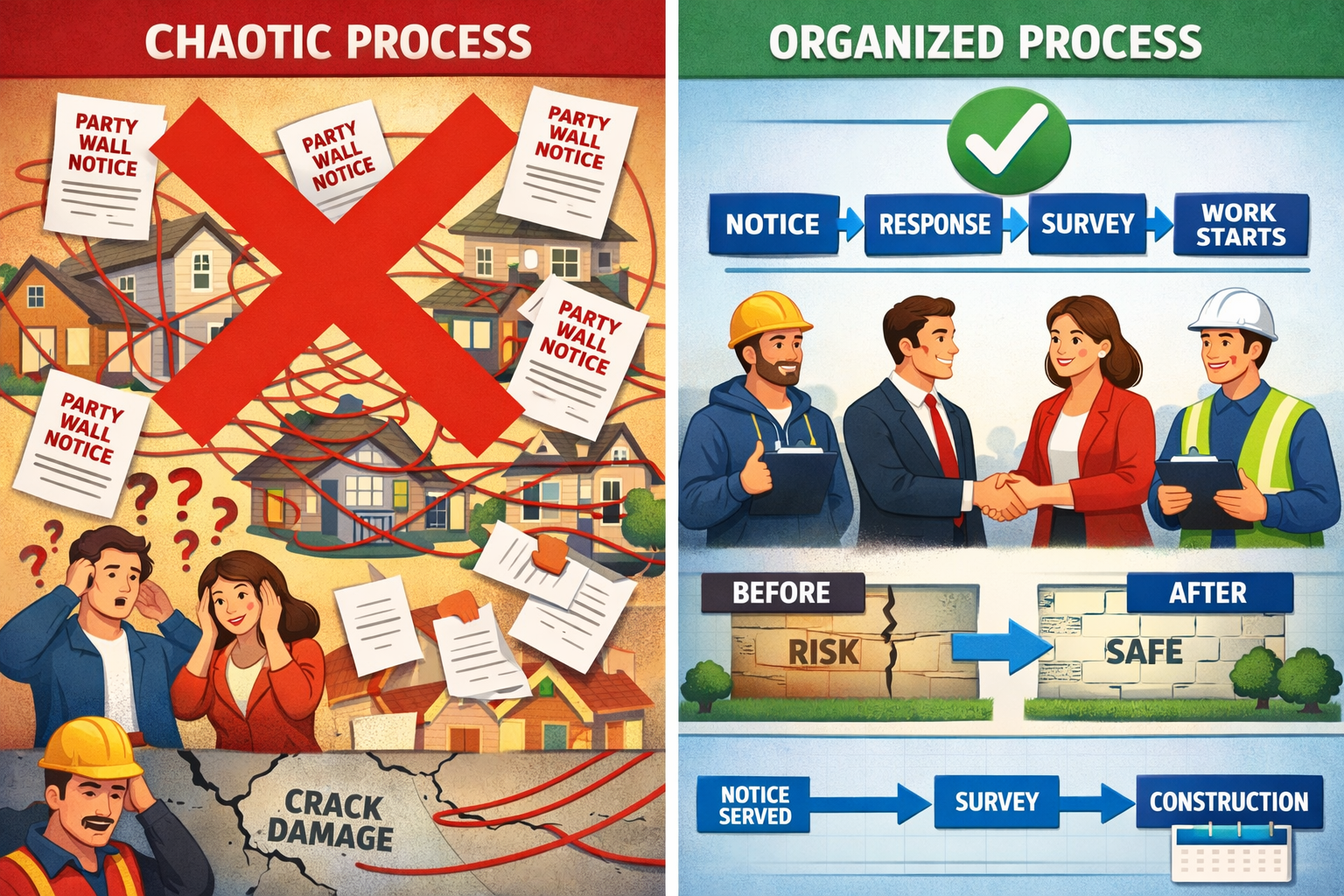
High-density developments face elevated risks of disputes, delays, and damage claims. Effective risk mitigation requires proactive strategies:
Pre-Construction Risk Assessment
- Conduct structural surveys of all adjoining properties before works commence
- Identify vulnerable structures requiring additional monitoring or support
- Assess ground conditions and potential for differential settlement
- Evaluate existing defects that could be exacerbated by construction
Ongoing Monitoring Protocols
- Implement vibration monitoring for excavation and piling works
- Schedule interim inspections at critical construction phases
- Maintain photographic records of work progression
- Establish rapid response procedures for emerging issues
Stakeholder Communication Systems
- Provide regular progress updates to all adjoining owners
- Create dedicated communication channels (phone line, email, project website)
- Host quarterly stakeholder meetings for extended projects
- Maintain transparent documentation accessible to all parties
Research shows that developments with proactive neighbor engagement programs experience 65% fewer formal disputes compared to those relying solely on statutory notice procedures.
Navigating Tenant Rights and Mixed-Tenure Complexities
The 2026 legislative changes have made tenant considerations central to party wall procedures in high-density urban extensions. This is particularly relevant in areas like North London and South London, where mixed-tenure developments are common.
Understanding the 2026 Tenant Rights Framework
Under the updated framework, party wall procedures must now account for:
Tenant notification requirements:
- Landlords must provide advance notice to tenants before serving party wall notices
- Tenants have consultation rights regarding works that may affect their occupancy
- Extended notice periods of 14-21 additional days may apply in rental properties [1]
Section 8 ground considerations:
- Landlord-initiated works must comply with new Section 8 ground requirements
- Works cannot be used as grounds for possession proceedings without proper party wall compliance
- Documentation standards have increased to protect tenant rights [1]
Practical Implications for Surveyors
When managing Party Wall Awards in High-Density Urban Extensions: Navigating Complex Notices for 2026 Housing Projects involving rental properties, surveyors must:
- Verify tenure status early in the assessment phase
- Coordinate with landlords to ensure tenant notifications are properly served
- Extend project timelines to accommodate additional consultation periods
- Document tenant communications as part of the award record
For developments with significant rental property components, building in an additional 3-4 weeks to the standard notice timeline is now advisable to ensure full compliance with 2026 requirements.
Mixed-Tenure Award Structures
High-density urban extensions often include a mix of:
- Owner-occupied freeholds
- Leasehold properties with various head lessees
- Rental properties with landlord-tenant relationships
- Commercial units with business tenants
Each tenure type requires slightly different notice procedures and rights considerations. Effective awards clearly delineate:
- Primary notice recipients (freeholders, head lessees, landlords)
- Secondary notification requirements (tenants, sub-lessees, occupiers)
- Rights and obligations specific to each party's legal status
- Communication protocols ensuring all stakeholders receive appropriate information
Best Practices for 2026 and Beyond
As urban densification continues and legislative frameworks evolve, surveyors must adopt forward-thinking approaches to Party Wall Awards in High-Density Urban Extensions: Navigating Complex Notices for 2026 Housing Projects.
Technology Integration
Modern party wall management increasingly relies on digital tools:
Property mapping software:
- GIS-based systems for visualizing party wall relationships
- Digital boundary plans with interactive property identification
- Cloud-based documentation accessible to all stakeholders
Notice management platforms:
- Automated tracking systems for notice service dates and response deadlines
- Digital signature solutions for consent and surveyor appointment documents
- Communication portals providing 24/7 access to project information
Condition survey technology:
- 360-degree photography for comprehensive pre-construction records
- Crack monitoring sensors for real-time structural movement detection
- Drone surveys for roof and upper-level inspections in dense developments
Professional Development and Specialization
The complexity of high-density urban extension projects demands specialized expertise. Surveyors should:
- Pursue continuing education on 2026 legislative changes and tenant rights
- Develop multi-party coordination skills through case study analysis
- Build local area expertise in specific high-density neighborhoods
- Establish professional networks with other surveyors for complex projects
Collaborative Industry Approaches
The most successful high-density developments involve collaboration among:
- Developers who prioritize early party wall planning in project timelines
- Architects who design with party wall implications in mind
- Surveyors who coordinate effectively across multiple properties
- Legal advisors who ensure compliance with evolving regulations
- Local authorities who facilitate efficient planning and building control processes
"The future of urban development depends on our ability to navigate party wall procedures efficiently while protecting the rights of all stakeholders. Surveyors who master multi-party coordination will be essential to delivering the housing London needs." — Industry Expert Commentary, 2026
Conclusion
Party Wall Awards in High-Density Urban Extensions: Navigating Complex Notices for 2026 Housing Projects represents one of the most challenging aspects of modern urban development. The combination of multiple adjoining properties, mixed-tenure arrangements, and evolving legislative requirements demands systematic approaches, proactive coordination, and specialized expertise.
Surveyors who successfully navigate these complexities focus on:
✅ Early planning and comprehensive property assessment before notice service
✅ Coordinated communication with all stakeholders throughout the process
✅ Efficient award structures that balance legal protection with practical implementation
✅ Proactive risk management through monitoring and stakeholder engagement
✅ Compliance with 2026 legislation including tenant rights and notification requirements
The benefits of mastering these skills extend beyond individual projects. Surveyors who develop reputations for effective multi-party coordination become invaluable partners in urban development, enabling housing delivery while protecting property rights and maintaining neighborhood relationships.
Next Steps for Surveyors
If you're managing or planning a high-density urban extension project:
- Conduct early assessment of all party wall relationships and tenure arrangements
- Develop a coordination plan with clear timelines accounting for 2026 legislative requirements
- Engage experienced surveyors familiar with multi-party scenarios in your area
- Implement proactive communication strategies with all adjoining owners and tenants
- Consider shared award structures to maximize efficiency and minimize costs
For professional assistance with complex party wall scenarios, explore our party wall notices services or review our comprehensive information on party wall awards. Understanding the nuances of high-density urban extensions today positions surveyors for success in the increasingly complex urban development landscape of 2026 and beyond.
References
[1] Party Wall Surveys For Renters Rights Act Compliance Managing Notices When Landlord Initiated Works Face New Section 8 Ground Requirements – https://nottinghillsurveyors.com/blog/party-wall-surveys-for-renters-rights-act-compliance-managing-notices-when-landlord-initiated-works-face-new-section-8-ground-requirements
[2] What Is A Party Wall Agreement And Party Wall Award – https://westvilleassociates.com/blog/what-is-a-party-wall-agreement-and-party-wall-award
[3] Party Wall Awards – https://jlewissurveyors.co.uk/party-wall-awards/
[4] Party Wall Agreement – https://hoa.org.uk/advice/guides-for-homeowners/i-am-improving/party-wall-agreement/
[5] Party Wall Agreements And Townhome Declarations Key Issues To Watch Out For When Drafting – https://ngazette.com/party-wall-agreements-and-townhome-declarations-key-issues-to-watch-out-for-when-drafting/