


Over 70% of loft conversion projects in England and Wales unknowingly trigger the Party Wall Act 1996, yet many homeowners only discover their legal obligations after construction has already begun—leading to costly delays, strained neighbour relations, and potential legal disputes. Understanding the Party Wall Act triggers for loft conversions, notice requirements, and surveyor roles in 2026 is essential for anyone planning to expand their living space upward in a semi-detached or terraced property.
The Party Wall Act 1996 exists to protect both building owners undertaking construction work and adjoining owners whose properties might be affected. When planning a loft conversion, specific structural modifications automatically activate the Act's requirements, mandating formal notification procedures and, in many cases, the appointment of qualified surveyors to oversee the process.
Key Takeaways
- Steel beam insertion into party walls is the most common trigger for Party Wall Act compliance during loft conversions
- At least two months' notice must be served before structural works begin, with specific documentation requirements
- Party wall surveyors play crucial roles in documenting existing conditions, mediating disputes, and issuing legally binding awards
- Detached properties and conversions using independent structural supports may not require party wall agreements
- Written consent or formal awards must be obtained before commencing any work that affects shared structures
Understanding Party Wall Act Triggers for Loft Conversions: Notice Requirements and Surveyor Roles in 2026
The Party Wall Act 1996 applies exclusively to England and Wales, providing a legislative framework for preventing and resolving disputes between neighbours undertaking building work[2]. For loft conversions, understanding which specific activities trigger the Act's requirements is the first critical step in ensuring legal compliance.
What Is the Party Wall Act?
The Party Wall etc. Act 1996 establishes legal procedures for work on shared walls, boundary structures, and excavations near neighbouring properties. The Act covers three main types of work:
- Work directly to an existing party wall or structure
- Building a new wall at or astride the boundary line
- Excavating within three or six metres of a neighbouring building
For loft conversions specifically, the first category—work directly to existing party walls—represents the most frequent trigger point.
The Geographic Scope
Property owners must remember that the Party Wall Act 1996 applies only in England and Wales. Scotland and Northern Ireland operate under different legal frameworks for boundary and structural work[2]. This geographical limitation is particularly important for construction professionals working across the UK who must adapt their procedures based on location.
Common Loft Conversion Activities That Trigger the Party Wall Act
Not every loft conversion requires party wall procedures. Understanding which specific structural interventions activate the Act's requirements helps homeowners plan appropriately and budget for the necessary legal processes.
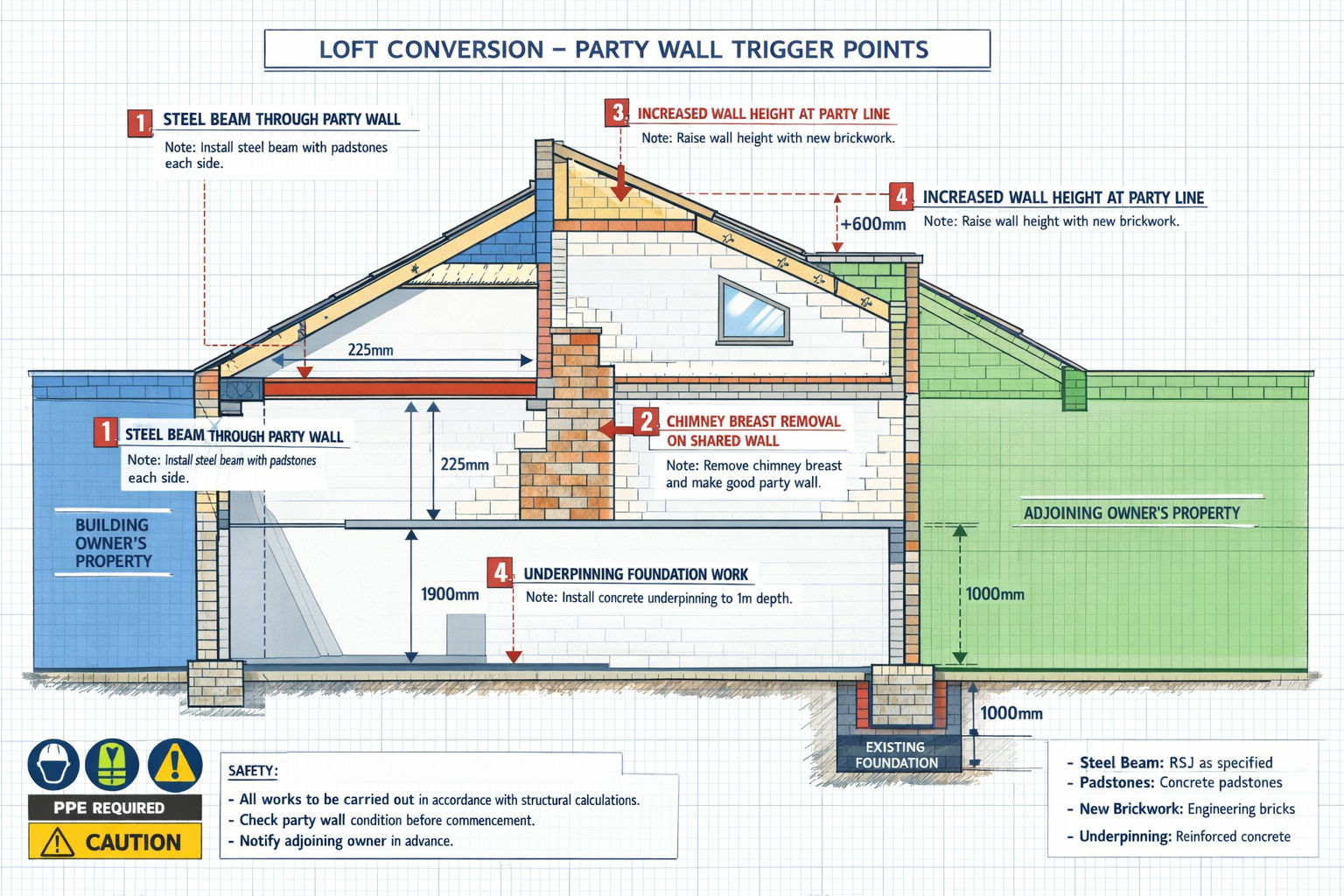
Steel Beam Insertion: The Primary Trigger
Inserting steel beams into party walls represents the most common trigger for Party Wall Act compliance during loft conversions[3][7]. Steel beams provide essential structural support when creating open-plan loft spaces or removing load-bearing walls, but cutting into a shared wall to accommodate these beams constitutes notifiable work under the Act.
The structural modification involved in beam insertion includes:
- Cutting pockets or recesses into the party wall
- Removing masonry to create beam seating points
- Introducing new loads onto the shared structure
- Potential vibration during installation
Each of these activities directly affects the party wall's integrity and potentially impacts the adjoining owner's property, making formal notification mandatory[1].
Chimney Breast Removal on Party Walls
Removing chimney breasts that are attached to or form part of party walls requires formal party wall procedures[1][3]. Many Victorian and Edwardian properties feature chimney breasts that extend through multiple floors, often positioned on or near the party wall line.
When removing these structures during a loft conversion, homeowners must:
- Serve appropriate party wall notices before work begins
- Obtain written consent from affected neighbours
- Arrange for structural surveys documenting existing conditions
- Ensure proper support for remaining chimney portions in adjoining properties
⚠️ Warning: Removing a chimney breast without proper party wall procedures can leave you liable for any damage to your neighbour's property, even if that damage appears months or years later.
Underpinning and Foundation Work
Underpinning party wall foundations triggers the Act's requirements[1]. Loft conversions sometimes necessitate foundation strengthening when:
- Additional loads from the new loft space exceed existing foundation capacity
- Ground conditions require stabilization before adding upper-floor weight
- Structural engineers identify settlement risks
The Act specifically covers excavation work within:
- Three metres of a neighbouring building if the work goes deeper than the neighbour's foundations
- Six metres of a neighbouring building if the work goes deeper than a line drawn at 45 degrees from the bottom of the neighbour's foundations[2]
Increasing Wall Height or Thickness
Raising the height of a party wall or increasing its thickness both constitute notifiable work[1]. Loft conversions may require these modifications when:
- Creating additional headroom in the loft space
- Building up gable walls that sit on the party wall line
- Strengthening existing walls to support new structural loads
Damp Proof Course Installation
Inserting a full-length damp proof course (DPC) into a party wall requires a party wall agreement[1][2]. While not all loft conversions involve DPC work, those addressing existing damp issues or meeting updated building regulations may need this intervention.
Other Structural Modifications
Additional triggers include:
- Cutting projections off party walls (such as corbels or decorative features)
- Demolishing and rebuilding portions of party walls
- Cutting into party walls for new services or ventilation
- Exposing previously concealed party walls during conversion work[1]
For comprehensive guidance on different work types, review the types of party wall works that commonly require formal procedures.
When Loft Conversions DON'T Require Party Wall Agreements
Understanding exemptions is equally important for avoiding unnecessary procedures and costs.
Detached Properties
Loft conversions on detached houses with no shared walls do not require party wall agreements[1][2]. The Act only applies where structures are shared or work occurs near neighbouring properties' foundations.
Independent Structural Solutions
Loft conversions using purpose-built columns that avoid the party wall entirely may not trigger the Act[1]. Modern engineering solutions can sometimes design around party wall involvement by:
- Installing independent steel frames within the building owner's property
- Using cantilevered structures that don't bear on shared walls
- Positioning all structural supports away from boundary lines
However, even when structural work avoids the party wall, other aspects of the conversion (such as nearby excavations) might still trigger notification requirements.
Internal Non-Structural Work
Purely internal, non-structural modifications such as:
- Installing insulation that doesn't affect the party wall
- Adding plasterboard on the building owner's side only
- Electrical work that doesn't penetrate the party wall
- Decorative finishes
These activities generally fall outside the Act's scope, though homeowners should verify with qualified professionals before proceeding.
Notice Requirements for Party Wall Act Compliance in Loft Conversions
The Party Wall Act establishes specific notice requirements that building owners must follow. Failure to serve proper notice can result in injunctions preventing work from proceeding.
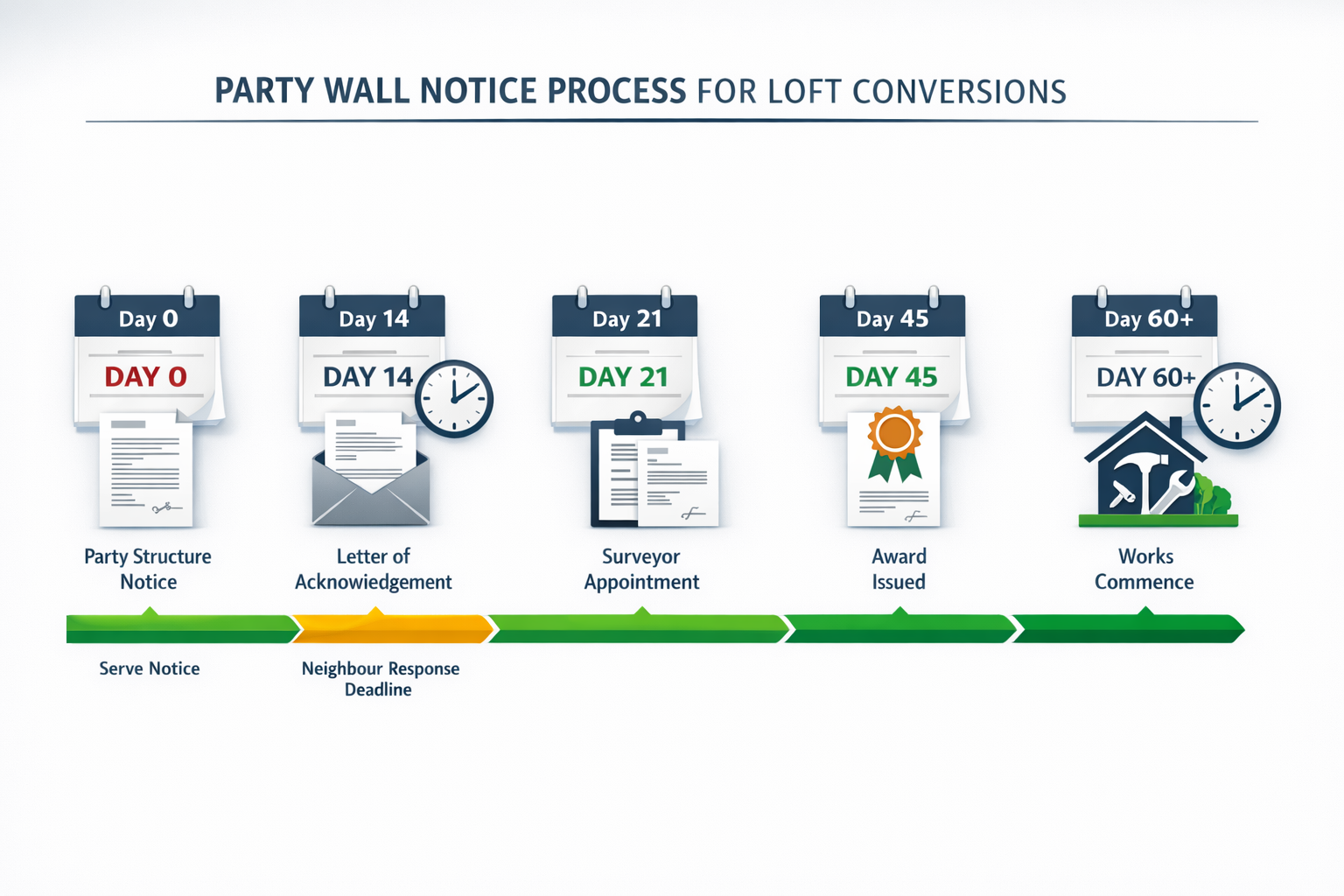
The Two-Month Minimum Notice Period
The Party Wall Act requires at least two months' notice before structural works can begin[3]. This timeline allows adjoining owners sufficient time to:
- Review the proposed works
- Seek independent advice
- Appoint their own surveyor if desired
- Raise concerns or objections
Building owners should factor this mandatory waiting period into project timelines, ideally serving notices well before intended construction start dates.
Types of Notices for Loft Conversions
Different types of party wall work require different notice forms:
| Notice Type | When Required | Notice Period |
|---|---|---|
| Party Structure Notice | Work directly to existing party walls or structures | 2 months |
| Line of Junction Notice | Building new walls at the boundary | 1 month |
| Notice of Adjacent Excavation | Excavation within 3m or 6m of neighbouring foundations | 1 month |
For most loft conversions involving steel beam insertion or chimney removal, a Party Structure Notice is the appropriate document[1].
What Must Be Included in Party Wall Notices
Formal party wall notices must contain specific information:
✅ Building owner's name and address
✅ Description of the proposed works
✅ Location of the works in relation to the party wall
✅ Proposed start date (at least 2 months from service)
✅ Architectural drawings or plans showing the work
✅ Details of any proposed structural modifications
Many building owners work with party wall surveyors or solicitors to ensure notices contain all required information and meet legal standards.
How to Serve Party Wall Notices
Notices must be served in writing and can be delivered by:
- Hand delivery to the adjoining owner
- Recorded delivery post to the property address
- Email if the adjoining owner has agreed to electronic service
⚠️ Critical: You cannot exclude neighbours from notification, even if you believe the work poses minimal risk[1]. The Act provides no exemptions based on the perceived scale or impact of proposed works.
Neighbour Responses to Party Wall Notices
After receiving a party wall notice, adjoining owners have three options:
- Consent in writing to the proposed works
- Dissent or fail to respond within 14 days (triggering the dispute resolution process)
- Request additional information before deciding
If neighbours consent in writing, work can proceed after the notice period expires. However, written consent doesn't eliminate the building owner's liability for any damage caused by the works.
The Dispute Resolution Process
When adjoining owners dissent or don't respond within 14 days, the Act's dispute resolution mechanism activates automatically. This process involves appointing party wall surveyors to prepare a legally binding document called a Party Wall Award.
For detailed guidance on responding to notices, see our article on party wall act notices: what they are and how to respond.
Surveyor Roles in Party Wall Act Procedures for Loft Conversions
Party wall surveyors play essential roles in facilitating smooth construction processes while protecting both parties' interests. Understanding their responsibilities helps building owners navigate the process effectively.
When to Appoint a Party Wall Surveyor
Party wall surveyors should be appointed early in the planning stage, ideally after architectural drawings are complete but before construction begins[3]. Early appointment allows surveyors to:
- Review plans for party wall implications
- Advise on notice requirements and timing
- Prepare comprehensive documentation before work starts
- Establish relationships with adjoining owners
While homeowners can handle party wall procedures themselves, professional surveyors bring expertise in construction, law, and dispute resolution that typically results in smoother processes.
The Three Surveyor Appointment Options
The Party Wall Act provides three surveyor appointment structures:
Option 1: Agreed Surveyor
Both parties appoint a single surveyor to act impartially for both sides. This option typically proves most cost-effective and efficient for straightforward loft conversions where neighbours maintain good relations.
For more on this approach, see having a party wall agreement without a surveyor.
Option 2: Two Surveyors (Plus Third Surveyor)
Each party appoints their own surveyor:
- The building owner's surveyor represents the person undertaking the work
- The adjoining owner's surveyor represents the neighbour
These two surveyors then jointly appoint a third surveyor who resolves any disagreements between them. This structure provides maximum protection for both parties but increases costs.
Option 3: Building Owner Appoints for Both Parties
If the adjoining owner doesn't appoint a surveyor within 10 days of being requested to do so, the building owner can appoint one on their behalf. This surveyor must still act impartially despite being appointed by the building owner.
Key Responsibilities of Party Wall Surveyors
Party wall surveyors perform multiple critical functions throughout the loft conversion process:
Pre-Construction Duties
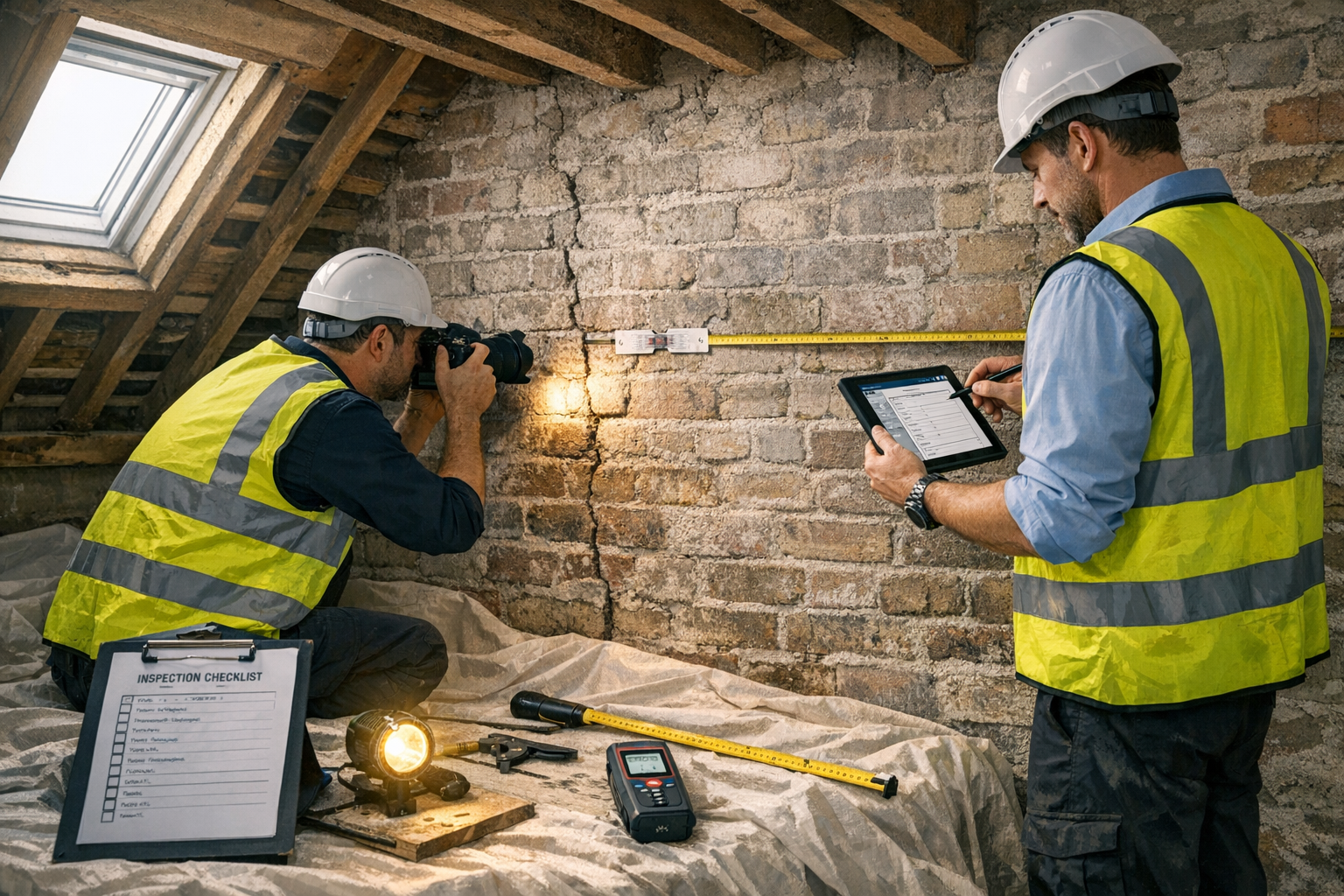
🔍 Preparing Schedules of Condition
Surveyors document the existing condition of both properties before work begins, creating detailed schedules of condition that include:
- Photographic records of all relevant areas
- Written descriptions of existing defects
- Measurements and technical assessments
- Documentation of finishes and materials
These schedules provide crucial evidence if disputes arise about damage caused by the works[4].
📋 Drafting Party Wall Awards
When neighbours dissent or don't respond to notices, surveyors prepare party wall awards—legally binding documents that specify:
- The works to be undertaken
- When and how work will proceed
- Access arrangements for inspections
- Security for expenses (if required)
- Dispute resolution procedures
Awards must be served on both parties and become enforceable once issued.
During Construction
🏗️ Monitoring Works
Surveyors conduct periodic inspections to ensure:
- Work proceeds according to the award specifications
- Construction methods don't exceed agreed parameters
- Proper care is taken to minimize disruption
- Safety measures protect adjoining properties
🤝 Mediating Issues
When concerns arise during construction, surveyors mediate between parties to find practical solutions that protect everyone's interests while allowing work to continue.
Post-Construction Duties
🔎 Final Inspections
After completion, surveyors inspect both properties to:
- Compare conditions against pre-construction schedules
- Identify any damage caused by the works
- Determine appropriate remedial measures
- Verify compliance with the award terms
💰 Determining Compensation
If damage has occurred, surveyors assess appropriate compensation or specify remedial works the building owner must undertake.
Surveyor Qualifications and Selection
While the Party Wall Act doesn't mandate specific qualifications for surveyors, experienced professionals typically hold:
- RICS membership (Royal Institution of Chartered Surveyors)
- Specialist party wall qualifications or certifications
- Professional indemnity insurance
- Extensive experience with party wall matters
When selecting a surveyor, consider:
✓ Their experience with loft conversions specifically
✓ Knowledge of local construction practices (particularly important in London)
✓ Professional memberships and qualifications
✓ Availability and responsiveness
✓ Fee structures and transparency
Regional expertise matters—a party wall surveyor in North London may have different experience than one practicing in South London, East London, West London, or Central London.
Cost Considerations for Party Wall Procedures in Loft Conversions
Understanding the financial implications of party wall procedures helps building owners budget appropriately for their loft conversion projects.
Who Pays for Party Wall Procedures?
Under the Party Wall Act, the building owner typically pays all reasonable costs associated with party wall procedures, including:
- Their own surveyor's fees
- The adjoining owner's surveyor's fees (if appointed)
- The third surveyor's fees (if required)
- Costs of preparing schedules of condition
- Legal fees for drafting awards
This cost allocation applies even when neighbours object to the works, as the Act recognizes that the building owner initiated the process.
Typical Cost Ranges for 2026
Party wall costs for loft conversions vary based on project complexity and location:
| Service | Typical Cost Range (2026) |
|---|---|
| Agreed surveyor (simple case) | £700 – £1,200 |
| Building owner's surveyor | £800 – £1,500 |
| Adjoining owner's surveyor | £600 – £1,200 |
| Schedule of condition (per property) | £300 – £600 |
| Party wall award preparation | £400 – £800 |
| Third surveyor fees (if required) | £500 – £1,000 |
Complex loft conversions affecting multiple neighbours or involving extensive structural work may incur higher costs. For detailed cost breakdowns, review the costs of party wall the process.
Strategies to Minimize Party Wall Costs
Building owners can reduce party wall expenses by:
💡 Maintaining good neighbour relations to encourage agreed surveyor appointments
💡 Serving notices promptly to avoid rushed procedures
💡 Providing comprehensive information upfront to minimize back-and-forth
💡 Choosing experienced surveyors who work efficiently
💡 Planning work carefully to minimize party wall involvement
For additional cost-saving strategies, see our guide on how to keep party wall costs down.
Common Mistakes and Misconceptions About Party Wall Act Triggers
Several misunderstandings frequently cause problems for homeowners undertaking loft conversions.
Misconception 1: "My Architect Will Handle Party Wall Matters"
While architects design loft conversions, they typically don't manage party wall procedures. Building owners remain responsible for ensuring compliance, though architects should flag party wall implications during the design phase[6].
Misconception 2: "I Can Start Work While Waiting for Agreement"
You must not start works covered by the Party Wall Act before reaching agreement with your neighbour or obtaining a party wall award[2]. Starting work prematurely can result in:
- Injunctions stopping construction
- Liability for all costs incurred by neighbours
- Difficulty obtaining insurance coverage for damage
- Strained relationships that complicate future procedures
Misconception 3: "Small Works Don't Require Notices"
The Act contains no minimum threshold for notifiable works. Even minor interventions like inserting a small steel beam or cutting a single pocket into a party wall require proper notification[6].
Misconception 4: "Good Relationships Mean I Don't Need Formal Procedures"
While positive neighbour relations help immensely, they don't eliminate legal requirements. Formal procedures protect both parties by:
- Documenting existing conditions
- Establishing clear expectations
- Providing dispute resolution mechanisms
- Creating legal records of agreements
Misconception 5: "Party Wall Agreements Prevent All Disputes"
Party wall procedures minimize disputes but don't eliminate them entirely. However, proper documentation and professional surveyor involvement significantly reduce conflict likelihood and provide clear resolution pathways when issues arise.
Practical Checklist for Loft Conversion Party Wall Compliance
Use this checklist to ensure your loft conversion project complies with Party Wall Act requirements:
Planning Stage
- Review architectural plans with party wall implications in mind
- Identify all party wall triggers (steel beams, chimney removal, etc.)
- Determine which neighbours require notification
- Research and select qualified party wall surveyor(s)
- Factor party wall timeline (minimum 2 months) into project schedule
- Budget for party wall costs (surveyors, awards, schedules)
Notice Stage
- Prepare comprehensive party wall notices with all required information
- Include detailed architectural drawings showing proposed works
- Serve notices at least 2 months before intended start date
- Keep proof of service (recorded delivery receipts, etc.)
- Track neighbour response deadlines (14 days)
- Respond promptly to any questions or concerns raised
Surveyor Appointment Stage
- Appoint building owner's surveyor (or agreed surveyor)
- Request adjoining owner appoint their surveyor (if applicable)
- Ensure surveyors are appropriately qualified and insured
- Provide surveyors with complete project documentation
- Clarify fee structures and payment arrangements
- Establish communication protocols with surveyors
Pre-Construction Stage
- Arrange schedule of condition inspections
- Review draft party wall award before finalization
- Ensure award accurately reflects planned works
- Serve finalized award on all parties
- Arrange access for any required pre-construction surveys
- Confirm insurance coverage for party wall matters
Construction Stage
- Do not commence work until notice period expires and agreement reached
- Provide surveyors with construction schedule and contact details
- Facilitate surveyor inspections as required
- Report any deviations from planned works immediately
- Document any issues or concerns as they arise
- Maintain open communication with neighbours throughout
Post-Construction Stage
- Arrange final surveyor inspections
- Compare conditions against pre-construction schedules
- Address any identified damage promptly
- Obtain final sign-off from surveyors
- Settle all outstanding surveyor fees
- Retain all party wall documentation for future reference
Regional Considerations for London Loft Conversions
London presents unique party wall considerations due to:
🏘️ High-density housing with extensive shared walls
🏘️ Victorian and Edwardian terraces with complex party wall arrangements
🏘️ Property values that make thorough documentation especially important
🏘️ Diverse ownership structures including leasehold complications
London homeowners should work with surveyors experienced in their specific area, whether in North London, South London, East London, West London, or Central London.
Conclusion
Understanding Party Wall Act triggers for loft conversions, notice requirements, and surveyor roles in 2026 is essential for successful project completion without legal complications or neighbour disputes. Steel beam insertion remains the most common trigger, but chimney removal, underpinning, wall modifications, and other structural interventions also activate the Act's requirements.
The two-month minimum notice period demands early planning and proactive communication with neighbours. Party wall surveyors provide invaluable expertise in documenting existing conditions, mediating potential conflicts, and ensuring compliance with legal requirements throughout the construction process.
Next Steps for Your Loft Conversion Project
- Assess your plans for party wall triggers using the information in this guide
- Consult with qualified professionals including architects and party wall surveyors early in the planning process
- Engage with neighbours proactively to establish positive working relationships
- Serve notices promptly with comprehensive documentation and realistic timelines
- Budget appropriately for party wall costs as part of your overall project expenses
- Document everything to protect your interests and maintain clear records
By following proper procedures and working with experienced professionals, loft conversion projects can proceed smoothly while maintaining positive neighbour relations and full legal compliance. The Party Wall Act exists to protect everyone's interests—embrace it as a framework for successful construction rather than an obstacle to overcome.
For additional guidance on your specific situation, consult with qualified party wall surveyors who can provide tailored advice based on your property, location, and planned works. Proper planning and professional support transform party wall procedures from potential complications into straightforward administrative steps in your loft conversion journey.
References
[1] Party Wall Agreement Loft Conversion – https://www.houseup.co.uk/news/party-wall-agreement-loft-conversion
[2] Party Wall Agreement – https://hoa.org.uk/advice/guides-for-homeowners/i-am-improving/party-wall-agreement/
[3] Party Wall Surveyor Loft Conversion – https://biggerlivinglofts.com/blog/party-wall-surveyor-loft-conversion
[4] Schedules Of Condition In Party Wall Works Best Practices To Prevent Post Construction Claims In 2026 – https://nottinghillsurveyors.com/blog/schedules-of-condition-in-party-wall-works-best-practices-to-prevent-post-construction-claims-in-2026
[5] Party Wall Agreements What You Need To Know – https://www.fmb.org.uk/find-a-builder/ultimate-guides-to-home-renovation/party-wall-agreements-what-you-need-to-know.html
[6] Party Wall Act Misunderstandings London – https://www.houricanassociates.com/party-wall-news/party-wall-act-misunderstandings-london/
[7] Party Wall Agreements A Guide For Homeowners Planning Extensions – https://hfwjsurveyors.com/advice-insights/party-wall-agreements-a-guide-for-homeowners-planning-extensions/