


Nearly 40% of party wall disputes in England and Wales arise from disagreements over pre-existing damage versus construction-related harm. This staggering statistic reveals a critical vulnerability in property development: without comprehensive pre-work documentation, building owners face costly legal battles and inflated damage claims that could have been entirely prevented. Schedules of Condition in Party Wall Agreements: Best Practices for 2026 Pre-Work Documentation have become the essential shield protecting property owners from false allegations and financial exposure.
The Party Wall etc. Act 1996 establishes clear requirements for documenting property conditions before construction begins. Yet many building owners still underestimate the importance of thorough pre-work surveys, only to discover their oversight when facing substantial repair bills for damage they didn't cause. In 2026, with construction activity rebounding and property values at historic highs, the financial stakes have never been greater.
This comprehensive guide explores the critical role of Schedules of Condition within party wall procedures, detailing the documentation standards, photography protocols, and legal protections that safeguard both building and adjoining owners throughout the construction process.
Key Takeaways
- Mandatory documentation: Schedules of Condition are required for all notifiable party wall works under the Party Wall etc. Act 1996, protecting building owners from false damage claims
- Comprehensive coverage: Pre-work surveys must document all neighbouring properties potentially affected by construction, not just immediately adjacent buildings
- Digital standards: High-resolution photography with timestamps, GPS metadata, and detailed written reports form the foundation of legally defensible documentation
- Cost protection: Thorough pre-work surveys typically save building owners £3,000-£15,000 in disputed damage claims and legal fees
- Dual inspection requirement: Both pre-works and post-works inspections establish clear causation for any construction-related damage

Understanding Schedules of Condition in Party Wall Agreements
A Schedule of Condition represents a detailed snapshot of a property's physical state at a specific moment in time. Within the context of party wall procedures, this document serves as irrefutable evidence of pre-existing conditions before construction activities commence.[2]
What Constitutes a Schedule of Condition?
A legally robust Schedule of Condition comprises two essential components:
Written Documentation
- Detailed descriptions of all visible defects, cracks, stains, and structural conditions
- Room-by-room assessments focusing on areas adjacent to proposed works
- Measurements of existing cracks and settlement patterns
- Notes on material conditions, finishes, and decorative states
- Documentation of existing repairs or previous damage
Photographic Evidence
- High-resolution digital images of all documented areas
- Multiple angles of walls, ceilings, floors, and architectural features
- Close-up shots of existing defects with measurement references
- External elevations and boundary structures
- Timestamp and location metadata embedded in image files[3]
Legal Framework and Requirements
The Party Wall etc. Act 1996 doesn't explicitly mandate Schedules of Condition in its statutory text. However, established legal precedent and professional practice have made these surveys an essential component of the party wall award process.[3]
Mandatory Circumstances
A Schedule of Condition becomes necessary when building owners intend to undertake:
✅ Works directly to a party wall or party structure
✅ Excavations within 3 metres of a neighbouring building where works go deeper than the neighbour's foundations
✅ Excavations within 6 metres where works extend below a 45-degree plane from the neighbour's foundation base
✅ Construction of new walls at or astride the boundary line[3]
Protection for All Parties
The Schedule of Condition provides balanced protection within the party wall relationship:
For Building Owners:
- Establishes baseline conditions preventing exaggerated claims
- Provides evidence against allegations of damage from pre-existing conditions
- Reduces insurance premiums and contractor liability concerns
- Streamlines dispute resolution processes[2]
For Adjoining Owners:
- Documents property condition before potentially disruptive works
- Creates accountability mechanisms for construction damage
- Establishes clear remediation pathways if damage occurs
- Provides peace of mind throughout the construction period
Understanding the different types of party wall works helps property owners identify when comprehensive condition documentation becomes essential.
Best Practices for 2026 Pre-Work Documentation Standards
The evolution of digital technology and professional standards has transformed Schedule of Condition protocols. In 2026, best practices demand significantly higher documentation quality than previous years, reflecting both technological capabilities and legal expectations.
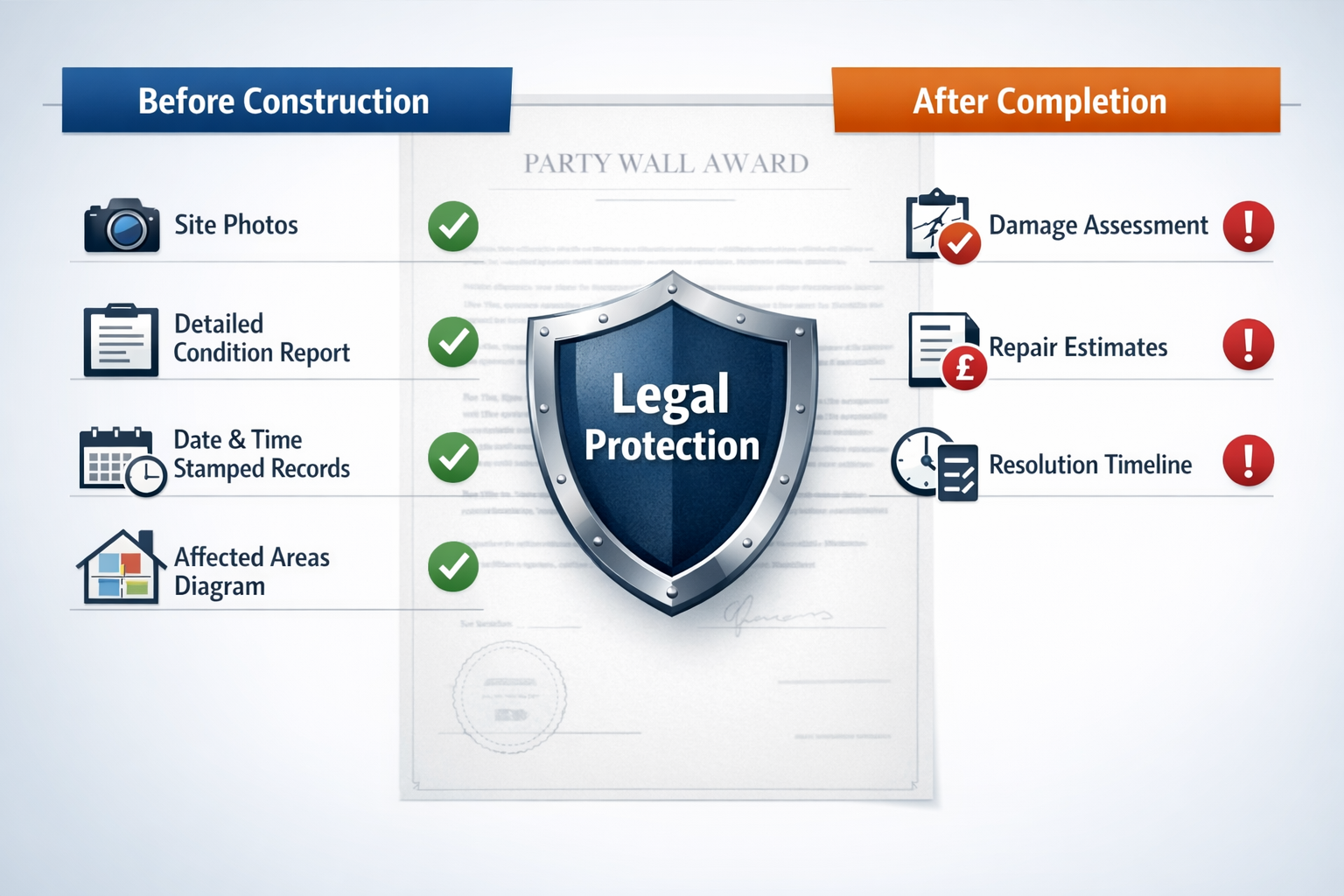
Comprehensive Property Coverage
Scope of Documentation
The Schedule of Condition must extend beyond immediately adjacent properties to encompass all structures potentially affected by the proposed works.[3] This comprehensive approach includes:
| Property Type | Documentation Requirements |
|---|---|
| Directly Adjacent | Full internal and external survey of all rooms sharing or near the party wall |
| Within 3 Metres | External elevations, foundations, structural elements, and internal areas facing work site |
| Within 6 Metres | External structural assessment, foundation zones, and vulnerable architectural features |
| Across the Street | External elevations if excavation or vibration impact is possible |
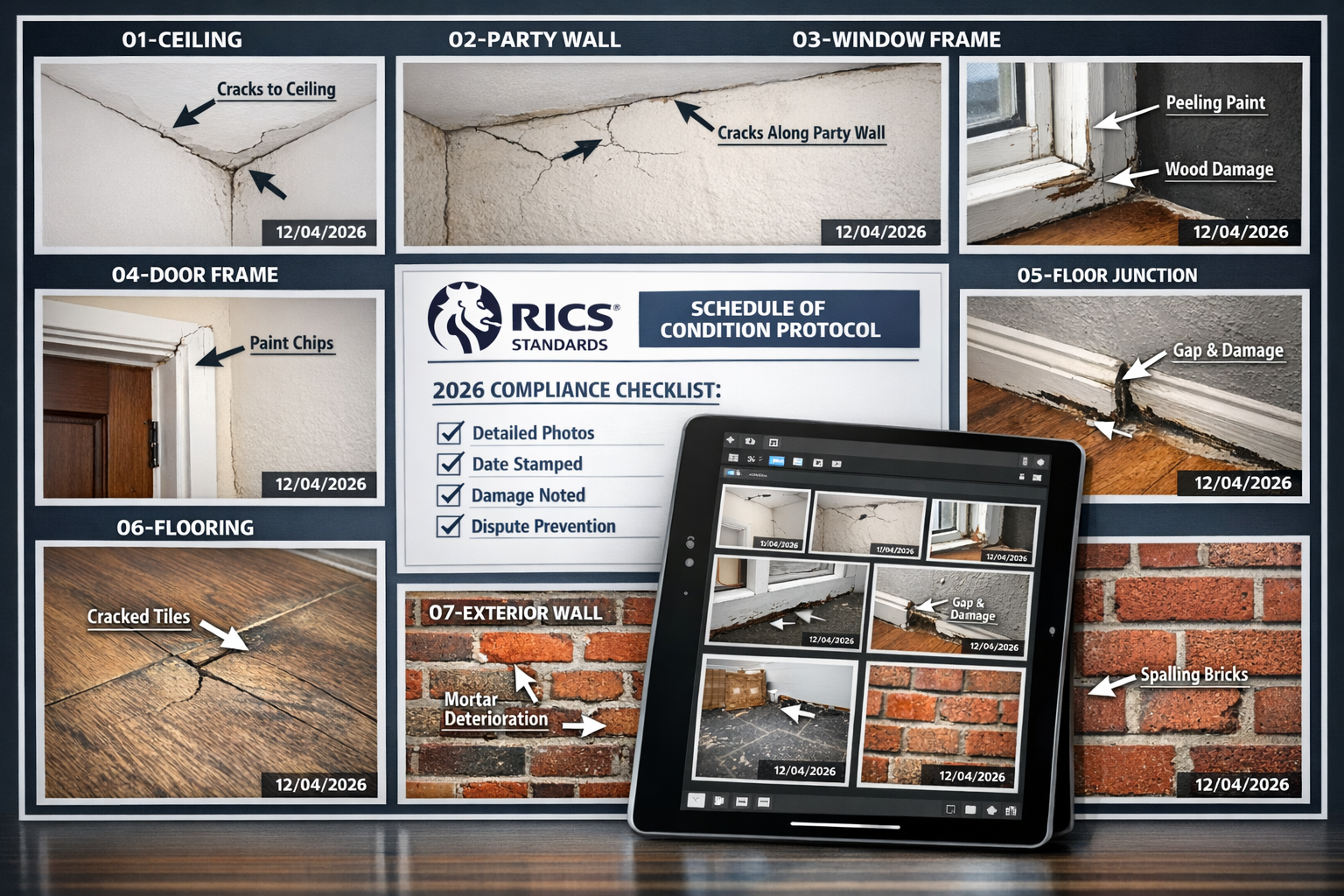
Digital Photography Protocols for 2026
Modern Schedules of Condition leverage advanced digital photography techniques that provide unprecedented detail and legal defensibility.
Technical Requirements:
📷 Resolution: Minimum 12 megapixels for general shots, 24+ megapixels for detail documentation
📷 Metadata: Embedded GPS coordinates, timestamp, camera settings, and photographer identification
📷 Lighting: Consistent natural or supplementary lighting to reveal surface conditions accurately
📷 Scale References: Measurement tools or reference objects in frame for size context
📷 File Management: Organized folder structures with clear naming conventions and backup protocols
Coverage Standards:
Each room or area requires systematic documentation:
- Wide-angle establishing shots showing overall room layout and relationship to party wall
- Mid-range photographs of each wall surface, ceiling, and floor area
- Close-up detail shots of existing cracks, stains, settlement, or defects
- Corner and junction documentation where walls meet ceilings and floors
- Architectural feature details including windows, doors, cornices, and decorative elements
Written Report Standards
The photographic evidence must be complemented by comprehensive written documentation that provides context and interpretation.[2]
Essential Report Elements:
Executive Summary
- Property addresses and ownership details
- Date and time of inspection
- Weather conditions and access limitations
- Overall condition assessment
Room-by-Room Analysis
- Detailed descriptions of observed conditions
- Cross-references to photographic evidence
- Measurements of significant defects
- Assessment of structural versus cosmetic issues
Risk Assessment
- Identification of vulnerable areas based on proposed works
- Prediction of potential impact zones
- Recommendations for protective measures
- Monitoring suggestions during construction
Professional Certification
- Surveyor qualifications and professional memberships
- Declaration of independence and impartiality
- Signature and professional seal
- Contact information for queries
Timeline and Notice Requirements
Proper sequencing of documentation within the party wall process ensures legal compliance and maximum protection.
Critical Timeline:
8-12 Weeks Before Construction:
- Review building plans with party wall surveyor
- Identify all potentially affected properties
- Prepare for comprehensive condition surveys
6-8 Weeks Before Construction:
- Serve party wall notices (minimum 2 months for party wall works, 1 month for excavation works)[4]
- Begin scheduling condition survey appointments
4-6 Weeks Before Construction:
- Conduct Schedule of Condition inspections
- Compile photographic and written documentation
- Prepare draft reports for review
2-4 Weeks Before Construction:
- Finalize Schedule of Condition reports
- Incorporate into Party Wall Award documentation
- Distribute copies to all parties
- Obtain acknowledgment of receipt
The formal notice requirements create a structured timeline that protects all parties. Understanding how to respond to party wall notices helps adjoining owners navigate this process effectively.
Cost Savings and Risk Mitigation Through Thorough Surveys
The financial implications of comprehensive pre-work documentation extend far beyond the initial survey costs. Building owners who invest in thorough Schedules of Condition consistently realize substantial savings through dispute avoidance and streamlined resolution processes.
Financial Analysis: Investment vs. Risk Exposure
Typical Schedule of Condition Costs (2026):
| Property Type | Survey Cost Range | Properties Covered |
|---|---|---|
| Single Adjoining Property | £450-£750 | 1 property, standard documentation |
| Multiple Properties | £1,200-£2,500 | 2-4 properties, comprehensive coverage |
| Complex Developments | £3,000-£6,000 | 5+ properties, detailed risk assessment |
Potential Dispute Costs Without Proper Documentation:
💰 Legal fees for dispute resolution: £5,000-£15,000
💰 Expert witness costs: £2,000-£8,000
💰 Inflated damage repair claims: £3,000-£25,000
💰 Project delays and contractor standby time: £1,000-£10,000 per week
💰 Relationship damage and ongoing neighbour conflicts: Incalculable
The cost-benefit analysis overwhelmingly favors comprehensive pre-work documentation. A £2,000 investment in thorough Schedules of Condition routinely prevents £15,000-£50,000 in dispute-related expenses.[2]
Risk Mitigation Strategies
Enhanced Documentation Approaches:
Video Walkthroughs
Supplementing still photography with video documentation provides additional context and captures dynamic conditions like existing movement or structural behaviour. Video files should include:
- Continuous room-to-room progression
- Verbal commentary describing observations
- Close-up panning across defect areas
- Timestamp and location verification
Specialist Assessments
For properties with unique features or heightened vulnerability, specialist surveys enhance protection:
- Structural engineer assessments for buildings with existing movement
- Heritage consultant documentation for listed buildings
- Vibration monitoring baseline readings for sensitive structures
- Drainage surveys for properties with potential subsidence risks
Regular Monitoring Protocols
Establishing interim inspection schedules during construction provides early warning of developing issues:
- Weekly visual inspections during high-risk work phases
- Monthly formal documentation updates
- Immediate investigation of any reported concerns
- Photographic comparison against baseline documentation
Integration with Party Wall Awards
Once completed, the Schedule of Condition becomes an integral component of the formal Party Wall Award, the legally binding document that governs how works proceed.[3]
Award Integration Requirements:
The Schedule of Condition should be:
- Appended as a formal schedule to the main Award document
- Referenced explicitly in the Award's terms and conditions
- Acknowledged by all parties as the baseline for damage assessment
- Accessible to contractors to inform their working methods and protection measures
This integration ensures that the pre-work documentation carries full legal weight throughout the construction process and any subsequent dispute resolution.
Post-Work Inspection Protocols
The Schedule of Condition process remains incomplete without thorough post-construction verification.[3]
Post-Work Inspection Requirements:
Timing: Conduct final inspection within 2-4 weeks of construction completion
Methodology:
- Systematic comparison against pre-work documentation
- Photography using identical angles and positions
- Detailed written analysis of any changes
- Classification of damage as construction-related or unrelated
Damage Assessment Process:
If new damage is identified:
- Documentation: Photograph and describe all new defects
- Causation Analysis: Determine whether damage resulted from notifiable works
- Remediation Options: Present adjoining owner with repair choices
- Contractor Rectification: Allow building owner's contractor to make good, or
- Independent Quotes: Obtain repair estimates with costs borne by building owner[3]
Understanding how to keep party wall costs down includes recognizing that thorough pre-work documentation prevents the most expensive disputes.
Professional Standards and Surveyor Selection
The quality of a Schedule of Condition directly correlates with the expertise and professionalism of the surveyor conducting the assessment. In 2026, property owners should apply rigorous selection criteria when appointing party wall surveyors.
RICS Standards and Professional Qualifications
Essential Qualifications:
🎓 RICS Membership: Royal Institution of Chartered Surveyors (MRICS or FRICS designation)
🎓 Specialist Experience: Demonstrated party wall expertise with Schedule of Condition portfolio
🎓 Professional Indemnity Insurance: Minimum £2 million coverage for 2026
🎓 Continuing Professional Development: Current knowledge of legal precedents and best practices
🎓 Local Expertise: Familiarity with regional construction methods and property types
Surveyor Responsibilities in Documentation
A competent party wall surveyor approaches Schedule of Condition preparation with systematic rigor:
Pre-Inspection Preparation:
- Thorough review of building plans and proposed works
- Identification of high-risk areas requiring enhanced documentation
- Coordination with all parties for access arrangements
- Preparation of inspection checklists and documentation templates[3]
On-Site Inspection:
- Systematic room-by-room progression
- Real-time note-taking and defect identification
- Comprehensive photographic documentation
- Engagement with property occupants to understand history
- Professional conduct and respect for occupied properties
Report Preparation:
- Timely compilation of findings (typically within 10-14 days)
- Clear, objective language avoiding advocacy
- Professional formatting with logical organization
- Quality control review before distribution
Whether you need a building owner's surveyor or an adjoining owner's surveyor, professional qualifications should guide your selection.
Geographic Considerations
Party wall requirements apply throughout England and Wales, but local construction characteristics influence documentation approaches.[4]
London-Specific Considerations:
London's dense Victorian and Edwardian housing stock presents unique challenges:
- Terraced properties with multiple party walls
- Basement excavations in areas with high water tables
- Listed building considerations in conservation areas
- Complex ownership structures in converted flats
Regional expertise matters significantly. Property owners in the capital should consider specialists like a party wall surveyor in Central London, North London, South London, East London, or West London depending on project location.
Common Pitfalls and How to Avoid Them
Even experienced property developers occasionally make errors that compromise the effectiveness of Schedules of Condition. Awareness of these common mistakes enables proactive avoidance.
Documentation Deficiencies
❌ Insufficient Photographic Coverage
- Problem: Gaps in documentation create ambiguity about pre-existing conditions
- Solution: Follow systematic room-by-room protocols with overlapping coverage
❌ Poor Image Quality
- Problem: Low-resolution or poorly lit photographs fail to reveal critical details
- Solution: Use professional equipment with proper lighting and minimum 12MP resolution
❌ Missing Metadata
- Problem: Images without timestamps or location data lack legal credibility
- Solution: Ensure camera settings preserve EXIF data; verify metadata before finalizing reports
Scope and Coverage Errors
❌ Limited Property Assessment
- Problem: Documenting only immediately adjacent properties while ignoring others within the zone of influence
- Solution: Conduct thorough risk assessment identifying all potentially affected structures[3]
❌ External-Only Documentation
- Problem: Failing to document internal conditions leaves vulnerability to interior damage claims
- Solution: Obtain access to all affected properties for comprehensive internal surveys
Timing and Process Failures
❌ Late Documentation
- Problem: Conducting surveys after construction has commenced eliminates baseline evidence
- Solution: Complete all Schedules of Condition before any site mobilization or preliminary works
❌ Inadequate Post-Work Inspection
- Problem: Failing to conduct comparative post-construction surveys prevents damage causation determination
- Solution: Schedule final inspections within 2-4 weeks of completion using identical methodology[3]
Communication Breakdowns
❌ Insufficient Stakeholder Engagement
- Problem: Poor communication with adjoining owners creates suspicion and resistance
- Solution: Provide clear explanations of the Schedule of Condition purpose and process
❌ Contractor Exclusion
- Problem: Failing to share documentation with construction teams leads to preventable damage
- Solution: Distribute Schedule of Condition reports to contractors with briefing on vulnerable areas
For those carrying out works or neighbours affected by construction, understanding these pitfalls prevents costly mistakes.
Emerging Technologies and Future Trends
The Schedule of Condition process continues to evolve as new technologies enhance documentation capabilities and legal standards adapt to digital innovations.
Digital Innovation in 2026
3D Laser Scanning
Advanced LIDAR technology creates precise three-dimensional models of properties, capturing:
- Millimeter-accurate measurements of all surfaces
- Comprehensive spatial relationships
- Detailed defect mapping
- Interactive digital models for comparison analysis
Drone Photography
Unmanned aerial vehicles enable documentation of previously difficult-to-access areas:
- Roof conditions and chimney stacks
- Upper-level external elevations
- Overall site context and relationships
- Efficient multi-property surveys
Cloud-Based Documentation Platforms
Specialized software systems streamline the Schedule of Condition process:
- Real-time photo uploads with automatic metadata preservation
- Collaborative annotation and reporting tools
- Secure access for all authorized parties
- Automated comparison algorithms for post-work analysis
Regulatory Developments
While the Party Wall etc. Act 1996 remains the statutory foundation, professional standards continue to evolve:
Enhanced Professional Guidelines
RICS and other professional bodies regularly update guidance on:
- Digital documentation standards
- Cybersecurity and data protection requirements
- Professional competence frameworks
- Dispute resolution protocols
Case Law Evolution
Recent legal decisions continue to refine expectations around:
- Standard of proof for damage causation
- Reasonable documentation requirements
- Surveyor duties and liabilities
- Remediation cost assessment methodologies
Practical Implementation Checklist
Property owners preparing for party wall works should follow this systematic approach to Schedule of Condition implementation:
For Building Owners
8-12 Weeks Before Construction:
- ✅ Engage qualified party wall surveyor with RICS credentials
- ✅ Review construction plans to identify all notifiable works
- ✅ Prepare property list of all potentially affected neighbours
- ✅ Budget for comprehensive Schedule of Condition surveys
6-8 Weeks Before Construction:
- ✅ Serve formal party wall notices with appropriate lead times
- ✅ Coordinate with surveyor to schedule condition surveys
- ✅ Prepare contractor briefing materials on protection requirements
4-6 Weeks Before Construction:
- ✅ Facilitate property access for condition surveys
- ✅ Review draft Schedule of Condition reports
- ✅ Address any documentation gaps or concerns
2-4 Weeks Before Construction:
- ✅ Ensure Schedule of Condition incorporated into Party Wall Award
- ✅ Distribute documentation to contractors
- ✅ Establish monitoring and communication protocols
- ✅ Confirm post-work inspection scheduling
During Construction:
- ✅ Maintain regular communication with adjoining owners
- ✅ Conduct interim inspections if significant concerns arise
- ✅ Document any incidents or reported issues immediately
After Construction:
- ✅ Schedule post-work inspections within 2-4 weeks of completion
- ✅ Compare conditions against baseline documentation
- ✅ Address any identified damage promptly and professionally
- ✅ Obtain final sign-off from all parties
For Adjoining Owners
Upon Receiving Party Wall Notice:
- ✅ Review notice carefully and seek professional advice if needed
- ✅ Understand your rights regarding Schedule of Condition
- ✅ Respond within 14-day statutory period[4]
- ✅ Consider appointing your own surveyor if concerns exist
During Survey Process:
- ✅ Facilitate reasonable access for condition documentation
- ✅ Point out existing defects or concerns to surveyor
- ✅ Request copies of all photographic evidence
- ✅ Review Schedule of Condition report thoroughly
Throughout Construction:
- ✅ Monitor works and report any immediate concerns
- ✅ Maintain photographic records of any observed issues
- ✅ Communicate through proper channels (surveyors, not directly with contractors)
- ✅ Document any disruption or access issues
Post-Construction:
- ✅ Participate in final inspection process
- ✅ Identify any new damage or changes
- ✅ Engage constructively in remediation discussions
- ✅ Seek professional advice if disputes arise
Understanding boundary wall rules and party fence wall definitions helps adjoining owners understand their rights and responsibilities.
Conclusion
Schedules of Condition in Party Wall Agreements: Best Practices for 2026 Pre-Work Documentation represent far more than bureaucratic formality—they constitute essential protection mechanisms that safeguard property values, prevent disputes, and ensure fair treatment for all parties in construction projects. The comprehensive documentation standards outlined in this guide reflect both legal requirements and professional best practices that have evolved through decades of party wall jurisprudence.
The financial case for thorough pre-work documentation remains overwhelming. A relatively modest investment of £450-£6,000 in professional Schedule of Condition surveys routinely prevents £15,000-£50,000 in dispute costs, legal fees, and inflated damage claims. Beyond the monetary considerations, comprehensive documentation preserves neighbourly relationships and enables construction projects to proceed with confidence and clarity.
Key Success Factors
The most effective Schedule of Condition implementations share common characteristics:
🏆 Professional Expertise: Engagement of qualified RICS surveyors with demonstrated party wall experience
🏆 Comprehensive Coverage: Documentation of all potentially affected properties, not just immediate neighbours
🏆 Technical Excellence: High-resolution digital photography with proper metadata and systematic coverage
🏆 Timely Execution: Completion before any construction activity commences
🏆 Clear Communication: Transparent engagement with all stakeholders throughout the process
🏆 Post-Work Verification: Comparative inspections establishing clear causation for any damage
Taking Action
Property owners planning construction works involving party walls should begin the Schedule of Condition process immediately:
Immediate Next Steps:
- Assess Your Project: Review plans to identify all notifiable works under the Party Wall etc. Act 1996
- Engage Professional Support: Contact qualified party wall surveyors for initial consultation
- Plan Your Timeline: Work backward from construction start date to ensure adequate documentation time
- Budget Appropriately: Allocate sufficient funds for comprehensive condition surveys
- Communicate Proactively: Inform neighbours early about planned works and documentation process
For those seeking professional guidance, exploring comprehensive schedule of condition services provides access to qualified specialists who can navigate the complexities of pre-work documentation.
The party wall process, when approached with diligence and professionalism, protects everyone involved. Building owners gain legal protection and project certainty. Adjoining owners receive assurance that their properties will be documented and protected. Contractors work with clear parameters and accountability mechanisms. The modest investment in comprehensive Schedules of Condition delivers returns that extend far beyond individual projects, contributing to a construction environment characterized by fairness, transparency, and mutual respect.
As construction activity continues to accelerate in 2026, the importance of rigorous pre-work documentation will only increase. Property owners who embrace best practices in Schedule of Condition preparation position themselves for successful projects free from the disputes and delays that plague inadequately documented construction works. The choice is clear: invest in comprehensive documentation now, or risk substantially greater costs when disputes inevitably arise.
References
[1] Party Wall Agreement – https://hoa.org.uk/advice/guides-for-homeowners/i-am-improving/party-wall-agreement/
[2] Schedule Of Condition – https://westvilleassociates.com/party-wall-surveyor/schedule-of-condition
[3] Schedule Of Condition – https://stokemont.com/advice/schedule-of-condition/
[4] Schedules Of Condition For Tenants Why They Matter – https://www.adamjoseph.co.uk/schedules-of-condition-for-tenants-why-they-matter