

Recent court rulings have fundamentally reshaped how party wall surveyors navigate the tension between serving their appointing owners and protecting the statutory rights of all parties. Between 2010 and 2023, at least five landmark cases have expanded adjoining owner protections while simultaneously clarifying the strict boundaries of surveyor authority—creating a complex landscape where balancing client duties and adjoining owner rights: evolving case law for party wall surveyors has become the profession's most pressing challenge in 2026.
The Party Wall etc. Act 1996 establishes surveyors as quasi-judicial figures who must maintain impartiality while being appointed and paid by one party. This inherent tension has intensified as courts have broadened interpretations of adjoining owner protections, particularly regarding security for expenses, damage compensation, and procedural rights. For surveyors working across London—from Central London to North London—understanding these evolving legal precedents is no longer optional but essential for professional practice.
Key Takeaways
- 🏛️ Kaye v Lawrence (2010) expanded adjoining owner rights to claim security for excavation works entirely on the building owner's land, not just works touching the party structure
- ⚖️ Surveyor impartiality is legally mandated under Section 7(2), requiring strict independence despite being appointed by one party
- 📋 Power & Kyson v Shah (2023) clarified that statutory procedures supersede common law rights once properly invoked
- 🔍 Draft awards cannot be shared with either party before formal service to maintain procedural integrity
- 💰 Damage compensation mechanisms established in case law provide clear frameworks for making good structural and decorative harm
Understanding the Legal Framework: Balancing Client Duties and Adjoining Owner Rights
The Statutory Foundation
The Party Wall etc. Act 1996 creates a unique legal mechanism where surveyors function as impartial tribunals rather than traditional advocates. Section 7(2) explicitly requires surveyors to act with "due diligence" and make awards that are "just and equitable." This statutory language establishes surveyors as decision-makers who must weigh competing interests rather than simply advance their appointing owner's position [7].
This framework differs fundamentally from typical professional relationships. While an adjoining owner's surveyor is appointed and compensated by the adjoining owner, they cannot act as that party's advocate. Similarly, building owner surveyors must resist pressure to minimize protections or rush procedures.
When Statutory Rights Arise
A critical development in balancing client duties and adjoining owner rights: evolving case law for party wall surveyors came from Court of Appeal rulings establishing that adjoining owner protections only commence once proper notice is served. Before notice, adjoining owners retain common law remedies including trespass and nuisance claims, but cannot invoke the Act's procedures [2].
This creates an important strategic consideration: building owners trigger the statutory process. Adjoining owners cannot unilaterally appoint surveyors, make awards, or impose Party Wall Act procedures on building owners who haven't served notice [6]. Understanding this procedural gateway helps surveyors advise clients on timing and approach.
The Scope of Surveyor Authority
Surveyors possess strictly limited jurisdiction. They can only determine matters "arising" under the Party Wall Act—specifically issues related to notifiable works described in Sections 1, 2, and 6 of the Act. Surveyors cannot rule on:
- General trespass disputes unrelated to notifiable works
- Planning permission conflicts
- Boundary disputes
- Nuisance claims outside the Act's scope
- Building regulation compliance [3]
This limitation protects surveyors from being drawn into broader neighbour disputes while ensuring their awards remain legally enforceable.
Landmark Cases Reshaping Balancing Client Duties and Adjoining Owner Rights
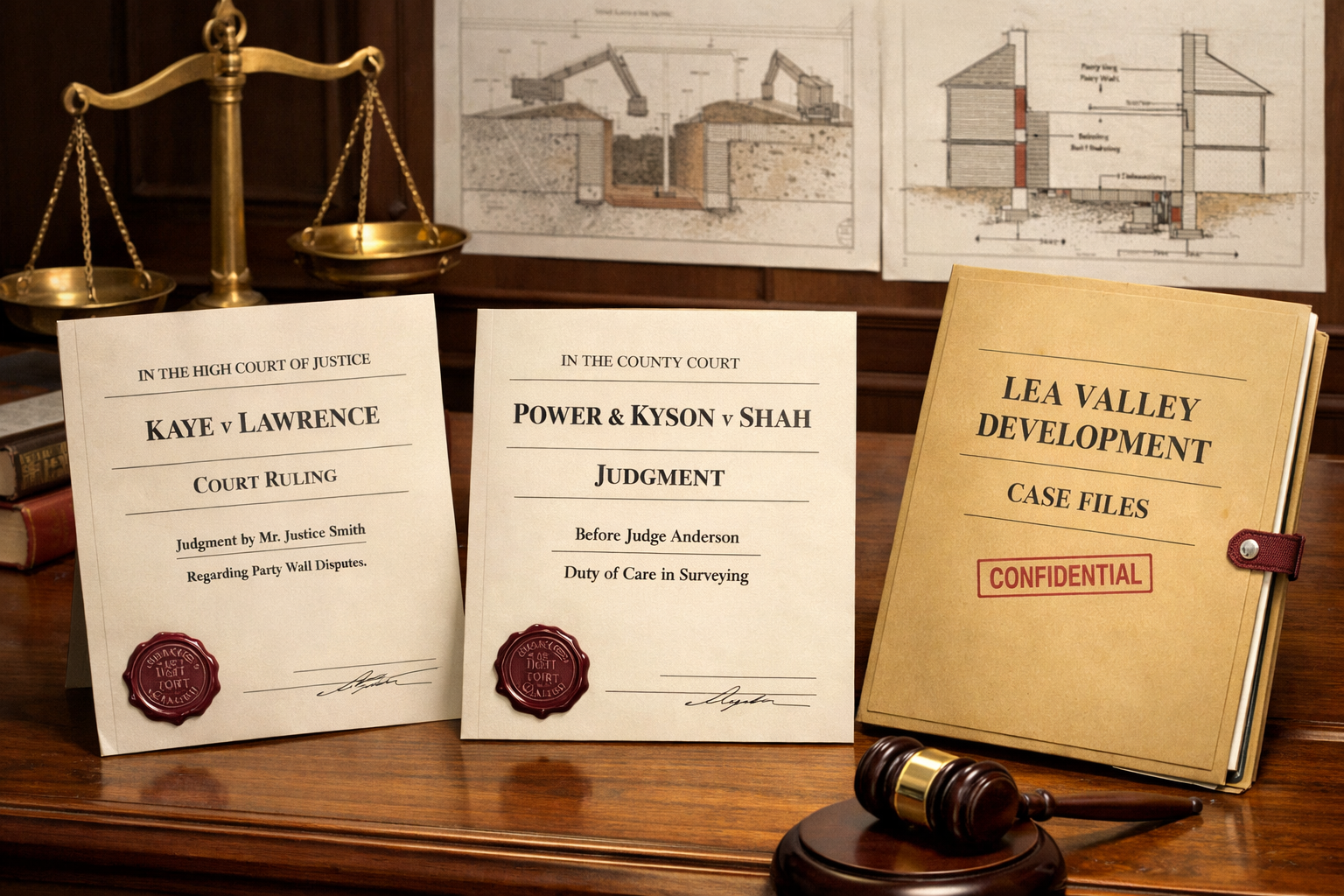
Kaye v Lawrence (2010): Expanding Security Rights
The Kaye v Lawrence decision fundamentally altered how surveyors assess security for expenses requests. Before this ruling, many practitioners believed adjoining owners could only claim security when works physically touched their property. The High Court rejected this narrow interpretation [1].
Mr Justice Ramsey held that surveyors must consider security requests for excavation works undertaken entirely on the building owner's land when those works create risks to the adjoining property. The court recognized that subsidence, vibration, and structural movement from nearby excavation can damage adjoining buildings even without physical contact [1].
Practical implications for surveyors:
- Assess excavation depth and proximity to adjoining foundations
- Consider soil conditions and water table effects
- Evaluate construction methodology and vibration risks
- Calculate appropriate security amounts based on potential repair costs
- Document risk assessment reasoning in awards
This broader interpretation means surveyors working on basement excavations across West London and East London must routinely consider security provisions even for works several meters from the boundary.
Power & Kyson v Shah (2023): Statutory vs Common Law Rights
This recent case clarified the relationship between Party Wall Act procedures and common law remedies—a crucial element of balancing client duties and adjoining owner rights: evolving case law for party wall surveyors [9].
The court accepted that once the Party Wall Act is properly invoked through valid notice, the statutory framework supplants common law rights for matters within the Act's scope. Adjoining owners cannot simultaneously pursue Party Wall procedures and common law remedies for the same works [9].
This ruling provides important clarity:
✅ Building owners retain common law rights for works outside the Act's scope
✅ Adjoining owners can pursue common law remedies before notice is served
✅ Once statutory procedures begin, they provide the exclusive framework for covered works
✅ Surveyors need not consider common law claims when determining awards for notifiable works
Lea Valley Development Limited v Derbyshire (2017): Damage Compensation
This case established practical frameworks for damage provisions in party wall awards. The court confirmed that surveyors should include clear mechanisms for addressing both structural and decorative damage caused by notifiable works [8].
Standard damage clause elements:
| Component | Purpose | Typical Provision |
|---|---|---|
| Making good obligation | Requires building owner to repair damage | "Building owner shall make good all damage…" |
| Payment in lieu option | Allows monetary compensation instead of repairs | "Or pay reasonable costs of making good…" |
| Surveyor determination | Provides dispute resolution mechanism | "Amount determined by surveyors if disputed…" |
| Time limits | Establishes reasonable completion periods | "Within 28 days of notification of damage…" |
These provisions protect adjoining owners while giving building owners flexibility in addressing damage. For surveyors, including comprehensive damage clauses demonstrates proper consideration of adjoining owner rights while maintaining workability for building owners.

Maintaining Impartiality While Serving Appointing Owners: Evolving Case Law for Party Wall Surveyors
The Independence Requirement
Section 7(2) of the Party Wall etc. Act 1996 requires surveyors to act with independence and impartiality. The Royal Institution of Chartered Surveyors emphasizes that party wall surveyors must function as impartial tribunals despite their appointment by one party [7].
This creates practical challenges. Appointing owners pay surveyor fees and naturally expect advocacy. However, surveyors who simply advance their client's position without genuinely considering the other party's rights risk:
- ⚠️ Awards being challenged and overturned in court
- ⚠️ Professional negligence claims
- ⚠️ Disciplinary action from professional bodies
- ⚠️ Damage to professional reputation
Strategies for Demonstrating Impartiality
1. Transparent Investigation Methods
Conduct thorough investigations that visibly consider both parties' interests. This includes:
- Detailed schedule of condition surveys of adjoining properties
- Comprehensive review of building owner's proposed methodology
- Independent structural assessment of risks
- Documented consideration of alternative approaches
2. Balanced Communication
Maintain professional communication with both parties while respecting the appointment relationship. Surveyors should:
- Respond to reasonable inquiries from non-appointing owners
- Explain decisions and reasoning when appropriate
- Avoid adversarial language that suggests advocacy
- Document all significant communications
3. Evidence-Based Decision Making
Ground all award provisions in objective evidence and established precedent:
📊 Reference relevant case law when determining security amounts
📊 Cite structural engineering principles for technical provisions
📊 Document risk assessments supporting protective measures
📊 Explain reasoning for rejecting or accepting requests
The Draft Award Controversy
An important procedural question affecting balancing client duties and adjoining owner rights: evolving case law for party wall surveyors concerns whether parties can review draft awards before formal service.
The consensus among leading practitioners is clear: neither party has an entitlement to see draft awards [4]. The Party Wall Act contains no provision for pre-service review, and allowing it could:
- Compromise surveyor independence by inviting pressure to modify awards
- Create improper negotiation over what should be determinations
- Delay the process while parties debate draft terms
- Undermine the quasi-judicial nature of surveyor decisions
Some surveyors share drafts as a courtesy, but this practice risks establishing expectations that can complicate the process. The safer approach maintains the award as a formal determination issued after independent consideration.
Best Practices for Investigations and Decision-Making Transparency
Comprehensive Site Investigation
Thorough investigation forms the foundation of defensible awards. For building owners carrying out works, this means:
Pre-works assessment:
- Detailed photographic and written condition surveys
- Structural assessment of existing party structures
- Review of proposed construction methodology
- Identification of potential risks to adjoining properties
- Consultation with structural engineers when appropriate
During works monitoring:
- Regular site inspections at critical construction stages
- Crack monitoring where settlement risks exist
- Vibration monitoring for sensitive structures
- Documentation of any emerging issues
Post-works verification:
- Final condition comparison against pre-works surveys
- Assessment of any damage requiring making good
- Verification of completed protective measures
Transparent Reasoning in Awards
Awards should clearly explain the basis for key provisions. This transparency serves multiple purposes:
✨ Demonstrates impartiality by showing balanced consideration
✨ Reduces disputes by helping parties understand decisions
✨ Provides appeal protection by documenting reasoning
✨ Educates parties about their rights and obligations
Example award language demonstrating transparency:
"Security for expenses in the amount of £15,000 is required pursuant to Section 12(1) of the Act. This amount reflects: (a) potential underpinning costs of £8,000-£10,000 should excavation cause settlement; (b) temporary works and monitoring costs of £3,000-£4,000; and (c) professional fees of £2,000. This assessment is based on the structural engineer's report dated [date], the proximity of excavation to the adjoining foundation (1.2m), and precedent from similar works in the locality."
Managing Costs Fairly
Party wall costs often become contentious. Surveyors must balance legitimate fee recovery with preventing excessive charges that burden building owners.
Cost management principles:
💰 Proportionality – Fees should reflect work complexity and value at risk
💰 Transparency – Provide fee estimates and explain billing basis
💰 Efficiency – Avoid unnecessary meetings, inspections, or correspondence
💰 Documentation – Maintain detailed time records supporting fee claims
For simple works like minor alterations, fees might range from £500-£1,500 per surveyor. Complex basement excavations with multiple adjoining properties might justify £3,000-£8,000 per surveyor. Understanding how to keep party wall costs down benefits all parties.

Practical Scenarios: Applying Evolving Case Law
Scenario 1: Basement Excavation Security Request
Situation: Building owner plans 2.5m basement excavation 1.8m from adjoining property boundary. Adjoining owner requests £25,000 security.
Surveyor considerations (applying Kaye v Lawrence):
- Assess actual risk – Review soil investigation, structural engineer's assessment of settlement risk
- Calculate proportionate security – Estimate realistic underpinning costs if settlement occurs
- Consider building owner's financial position – Verify ability to provide security
- Document reasoning – Explain security amount in award with reference to risk assessment
Balanced outcome: Award security of £12,000 based on structural engineer's assessment that underpinning would cost £8,000-£10,000 if required, plus £2,000 contingency for monitoring and professional fees.
Scenario 2: Disputed Construction Methodology
Situation: Building owner proposes continuous excavation. Adjoining owner wants staged excavation with monitoring between stages.
Surveyor approach:
- Review engineering justification for both approaches
- Assess relative risks – Does continuous excavation significantly increase risk?
- Consider practicality – Does staged approach unreasonably delay or increase costs?
- Determine proportionate requirement – Balance protection with reasonableness
Balanced outcome: Award requires monitoring points installed before excavation commences, with inspection after first 1m depth. If no movement detected, continuous excavation may proceed. If movement occurs, staged approach required.
Scenario 3: Access for Condition Survey
Situation: Adjoining owner refuses access for pre-works condition survey.
Surveyor considerations:
- Explain statutory basis – Section 8(1) provides right of entry for survey purposes
- Offer reasonable arrangements – Flexible scheduling, accompanied access
- Document refusal – Maintain written record of access requests and responses
- Include protective provision – Award notes inability to establish baseline condition
Award language:
"The Adjoining Owner has declined to provide access for a pre-works condition survey despite requests dated [dates]. In the absence of a baseline condition record, the Building Owner cannot be held responsible for pre-existing defects. Photographic evidence of the party wall and external elevations has been obtained from the Building Owner's property and will serve as the condition record."
Emerging Trends in 2026
Increased Scrutiny of Surveyor Independence
Professional bodies and courts are paying closer attention to surveyor impartiality. Recent disciplinary cases have addressed surveyors who:
- Failed to conduct adequate investigations of adjoining properties
- Issued awards clearly favoring appointing owners without justification
- Refused reasonable requests from non-appointing owners
- Demonstrated bias in communications or procedures
This trend reinforces the importance of balancing client duties and adjoining owner rights: evolving case law for party wall surveyors through demonstrable independence.
Technology in Condition Surveys and Monitoring
Advanced tools are improving investigation quality:
- 📱 3D laser scanning creates comprehensive baseline records
- 📱 Automated crack monitoring provides objective movement data
- 📱 Vibration sensors document construction impacts
- 📱 Digital platforms improve documentation and transparency
These technologies help surveyors demonstrate thorough, objective investigations that support impartial decision-making.
Greater Emphasis on Alternative Dispute Resolution
As parties become more aware of their rights, disputes are increasing. Surveyors increasingly incorporate ADR provisions in awards:
- Mediation clauses for damage assessment disputes
- Expert determination for technical disagreements
- Clear escalation procedures before court proceedings
These provisions reduce litigation costs while maintaining procedural fairness.
Navigating Common Challenges
When Appointing Owners Pressure for Favorable Terms
Challenge: Building owner demands award with minimal protections for adjoining owner to reduce costs and delays.
Response strategy:
- Educate client about statutory obligations and surveyor role
- Explain risks of inadequate awards being challenged
- Reference case law establishing required protections
- Document independence in file notes
- Consider resignation if pressure compromises independence
When Non-Appointing Owners Make Unreasonable Demands
Challenge: Adjoining owner requests excessive security, unnecessary conditions, or seeks to prevent legitimate works.
Response strategy:
- Distinguish reasonable from unreasonable requests based on evidence
- Explain limitations of surveyor authority
- Apply proportionality principles from case law
- Document reasoning for rejecting excessive demands
- Include only justified protections in award
Dealing with Uncooperative Parties
Some parties refuse to engage with the process. Surveyors must:
✓ Proceed despite non-cooperation – The Act allows surveyors to make awards even without party participation
✓ Document attempted engagement – Maintain records of communication attempts
✓ Make reasonable assumptions – Base decisions on available information
✓ Protect both parties – Include standard protections even if party doesn't request them
Understanding what happens when neighbours carry out works helps adjoining owners engage constructively with the process.
Professional Development and Continuing Education
Staying current with balancing client duties and adjoining owner rights: evolving case law for party wall surveyors requires ongoing education:
Essential knowledge areas:
- Recent case law and court decisions
- RICS guidance updates and practice notes
- Structural engineering principles for risk assessment
- Construction methodology and sequencing
- Professional ethics and independence requirements
Recommended practices:
- Attend specialist party wall conferences and seminars
- Join professional networks for case discussion
- Review published awards and court decisions
- Seek mentorship from experienced practitioners
- Maintain professional indemnity insurance with adequate coverage
Conclusion
The landscape of party wall surveying has evolved significantly through landmark cases like Kaye v Lawrence, Power & Kyson v Shah, and Lea Valley Development Limited v Derbyshire. These decisions have expanded adjoining owner protections while clarifying surveyor authority and independence requirements. Successfully balancing client duties and adjoining owner rights: evolving case law for party wall surveyors in 2026 demands rigorous impartiality, comprehensive investigations, and transparent decision-making.
Surveyors must resist pressure from appointing owners to act as advocates while simultaneously rejecting unreasonable demands from non-appointing owners. The quasi-judicial role requires evidence-based determinations that protect legitimate interests of both parties within the statutory framework. Awards should demonstrate thorough consideration of risks, proportionate protective measures, and clear reasoning supporting key provisions.
Actionable Next Steps
For surveyors seeking to enhance their practice:
- Review recent case law – Study the full decisions in key cases, not just summaries
- Develop investigation protocols – Create checklists ensuring comprehensive site assessment
- Enhance award templates – Include clear reasoning sections and case law references
- Invest in technology – Adopt tools improving documentation quality and objectivity
- Seek peer review – Have experienced colleagues review complex awards before service
- Document independence – Maintain detailed file notes showing balanced consideration
For building and adjoining owners, understanding these evolving legal principles helps set realistic expectations and facilitates constructive engagement with the Party Wall Act process. Working with qualified surveyors who demonstrate genuine impartiality produces better outcomes for all parties while reducing the risk of costly disputes.
The profession continues to evolve as courts refine the balance between statutory rights and practical construction needs. Surveyors who embrace their quasi-judicial role, maintain strict independence, and ground decisions in evidence and precedent will navigate this complex landscape successfully while advancing the profession's reputation and effectiveness.
References
[1] Party Wall Case Law Kaye V Lawrence – https://www.ansteyhorne.co.uk/news/party-wall-case-law-kaye-v-lawrence
[2] Party Wall Etc Act 1996 V Common Law – https://osborneslaw.com/blog/party-wall-etc-act-1996-v-common-law/
[3] The Top Party Wall Case Laws Every Building Owner Should Know – https://www.simplesurvey.co.uk/article/the-top-party-wall-case-laws-every-building-owner-should-know/
[4] Can An Adjoining Owner Request To See A Draft Party Wall Award – https://www.tayross.com/blogs/can-an-adjoining-owner-request-to-see-a-draft-party-wall-award
[6] Court Of Appeal Rules That Party Wall Act Awards Cannot Be Imposed On Building Owners By Adjoining Owners – https://cornerstonebarristers.com/court-of-appeal-rules-that-party-wall-act-awards-cannot-be-imposed-on-building-owners-by-adjoining-owners/
[7] Party Wall Surveyors Impartiality – https://ww3.rics.org/uk/en/journals/built-environment-journal/party-wall-surveyors-impartiality.html
[8] Practice Changing Party Wall Case Law Lea Valley Development Limited V Derbyshire 2017 – https://www.peterbarry.co.uk/blog/practice-changing-party-wall-case-law-lea-valley-development-limited-v-derbyshire-2017/
[9] Practice Changing Party Wall Case Law Power Kyson V Shah 2023 – https://www.peterbarry.co.uk/blog/practice-changing-party-wall-case-law-power-kyson-v-shah-2023/
SEO Meta Title: Client Duties vs Adjoining Rights: Party Wall Case Law