


{"cover":"Professional landscape format (1536×1024) hero image with bold text overlay: 'Protecting Adjoining Owners During Party Wall Excavations' in extra large 72pt white bold sans-serif font with dark semi-transparent background panel, centered upper third. Background shows a dramatic urban construction excavation scene beside a row of Victorian terraced houses in London, deep foundation trench visible, surveyor in hi-vis vest holding clipboard and measuring equipment, golden hour lighting. Color scheme: deep navy blue, white text, amber construction accents. Magazine cover quality, editorial style, high contrast, professional photography aesthetic.","content":["Detailed landscape format (1536×1024) showing a professional party wall surveyor in business attire kneeling beside an open foundation excavation trench adjacent to a brick terraced house, using a laser level and measuring tape to document foundation depths. Clipboard with Schedule of Condition forms visible. Split composition: left side shows undisturbed neighbouring property, right side shows active excavation. Warm daylight, photorealistic editorial quality, depth-of-field focus on surveyor tools and foundation measurement, urban London residential street backdrop.","Landscape format (1536×1024) overhead flat-lay composition on a wooden desk showing a formal Party Wall Award document with official stamps, a detailed Schedule of Condition report with annotated photographs of wall cracks and foundation details, a tape measure, architectural cross-section drawings showing 3-metre and 6-metre excavation zones with 45-degree angle lines marked in red, and a pen. Professional document photography style, clean neutral background, sharp focus on technical annotations, legal document aesthetic, editorial quality.","Landscape format (1536×1024) showing a formal dispute resolution scene: two party wall surveyors and a third surveyor seated at a conference table reviewing enforcement documents, with a laptop showing construction monitoring data, structural crack gauges and photographic evidence spread on the table. Background window reveals a residential construction site. Professional business environment, cool blue office lighting, focused expressions, legal proceedings atmosphere, photorealistic editorial quality with depth of field on the enforcement documents."]

Nearly one in three party wall disputes in England and Wales involves excavation works — yet the majority of damage claims could be avoided with proper pre-construction documentation. When a neighbour starts digging foundations close to your property without the right protections in place, the consequences can range from hairline cracks to catastrophic structural failure. Protecting adjoining owners during party wall excavations: surveyor schedules of condition and award enforcement in 2026 has never been more critical, as urban densification drives deeper basements and tighter site constraints across London and beyond.
This guide cuts through the legal complexity to explain exactly how schedules of condition, Party Wall Awards, and enforcement mechanisms work together to shield adjoining owners from harm — before, during, and after excavation works.
Key Takeaways 📋
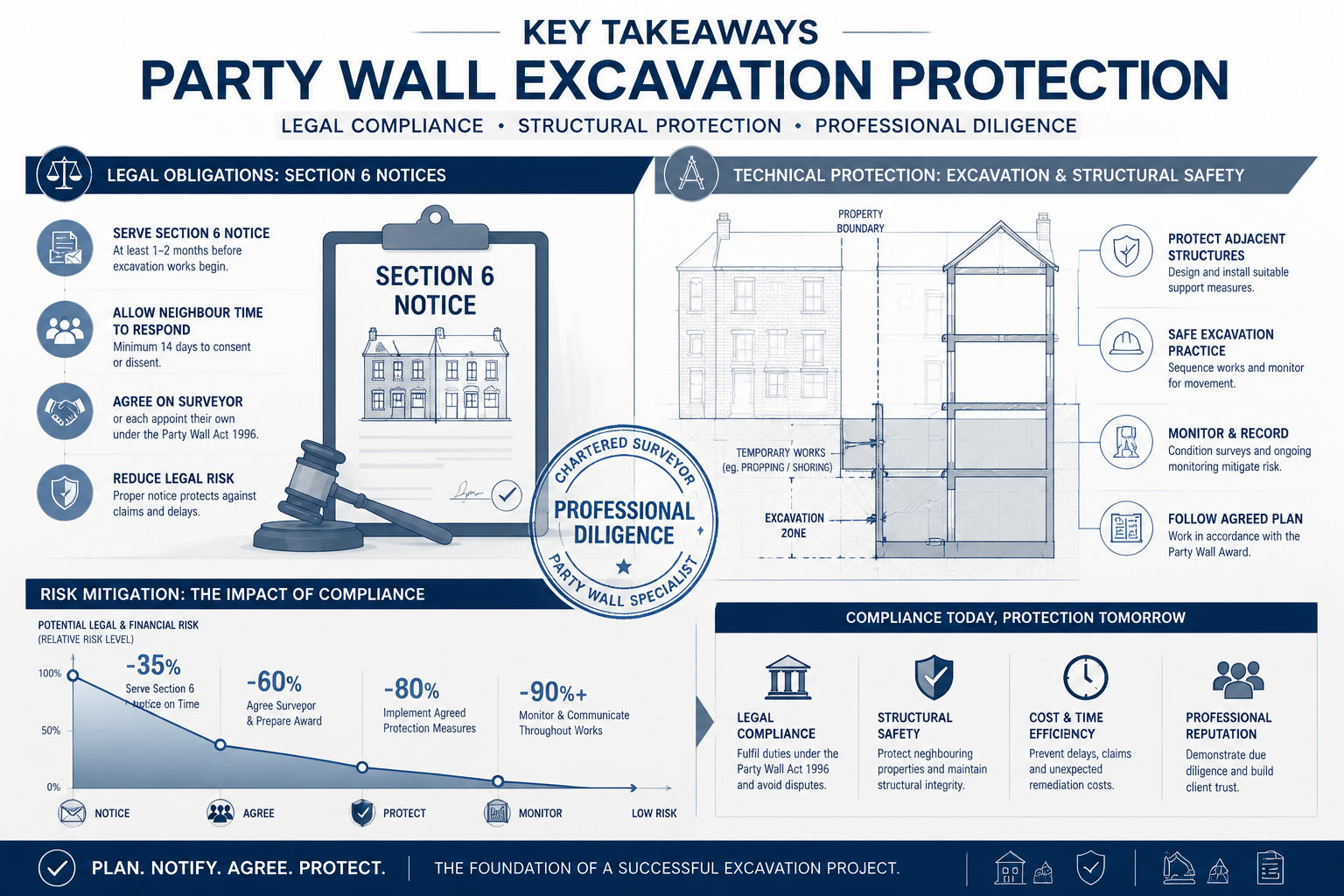
- A Section 6 Notice is legally required when excavating within 3 metres or 6 metres of a neighbouring structure, depending on depth and geometry.
- A Schedule of Condition documents the pre-existing state of the adjoining property — it is the single most powerful tool for resolving damage disputes.
- The Party Wall Award sets legally binding rules for how excavation work must proceed, including sequencing, underpinning, and monitoring requirements.
- Building owners bear full financial responsibility for surveyors' fees, Award preparation costs, and any damage caused by their works.
- Non-compliance with a served notice or Award can result in an injunction halting all works immediately.
Understanding Section 6 Notices: The Legal Gateway to Excavation Protection
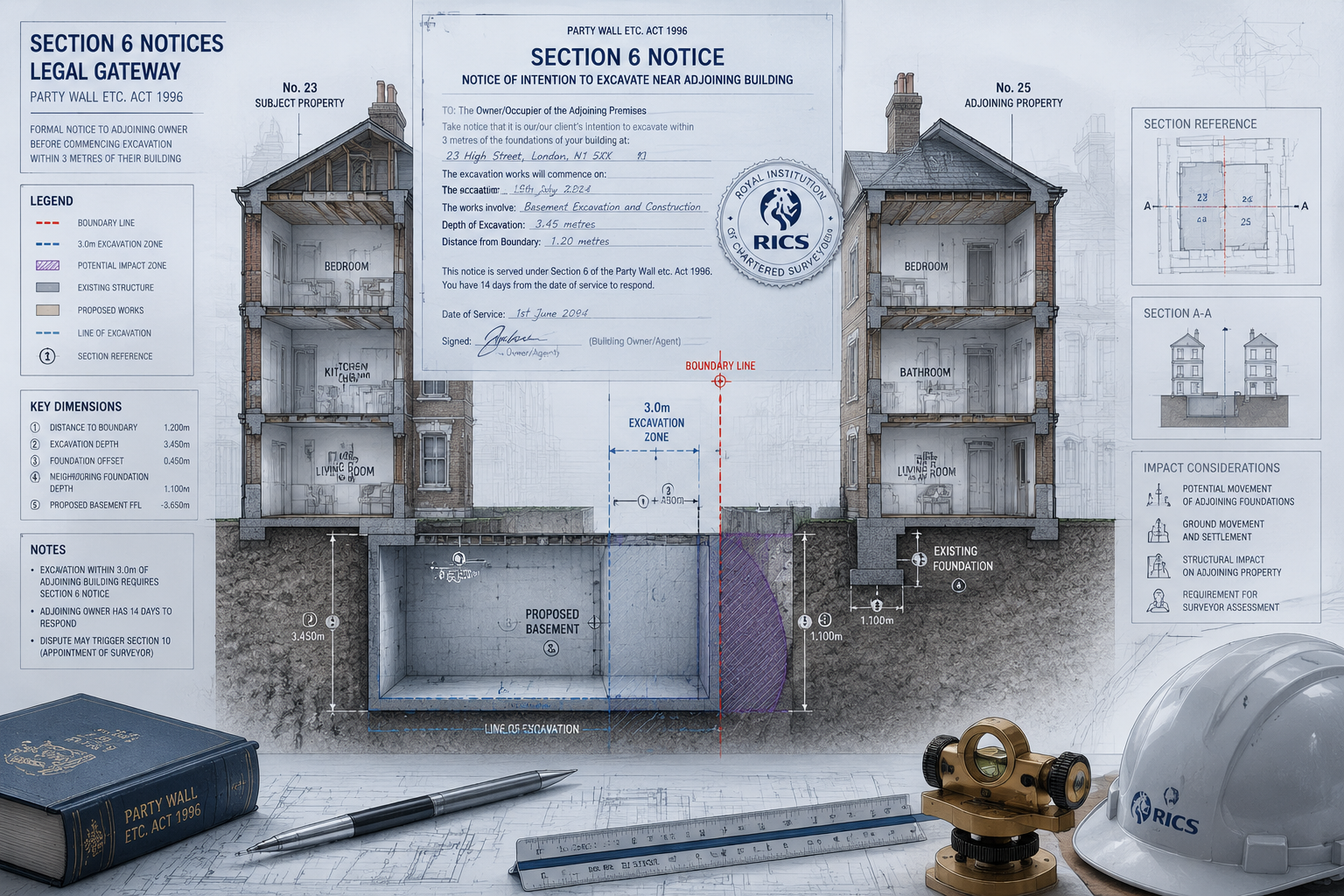
Before any spade enters the ground, the law demands a formal process. The Party Wall etc. Act 1996 governs excavation works in England and Wales — it does not apply in Scotland or Northern Ireland [2]. Under Section 6 of the Act, a building owner must serve a formal Notice of Adjacent Excavation and Construction when:
- Excavating for new foundations within 3 metres of a neighbouring building, and the proposed foundation depth is deeper than the bottom of the neighbour's existing foundations [1]
- Excavating within 6 metres of a neighbouring building, where any part of the excavation intersects a 45-degree plane drawn downward from the bottom of the neighbour's foundations [1]
💡 Pull Quote: "Distance alone is not enough to trigger the 3-metre rule — the critical test is whether the new foundation will be deeper than the neighbour's existing foundations." [1]
The 45-Degree Geometry Test Explained
The 6-metre rule is often misunderstood. It is not simply about lateral distance. A plane is drawn at 45 degrees downward from the base of the adjoining owner's foundations. If any part of the proposed excavation intersects that plane — regardless of how far away it sits horizontally — a Section 6 Notice must be served [1].
This geometric test matters enormously in London, where basement extensions routinely push 3–4 metres below ground level, bringing even distant properties within the 6-metre trigger zone.
What Must a Section 6 Notice Include?
The notice is not a casual letter. It must contain [1]:
| Required Element | Purpose |
|---|---|
| Proposed foundation depth | Establishes whether depth trigger is met |
| Intended location of new wall/structure | Allows risk assessment by adjoining surveyor |
| Plans and sections of the excavation | Enables geometric analysis of 45-degree rule |
Minimum notice period: One calendar month before works begin — shorter than the two months required for standard party wall works [4]. Missing this deadline is not a technicality; it strips the building owner of Act protections entirely.
For adjoining owners unsure of their rights, the adjoining owners' guide provides a clear starting point.
The Schedule of Condition: Your Most Powerful Pre-Excavation Protection Tool
Once a Section 6 Notice is served and the adjoining owner dissents (triggering the surveyor process), the appointed surveyor's first major task is preparing a Schedule of Condition. This document is the backbone of protecting adjoining owners during party wall excavations: surveyor schedules of condition and award enforcement in 2026.
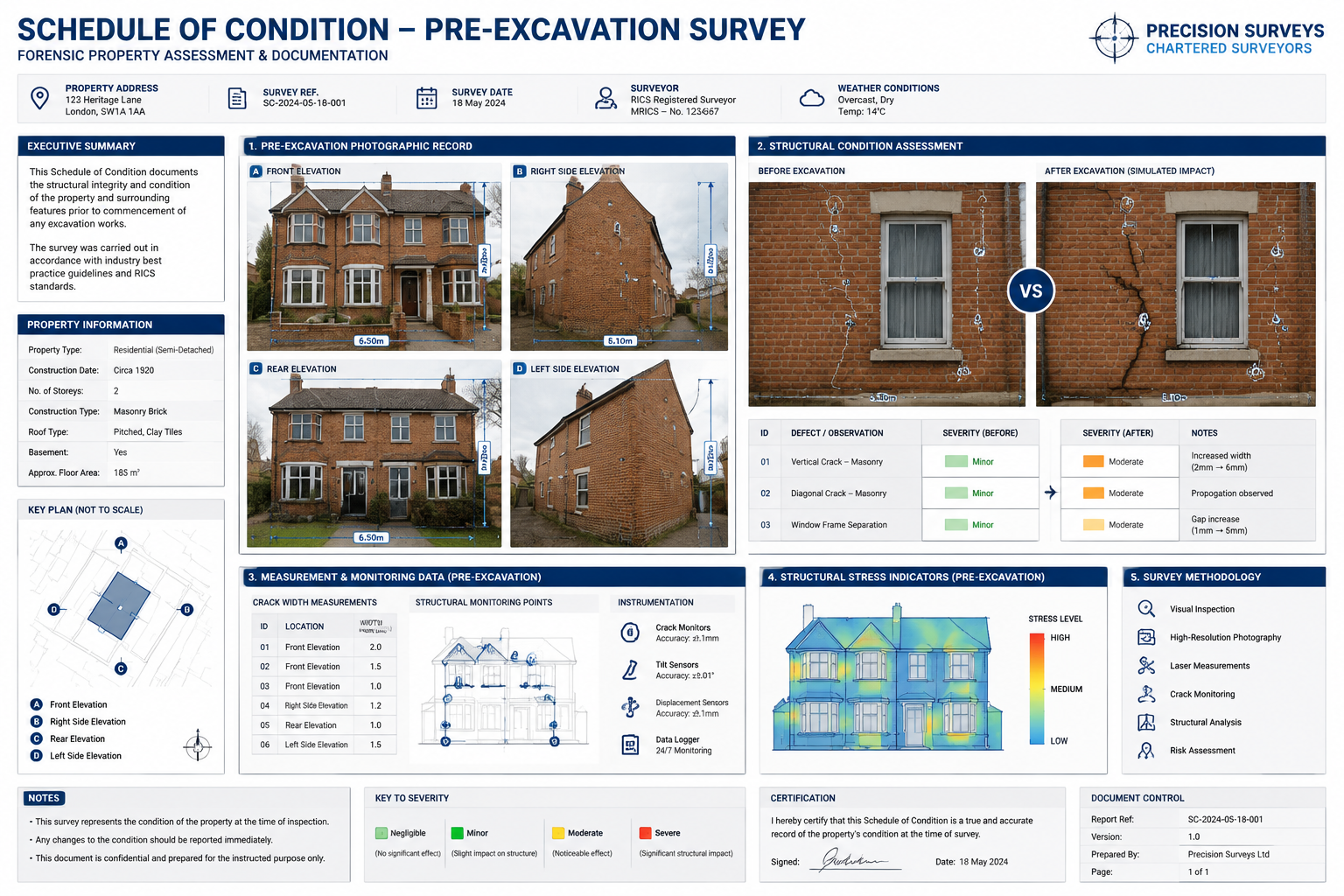
A Schedule of Condition is a detailed, photographic and written record of the adjoining property's existing state before works commence. It typically includes:
- 📸 Photographic evidence of all walls, floors, ceilings, and external surfaces
- 📝 Written descriptions of existing cracks, settlement patterns, and defects
- 📐 Crack gauge readings to establish baseline measurements
- 🗓️ Date-stamped records to confirm the pre-works condition
Why the Schedule of Condition Is Non-Negotiable
Without this document, proving that a crack appeared because of the excavation — rather than existing beforehand — becomes extremely difficult. Courts and surveyors rely on the schedule to distinguish between:
- New damage caused directly by excavation works (building owner's liability)
- Pre-existing defects merely made visible by construction activity (not the building owner's liability) [4]
This distinction matters. Recent Court of Appeal rulings have clarified that building owners should not be held liable for pre-existing structural issues that excavation works simply bring to light [4]. A thorough schedule protects both parties — it gives the adjoining owner clear evidence of new damage while shielding the building owner from inflated claims.
🔑 Key Point: The schedule should be prepared by the adjoining owner's appointed surveyor, not the building owner's surveyor, to ensure impartiality.
For those wondering whether a surveyor is truly necessary, the guide on having a party wall agreement without a surveyor explains the significant risks of proceeding without professional documentation.
Party Wall Awards: Legally Binding Rules for Excavation Works
A Party Wall Award (sometimes called the "agreed document") is the formal instrument that governs how excavation works must proceed [2]. Understanding Party Wall Awards is essential for both building owners and adjoining owners.
The Award is prepared by the appointed surveyor(s) and becomes legally binding on both parties once served. For excavation works, a well-drafted Award will typically specify:
Core Contents of an Excavation Party Wall Award
🏗️ Construction Methodology
- Sequencing of digging operations to minimise ground movement
- Underpinning requirements if existing foundations are at risk
- Specification for temporary support structures [1]
📊 Monitoring Requirements
- Frequency of crack gauge readings during works
- Trigger levels at which works must pause pending inspection
- Requirements for a structural engineer's sign-off at key stages
🔒 Access Rights
- Surveyor's right to inspect the adjoining property during works
- Notice periods before access visits
- Conditions under which works can be halted
💰 Financial Provisions
- Confirmation that the building owner pays all reasonable costs [4]
- Process for assessing and compensating damage claims
- Security for expenses provisions where appropriate
Who Pays for What?
Under the Party Wall Act 1996, the building owner bears full financial responsibility for [4]:
- Their own surveyor's fees
- The adjoining owner's surveyor's fees
- Party Wall Award preparation costs
- Third surveyor fees (if appointed)
- Land Registry search fees (typically £8 per search) [4]
- Compensation for any damage caused by the works
This cost allocation exists because the building owner is the party choosing to carry out works that affect their neighbour. The adjoining owner should never be out of pocket simply for asserting their legal rights.
For a detailed breakdown of what to expect financially, the costs of party wall process guide covers the full picture.
Protecting Adjoining Owners During Party Wall Excavations: Surveyor Schedules of Condition and Award Enforcement in 2026
The Award is only as effective as its enforcement. In 2026, surveyors have several mechanisms available to ensure compliance — and adjoining owners have stronger practical tools than many realise.
The Role of the Appointed Surveyor During Works
A surveyor appointed under the Party Wall Act is not simply a document preparer. Their role continues throughout the works. Key enforcement functions include:
Ongoing site monitoring: The surveyor has the right to inspect the site and the adjoining property at reasonable intervals. If crack gauges show movement beyond agreed trigger levels, the surveyor can instruct works to pause.
Issuing supplementary Awards: If circumstances change — for example, if unexpected ground conditions require deeper excavation — the surveyor can issue an additional Award to address the new situation.
Resolving disputes impartially: Crucially, an appointed surveyor acts impartially — not as an advocate for either party. This is a statutory duty under the Act, and it is what gives Awards their legal weight [8].
What Happens When the Building Owner Ignores the Award?
Non-compliance with a Party Wall Award is a serious legal matter. If a building owner breaches the terms of an Award, the adjoining owner's options include:
- Seeking an injunction in the County Court to halt works immediately
- Applying to the court to enforce specific Award provisions
- Claiming compensation through the courts for any damage caused
Critically, if excavation work begins without a Section 6 Notice ever being served, neighbours can seek an injunction to stop the work immediately. The building owner then loses all protections the Act provides and becomes solely liable for any resulting damage [1].
⚠️ Warning: An injunction does not just pause works — it can add weeks or months to a project timeline and significantly increase costs. Compliance is always cheaper than enforcement.
The Third Surveyor Mechanism
Where the two appointed surveyors cannot agree on a matter, either party can refer the dispute to a Third Surveyor — selected in advance when the Award is first made. The Third Surveyor's determination is binding and can only be appealed to the County Court within 14 days of the Award being served [8].
This mechanism ensures that disputes are resolved quickly and professionally, without the costs and delays of full court proceedings.
For those carrying out excavation works, the building owners' surveyor guide explains how to navigate the process efficiently.
Practical Steps for Adjoining Owners in 2026
Receiving a Section 6 Notice can feel alarming. Here is a clear action plan:
Step-by-Step Response Guide
Step 1 — Read the Notice carefully ✅
Check that it includes the required information: foundation depth, location of new structure, and plans/sections. An incomplete notice may be invalid.
Step 2 — Respond within 14 days ✅
Adjoining owners have 14 days to consent or dissent. Silence after 14 days is treated as dissent, automatically triggering the surveyor appointment process.
Step 3 — Appoint your own surveyor ✅
Do not rely on the building owner's surveyor. Appoint an independent adjoining owner's surveyor to represent your interests. Remember — the building owner pays your surveyor's reasonable fees [4].
Step 4 — Ensure a thorough Schedule of Condition is prepared ✅
Before any excavation begins, your surveyor should document every room, wall, and surface of your property. Insist on photographic records with date stamps.
Step 5 — Review the draft Award carefully ✅
Before signing off, check that the Award includes adequate monitoring requirements, clear trigger levels, and explicit provisions for damage compensation.
Step 6 — Monitor throughout the works ✅
Keep your own photographic records during the works. Report any concerns to your surveyor promptly — do not wait until works are complete.
Common Mistakes Adjoining Owners Make
| Mistake | Consequence |
|---|---|
| Consenting without reading the notice | Losing rights to surveyor protection |
| Relying on the building owner's surveyor | Conflict of interest, weaker schedule |
| Failing to document during works | Difficulty proving new damage |
| Missing the 14-day response window | Automatic dissent, but delayed process |
| Waiting too long to report damage | Harder to link damage to specific works |
Geographic Considerations: London's Unique Excavation Challenges
London's dense urban fabric makes party wall excavation issues particularly acute. Terraced Victorian housing, shallow clay soils, and the growing trend for basement extensions mean that Section 6 Notices are served in their thousands every year across the capital.
Whether a property is in a dense urban core or a quieter residential area, the same statutory protections apply. Specialist surveyors operating across South London, North London, East London, and West London understand the specific ground conditions, building typologies, and local authority requirements that affect excavation risk in each area.
London clay, in particular, is highly susceptible to shrinkage and swelling — making pre-excavation baseline documentation even more critical. A Schedule of Condition prepared in summer (when clay is dry and shrunk) will look very different from one prepared in winter (when clay is saturated and swollen). Experienced surveyors account for these seasonal variations in their documentation.
Conclusion: Taking Action Before the First Shovel Moves
The message for 2026 is clear: pre-excavation documentation and proactive engagement with the Party Wall process are the most effective forms of protection available to adjoining owners. Waiting until damage appears is always more costly — financially and emotionally — than investing in a thorough Schedule of Condition and a well-drafted Party Wall Award from the outset.
Actionable Next Steps
For adjoining owners:
- ✅ As soon as you receive a Section 6 Notice, appoint your own independent surveyor
- ✅ Insist on a comprehensive, photographic Schedule of Condition before any digging begins
- ✅ Review the Party Wall Award carefully and ensure it includes monitoring triggers
- ✅ Keep your own contemporaneous photographic record throughout works
For building owners:
- ✅ Serve Section 6 Notices at least one month before works begin — and check the depth and geometry triggers carefully
- ✅ Budget for all reasonable party wall costs, including the adjoining owner's surveyor fees
- ✅ Engage cooperatively with the surveyor process — an Award that both parties understand reduces disputes
For both parties:
- ✅ Use a qualified, experienced party wall surveyor — not a general contractor or architect unfamiliar with the Act
- ✅ Understand that the surveyor acts impartially, not as an advocate
- ✅ Remember that the Act's protections exist to enable construction to happen safely — not to stop it
Protecting adjoining owners during party wall excavations: surveyor schedules of condition and award enforcement in 2026 is ultimately about one thing — ensuring that one person's building project does not become their neighbour's nightmare. With the right documentation, the right surveyor, and the right Award in place, both parties can move forward with confidence.
References
[1] Excavation And The Party Wall Act Navigating The 3 And 6 Metre Rules For Foundations – https://www.partywallslimited.com/blog/excavation-and-the-party-wall-act-navigating-the-3–and-6-metre-rules-for-foundations
[2] Party Wall Agreement – https://hoa.org.uk/advice/guides-for-homeowners/i-am-improving/party-wall-agreement/
[4] Party Wall Dispute – https://onlinearchitecturalservices.com/party-wall-dispute/
[7] Party Wall Act Notices For Excavations Near Boundaries Serving Valid Notices To Avoid Injunctions In 2026 – https://nottinghillsurveyors.com/blog/party-wall-act-notices-for-excavations-near-boundaries-serving-valid-notices-to-avoid-injunctions-in-2026
[8] Party Wall Faqs – https://jdmsurveyors.com/party-wall-faqs/
[9] Understanding Party Wall Act What Homeowners Need Know Before Renovating – https://www.partywallslimited.com/blog/understanding-party-wall-act-what-homeowners-need-know-before-renovating