


Nearly one in three Party Wall Act disputes in England and Wales stems from homeowners beginning internal structural work without realising the law applied to them. The assumption is understandable — if you're working inside your own home, why would your neighbour's legal rights be involved? The answer lies in the physics of shared walls and the reach of the Party Wall etc. Act 1996.
This guide addresses Party Wall Notices for Internal Structural Changes: When Cutting Into Load-Bearing Walls Requires Surveyor Intervention head-on. It explains exactly when internal renovations cross the legal threshold, what notices must be served, and when a qualified surveyor stops being optional and becomes essential.
⚠️ Important: The Party Wall etc. Act 1996 applies to England and Wales only. It does not extend to Scotland or Northern Ireland, which operate under separate legal frameworks. [1]
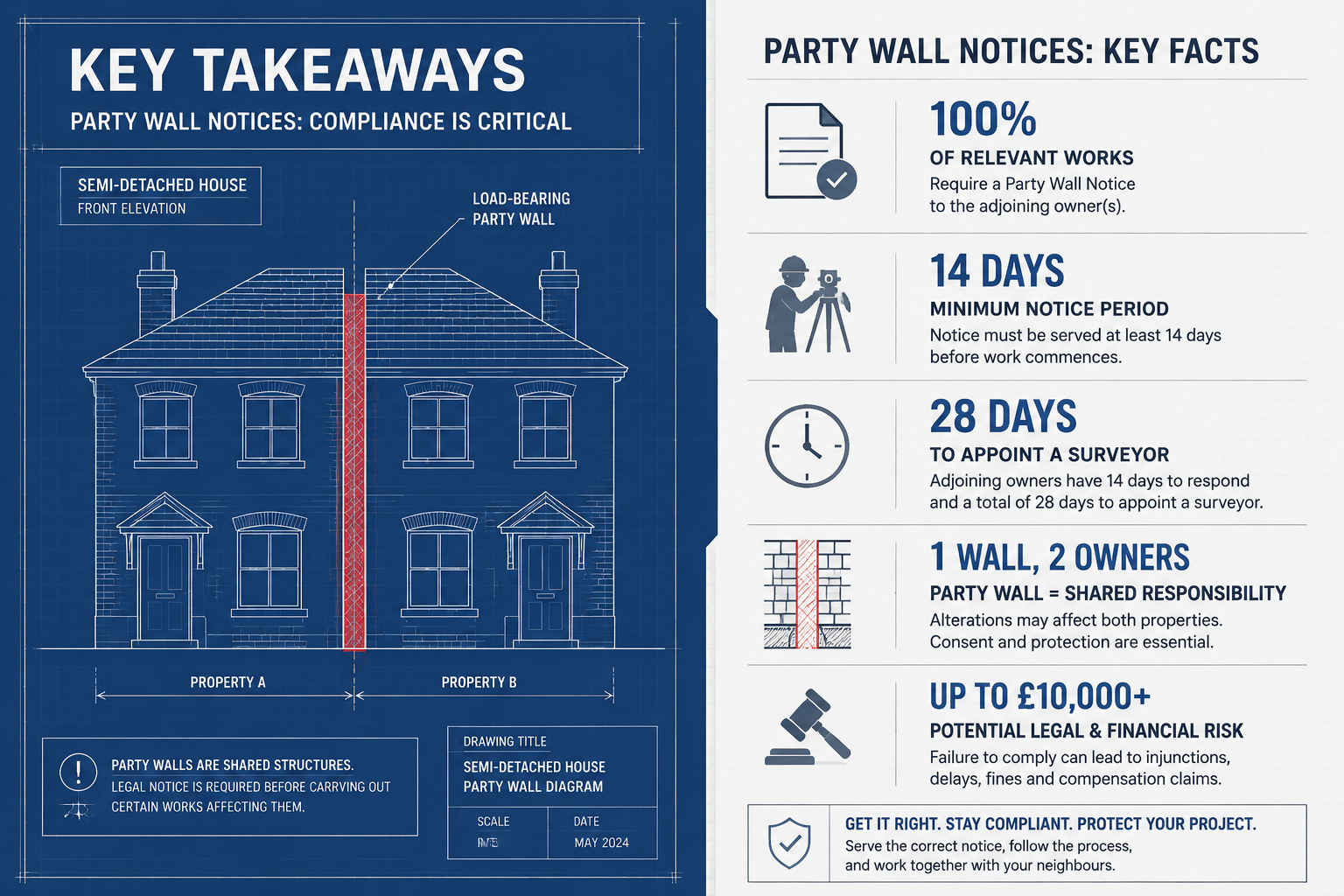
Key Takeaways
- ✅ Cutting into a load-bearing party wall to insert steel beams or structural supports triggers a Section 3 Party Structure Notice — even if the work happens entirely inside your home.
- ✅ Neighbours have 14 days to respond to a Party Wall Notice; failure to respond automatically triggers the dispute resolution process and mandatory surveyor appointment. [1]
- ✅ A two-month notice period must be observed before any structural work affecting a party wall can begin. [3]
- ✅ Notices containing vague descriptions or incorrect owner names can be rendered legally invalid, causing costly delays. [3]
- ✅ A schedule of condition must be completed before work starts to protect both parties in any future dispute. [1]
What Makes a Wall a "Party Wall" — And Why Internal Work Still Counts
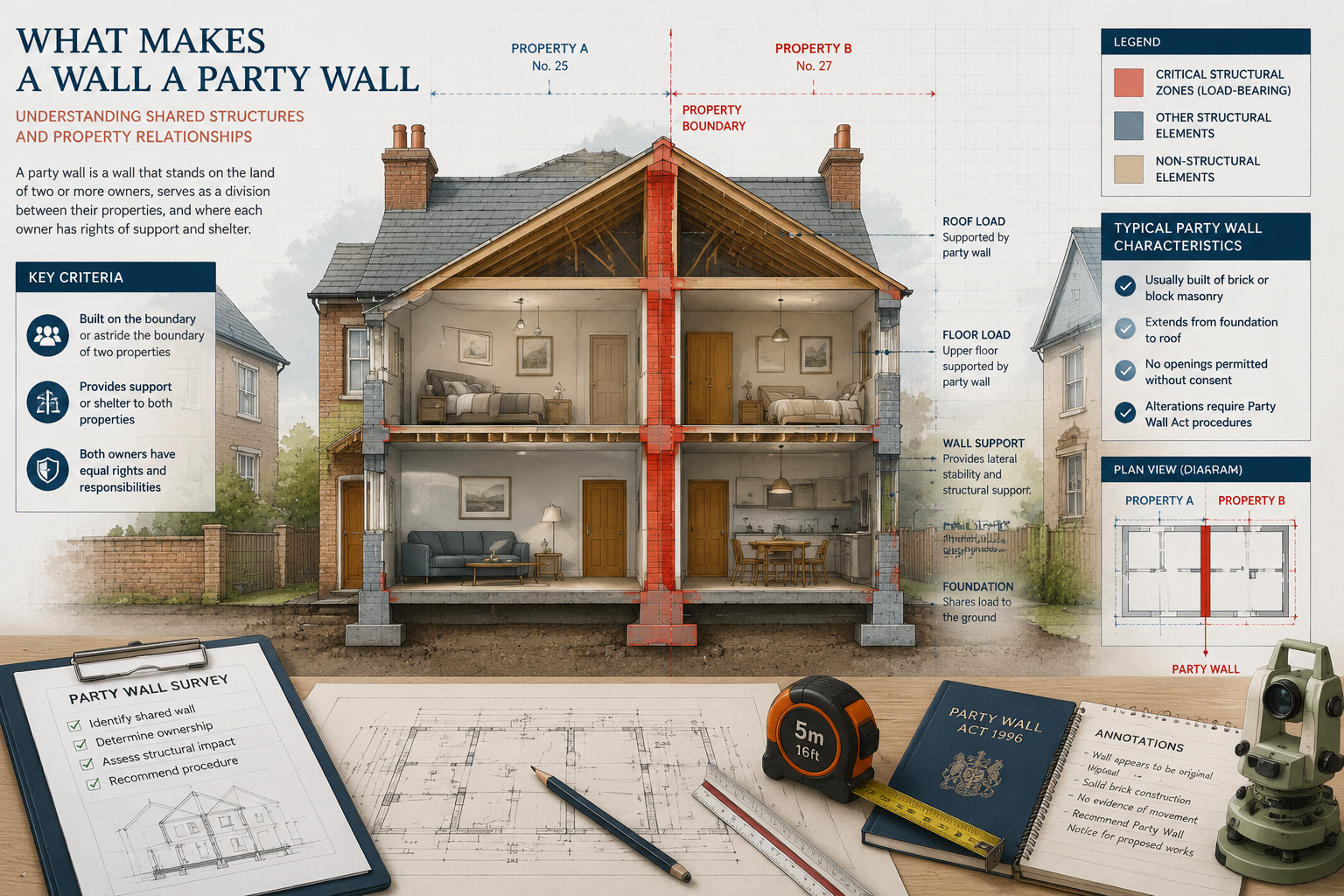
Many homeowners picture a party wall as the fence or boundary between two gardens. In legal terms, the definition is far more precise — and far more relevant to internal renovations.
Under the Party Wall etc. Act 1996, a party wall is a wall that:
- Stands on the boundary between two properties and is shared by both owners, or
- Forms part of one building but is built up to or astride the boundary line
This means the brick or block wall separating your living room from your neighbour's in a terraced or semi-detached property is almost certainly a party wall. When that wall is also load-bearing — supporting floor joists, roof structures, or upper storeys — any structural interference with it falls squarely within the Act's scope.
Common Internal Works That Trigger the Act
| Type of Work | Party Wall Act Triggered? |
|---|---|
| Cutting into party wall for RSJ/steel beam | ✅ Yes — Section 3 Notice required |
| Loft conversion with party wall modifications | ✅ Yes — very common trigger [1] |
| Removing or altering load-bearing wall sections | ✅ Yes |
| Inserting new damp proof course | ✅ Yes [1] |
| Excavation within 3–6 metres of neighbour's structure | ✅ Yes [5] |
| Purely cosmetic internal decoration | ❌ No |
| Non-structural internal partition walls | ❌ No |
The critical distinction is whether the work physically affects the shared structure. Painting a wall? No notice needed. Cutting into it to seat a steel beam? That's a different matter entirely.
For a broader overview of the types of work covered, see the full guide to types of party wall works.
Understanding Party Wall Notices for Internal Structural Changes: When Cutting Into Load-Bearing Walls Requires Surveyor Intervention
The Section 3 Party Structure Notice
When work involves cutting into, exposing, or structurally modifying a party wall, the correct legal instrument is a Section 3 Party Structure Notice. This is distinct from the Line of Junction Notice (for new walls on boundaries) and the Section 6 Notice (for excavation works).
A Section 3 Notice must be served at least two months before work begins. [3] This is not a guideline — it is a statutory requirement. Starting work before this period expires exposes the building owner to injunctions and potential liability for any resulting damage.
What must the notice include?
- Full name and address of the building owner
- Full address of the property where work will take place
- A specific description of the proposed work — vague terms like "renovation works" or "extension" are not acceptable [3]
- The proposed start date
💬 "The notice must state specifically: 'Cut into the party wall to accommodate steel beams at ground floor level.' Vague descriptions risk invalidating the entire notice." [3]
Incorrect owner names are another common pitfall. Always verify ownership through HM Land Registry before serving — errors here can render the notice void and restart the clock entirely. [3]
For detailed guidance on how to serve a notice correctly, the Party Wall Act Notices guide provides a practical walkthrough.
The 14-Day Response Window
Once a valid notice is served, the adjoining owner has exactly 14 days to respond in writing. [1] Three outcomes are possible:
- Written consent — Work can proceed after the two-month notice period. No surveyor is required (though one is still advisable).
- Written dissent — A party wall surveyor must be appointed. The dispute resolution process begins.
- No response — Legally treated as dissent. Surveyor appointment becomes mandatory. [1]
This is the point at which surveyor intervention moves from recommended to legally required.
When Surveyor Intervention Becomes Mandatory
Dissent and the Dispute Resolution Process
If a neighbour dissents or simply ignores the notice, the building owner cannot proceed without going through the Act's formal dispute resolution mechanism. This involves:
- Appointing a party wall surveyor — either an agreed single surveyor for both parties, or one surveyor each
- Surveyor inspection and assessment — the surveyor(s) review the proposed works, the condition of the shared structure, and any risks to the adjoining property
- Issuing a Party Wall Award — a legally binding document setting out what work can be done, how, and under what conditions [2]
The Party Wall Award process adds time to any project timeline. Depending on complexity and surveyor availability, obtaining an Award can take several weeks beyond the initial notice period. [2] Factoring this into project planning from day one avoids costly delays.
The Schedule of Condition: Non-Negotiable Protection
Before any structural work begins, a schedule of condition must be prepared. This is a detailed photographic and written record of the current state of the adjoining property — walls, ceilings, floors, and any existing cracks or defects. [1]
Why does this matter? If the neighbour later claims the building work caused a crack in their plaster or damaged their foundations, the schedule of condition is the primary evidence used to determine whether the damage pre-existed or was caused by the works. Without it, the building owner has no defence.
A professional schedule of condition is typically prepared by the party wall surveyor as part of the Award process, but it can also be commissioned independently.
Loft Conversions: A Particularly Common Trigger
Loft conversions are among the most frequent scenarios where homeowners are surprised to find the Party Wall Act applies. [1] When a loft conversion requires:
- Cutting into the party wall to seat new structural timbers or steel beams
- Raising or altering the party wall itself
- Installing new floor joists that bear on the shared wall
…a Section 3 Notice is required. Many loft conversion contractors overlook this step, leaving homeowners exposed to legal action mid-project.
Navigating the Process: A Step-by-Step Overview
Here is a simplified timeline for internal structural work affecting a party wall:
Step 1 — Confirm the wall's status
Check whether the wall is a party wall under the Act. When in doubt, consult a party wall surveyor before any planning begins.
Step 2 — Prepare the Section 3 Notice
Draft the notice with precise descriptions of the work. Verify owner details via HM Land Registry. For a template to get started, a sample party wall agreement template can be a useful reference.
Step 3 — Serve the notice
Serve at least two months before the intended start date. Keep proof of service (recorded delivery or hand-delivered with witness).
Step 4 — Await response (14-day window)
If consent is given in writing, proceed after the notice period. If dissent or no response, move to Step 5.
Step 5 — Appoint a surveyor
Both parties appoint surveyors (or agree on one). The surveyor assesses the works and prepares the Party Wall Award.
Step 6 — Schedule of condition
The surveyor documents the condition of the adjoining property before work begins.
Step 7 — Proceed under the Award
Work begins in accordance with the Award's terms. Any deviations must be agreed in writing.

Costs, Risks, and How to Keep Things Manageable
Who Pays for the Surveyor?
In most cases, the building owner (the person carrying out the work) pays the surveyor's fees — including the adjoining owner's surveyor if separate surveyors are appointed. [2] This is a significant cost consideration that should be built into any project budget from the outset.
For practical strategies on managing these expenses, the guide on how to keep party wall costs down offers actionable advice.
The Risks of Skipping the Process
Proceeding without serving a valid notice or obtaining a Party Wall Award when one is required carries serious consequences:
- 🚫 Injunctions — Neighbours can apply to court to halt work immediately
- 💷 Damages — Liability for any structural damage caused, with no schedule of condition to limit claims
- ⏱️ Delays — Retroactively obtaining an Award mid-project is far more disruptive than doing it correctly upfront
- 📉 Property value impact — Unresolved party wall disputes can complicate future property sales
Can You Do It Without a Surveyor?
If a neighbour provides written consent within the 14-day window, a surveyor is not legally required. However, even in this scenario, having a surveyor prepare a schedule of condition is strongly advisable.
For those considering whether to proceed without professional involvement, the article on having a party wall agreement without a surveyor outlines the specific circumstances where this is and isn't appropriate.
Frequently Asked Questions
Q: Does the Act apply if the load-bearing wall is entirely within my property?
Only if it is a party wall — i.e., shared with or built on the boundary with a neighbour. A purely internal wall with no connection to a shared boundary is not covered.
Q: What if my neighbour is a tenant, not the owner?
The notice must be served on the property owner, not the tenant. Always verify ownership through HM Land Registry.
Q: Can I serve notice by email?
The Act requires written notice. Email is generally accepted if the adjoining owner has agreed to receive notices electronically, but recorded post or hand delivery with proof is safer.
Q: How long is a Party Wall Notice valid?
A notice is valid for 12 months from the date of service. If work does not begin within that period, a new notice must be served.
Conclusion: Act Early, Document Everything, and Get the Right Advice
The core message of Party Wall Notices for Internal Structural Changes: When Cutting Into Load-Bearing Walls Requires Surveyor Intervention is simple: internal does not mean exempt. The moment a structural modification touches a shared wall, the Party Wall etc. Act 1996 comes into play — and the consequences of ignoring it are far more disruptive than the process itself.
Actionable Next Steps
- Identify your wall's status — Before any planning, confirm whether the wall in question is a party wall. If uncertain, consult a qualified surveyor.
- Serve notice early — Build the two-month notice period into your project timeline from day one. Delays here cascade through the entire schedule.
- Be specific in your notice — Describe the work precisely. Vague notices are invalid notices.
- Commission a schedule of condition — Protect yourself regardless of whether your neighbour consents.
- Budget for surveyor fees — If dissent is likely, factor in the cost of two surveyors and a Party Wall Award.
- Find a local expert — If you're in London, specialist support is available across South London, North London, and beyond.
The Party Wall Act exists to protect both building owners and their neighbours. Used correctly, it provides a clear, fair framework for getting structural work done without damaging relationships — or properties.
References
[1] Party Wall Agreement – https://hoa.org.uk/advice/guides-for-homeowners/i-am-improving/party-wall-agreement/
[2] Party Wall Dispute – https://onlinearchitecturalservices.com/party-wall-dispute/
[3] Party Wall Notices Explained A Simple Guide For Home Extensions – https://www.prideroad.co.uk/party-wall-notices-explained-a-simple-guide-for-home-extensions/
[4] Party Wall Agreements What You Need To Know – https://www.fmb.org.uk/find-a-builder/ultimate-guides-to-home-renovation/party-wall-agreements-what-you-need-to-know.html
[5] When Do You Need A Party Wall Agreement – https://westvilleassociates.com/blog/when-do-you-need-a-party-wall-agreement
