

Fewer than one in three homeowners correctly understands what a party wall surveyor actually does — and that knowledge gap costs people money, time, and neighbourly goodwill every year. Many clients still assume the surveyor they appoint is their personal advocate, fighting their corner the way a solicitor might. That assumption is wrong, and it can lead to serious procedural errors, invalid awards, and even costly legal challenges.
The Surveyor's Role in Party Wall Disputes: Independence, Reasonableness, and the Duty to Act Statutorily is one of the most misunderstood areas of UK property law. Under the Party Wall etc. Act 1996, surveyors do not act as hired guns for the party that appoints them. They act as statutory officers with a legal duty to be independent, reasonable, and procedurally correct — regardless of who is paying their fee.
This article unpacks exactly what that means, why it matters, and what both building owners and adjoining owners should understand before entering the party wall process in 2026.
Key Takeaways 📋
- Party wall surveyors are statutory officers, not personal advisers — their duty is to the Act, not to the appointing party.
- Independence is not optional — a surveyor who acts as an advocate risks producing an invalid award.
- Reasonableness is a legal standard, not a vague preference; awards must be proportionate and defensible.
- Both the building owner's surveyor and the adjoining owner's surveyor share the same fundamental obligations under the Act.
- Understanding the statutory framework protects all parties and reduces the risk of disputes escalating to court.
What Does "Acting Statutorily" Actually Mean?
The phrase "acting statutorily" sounds technical, but the core idea is straightforward: a party wall surveyor must follow the framework set out in the Party Wall etc. Act 1996, and that framework takes priority over the wishes of whoever appointed them.
Section 10 of the Act is the engine room of this principle. It gives surveyors the authority — and the obligation — to resolve disputes by making a party wall award. That award is a legally binding document. It must be made in good faith, based on the facts, and within the powers granted by the Act. A surveyor who simply rubber-stamps whatever their appointing party wants is not acting statutorily — they are acting as an advocate, which is a fundamentally different (and improper) role.
The Statutory Framework at a Glance
| Concept | What It Means in Practice |
|---|---|
| Statutory duty | The surveyor's primary obligation is to the Act, not the client |
| Independence | Decisions must be made on merit, free from commercial pressure |
| Reasonableness | Awards must be proportionate and fair to both parties |
| Good faith | Surveyors must act honestly and without improper motive |
| Jurisdiction | Surveyors can only make awards on matters the Act covers |
💡 Pull Quote: "A party wall surveyor is not your solicitor. They are a statutory officer whose job is to make the Act work — for everyone involved."
Understanding what types of party wall works trigger the Act's provisions is the first step. Once the process is engaged, the surveyor's statutory role kicks in immediately.
Independence: The Cornerstone of the Surveyor's Role in Party Wall Disputes
Independence is not merely a professional nicety — it is a legal requirement embedded in the Act itself. Section 10(12) makes clear that each surveyor appointed under the Act must act impartially. The courts have reinforced this principle repeatedly.
What Independence Looks Like in Practice
A truly independent surveyor will:
- ✅ Assess the proposed works objectively, regardless of which party appointed them
- ✅ Raise concerns about a building owner's plans if those plans are unreasonable or unsafe
- ✅ Refuse to sign an award they believe is outside the Act's powers
- ✅ Communicate openly with the other surveyor, even when that feels uncomfortable for their appointing party
- ✅ Decline instructions that would compromise their impartiality
A surveyor who fails these tests — who simply does whatever their client demands — is not fulfilling the surveyor's role in party wall disputes. They are exposing their client to the risk of a void or voidable award, which can be challenged in the County Court under Section 10(17) of the Act.
The "Agreed Surveyor" Option
One important mechanism worth understanding is the agreed surveyor — a single surveyor appointed by both parties to act for both simultaneously. This arrangement, permitted under Section 10(1)(b), is only workable because of the independence principle. If surveyors were advocates, an agreed surveyor would be impossible. The fact that the Act allows it underscores that independence is the default expectation for all party wall surveyors.
For those considering whether professional involvement is essential, it is worth reading about having a party wall agreement without a surveyor — though in most dispute scenarios, professional statutory involvement is strongly advisable.
Reasonableness: The Legal Standard Surveyors Must Meet
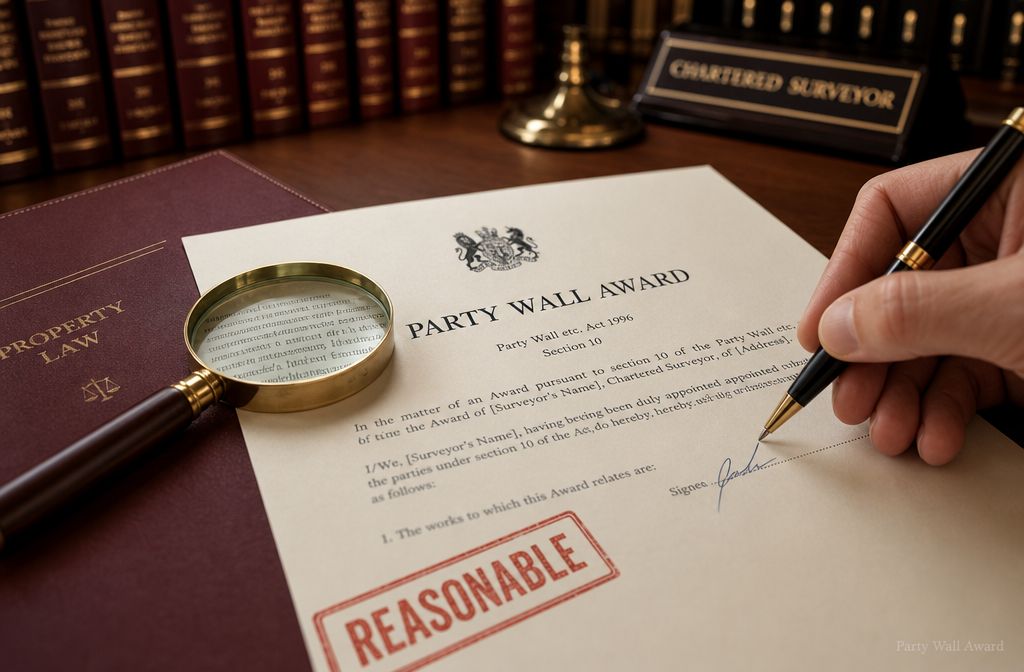
"Reasonableness" in the context of party wall work is not a soft concept. It is a legal standard that courts apply when reviewing awards. An award that imposes disproportionate conditions on a building owner — or one that fails to adequately protect an adjoining owner — can be appealed and overturned.
What Makes an Award "Reasonable"?
A reasonable party wall award typically:
- Reflects the actual risk posed by the proposed works, rather than worst-case speculation
- Imposes conditions proportionate to the nature and scale of the works
- Protects the adjoining owner without unnecessarily obstructing the building owner's lawful development rights
- Is grounded in evidence — surveys, structural assessments, schedules of condition
- Follows established practice and does not introduce novel conditions without clear justification
The party wall award is the formal output of this balancing act. Getting it right requires both legal knowledge and practical construction expertise.
Common Reasonableness Failures
Surveyors sometimes fall into predictable traps that undermine the reasonableness of their awards:
- Over-protective conditions — Adjoining owner's surveyors occasionally impose restrictions so onerous that they effectively prevent lawful works. Courts have struck down such conditions.
- Under-protective awards — Building owner's surveyors sometimes produce awards that ignore genuine risks to neighbouring properties.
- Scope creep — Including conditions or requirements that fall outside the Act's jurisdiction entirely.
- Ignoring the schedule of condition — Failing to properly document pre-existing damage, which later causes disputes about liability.
A properly conducted schedule of condition is one of the most effective tools for ensuring a reasonable, evidence-based award.
The Distinct Roles: Building Owner's Surveyor vs. Adjoining Owner's Surveyor
While both surveyors share the same statutory obligations, their starting positions are different, and understanding this distinction helps clarify why disputes sometimes arise.
The Building Owner's Surveyor
The building owner's surveyor is appointed to facilitate the building owner's proposed works within the framework of the Act. Their role includes:
- Serving or reviewing party wall notices correctly
- Drafting the party wall award
- Ensuring the works are properly defined and scoped
- Liaising with the adjoining owner's surveyor
However — and this is critical — they cannot simply advocate for the building owner's preferred outcome. If the proposed works carry genuine risk, the building owner's surveyor must acknowledge that and reflect it in the award.
The Adjoining Owner's Surveyor
The adjoining owner's surveyor is appointed to protect the adjoining owner's interests. But "protection" does not mean obstruction. Their role is to:
- Review the proposed works critically and fairly
- Identify genuine risks and ensure appropriate safeguards
- Negotiate reasonable conditions with the building owner's surveyor
- Ensure the adjoining owner understands the process and their rights
⚠️ Important: An adjoining owner's surveyor who refuses to engage constructively, delays proceedings without justification, or demands unreasonable conditions is not fulfilling their statutory duty — and may expose themselves to criticism or cost consequences.
When Surveyors Disagree: The Third Surveyor
When the two appointed surveyors cannot agree, either party can refer the matter to a third surveyor — selected in advance under Section 10(1)(c). The third surveyor acts as a statutory adjudicator. Their decision is binding, subject only to appeal in the County Court. This mechanism exists precisely because the Act anticipates that surveyors will sometimes reach different conclusions in good faith.
Practical Implications: What Clients Should Understand in 2026
The Surveyor's Role in Party Wall Disputes: Independence, Reasonableness, and the Duty to Act Statutorily has direct practical consequences for anyone involved in the party wall process. Here is what both building owners and adjoining owners should know:
For Building Owners 🏗️
- Appointing a surveyor does not mean having someone who will always say yes to your plans
- If your surveyor raises concerns about your proposed works, listen — they are protecting you from a potentially void award
- Attempting to pressure your surveyor into producing a favourable award is counterproductive and potentially harmful
- Understanding the costs of the party wall process upfront helps set realistic expectations
For Adjoining Owners 🏠
- Your surveyor's job is to protect your legitimate interests — not to block your neighbour's lawful development
- Demanding conditions that go beyond what the Act permits will not produce a valid award
- Cooperation with the process is generally in your best interest
- If your neighbour is already carrying out works, understanding what to do when a neighbour is carrying out works is essential
Red Flags to Watch For
| Red Flag | What It May Indicate |
|---|---|
| Surveyor agrees with everything their client says | Possible lack of independence |
| Award produced unusually quickly without proper inspection | Inadequate due diligence |
| Conditions far exceed the scope of the works | Possible overreach or advocacy |
| Surveyor refuses to communicate with the other surveyor | Procedural failure |
| Award contains conditions outside the Act's powers | Risk of invalidity |
Why the Statutory Framework Protects Everyone
It might seem frustrating to appoint a surveyor who will not simply do what you want. But the statutory framework exists for good reason: it creates a level playing field that protects both parties and gives the resulting award legal force.
An award made by independent, reasonable surveyors acting within their statutory powers is:
- Legally binding on both parties
- Enforceable through the courts if necessary
- Difficult to challenge unless there has been a genuine procedural error
- Protective — it limits liability for both the building owner and the adjoining owner
By contrast, an award produced by surveyors acting as advocates — or produced outside the Act's framework — is vulnerable to challenge, may be void, and provides no reliable legal protection to anyone.
The Party Wall etc. Act 1996 was designed to resolve disputes without litigation. When surveyors fulfil their statutory role properly, that goal is achieved. When they do not, the courts become involved — at significant cost to all parties.
Conclusion: Working With the Statutory Framework, Not Against It
The Surveyor's Role in Party Wall Disputes: Independence, Reasonableness, and the Duty to Act Statutorily is not a bureaucratic inconvenience — it is the foundation of a system that protects property owners on both sides of a shared wall.
The key insight is this: a party wall surveyor who acts independently and reasonably is doing their job correctly, even when that means telling their appointing party something they do not want to hear. That independence is what gives the resulting award its legal weight and practical value.
Actionable Next Steps ✅
- Before appointing a surveyor, clarify that you understand their statutory role — they are not your personal advocate
- Ask your surveyor to explain the basis for any conditions in the award, ensuring they fall within the Act's powers
- Engage constructively with the process — delays and obstructions rarely serve anyone's interests
- If in doubt about costs, explore strategies to keep party wall costs down without compromising the integrity of the process
- Seek qualified professionals who understand both the legal and practical dimensions of the Act — particularly in complex urban environments where party wall issues are common
Whether the works are in Central London, South London, or anywhere else in the capital, the statutory obligations remain the same. The surveyor's role is fixed by law — and understanding that role is the single most important thing any party to a party wall dispute can do in 2026.