


Nearly one in three party wall disputes in the UK involves a neighbour claiming that building works caused damage to their property — yet the majority of those disputes could be resolved quickly if a proper party wall award had been in place from the start [1]. Understanding how party wall awards protect against future damage claims — through evidence gathering, access rights, and post-work checks — is not just useful for surveyors. It is essential knowledge for any homeowner planning works or living next door to someone who is.
This article explains the full protective lifecycle of a party wall award: from the schedule of condition that locks in pre-works evidence, through the access rights that keep inspections lawful, to the post-completion powers that allow surveyors to act on damage claims long after the dust has settled.
Key Takeaways 📋
- A party wall award is a legally binding document that does far more than authorise works — it creates an evidence framework for future damage claims.
- A schedule of condition attached to the award is the single most powerful tool for resolving "before vs after" disputes.
- Awards grant statutory access rights to surveyors and building owners, making inspections lawful at every stage.
- Surveyors retain continuing powers under the Act to deal with damage even years after works are complete.
- Court enforcement of monetary obligations is subject to a 6-year limitation period under the Limitation Act 1980.
What Is a Party Wall Award and Why Does It Matter Beyond Day One?
Most homeowners treat a party wall award as a box-ticking exercise — something to obtain before the builders arrive and then file away. That view misses the point entirely.
A party wall award (sometimes called a party wall agreement) is a legally binding document prepared by one or more appointed surveyors under Section 10 of the Party Wall etc. Act 1996. It sets out the manner and timing of works, the rights and obligations of both parties, and — critically — the mechanisms for dealing with any damage that arises [6].
💬 "A good award is not just about getting works started. It sets up the evidence and safeguards needed to resolve disputes that may emerge months or even years later."
The award is the central protection mechanism for adjoining owners. It does not simply describe what will happen during construction. It creates a legal structure that governs what happens after construction too [7].
To understand the full range of works that can trigger an award, see the types of party wall works that fall under the Act.
How Party Wall Awards Protect Against Future Damage Claims: The Role of the Schedule of Condition
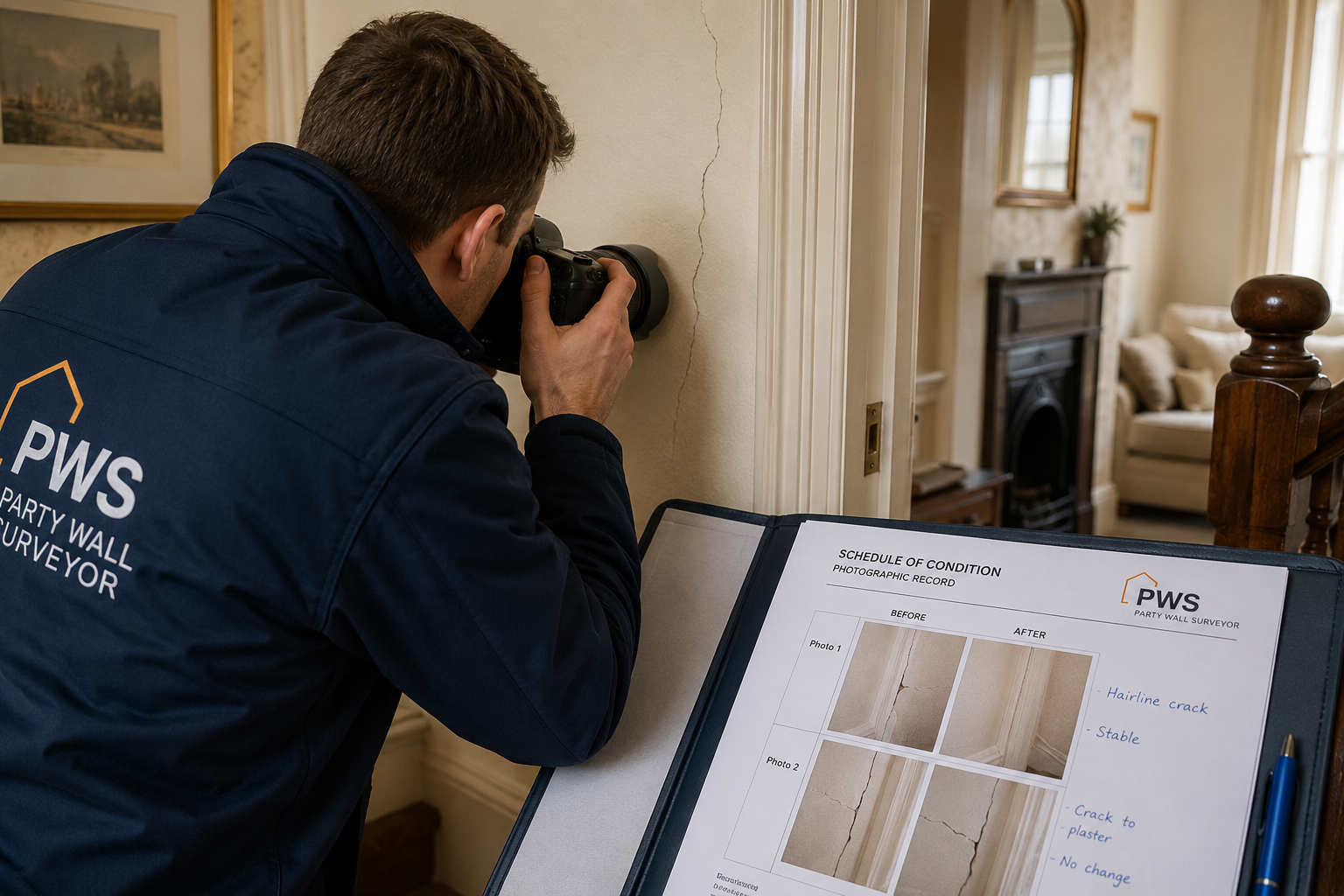
What Is a Schedule of Condition?
The schedule of condition is a detailed, usually photographic, record of the adjoining owner's property before notifiable works begin. It captures:
- Existing cracks, hairline fractures, and structural defects
- The condition of plasterwork, ceilings, floors, and finishes
- The state of external walls, rooflines, and drainage near the works
This document is typically annexed directly to the party wall award, making it part of the legally binding record [9].
Why It Is the Most Important Evidential Tool
When a neighbour later claims that works caused a new crack or damaged a wall, the schedule of condition provides an objective "before" snapshot. Without it, any dispute becomes a matter of one person's word against another's.
With it, the surveyor — or a court — can compare the current state of the property against the pre-works baseline and make an evidence-based determination of whether the damage is genuinely new and likely caused by the works [1].
| Without a Schedule of Condition | With a Schedule of Condition |
|---|---|
| Disputes rely on memory and opinion | Disputes resolved by objective comparison |
| Building owner may face inflated claims | Claims limited to genuinely new damage |
| Adjoining owner may struggle to prove causation | Causation supported by photographic evidence |
| Costly litigation more likely | Early settlement far more achievable |
Industry guidance from RICS confirms that a photographic schedule of condition "helps prevent disputes over damage in the future" by providing clear, objective evidence [9]. This is not optional best practice — it is the professional standard expected of any competent surveyor.
For adjoining owners who want to understand their rights in this process, the adjoining owners' guide provides a useful starting point.
What Happens When No Schedule Is Prepared?
The consequences can be severe for building owners. Without a pre-works record, a building owner cannot easily disprove a damage claim. Courts and surveyors may give the benefit of the doubt to the adjoining owner, potentially resulting in compensation payments for damage that may have pre-existed the works [1][3].
The lesson is straightforward: a well-drafted award with a thorough schedule of condition protects both parties — the adjoining owner gains evidence to support a genuine claim, and the building owner gains protection against exaggerated or unfounded ones.
Access Rights Under a Party Wall Award: Keeping Inspections Lawful
Statutory Rights of Access
One of the most practical — and often overlooked — protections within a party wall award is the right of access it confers. Under Section 8 of the Party Wall etc. Act 1996, a building owner and their surveyors have the right to enter the adjoining owner's property at reasonable times for the purposes of:
- Carrying out the notifiable works
- Inspecting the condition of the adjoining property before, during, and after works
- Making good any damage caused by the works
This right of access is statutory, meaning it exists regardless of whether the adjoining owner consents on the day. The award formalises and documents this right, giving both parties clarity on when and how access will occur [6].
How Awards Structure Access in Practice
A well-drafted party wall award will typically specify:
- ✅ Notice requirements — how much advance notice must be given before entry (usually not less than 14 days)
- ✅ Hours of access — typically restricted to normal working hours
- ✅ Scope of access — which rooms or areas may be entered and for what purpose
- ✅ Accompanied access — whether the adjoining owner or their surveyor should be present
Without these provisions clearly set out, disputes about access can delay works and increase costs for everyone involved. To understand how party wall costs are affected by disputes and delays, it is worth reviewing the full cost framework.
Access for Post-Work Inspections
Access rights do not end when the builders leave. The award's access provisions extend to post-completion inspections, allowing surveyors to return and assess whether any damage has occurred as a result of the works. This is a critical feature of how party wall awards protect against future damage claims, because it means the inspection process has a legal basis even after the project is finished [4].
How Party Wall Awards Protect Against Future Damage Claims: Post-Work Powers and Continuing Jurisdiction
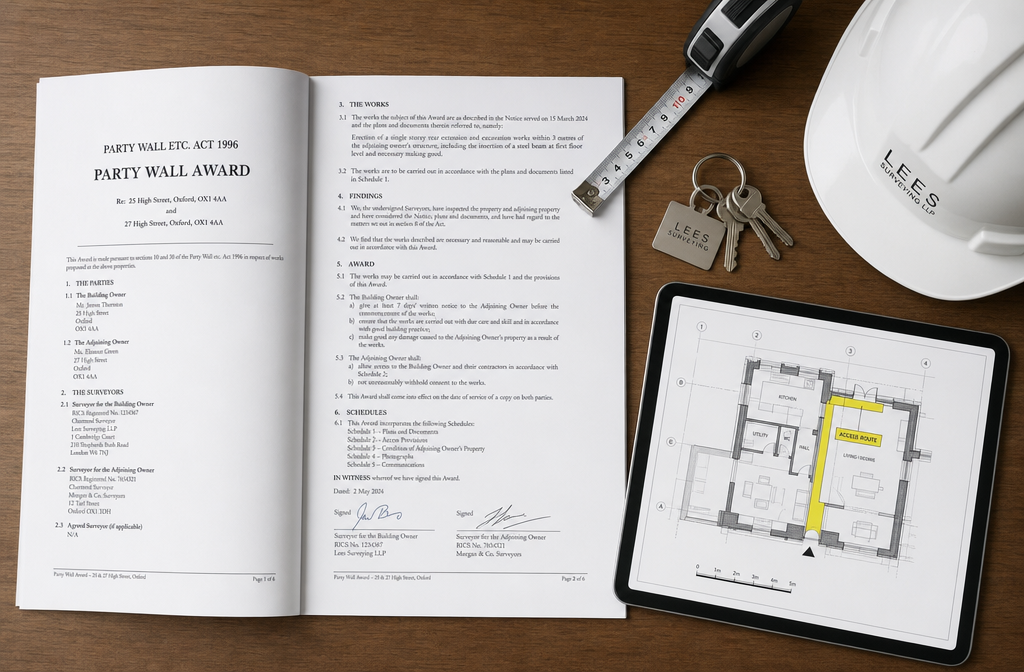
Surveyors Retain Continuing Powers After Completion
A common misconception is that a party wall award becomes irrelevant once the works are complete. In fact, the opposite is true. Under Sections 10(1) and 10(12)(c) of the Act, appointed surveyors retain the power to act in relation to "any other matter arising out of or incidental to the dispute" — and this includes damage that only becomes apparent after the works have finished [4].
This means that if a crack appears six months after a loft conversion, or subsidence develops a year after underpinning works, the surveyors appointed under the original award can:
- Enforce the original award — if it already addresses the type of damage in question
- Draw up a new award — compelling the building owner to make good the damage and/or pay compensation
- Determine the extent of liability — using the schedule of condition as the evidential baseline [4][9]
There is no statutory time limit restricting surveyors from exercising these continuing powers, which provides significant long-term protection for adjoining owners where defects only emerge gradually [4].
The 6-Year Limitation Period for Court Enforcement
While surveyors have continuing jurisdiction, court enforcement of monetary obligations is a different matter. Two provisions of the Limitation Act 1980 are relevant:
- Section 2 — A claim for monies owed under the terms of the award itself must be issued within 6 years of the date the payment should have been made.
- Section 9 — A claim for monies due "under a statute" (such as compensation under the Party Wall Act) must also be commenced within 6 years of the date the claim arose.
This effectively caps long-tail damage claims in court, even though the surveyors' own powers remain unconstrained [4]. The practical implication: do not delay. If damage is identified, the surveyor process should be engaged promptly to preserve all options.
Making Good vs. Monetary Compensation
Awards typically give building owners the option to either make good damage in kind (i.e., repair it) or pay monetary compensation. If a building owner refuses to do either, the adjoining owner can apply to the county court to enforce the award. The court will treat the award as a binding legal obligation [1][3].
💡 Key point: Ignoring a party wall award is not a low-risk strategy. Courts have awarded significant costs against building owners who proceeded without proper awards or failed to honour their obligations under existing ones [3].
Post-Work Checks: What a Good Award Should Require
The Post-Completion Inspection Process
A well-structured award will include explicit provisions for a post-completion inspection — a formal visit by the surveyor(s) after works are finished to compare the current state of the adjoining property against the schedule of condition.
This inspection should:
- Be carried out within an agreed timeframe after practical completion (commonly 2–4 weeks)
- Be attended by both surveyors (or the agreed surveyor) and ideally by both owners
- Result in a written record noting any new damage identified
- Trigger the making-good or compensation process if new damage is confirmed [1][7]
What Happens If Damage Is Found?
If the post-completion inspection identifies damage that was not present in the schedule of condition, the process is clear:
- The surveyor documents the new damage with photographs and written notes
- A supplementary award or notice is issued specifying the remedial works required or the compensation payable
- The building owner is given a reasonable timeframe to carry out repairs or make payment
- If they fail to comply, the adjoining owner can enforce through the county court [1][4]
This structured process is far less costly and adversarial than civil litigation, which is one of the key reasons the Party Wall etc. Act 1996 was designed around surveyor-led dispute resolution rather than court proceedings.
Practical Tips for Adjoining Owners 🏠
- Request a copy of the full award including the schedule of condition before works begin
- Attend the pre-works survey if possible, to flag any existing defects you are concerned about
- Keep your own photographic record of vulnerable areas as a supplementary reference
- Report concerns promptly — do not wait until works are complete if you notice damage developing during construction
- Engage your appointed surveyor immediately if you believe damage has occurred; do not attempt to negotiate directly with the building owner first
For those navigating this process without professional support, it is worth understanding the risks of having a party wall agreement without a surveyor before proceeding.
Common Mistakes That Undermine Award Protections
Even when an award is in place, certain errors can weaken its protective value:
| Mistake | Consequence |
|---|---|
| Vague or incomplete schedule of condition | Difficult to prove new damage is work-related |
| No post-completion inspection clause | Damage may go unrecorded and unaddressed |
| Failing to serve proper notice before works | Award may be invalid; no access rights exist [2] |
| Delaying damage claims beyond 6 years | Court enforcement may be time-barred |
| Building owner proceeding without an award | Exposed to injunctions and uncapped liability [3] |
Serving the right notices at the right time is the foundation of a valid award. For guidance on this, the party wall notices process is explained in detail.
Conclusion: A Party Wall Award Is Your Long-Term Safety Net
Understanding how party wall awards protect against future damage claims — through evidence, access rights, and post-work checks — reframes the entire purpose of the party wall process. It is not bureaucratic box-ticking. It is a legal safety net that operates before, during, and after construction.
Actionable Next Steps
-
If you are a building owner: Engage a qualified surveyor early, ensure a thorough schedule of condition is prepared, and include explicit post-completion inspection provisions in the award. Review the building owners' guide for a full overview of your obligations.
-
If you are an adjoining owner: Do not consent to works without a formal award in place. Request a copy of the schedule of condition, attend the pre-works survey, and know that your surveyor retains continuing powers to act on your behalf long after the works finish. The adjoining owners' surveyor service can provide independent representation.
-
If damage has already occurred: Act promptly. Engage your appointed surveyor, gather photographic evidence, and do not allow the 6-year limitation window to close before taking action.
-
If you are unsure whether works require an award: Check the schedule of condition service and seek professional advice before works begin.
A party wall award that is properly drafted, properly evidenced, and properly enforced is one of the most effective legal tools available to UK homeowners. Used correctly, it resolves disputes quickly, fairly, and without the cost of litigation.
References
[1] Party Wall Act Dealing With Damage – https://bandsc.co.uk/party-wall-act-dealing-with-damage/
[2] Difference Between Party Wall Notices And Awards – https://www.partywallslimited.com/blog/difference-between-party-wall-notices-and-awards
[3] Costly Consequence Of Ignoring The Party Wall Act – https://www.ansteyhorne.co.uk/news/costly-consequence-of-ignoring-the-party-wall-act
[4] How Long Does A Party Wall Award Last – https://iconsurveyors.co.uk/faqs/how-long-does-a-party-wall-award-last/
[6] Party Wall Agreement – https://hoa.org.uk/advice/guides-for-homeowners/i-am-improving/party-wall-agreement/
[7] Understanding Party Wall Award Comprehensive Guide Novellosurveyors Uuf0e – https://www.linkedin.com/pulse/understanding-party-wall-award-comprehensive-guide-novellosurveyors-uuf0e
[9] Jan 22 Party Wall Legislation And Procedure 7th Edition – https://www.rics.org/content/dam/ricsglobal/documents/standards/jan_22_party_wall_legislation_and_procedure_7th_edition.pdf