


Fewer than one in three building owners correctly identify every adjoining owner when their project involves a block of flats — a mistake that can invalidate notices, stall construction, and expose them to legal liability. Serving Party Wall Notices on Flats, Leaseholders, and Mixed Ownership Buildings: Who Counts as the Adjoining Owner? is one of the most technically demanding aspects of the Party Wall etc. Act 1996, precisely because ownership in residential blocks is rarely held by a single person.
When a building is divided into flats, ownership is layered. A freeholder may own the structure. Leaseholders occupy individual units. A management company may control common parts. Each layer can trigger separate notice obligations — and missing even one can unravel an otherwise well-prepared project.
Key Takeaways 📋
- The Party Wall etc. Act 1996 defines "adjoining owner" broadly — it includes anyone with a freehold or leasehold interest of more than one year in a property that adjoins the proposed works.
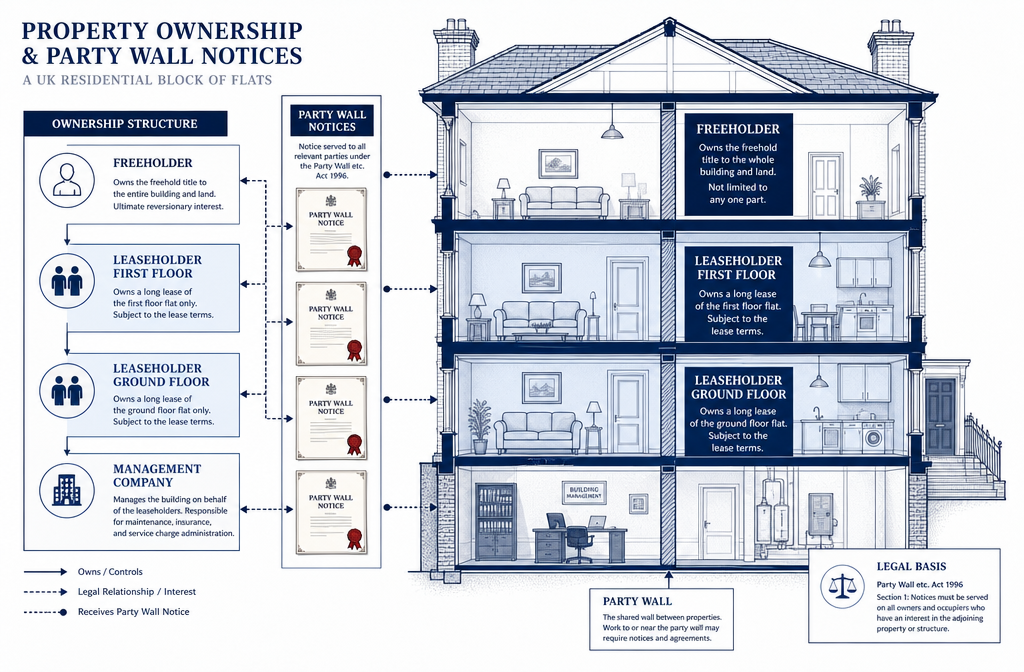
- In a block of flats, both the freeholder AND each leaseholder may qualify as adjoining owners and must each receive a valid party wall notice.
- Management companies and residents' associations do not automatically qualify as adjoining owners unless they hold a relevant property interest.
- Serving notice on the wrong person — or missing someone entirely — can invalidate the process, delay works, and create legal disputes.
- A qualified party wall surveyor can identify all correct recipients, especially in complex mixed-ownership scenarios.
What the Party Wall etc. Act 1996 Says About "Adjoining Owner"
The Party Wall etc. Act 1996 defines an adjoining owner as any person who is an owner of land, buildings, storeys, or rooms adjoining those of the building owner. Crucially, "owner" under the Act is not limited to freehold title. It includes:
- Freeholders — those holding the freehold title to the land or building
- Leaseholders — those holding a lease with more than one year remaining
- Mortgagees in possession — lenders who have taken physical possession of a property
- Persons entitled to receive rent in certain circumstances
💡 Pull Quote: "The Act casts a wide net. Anyone with a qualifying interest in an adjoining property — not just the person who lives there — must receive proper notice."
This breadth is intentional. The Act aims to protect all parties with a genuine stake in the structural integrity of a shared or adjacent wall. When ownership is fragmented across a block of flats, that protective net must be cast over every qualifying interest.
The One-Year Leasehold Threshold
A leaseholder with less than one year remaining on their lease does not qualify as an adjoining owner under the Act. However, this is a narrow exception. The vast majority of residential leaseholders — holding leases of 99, 125, or even 999 years — are firmly within scope. When in doubt, treat every leaseholder as a qualifying adjoining owner.
Identifying Adjoining Owners in Blocks of Flats and Mixed Ownership Buildings
This is where Serving Party Wall Notices on Flats, Leaseholders, and Mixed Ownership Buildings: Who Counts as the Adjoining Owner? becomes genuinely complex. A typical converted Victorian terrace in London, for example, might involve:
| Party | Likely Qualifying as Adjoining Owner? |
|---|---|
| Freehold owner of the block | ✅ Yes |
| Leaseholder — ground floor flat | ✅ Yes (if lease > 1 year) |
| Leaseholder — first floor flat | ✅ Yes (if lease > 1 year) |
| Leaseholder — second floor flat | ✅ Yes (if lease > 1 year) |
| Management company (no property interest) | ❌ Not automatically |
| Residents' association | ❌ No |
| Mortgage lender (not in possession) | ❌ No |
| Sub-tenant (short-term tenancy) | ❌ Usually no |
The Freeholder's Role
The freeholder of an adjoining block holds the reversionary interest in the entire building. Even if they do not occupy any part of the property, they retain a legal interest in the structure and must receive a party wall notice. Failing to serve the freeholder is one of the most common errors in flat-related party wall disputes.
Each Leaseholder Is a Separate Adjoining Owner
Here is the point that surprises many building owners: every individual leaseholder in an adjoining block is a separate adjoining owner in their own right. This means:
- A separate notice must be served on each leaseholder whose flat adjoins or is affected by the proposed works
- Each leaseholder has the independent right to consent or dissent
- If any one leaseholder dissents, a dispute is deemed to arise for that individual, triggering the surveyor appointment process
For a building owner planning a basement excavation beneath a terrace of converted flats, this could mean serving notices on five, six, or even more separate parties — each of whom must be identified, located, and served correctly.
Does the Adjoining Flat Have to Be Directly Adjacent?
Not necessarily. The Act covers adjoining owners — those whose land or buildings are next to or touching the proposed works. In a block of flats:
- A leaseholder on the ground floor may be an adjoining owner for excavation works
- A leaseholder on the upper floor may be an adjoining owner for works to a party wall or party structure
- A leaseholder on a non-adjacent floor may not qualify if their unit has no structural connection to the works
The test is always: does this person hold a qualifying interest in land or a building that adjoins the proposed works? When uncertain, erring on the side of serving notice is the safer approach. Learn more about who qualifies as an adjoining owner and what their rights are under the Act.
Management Companies, Head Lessees, and Other Complicating Factors
Management Companies
A management company that merely manages the block — collecting service charges, arranging insurance, maintaining common areas — does not automatically hold a qualifying property interest. However, some management companies are granted a long lease of the common parts or the entire building under the terms of the lease structure. In that case, they may well qualify as an adjoining owner.
Always check:
- Does the management company hold a lease of any part of the building?
- Is the management company the registered proprietor of any title at HM Land Registry?
- Does the management company have a right to manage that confers any proprietary interest?
Head Lessees
Some blocks operate with a head lessee — a company or individual who holds a long lease of the entire building from the freeholder, and then sub-leases individual flats to occupiers. In this structure:
- The freeholder is an adjoining owner ✅
- The head lessee is an adjoining owner ✅
- Each sub-leaseholder (if their sub-lease exceeds one year) is also an adjoining owner ✅
This three-tier structure is common in purpose-built blocks and requires careful investigation before any notices are served.
Residents' Management Companies (RMCs)
An RMC is a company through which leaseholders collectively manage their building. Unless the RMC itself holds a property interest (such as owning the freehold), it does not qualify as an adjoining owner. The individual leaseholders who are members of the RMC still need to be served in their own right.
⚠️ Common Mistake: Serving notice on the management company or RMC instead of — or in addition to — the individual leaseholders. This does not satisfy the Act's requirements for those leaseholders.
How to Identify All Adjoining Owners: A Practical Step-by-Step Process
Getting this right requires methodical research. Here is a practical approach:
Step 1: Search HM Land Registry 🔍
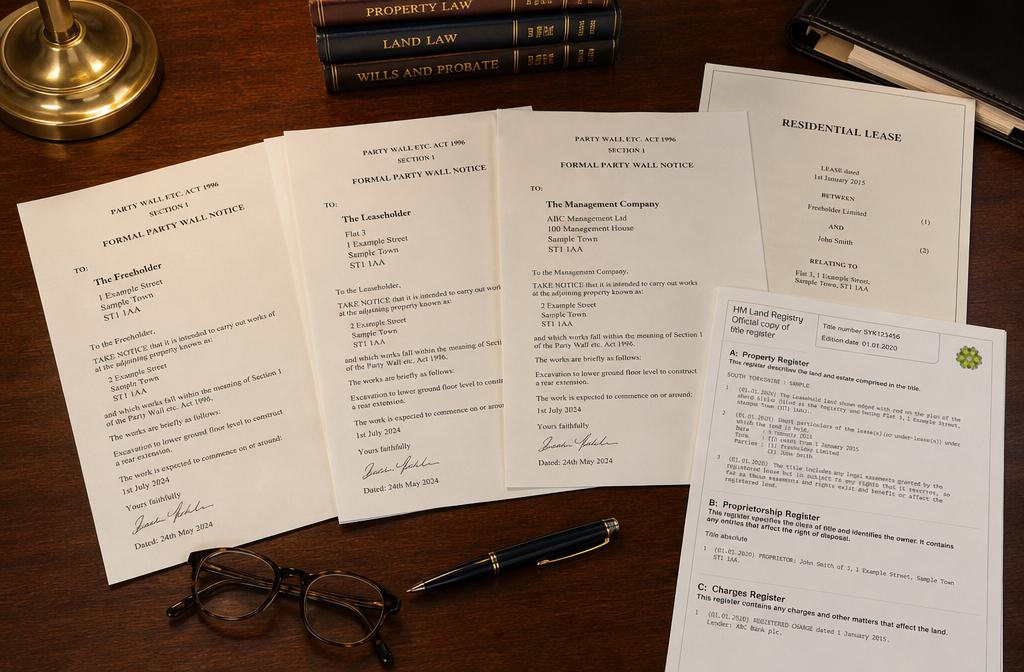
Obtain the title register for the adjoining property. This will identify the registered freehold owner. If the building is divided into flats, individual leasehold titles will also be registered separately.
Step 2: Check for Multiple Registered Titles
A converted block may have a freehold title and multiple leasehold titles. Each registered leasehold title represents a potential adjoining owner.
Step 3: Review Lease Documents
Identify whether a head lease exists and whether any management company holds a leasehold interest in the common parts or the whole building.
Step 4: Establish Contact Details
For each qualifying adjoining owner, identify a valid address for service. Under the Act, notices may be served:
- Personally
- By post to the owner's last known address
- By leaving notice at the property (if the owner cannot be found)
Step 5: Serve All Notices Simultaneously
All qualifying adjoining owners should receive their notices at the same time. Staggered service can create confusion about response deadlines and dispute timelines.
Step 6: Record Everything
Keep a written record of who was served, when, and how. This is essential evidence if a dispute arises later.
For guidance on the different types of notices that may need to be served, see the Party Structure Notice guide.
Common Pitfalls When Serving Party Wall Notices on Flats and Mixed Ownership Buildings

Understanding Serving Party Wall Notices on Flats, Leaseholders, and Mixed Ownership Buildings: Who Counts as the Adjoining Owner? means knowing what can go wrong — and why it matters.
❌ Pitfall 1: Serving Only the Occupier
Many building owners serve notice on whoever answers the door or replies to a letter. In a block of flats, the occupier may be a short-term tenant with no qualifying interest. The notice must go to the owner of the qualifying interest, not simply the person living there.
❌ Pitfall 2: Ignoring Absent Freeholders
Freeholders of residential blocks are often companies or individuals who do not live on the premises. They can be difficult to locate but must still be served. Using Land Registry searches is essential.
❌ Pitfall 3: Assuming One Notice Covers Everyone
A single notice addressed to "the owners and occupiers" of an adjoining property is not sufficient where multiple separate legal interests exist. Each qualifying adjoining owner is entitled to their own notice.
❌ Pitfall 4: Overlooking Upper-Floor Leaseholders
For excavation works or works to lower-floor party structures, building owners sometimes assume only ground-floor leaseholders are affected. Depending on the structure, upper-floor leaseholders may also have a qualifying interest in the party wall or party structure being affected.
❌ Pitfall 5: Confusing "Adjoining" with "Adjacent"
The Act uses "adjoining" in a structural and legal sense, not purely a geographical one. A flat that shares a party wall — even diagonally or through a common structural element — may qualify. Always take professional advice when the structural relationship is unclear.
For a fuller explanation of what constitutes a party structure, see the guide on party wall notices and how to respond.
What Happens After Notices Are Served on Multiple Adjoining Owners?
Once notices are correctly served, each adjoining owner has 14 days (for most notices) to respond. They may:
- Consent in writing — works may proceed under agreed conditions
- Dissent — triggering the appointment of a party wall surveyor
- Fail to respond — treated as dissent after the notice period expires
In a block of flats, it is entirely possible to receive a mixture of responses. Some leaseholders may consent; others may dissent. Each dissent triggers a separate dispute resolution process. This can result in multiple surveyors being appointed, though in practice parties often agree to appoint a single agreed surveyor to manage the process efficiently.
The outcome of the dispute process is a Party Wall Award — a legally binding document that sets out how works are to be carried out, what protections are in place for the adjoining owners, and how any damage will be addressed.
For building owners navigating this process, understanding the building owner's rights and responsibilities is equally important.
When to Seek Professional Help
The complexity of identifying adjoining owners in blocks of flats, leasehold buildings, and mixed-ownership structures is precisely why professional party wall surveyors exist. A qualified surveyor will:
- Conduct title searches to identify all qualifying interests
- Advise on whether specific parties qualify as adjoining owners
- Draft and serve notices correctly on each party
- Manage the dispute resolution process if consent is not given
- Prepare or review the Party Wall Award to protect all parties
Attempting to navigate a multi-party notice process without professional guidance significantly increases the risk of invalid notices, construction delays, and costly disputes. The costs of the party wall process are almost always lower than the cost of resolving a dispute caused by defective notice service.
Conclusion: Get the Recipients Right Before Work Begins
Correctly identifying every adjoining owner is not a formality — it is the legal foundation on which the entire party wall process rests. In 2026, with London's housing stock increasingly divided into leasehold flats and complex mixed-ownership structures, the question of who counts as the adjoining owner has never been more important to answer accurately.
Actionable next steps:
- ✅ Search HM Land Registry for all registered titles associated with the adjoining property before serving any notice
- ✅ Identify every qualifying interest — freeholder, head lessee, individual leaseholders — and treat each as a separate adjoining owner
- ✅ Do not rely on the occupier to represent the legal owner; always serve the registered proprietor
- ✅ Serve all notices simultaneously and keep detailed records of service
- ✅ Engage a qualified party wall surveyor for any project involving blocks of flats, leasehold buildings, or mixed-ownership structures
Getting this right from the start protects the building owner, respects the rights of every adjoining owner, and keeps the project on track.
