

Nearly one in three residential construction disputes in England and Wales involves a party wall — yet the legal instrument designed to prevent those disputes, the Party Wall Award, remains widely misunderstood by both building owners and their neighbours. Party Wall Awards Demystified: Schedules of Condition, Safeguards, and Enforceability Essentials is exactly the kind of deep-dive resource that property owners, developers, and surveyors need heading into 2026, when urban densification and basement conversions continue to push shared walls to their limits.
This guide breaks down every component of a Party Wall Award — from recitals and working drawings to indemnity clauses and enforcement mechanisms — using practical, real-world examples to show how each element protects both parties and keeps projects on track.
Key Takeaways 📌
- A Party Wall Award is a legally binding document under the Party Wall etc. Act 1996 that governs how notifiable works must be carried out near or on a shared wall.
- A Schedule of Condition is the evidentiary backbone of the Award — without it, proving pre-existing damage is nearly impossible.
- Awards contain multiple safeguards including working-hours restrictions, method statements, and indemnity clauses that protect adjoining owners.
- Party Wall Awards are directly enforceable through the County Court without the need for separate litigation.
- Getting the Award right from the start prevents costly disputes, delays, and injunctions on 2026 construction projects.
What Is a Party Wall Award and Why Does It Matter?
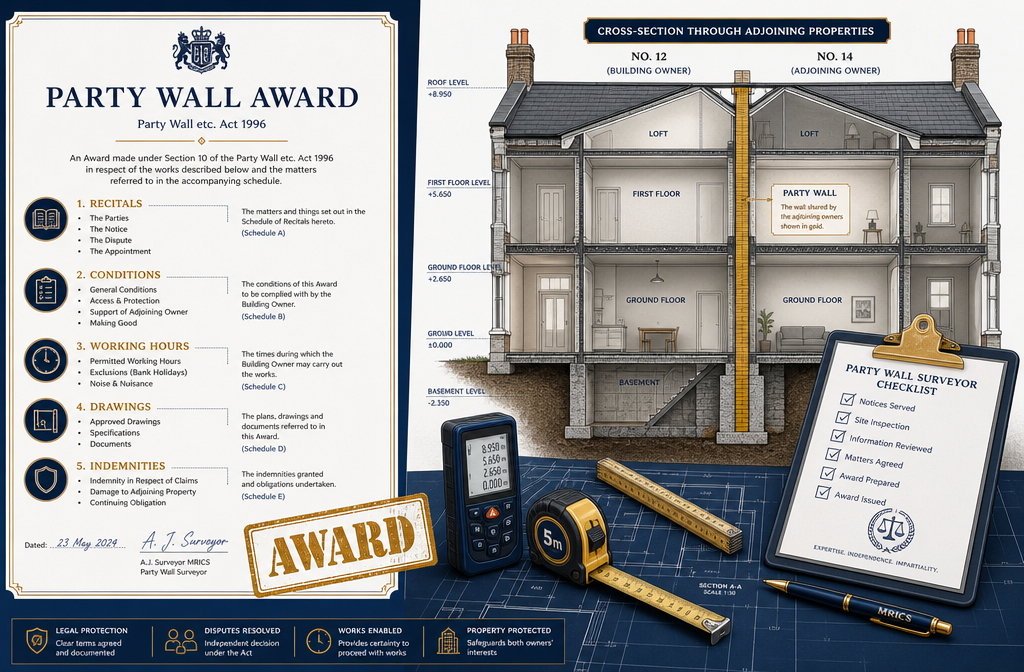
A Party Wall Award — sometimes called a "party wall agreement" in everyday language — is a formal written determination made by one or more appointed surveyors under the Party Wall etc. Act 1996. It is not a simple neighbourly handshake. It is a legally binding instrument that defines the rights, responsibilities, and protections of both the building owner (the person carrying out works) and the adjoining owner (the neighbour affected by those works).
💡 Pull Quote: "A Party Wall Award is less about permission and more about protection — it sets the rules of engagement for construction work that could affect someone else's property."
When Is an Award Required?
An Award becomes necessary when:
- A neighbour dissents to a Party Wall Notice (or fails to respond within 14 days, which is deemed dissent).
- The works involve notifiable activities such as cutting into a party wall, underpinning, or excavating within 3–6 metres of an adjoining structure.
- Both parties cannot reach a written agreement without surveyor involvement.
If you are unsure whether your planned project triggers the Act, reviewing the types of party wall works covered under the legislation is a useful starting point.
The Surveyor Appointment Process
| Scenario | Surveyor Arrangement |
|---|---|
| Adjoining owner agrees | Agreed surveyor — one surveyor acts for both parties |
| Adjoining owner dissents | Each party appoints their own surveyor; the two appoint a Third Surveyor if needed |
| Adjoining owner ignores notice | Building owner can appoint a surveyor on their behalf |
Once appointed, surveyors have a statutory duty to act impartially — even the building owner's surveyor must consider the adjoining owner's interests fairly.
The Core Components of a Party Wall Award: A Step-by-Step Breakdown
Understanding Party Wall Awards Demystified: Schedules of Condition, Safeguards, and Enforceability Essentials begins with knowing exactly what goes inside the document. A well-drafted Award typically contains the following sections:
1. 📋 Recitals
The recitals are the opening statements of the Award. They record:
- The names and addresses of all parties
- The property addresses
- The nature of the dispute or dissent
- The surveyor appointments and dates
- A reference to the relevant sections of the Party Wall etc. Act 1996
Think of recitals as the "whereas" clauses — they establish context and confirm the Award's legal basis.
2. 🏗️ Description of Works
This section describes precisely what the building owner is permitted to do. Vague descriptions cause disputes later. A good description will reference:
- Specific wall locations (e.g., "the party wall between No. 14 and No. 16 Maple Street")
- The nature of the works (e.g., "insertion of a steel beam at first-floor level")
- Reference to approved drawings (listed by drawing number and revision)
Example: An Award for a rear extension might state: "The building owner is permitted to cut into the party wall at ground-floor level to a depth not exceeding 215mm for the purpose of building in a new steel padstone, as shown on Drawing Ref: EXT-001 Rev B."
3. 📐 Drawings and Specifications
Drawings are attached to and form part of the Award. These typically include:
- Structural drawings showing beam positions, padstones, and wall ties
- Architectural drawings showing the extent of works
- Method statements from the structural engineer
These documents are not optional extras — they are legally incorporated into the Award and define the permitted scope of works. Any deviation from them could expose the building owner to liability.
4. ⏰ Working Conditions and Restrictions
This is where the Award's practical safeguards live. Standard conditions typically include:
- Working hours: Usually Monday–Friday 8am–6pm, Saturday 8am–1pm, no Sundays or Bank Holidays
- Noise and dust control: Requirements for hoarding, dust sheets, or water suppression
- Structural monitoring: Crack monitors or tell-tales on sensitive walls
- Temporary propping: Requirements to support the adjoining owner's structure during works
- Access provisions: Rights of entry for the adjoining owner's surveyor to inspect
⚠️ Important: Breaching working-hour conditions is one of the most common causes of neighbour complaints. Contractors must be briefed on these restrictions before work begins.
5. 💷 Costs and Fees
The Award will state who pays for what. In most cases:
- The building owner pays the adjoining owner's surveyor fees
- The building owner pays for any damage caused to the adjoining property
- Costs of the Third Surveyor (if used) are allocated by the surveyors
For a clearer picture of what to budget, the costs of the party wall process page provides useful guidance.
6. 🛡️ Indemnity Clauses
Indemnity clauses are the financial safety net for adjoining owners. They typically state that the building owner indemnifies the adjoining owner against:
- Physical damage to the adjoining property caused by the notifiable works
- Consequential losses arising from structural failure or negligence
- Costs of making good any damage identified post-construction
Real example: If a basement excavation causes a crack in the adjoining owner's kitchen wall, the indemnity clause obligates the building owner to repair it — or pay for repairs — regardless of whether the crack was foreseeable.
Schedule of Condition: The Evidentiary Cornerstone of Every Award
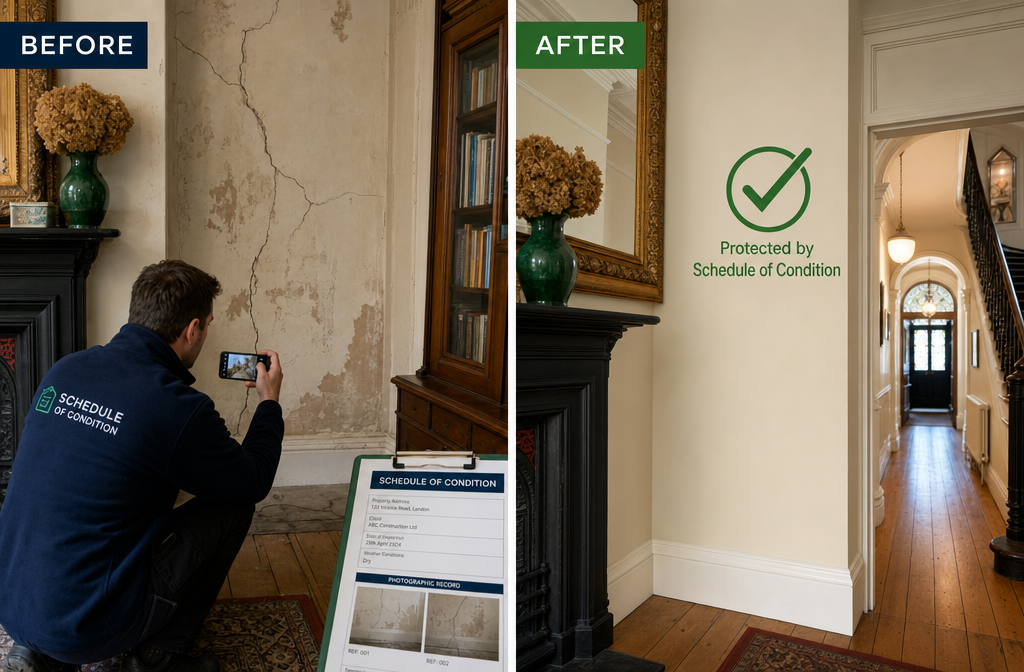
No section of Party Wall Awards Demystified: Schedules of Condition, Safeguards, and Enforceability Essentials is more practically important than this one. The Schedule of Condition is a detailed photographic and written record of the adjoining property's condition before works begin.
Why the Schedule of Condition Is Non-Negotiable
Without a Schedule of Condition, disputes about pre-existing versus construction-caused damage become almost impossible to resolve fairly. Consider this scenario:
Scenario: A building owner completes a loft conversion. The adjoining owner subsequently claims that three large cracks in their bedroom ceiling were caused by the works. Without a Schedule of Condition, there is no baseline evidence. The building owner cannot prove the cracks existed before; the adjoining owner cannot prove they did not.
A properly prepared Schedule eliminates this uncertainty entirely.
What a Schedule of Condition Covers
A thorough Schedule typically documents:
| Area Inspected | What Is Recorded |
|---|---|
| External walls | Existing cracks, pointing condition, staining |
| Internal walls and ceilings | Hairline cracks, plaster condition, damp patches |
| Floors | Existing movement, gaps, squeaks |
| Windows and doors | Frame condition, operation, existing damage |
| Roof (where accessible) | Tile condition, flashing, gutters |
| Garden and outbuildings | Existing settlement, boundary structures |
Each item is photographed, dated, and described in writing. The Schedule is then appended to the Award and signed by the surveyors.
How the Schedule Protects Both Parties 🤝
- Adjoining owners gain documented proof of pre-works condition, making damage claims straightforward.
- Building owners gain protection against inflated or fraudulent claims for damage that existed before their works began.
- Surveyors have a clear reference point for any post-works inspection.
For adjoining owners wondering what their rights are during a neighbour's project, the adjoining owners' guide explains the full picture.
Enforceability: What Happens When an Award Is Ignored?
A Party Wall Award is only as effective as its enforcement. This is where many property owners are surprised to learn just how powerful the instrument actually is.
Legal Status of a Party Wall Award
Under Section 10(16) of the Party Wall etc. Act 1996, a Party Wall Award is final and binding on all parties, subject only to the right of appeal within 14 days of service. This means:
- It does not need to be registered at the Land Registry to be enforceable
- It does not require a separate court order to have legal effect
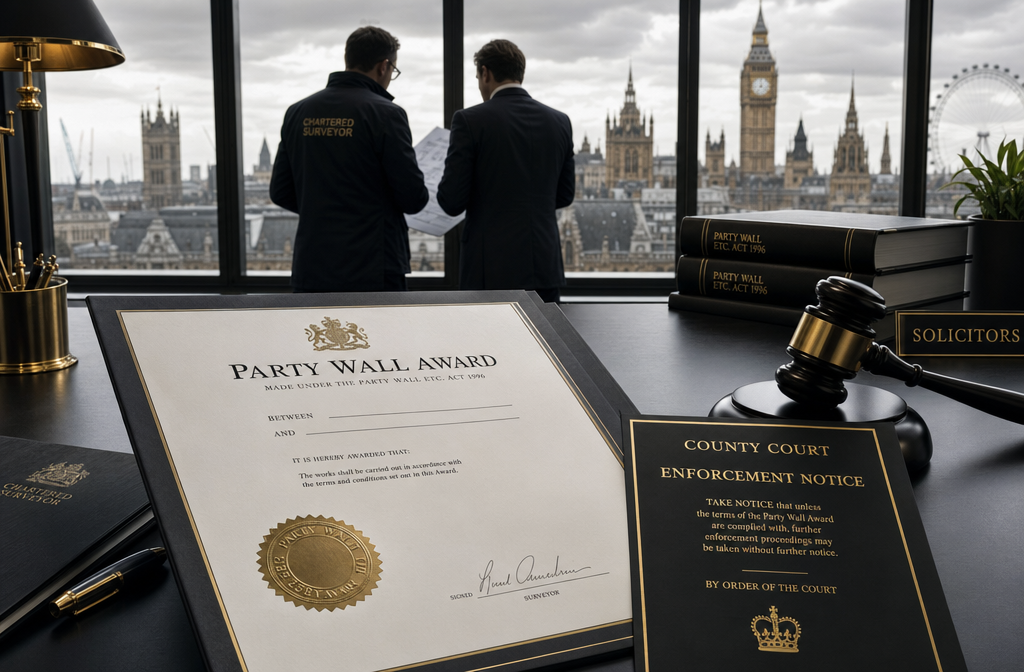
- It can be enforced directly through the County Court
Appealing an Award
Either party can appeal to the County Court within 14 days of the Award being served. Grounds for appeal are typically limited to:
- The Award was made outside the surveyors' jurisdiction
- The Award contains a fundamental error of law
- The surveyors acted improperly or exceeded their powers
Courts rarely overturn Awards on minor procedural grounds — the bar is deliberately high to prevent tactical appeals that delay construction.
Enforcement in Practice
If the building owner ignores the Award and proceeds with works in breach of its conditions, the adjoining owner has several remedies:
- Injunction — Apply to the County Court for an injunction to stop works immediately
- Damages — Claim compensation for any loss or damage suffered
- Self-help — In limited circumstances, the adjoining owner may take reasonable steps to protect their property
If the building owner fails to serve a valid notice and proceeds without an Award at all, the adjoining owner can seek an injunction to halt works entirely — a costly and embarrassing outcome for any developer.
💡 Pull Quote: "An ignored Party Wall Award is not a minor administrative oversight — it is a breach of statutory duty that can result in injunctions, damages claims, and significant project delays."
The Third Surveyor Mechanism 🔑
One of the most underused safeguards in the Act is the Third Surveyor. Appointed at the outset (but rarely called upon), the Third Surveyor acts as an arbiter when the two party-appointed surveyors cannot agree. Either surveyor — or either owner — can call on the Third Surveyor to make a determination. This keeps disputes out of court and resolves them quickly.
Common Mistakes That Undermine Party Wall Awards in 2026
Even well-intentioned parties make errors that reduce the effectiveness of their Award. Here are the most frequent pitfalls to avoid:
❌ Mistake 1: Vague Descriptions of Works
Awards that describe works in broad terms (e.g., "general building works") leave room for disputes about what was actually permitted. Always insist on specific, drawing-referenced descriptions.
❌ Mistake 2: Skipping the Schedule of Condition
Some parties try to save time or money by omitting the Schedule. This is a false economy. The cost of a proper Schedule is minimal compared to the cost of a disputed damage claim.
❌ Mistake 3: Serving Notices Too Late
The Act requires notices to be served at least two months before notifiable works begin (one month for Line of Junction works). Late service can invalidate the process and delay projects. For guidance on the notice process, see Party Wall Act notices explained.
❌ Mistake 4: Assuming Consent Means No Award Is Needed
If an adjoining owner consents in writing to a Party Wall Notice, no Award is needed — but only if that consent is properly recorded and the works proceed exactly as described in the notice. Any change to the works may require a fresh notice or supplemental Award.
❌ Mistake 5: Not Briefing Contractors
The Award binds the building owner, but contractors on site are the ones who actually comply (or fail to comply) with its conditions. Contractors must receive a copy of the relevant conditions before work begins.
Practical Tips for a Smooth 2026 Party Wall Process
Whether acting as a building owner or an adjoining owner, these steps will help ensure the Award works as intended:
For Building Owners:
- Serve notices early — ideally 3 months before planned start date
- Appoint an experienced surveyor who knows how to draft clear, comprehensive Awards
- Provide complete drawings to surveyors before the Award is finalised
- Brief your contractor on all Award conditions before work begins
- Keep a copy of the Award on site throughout the project
For Adjoining Owners:
- Do not ignore Party Wall Notices — respond within 14 days
- Appoint your own surveyor (the building owner typically pays their fees)
- Ensure the Schedule of Condition covers all vulnerable areas of your property
- Request a post-works inspection once construction is complete
- Know your right to call on the Third Surveyor if disputes arise
For those managing costs, there are practical ways to keep party wall costs down without compromising on protection.
Conclusion: Getting Party Wall Awards Right in 2026
The Party Wall Award is one of the most effective dispute-prevention tools in English property law — but only when it is properly prepared, clearly drafted, and actively enforced. Party Wall Awards Demystified: Schedules of Condition, Safeguards, and Enforceability Essentials has shown that every component of the Award — from recitals and drawings to indemnity clauses and the Schedule of Condition — serves a specific protective function.
Actionable Next Steps ✅
- Identify your role — Are you a building owner or an adjoining owner? Your obligations and rights differ significantly. Review the relevant guidance for building owners or adjoining owners.
- Check whether your works are notifiable — Review the types of party wall works to confirm whether the Act applies.
- Serve notices on time — Use the party wall notices resource to understand what must be served and when.
- Appoint a qualified surveyor — Especially for complex projects, a specialist surveyor ensures the Award is watertight. Find local expertise through the locations directory.
- Insist on a Schedule of Condition — Do not allow works to begin without one, regardless of how friendly the relationship with your neighbour appears.
A robust Party Wall Award, built on a thorough Schedule of Condition and clear contractual safeguards, is the difference between a smooth 2026 construction project and a costly, stressful legal dispute.