


Fewer than one in ten party wall disputes ever reaches a formal challenge — yet the consequences of missing the window to appeal can be permanent and costly. Many property owners and even some surveyors assume that once a party wall award is issued, it is completely untouchable. That assumption is only partly correct. Party wall awards can be challenged, but the rules governing when, how, and on what grounds are strict, unforgiving, and widely misunderstood. This guide on Can Party Wall Awards Be Challenged? The Grounds, Time Limits, and Practical Steps for Surveyors and Owners cuts through the confusion to give both building owners and adjoining owners a clear, actionable picture of their rights.
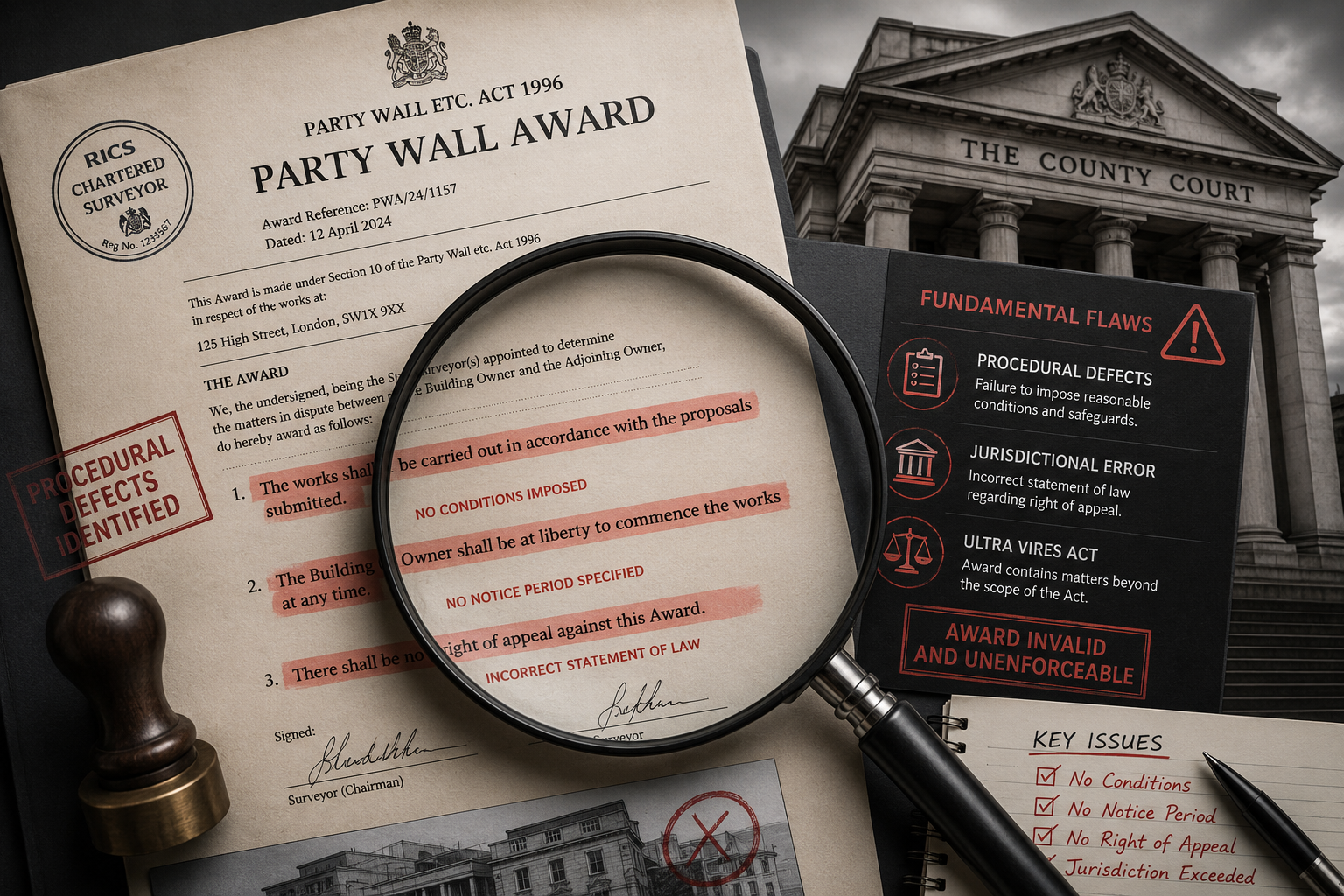
Key Takeaways 📌
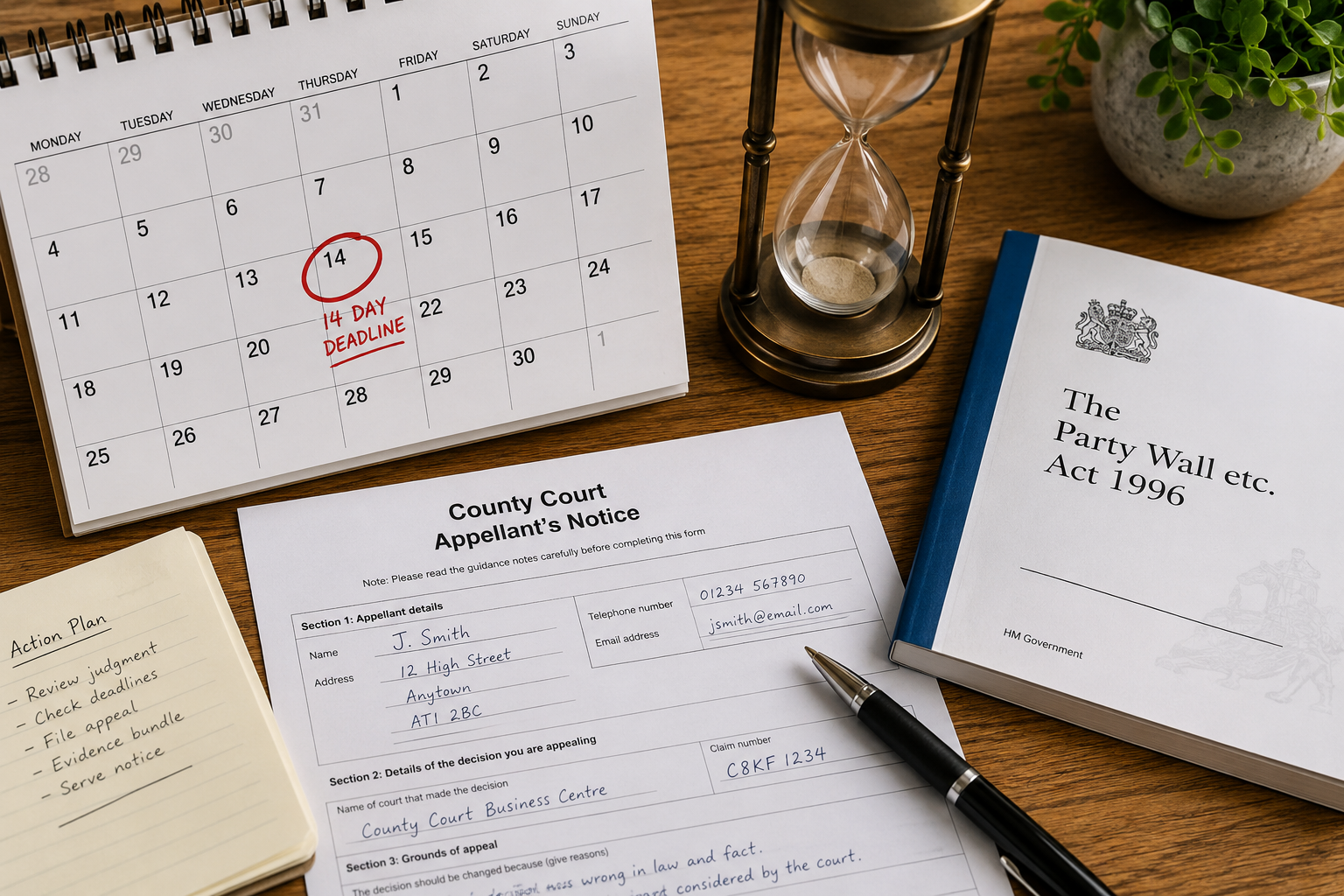
- Yes, a party wall award can be challenged — but only by appealing to the County Court within 14 days of the award being served. [1][7]
- After that 14-day window closes, the award becomes binding and conclusive and cannot normally be questioned by any court. [1]
- Valid grounds for challenge include jurisdictional defects, procedural errors, and awards that are unreasonable or unjust in their terms.
- The practical step is to file an appellant's notice in the County Court, clearly stating the grounds for appeal. [7]
- A separate 6-year limitation period applies to recovering money owed under a valid award — this is distinct from challenging the award itself. [5]
What Is a Party Wall Award and Why Does Finality Matter?
A party wall award (sometimes called a "party wall agreement" in everyday language) is a legally binding document produced by one or more appointed surveyors under the Party Wall etc. Act 1996. It sets out the rights and obligations of both the building owner and the adjoining owner in relation to proposed construction works affecting a shared wall, boundary, or structure.
Understanding the party wall award process is essential before exploring challenges. The award typically covers:
- The scope of permitted works
- Hours of working and access arrangements
- Security for expenses and compensation provisions
- A schedule of condition to record the state of the adjoining property before works begin
The Act deliberately builds in finality. Section 10(16) and 10(17) of the Party Wall etc. Act 1996 state that an award shall be "conclusive" and that no appeal shall lie except as provided by the Act itself. This finality is intentional — it prevents construction projects from being indefinitely stalled by repeated legal challenges. [1]
💬 "If no appeal is made within 14 days, the party wall award is binding and conclusive and cannot be questioned by any Court." — Anstey Horne Professional Fact Sheet [1]
The Grounds for Challenging a Party Wall Award
Not every grievance with a party wall award justifies a legal challenge. Courts take the finality of awards seriously, and a challenge is unlikely to succeed simply because one party is unhappy with the outcome. However, there are recognised grounds on which an appeal may succeed.
1. Jurisdictional Defects
A party wall award can be challenged if the surveyors who made it lacked the jurisdiction to do so. Common jurisdictional defects include:
- The works described in the award fall outside the scope of the Party Wall etc. Act 1996
- The notice served by the building owner was invalid (e.g., served too late, on the wrong person, or in the wrong form) — see our guide on party wall act notices for more on valid notice requirements
- The surveyor was not properly appointed under the Act
- The award covers land or structures that are not party walls or party structures as defined by the Act
If the surveyors had no jurisdiction to act, the award is void — not merely voidable — and the 14-day time limit may not apply in the same way. Courts have historically been willing to declare void awards as nullities even outside the appeal window, though this remains a complex legal area best handled by a solicitor.
2. Procedural Errors
Even where jurisdiction exists, an award may be challenged if the procedure followed was fundamentally flawed. Examples include:
- One surveyor failed to give proper notice to the other before making an ex-parte award
- The third surveyor was selected improperly or acted outside their remit
- The award was not served correctly on both parties
3. Unreasonable or Unjust Terms
Courts have the power to modify an award, not just quash it. Under section 10(17) of the Act, the County Court may rescind or modify an award if it considers it unreasonable in its terms. This is a higher bar than mere dissatisfaction — the terms must be demonstrably unjust or disproportionate.
Examples might include:
- Compensation figures that bear no rational relationship to the actual loss suffered
- Working hour restrictions so severe they make the works commercially unviable without good reason
- Conditions that go beyond what is reasonably necessary to protect the adjoining owner
4. Awards Made in Bad Faith or Fraud
While rare, an award made through fraud or collusion between surveyors can be challenged outside the normal appeal process. This is an extreme ground and requires strong evidence.
The Critical 14-Day Time Limit Explained
| Scenario | Time Limit | Action Required |
|---|---|---|
| Appealing the award itself | 14 days from service | File appellant's notice in County Court |
| Recovering money under a valid award | 6 years (Limitation Act 1980) | Civil claim in court |
| Challenging a void/jurisdictional award | No fixed limit (but act promptly) | Seek legal advice immediately |
The 14-day appeal window is the single most important deadline in this entire area of law. Both the building owner and the adjoining owner have a statutory right of appeal to the County Court, and this must be exercised within 14 days of the award being served. [1][2][7]
This is not 14 working days. It is 14 calendar days. Miss it, and the award becomes binding and conclusive. [1]
⚠️ Critical point: The 14-day clock starts running from the date the award is served on the party — not from the date they actually read it, or the date it was signed by the surveyors.
The 6-year limitation period is a separate and distinct concept. It applies to situations where a valid award has been made and one party owes money to the other under it (for example, compensation for damage caused during works). The Limitation Act 1980 gives the aggrieved party up to six years to bring a claim to recover that money. [5] This does not mean the award itself can be challenged after six years — it cannot.
Practical Steps: How to Challenge a Party Wall Award
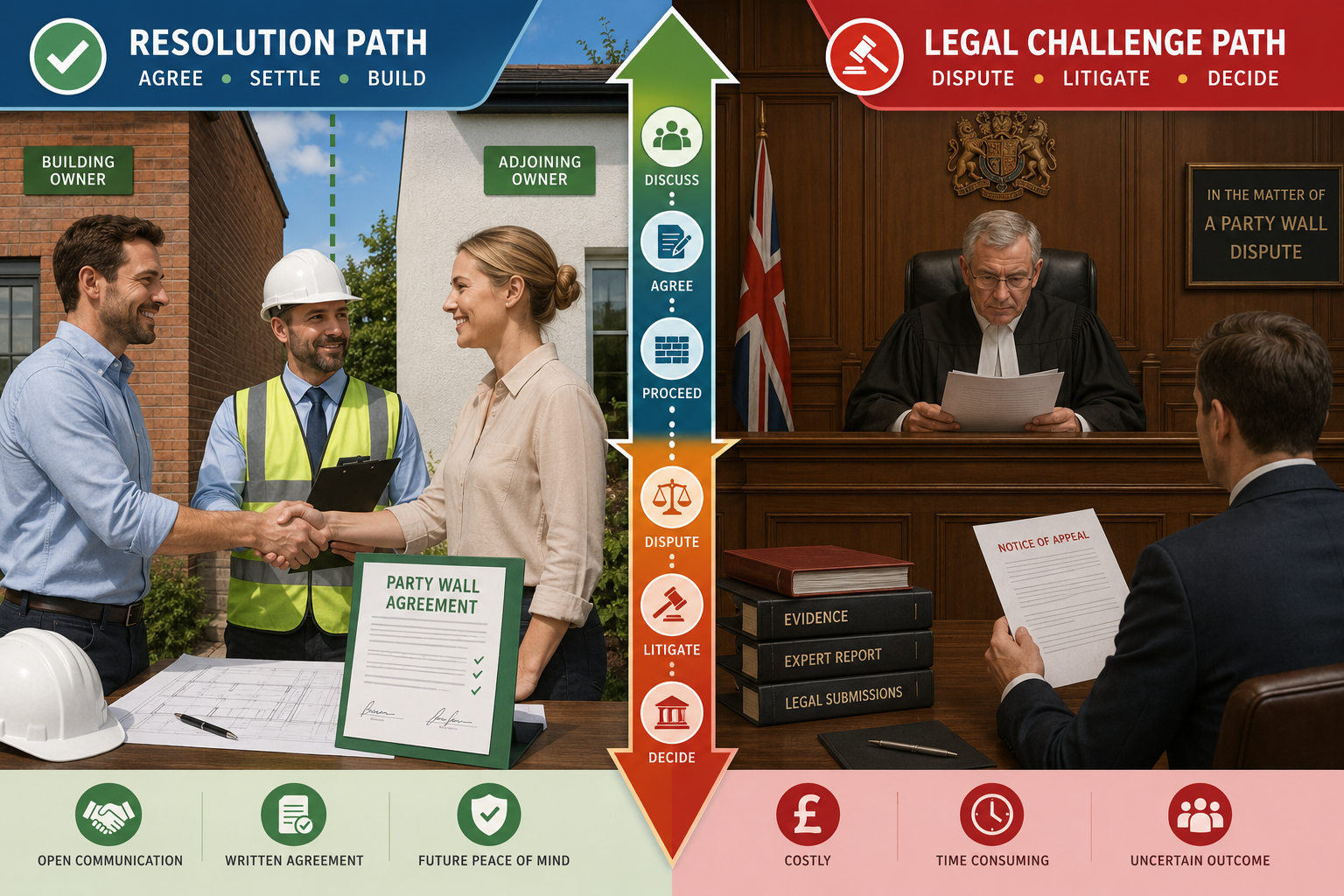
If grounds for challenge exist and the 14-day window is still open, here is the step-by-step process.
Step 1: Take Immediate Legal Advice
Do not wait. Instruct a solicitor with experience in property or party wall disputes the moment the award is served, if there is any doubt about its validity or fairness. Given the 14-day window, there is no time to hesitate.
Step 2: Identify the Specific Grounds
Work with the solicitor and, where appropriate, an independent party wall surveyor to identify the precise grounds for appeal. Vague dissatisfaction will not succeed. The grounds must be clearly articulated — whether jurisdictional, procedural, or relating to the unreasonableness of specific terms.
Step 3: File an Appellant's Notice in the County Court
The formal mechanism for challenging a party wall award is to file an appellant's notice in the County Court, clearly explaining why the award is being appealed. [7] This is the route confirmed by GOV.UK's official guidance and echoed by the Federation of Master Builders. [4][7]
The appellant's notice should:
- Identify the award being challenged (date, parties, surveyors)
- State the specific grounds of appeal
- Set out the relief sought (e.g., rescission, modification of specific terms)
Step 4: Serve Notice of the Appeal
Once filed, the appeal must be served on the other party and on the surveyors who made the award. Failure to do this correctly can itself cause procedural problems.
Step 5: Attend the Hearing
The County Court will list the matter for a hearing. Both parties will have the opportunity to present their arguments. The court may:
- Uphold the award in full
- Modify specific terms it considers unreasonable
- Rescind the award entirely (rare, usually only for jurisdictional defects)
What Happens If the Appeal Window Is Missed?
Once 14 days have passed without an appeal, the award is binding and conclusive. [1][2] This means:
- The courts will generally refuse to hear any challenge to the award's terms or validity
- The parties must comply with the award as issued
- Any breach of the award can be enforced through the courts
The only realistic exception is where the award is void for want of jurisdiction — meaning the surveyors had no power to make it at all. In such cases, some courts have been willing to consider the matter even outside the 14-day window, on the basis that a void act cannot be made valid by the passage of time. However, this is legally uncertain territory and should not be relied upon without specialist advice.
For adjoining owners who are concerned about works already underway without proper notice, the adjoining owner's surveyor service can help assess the position and advise on available remedies.
Practical Considerations: Is a Challenge Worth Pursuing?
Before filing an appeal, it is worth making a clear-eyed assessment of whether the challenge is realistically likely to succeed and whether the cost is proportionate.
Factors that support pursuing a challenge:
- ✅ Clear jurisdictional defect (works outside the Act, invalid notice)
- ✅ Demonstrably unreasonable financial terms causing significant loss
- ✅ Procedural error that materially affected the outcome
- ✅ High-value project where the award terms have major financial consequences
Factors that suggest accepting the award:
- ❌ Mere dissatisfaction with the outcome
- ❌ Minor differences in working hours or access arrangements
- ❌ The cost of legal proceedings exceeds the benefit of winning
- ❌ The 14-day window has already closed
It is also worth noting that the costs of the party wall process — including surveyor fees — are typically borne by the building owner. If the award is successfully challenged and modified, cost consequences may follow.
Advice for Surveyors: Drafting Awards That Are Appeal-Proof
For party wall surveyors, the best defence against a successful appeal is a well-drafted, procedurally sound award. Key principles include:
- Confirm jurisdiction at the outset — ensure the works fall within the Act, the notice is valid, and appointments are properly documented. Review the types of party wall works covered by the Act.
- Follow procedure meticulously — give proper notice to the other surveyor before making any award, especially ex-parte awards
- Ensure terms are proportionate — compensation and conditions must be rationally connected to the actual risk or loss
- Document reasoning — where the award departs from standard practice, record the reasons clearly
- Serve the award correctly — confirm service on all parties and record the date
A schedule of condition prepared before works begin is also essential — it provides the evidential baseline for any later compensation claims and reduces disputes about pre-existing damage.
Regional Considerations for London Property Owners
Party wall disputes are particularly common in London, where terraced and semi-detached properties share walls and where development pressure is high. Whether the property is in North London, South London, East London, or West London, the same national rules apply — but local expertise matters when assessing the specific risks of basement excavations, loft conversions, and extensions in dense urban settings.
In 2026, with London's housing stock continuing to evolve through permitted development and urban densification, the volume of party wall awards being issued remains high. So too does the potential for awards that are challenged — successfully or otherwise.
Conclusion: Act Fast, Act Informed
The answer to Can Party Wall Awards Be Challenged? The Grounds, Time Limits, and Practical Steps for Surveyors and Owners is a qualified yes — but the conditions are strict and the window is narrow.
Here are the actionable next steps for anyone facing this situation in 2026:
- Check the date of service — the 14-day countdown begins the moment the award is served.
- Identify the grounds — jurisdictional defects, procedural errors, or unreasonable terms are the strongest bases for challenge.
- Instruct a solicitor immediately — do not wait to see if the situation resolves itself.
- File an appellant's notice in the County Court within 14 days if grounds exist. [7]
- If the window has passed, assess whether the award is potentially void for jurisdictional reasons — and take specialist legal advice.
- For surveyors, draft every award with procedural rigour and proportionate terms to minimise vulnerability to appeal.
A party wall award is a powerful document — but it is not beyond scrutiny. Knowing the rules is the first step to protecting your rights.
References
[1] Party Wall Fact Sheet – https://www.ansteyhorne.co.uk/services/party-wall-fact-sheet
[2] Party Wall Agreement – https://hoa.org.uk/advice/guides-for-homeowners/i-am-improving/party-wall-agreement/
[3] Party Wall Awards And Change Of Ownership What Really Happens When The Neighbours Or You Sell – https://www.tayross.com/blogs/party-wall-awards-and-change-of-ownership-what-really-happens-when-the-neighbours-or-you-sell
[4] Party Wall Agreements What You Need To Know – https://www.fmb.org.uk/find-a-builder/ultimate-guides-to-home-renovation/party-wall-agreements-what-you-need-to-know.html
[5] Buying Property Party Wall Award – https://osborneslaw.com/blog/buying-property-party-wall-award/
[7] If You Cant Agree – https://www.gov.uk/party-walls-building-works/if-you-cant-agree