


{"cover":"Professional landscape format (1536×1024) hero image with bold text overlay: 'Can You Start Work Without a Party Wall Award?' in extra large 72pt white bold sans-serif font with dark semi-transparent background panel, centered upper-third composition. Background shows a dramatic split scene: left side shows a brick terraced house with scaffolding and construction workers, right side shows a worried homeowner holding legal documents with a red warning stamp. Color palette: deep navy blue, white text, red accent warning elements. High contrast, editorial magazine cover quality, professional photography aesthetic.","content":["Detailed landscape format (1536×1024) editorial illustration showing a UK terraced house cross-section with a party wall highlighted in red between two properties. On the left side, a building owner with hard hat looks eager to start work with tools ready. On the right side, an adjoining owner looks confused holding an unanswered notice letter. A large clock in the background shows time pressure. Legal documents labeled 'Party Wall Notice' and 'Party Wall Award' are visible. Color scheme: muted blues and grays with red warning highlights. Clean, informative, professional illustration style.","Detailed landscape format (1536×1024) showing a dramatic courtroom or legal dispute scene from above: a wooden table with scattered documents labeled 'Party Wall Dispute', 'Injunction Notice', 'Schedule of Condition', and 'Damage Claim'. Two opposing figures sit on either side of the table with a solicitor in the middle. Red warning icons and pound sterling symbols float above documents suggesting financial risk. Background shows cracked brickwork and structural damage photos pinned to a board. Color scheme: dark wood tones, white documents, red and amber warning colors. Editorial, high-contrast, professional legal aesthetic.","Detailed landscape format (1536×1024) showing a side-by-side comparison infographic scene: left panel labeled 'Informal Consent' shows two neighbours shaking hands casually over a garden fence with a speech bubble saying 'Sure, go ahead!' — depicted as fragile and legally weak with a dotted border. Right panel labeled 'Formal Party Wall Award' shows a professional surveyor handing over an official stamped document with solid borders, checkmarks, and legal protection icons. Center dividing line shows a scale of justice tipping toward the formal route. Color scheme: amber/orange for informal, green for formal, clean white background. Infographic-style, educational, professional design."}

Nearly one in three party wall disputes escalates into a formal legal conflict — often because a building owner assumed silence meant approval, or that a friendly chat over the fence was enough. Understanding whether you can start work without a party wall award, and what owners risk when neighbours haven't responded or have only given informal consent, is not just a legal technicality. It can be the difference between a smooth renovation and a costly, stressful injunction.
This article cuts through the confusion around the Party Wall etc. Act 1996 and explains exactly what the law requires, what silence really means, and why informal agreements leave building owners dangerously exposed.
Key Takeaways 📋
- Silence is dissent — if a neighbour does not respond to a party wall notice within 14 days, the law treats it as a dispute, not consent.
- Informal consent is not legally binding — a verbal agreement or friendly email does not satisfy the Party Wall etc. Act 1996.
- Starting work without a valid award or written consent exposes you to injunctions, damage claims, and legal costs.
- A party wall award protects both parties — it is not just a bureaucratic hurdle.
- Retrospective awards are possible but complicated — prevention is always cheaper than cure.
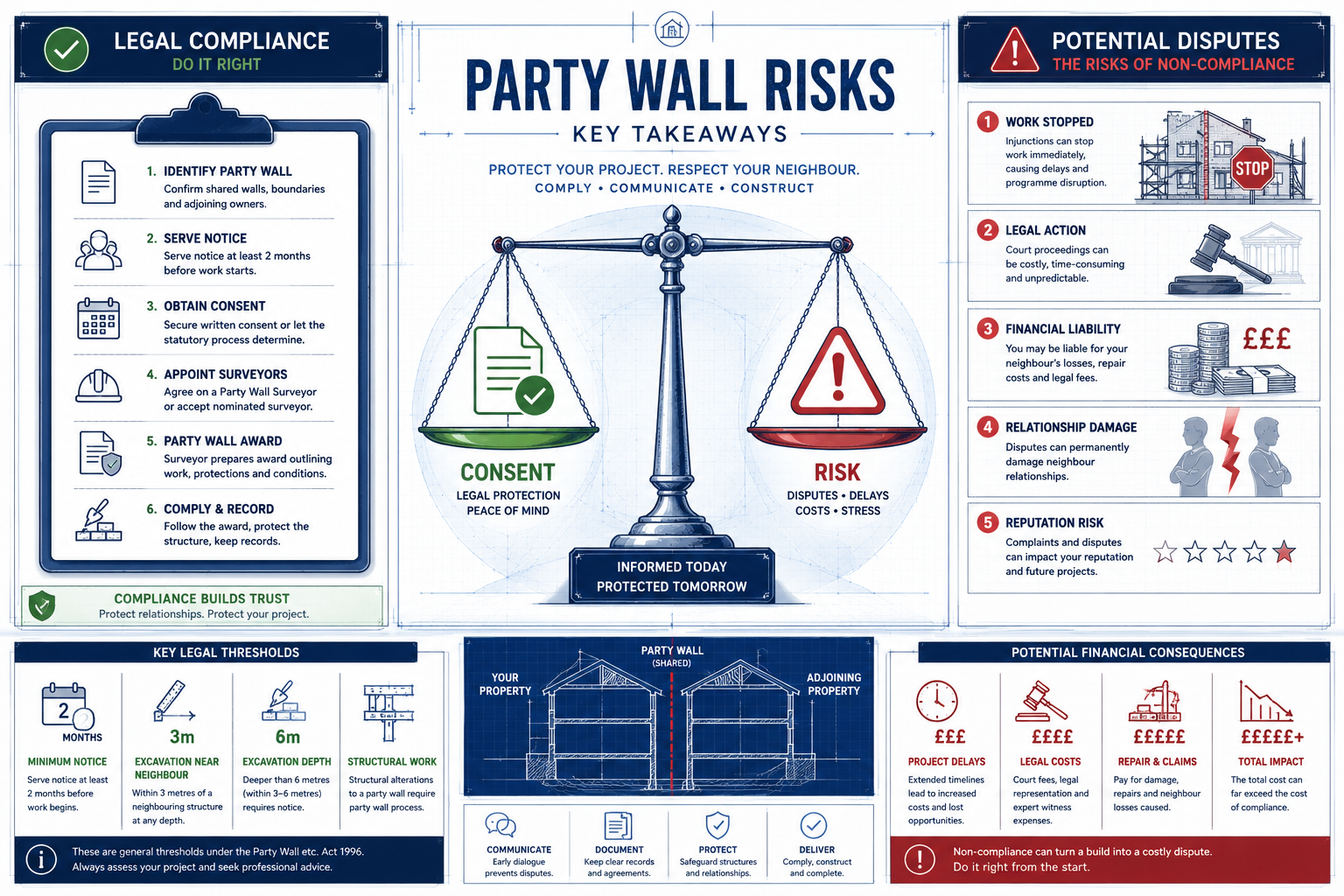
What the Party Wall etc. Act 1996 Actually Requires
The Party Wall etc. Act 1996 applies in England and Wales. It governs works that affect shared walls, boundary structures, and excavations near neighbouring buildings. Before carrying out notifiable works, a building owner must serve a valid party wall notice on every adjoining owner.
After receiving the notice, the adjoining owner has 14 days to respond. There are only two legally valid outcomes:
| Adjoining Owner's Response | Legal Effect |
|---|---|
| Gives written consent within 14 days | Work can proceed without a formal award |
| Does not respond within 14 days | Deemed dissent — dispute procedure triggered |
| Expressly dissents | Dispute procedure triggered |
💡 Pull Quote: "The law does not recognise silence as consent. A neighbour who simply ignores a notice has, in legal terms, objected to the works." [8]
Once a dispute is triggered — whether by silence or express dissent — both parties must appoint surveyors. Those surveyors then produce a party wall award, which sets out the conditions under which work may proceed [4]. Only after that award is in place can notifiable work lawfully begin.
What Counts as Notifiable Work?
Not every building project triggers the Act. Common notifiable works include:
- 🧱 Cutting into a party wall (e.g., for beams or RSJs)
- 🏗️ Building up to or astride the boundary line
- 🔨 Demolishing and rebuilding a party wall
- 🕳️ Excavating within 3 or 6 metres of a neighbour's foundations (depending on depth)
- 🪟 Inserting a damp-proof course through a party wall
For a full breakdown of which projects require notices, see types of party wall works.
Can You Start Work Without a Party Wall Award? The Real Answer
The short answer is: it depends on whether you have valid written consent.
If a neighbour provides written consent within the 14-day response window, no formal award is needed and work can begin once the relevant notice period expires [5]. However, if no response has been received, or if consent was only given verbally or informally, the answer is an unambiguous no — starting work would be unlawful under the Act [1].
The Danger of Assuming Silence Means "Go Ahead"
This is where many building owners get into serious trouble. A neighbour who does not reply to a notice within 14 days has not consented — they have, in legal terms, dissented [8]. The Act is explicit on this point. Proceeding on the basis of unanswered notices is one of the most common mistakes building owners make [9].
⚠️ Warning: Starting notifiable work without a valid award or written consent is not just a civil risk — it can result in a court injunction that stops work immediately, even if scaffolding is already up and contractors are on-site [2].
What About Work Already Started?
If work has begun without an award, the adjoining owner can apply to the courts for an injunction. Courts have historically been willing to grant these, even mid-project [6]. The building owner may then face:
- Immediate work stoppage
- Legal costs (often significant)
- Retrospective surveyor fees
- Compensation claims for any damage caused
A retrospective party wall award can sometimes be obtained after work has started, but surveyors must be appointed and the process followed properly — and there is no guarantee [6]. This is explored further in our guide on party wall awards.
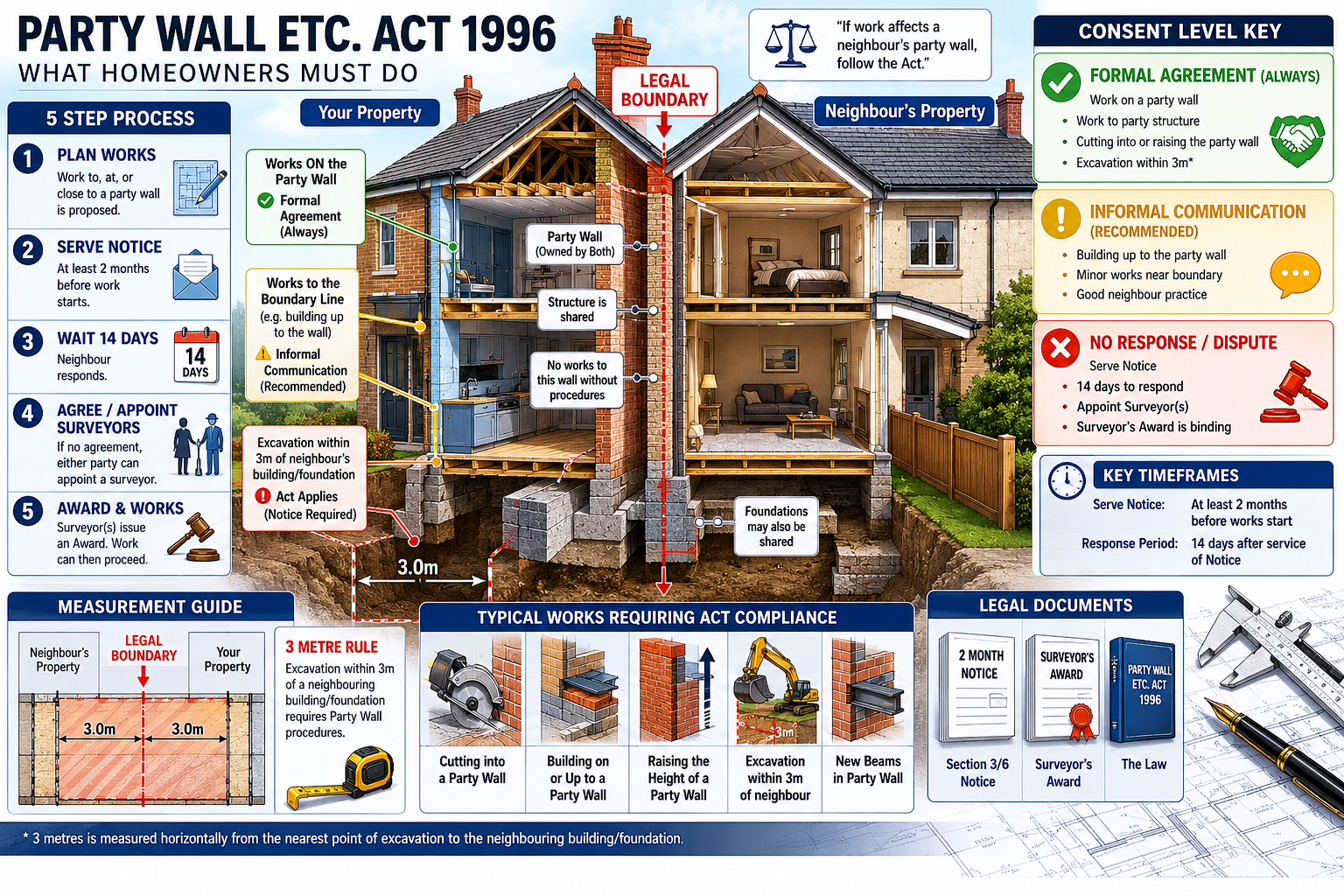
What Owners Risk When Neighbours Haven't Responded or Have Only Given Informal Consent
This is the crux of the issue. Many building owners receive what feels like approval — a wave from next door, a text message saying "fine by me," or simply no reply at all — and assume they are covered. They are not.
Risk 1: Court Injunctions 🚫
An adjoining owner who discovers work has started without a valid award can apply for an injunction through the County Court or High Court [2]. These applications are often granted quickly. Once an injunction is in place, all work must stop until the party wall process is properly completed. This can delay a project by weeks or months.
Risk 2: Unlimited Damage Liability 💷
Without a schedule of condition — a document that records the pre-works state of the adjoining property — a building owner has no baseline to dispute damage claims. If a neighbour later claims that cracks, subsidence, or structural damage were caused by the works, the building owner has no evidence to defend against inflated or false claims [3].
A formal party wall award almost always includes a schedule of condition. Without one, the building owner is exposed to claims they cannot effectively challenge.
Risk 3: The Informal Consent Trap 🪤
A verbal "yes" or a casual text message does not satisfy the requirements of the Party Wall etc. Act 1996 [1]. Even a written email that simply says "I'm happy for you to go ahead" may be insufficient if it does not clearly reference the specific notice served and the works described.
Why does this matter? Because:
- The neighbour can change their mind at any time before work starts
- If the neighbour sells the property, the new owner is not bound by informal agreements
- If a dispute arises during works, there is no formal framework to resolve it
- The building owner has no legal protection against damage claims
For more on what constitutes a valid agreement, see our article on having a party wall agreement without a surveyor.
Risk 4: Retrospective Costs and Delays ⏱️
Even if an injunction is avoided, a neighbour who later raises concerns can trigger the dispute procedure retrospectively. The building owner may then need to:
- Appoint a party wall surveyor
- Pay for both their own surveyor and potentially the adjoining owner's surveyor
- Wait for an award to be drafted and agreed
- Potentially undo or modify completed work
These costs can easily exceed what a properly managed party wall process would have cost from the start. For a realistic view of what the process involves financially, see party wall costs and the process.
Risk 5: Impact on Property Sale or Insurance 🏠
Carrying out notifiable works without a party wall award can create complications when selling the property. Solicitors acting for buyers routinely ask for evidence of party wall compliance. If no award exists, buyers may request indemnity insurance or reduce their offer. In some cases, sales have fallen through entirely [10].
Friendly Conversation vs. Written Consent vs. Formal Award: Know the Difference
Understanding the hierarchy of consent is essential for any building owner planning notifiable works.
Level 1: Friendly Conversation ❌ (Not Legally Valid)
A chat over the fence, a phone call, or a verbal agreement carries no legal weight under the Party Wall etc. Act 1996. It cannot be enforced, it does not protect either party, and it provides no framework for resolving disputes.
Level 2: Written Informal Consent ⚠️ (Potentially Insufficient)
An email or letter from a neighbour saying they are happy with the works is better than nothing — but it is still not a formal response under the Act unless it explicitly acknowledges the notice served and consents to the specific works described. Even then, it does not provide the protections of a formal award [1].
Level 3: Written Consent Under the Act ✅ (Valid — No Award Needed)
If a neighbour responds in writing within 14 days of receiving a valid notice, and their written consent clearly references the notice and the works, this is a valid statutory consent. No party wall award is required, and work can proceed once the notice period expires [5]. This is sometimes called a "consent notice" or "letter of consent."
Level 4: Formal Party Wall Award ✅✅ (Full Protection)
A party wall award drafted by appointed surveyors provides the highest level of protection. It sets out:
- The works permitted
- How and when they may be carried out
- Access rights
- Compensation provisions
- A schedule of condition
This document is legally binding and enforceable. It protects both the building owner and the adjoining owner [4]. For a detailed look at what these documents contain, see our guide on party wall awards.
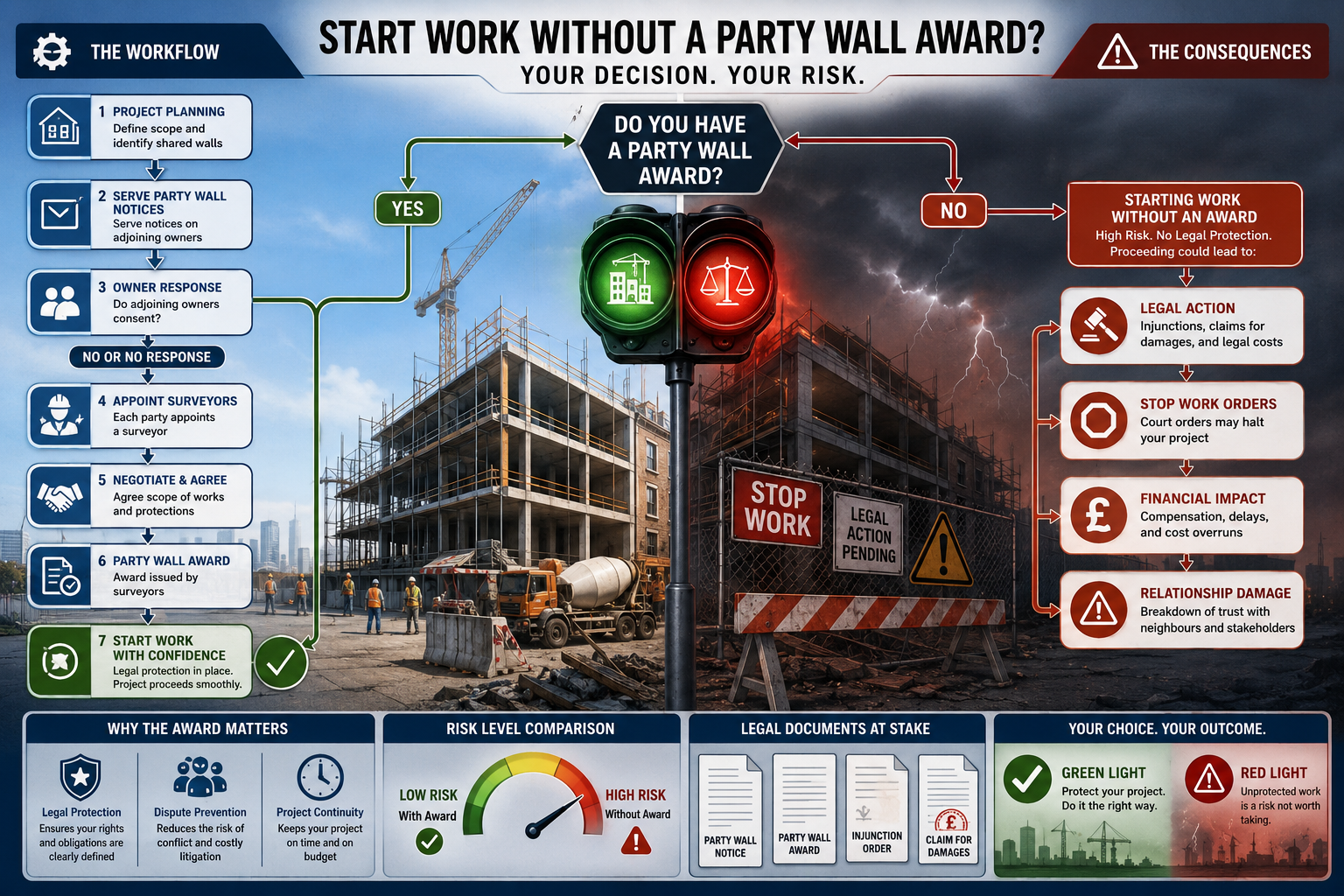
What to Do If a Neighbour Hasn't Responded
If the 14-day response window has passed without a reply, the building owner must not start work. Instead, the following steps apply:
- Confirm the notice was properly served — check the address, the description of works, and the notice period used. For guidance on this, see party wall notices.
- Appoint a party wall surveyor — the building owner should appoint their own surveyor immediately. If the neighbour remains unresponsive, the building owner's surveyor may be able to act as an "agreed surveyor" or appoint a surveyor on the neighbour's behalf after a further 10-day period [8].
- Do not attempt to proceed informally — approaching the neighbour again for a casual agreement at this stage does not reset the clock or satisfy the Act.
- Await the award — once surveyors are appointed, the award process can move relatively quickly, often within a few weeks for straightforward projects.
For building owners in London, specialist help is available from party wall surveyors across London.
Frequently Asked Questions
Q: Can I start work if my neighbour verbally agreed?
No. Verbal consent has no standing under the Party Wall etc. Act 1996. Only written consent that properly acknowledges the notice served is valid [1].
Q: What if my neighbour is impossible to contact?
The Act has provisions for this. After serving notice and waiting the required period, a surveyor can be appointed on the non-responsive neighbour's behalf [8]. Do not simply proceed without following this process.
Q: Does an informal email from my neighbour protect me?
Not reliably. An email that does not clearly reference the specific notice and works may not satisfy the Act. Always seek confirmation from a qualified surveyor before relying on informal communications [3].
Q: Can I get a retrospective party wall award?
Yes, in some cases — but it is complex, potentially more expensive, and does not protect against claims for damage that occurred before the award was made [6].
Q: How long does getting a party wall award take?
For straightforward projects where both parties cooperate, an award can typically be produced within 4–8 weeks. Disputes or unresponsive neighbours can extend this significantly.
Conclusion: Don't Gamble With Your Build
The risks of starting notifiable work without a party wall award — or on the basis of a neighbour's silence or informal consent — are real, significant, and entirely avoidable. An injunction can halt a project mid-build. Damage claims without a schedule of condition can be impossible to defend. Informal agreements offer no protection when relationships sour.
Actionable next steps for building owners in 2026:
- ✅ Serve the correct notice well in advance — understand which type of notice applies to your project by reviewing party wall act notices.
- ✅ Wait for a written response — do not assume silence is consent.
- ✅ Appoint a surveyor promptly if the neighbour dissents or does not respond within 14 days.
- ✅ Ensure a schedule of condition is completed before any work begins.
- ✅ Keep all documentation — notices, responses, and awards should be stored securely.
The party wall process exists to protect everyone involved. Following it properly is not just a legal obligation — it is the smartest thing a building owner can do to protect their investment, their timeline, and their relationship with their neighbours.
References
[1] Can You Start Building Work Without A Party Wall Agreement – https://partywallsurveyor-london.uk/can-you-start-building-work-without-a-party-wall-agreement/
[2] Neighbour Started Work Without Party Wall Agreement – https://lawhive.co.uk/knowledge-hub/neighbour-disputes/neighbour-started-work-without-party-wall-agreement
[3] Party Wall Common Questions – https://www.hsa-surveyors.com/party-wall-common-questions/
[4] Difference Between Party Wall Notices And Awards – https://www.partywallslimited.com/blog/difference-between-party-wall-notices-and-awards
[5] Party Wall Agreements What You Need To Know – https://www.fmb.org.uk/find-a-builder/ultimate-guides-to-home-renovation/party-wall-agreements-what-you-need-to-know.html
[6] Can Building Work Start Before The Award Is Finalised – https://westvilleassociates.com/party-wall-surveyor/disputes/can-building-work-start-before-the-award-is-finalised
[8] If You Can't Agree – https://www.gov.uk/party-walls-building-works/if-you-cant-agree
[9] So What If I Don't Serve A Party Wall Notice – https://www.coburnspartywall.co.uk/blog/so-what-if-i-dont-serve-a-party-wall-notice
[10] Can You Start Work Without An Agreement – https://faulknersurveyors.co.uk/can-you-start-work-without-an-agreement/