

Nearly one in three party wall disputes that reach formal resolution could have been avoided if the original notice had been drafted correctly. That single statistic reframes the entire DIY party wall notice debate — it is not just about saving money upfront; it is about whether a poorly worded document will cost far more later.
This guide examines DIY Party Wall Notices: What's Legally Allowed vs What's Sensible in 2026 in full detail. It covers what the law actually permits, where self-served notices commonly fail, and how to make a genuinely informed decision before picking up a pen or downloading a template.
Key Takeaways 📋
- ✅ It is entirely legal to serve your own party wall notice — no law requires a surveyor to do it.
- ⚠️ Validity depends on content, not who prepares the document; a missing detail can invalidate a notice entirely.
- 🔍 Three notice types exist under the Party Wall etc. Act 1996, and choosing the wrong one is a common DIY error.
- 💸 A flawed notice can trigger disputes, delays, and costs that far exceed professional fees.
- 🤝 Professional surveyors add value beyond paperwork — they manage neighbour relations and protect both parties legally.
What the Law Actually Says About DIY Party Wall Notices
The Party Wall etc. Act 1996 places the legal obligation to serve notice on the building owner — the person carrying out the work. Crucially, the Act does not require a surveyor, solicitor, or any professional to prepare or serve that notice [8]. Any competent adult can do it themselves.
That legal reality is important. It means DIY party wall notices are not a grey area or a loophole — they are explicitly permitted. The question is whether "legally allowed" and "sensible" are the same thing.
The Three Notice Types You Must Know
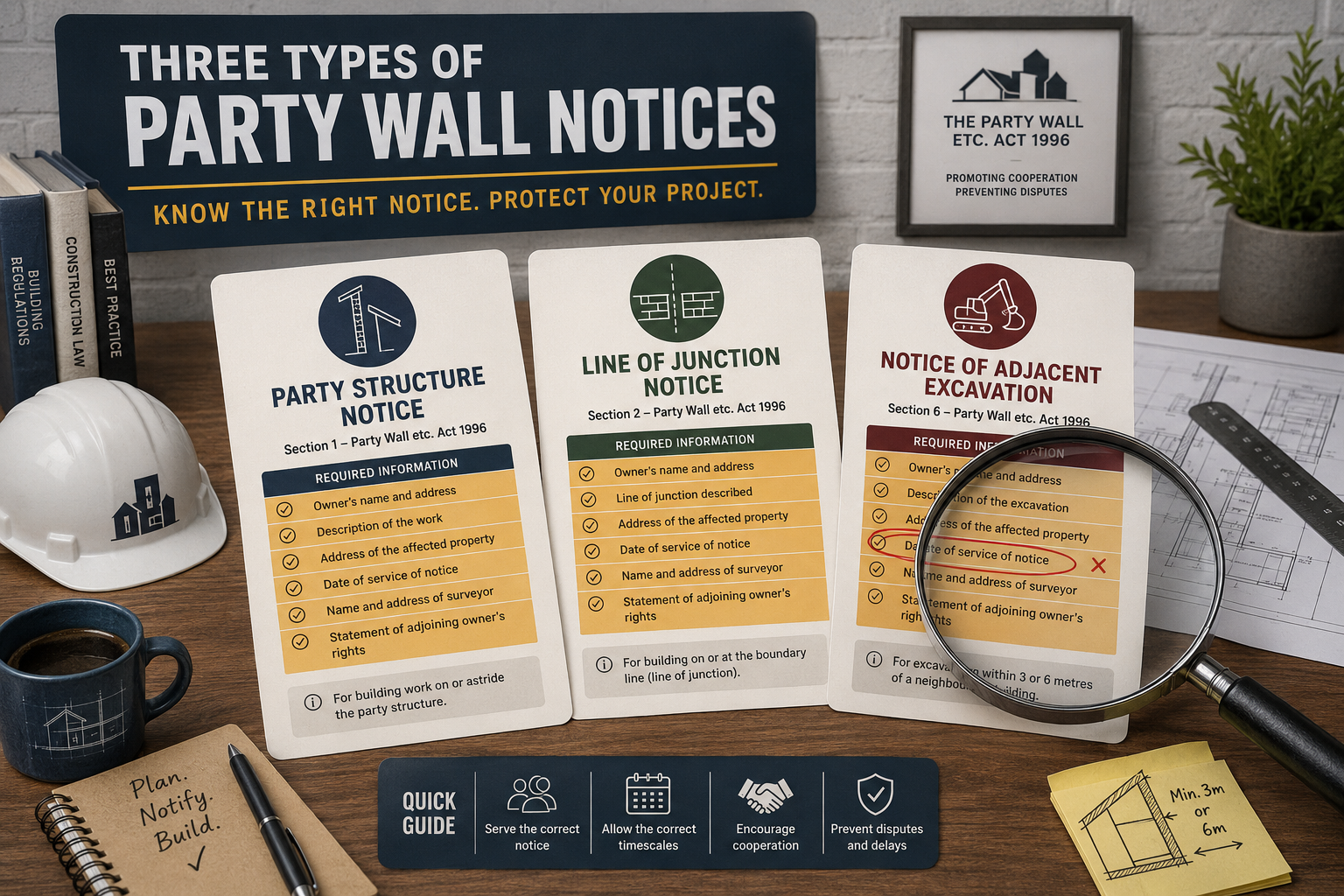
Choosing the correct notice type is the first place DIY attempts go wrong. The Act provides for three distinct notices [5]:
| Notice Type | When It Applies |
|---|---|
| Party Structure Notice | Work on an existing shared wall — cutting in, raising height, underpinning |
| Line of Junction Notice | Building a new wall at or astride the boundary line |
| Notice of Adjacent Excavation | Excavating within 3m or 6m of a neighbour's structure |
Each notice has different minimum notice periods, content requirements, and legal consequences. For a deeper look at the Party Structure Notice specifically, see this guide on what a Party Structure Notice is and how to serve it in London.
Minimum Content Requirements for a Valid Notice
A notice that omits any of the following is potentially invalid [1]:
- Full name and address of the building owner
- Full name and address of the adjoining owner
- Clear description of the proposed works — vague language is a common failure point
- Start date of the intended works (with correct notice periods observed)
- Signature of the building owner or their authorised agent
💬 "A notice is only as good as its accuracy. Courts and surveyors have repeatedly found that ambiguous work descriptions give adjoining owners grounds to dispute the notice entirely."
Notice periods matter too. A Party Structure Notice requires two months' notice before work begins; a Line of Junction Notice requires one month [1]. Serving too late — even by a day — can mean starting over.
Common DIY Drafting Mistakes That Invalidate Notices
Understanding DIY Party Wall Notices: What's Legally Allowed vs What's Sensible in 2026 means being honest about where self-service most frequently fails. The errors below are not rare edge cases — they appear regularly in disputed awards and court proceedings.

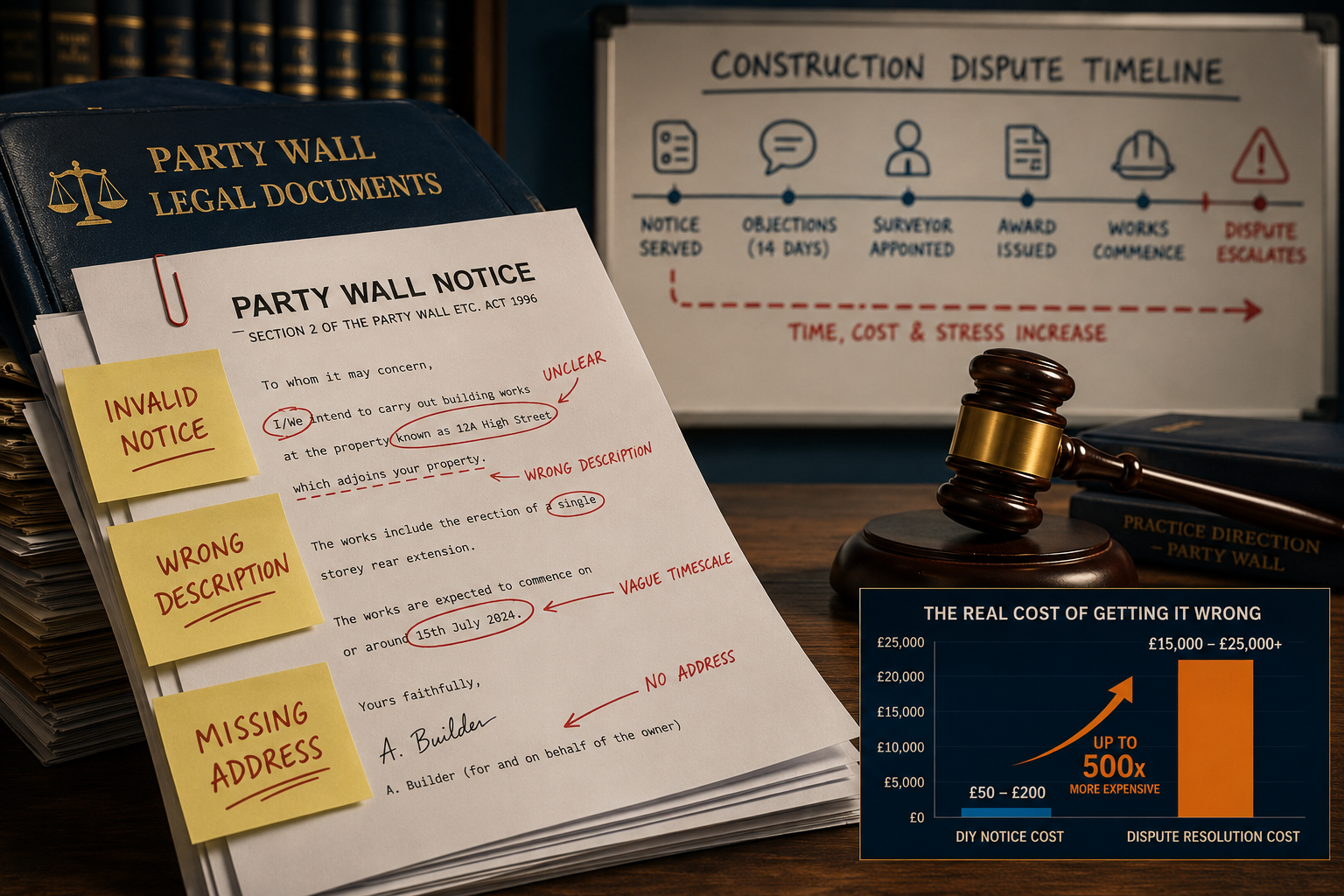
🚫 Mistake 1: Vague Work Descriptions
The most common drafting failure is describing works too broadly. Phrases like "general building works" or "rear extension" do not satisfy the Act's requirement for a clear description [4]. A valid notice should specify:
- The exact nature of structural work (e.g., "cutting into the party wall to insert a padstone at first-floor level")
- The materials to be used where relevant
- The approximate depth of any excavation
🚫 Mistake 2: Wrong Notice Type for the Work
A building owner planning a loft conversion who serves only a Party Structure Notice — without also serving a Notice of Adjacent Excavation for new foundations — has served an incomplete notice. Each element of the project that triggers the Act needs its own correct notice [6].
🚫 Mistake 3: Serving on the Wrong Person
The notice must be served on the legal owner of the adjoining property, not just the occupier. If a neighbour rents their home, the freeholder and potentially the leaseholder may both need to be notified [2]. Getting this wrong means the notice has no legal effect.
🚫 Mistake 4: Incorrect Service Method
The Act permits personal delivery, postal service, or — if the owner is unknown — fixing the notice to the property. Sending a notice by email or text message is not valid service under the Act [4]. This catches many DIY attempts off guard.
🚫 Mistake 5: Misidentifying the Wall Type
Not every shared wall is a "party wall" in the legal sense. Understanding the difference between a party fence wall and a boundary wall is essential before deciding which notice — if any — applies. Serving a notice for a wall that is not covered by the Act creates confusion; failing to serve one for a wall that is covered creates liability.
What Happens When a DIY Notice Backfires
A flawed notice does not simply get corrected and move on. The consequences can cascade through the entire project timeline and budget.
The Dispute Mechanism Kicks In Automatically
If an adjoining owner does not consent within 14 days of receiving a valid notice, a dispute is deemed to have arisen [8]. At that point, a surveyor (or surveyors) must be appointed to produce a Party Wall Award. If the original notice was invalid, the entire process may need to restart — adding weeks or months to a project.
Invalid Notices at Award Stage
A party wall surveyor preparing an award is entitled to scrutinise the underlying notice. If it is found defective, the surveyor cannot proceed on the basis of that notice [3]. The building owner must re-serve correctly, observe the full notice period again, and absorb any delay costs.
Invalid Notices at Court Stage
In the rare cases that reach the County Court, judges have dismissed building owners' positions entirely because the foundational notice was defective. At that stage, legal costs — easily running into thousands of pounds — dwarf whatever was saved by not hiring a surveyor in the first place [2].
💬 "The false economy of a DIY notice becomes painfully apparent when a project stalls for two months because a notice period was miscalculated."
The Honest Case For and Against DIY Notices
Balanced analysis of DIY Party Wall Notices: What's Legally Allowed vs What's Sensible in 2026 requires acknowledging that DIY is not always the wrong choice. Context matters enormously.
✅ When DIY May Be Appropriate
- Simple, low-risk works — e.g., a minor loft conversion with no structural work to the party wall itself
- Excellent neighbour relations — where the adjoining owner is likely to consent quickly and without conditions
- Clear, straightforward work descriptions — where the scope is unambiguous and well-documented
- Budget constraints — where professional fees would genuinely be disproportionate to the scale of works
For those who do proceed with a DIY approach, resources like a free sample party wall agreement template can provide a useful starting framework — though templates must still be adapted carefully to the specific circumstances.
⚠️ When DIY Is a Significant Risk
- Complex structural works — underpinning, beam insertions, significant excavations
- Difficult neighbour relationships — where any procedural error will be exploited
- Multiple adjoining owners — flats, terraced properties, or corner plots where several parties need notice
- High-value properties — where the financial exposure from a dispute is substantial
- Previous boundary disputes — where the legal history of the wall is contested
For anyone in these situations, the costs of the party wall process are worth reviewing — professional fees are often more reasonable than assumed, especially when weighed against dispute resolution costs.
Practical Steps If You Decide to Serve Your Own Notice
For those who proceed with a DIY approach after careful consideration, the following checklist reduces the most common failure points:
Pre-Notice Checklist ✅
- Identify the correct notice type for every element of the proposed works
- Confirm the legal owner of the adjoining property via Land Registry
- Describe the works precisely — use architectural drawings or specifications where available
- Calculate notice periods correctly from the intended start date
- Choose a valid service method — personal delivery or recorded post is safest
- Keep proof of service — a signed receipt or postal certificate
After Serving the Notice
Once served, the adjoining owner has 14 days to respond [1]. Their options are:
- Consent — works can proceed (get this in writing)
- Dissent and appoint a surveyor — the award process begins
- Do nothing — after 14 days, a dispute is deemed to have arisen
If dissent occurs, the building owner may still benefit from understanding how a party wall agreement can work without a surveyor in certain limited circumstances — though professional involvement is strongly advisable once a formal dispute arises.
For London-based projects, specialist local support is available across all areas, including North London, South London, East London, and West London.
The Sensible Middle Ground in 2026
The legal and practical landscape of DIY Party Wall Notices: What's Legally Allowed vs What's Sensible in 2026 points toward a pragmatic middle ground for most homeowners.
Hybrid approaches are increasingly common:
- Self-serve the notice, then instruct a surveyor only if the neighbour dissents
- Pay for a one-off consultation with a surveyor to review a self-drafted notice before service
- Use a surveyor for complex elements (e.g., excavation notices) while handling simpler notices independently
This approach captures cost savings without gambling the entire project on a document that may not withstand scrutiny.
💬 "The Party Wall etc. Act 1996 was designed to protect both building owners and neighbours. A notice that fails in that purpose — however cheaply it was produced — has not served anyone well."
Conclusion: What to Do Next
The answer to whether DIY party wall notices are sensible in 2026 is not a blanket yes or no — it depends entirely on the complexity of the works, the relationship with the neighbour, and the building owner's willingness to research the requirements thoroughly.
Here are the actionable next steps:
- 📋 Identify your notice type — review the types of party wall works that apply to your project before drafting anything.
- 🔍 Check the adjoining owner's legal identity via Land Registry — do not assume the occupier is the owner.
- 📝 Draft with precision — vague descriptions are the single biggest cause of invalid notices.
- ⏱️ Calculate notice periods carefully — two months for Party Structure Notices, one month for Line of Junction Notices.
- 🤝 Consider a professional review — even a brief paid consultation can catch errors before they become expensive disputes.
- 💡 Know when to step back — if the works are complex or the neighbour relationship is strained, professional instruction is not a luxury; it is risk management.
The Party Wall etc. Act 1996 exists to protect everyone involved in a building project. A well-served notice — whether DIY or professionally prepared — is the foundation of a project that proceeds smoothly, legally, and without the kind of neighbour disputes that can outlast the construction itself.
References
[1] When How Tell Them – https://www.gov.uk/party-walls-building-works/when-how-tell-them
[2] Party Wall Matters – https://www.rocketlawyer.com/gb/en/property/manage-your-property/legal-guide/party-wall-matters
[3] Can I Do A Party Wall Agreement Myself Or Need A Surveyor – https://legalclarity.org/can-i-do-a-party-wall-agreement-myself-or-need-a-surveyor/
[4] How To Serve A Party Wall Notice – https://partywalldiy.com/guides/how-to-serve-a-party-wall-notice
[5] Work Tell Your Neighbour About – https://www.gov.uk/party-walls-building-works/work-tell-your-neighbour-about
[6] Party Wall Notice – https://echelonpartywall.co.uk/resources/guides/party-wall-notice/
[8] Party Walls Building Works – https://www.gov.uk/party-walls-building-works