

Only 14 days stand between receiving a party wall notice and losing your right to shape how your neighbor's construction project affects your home. Yet most homeowners who receive one have no idea what it means, what they can do, or how much leverage they actually hold. Responding to Party Wall Notices as a Neighbor: Your Rights and Options in 2026 is not just a legal formality — it is one of the most powerful tools available to protect your property, your peace of mind, and your financial interests.
Key Takeaways 📋
- You have just 14 days to respond in writing to a party wall notice — silence is treated as dissent.
- Three response options exist: consent, appoint an agreed surveyor, or appoint separate surveyors.
- The building owner typically pays surveyor fees, not you as the adjoining owner.
- A Schedule of Condition protects you by documenting your property's state before work begins.
- The Party Wall etc. Act 1996 cannot stop lawful work — but it can ensure it is carried out safely and with accountability.
What Is a Party Wall Notice and Why Does It Matter?
Before exploring your response options, it helps to understand exactly what landed in your letterbox. A party wall notice is a formal legal document served under the Party Wall etc. Act 1996 by a building owner who intends to carry out work that affects a shared wall, boundary, or structure.
💡 Pull Quote: "The Party Wall etc. Act 1996 is an enabling act — it facilitates construction while protecting adjoining properties. It does not stop lawful work, but it ensures that work is done safely." [5]
Common works that trigger a notice include:
- Loft conversions involving the party wall
- Rear extensions built up to or astride the boundary
- Basement excavations near neighboring foundations
- Structural alterations to a shared wall
Understanding what types of party wall works trigger this process helps you assess the scale of what your neighbor is planning — and how carefully you need to respond.
Responding to Party Wall Notices as a Neighbor: Your Rights and Options in 2026 — The 14-Day Rule
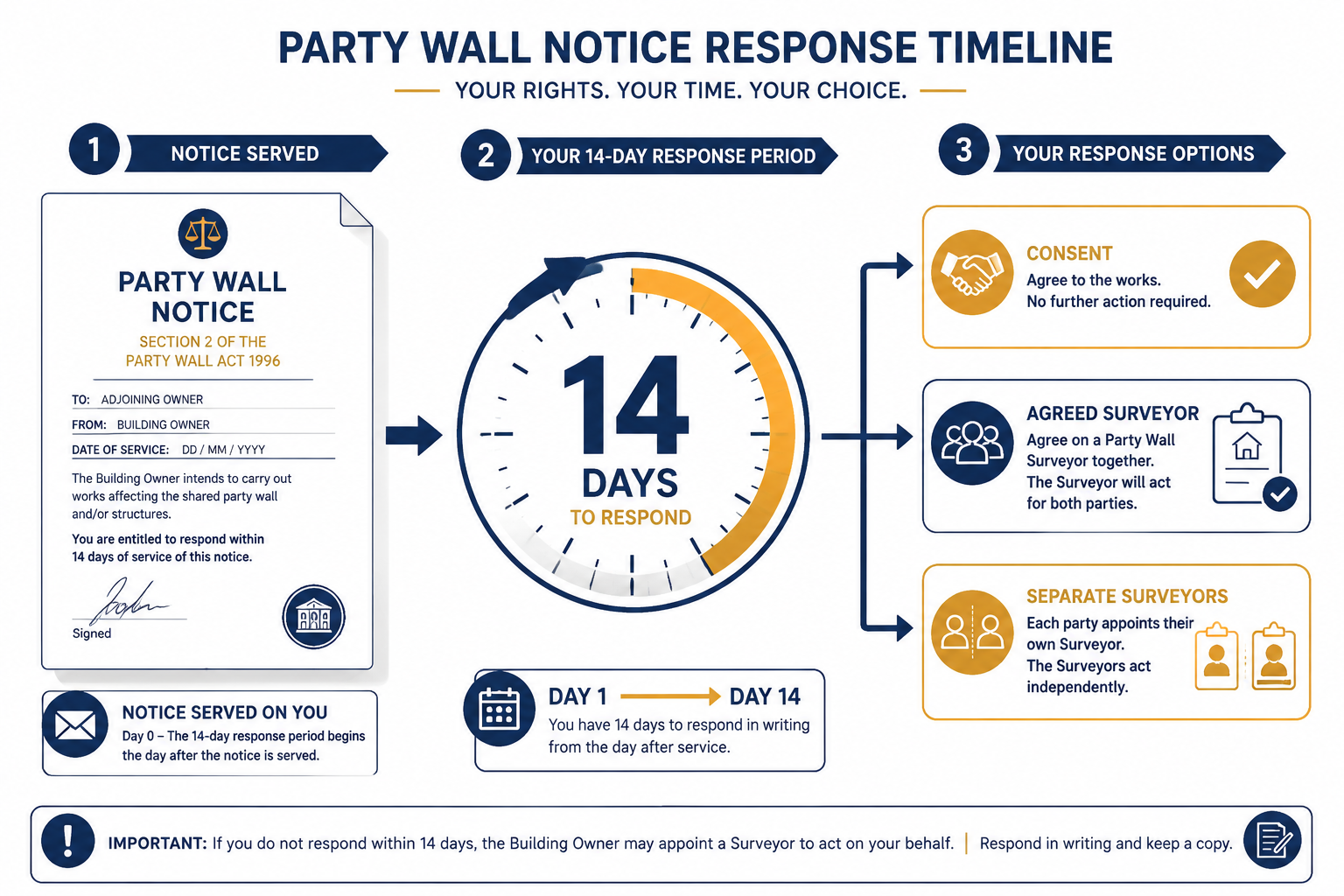
The most critical fact every adjoining owner must know: you have exactly 14 days from receipt of the notice to respond in writing [1]. Missing this window is not a neutral outcome. Under the Act, failure to respond within 14 days is automatically treated as a dissent, which triggers the formal dispute resolution process — even if you had no objection at all.
This matters because once the dispute process is triggered without your active participation, the building owner can appoint a surveyor on your behalf. That surveyor will represent your interests, but you had no say in choosing them.
What Counts as a Valid Notice?
A valid party wall notice must:
- ✅ Be served in writing
- ✅ Identify the building owner and the adjoining owner
- ✅ Describe the proposed works clearly
- ✅ State the intended start date
- ✅ Be delivered in person, by post, or by email (if you have agreed to electronic communication) [3]
Always keep proof of delivery if you are the building owner, and as an adjoining owner, note the exact date you received the notice — your 14-day clock starts from that point.
For a deeper look at how notices work from both sides, the guide to Party Wall Act notices covers the full process clearly.
Your Three Response Options Explained
When responding to a party wall notice as a neighbor, you have three distinct paths. Each carries different implications for cost, control, and complexity.

Option 1: Consent ✅
Consenting means you agree to the proposed works without requiring a formal Party Wall Award. This is the simplest outcome and is appropriate when:
- The works are minor and low-risk (e.g., small repairs to a shared wall)
- You have reviewed the plans and are satisfied they pose no threat to your property
- You have a good relationship with your neighbor and trust their contractor
- You have received clear, detailed drawings showing exactly what will happen [2]
Important: Consenting does not mean you waive all rights. You can still request a Schedule of Condition before work begins to document your property's existing state. If damage occurs later, this record is invaluable.
⚠️ Do not consent if you have concerns about the scope of work, the quality of the plans, or the potential for structural impact. Once you consent, the formal protections of the Act no longer apply.
Option 2: Dissent and Appoint an Agreed Surveyor 🤝
Both you and your neighbor jointly appoint a single, impartial surveyor to act for both parties. This surveyor prepares a Party Wall Award — a legally binding document that sets out exactly how the work will be carried out, the timeline, and the protective measures required [3].
Advantages of an agreed surveyor:
| Factor | Benefit |
|---|---|
| Cost | Usually cheaper than two separate surveyors |
| Speed | Faster resolution with one point of contact |
| Simplicity | Less back-and-forth between parties |
| Impartiality | Surveyor must act fairly to both sides |
This option works well when the relationship between neighbors is cooperative and the works are relatively straightforward. The building owner typically covers the surveyor's fees [3].
Option 3: Dissent and Appoint Separate Surveyors 🔍
Each party appoints their own surveyor. If those two surveyors cannot agree, they select a third surveyor to make the final decision. This is the most formal route and is advisable when:
- The proposed works are complex or large-scale
- There is tension or distrust between you and your neighbor
- You have specific concerns about structural risk or damage
- The building owner's plans are unclear or incomplete [2]
As an adjoining owner, your own surveyor works exclusively in your interest. They will scrutinize the plans, negotiate conditions, and ensure the Party Wall Award properly protects your property. Crucially, the building owner pays your surveyor's reasonable fees in most cases [3].
If you are in London and need specialist support, adjoining owners' surveyor services are available across the city to help navigate this process.
The Party Wall Award: Your Legal Shield
When dissent is registered and surveyors are appointed, the outcome is a Party Wall Award — a legally binding document that governs the entire project [3]. Think of it as a contract between you and your neighbor, enforced by law.
A well-drafted Party Wall Award will typically include:
- 📐 Detailed description of the permitted works
- 🗓️ Working hours and start/finish dates
- 🔒 Access rights for the building owner's contractors
- 🛡️ Protective measures to prevent damage to your property
- 📸 Schedule of Condition as an appendix
- 💷 Liability for costs if damage occurs
The award is binding on both current and future owners of both properties [6]. This means if you sell your home, the protections in the award transfer to the new owner — a significant benefit.
For more detail on what these documents contain, the guide to Party Wall Awards explains the structure and legal weight of these instruments.
Responding to Party Wall Notices as a Neighbor: Your Rights and Options in 2026 — Protecting Your Property
The Schedule of Condition: Non-Negotiable Protection
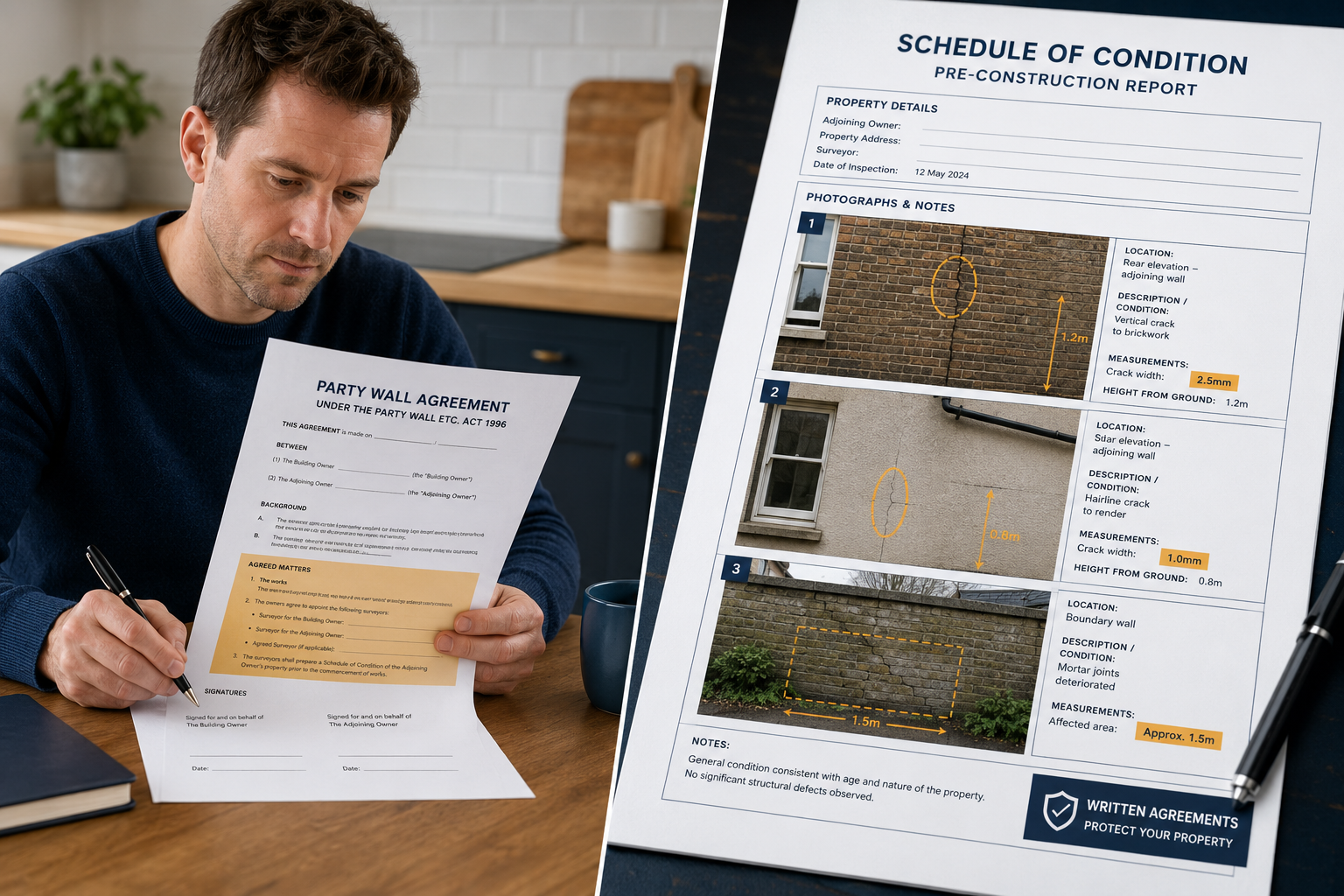
Whether you consent or dissent, always request a Schedule of Condition before any work begins [4]. This is a detailed photographic and written record of your property's current state — walls, ceilings, floors, foundations, and any existing cracks or defects.
Why does this matter so much? Because without it, proving that a new crack or structural movement was caused by your neighbor's work becomes extremely difficult. With a Schedule of Condition in place, the burden of proof shifts significantly in your favor.
A professional schedule of condition is prepared by a qualified surveyor and forms part of the Party Wall Award. It is one of the most cost-effective forms of protection available to an adjoining owner.
Negotiation Tactics to Minimize Disruption 💬
Receiving a party wall notice does not mean you are powerless. Here are practical steps to protect your interests:
- Request full drawings immediately. You are entitled to see detailed plans. Vague descriptions are not acceptable.
- Specify working hours. The Party Wall Award can restrict noisy work to reasonable hours (e.g., no work before 8am or after 6pm on weekdays).
- Require dust and vibration controls. Particularly relevant for excavation or demolition work near your property.
- Insist on a named site supervisor. Having a single point of contact for complaints speeds up resolution.
- Document everything in writing. Even informal conversations about the works should be followed up with an email summary.
- Seek professional advice early. Consulting a surveyor before responding — even just for an initial conversation — can clarify your position significantly [2].
Common Mistakes Adjoining Owners Make
Understanding what not to do is just as important as knowing your rights.
| ❌ Mistake | ✅ Better Approach |
|---|---|
| Ignoring the notice entirely | Respond in writing within 14 days |
| Consenting without reviewing plans | Request full drawings before consenting |
| Assuming consent means no protection | Always request a Schedule of Condition |
| Appointing any surveyor without research | Choose a qualified, experienced party wall surveyor |
| Trying to stop lawful work | Focus on conditions and protections instead |
It is also worth understanding the boundaries of the Act. The Party Wall etc. Act 1996 cannot be used to prevent lawful building work [5]. If your neighbor has planning permission and is following the Act, the work will proceed. Your goal as an adjoining owner is not to block the project but to ensure it is carried out safely, with proper protections in place.
Cost Implications: What Will This Actually Cost You?
One of the most common concerns for adjoining owners is financial. The good news: in the vast majority of cases, you pay nothing [3].
The building owner — the person carrying out the work — is responsible for:
- Their own surveyor's fees
- Your surveyor's reasonable fees (when you dissent and appoint separately)
- The cost of preparing the Party Wall Award
- Any damage caused to your property during the works
The only scenario where costs might fall to you is if your actions or unreasonable demands have escalated the dispute unnecessarily. Acting reasonably and in good faith throughout the process protects you here.
For guidance on keeping the overall process affordable, the tips on how to keep party wall costs down offers practical advice for both parties.
When Relationships Break Down: Escalation and Appeals
If you disagree with the terms of a Party Wall Award, you have 14 days to appeal to the County Court from the date the award is served. Appeals must be based on legal grounds — not simply dissatisfaction with the outcome.
In practice, most disputes are resolved by the surveyors without reaching court. The three-surveyor mechanism (two party surveyors plus a third) is specifically designed to break deadlocks efficiently.
If your neighbor begins work without serving a valid notice, you may be able to seek an injunction to halt the works. This is a more serious step and requires legal advice, but it is a real remedy available to adjoining owners whose rights have been ignored.
Responding to Party Wall Notices as a Neighbor: Your Rights and Options in 2026 — Quick Reference
Here is a summary of the key timelines and actions every adjoining owner should know:
| Stage | Timeframe | Action Required |
|---|---|---|
| Notice received | Day 0 | Note the date; review the notice carefully |
| Response deadline | Day 14 | Respond in writing (consent or dissent) |
| Surveyor appointment | Within days of dissent | Agree on surveyor(s) with building owner |
| Schedule of Condition | Before work starts | Commission or agree to preparation |
| Party Wall Award served | Before work starts | Review carefully; note appeal deadline |
| Appeal window | 14 days from award | Appeal to County Court if necessary |
| Works complete | Project end | Check for damage; refer to Schedule of Condition |
Conclusion: Take Control of the Process
Receiving a party wall notice can feel overwhelming — but it is also an opportunity. The 14-day response window is not just a deadline; it is a doorway to legal protections that most homeowners never know they have.
Actionable Next Steps ✅
- Read the notice carefully and note the exact date you received it.
- Do not ignore it — even if you have no objections, respond in writing within 14 days.
- Request full plans and drawings from your neighbor before making any decision.
- Consult a qualified party wall surveyor — even a brief consultation can clarify your position and options.
- Commission a Schedule of Condition regardless of whether you consent or dissent.
- Keep all correspondence in writing throughout the process.
- Remember: the building owner pays your reasonable surveyor fees in most cases.
Whether the proposed works are a modest loft conversion or a major basement excavation, the Party Wall etc. Act 1996 gives adjoining owners real, enforceable rights. Use them wisely, act within the timeframes, and seek professional guidance when in doubt.
For personalized support, explore the my neighbor is carrying out works resource — a dedicated guide for exactly this situation.
References
[1] How To Respond To A Party Wall Notice For Adjoining Owners – https://www.ansteyhorne.co.uk/news/how-to-respond-to-a-party-wall-notice-for-adjoining-owners?utm_source=openai
[2] How To Respond To A Party Wall Notice Consent Dissent Or Agreed Surveyor – https://www.houricanassociates.com/party-wall-news/how-to-respond-to-a-party-wall-notice-consent-dissent-or-agreed-surveyor/?utm_source=openai
[3] What Are Party Walls And When Do You Need A Notice – https://legalclarity.org/what-are-party-walls-and-when-do-you-need-a-notice/?utm_source=openai
[4] Party Wall Notice Response Options – https://iconsurveyors.co.uk/blog/party-wall-notice-response-options/?utm_source=openai
[5] Served Notice – https://www.partywall.expert/served-notice/?utm_source=openai
[6] Your Party Wall Rights And Responsibilities – https://legalclarity.org/your-party-wall-rights-and-responsibilities/?utm_source=openai