


Fewer than one in three homeowners building a side extension in England correctly identifies which Party Wall Act notice applies before work begins — a gap in knowledge that routinely leads to injunctions, cost disputes, and damaged neighbourly relations. Understanding Party Wall Notices for Side Extensions: Width Thresholds, Award Safeguards, and 2026 Permitted Development Ties is not optional for anyone extending along a boundary line. It is the legal and practical foundation on which every side extension project must rest.
This guide cuts through the overlap between permitted development rules and the Party Wall etc. Act 1996, explains exactly when notices are triggered, and outlines the surveyor strategies that protect both building owners and adjoining owners in 2026.
Key Takeaways
- A side extension that falls within permitted development rights still requires a Party Wall Notice if it involves building on or near the boundary or excavating within 3 metres of a neighbour's foundations.
- Three distinct notice types apply to side extensions: the Line of Junction Notice (Section 1), the Party Structure Notice (Section 2), and the Adjacent Excavation Notice (Section 6).
- Under 2026 permitted development rules, a side extension must not exceed half the width of the original house and must stay within strict height limits.
- A Party Wall Award is the legally binding document that safeguards both parties once a neighbour dissents from a notice.
- Vibration monitoring clauses and schedule of condition surveys are the two most effective surveyor tools for preventing post-construction disputes.
Why Side Extensions Create Unique Party Wall Challenges
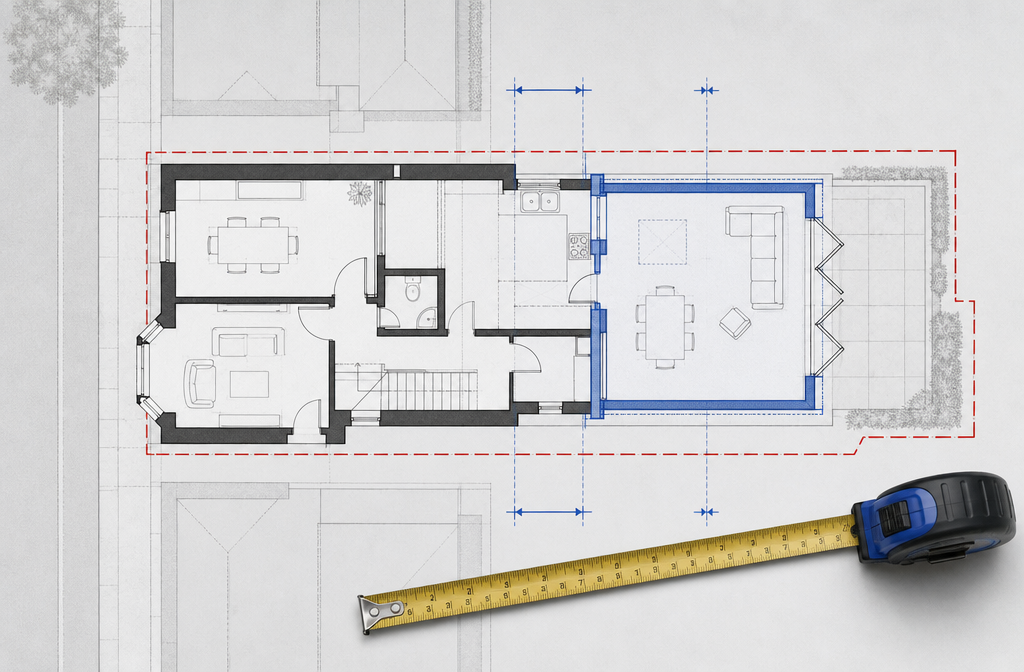
A rear extension typically sits well within a garden, but a side extension — including the popular side return infill on Victorian and Edwardian terraces — almost always runs directly along the boundary. That proximity is what makes side extensions a distinct category under both planning law and the Party Wall etc. Act 1996.
The Act was designed precisely for this scenario. When a building owner constructs a new wall at or near the line of junction, or when excavation work risks undermining a neighbour's foundations, the legislation steps in to create a formal framework for managing risk. Permitted development rights determine whether planning permission is needed; the Party Wall Act determines whether a formal notice must be served. These are two entirely separate legal questions, and confusing them is one of the most common mistakes homeowners make.
For a clear overview of how the Act operates and what it covers, the Party Wall etc. Act 1996 guide provides a solid starting point.
The Side Return: A Special Case
The side return — the narrow strip of land running alongside a kitchen in a terraced or semi-detached house — is the most common location for side extension work in London and other dense urban areas. Infilling this space almost always means:
- Building a new wall directly on or adjacent to the boundary
- Excavating for new foundations within metres of the neighbour's existing structure
- Potentially tying into or working near an existing party fence wall
Each of these activities can trigger one or more notice obligations under the Act. Understanding which notice applies — and when — is the critical first step. For a detailed breakdown of what party fence walls and boundary walls actually are in legal terms, see this guide on boundary wall rules.
Width Thresholds and 2026 Permitted Development Rules
Understanding the permitted development (PD) framework is essential context for any side extension project, because PD status affects the scope and nature of the work — which in turn affects which Party Wall notices may be needed.
The Half-Width Rule
Under current permitted development rights in England, a side extension must not exceed half the width of the original house [1]. For a house with an original width of 8 metres, the maximum permitted extension width is 4 metres. This measurement is taken from the original house as it stood on 1 July 1948 (or when first built, if later), not from any previous extensions.
This rule matters for party wall purposes because a wider extension is more likely to:
- Sit closer to or on the boundary
- Require deeper or more extensive foundations
- Affect a greater length of any shared boundary structure
Height Restrictions
The 2026 permitted development framework also imposes strict height controls [2]:
| Scenario | Maximum Height |
|---|---|
| Standard side extension | 4 metres |
| Extension within 2 metres of a boundary | 3 metres at eaves |
| Extension matching existing roof pitch | Must not exceed original ridge height |
The eaves restriction is particularly relevant for side returns, which by definition sit within 2 metres of the boundary. A lower eaves height reduces the structural load near the boundary, which can simplify the party wall process — but it does not remove the obligation to serve notice.
Materials Consistency Requirement
To qualify under permitted development, materials used in the side extension must be of a similar appearance to those of the existing house [3]. This requirement has a secondary party wall relevance: if a surveyor is preparing a Party Wall Award, the materials specification in the award should align with the PD materials condition to avoid creating a conflict between planning and party wall obligations.
Key point: Permitted development rights do not exempt a building owner from serving Party Wall Notices. PD status and party wall obligations operate on entirely separate legal tracks.
Notice Triggers: When a Side Extension Requires a Party Wall Notice
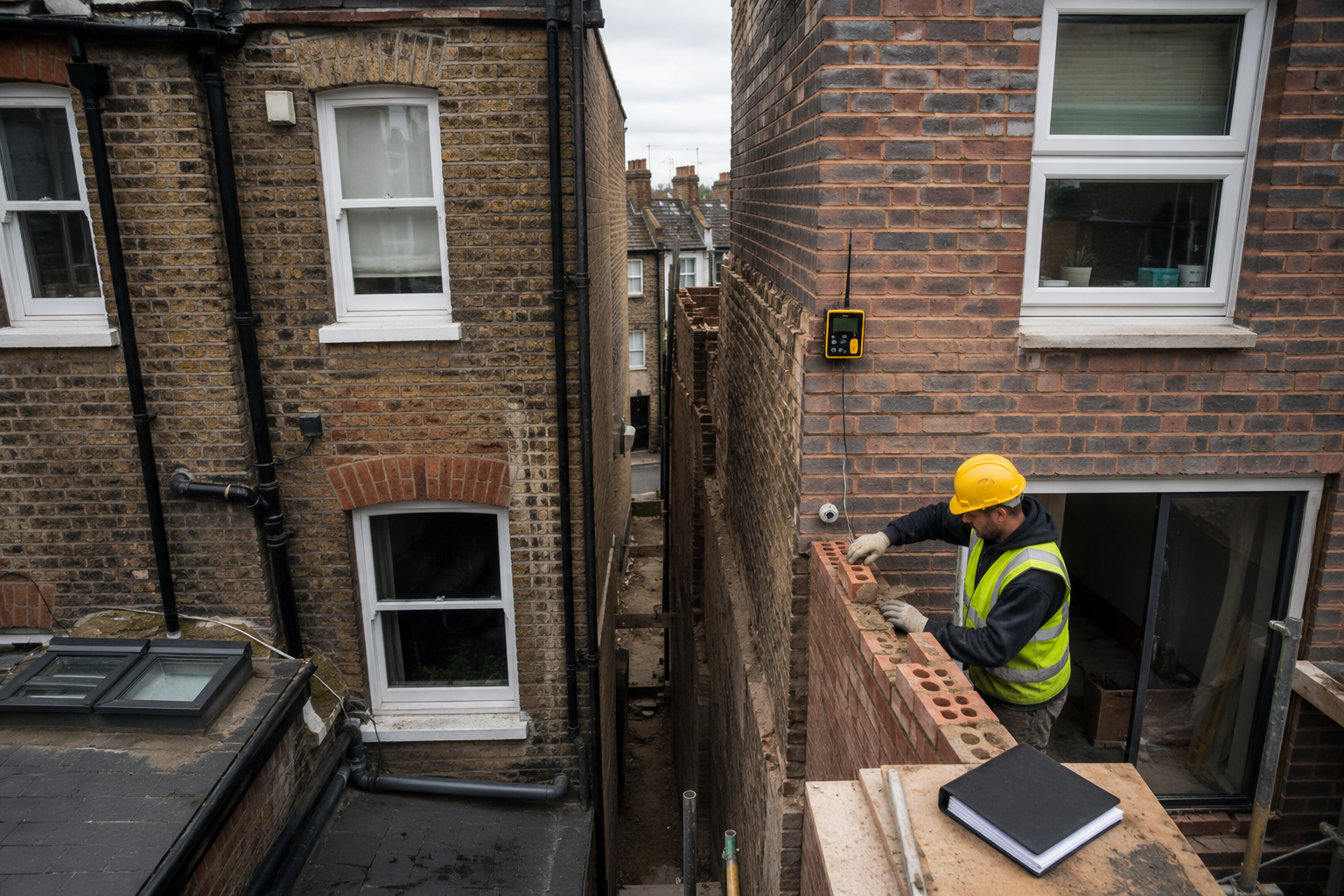
The question of whether a Party Wall Notice is required for a side extension depends on the specific nature of the works, not on whether the project has PD status or planning permission. Three notice types are relevant [5].
Line of Junction Notice (Section 1)
This notice is required when a building owner intends to build a new wall on the line of junction (the boundary) or astride the boundary line [5]. For side extensions, this is the most commonly triggered notice.
Trigger conditions:
- Building a new wall with one face flush against the boundary
- Building a wall that straddles the boundary (requires neighbour consent)
- Constructing any new structure at the line of junction
Notice period: At least one month before work begins [5].
If the neighbour consents, work can proceed as planned. If the neighbour dissents or does not respond within 14 days, a Party Wall Award must be agreed before work starts. For a full explanation of how notices work and how to respond to them, see this guide to Party Wall Act notices.
Party Structure Notice (Section 2)
This notice applies when work involves cutting into, underpinning, raising, or otherwise affecting an existing party wall or party fence wall [5]. For side extensions, this is triggered when:
- The extension ties into an existing shared boundary wall
- The builder needs to cut a flashing or weathering into a neighbour's wall
- The existing party fence wall is to be demolished and rebuilt as part of the extension
Notice period: At least two months before work begins [5].
The two-month lead time makes early notice service critical. Delays in serving this notice are the single most common cause of project programme overruns on side extension builds. For more detail on how to serve this specific notice correctly, see the guide on Party Structure Notices.
Adjacent Excavation Notice (Section 6)
This notice is required when excavation work will take place within 3 metres of a neighbouring structure and to a depth lower than the neighbour's foundations [4]. For side extensions with new strip or pad foundations, this is frequently triggered.
Notice period: At least one month before work begins [5].
A surveyor should always check the depth of the neighbour's existing foundations before advising on Section 6 obligations. In older London terraces, shallow Victorian foundations mean that even modest new foundations can trigger this notice.
Summary table of notice types:
| Notice Type | Section | Trigger | Notice Period |
|---|---|---|---|
| Line of Junction Notice | Section 1 | New wall on/at boundary | 1 month |
| Party Structure Notice | Section 2 | Work to existing party wall | 2 months |
| Adjacent Excavation Notice | Section 6 | Excavation within 3m of neighbour | 1 month |
Party Wall Awards: Safeguards for Side Extension Projects
When a neighbour dissents from a Party Wall Notice — or fails to respond within the statutory 14-day period — the dispute resolution mechanism under the Act is triggered, and a Party Wall Award must be produced [6]. This document is the primary legal safeguard for both parties throughout the construction process.
For a comprehensive overview of what awards contain and how they are structured, the Party Wall Awards guide covers the full process in detail.
What a Party Wall Award Contains
A well-drafted award for a side extension should include:
- Permitted works: A precise description of the works authorised, including drawings and specifications
- Working hours: Restrictions on when noisy or vibration-generating work can take place
- Access rights: Provisions for the surveyor and building owner to access the adjoining property if necessary
- Security for expenses: Provisions protecting the adjoining owner if damage occurs
- Schedule of condition: A record of the existing state of the neighbour's property before work begins
The schedule of condition is arguably the most important protective document in a side extension award. Without it, any pre-existing cracks or defects in the neighbour's property could be attributed to the building works, creating a dispute that is difficult and expensive to resolve. Learn more about schedule of condition surveys and why they matter.
Vibration Monitoring Clauses
For side extensions involving mechanical excavation, concrete breaking, or compaction work near a shared boundary, vibration monitoring clauses are a critical surveyor strategy. These clauses require the building owner to:
- Install calibrated vibration monitors on or near the shared wall before work begins
- Set peak particle velocity (PPV) thresholds — typically 5mm/s for residential structures
- Halt work immediately if thresholds are exceeded
- Provide monitoring data to the adjoining owner's surveyor on request
Vibration monitoring transforms a subjective "I felt my house shake" complaint into an objective, measurable record. For building owners, it provides evidence that works were conducted responsibly. For adjoining owners, it provides a clear trigger for stopping work if limits are breached.
Swift Agreement Strategies
Experienced surveyors use several strategies to reach agreed awards quickly and keep costs manageable:
- Agreed surveyor appointments: Both parties appoint a single agreed surveyor, which is faster and cheaper than two separate surveyors [see how to keep party wall costs down].
- Pre-notice conversations: Informally sharing drawings with the neighbour before serving formal notice often reduces dissent rates significantly.
- Detailed notice packages: Serving a notice with full drawings, specifications, and a draft method statement reduces the number of questions and objections that follow.
- Early schedule of condition: Commissioning the schedule of condition immediately after notice is served, rather than waiting for the award to be agreed, compresses the programme.
For those managing costs carefully, understanding the full costs of the party wall process helps set realistic budgets from the outset.
Practical Guidance for Building Owners in 2026

The intersection of Party Wall Notices for Side Extensions: Width Thresholds, Award Safeguards, and 2026 Permitted Development Ties creates a checklist that every building owner should work through before breaking ground.
Pre-Construction Checklist
Step 1 — Confirm PD eligibility
Verify that the proposed extension meets the half-width rule, height restrictions, and materials consistency requirements. If the extension exceeds PD limits, planning permission is required — and the party wall process runs in parallel, not instead.
Step 2 — Identify applicable notices
Walk the site with a surveyor and identify:
- Whether the new wall will sit on or at the boundary (Section 1)
- Whether any existing party wall or fence wall will be affected (Section 2)
- Whether excavation will go deeper than the neighbour's foundations within 3 metres (Section 6)
Step 3 — Serve notices with sufficient lead time
Given that a Party Structure Notice requires two months' notice, and that disputes can add further time, notices should be served at least three months before the planned start date for any side extension involving an existing party wall.
Step 4 — Commission a schedule of condition
Before any work begins, a photographic and written record of the neighbour's property should be produced and agreed. This protects both parties.
Step 5 — Include vibration monitoring in the method statement
For any mechanical works near the boundary, specify monitoring equipment, PPV thresholds, and reporting procedures in the contractor's method statement and in the Party Wall Award.
What Happens If a Neighbour Refuses
A neighbour cannot legally block a side extension that complies with the Party Wall Act and permitted development rules. If a neighbour dissents, the statutory dispute resolution process is triggered, and surveyors produce a binding award [6]. The building owner can proceed once the award is in place. The key is ensuring that notices are correctly served and that the award process is not delayed by procedural errors.
For adjoining owners who have received a notice and are unsure how to respond, the adjoining owners section provides clear guidance on rights and options.
Conclusion
Party Wall Notices for Side Extensions: Width Thresholds, Award Safeguards, and 2026 Permitted Development Ties represent a layered set of legal obligations that cannot be reduced to a single checklist item. The permitted development framework sets the physical boundaries of what can be built without planning permission. The Party Wall Act sets the procedural requirements for how it must be built when it affects a shared boundary or neighbouring structure.
The practical takeaways for 2026 are clear:
- Confirm PD compliance on width and height before designing the extension
- Identify which of the three notice types applies — or whether multiple notices are needed
- Serve notices early, with full supporting documentation, to minimise the risk of delays
- Insist on a schedule of condition and vibration monitoring clauses in every Party Wall Award for side extension works
- Use the agreed surveyor route where possible to reduce costs and accelerate the award process
For building owners planning a side extension in London, working with an experienced party wall surveyor from the outset is the most effective way to protect the project programme and the neighbourly relationship. Those in specific areas can find local expertise through the party wall surveyor locations directory.
Getting the party wall process right is not a bureaucratic hurdle — it is the mechanism that allows ambitious side extension projects to proceed smoothly, legally, and without the disputes that can turn a building project into a costly legal battle.
References
[1] Side Extension Permitted Development The Complete Uk Guide – https://myhomeplans.co.uk/blog/f/side-extension-permitted-development-the-complete-uk-guide?utm_source=openai
[2] Permitted Development Rules What You Need To Know – https://www.fmb.org.uk/find-a-builder/ultimate-guides-to-home-renovation/permitted-development-rules-what-you-need-to-know.html?utm_source=openai
[3] Side Extensions – https://www.townplanning.info/permitted-development/householder-permitted-development-pd-rights/side-extensions/?utm_source=openai
[4] Party Wall Notice For Extension – https://www.expresspartywall.com/party-wall-notice-for-extension/?utm_source=openai
[5] Party Wall Notice Explained – https://www.surveyofpartywall.co.uk/party-wall-notice-explained/?utm_source=openai
[6] What Happens If A Neighbor Refuses A Party Wall Notice – https://legalclarity.org/what-happens-if-a-neighbor-refuses-a-party-wall-notice/?utm_source=openai