


Fewer than one in three homeowners extending beyond a basement level realise that shallow foundations — not just deep excavations — can trigger a legal obligation under the Party Wall etc. Act 1996. That blind spot causes project delays, neighbourly disputes, and in some cases, costly retrospective action. Understanding Party Wall Notices for Rear Extensions Beyond Basements: Surveyor Validation and Fast-Track Award Strategies is therefore not optional for anyone planning a ground-level or sub-ground rear extension in 2026.
This guide cuts through the procedural complexity, explains exactly which notices apply to which works, and outlines proven methods surveyors use to accelerate the award process without cutting corners.
Key Takeaways
- Rear extensions with new foundations within 3 metres of a neighbouring structure almost always require a formal Party Wall Notice, even when the work is permitted development.
- Basement excavations that go deeper than a neighbour's foundations trigger a Notice of Adjacent Excavation under Section 6 of the Act.
- Shallow foundation works are frequently overlooked in permitted development projects, creating legal exposure for building owners.
- Appointing a single agreed surveyor can reduce the time to a completed Party Wall Award by 30 to 40 percent compared to dual-surveyor appointments.
- Realistic fast-track awards take a minimum of one week under optimal conditions; claims of 24 to 48-hour turnarounds are rarely achievable in practice.
Why Shallow Foundations in Rear Extensions Are Frequently Overlooked
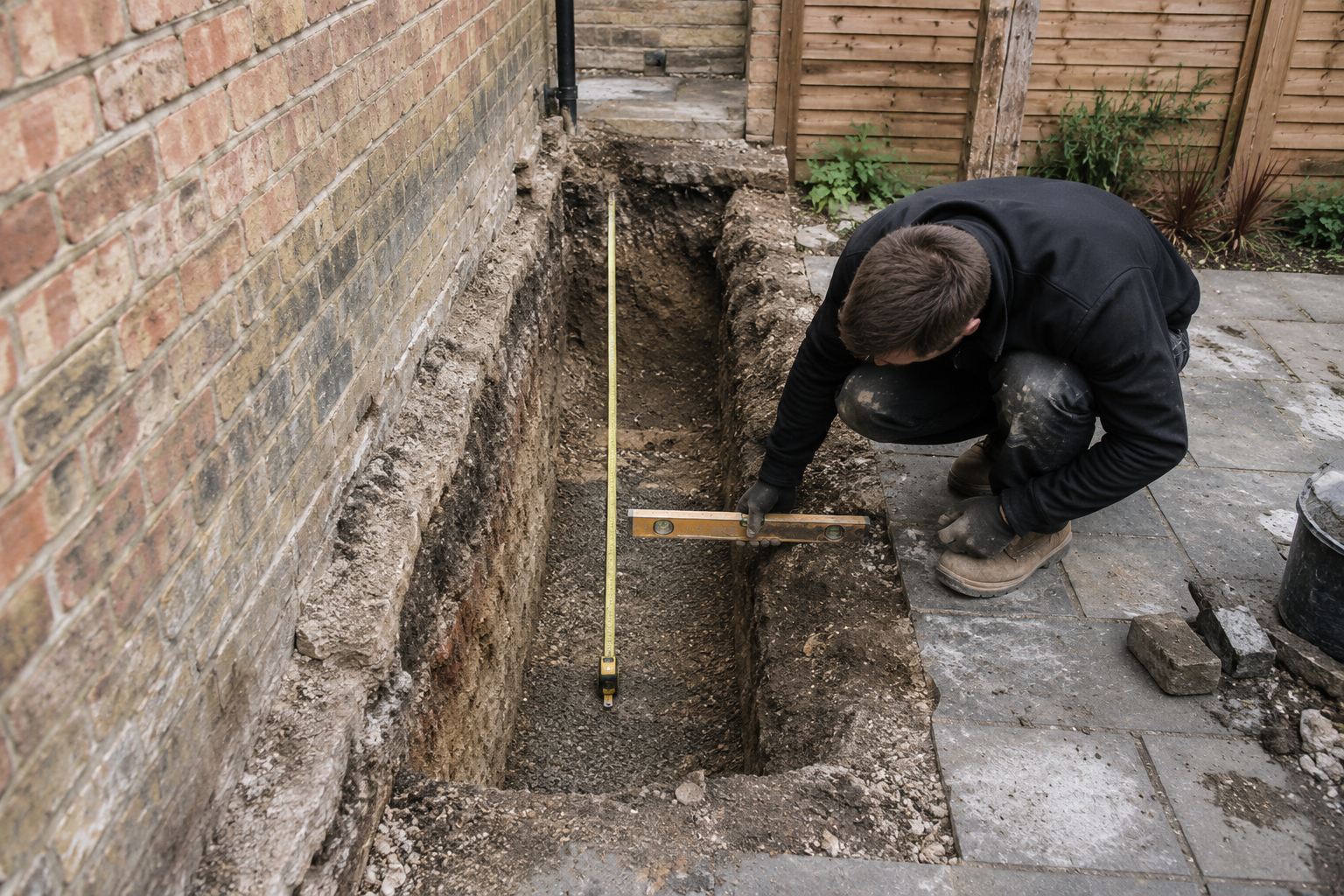
Most homeowners focus on basement depth when assessing party wall obligations. The assumption is that surface-level or lightly excavated rear extensions sit safely outside the Act's reach. This is incorrect, and the misunderstanding is widespread.
Under Section 6 of the Party Wall etc. Act 1996, any excavation within 3 metres of a neighbouring building or structure, where that excavation goes deeper than the neighbour's foundations, requires a Notice of Adjacent Excavation. The critical word is "deeper" — not "significantly deeper." Even a marginal difference in foundation depth is enough to engage the statutory process [3].
For a standard single-storey rear extension on a terraced London property, the new strip foundations may only go 600mm to 900mm below ground. If the adjoining property's existing foundations sit at a similar or shallower level, the trigger is met. This scenario plays out constantly in permitted development projects where homeowners and even some contractors assume that because planning permission is not required, party wall obligations do not apply either. That assumption is legally wrong [2].
Three common scenarios where shallow foundation notices are missed:
- Single-storey rear extensions on terraced homes where new foundations undercut neighbouring footings by even a small margin.
- Outbuilding or garden room construction within 3 metres of a shared fence wall or boundary structure.
- Replacement of existing ground-floor slabs that involve new sub-base excavation close to a party fence wall.
For a clear explanation of what qualifies as a party fence wall and how the Act defines boundary structures, see this guide on understanding party fence walls under the Party Wall Act.
"The Act does not care how modest the works appear above ground. What matters is the relationship between the new foundation depth and the neighbour's existing foundation level."
Permitted development status grants planning permission by default. It does not grant exemption from the Party Wall etc. Act 1996. These are entirely separate legal frameworks [4].
Which Party Wall Notices Apply to Rear Extensions and Basement Works

Understanding Party Wall Notices for Rear Extensions Beyond Basements: Surveyor Validation and Fast-Track Award Strategies requires clarity on which notice type applies to which category of work. There are three primary notice types under the Act, and rear extension projects can engage more than one simultaneously [3].
Party Structure Notice (Section 1 and Section 2)
A Party Structure Notice is required when works affect an existing party wall — for example, cutting into it to insert a beam or raising its height. For rear extensions, this applies when the extension connects to or bears on a shared wall between two properties.
Serving this notice correctly is essential. For a detailed breakdown, the guide on what a Party Structure Notice is and how to serve it in London provides step-by-step guidance.
Notice of Adjacent Excavation (Section 6)
This is the notice most commonly missed in rear extension projects. It applies when:
- Excavation occurs within 3 metres of a neighbouring structure and goes deeper than that structure's foundations, or
- Excavation occurs within 6 metres of a neighbouring structure and would cut a line drawn downward at 45 degrees from the base of that structure's foundations.
The 6-metre rule is particularly relevant for basement extensions, where excavation depth is substantial [3].
Line of Junction Notice (Section 1)
Where a building owner intends to build on or at the boundary line — including foundation walls that sit directly on or straddle the boundary — a Line of Junction Notice is required. This is relevant for rear extensions that extend to the full width of a plot.
Notice Validity and Expiry
All notices expire after one year if works do not commence. If an adjoining owner changes during that period, a fresh notice must be served on the new owner. Consent given following a notice similarly expires if works are not started within the valid period [3].
| Notice Type | Trigger | Minimum Notice Period |
|---|---|---|
| Party Structure Notice | Works to existing party wall | 2 months |
| Line of Junction Notice | Building on/at boundary | 1 month |
| Notice of Adjacent Excavation | Excavation within 3m or 6m | 1 month |
For a comprehensive overview of party wall notices and how to respond to them, including what adjoining owners should do when served, refer to the dedicated guidance available for both building owners and neighbours.
Surveyor Validation: What It Means and Why It Matters
A Party Wall Notice served incorrectly — wrong format, wrong recipient, insufficient detail — is legally invalid. Surveyor validation is the process by which a qualified party wall surveyor reviews the notice before or immediately after service to confirm it meets the statutory requirements of the Act.
Key elements a surveyor validates:
- Correct identification of the building owner and adjoining owner
- Accurate description of the proposed works
- Correct notice type for the works described
- Proper service method (personal delivery, post, or affixing to the premises)
- Accurate commencement date and notice period
An invalidly served notice does not start the statutory clock. This means the minimum notice period has not begun, and any works commenced on the basis of an invalid notice expose the building owner to an injunction and damages [4].
For building owners managing their own projects, understanding the full party wall process and costs helps set realistic expectations before appointing a surveyor.
Schedule of Condition: An Underused Protection Tool
Before any notifiable works begin, a schedule of condition should be prepared. This is a photographic and written record of the adjoining property's condition prior to works commencing. It protects both parties: the building owner avoids liability for pre-existing damage, and the adjoining owner has documented evidence if new damage occurs.
Surveyors who validate notices should routinely recommend a schedule of condition as part of the pre-award process. In practice, it is one of the most cost-effective risk management steps available.
Fast-Track Award Strategies: Realistic Timelines and Proven Methods
This is where Party Wall Notices for Rear Extensions Beyond Basements: Surveyor Validation and Fast-Track Award Strategies becomes directly actionable. The standard timeline from notice service to a completed Party Wall Award can stretch to three months or more when disputes arise or when surveyors are slow to coordinate. However, with the right approach, that timeline can be compressed significantly.
Strategy 1: Appoint a Single Agreed Surveyor
The most effective acceleration method is appointing one agreed surveyor to act for both the building owner and the adjoining owner. This eliminates the coordination delays inherent in dual-surveyor appointments, where two professionals must agree on every clause of the award before it can be issued.
Research indicates that agreed surveyor appointments complete awards 30 to 40 percent faster than dual-surveyor arrangements [1]. The agreed surveyor must act impartially, but the efficiency gains are substantial when both parties trust the process.
For more on how this works in practice, the guide on having a party wall agreement without a separate surveyor for each party explains the agreed surveyor route clearly.
Strategy 2: Front-Load Documentation
Delays in the award process are frequently caused by incomplete documentation at the outset. Surveyors cannot finalise an award without:
- Confirmed architectural drawings showing foundation depth and proximity to boundaries
- Structural engineer's specification for the new foundations
- Completed schedule of condition for the adjoining property
- Signed appointment letters from all parties
Preparing all of this before the notice period expires means the surveyor can move immediately to drafting the award once the statutory period concludes. This single step eliminates what is often a two to four week lag in the process.
Strategy 3: Use Expedited Service Agreements
Some surveying firms offer expedited service packages for time-sensitive projects. These typically start at £950 plus VAT and include immediate surveyor availability, rapid document review, and accelerated schedule of condition preparation [1].
What expedited service realistically delivers:
- Surveyor availability within 24 to 48 hours of instruction
- Schedule of condition completed within two to three days
- Award drafted and issued within five to seven working days of all documentation being received
"Firms advertising 24 or 48-hour award turnarounds are setting unrealistic expectations. A properly constructed award, even under optimal conditions, takes a minimum of one week from the point all documentation is in order." [1]
Strategy 4: Secure Early Consent Where Possible
If an adjoining owner consents to the works in writing within the notice period, the statutory process is effectively concluded without the need for a formal award. This is the fastest possible outcome and costs nothing beyond the notice preparation itself.
Achieving consent requires early, transparent communication with neighbours. Sharing drawings, explaining the works, and addressing concerns before serving the notice dramatically increases the likelihood of written consent within the 14-day response window.
For building owners wanting to understand their rights and obligations before starting this process, the building owner's guide to party wall works provides a clear starting point.
Strategy 5: Choose a Surveyor with Local Knowledge
Party wall awards for rear extensions in dense urban areas — particularly in London — benefit from surveyors who understand local construction conditions, typical foundation depths, and the specific characteristics of Victorian and Edwardian terraced housing stock. A surveyor unfamiliar with the area may require additional site visits or consultations that add days or weeks to the process.
Whether the project is in Central London, South London, or East London, local expertise directly affects both the speed and quality of the award.
Common Mistakes That Derail the Award Process

Even well-intentioned building owners make procedural errors that extend timelines and increase costs. The following mistakes are consistently observed in rear extension projects:
Serving notice too late. The minimum notice period for a Notice of Adjacent Excavation is one month. For a Party Structure Notice, it is two months. Serving notice after works have already started is a statutory breach and can result in an injunction halting the project entirely.
Failing to identify all adjoining owners. In terraced properties, there may be two or three adjoining owners depending on the configuration of the works. Each must receive a separate notice. Omitting one invalidates the process for that boundary.
Assuming permitted development means no party wall obligation. As noted earlier, these are separate legal frameworks. Permitted development status has no bearing on party wall obligations [2].
Not keeping records of service. Notices must be provably served. Using recorded post, personal delivery with a witness, or a solicitor's letter creates an evidential trail. An adjoining owner who later claims they never received a notice can derail the entire process if service cannot be proven.
Ignoring the 14-day response window. If an adjoining owner does not respond within 14 days of a notice being served, a dispute is deemed to have arisen automatically. This triggers the surveyor appointment process. Building owners who wait longer than 14 days hoping for a response are simply losing time [3].
For a practical overview of party wall award templates and what a completed award contains, reviewing a sample document before the process begins helps building owners understand what they are working toward.
Conclusion
Navigating Party Wall Notices for Rear Extensions Beyond Basements: Surveyor Validation and Fast-Track Award Strategies in 2026 requires both legal accuracy and procedural efficiency. The most common failure point is not the basement itself — it is the shallow foundation work that homeowners and contractors routinely assume falls outside the Act's scope. It frequently does not.
Actionable next steps for building owners in 2026:
- Obtain structural drawings confirming new foundation depths before assessing party wall obligations — do not rely on estimates.
- Identify all adjoining owners and the correct notice type for each boundary affected by the works.
- Serve notices with the correct statutory minimum notice periods, keeping documented proof of service for every notice.
- Prepare the schedule of condition and all supporting documentation before the notice period expires to eliminate post-notice delays.
- Consider the agreed surveyor route if the adjoining owner is cooperative — it is the single most effective way to compress the award timeline.
- If speed is critical, instruct a surveyor offering an expedited service package and confirm what that package actually includes before committing.
The Party Wall etc. Act 1996 is not an obstacle to building. Handled correctly, it is a structured framework that protects all parties and keeps projects moving. The building owners who experience the fewest delays are those who engage the process early, prepare thoroughly, and work with surveyors who know how to move efficiently within the statutory framework.
References
[1] Timeline For Party Wall Notices To Awards Avoiding Delays In 2026 Fast Track Projects – https://partywallsurveyorlondon.uk/blogs/timeline-for-party-wall-notices-to-awards-avoiding-delays-in-2026-fast-track-projects/?utm_source=openai
[2] Party Wall Notice For Extension – https://www.expresspartywall.com/party-wall-notice-for-extension/?utm_source=openai
[3] What Notices Do I Need To Serve – https://www.partywall.info/what-notices-do-i-need-to-serve-.html?utm_source=openai
[4] Difference Between Party Wall Notices And Awards – https://www.partywallslimited.com/blog/difference-between-party-wall-notices-and-awards?utm_source=openai