


Roughly one in three homeowners who carry out building work near a shared wall never serve a Party Wall Notice — and a significant portion of them are actually within their rights not to. Understanding the boundary between notifiable and exempt work is one of the most misunderstood aspects of property law in England and Wales, and getting it wrong in either direction carries real consequences. This article examines Party Wall Act exemptions and grey areas: works that don't require notices and how surveyors validate exemption claims, so that building owners and adjoining owners can make informed, legally sound decisions in 2026.
Key Takeaways
- Not all work near or on a party wall triggers the Party Wall etc. Act 1996 — minor works such as drilling for shelves or re-plastering are typically exempt.
- Structural interventions, including cutting into a party wall to insert a beam or removing a chimney breast, are notifiable regardless of how "minor" they appear.
- Grey areas exist where the line between exempt and notifiable work is genuinely ambiguous, and a qualified surveyor's assessment is the most reliable way to resolve them.
- Failing to serve a notice when one is legally required can result in injunctions, work stoppages, and liability for damages.
- Accurate pre-work documentation strengthens exemption claims and protects all parties if a dispute arises later.

Understanding the Legal Framework: What the Party Wall etc. Act 1996 Actually Covers
The Party Wall etc. Act 1996 provides a structured legal mechanism for managing building work that affects shared walls, boundary structures, and excavations near neighbouring properties. It applies in England and Wales and covers three broad categories of work:
- Work on an existing party wall or party structure (Section 2)
- New building at or astride the boundary line (Section 1)
- Excavation near neighbouring buildings (Section 6)
However, the Act does not apply to every single task a homeowner might carry out on or near a shared wall. The legislation was designed to regulate work that poses a genuine risk to the structural integrity of a shared structure or to the adjoining owner's property — not to create bureaucratic hurdles for routine maintenance [1].
Understanding what falls outside the Act's scope is just as important as understanding what falls within it. The types of party wall works that require formal notices are clearly defined, but the exemptions are often less well publicised.
The Core Principle Behind Exemptions
The Act's exemptions are rooted in a proportionality principle: if work does not structurally affect the party wall or pose a material risk to the adjoining owner's property, it falls outside the statutory framework. This principle guides how surveyors assess borderline cases and is the foundation for understanding which works are genuinely exempt.
Works That Are Genuinely Exempt from Party Wall Notices
The UK government's official guidance confirms that certain minor works do not require a party wall notice [1]. These include:
| Type of Work | Exempt? | Reason |
|---|---|---|
| Drilling into a party wall to fix shelves | Yes | No structural interference |
| Re-plastering a party wall surface | Yes | Superficial, no structural impact |
| Painting or decorating a party wall | Yes | Cosmetic only |
| Installing electrical sockets into a party wall | Generally yes | Typically no structural impact |
| Replacing like-for-like fixtures on a party wall | Usually yes | No material alteration |
| Cutting into a party wall to insert a beam | No | Structural intervention required |
| Removing a chimney breast from a party wall | No | Affects structural load path |
| Underpinning a party wall | No | Direct structural work |
| Raising the height of a party wall | No | Notifiable under Section 2 |
The key distinction is whether the work involves structural interference. Superficial work — anything that sits on the surface of the wall without penetrating its structural core — is generally exempt. Work that cuts into, removes, inserts into, or alters the load-bearing capacity of the wall is not.
Permitted Development and the Act
A common misconception is that permitted development rights and Party Wall Act compliance are linked. They are entirely separate legal regimes. A project may have permitted development rights under planning law but still require a party wall notice. Conversely, some work that requires planning permission may not trigger the Act at all. The two frameworks operate independently [1].
Internal Works: A Common Source of Confusion
Many homeowners assume that because work is happening inside their own property, it is automatically exempt. This is incorrect. Internal works that affect the structural integrity of a party wall — such as removing a chimney breast that forms part of the shared wall — do require notice [1]. The location of the work (inside vs. outside) is not the determining factor; the structural impact on the shared wall is.
Grey Areas: Where the Line Between Exempt and Notifiable Becomes Unclear
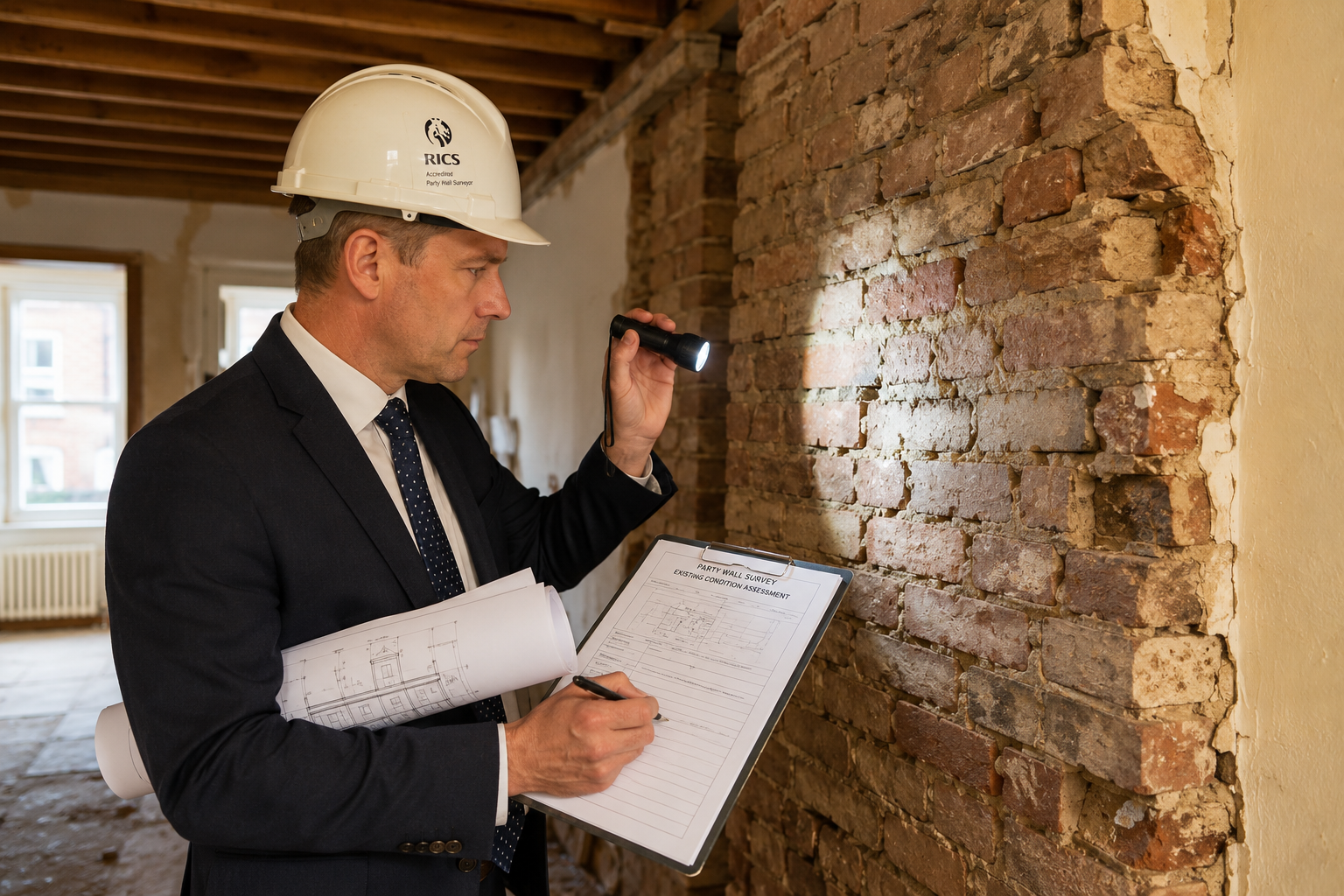
Party Wall Act exemptions and grey areas represent the most challenging territory for both building owners and their advisers. Several categories of work consistently generate uncertainty.
Tanking and Waterproofing
Applying waterproofing membranes or tanking systems to a party wall can involve mechanical fixings, surface preparation that removes material from the wall, or the application of chemical compounds that penetrate the wall's surface. Whether this constitutes notifiable work depends on the depth of penetration and the method used. Surveyors will typically assess whether the wall's structural integrity is materially affected.
Chasing for Services
Running electrical cables or plumbing pipes through a party wall by chasing (cutting a channel) into the surface sits in a genuine grey area. Shallow chasing that does not compromise the wall's structural section may be exempt. Deeper chasing, or chasing that runs through the full thickness of the wall, is more likely to be notifiable. The depth, length, and structural context all matter.
Removing Chimney Breasts
This is one of the most frequently disputed grey areas. Removing a chimney breast that projects into a room but is structurally tied to a party wall can affect the load path through the shared structure. Even where the chimney breast is entirely within one owner's property, if it forms part of the party wall's structural composition, a notice is required [1]. This surprises many homeowners and their contractors.
Loft Conversions and Party Wall Junctions
Loft conversions often involve cutting into or building onto party walls at roof level. Whether a specific element of a loft conversion triggers the Act depends on the precise nature of the structural work. Inserting steel beams into party walls, raising party wall sections, or cutting into party wall structures to form new openings are all notifiable. Purely internal structural work that does not touch the party wall may not be.
For those undertaking works in London, consulting a party wall surveyor in North London or a party wall surveyor in South London early in the planning process can prevent costly mistakes.
The "Ordinary Repairs" Defence
Section 2(7) of the Act provides that certain repairs and maintenance works do not require notice if they are carried out in the same materials and to the same design as the existing structure. However, this defence is narrower than many assume. If the repair involves any structural alteration — even one that appears minor — it may fall outside the ordinary repairs exemption.
"The Act was designed to facilitate building work, not obstruct it — but only where that work genuinely poses no risk to the shared structure or the neighbour's property."
How Surveyors Validate Exemption Claims
When a dispute arises over whether specific works are exempt, or when a building owner wants professional confirmation before proceeding without a notice, a party wall surveyor plays a central role. Understanding how surveyors validate exemption claims is essential for anyone navigating this process [2].
The Assessment Process
A qualified surveyor's validation of an exemption claim typically involves:
- Reviewing the proposed works — examining drawings, specifications, and contractor plans to understand exactly what is intended.
- Inspecting the party wall — physically assessing the wall's construction, condition, and structural context.
- Applying the statutory test — determining whether the proposed work falls within any of the notifiable categories under Sections 1, 2, or 6 of the Act.
- Considering case law and professional guidance — drawing on RICS guidance and relevant legal precedent to inform the assessment [2].
- Documenting the conclusion — providing a written opinion that can be relied upon by both parties.
The Role of RICS Standards
The Royal Institution of Chartered Surveyors (RICS) requires that surveyors acting under the Party Wall Act maintain impartiality and exercise due diligence [2]. This is particularly important when validating exemption claims, because a surveyor's opinion can determine whether a building owner proceeds without notice or is required to serve one.
RICS recommends that only chartered surveyors holding MRICS or FRICS status be appointed under the Act [6]. These professionals are required to maintain current knowledge of legislation, case law, and professional standards — all of which inform the quality of an exemption assessment.
When Disputes Arise Over Exemptions
If an adjoining owner disputes a building owner's claim that their work is exempt, the Act provides a framework for resolution [4]. This typically involves appointing surveyors to assess the work and, if necessary, making a formal determination. A 2025 research study found that out of 66 party wall appeals since 2002, none related to awards made by an agreed surveyor — suggesting that the agreed surveyor model is highly effective at resolving disputes, including those about exemptions [3].
For adjoining owners who believe their neighbour's work is notifiable but no notice has been served, the adjoining owner's surveyor route provides a formal mechanism for raising concerns and seeking protection.
The Importance of a Schedule of Condition
Even where work is genuinely exempt, maintaining a schedule of condition — a documented record of the adjoining property's condition before work begins — is strongly advisable. This documentation supports exemption claims by establishing a pre-work baseline and provides evidence if any damage dispute arises later [5]. Surveyors frequently recommend this even for works that clearly fall outside the Act's scope.
The Consequences of Getting It Wrong

The risks of misidentifying exempt work run in both directions.
Proceeding Without a Notice When One Is Required
Failing to serve a required party wall notice can lead to serious legal and financial consequences [7]:
- Injunctions — a court can order work to stop until proper notice procedures are followed.
- Liability for damages — if the adjoining owner suffers loss as a result of unnotified work, the building owner may be liable.
- Increased costs — retrospective party wall procedures are more complex and expensive than proactive ones.
- Reputational and relationship damage — disputes with neighbours can escalate quickly and prove difficult to resolve.
For building owners unsure of their position, reviewing the party wall notices process and seeking professional advice before work begins is far less costly than managing a dispute after the fact.
Serving an Unnecessary Notice
While less legally risky, serving a notice when one is not required can cause unnecessary delays, trigger the appointment of surveyors, and generate costs that could have been avoided. Understanding genuine exemptions protects building owners from over-compliance as much as under-compliance.
The Cost Dimension
Understanding how to keep party wall costs down is a practical concern for most homeowners. Correctly identifying exempt work from the outset avoids unnecessary surveyor fees. Where work is genuinely notifiable, early engagement with the process — including seeking consent from the adjoining owner — can reduce costs significantly compared to a contested procedure.
Practical Steps for Building Owners in 2026
For anyone planning building work near a shared wall in 2026, the following steps represent best practice:
- Identify the nature of the work early — determine whether it involves structural interference with a party wall, boundary construction, or excavation near a neighbour's foundations.
- Consult the Act directly — the Party Wall etc. Act 1996 is publicly available and sets out the notifiable categories clearly.
- Seek a professional opinion for grey areas — if there is any doubt, a brief consultation with a qualified surveyor is far less costly than managing a dispute later.
- Document the pre-work condition — even for exempt works, a schedule of condition protects all parties.
- Serve notice promptly if required — notices must be served within specific timeframes before work begins [1].
- Consider an agreed surveyor — where both parties are willing, a single agreed surveyor can resolve questions about exemptions efficiently and cost-effectively [3].
Those carrying out works in the capital can access specialist advice from surveyors covering East London, West London, and Central London.
Conclusion
Party Wall Act exemptions and grey areas represent a genuinely complex area of property law — one where the consequences of misunderstanding can range from unnecessary costs to legal injunctions. The core principle is straightforward: work that does not structurally affect a party wall is generally exempt; work that does is not. But the application of that principle to specific projects, materials, and construction methods is where professional expertise becomes indispensable.
Actionable next steps:
- Before starting any building work near a shared wall, assess whether it involves structural interference — not just physical proximity.
- For any work that falls into a grey area, commission a formal exemption assessment from a chartered party wall surveyor before proceeding.
- Prepare a schedule of condition for all works near party walls, regardless of whether a notice is required.
- If an adjoining owner disputes an exemption claim, engage the Act's dispute resolution framework promptly rather than allowing the disagreement to escalate.
- Use the agreed surveyor model where possible — research confirms it is the most effective mechanism for resolving party wall disputes efficiently [3].
Getting the exemption question right from the outset is not just about legal compliance. It is about protecting the working relationship with neighbours, managing project costs, and ensuring that building work proceeds smoothly and without interruption.
References
[1] Party Walls Building Works – https://www.gov.uk/party-walls-building-works?utm_source=openai
[2] Party Wall Legislation And Procedure – https://www.rics.org/profession-standards/rics-standards-and-guidance/sector-standards/building-surveying-standards/party-wall-legislation-and-procedure?utm_source=openai
[3] The Failure Of The Agreed Surveyor Role Section 101a Of The Party Wall Etc Act 1996 – https://www.researchgate.net/publication/393179648_The_failure_of_the_agreed_surveyor_role_Section_101a_of_the_Party_Wall_etc_Act_1996?utm_source=openai
[4] If You Cant Agree – https://www.gov.uk/party-walls-building-works/if-you-cant-agree?utm_source=openai
[5] Party Wall Award – https://www.aylingassociates.com/knowledge/party-wall-award?utm_source=openai
[6] Party Walls – https://www.rics.org/consumer-guides/party-walls?utm_source=openai
[7] Party Wall Notice Requirements Service And Counter Notices – https://legalclarity.org/party-wall-notice-requirements-service-and-counter-notices/?utm_source=openai