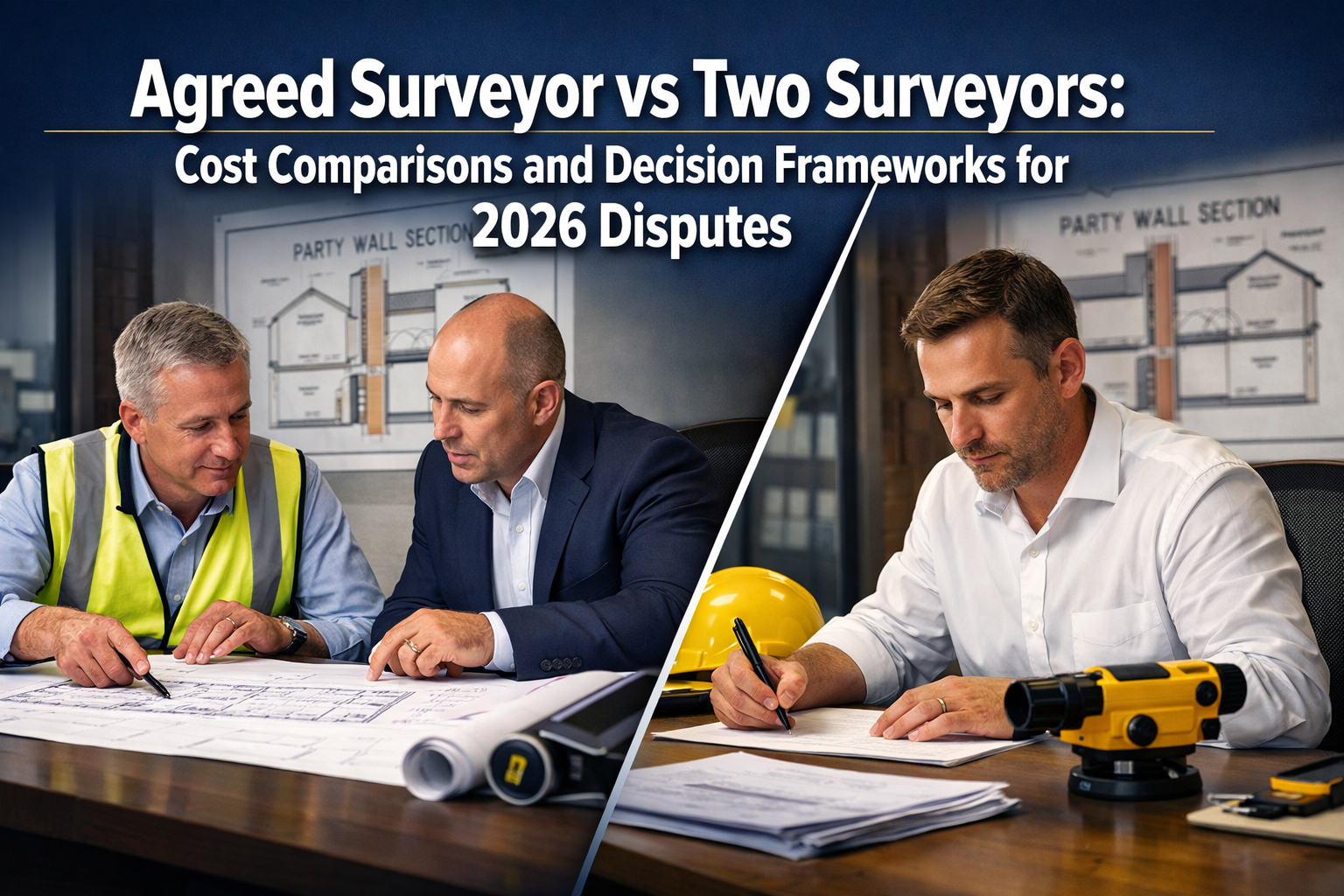
Property disputes under the Party Wall Act can cost building owners anywhere from £800 to over £3,000 depending on surveyor appointments—yet most property owners don’t realize they have a choice that could cut their expenses in half. The decision between appointing an Agreed Surveyor versus two separate surveyors represents one of the most significant financial and strategic choices in party wall procedures, with implications that extend far beyond immediate costs to affect project timelines, relationship dynamics, and dispute resolution outcomes.
Understanding the Agreed Surveyor vs Two Surveyors: Cost Comparisons and Decision Frameworks for 2026 Disputes becomes essential when navigating party wall matters, as this choice fundamentally shapes the entire process from initial notice to final award.
Key Takeaways
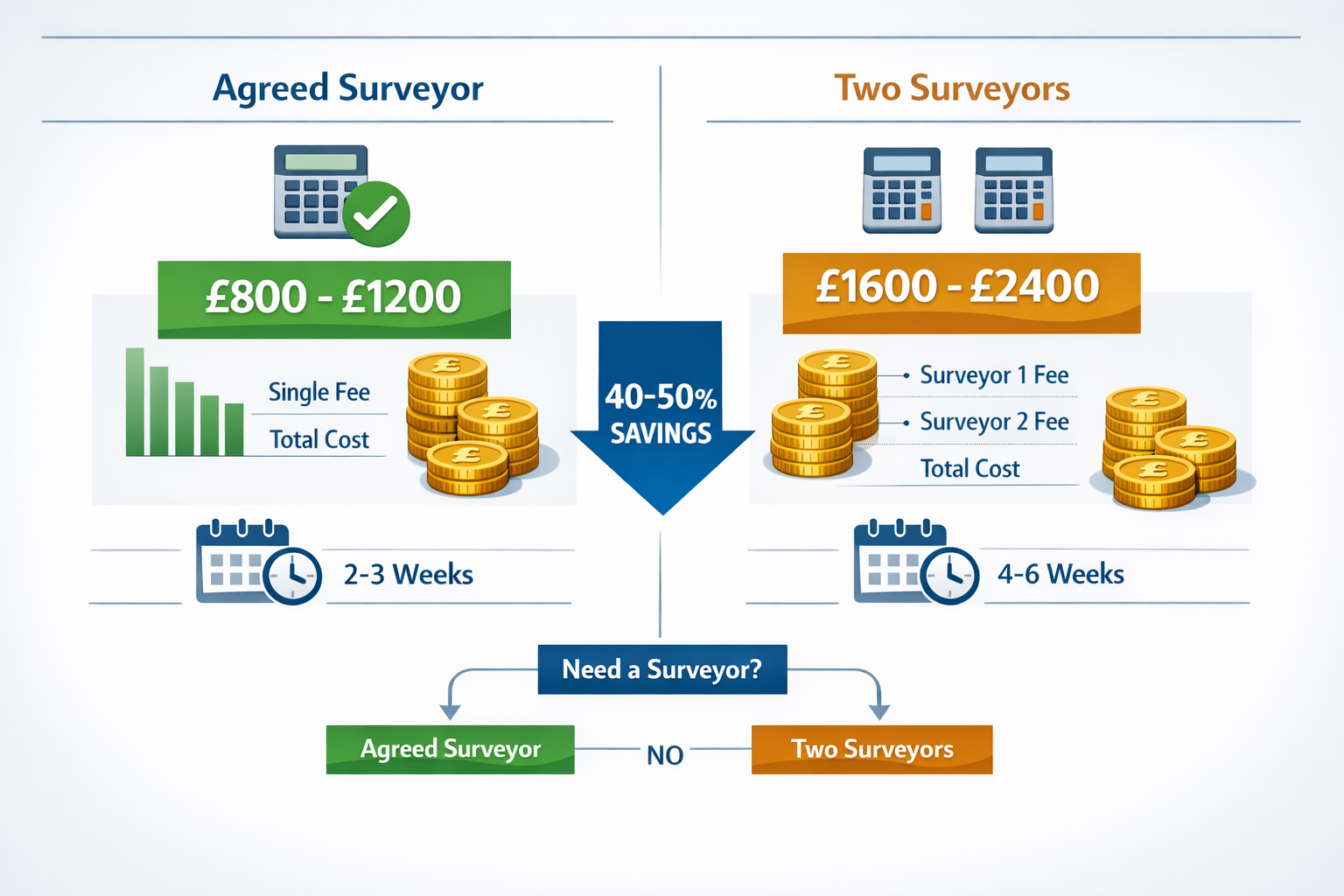
- 💰 Building owners pay all surveyor fees under the Party Wall Act, making the Agreed Surveyor option typically 40-50% cheaper than two-surveyor appointments
- ⚖️ Agreed Surveyors must act impartially despite being paid by the building owner, with professional obligations to both parties equally
- ⏱️ Single surveyor appointments complete faster, typically 2-3 weeks versus 4-6 weeks for two-surveyor arrangements
- 🔍 Adjoining owners retain the legal right to dissent and appoint their own surveyor regardless of cost implications
- 🎯 Third surveyor escalation provides resolution when two surveyors reach deadlock, adding another cost layer to contentious disputes
Understanding the Two Appointment Options Under the Party Wall Act
The Party Wall etc. Act 1996 establishes two distinct pathways for surveyor appointments when neighbors cannot reach agreement on proposed works. Each option carries different cost structures, timelines, and strategic advantages.
What Is an Agreed Surveyor?
An Agreed Surveyor represents a single professional appointed jointly by both the building owner and adjoining owner to act impartially on behalf of both parties.[1] This individual assumes full responsibility for:
- Conducting condition surveys of adjoining properties
- Drafting the Party Wall Award
- Ensuring compliance with statutory requirements
- Mediating between both parties’ interests
- Resolving disputes that arise during works
Despite receiving payment exclusively from the building owner, the Agreed Surveyor maintains professional obligations to act without bias. This arrangement mirrors how a single solicitor cannot represent both parties in a property transaction—the surveyor must balance competing interests fairly.[1]
What Is a Two-Surveyor Appointment?
In a two-surveyor arrangement, each party appoints their own independent surveyor to represent their specific interests. The building owner’s surveyor and adjoining owner’s surveyor then collaborate to:
- Jointly inspect the adjoining property
- Negotiate award terms that protect both parties
- Agree on appropriate working methods and safeguards
- Resolve technical disputes through professional discussion
- Select a Third Surveyor before beginning work (mandatory requirement)
The building owner remains financially responsible for both surveyors’ fees under the Act, even though the adjoining owner selects and instructs their own representative.[1]
Agreed Surveyor vs Two Surveyors: Cost Comparisons for 2026 Disputes
Financial considerations often dominate the decision-making process, particularly for building owners carrying out works who bear all surveyor costs regardless of the appointment structure.
Detailed Fee Breakdown
| Cost Component | Agreed Surveyor | Two Surveyors |
|---|---|---|
| Initial appointment fee | £800-£1,200 | £800-£1,200 (each) |
| Condition survey | Included | £400-£600 (each) |
| Award preparation | Included | Split responsibility |
| Site visits during works | £150-£250 per visit | £150-£250 (each surveyor) |
| Dispute resolution | Included | Additional negotiation time |
| Total typical cost | £1,200-£1,800 | £2,400-£3,600 |
These figures represent standard residential party wall matters in 2026. Complex commercial projects or contentious disputes can escalate costs significantly beyond these ranges.
Hidden Cost Factors
Beyond the obvious fee differences, several hidden costs affect the true financial comparison:
Time-related expenses: Two-surveyor appointments typically extend project timelines by 2-4 weeks, potentially increasing:
- Site security costs
- Equipment rental fees
- Contractor standby charges
- Financing costs for delayed completion
Relationship costs: Adversarial two-surveyor processes can damage neighbor relations, leading to:
- Future cooperation difficulties
- Increased scrutiny of subsequent work
- Potential retaliatory planning objections
- Long-term community tension
Administrative burden: Managing two surveyors requires additional:
- Communication coordination
- Document management
- Decision-making delays
- Project management overhead
For context, standard RICS Level 2 homebuyer surveys average £445 in 2026, while comprehensive Level 3 surveys reach £630.[2] Party wall surveyor fees reflect the specialized legal knowledge, liability exposure, and ongoing responsibility these professionals assume throughout construction projects.
Understanding costs of the party wall process helps property owners budget appropriately and make informed decisions about surveyor appointments.
Decision Framework: When to Choose Each Option
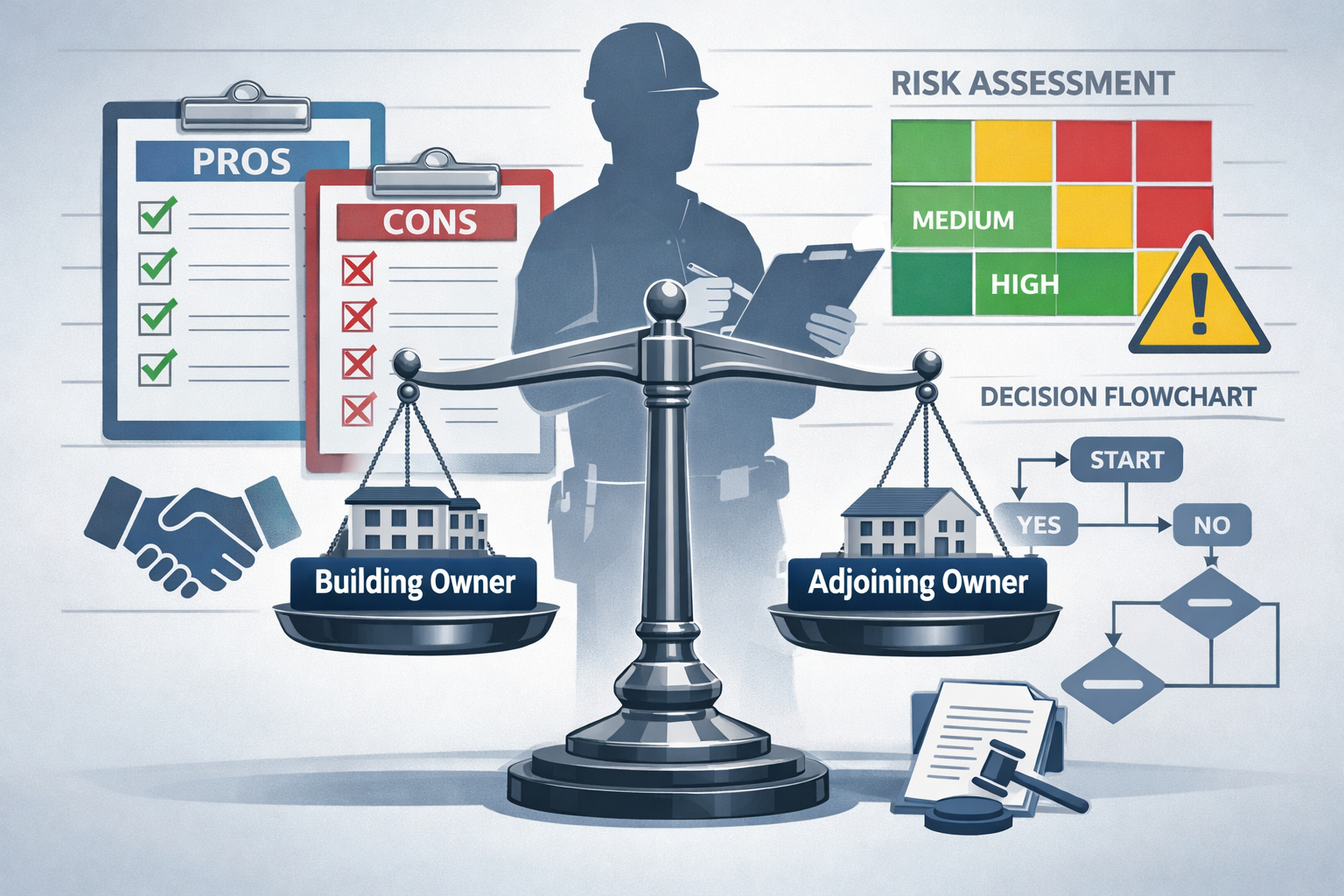
The choice between an Agreed Surveyor and two surveyors shouldn’t rest solely on cost considerations. Strategic factors, relationship dynamics, and project complexity all influence the optimal selection.
When an Agreed Surveyor Makes Sense
Straightforward projects with cooperative neighbors: When both parties maintain good relations and the proposed works follow standard patterns, a single surveyor efficiently manages the process without unnecessary complexity.
✅ Advantages for building owners:
- Reduced overall costs (40-50% savings)
- Faster award preparation and work commencement
- Simplified communication channels
- Single point of accountability
- Lower administrative burden
✅ Advantages for adjoining owners:
- No personal financial exposure
- Professional protection without cost
- Faster resolution and work completion
- Reduced involvement required
- Impartial professional oversight
Cost-conscious projects: Small-scale works like single-story extensions, loft conversions, or minor structural alterations often benefit from Agreed Surveyor appointments where cost efficiency matters significantly.
Time-sensitive construction schedules: Projects with tight deadlines, seasonal constraints, or financing time limits benefit from the streamlined Agreed Surveyor process.
When Two Surveyors Are Preferable
Complex or high-risk works: Major structural alterations, basement excavations, or works affecting multiple properties warrant dedicated representation for each party’s interests.
⚠️ Situations favoring separate appointments:
- Significant structural work near party walls
- Excavation within 3 meters of adjoining foundations
- Previous disputes or strained neighbor relations
- High-value properties where damage risks are substantial
- Commercial properties with business interruption concerns
- Technical disagreements about proposed methods
Contentious relationships: When neighbors are carrying out works and trust has broken down, independent representation provides peace of mind and protects each party’s legitimate interests.
Adjoining owner preference: The Act explicitly grants adjoining owners the right to dissent and appoint their own surveyor.[1] This legal protection ensures vulnerable parties aren’t pressured into arrangements that may not serve their interests.
Professional advice scenarios: Adjoining owners with limited construction knowledge often benefit from dedicated professional guidance throughout the process, particularly when evaluating technical proposals or potential property impacts.
Comparative Pros and Cons Table
| Factor | Agreed Surveyor | Two Surveyors |
|---|---|---|
| Cost to building owner | ✅ Lower (£1,200-£1,800) | ❌ Higher (£2,400-£3,600) |
| Timeline | ✅ Faster (2-3 weeks) | ❌ Slower (4-6 weeks) |
| Impartiality | ⚠️ Professional obligation | ✅ Dedicated representation |
| Communication | ✅ Single point of contact | ❌ Multiple coordination points |
| Dispute resolution | ⚠️ Internal to one surveyor | ✅ Negotiated between professionals |
| Adjoining owner confidence | ❌ Potential bias concerns | ✅ Independent advocate |
| Complexity handling | ⚠️ Suitable for standard works | ✅ Better for complex projects |
| Accountability | ✅ Clear single responsibility | ⚠️ Shared between two parties |
The Impartiality Question: Can One Surveyor Truly Serve Both Parties?
The most common concern about Agreed Surveyor appointments centers on perceived bias. When the building owner pays all fees, can a single surveyor genuinely act impartially?
Professional Standards and Legal Obligations
RICS-registered surveyors operate under strict professional codes that mandate impartiality regardless of payment sources.[1] These obligations include:
- Duty of care to both parties: Legal responsibility to protect both building and adjoining owners’ interests equally
- Professional indemnity insurance: Coverage that applies to both parties, creating financial incentive for balanced decisions
- Regulatory oversight: RICS disciplinary procedures for surveyors who demonstrate bias
- Reputational risk: Professional standing depends on maintaining fairness across all appointments
“An Agreed Surveyor must act impartially and is not permitted to show bias toward either the building owner or adjoining owner, despite being paid by the building owner.”[1]
Practical Safeguards
Several mechanisms protect against bias in Agreed Surveyor appointments:
- Award review rights: Either party can challenge an award they consider unfair
- Third Surveyor appeal: Dissatisfied parties can escalate disputes to an independent Third Surveyor
- Professional reputation: Surveyors depend on recommendations from both building and adjoining owners
- Transparent documentation: Awards must clearly justify all decisions and protective measures
When Bias Concerns Are Legitimate
Despite professional safeguards, certain situations genuinely warrant separate representation:
- Previous relationship between building owner and surveyor: Pre-existing business relationships may create unconscious bias
- Extremely contentious disputes: When trust has completely broken down, perception matters as much as reality
- Significant power imbalances: Corporate building owners versus individual homeowners may benefit from independent advocacy
- Technical disagreements: Fundamental disputes about construction methods require negotiation between equals
Adjoining owners concerned about potential bias should exercise their statutory right to appoint their own surveyor. This decision carries no stigma and represents prudent self-protection in appropriate circumstances.
Third Surveyor Escalation: The Final Safety Net
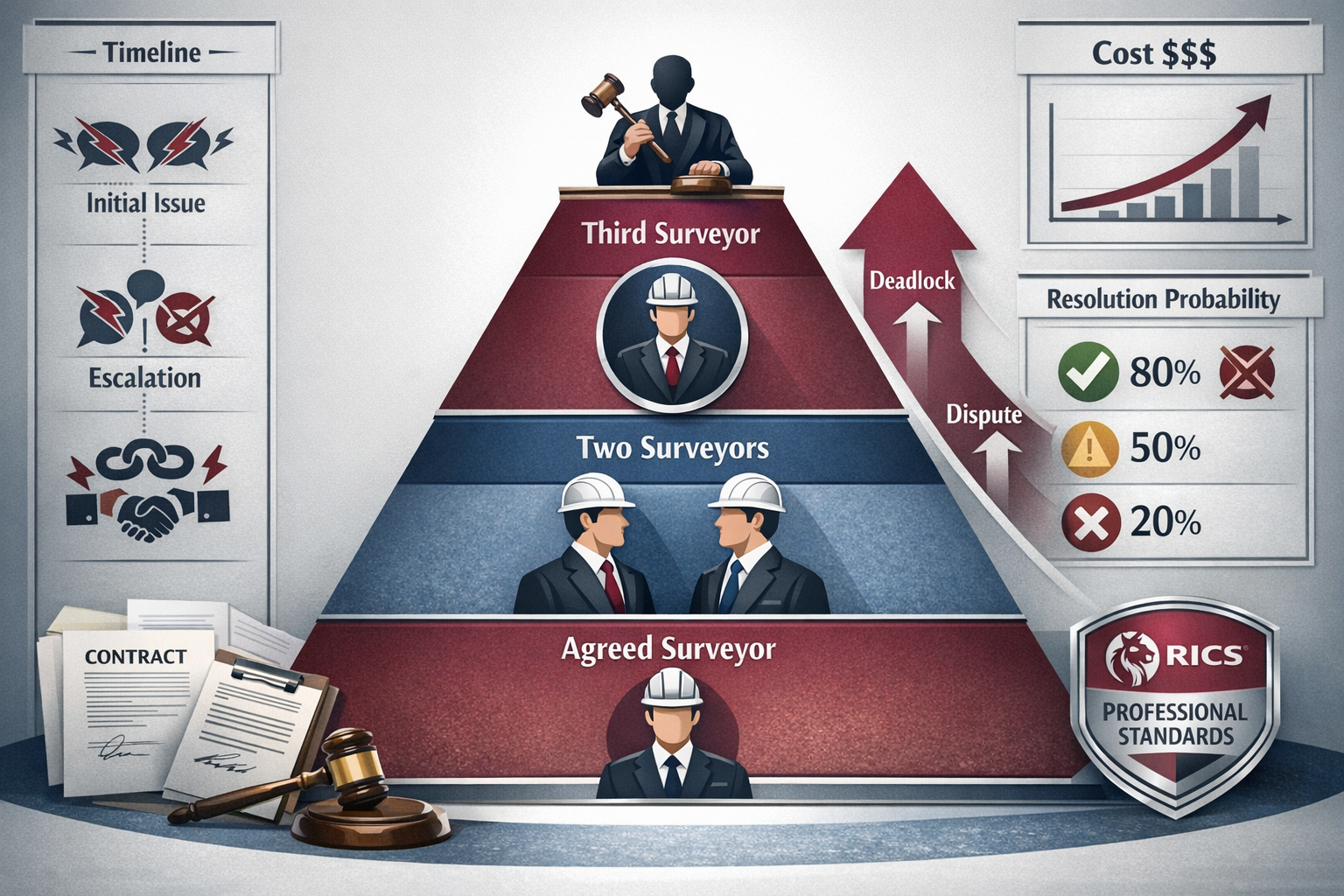
When two surveyors cannot reach agreement on award terms, the Party Wall Act provides a critical safety mechanism: the Third Surveyor.
How Third Surveyor Selection Works
Before any party wall work commences, the two appointed surveyors must jointly select and agree upon a Third Surveyor.[1] This individual serves as:
- Dispute arbitrator: Makes binding decisions when the two surveyors reach deadlock
- Technical expert: Provides specialist knowledge on complex construction issues
- Impartial adjudicator: No prior relationship with either party or their surveyors
- Final authority: Decisions are legally binding on both parties
When Third Surveyor Intervention Becomes Necessary
Third Surveyor involvement typically arises from:
- Fundamental disagreement on working methods: One surveyor considers proposed techniques unsafe or inappropriate
- Protective measure disputes: Disagreement about necessary safeguards, monitoring, or insurance requirements
- Schedule of condition conflicts: Disputes about pre-existing property conditions or damage attribution
- Access and timing issues: Inability to agree on work hours, access arrangements, or project phasing
- Cost allocation disputes: Disagreement about which party bears responsibility for specific protective measures
Cost Implications of Third Surveyor Escalation
Third Surveyor involvement adds another cost layer to party wall procedures:
- Selection fee: £200-£400 for Third Surveyor appointment
- Dispute resolution fee: £800-£2,000 depending on complexity
- Extended timeline costs: Additional 2-4 weeks before work can commence
- Legal representation: Some parties engage solicitors at this stage, adding £1,500-£5,000+
The building owner typically bears these costs as well, making Third Surveyor escalation the most expensive dispute resolution path. This financial reality creates strong incentive for surveyors to reach agreement through professional negotiation.
Preventing Third Surveyor Escalation
Several strategies reduce the likelihood of costly Third Surveyor involvement:
✅ Early surveyor communication: Surveyors who engage early and frequently resolve most issues before formal deadlock
✅ Detailed initial proposals: Comprehensive building owner proposals that address potential concerns proactively reduce later disputes
✅ Realistic protective measures: Building owners who accept reasonable safeguards avoid unnecessary conflict over minor protections
✅ Professional surveyor selection: Experienced party wall surveyors with established working relationships resolve issues more efficiently
Property owners can learn how to keep party wall costs down by making strategic decisions early in the process.
Regional Considerations for 2026 Surveyor Appointments
Geographic location influences surveyor availability, cost structures, and typical appointment patterns across the UK.
London Market Dynamics
The capital’s high property values and dense development create unique party wall dynamics:
- Higher surveyor fees: London surveyors typically charge 20-30% premiums over regional rates
- Greater complexity: Multi-party disputes involving terraced properties require sophisticated coordination
- More frequent two-surveyor appointments: High property values justify additional professional protection
Property owners can find specialized expertise through party wall surveyors in North London, West London, South London, East London, and Central London.
Regional Variations
Outside London, party wall procedures often follow different patterns:
- Lower overall costs: Regional surveyors charge £600-£1,000 for Agreed Surveyor appointments
- More cooperative approaches: Less adversarial culture in many regional markets
- Surveyor availability: Smaller professional pools may limit choice in rural areas
- Simpler projects: Fewer basement excavations and complex structural works
Practical Steps for Making Your Decision
When faced with the Agreed Surveyor vs Two Surveyors: Cost Comparisons and Decision Frameworks for 2026 Disputes choice, follow this systematic approach:
For Building Owners
Step 1: Assess project complexity
- Review types of party wall works your project involves
- Identify high-risk elements requiring additional oversight
- Evaluate proximity to adjoining foundations and structures
Step 2: Evaluate neighbor relationship
- Consider communication history and current rapport
- Assess likelihood of cooperation versus conflict
- Determine whether trust exists for shared representation
Step 3: Calculate total cost implications
- Compare direct surveyor fees for both options
- Factor in timeline differences and associated costs
- Consider potential Third Surveyor escalation risks
Step 4: Propose Agreed Surveyor strategically
- Suggest experienced, well-regarded professionals
- Emphasize cost savings and efficiency benefits
- Respect adjoining owner’s right to decline
Step 5: Prepare for either outcome
- Budget for higher two-surveyor costs as contingency
- Maintain positive communication regardless of choice
- Focus on project success rather than appointment method
For Adjoining Owners
Step 1: Understand your rights
- Recognize your legal entitlement to appoint your own surveyor
- Know that building owners pay all surveyor fees
- Understand that you face no financial exposure for professional representation
Step 2: Evaluate the proposed Agreed Surveyor
- Research their qualifications, experience, and reputation
- Check RICS registration and professional standing
- Consider whether they have local knowledge of property types
Step 3: Assess your comfort level
- Gauge your trust in the building owner’s intentions
- Evaluate project complexity and potential property risks
- Consider your own construction knowledge and confidence
Step 4: Make an informed decision
- Accept Agreed Surveyor if comfortable with impartiality
- Appoint your own surveyor if concerns exist—no explanation needed
- Communicate decision clearly within statutory timeframes
Step 5: Engage constructively
- Provide reasonable access for condition surveys
- Respond promptly to surveyor communications
- Focus on legitimate protection rather than obstruction
Understanding having a party wall agreement without a surveyor helps contextualize when professional involvement becomes necessary versus optional.
Common Mistakes to Avoid
❌ Choosing based solely on cost: The cheapest option isn’t always the best long-term decision, particularly for complex or high-risk projects.
❌ Pressuring neighbors into Agreed Surveyor: Building owners who aggressively push for single surveyor appointments often trigger defensive two-surveyor responses.
❌ Delaying surveyor appointments: Late appointments compress timelines and increase costs through rushed work and premium fees.
❌ Selecting inexperienced surveyors: Unqualified or inexperienced professionals create more problems than they solve, regardless of appointment structure.
❌ Ignoring relationship dynamics: Technical factors matter, but neighbor relationships often determine whether disputes escalate or resolve smoothly.
❌ Failing to communicate: Both parties benefit from clear, respectful communication throughout the process, regardless of surveyor appointment method.
❌ Assuming bias automatically: Professional surveyors take impartiality seriously; Agreed Surveyors can and do protect both parties effectively in appropriate circumstances.
Conclusion
The Agreed Surveyor vs Two Surveyors: Cost Comparisons and Decision Frameworks for 2026 Disputes decision represents far more than a simple cost calculation. While Agreed Surveyor appointments typically save building owners 40-50% in direct fees and reduce timelines by several weeks, the optimal choice depends on project complexity, relationship dynamics, and risk tolerance for all parties involved.
Building owners benefit financially from Agreed Surveyor arrangements but must balance cost savings against the strategic value of smoother neighbor relations that two-surveyor appointments sometimes facilitate. Adjoining owners should exercise their legal right to independent representation when genuine concerns exist, without guilt about cost implications they don’t bear.
Actionable Next Steps
If you’re a building owner planning works:
- Serve proper party wall notices at least two months before starting work
- Propose a qualified Agreed Surveyor with strong local reputation
- Budget for two-surveyor costs as contingency planning
- Maintain open communication with neighbors throughout the process
- Accept reasonable protective measures to avoid costly disputes
If you’re an adjoining owner receiving notice:
- Understand your rights under the Party Wall etc. Act 1996
- Evaluate the proposed Agreed Surveyor objectively
- Appoint your own surveyor if any concerns exist
- Respond within statutory timeframes to avoid deemed consent
- Focus on legitimate protection rather than obstruction
For both parties:
- Consult qualified RICS-registered party wall surveyors early
- Prioritize professional expertise over cost minimization
- Maintain perspective on long-term neighbor relationships
- Document all communications and agreements carefully
- Seek legal advice for unusually complex or contentious situations
The party wall process exists to protect all parties’ legitimate interests while enabling necessary construction work. Whether through an Agreed Surveyor or two separate appointments, professional surveyor involvement provides the technical expertise, legal compliance, and dispute resolution mechanisms that make neighbor construction projects succeed. Making informed decisions about surveyor appointments based on project-specific factors rather than generic assumptions ensures optimal outcomes for everyone involved.
For additional guidance on your specific situation, review our general FAQs or consult with qualified party wall professionals who can provide tailored advice based on your unique circumstances.
References
[1] Agreed Surveyor Vs Two Surveyor – stokemont.com
[2] How Much Does A House Survey Cost – comparemymove.com
Speak to a RICS chartered party wall surveyor
Free initial consultation. Notices, awards and schedules of condition across London and nationwide.