
Fewer than one in five homeowners who remove a chimney breast serving a party wall correctly complete all the legal steps required before work begins — and the consequences of getting it wrong can include injunctions, costly reinstatement orders, and bitter neighbour disputes that follow a property through every future sale. Chimney Breast Removals and Party Wall Awards: Surveyor Structural Checks, Notice Validity, and Damage Prevention Clauses sit at the intersection of structural engineering, property law, and neighbourly obligation, making this one of the most technically demanding renovation projects a building owner can undertake in 2026.
This guide walks building owners through every stage: from understanding why chimney breast removal is classified as high-risk party wall work, to serving a valid notice, commissioning the right structural assessments, and ensuring a robust Party Wall Award protects all parties against future damage claims.
Key Takeaways 📋
- Legal notice is mandatory before removing any chimney breast that forms part of, or is attached to, a party wall — governed by Section 2(2)(G) of the Party Wall etc. Act 1996.
- A Party Wall Award must be in place if the adjoining owner dissents or fails to respond within the statutory timeframe.
- Structural engineer sign-off is non-negotiable: the remaining chimney stack must be supported by steel beams or gallows brackets approved by Building Control.
- Damage prevention clauses within the Award protect both building owners and neighbours from unresolved liability post-completion.
- Surveyor fees for both sides are typically borne by the building owner carrying out the works.
Why Chimney Breast Removal Is High-Risk Party Wall Work
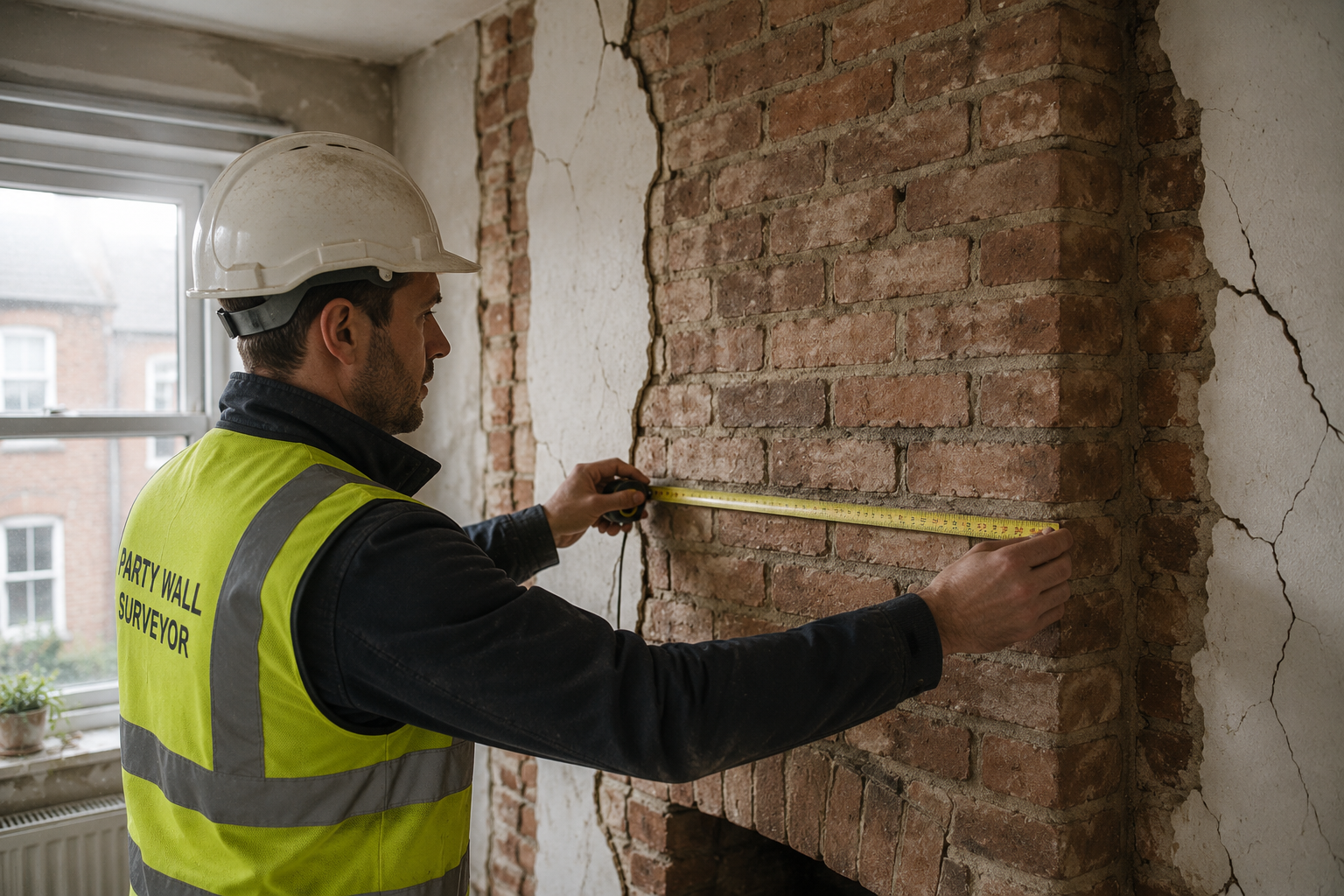
Removing a chimney breast is not a cosmetic task. Industry professionals consistently categorise it as “one of the higher risk forms of party wall works,” requiring the same structural rigour as removing a load-bearing wall [3]. The reason is straightforward: in a Victorian or Edwardian terraced or semi-detached property, a chimney breast is often bonded into the party wall itself, meaning any removal directly affects the structural integrity of the shared structure.
The Legal Framework: Section 2(2)(G) of the Party Wall etc. Act 1996
The legal basis for regulating this work is precise. Section 2(2)(G) of the Party Wall etc. Act 1996 specifically addresses “cutting away from a party wall any projecting chimney breast, jamb or flue, or other projection” for structural purposes [3]. This is not a grey area — the Act explicitly names chimney breast removal as a notifiable activity.
Understanding the Party Wall etc. Act 1996 in full helps building owners appreciate that the notice requirement is not bureaucratic box-ticking. It exists to protect the structural fabric of adjoining properties and to create a clear legal record of the condition of those properties before work begins.
💡 Pull Quote: “A chimney breast bonded into a party wall is not just a feature of your home — it is part of your neighbour’s home too. Remove it without proper process and you are altering their property without consent.”
When Does the Act Apply?
The Act applies when:
| Scenario | Party Wall Act Applies? |
|---|---|
| Chimney breast on an internal wall only | ❌ No (Building Regs still apply) |
| Chimney breast attached to or forming part of a party wall | ✅ Yes |
| Chimney stack sits on a shared or party wall | ✅ Yes |
| Work affects the foundation of a shared structure | ✅ Yes |
Even if only a portion of the work touches the shared structure, a party wall agreement is mandatory [4]. Building owners who assume their works are “mostly internal” and skip the notice process expose themselves to significant legal and financial risk.
Serving a Valid Party Wall Notice: Timelines, Content, and Common Errors
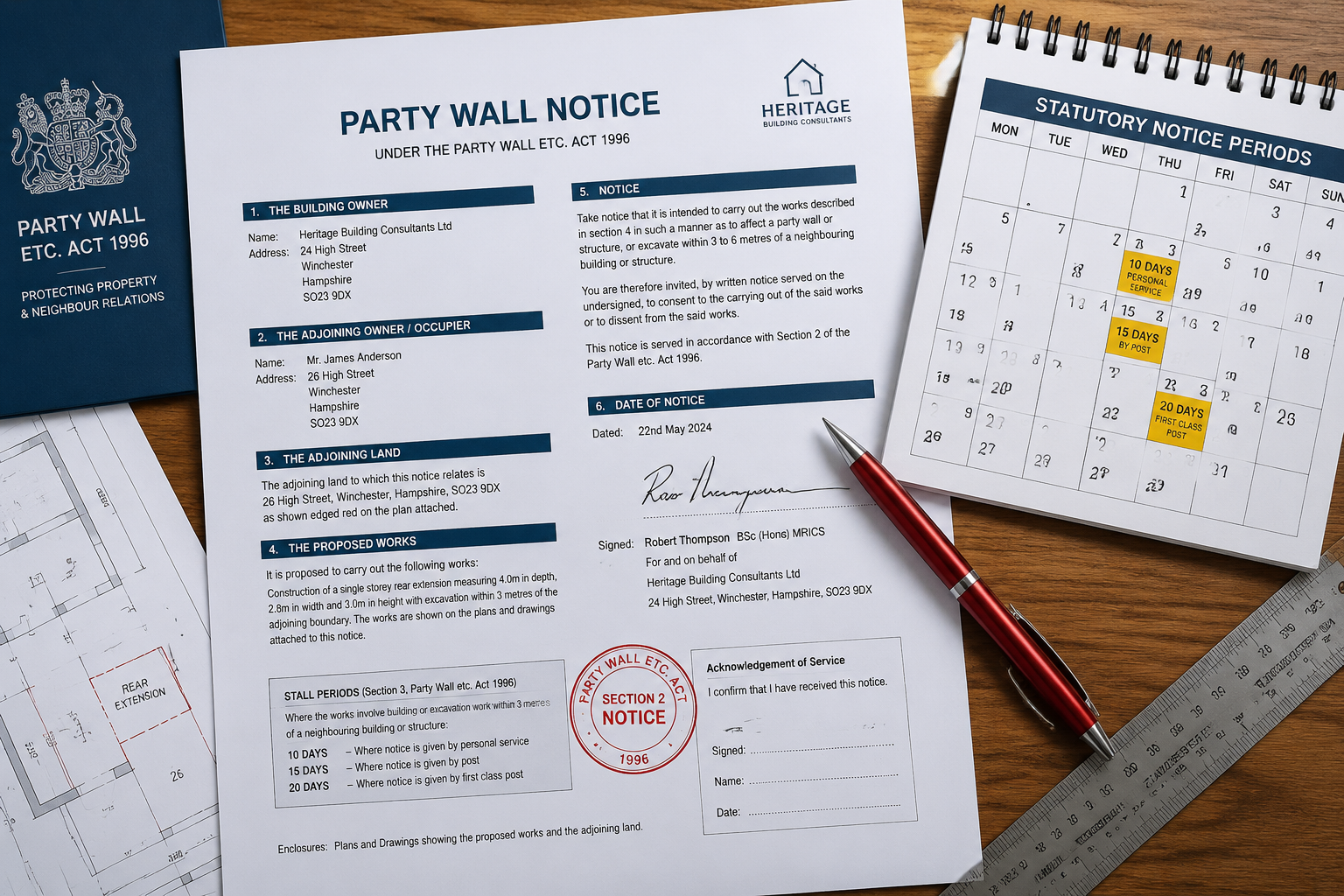
The notice process is where many projects go wrong before a single brick is removed. A Party Wall Notice under Section 3 of the Act must be served on all adjoining owners before work commences, and its validity depends on strict compliance with statutory requirements [3].
What Must a Valid Notice Include?
A valid Party Structure Notice must contain:
- Full name and address of the building owner
- A clear description of the proposed works, including the chimney breast removal and any associated structural support works
- The proposed start date (work cannot begin until the notice period has elapsed)
- Reference to the Party Wall etc. Act 1996
For a detailed breakdown of what these notices must contain and how to serve them correctly, the guide on Party Wall Act notices — what they are and how to respond provides practical, step-by-step guidance.
Statutory Timeframes and Notice Validity ⏱️
Notice validity is tied directly to statutory timeframes [1]. The adjoining owner has 14 days from receipt of the notice to respond. Three outcomes are possible:
- Written consent given → Work can proceed without a formal Award (though a Schedule of Condition is still strongly advised)
- Dissent given → A Party Wall Award must be prepared by appointed surveyor(s)
- No response within 14 days → A dispute is deemed to have arisen, triggering the mandatory Award process
⚠️ Critical Warning: Serving notice and then starting work before the 14-day period expires — or before an Award is in place — is unlawful. Courts have issued injunctions halting works mid-project in such cases.
Common Notice Errors That Invalidate the Process
- Serving notice on a tenant rather than the freeholder (the legal owner)
- Failing to describe the structural support works (gallows brackets, steel beams) as part of the notice
- Serving notice with an insufficient lead time before the proposed start date
- Not serving notice on all adjoining owners where multiple properties share the party wall
Understanding what a Party Structure Notice is and how to serve it in London can help building owners avoid these procedural pitfalls before they become expensive problems.
Surveyor Structural Checks, Party Wall Awards, and Damage Prevention Clauses
The appointment of a qualified party wall surveyor is not optional once a dispute is triggered — it is a statutory requirement. This section covers the surveyor’s role in structural assessment, the content of a robust Party Wall Award, and the damage prevention clauses that protect both parties long after the scaffolding comes down.
The Surveyor’s Role in Structural Assessment
A party wall surveyor’s responsibilities go beyond paperwork. For chimney breast removal specifically, the surveyor must:
- Assess the existing condition of the party wall and adjoining property before work begins (a Schedule of Condition)
- Review the structural engineer’s design for the remaining chimney stack support
- Confirm that Building Control approval has been obtained or is in progress
- Identify any pre-existing cracks or defects that could later be confused with works-related damage
The Schedule of Condition is one of the most important documents produced during this process. It creates a photographic and written record of the adjoining property’s condition immediately before works begin, providing an objective baseline for any future damage claims.
Structural Engineer Requirements 🏗️
The remaining chimney stack — which may extend through the loft space and above the roofline — must be adequately supported once the breast below is removed. Two primary support methods are used:
| Support Method | Description | Approval Required |
|---|---|---|
| Steel RSJ/Beam | A rolled steel joist spanning the void left by the removed breast | Structural engineer design + Building Control |
| Gallows Brackets | A bracket system cantilevering the stack from the party wall | Building Control verification required first [4] |
💡 Key Point: Gallows brackets may be acceptable to a building inspector as an alternative to steel beams in some circumstances, but this must be verified with the local Building Control office before proceeding [4]. Assuming one method is acceptable without confirmation can cause costly delays.
Improper support of the remaining stack can lead to cracking, structural instability, or in extreme cases, collapse [1]. The structural engineer’s design must be submitted to Building Control, and a completion certificate must be obtained after the final inspection — a document that should be retained permanently for property records [2].
What a Robust Party Wall Award Must Contain
A Party Wall Award is a legally binding document. For chimney breast removal works, a well-drafted Award should include:
- Description of the permitted works in precise technical detail
- Working hours restrictions to minimise disruption to the adjoining owner
- Access rights for the building owner’s contractors to the adjoining property if needed
- The Schedule of Condition as an annexed document
- Damage prevention clauses — the most critical protective element
- Dispute resolution provisions if damage is identified post-completion
- Surveyor fee arrangements confirming the building owner’s liability for costs [1]
The guide on Party Wall contract templates and Awards provides useful context on how these documents are structured and what building owners should look for before signing.
Damage Prevention Clauses: The Protective Core of the Award 🛡️
Damage prevention clauses are the mechanism by which the Award protects both the building owner and the adjoining owner from unresolved liability. These clauses typically:
- Require the building owner to make good any damage caused to the adjoining property as a direct result of the notified works
- Specify the standard of reinstatement (like-for-like materials, professional trades)
- Set a timeframe within which damage must be reported and remedied
- Establish a process for independent assessment if the parties disagree on whether damage was caused by the works
Without robust damage prevention clauses, a building owner who removes a chimney breast and inadvertently causes cracking in the neighbour’s ceiling plasterwork faces an open-ended liability dispute. The Award converts that uncertainty into a clear, enforceable framework.
💡 Pull Quote: “A Party Wall Award without strong damage prevention clauses is like a building contract without a defects liability period — it leaves the most important protection out entirely.”
Who Pays the Surveyor Fees?
The building owner carrying out the works is responsible for reasonable surveyor fees on both sides [1]. This includes:
- Their own appointed surveyor’s fees
- The adjoining owner’s appointed surveyor’s fees (where the adjoining owner has appointed one)
- Any agreed third surveyor fees if a dispute arises between the two appointed surveyors
For building owners concerned about managing overall project costs, the resource on how to keep party wall costs down offers practical strategies for reducing fees without compromising on legal compliance.
The Award as a Long-Term Property Record
Party Wall Awards must be kept on file permanently [2]. When the property is sold, the Award forms part of the legal pack and demonstrates to prospective buyers that:
- The chimney breast removal was carried out lawfully
- Structural support was properly designed and approved
- The adjoining owner’s rights were respected throughout
- Any damage was identified and remedied
Buyers’ solicitors routinely request Party Wall Awards as part of conveyancing searches. A missing Award for works of this nature can delay or even derail a sale.
The Full Process: A Step-by-Step Overview
For building owners approaching this project in 2026, the complete process can be summarised as follows:
- Appoint a structural engineer to assess the chimney breast and design the support system for the remaining stack
- Confirm Building Control requirements with the local authority, including whether gallows brackets or steel beams are required
- Identify all adjoining owners who share the party wall affected by the works
- Serve a valid Party Wall Notice under Section 3 of the Act, with sufficient lead time
- Await the statutory 14-day response period
- If consent is given: commission a Schedule of Condition and proceed
- If dissent or no response: appoint a party wall surveyor; the adjoining owner appoints theirs; the Award is prepared
- Ensure the Award is signed and all damage prevention clauses are in place before works start
- Complete the works in accordance with the Award’s conditions
- Obtain a Building Control completion certificate and file it with the Party Wall Award
Building owners in London can find specialist support through party wall surveyors in South London, East London, and across the capital, depending on the location of the works.
Conclusion: Protecting Your Project and Your Neighbour’s Property
Chimney Breast Removals and Party Wall Awards: Surveyor Structural Checks, Notice Validity, and Damage Prevention Clauses represent a tightly interlocked set of legal, structural, and procedural obligations. No single element can be skipped without undermining the whole framework.
The key lesson for building owners in 2026 is this: the Party Wall process is not an obstacle to your project — it is the mechanism that makes your project defensible. A valid notice, a properly drafted Award, a structural engineer’s approved design, and robust damage prevention clauses together create a project that is legally sound, structurally safe, and protected against future claims.
Actionable Next Steps ✅
- Consult a party wall surveyor early — ideally before appointing a contractor, so the notice timeline does not delay the build programme
- Commission a structural engineer to assess the chimney stack support requirements before serving notice
- Review the Party Wall Award carefully before signing — ensure damage prevention clauses are specific, not generic
- Retain all documents — notice, consent or Award, Schedule of Condition, structural engineer’s report, and Building Control completion certificate — in a single property file
- Do not start work until all statutory periods have elapsed and, where required, a signed Award is in place
For personalised guidance on chimney breast removal and party wall obligations, contact a qualified party wall surveyor to discuss the specific circumstances of your project.
References
[1] Removing A Chimney Breast On A Party Wall Costs Process Legal Requirements – thepartywallguru.com
[2] Chimney breast removal – designingbuildings.co.uk
[3] Taking Out A Chimney Breast – stokemont.com
[4] Removing Chimney Breast Party Wall Agreement – collier-stevens.co.uk
Speak to a RICS chartered party wall surveyor
Free initial consultation. Notices, awards and schedules of condition across London and nationwide.