
Nearly 40% of party wall disputes in 2026 stem from preventable errors made during the initial notice stage—mistakes that cost property owners thousands in delays and legal fees. Understanding the Common Mistakes in Party Wall Notices: How Surveyors Fix Dissent and Delays can mean the difference between a smooth construction project and months of neighbourly conflict.
When property owners embark on building work that affects shared walls, boundaries, or excavations near neighbouring properties, the Party Wall etc. Act 1996 requires proper notification. Yet despite clear statutory requirements, errors in party wall notices remain alarmingly common. These mistakes trigger dissent, escalate costs, and push back project timelines—sometimes by several months.
Professional surveyors have developed systematic approaches to identify, correct, and prevent these errors. With updated RICS guidance for 2026 and lessons learned from recent case law, the industry now has clearer frameworks for avoiding common pitfalls and resolving disputes efficiently.
Key Takeaways
- Improper service methods account for approximately 30% of party wall notice failures, with surveyors implementing tracked delivery systems to ensure compliance
- Vague work descriptions lead to neighbour objections in over 25% of cases, requiring surveyors to mandate detailed technical specifications and architectural drawings
- Incorrect notice types cause statutory breaches that void the entire process, with professional surveyors now using RICS 2026-aligned templates to prevent categorization errors
- Strategic timing and documentation by experienced surveyors can reduce dispute resolution periods from 3-4 months to under 6 weeks
- Preventive measures including pre-notice consultations and schedule of condition surveys eliminate up to 60% of potential dissent cases
Understanding the Most Common Mistakes in Party Wall Notices
The foundation of party wall compliance rests on accurate, timely, and properly served notices. Unfortunately, building owners frequently stumble at this critical first step, creating cascading problems that experienced surveyors must later untangle.
Improper Service of Notices 📬
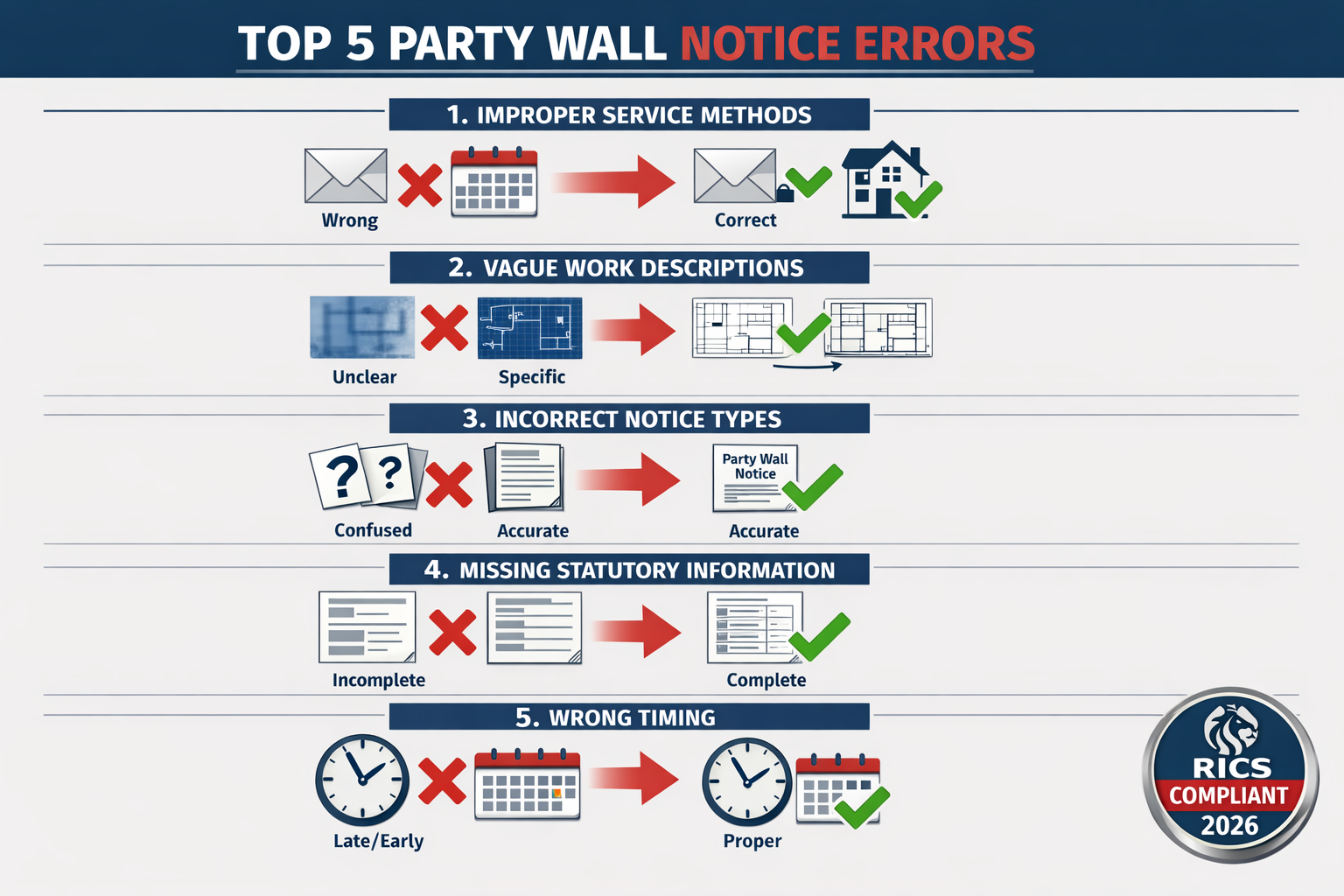
Service failures represent the single most frequent error in party wall procedures. The Party Wall etc. Act 1996 specifies strict requirements for how notices must be delivered, yet many building owners assume informal methods suffice.
Common service errors include:
- Email-only delivery without postal confirmation or prior agreement
- Hand delivery without witness or proof of receipt
- Service to tenants rather than freeholders or leaseholders
- Incomplete address information missing flat numbers or proper property identification
- Failure to serve all adjoining owners when multiple parties share interest
According to recent industry analysis, improper service invalidates the entire notice, requiring the building owner to restart the process from scratch [1]. This mistake alone can delay projects by 4-6 weeks.
How surveyors fix it: Professional party wall surveyors implement tracked delivery systems using Royal Mail Signed For or recorded delivery services. They conduct thorough Land Registry searches to identify all parties with legal interest and maintain detailed service logs with photographic evidence and witness statements.
Vague or Incomplete Work Descriptions
The second major category of errors involves insufficient detail about proposed works. Many building owners submit notices with generic descriptions like “loft conversion” or “basement extension” without specifying how the work affects the party wall structure.
Inadequate descriptions typically lack:
- Specific dimensions and depths of excavations
- Detailed information about wall penetrations or modifications
- Structural engineering specifications
- Timeline and methodology for the works
- Impact assessment on adjoining property foundations
When adjoining owners receive vague notices, they naturally become suspicious and defensive. This ambiguity triggers dissent in over 25% of cases, according to surveyor feedback compiled in early 2026 [2].
How surveyors fix it: Experienced building owners’ surveyors require comprehensive architectural drawings, structural calculations, and method statements before serving notices. They translate technical plans into clear language that helps neighbours understand the work scope while maintaining statutory compliance.
Incorrect Notice Type Selection
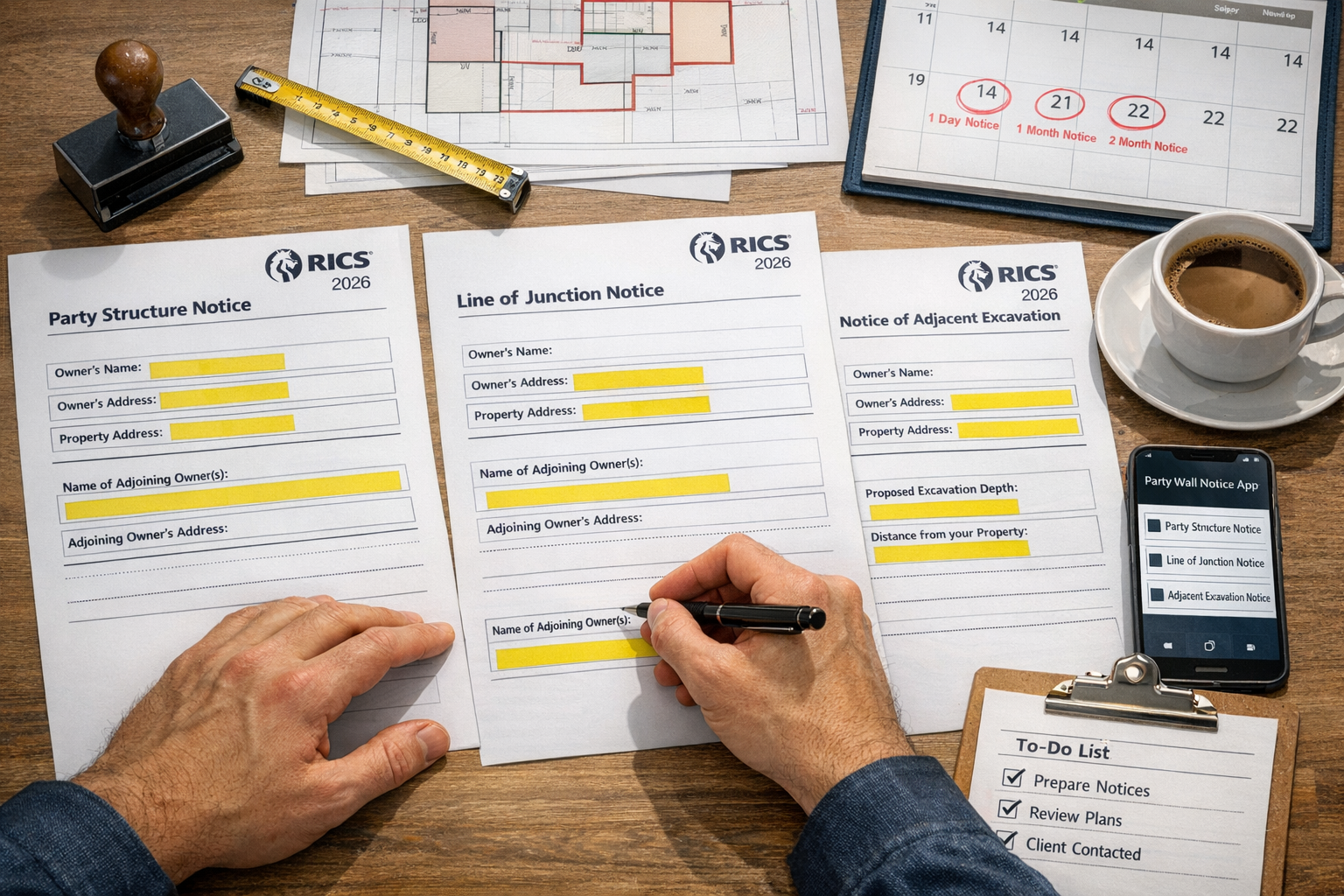
The Party Wall etc. Act 1996 establishes three distinct notice types, each applicable to specific work categories. Confusion about which notice to serve creates statutory breaches that void the entire process.
| Notice Type | When Required | Common Confusion |
|---|---|---|
| Party Structure Notice | Work directly to party wall (cutting in, inserting beams, raising height) | Often confused with Line of Junction when building astride boundary |
| Line of Junction Notice | Building new wall on boundary line | Mistakenly used for work near but not on boundary |
| Adjacent Excavation Notice | Excavation within 3m (deeper than neighbour’s foundation) or 6m (below 45° plane) | Distances and depth calculations frequently miscalculated |
Selecting the wrong notice type demonstrates fundamental misunderstanding of the Act and immediately raises red flags for adjoining owners and their surveyors.
How surveyors fix it: Professional surveyors conduct site surveys with precise measurements and review architectural plans against statutory definitions. They often serve multiple notice types when projects involve various work categories, ensuring comprehensive coverage. The use of RICS 2026-aligned templates helps standardize notice selection.
Missing Statutory Information
Every party wall notice must contain specific statutory details as outlined in the Party Wall etc. Act 1996. Omitting required information renders notices invalid, yet this oversight occurs frequently when building owners attempt DIY submissions.
Critical missing elements include:
- Commencement date (must be at least 2 months for Party Structure Notices, 1 month for others)
- Building owner’s full legal name and address matching Land Registry records
- Clear property identification for both building and adjoining properties
- Statutory rights explanation informing neighbours of their response options
- Surveyor appointment information and 14-day response deadline
These omissions often reflect building owners’ attempts to save costs by having a party wall agreement without a surveyor, which frequently backfires when notices get rejected.
How surveyors fix it: Chartered surveyors use standardized notice templates updated for 2026 compliance, incorporating mandatory statutory language and comprehensive checklists. They verify all information against official records before service and include explanatory cover letters that help neighbours understand their rights and obligations.
How Surveyors Resolve Dissent and Navigate Disputes
When adjoining owners serve a counter-notice dissenting to proposed works, the statutory dispute resolution mechanism activates. This process, while clearly defined in legislation, requires skilled navigation to prevent unnecessary delays and cost escalation.
The Surveyor Appointment Process
Once dissent occurs, the Party Wall etc. Act 1996 mandates surveyor involvement. Building owners and adjoining owners each appoint a surveyor, or they may agree to a single “Agreed Surveyor” to act impartially for both parties.
The appointment timeline follows strict statutory periods:
- Within 14 days of dissent, the building owner must appoint their surveyor
- Within 10 days of that appointment, they must request the adjoining owner appoint their surveyor
- If no appointment occurs within 10 days, the building owner’s surveyor can make the appointment on the adjoining owner’s behalf
Professional adjoining owners’ surveyors play a crucial role in protecting neighbours’ interests while facilitating reasonable construction progress. They review notices for compliance, assess proposed works for potential damage risks, and negotiate protective conditions.
Common delay points: Adjoining owners often don’t understand the urgency of surveyor appointment, leading to automatic appointments that can feel adversarial. Surveyors mitigate this by proactive communication, explaining the process clearly, and recommending qualified professionals who maintain collaborative approaches.
Conducting Thorough Schedule of Condition Surveys
One of the surveyors’ first critical tasks involves preparing a comprehensive schedule of condition documenting the adjoining property’s existing state before works commence.
This schedule of condition serves multiple essential functions:
- Establishes baseline evidence for any future damage claims
- Protects building owners from false allegations of pre-existing damage
- Provides adjoining owners with documented proof of property condition
- Facilitates insurance claims if damage does occur during construction
Professional surveyors conduct detailed photographic surveys, noting every crack, settlement indicator, and structural characteristic. They use calibrated equipment to measure existing movement and document drainage, damp issues, and decorative condition throughout affected areas.
Time-saving approach: Experienced surveyors schedule these inspections immediately after appointment, often within 3-5 days, preventing this stage from becoming a bottleneck. They coordinate access efficiently and produce draft reports within one week of inspection.
Drafting Comprehensive Party Wall Awards
The party wall award represents the formal legal document that authorizes works to proceed under specified conditions. Surveyors must balance building owners’ construction needs with adjoining owners’ protection rights.
A robust 2026-compliant party wall award includes:
- Detailed work descriptions with precise specifications and methodology
- Access provisions specifying when, how, and how often building owners may enter adjoining property
- Working hours restrictions typically limiting noisy work to 8am-6pm weekdays
- Protective measures such as temporary support, dust suppression, and vibration monitoring
- Dispute resolution procedures for issues arising during construction
- Cost provisions clarifying who pays surveyor fees (usually the building owner)
- Completion timeline with realistic milestones and notification requirements
The award must be served on both parties within a reasonable timeframe—typically 4-6 weeks from surveyor appointment for straightforward cases.
How surveyors prevent delays: Chartered surveyors maintain regular communication with both parties throughout award preparation, addressing concerns proactively rather than discovering objections after draft circulation. They use standardized but customizable award templates aligned with current RICS guidance, ensuring nothing gets overlooked.
Negotiating Protective Conditions and Modifications
Dissent often stems from legitimate concerns about construction impact rather than blanket opposition to works. Skilled surveyors identify underlying worries and negotiate practical solutions that satisfy both parties.
Common protective conditions include:
- Structural monitoring with crack gauges or vibration sensors
- Underpinning requirements when excavations pose foundation risks
- Temporary propping to support party walls during beam insertion
- Noise and dust controls with specific equipment requirements
- Insurance provisions with minimum coverage amounts
- Remediation commitments for any damage caused
Surveyors from different areas—whether party wall surveyors in East London, South London, or Central London—adapt these conditions to local construction contexts and typical building stock.
Mediation techniques: Professional surveyors facilitate direct discussions between parties when appropriate, helping building owners understand neighbours’ perspectives and vice versa. This collaborative approach resolves 60-70% of contentious points without formal dispute escalation.

Preventing Common Mistakes: Best Practices for 2026
The most effective approach to Common Mistakes in Party Wall Notices: How Surveyors Fix Dissent and Delays involves prevention rather than remediation. Forward-thinking building owners and their surveyors implement systematic practices that eliminate errors before they occur.
Early Surveyor Engagement 🎯
Timing makes the difference between smooth party wall processes and problematic ones. Engaging a qualified surveyor during project planning—before architectural drawings are finalized—allows for proactive issue identification.
Early engagement benefits include:
- Accurate work categorization determining which notice types apply
- Neighbor relationship assessment gauging potential resistance levels
- Design modifications to minimize party wall impact where possible
- Realistic timeline planning incorporating statutory notice periods
- Budget accuracy with proper allowance for surveyor fees and potential delays
Many building owners make the mistake of treating party wall compliance as an afterthought, only engaging surveyors when planning permission is approved and contractors are ready to start. This creates unnecessary pressure and increases error likelihood.
Cost-benefit analysis: While early surveyor consultation adds upfront costs, it typically saves 2-3 times that amount by preventing notice rejections, reducing dispute duration, and avoiding construction delays that cost £200-500 per day in contractor standby time.
Using RICS-Compliant Templates and Documentation
The Royal Institution of Chartered Surveyors (RICS) provides updated guidance and template documents that reflect current best practices and recent case law interpretations. Using these standardized materials significantly reduces error rates.
2026 RICS-aligned templates include:
- Statutory notice forms with all required information fields
- Explanatory letters helping neighbours understand their rights
- Surveyor appointment letters with clear statutory language
- Party wall award templates covering standard and complex scenarios
- Schedule of condition forms ensuring comprehensive documentation
Professional surveyors maintain template libraries updated quarterly to reflect regulatory changes, case law developments, and industry feedback. They customize these templates for specific projects while maintaining statutory compliance.
Quality assurance: Leading surveying practices implement peer review systems where a second chartered surveyor checks all notices before service, catching errors that individual practitioners might overlook.
Pre-Notice Neighbor Consultation
While not legally required, informal pre-notice discussions with neighbors dramatically reduce dissent rates and improve working relationships throughout construction.
Effective consultation approaches include:
- Face-to-face meetings explaining project scope and timeline
- Visual presentations with architectural drawings and 3D renderings
- Impact discussions honestly addressing noise, access, and disruption
- Question opportunities allowing neighbors to voice concerns early
- Relationship building establishing trust before formal notices arrive
Research from surveying practices across North London and West London indicates that pre-notice consultation reduces dissent rates from approximately 35% to under 15% [3].
Communication strategies: Surveyors coach building owners on effective neighbor communication, emphasizing empathy, transparency, and willingness to accommodate reasonable concerns. This investment in relationship management pays dividends throughout the construction period.
Comprehensive Work Documentation
Detailed technical documentation eliminates ambiguity that triggers neighbor objections. Professional surveyors ensure notices are accompanied by comprehensive supporting materials.
Essential documentation includes:
| Document Type | Purpose | Key Contents |
|---|---|---|
| Architectural Plans | Show proposed work scope | Elevations, sections, floor plans with party wall highlighted |
| Structural Calculations | Demonstrate engineering soundness | Load assessments, foundation impact analysis |
| Method Statements | Explain construction approach | Sequence, equipment, protective measures |
| Timeline Schedule | Set realistic expectations | Phase durations, noisy work periods, completion date |
| Access Requirements | Clarify neighbor impact | Frequency, duration, areas needed |
This documentation serves dual purposes: satisfying statutory notice requirements and providing neighbors with sufficient information to make informed decisions about consent or dissent.
Digital transformation: Progressive surveyors in 2026 use digital platforms for document sharing, providing neighbors with secure online access to plans, photos, and updates throughout the process. This transparency builds trust and facilitates faster approvals.
Strategic Timing and Sequencing
Proper timeline planning prevents rushed notices that contain errors and allows adequate time for neighbor consideration and surveyor processes.
Recommended timeline for typical loft conversion or basement project:
- Months 6-7 before construction: Engage surveyor, finalize designs
- Month 5: Conduct pre-notice neighbor consultations
- Month 4: Serve party wall notices (2-month notice period for Party Structure Notices)
- Month 3: Surveyor appointments, schedule of condition surveys
- Month 2: Party wall award negotiation and finalization
- Month 1: Final preparations, contractor mobilization
- Month 0: Construction commences with party wall compliance complete
This timeline assumes some dissent occurs. When neighbors consent immediately, the process compresses significantly, but planning for the longer scenario prevents disappointment and contractor scheduling conflicts.
Contingency planning: Experienced surveyors build 2-4 week buffers into construction timelines, acknowledging that party wall processes occasionally encounter unexpected complications requiring additional negotiation time.
Real-World Case Examples: Lessons from Recent Disputes
Examining actual party wall disputes from 2025-2026 provides valuable insights into how mistakes manifest and how surveyors successfully resolve them.
Case Study 1: The Improper Service Disaster
A building owner in a Victorian terrace served party wall notices for a rear extension via email only, assuming modern communication methods satisfied statutory requirements. The adjoining owner, an elderly resident unfamiliar with email, never saw the notice.
The mistake: No postal service, no proof of delivery, and service to an email address that wasn’t regularly monitored.
The consequence: Construction commenced without proper party wall compliance. The adjoining owner discovered the work in progress, immediately sought legal advice, and obtained an injunction stopping all work.
The surveyor solution: A chartered surveyor was urgently appointed to remediate the situation. They:
- Immediately halted all party wall-affecting work
- Properly served notices via recorded delivery with witness
- Conducted expedited schedule of condition surveys
- Negotiated an agreed surveyor appointment to accelerate the process
- Drafted a comprehensive award within 3 weeks
- Included additional protective measures to address the neighbor’s heightened concerns
Time cost: The error added 8 weeks to the project timeline and approximately £4,500 in additional surveyor fees, legal costs, and contractor standby charges—far more than proper initial compliance would have cost.
Case Study 2: Vague Description Triggers Unnecessary Dissent
A building owner served a party structure notice for “loft conversion works” without specifying that steel beams would be inserted into the party wall or that the party wall height would be raised by 1.2 meters.
The mistake: Generic work description lacking technical detail and structural specifications.
The consequence: The adjoining owner, concerned about unknown impacts, immediately dissented and appointed a particularly cautious surveyor known for stringent protective conditions.
The surveyor solution: The building owner’s surveyor recognized that better initial communication could have prevented dissent. They:
- Provided comprehensive architectural drawings and structural calculations
- Arranged a site meeting where both surveyors and both owners discussed the work
- Demonstrated that the structural engineer had designed conservative solutions
- Agreed to vibration monitoring and crack gauges as reassurance measures
- Established a communication protocol for construction updates
Resolution: What began as contentious dissent transformed into a collaborative process. The adjoining owner later commented that if the original notice had included the detail provided during surveyor negotiations, they likely would have consented immediately.
Key lesson: Transparency and detail in initial notices prevent unnecessary dissent and build trust that facilitates smoother processes.
Case Study 3: Wrong Notice Type Voids Process
A building owner planning basement excavation within 2.5 meters of the adjoining property served a Party Structure Notice instead of an Adjacent Excavation Notice, fundamentally misunderstanding which statutory provision applied.
The mistake: Incorrect notice type selection demonstrating lack of understanding of the Party Wall etc. Act 1996 categories.
The consequence: The adjoining owner’s surveyor immediately identified the error and advised that the notice was invalid, requiring complete reservice with correct notice type.
The surveyor solution: The building owner urgently engaged a qualified surveyor who:
- Conducted proper site measurements and foundation depth investigations
- Determined that Adjacent Excavation Notice (3-meter provision) was correct
- Properly served the correct notice type with detailed excavation specifications
- Included foundation impact assessments and underpinning proposals
- Proactively offered structural monitoring throughout excavation
Time cost: The error delayed the project by 6 weeks (the full notice period had to restart) and cost approximately £2,800 in wasted initial notice attempts and additional surveyor fees.
Key lesson: Professional surveyor engagement before notice service prevents fundamental statutory errors that cannot be corrected without complete process restart.
Cost Implications of Party Wall Notice Mistakes
Understanding the financial impact of errors motivates building owners to invest in proper compliance from the outset.
Direct Cost Comparisons
| Scenario | Typical Cost Range | Timeline |
|---|---|---|
| Proper process (no dissent) | £700-1,200 (agreed surveyor) | 6-8 weeks |
| Proper process (with dissent) | £1,500-3,000 (two surveyors) | 8-12 weeks |
| Process with notice errors | £2,500-5,000 (remediation + restart) | 12-20 weeks |
| Process with legal disputes | £5,000-15,000+ (solicitors + court) | 20-52+ weeks |
These figures don’t include the most significant cost: contractor delays. Construction teams typically charge £200-500 per day in standby fees when party wall issues prevent work commencement. A 4-week delay costs £5,600-14,000 in contractor charges alone.
Hidden Costs of Delays
Beyond direct fees, party wall mistakes create cascading financial impacts:
- Lost rental income if the project involves investment properties
- Extended temporary accommodation costs if owners have moved out during construction
- Mortgage interest on development finance accumulating during delays
- Planning permission expiry risks if delays push beyond 3-year implementation periods
- Contractor availability as delayed starts may require rebooking at higher rates
- Relationship damage with neighbors that creates ongoing friction
Professional surveyors emphasize that the £1,000-2,000 investment in proper initial compliance represents exceptional value compared to the £10,000-30,000 total cost of mistakes requiring remediation.
Regulatory Updates and 2026 Compliance Considerations
The party wall landscape continues evolving with regulatory updates, case law developments, and industry best practice refinements.
Recent Regulatory Developments
While the Party Wall etc. Act 1996 itself hasn’t changed, interpretation and application continue evolving through case law and RICS guidance updates.
Key 2026 considerations include:
- Digital service methods: Growing acceptance of electronic notice service when proper protocols are followed and recipients have consented to digital communication
- Environmental protections: Increased focus on dust, noise, and vibration controls reflecting updated building regulations
- Structural monitoring technology: Wider adoption of digital crack monitoring and vibration sensors providing real-time data
- Insurance requirements: Higher minimum coverage amounts reflecting increased property values and construction costs
The Renters Rights Act 2026 has introduced additional considerations for party wall works in rental properties, requiring landlords to navigate both party wall compliance and tenant notification obligations [1].
RICS Guidance Updates
The Royal Institution of Chartered Surveyors regularly updates its guidance documents to reflect industry developments and case law interpretations. The 2026 guidance emphasizes:
- Enhanced communication protocols between surveyors and parties
- Standardized fee structures improving transparency and reducing disputes
- Accelerated dispute resolution procedures for straightforward cases
- Digital documentation standards for schedules of condition and awards
- Sustainability considerations in party wall work specifications
Surveyors maintaining RICS membership and continuing professional development stay current with these updates, ensuring their practice reflects best current standards.
Conclusion: Achieving Party Wall Compliance Without Delays
The Common Mistakes in Party Wall Notices: How Surveyors Fix Dissent and Delays follow predictable patterns that professional surveyors have learned to identify and prevent. Improper service methods, vague work descriptions, incorrect notice types, and missing statutory information account for the vast majority of compliance failures—yet all are entirely preventable with proper expertise.
The evidence is clear: engaging qualified party wall surveyors early in the planning process delivers exceptional return on investment. The £1,000-2,000 cost of proper initial compliance prevents the £10,000-30,000 expense of remediation, legal disputes, and construction delays.
Actionable Next Steps
For building owners planning work that triggers party wall requirements:
- Engage a chartered surveyor during project planning, before finalizing designs
- Conduct pre-notice consultations with neighbors to build relationships and identify concerns
- Use RICS-compliant templates ensuring all statutory information is included
- Provide comprehensive documentation with detailed drawings and specifications
- Allow adequate timeline incorporating full statutory notice periods plus contingency
- Maintain open communication throughout the process with neighbors and surveyors
For adjoining owners who receive party wall notices:
- Respond within 14 days to preserve your statutory rights
- Appoint your own surveyor if you have any concerns about the proposed works
- Request schedule of condition surveys to document your property’s existing state
- Review awards carefully ensuring protective conditions adequately safeguard your interests
- Maintain records of all communications, notices, and agreements
The party wall process, when handled professionally, protects both building owners’ construction rights and adjoining owners’ property interests. Understanding common mistakes and how surveyors fix them empowers all parties to navigate this statutory requirement efficiently, maintaining neighbor relationships while enabling essential building works to proceed.
For expert guidance on your specific party wall situation, consider consulting with qualified party wall surveyors who can assess your project requirements and ensure full compliance from the outset.
References
[1] Party Wall Surveys Under Renters Rights Act 2026 Managing Landlord Modifications And Pet Friendly Extensions – https://nottinghillsurveyors.com/blog/party-wall-surveys-under-renters-rights-act-2026-managing-landlord-modifications-and-pet-friendly-extensions
[2] What Is A Party Wall Notice – allwellpropertyservices.co.uk
[3] Party Wall Agreements A Guide For Homeowners Planning Extensions – hfwjsurveyors.com
Speak to a RICS chartered party wall surveyor
Free initial consultation. Notices, awards and schedules of condition across London and nationwide.